• Wobar and the Quest for the Magic Calumet
    Now available for $24.95 including shipping.
  • Now available for $21.00 including postage.
  • Recent Articles

  • Vendors I Like

    click here to buy from Cobrahead Click Here to buy from Cobrahead
  • Cobrahead

    This is the best darn weeder made in the country, and I think I've tried them all. I use it to dig weeds, tease out grass roots, and mix soil at planting time. Neither right nor left handed, it is lightweight and strong.
  • West Lebanon Supply

    I buy all of my organic fertilizers and soil amendments at West Lebanon Supply. They carry several lines of seeds, watering devices, tomato cages, landscape fabric and much more. They also sell pet supplies - and allow dogs in the store!
  • E.C. Brown Nursery

    E.C. Brown Nursery has an amazing selection of high quality trees, shrubs and perennials. The staff is incredibly knowledgeable. Looking for something unusual? E.C. Brown Nursery probably has it.

Starting Plants from Seed


It seems to me that the prices of many things have gone up significantly in recent times. One way to combat that, as a gardener, is to start plants by seed instead of buying plants that someone else as started, watered and mothered for months.
 
Many gardeners enjoy starting lettuce or carrots by seed outdoors, but few of us start perennial or biennial flowers by seed. Why is that? Because we want results right away. This summer we want gorgeous new varieties of purple cone flower, black-eyed Susans or Shasta daisies. Alas, most perennials and biennials will develop into handsome plants this year if started by seed, but few will blossom before next year.
 

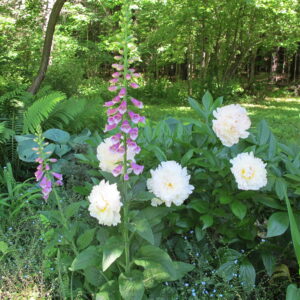
Peonies with foxglove

Biennials, by definition, do not bloom in their first year. They grow foliage this year, send up a flower stalk next year, and then, having produced seed, they die. Probably the best known of these are foxgloves, specifically Digitalis purpurea. It has a flower stalk that is 18 to 60 inches tall, adorned with blooms in pink and purple and shaped a bit like the finger of a glove. One named variety, “Foxy” will bloom late in its first year if started early enough. Foxglove blossoms bloom in sequence along their stem over several weeks.
 
Foxgloves do well in part shade and like lightly moist soil. They are easy to propagate: I just cut a stalk that has finished blooming, and shake the small seeds over bare, lightly cultivated soil and pat down without covering. There are also yellow foxgloves that are fully perennial (Digitalis lutea).
 
Hollyhocks are also terrific biennial flowers, though some books list them as half-hardy perennials. These beauties can grow to be up to six-feet tall and bloom for a long time. If you cut off the stem as soon as it finishes blooming, sometimes you can confuse the poor thing – it doesn’t know if it produced seed or not. So it may send up another flower stem next year.
 

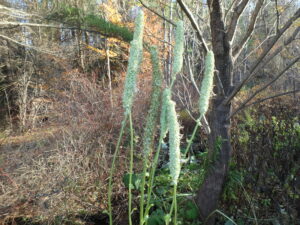
Canadian sanguisorba in November

Perennials generally live for several to many years. The genus “Sanguisorba” includes several species of perennial flowers, all of which are delightful. The common name for these is burnet. “Sanguisorba canadensis” is our naïve species, a tall, late flowering wetland species, and is called Canadian burnet. I’ve had a big clump for 20 years at least, and love its fuzzy white pendulous blossoms. Pollinators love it in the fall.


My favorite of the burnets is Sanguisorba hakusanensis or Korean Burnet, one called “Lilac Squirrel”. Why that name? The blossoms are pink to lilac in color and hang down like the squirrel tails attached to bicycle handlebars in the 1950’s. Less tall than our native, it does need staking as it can get to be 2- to 4-feet tall. I have found it easy to propagate by seed, and blooms in its second year.  I collect and grow all species of burnets, which can grow from miniatures to big bush clumps of gorgeous foliage 5-feet tall and 5-feet wide, but have not collected seed from them – yet.
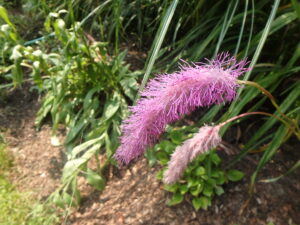
Lilac squirrel Snguisorba blossoms are delightful to touch and see


Hosta are great foliage plant that do best in shady areas in rich soils. If you collect seed from your favorite hostas be forewarned that most hostas are hybrids and the seeds will not produce plants identical to their seed-producing parent plant. I only planted them by seed once, and I did it with seed from one called “Hosta sieboldii”.The parent plant is known for having variegated leaves, but mine produces all-green leaves. Still, I’ve had that clump for 40 years, and it gives me pleasure every time I walk past it.
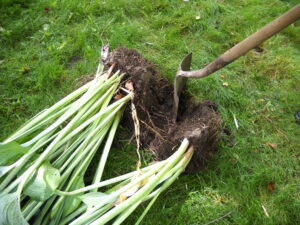
 

Dividing hostas is an easy way to get more. 005

Generally it is best to give hosta seeds a cold period of 6 to 8 weeks in your refrigerator. This is true for many varieties of seed, so a good practice for all. Hosta seeds may need some sunshine on them to germinate, so cover them with a very thin layer of soil in their starting pots, or with vermiculite. Mature hostas are easy to divide to get more plants.
 
What about starting trees from seed? It’s not hard: blue jays and squirrels do it all the time – they bury them, and forget where they put them, just like us with the car keys. Although you can plant tree seeds, I recommend just looking for first-year seedlings planted by your wildlife. Of course, this works best with native trees like oaks and maples.
 

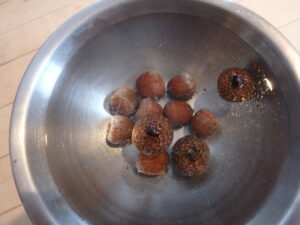
Acorns that float are not likely to germinate so throw them out and plant the ones that sink

Last year I dug up half a dozen sprouted acorns and moved them to an area that needed more trees to screen my property from the road. It was a dry summer and I was less than fully vigilant, so some of them died. But there will be others I can dig up this year. Remember: watering is key for any first year planting.

 
So here is my challenge: Go to your local garden center and buy seed packets for three perennials or biennials. Start them either indoors under lights, or later, outdoors. Buy things that you like and want several plants, or even a bed full of them. You can fill in a bed of first year perennials with some annuals that will bloom this year. Please email me how that works out for you if you do so.
 
Lastly, it might better to plant flower seeds in small pots rather than in the soil, as it can be difficult to identify them when weed seeds are growing around them. Or plant them in a perfect circle to help identify them. Good luck!
 
Reach Henry by e-mail at henry.homeyer@comcast.net or by snail mail at P.O. Box 364, Cornish Flat, NH 03746. His column appears here monthly.