Introducing Art, Whimsy and Laughter into Your Garden
Posted on Thursday, July 23, 2026 · Leave a Comment
For some, gardening is serious business. Not me. Well, I do consider myself a serious gardener, having been growing things since I was a toddler, but I like to make our gardens full of plants – and things – that bring smiles or even laughs to anyone visiting the garden. Gardens should be beautiful, but also fun.
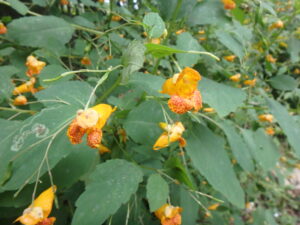
Jewel weed can be aggressive but a few add fun to the garden
When I was a small boy my older sister, Ruth Anne, introduced me to jewel weed, also called touch-me-not (Impatiens capensis). It is an annual weed that grows is shady, moist areas and has small bright yellow and orange flowers. But the best part for a kid are the seed pods. Each little canoe-shaped pod is spring loaded with seeds, and when ripe, these pods can throw seeds several feet. Pick one, and it explodes in your hand. Guaranteed to make a child – or this old guy – laugh. Mind you, I try hard to eradicate 98% of the jewel weed I see in our gardens, but I leave a few at the edges to amuse and delight kids of all ages.
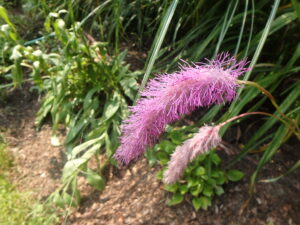
Lilac squirrel Sanguisorba blossoms are delightful to touch and see
Fuzzy plants are great for getting visitors to smile. Right now I have a variety of burnet (Sanguisorba spp.) that is named ‘Lilac Squirrel’. If you are of a certain age, you may remember when bicycles sometimes were adorned with real squirrel tails on the ends of the handlebars. These flowers, a lovely pink-lilac color, hang down like those squirrel tails, hence the name. I always am delighted when I see them. They make me smile. As do pussywillows in the spring.
Then there is turtlehead (Chelone obliqua), a gorgeous, tall, fall blooming flower I grow in moist, part shade to full sun locations. It has pink flowers that mimic the open mouth of a turtle. They are loved by bumblebees that force themselves inside the blossoms, with little room to spare. Once inside, they sometimes make what I call “growling noises”. Are the bees angry they are having a hard time finding their way out? Drunk on pollen? I don’t know, but I grin when I hear them.
Back in the 1980’s, when we had real cold winters, I had grown a peach tree to size and was anticipating a good crop of fruit. I waited, come spring, for it leaf out. And waited. No luck. It was dead. Instead of lamenting my misfortune, I planted annual vines all around it: morning glories, climbing nasturtium, scarlet runner beans and perhaps others. They grew, they blossomed, they amazed visitors: “What tree is that?” When I told them it was a dead peach, they laughed, every one.
Later I had a contorted hazelnut die of old age and my wife, Cindy, who is a fabric artist, tied on strips of different colored cloth to the branches. They blew in the breeze and added color to the garden for a year or more.
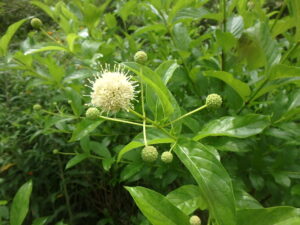
Buttonbush flower
A shrub I grow next to my little stream is called buttonbush (Cephalanthus occidentalis). This full-sun to part shade shrub is a native, often growing in standing water in swamps – I just saw some in bloom down in Connecticut in the wild, but have never seen it up here, except in my garden. Why is it worthy of a giggle? When blooming it has one-inch spherical blossoms with many tiny white florets coming out of it, sort of like what I always imagined Sputnik to look like, with little antennae sticking out. You will want to touch it, sniff it. But it is not a handsome shrub most of the year. Although rated as a Zone 5 plant, for me it dies back to the ground most years in winter – even though we’ve been moved from Zone 4 to Zone 5.
Surprise in the garden can be good for a giggle, too. For several years I had “Sister Mary-Lou” in the garden. She was a full-bodied, bosomy scarecrow in a purple dress
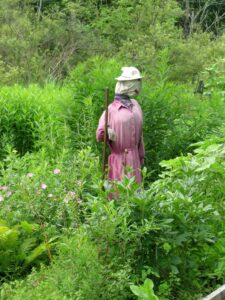
Sister Mary-Lou, the, Scarecrow, lived in the garden for a few years.
and old rubber barn boots. She was not made to scare away crows (as her ancestors were), but for the fun of seeing her. Even when I knew she was there, she was real enough to startle me early in the morning. Which then made me laugh at myself. She went traveling to the Tunbridge, Vermont “World’s Fair” in the late 1990’s and won Best in Show in the scarecrow competion, though she declined to brag about that. She has long been retired. A good scarecrow is always three dimensional, not just some clothes hung on a pole and a cross bar.
Each year for the past 20 years or more there has been an event in Woodstock, Vermont called Sculpture Fest on the property of Charlet and Peter Davenport at 509 Prosper Rd. and at the adjoining King Farm, a non-profit. This year it opened in mid-July and will remain open, dawn to dusk throughout the summer and into the fall. And although it displays some serious works of art, it also always has some fun and whimsy – and ideas for me about what I might add to our gardens. It is free and open to the public.
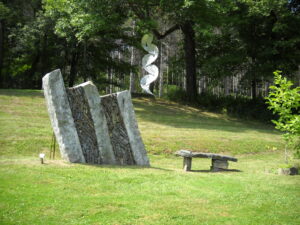
Sculpture Fest has both whimsical and serious sculpture
So what whimsy might you add to your garden? I remember when pink plastic flamingoes were popular on front lawns. Then they became passé. Recently I saw a few poking their noses out of a field of tall grass – and had a chuckle. Yard sculpture can be almost anything. I have a rusty toy truck from the 1940’s sitting atop a stone wall. I like seeing it there, and have had nice comments about it from visitors.
So stop at that yard sale you might otherwise pass by. See if there is anything interesting, colorful or weird that you might sneak into the garden. After all, garden whimsy doesn’t need to be weeded!
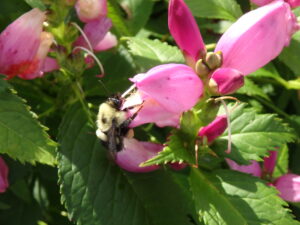
Turtlehead is loved by bumblebees
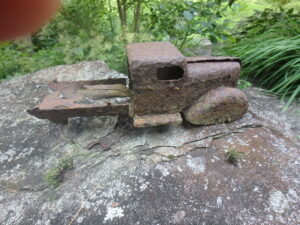
Toy truck as whimsy
Plants that Have Stood the Test of Time
Posted on Wednesday, July 1, 2026 · Leave a Comment
The Fourth of July celebrations are over – the fireworks, parades, hot dogs and strawberry shortcake. Leading up to the Fourth I paused to think about the gardens of Thomas Jefferson, one of the authors and signers of the Declaration of Independence. He lived and gardened at Monticello, his estate in Virginia. According to the Monticello website, Jefferson planted (or ordered and supervised) the planting of 160 different kinds of trees and shrubs as well as perennials, annuals and vegetables – and kept notes of everything. Monticello still grows almost everything he did.
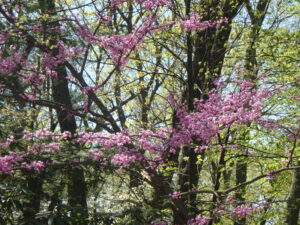
Redbuds will bloom well even in part shade
Jefferson grew one of my favorite trees, the Eastern Redbud (Cercis canadensis). It is a wonderful early-summer blooming medium-sized tree and I’ve had one for at least 10 years. It is suitable for a part shade location or full sun. In the wild (New Jersey and south) it is found mainly as an understory tree. It blooms in early summer with small pink blossoms that seemingly pop right out of the bark. Cold hardy varieties are common now and it is rated to Zone 4.
Jefferson loved peaches. He grew over 30 kinds of peaches but we can grow just a handful that are sold here in New England. A few will survive a Zone 4 winter, but Zone 5 is better for peaches, with winters that never drop below minus 20.
All peaches do best in full sun, meaning six hours of sun or more per day in summer. They are self-fruitful – they self-pollinate and you need only one tree to get fruit. Apple, plums and most pears do need a second variety that blooms at the same time for pollination. Most fruit trees are said to”Not like wet feet.” So don’t plant them in an area where the soil is usually wet.
The ‘Reliance’ peach, developed at UNH has been around for decades and is one of the better cold hardy peaches. It is productive and tasty. Other good peaches are Red Haven and Madison. Contender is well thought of, but I have not found the fruit very tasty, and a lot my fruit has rotted on the tree. Other growers love it. Try to taste peach varieties before planting one.
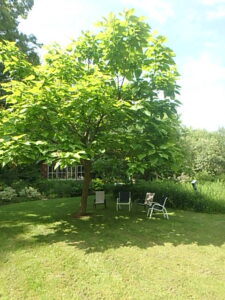
Catalpas are fast growing trees suitable as shade trees
Jefferson was intrigued by sugar maples as an alternate source for sugar, but they did not do well down there. Virginia is a bit too hot. In my experience, if you have an old maple that is declining in health, try giving its some garden lime. Spread it not just under the drip line, but go out much farther because the roots do.
I gave lime to an old maple because I read about an experiment in 1999 at the Hubbard Brook Experimental Station in northern New Hampshire. Scientist found that acid rains had depleted calcium in soils there. They distributed calcium (using crop dusters) and it found increased health in stands of sugar maples and red spruce. I‘ve given my old sugar maple several applications of lime over the last 25 years and it is doing fine. And don’t park cars under your maples as root compaction is not well tolerated.
One of Jefferson’s favorite trees was Southern Catalpa (C. bignonioides). That is hardy to Zone 6, but I grow northern Catalpa (C.speciosa) and love it. I planted mine 8 years ago as an 8-foot tall tree that came in a 7 or 10-gallon pot. Now it is 30-some feet tall with a trunk diameter of 12-inches a foot off the ground. My catalpa blooms vigorously in late June or early July each year, producing cream colored flowers that are 2-inches long and flecked with purple inside, growing in panicles. The seed pods look like foot-long beans.
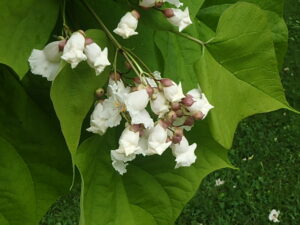
Catalpa blossoms
Catalpas can get 60 feet or more tall, and are a bit weak-wooded, so they are prone to wind damage or blow-overs. My solution? I use an extension ladder to get up to a spot 30-feet off the ground each fall and cut off all growth that occurred that year. I top it. That keeps it from getting too tall – it can and does grow up to 5-feet in a year. Of course, at some point I won’t be allowed up a ladder. So far, so good. I’ve done it for the last 3years.
Jefferson loved lilacs, as we all do. If your lilac has not produced many blossoms in recent years, it may also need a treatment of garden lime. Lilacs do best with soil that has a neutral pH – around 7.0, and lime will help get the pH closer to neutral. By now they have already set their buds for next year, but add lime or wood ashes now while you are thinking of it.
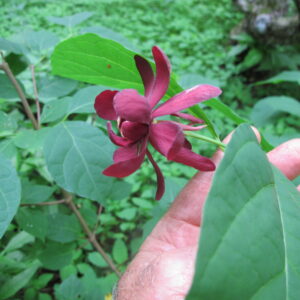
Calycanthus or sweetshrub is a shade-loving shrub.
A shrub liked by Jefferson is called the Carolina Sweet Shrub (Calycanthus spp.). I grow it, but found it a bit fussy. I moved mine twice to find, like Cinderella, the fit that was “just right”. I first tried it in full sun and the leaves scorched – despite plenty of moisture. After the second year I moved it into shade, but it didn’t get enough sun and did not bloom much. Finally, five years later, I moved it under a big pear tree, where it gets filtered sun all day and it blooms and grows vigorously. The blossoms are a deep wine red, up to 2-inches across and shaped like little peonies. Some specimens are very fragrant, though mine is not. It blooms in early summer,
Like Jefferson, I like keeping a list of what woody plants I grow. Since I bought my house in 1970, I have planted at least 118 different kinds of woody plants, and about 95% of them have survived. And I’m still going to plant a few more. I make it through winter and mud season each year, in part, because I want to see what plants survived, too.
It’s Time to Pay Attention to the Vegetable Garden
Posted on Friday, June 12, 2026 · Leave a Comment
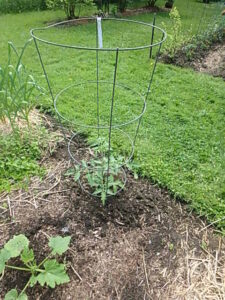
Tomato cages keep plants from sprawling on the ground
By now, most of us have planted our vegetable gardens. My peas, onions, lettuce, spinach and potatoes went in early, and now our tomatoes and peppers have settled in and are starting to grow. Is it hammock time? No, now it’s better to do some maintenance so that we can go to the beach later on – with a good conscience.
Many gardeners are looking for a magic potion to put on their tomato plants to prevent that nasty fungal disease that blackens the leaves and shortens the lifespan and production of their tomato plants. Alas, there is none. But there are a few things you can do to minimize it.
Right now go look at your tomato plants: do they have any leaves that touch the soil? If so, take a sharp knife or scissors and cut them off. The spores of the disease are in the soil – unless you area starting somewhere that was, most recently, lawn or field. That first year you will probably have plants free of blackened leaves.
Mulch under your tomato plants now, before disease sets in. The spores get on leaves by splash-up when you water or get a heavy rain. Got a bagger on your lawn mower? Save the grass and spread it over the soil. Or you can buy straw (which is seed-free) or mulch hay (which is not, but is less expensive). Spreading 4-layers of newspaper on the ground before putting down mulch helps keep soil moist and helps weeds from germinating. I don’t recommend using chipped branches or bark mulch in the vegetable garden.
One last bit of advice on tomatoes: I have found that buying the biggest cages possible is best: 54 inches tall, with 4 legs not 3. They’re not cheap, but you should get 25 years or more out of each if store them in the barn for the winter.
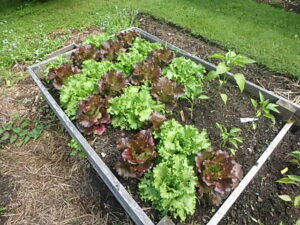
It’s time to start more lettuce from seed
I have plenty of lettuce to eat right now, having planted it early. But I will start seeds now. Although I could sow seeds directly in the ground, I prefer to plant in seeds in cells and keep them on a sunny deck where I will see them, water them, and monitor them. When they have 2 true leaves, sturdy ones, I will plant them in the ground. That allows me to space them well. Small seeds are easy to over-plant directly in the ground, and then I’d have to find the time to thin them later.
That brings me to thinning, sigh. The most tedious job in the garden. If you planted carrots, beets and radishes early on, they are about ready to thin. Start now and thin to 1-inch apart. Then, by the fourth of July, thin again – but to 3-inches apart. Crowded carrots compete with their cousins for water and minerals just as they would with weeds. Eat those thinnings. Young carrots are a real treat.
I don’t mind weeding. Some of you do, and I agree it can be tedious. Young people wear earbuds and listen to music, but I like to listen to the birds and the burble of my brook going by. Did you know that by adding stones to a brook you can tune it? In 2003 I interviewed Robert Irwin, an installation artist who designed the gardens at J. Paul Getty Center in Los Angeles, and he told me he personally “tuned” a recirculating brook he had installed at the gardens. Water falling over stones makes a pleasant sound which depends on the drop and quantity of water falling.
But back to weeding. The best time to weed is after a rain or a good watering. I use a CobraHead weeder, a single-tined tool which easily slides through the soil, loosening it so that weeds pull easily, and weed roots are less likely to snap off. Right now is the time to weed because the bigger they get, the more difficult they are to pull.
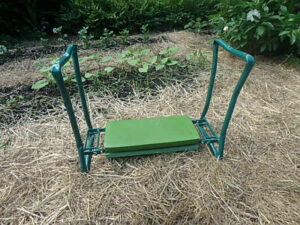
The kneeler is comfy and makes it easier to stand
I used to do all my weeding standing up, bent from the waist. Now? Mostly I kneel. I use a “Garden Kneeler” I got from Gardener’s Supply Company. It has a padded kneeling platform a few inches off the ground and handrails on the sides that are a great help in getting up from the kneeling position. Turned over, it provides a seat, and it can be folded up for storage. Using mine, I just weeded a double row of onions 16 feet long, and felt no aches and pains from doing so.
To avoid re-weeding the same bed, over and over, there are two things you should do: 1) never let your weeds flower and produce seeds. 2) Mulch after weeding. Same as above, newspaper covered with straw. In the old days, newspapers used toxic chemicals in the ink. Now? As far as I know, all the inks are made with soy products. By the end of the summer my earthworms will have mostly eaten the papers.

The first step of mulching as I do it is to put down newspaper003
If you grow potatoes, it is important to watch for potato beetles. Go down the row, pawing through the leaves so you can watch for the orange egg masses under the leaves and scrape them off. Later, if you look for larvae or beetles every day or two and pick them off, you can control the problem in a home garden. Just drop the culprits in a jar of soapy water. There is also a biological control called Bt which is a naturally-occurring bacterium that you can spray; it sickens the larvae as they eat the leaves but will not harm anything else.
I’ve been picking and eating homegrown vegetables all my life, and I am convinced that it helps me stay young(ish) and healthy. And it gives me great joy.
Tips for Growing Wonderful Flowers
Posted on Monday, June 1, 2026 · Leave a Comment
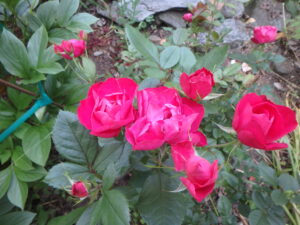
Knock out roses are reliable bloomers
I’ve heard it said that June is the most common month for weddings. I’m not sure why, but my theory is that June, despite black flies and noxious ticks, is a great month to be outside for wedding receptions. Roses are in bloom, as are peonies, iris and so much more.
Roses have evolved considerably since I was a boy in the 1950’s. Breeders have created modern hybrids that are disease-free and bloom almost non-stop all summer. In the old days rosarians sprayed roses regularly with various poisons to minimize damage from fungal diseases and insect pests.
Many told fashioned roses bloom mostly in June and are deliciously fragrant. New hybrids will bloom more or less continuously all summer if in full sun, but most are not fragrant. And they are rarely attacked by insects as they have no scent that would attract them. Since I’m technically a geezer, I should grow the old fashioned roses – but I like these new hybrids.
There are several lines of trademarked roses. I love the ‘Knock-Out’ roses. They are winter hardy (in Zone 4) and offer blooms until October for me. Everything the Proven Winner people grow – annuals, perennials, roses – do very well. Their ‘Oso Easy’ line of roses is well regarded, but I haven’t personally grown any.
My wife loves heirloom roses and has had great luck buying some from Old Sheep Meadows Nursery in Alfred, Maine. And if they will grow in Alfred, Maine, they will grow where you are. According to his website, the owner, Raymond Graber, has been growing roses in Maine for over 60 years. He has a wealth of knowledge and he is happy to share it.
Three bits of knowledge I can share abut roses: 1. They love – and need – plenty of water. Water daily in hot or dry times. 2. They like dark, rich soil and some added garden lime and slow-release organic fertilizer at planting time. 3. Although six hours of sunshine or more is recommended, most will do fine with four. You don’t have any roses? Go buy a few. We only live once.
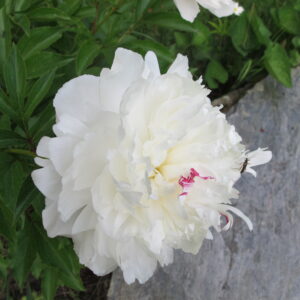
Peony ‘Festiva maxima’ that my grandmother grew
Most plants have a finite lifespan. Many perennials will die out in 10 years. Some trees last a hundred or more. But I often say, “Properly planted, peonies will live forever.” My maternal grandmother, Anna Lenat, died in 1953 when I was just seven years old. My mother dug up one of her peonies and brought it to our home in Connecticut. I dug it up again in 1984 and divided it, leaving half with my mom, and planting half at my home in Cornish, NH. The roots or tubers, presumably more than 100 years old by now, still produce plenty of blossoms.
I always recommend buying peonies in June when they’re in bloom –seeing is believing. Some are fragrant – even heavenly fragrant – while others are not. Some have stiff, strong stems, while others flop even on sunny days from the weight of their magnificent blossoms. “Single” peonies have just one row of petals so are less prone to flopping. But most common are the doubles: gorgeous, but with so many petals they flop when it rains.
Peony rings are wire cages sold to hold up flower stems even on rainy days. Most are too low to really do the job right. Plus, you have to remember early in May to install them. By now mature plants are too big to fit the cages over them. My solution is to poke three bamboo stakes firmly into the soil around each plant and then connect them at the appropriate height with green garden twine. If you were a Scout, you may remember learning to tie a clove hitch. That’s the knot you want.
If you bought a nice peony a few years ago and it no longer blooms, you may have planted it too deeply, or covered the “nibs” (growing points) with too much mulch. Feel around the plant to see where next year’s growth will emerge from little pointy nibs. More than an inch of cover will often inhibit blooming. Yes, you will have a healthy plant – but no blossoms.
My great Great-Granny told me that peonies need ants crawling around on the buds for them to open. Not true. Peonies attract aphids, and ants come to harvest the sweet “nectar” that is their poop.
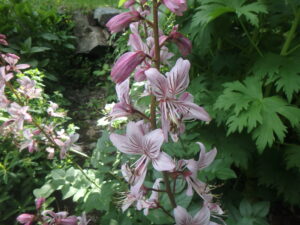
Gas plant is a good addition to any garden
Other great June flowers in my garden include gas plant (Dictamus alba) which has an intense citrus odor that is strongest at dusk to attract night-flying moths.
Delphiniums are wonderful plants with stalks often over 5-feet tall and loaded with blue, purple or white blossoms. But you do need to stake them to keep them upright in the rain. Scratch in some slow release organic fertilizer each spring as they are heavy feeders. And if you cut them back to the ground after blooming, they probably will re-bloom in the fall.
Perennial bachelor buttons (Centaurea montana) are easy to grow and make good cut flowers. Blue to purple, they love sun and will make you feel like you have made it as a gardener.
All the flowering plants are wonderful. Think back to what your parents and grandparents grew. That’s a good place to start shopping. Or better yet, see if you can dig some plants from their gardens if they will let you.
Henry can be reached at PO Box 364, Cornish Flat, NH 03746 or henry.homeyer@
comast.net. He is the author of 4 gardening books.
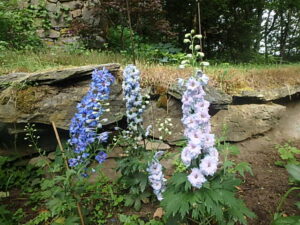
Delphinium are gorgeous but each stalk needs support
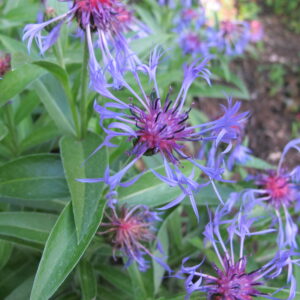
Bachelor buttons have unusual, spidery flowers.
Late May in the Garden
Posted on Monday, May 25, 2026 · Leave a Comment
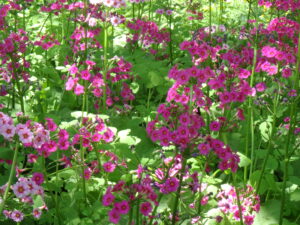
Candleabra primroses delight me each year starting in late May
Asking me to name my favorite flower is, perhaps, like asking you to name your favorite child or dog. But late May brings one of my top picks: the candelabra primrose (Primula japonica). It sends up a flower stalk with a circle of florets, then it grows a few inches and sends out more blossoms, getting taller and blooming sequentially for nearly a month. They grow best in deep, rich, moist soil in partial shade and ideally under old apple trees.
Late May will also produce early peonies I love including two part- shade peonies, Paeonia obovata and P. tenuifolia. The latter is also known as the fernleaf peony for its finely cut foliage; the blossoms are a deep red. Neither are common in garden centers, but keep an out for them.
Spring is a good time to improve your soil. Most commercial farmers grow food by adding chemical fertilizer to the soil before planting. I am an organic gardener, meaning I do not use pesticides nor do I use any chemical fertilizer.
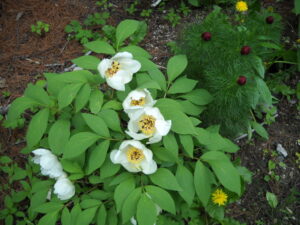
Peony Woodland (P. obovata) with red buds of the fernleaf peony 002
Chemical fertilizers are safe to use, but only provide three of the 17 elements needed by plants to grow and thrive. Granted, most of those elements are needed in very small quantities and may already be in the soil, but I want to provide my plants with the equivalent of a full 5-course meal, not a bowl of white rice.
Chemical fertilizers only contain nitrogen (N), phosphorus (P), potassium (K), and lots of filler. A 5-10-5 fertilizer is 5% N, 10% P, 5% K; the rest -80%- is filler. Nitrogen in the form of nitrate and ammonia ions is used by plants to make proteins, fueling green growth. Phosphorous promotes growth of roots, blooming, seeds and fruits. Potassium is important for growing thick cell walls to survive cold and excess heat.
Plants also need other elements in order to thrive: calcium (for cell metabolism), magnesium (for chlorophyll needed for photosynthesis), sulfur (for making proteins and fats). Also needed are micronutrients like iron, chlorine, manganese, zinc, copper, boron, molybdenum and nickel.
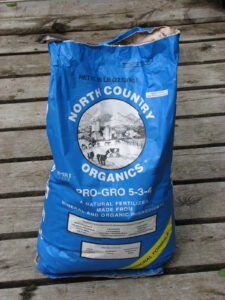
Pro-Gro Organic Fertilizer is a slow release fertilizer.
All those elements above are found in organic fertilizers like Pro-Gro, Gro-Tone and others. And while most chemical fertilizer provide water-soluble elements for quick absorption, organic fertilizers are mostly slow-release, providing key elements over a period of months, or even years. Most contain things like cotton seed meal, kelp meal, ground peanut shells and ground oyster shells.
So what can you do to improve your soil? Add compost. Don’t buy just a bag or two of compost and think it will improve your whole vegetable garden with some left over for new perennials. Borrow a pick-up truck and get a “scoop” from a front-end loader at your garden center. Or get it delivered. Alternatively, you can buy aged manure from your local dairy farmer. Even aged manure will have some weed seeds, but it will add good organic material that will be used by your plants.
Why is compost so good? Well-made compost is full of microorganisms that will work with your plants. Many produce organic acids that help to dissolve minerals from fine stone particles in the soil and make those minerals available to your plants. Compost is, or should be, biologically active: full of living bacteria and fungi. And it will improve soil texture making root growth easier for your plants.
Our soils were created back during the last ice age when glaciers a mile thick ground up bedrock, making sand and even the finer bits of stone that are in clay and loam. Fully 50% of all soil is made of ground up rocks. The rest? Anywhere from 1% to 8% is organic matter, and the rest – nearly 50% of soil by volume – is air. Oxygen is absorbed by root hairs from the air in the soil.
Two other key ingredients do not come from the soil. Plants get carbon, a major part of all plants, from carbon dioxide that is in our air. Nitrogen is in our air, but most nitrogen used by plants comes from decayed plant or animal material – or is made in a chemical factory and sold as a fertilizer.
I highly recommend getting your soil tested every 3 to 5 years. Each state university offers a service for gardeners and farmers. It will tell you soil pH (a measure of acidity), soil type, levels of some soil minerals and the percentage of organic matter. It will offer suggestions on what to add to your soil, though different plants have different needs. You should strive to have 4% or more organic matter in your soil.
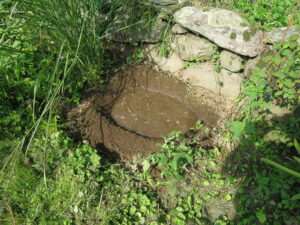
Testing drainage is simple. Dig a hole, fill it up, see how long it takes to drain.
You can perform a simple test to see how well your soil holds water or drains. Dig a hole 24 inches wide and 8 inches deep with sloping sides. Fill it with your hose and time how long it takes to drain. Sandy soil will drain almost immediately. Clay soil will hold water for several hours, even overnight. Good loam might take an hour or two, depending on how much rain you’ve had recently.
Adding compost will help heavy clay or sandy soils will help them considerably. Soil texture and the ability to hold some water but draining well is important to most plants. Compost does both.
Improving your soil takes years, even decades. Yes, I do use some slow-release organic fertilizer at planting time, but my real success has come from years of adding compost.

 Click Here to buy from Cobrahead