-

Now available for $24.95 including shipping. -
Now available for $21.00 including postage. Vendors I Like
 Click Here to buy from Cobrahead
Introducing Art, Whimsy and Laughter into Your Garden
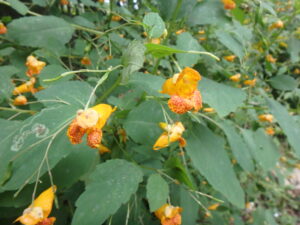
Jewel weed can be aggressive but a few add fun to the garden
When I was a small boy my older sister, Ruth Anne, introduced me to jewel weed, also called touch-me-not (Impatiens capensis). It is an annual weed that grows is shady, moist areas and has small bright yellow and orange flowers. But the best part for a kid are the seed pods. Each little canoe-shaped pod is spring loaded with seeds, and when ripe, these pods can throw seeds several feet. Pick one, and it explodes in your hand. Guaranteed to make a child – or this old guy – laugh. Mind you, I try hard to eradicate 98% of the jewel weed I see in our gardens, but I leave a few at the edges to amuse and delight kids of all ages.
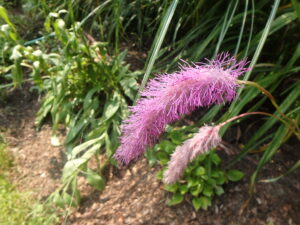
Lilac squirrel Sanguisorba blossoms are delightful to touch and see
Fuzzy plants are great for getting visitors to smile. Right now I have a variety of burnet (Sanguisorba spp.) that is named ‘Lilac Squirrel’. If you are of a certain age, you may remember when bicycles sometimes were adorned with real squirrel tails on the ends of the handlebars. These flowers, a lovely pink-lilac color, hang down like those squirrel tails, hence the name. I always am delighted when I see them. They make me smile. As do pussywillows in the spring.
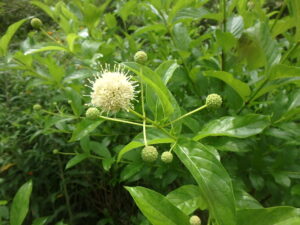
Buttonbush flower
A shrub I grow next to my little stream is called buttonbush (Cephalanthus occidentalis). This full-sun to part shade shrub is a native, often growing in standing water in swamps – I just saw some in bloom down in Connecticut in the wild, but have never seen it up here, except in my garden. Why is it worthy of a giggle? When blooming it has one-inch spherical blossoms with many tiny white florets coming out of it, sort of like what I always imagined Sputnik to look like, with little antennae sticking out. You will want to touch it, sniff it. But it is not a handsome shrub most of the year. Although rated as a Zone 5 plant, for me it dies back to the ground most years in winter – even though we’ve been moved from Zone 4 to Zone 5.
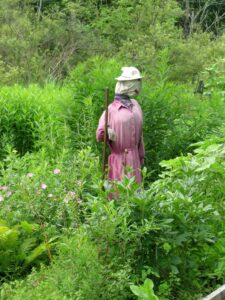
Sister Mary-Lou, the, Scarecrow, lived in the garden for a few years.
and old rubber barn boots. She was not made to scare away crows (as her ancestors were), but for the fun of seeing her. Even when I knew she was there, she was real enough to startle me early in the morning. Which then made me laugh at myself. She went traveling to the Tunbridge, Vermont “World’s Fair” in the late 1990’s and won Best in Show in the scarecrow competion, though she declined to brag about that. She has long been retired. A good scarecrow is always three dimensional, not just some clothes hung on a pole and a cross bar.
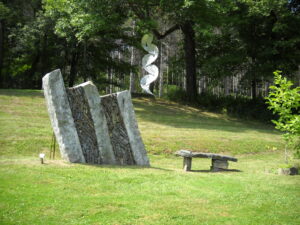
Sculpture Fest has both whimsical and serious sculpture
So what whimsy might you add to your garden? I remember when pink plastic flamingoes were popular on front lawns. Then they became passé. Recently I saw a few poking their noses out of a field of tall grass – and had a chuckle. Yard sculpture can be almost anything. I have a rusty toy truck from the 1940’s sitting atop a stone wall. I like seeing it there, and have had nice comments about it from visitors.
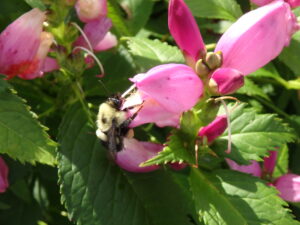
Turtlehead is loved by bumblebees
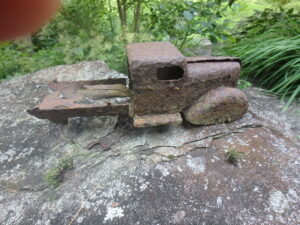
Toy truck as whimsy
“Organic Gardening – Not Just in the Northeast”
Henry’s latest Book, Organic Gardening (not just) in the Northeast: A Hands-On Month-by-Month Guide is now available for $21.00 INCLUDING postage. To Learn more about this book click here:
Organic Gardening (not just) in the Northeast: A Hands-On Month-by-Month Guide is organized around the calendar year, starting in March and continuing through the year with timely advice. The book is packed with useful information you won’t find elsewhere: how to sharpen your pruners, use a screwdriver to test for compaction in your lawn, and build a welcoming cedar arbor as an entrance to the garden. Learn how to grow ladyslipper orchids or Himalayan blue poppies, prune apple trees, grow giant pumpkins, and even how to start a date palm from a grocery store date or build a small stone igloo to delight the grandchildren. Eccentric, eclectic, and entertaining, whether you are a beginner or a veteran, this book has something more for you. To see what other garden writers have said about it click here