Tips for Forcing Spring Bulbs to Bloom Indoors
Posted on Wednesday, November 4, 2020 · Leave a Comment
November is the gloomiest month of all. It’s cold and raw, but usually without enough snow to XC-ski on. It rains nearly every day, or seems like it does. The garden is put to bed, or if I‘ve neglected to do something, it probably won’t happen until spring. But this is a good time to force bulbs for early spring blooming indoors.
To force bulbs means preparing them in such a way as to force them to bloom early indoors, before they would bloom outdoors. Daffodils or crocus, for example, can be made to bloom by mid-February indoors, and tulips in March.
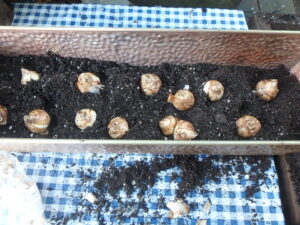
Daffodil bulbs ready to be covered with soil
On a raw day recently I planted 20 “Tete-a-Tete” daffodils in pots. Each of these will produce one or more brilliant yellow blossoms just when I’m sick of winter, and re-new my faith that spring is on the way. Bulbs have everything they need in order to bloom. All we have to do is offer a suitable place to spend the winter. Here is what I did:
First, I selected nice deep pots for planting. In the soil outside, daffodils are planted with six inches of soil over their pointy little noses. But in a pot, three inches is fine. I selected pots that were five or six inches deep, and placed 3 inches of potting soil in each. It’s fine to place the bulbs close together, just a couple of inches apart.
The potting soil I used was already damp, but after the bulbs were covered and ready for their winter sleep, I watered lightly. I will check them from time to time throughout the winter to make sure the soil does not dry out. The bulbs need moisture to develop roots and prepare to bloom. But be moderate: a soil mix that is soggy can rot roots.
I have a cold basement that I keep lightly heated to avoid freezing temperatures – my old house is set on a hill, and the basement is above ground in the back of the house where I keep my bulbs. The ideal temperature for forcing bulbs is around 40 degrees for good root development. You can begin the process by leaving your pots outdoors until real cold weather is upon us. Cover the pots with leaves to minimize temperature fluctuations.
If you have a warm basement, you can try placing pots in an unheated garage or mudroom, or perhaps in the bulkhead if you have one. Everything I have read says to keep the pots in a dark place, though I think that only matters once the bulbs have started to send up leaves or buds. The bulbs can’t know about light while covered with soil. So put the pots in a cardboard box if you have them in a garage with windows.
How long do bulbs need to stay dormant? The little bulbs – crocus, snowdrops and such – only need 8 to 10 weeks, daffodils need 12 weeks, and tulips need 16 weeks. I always place a plant tag in the pot with the date I started the process. And tulips will not bloom if you bring them into the warmth of the house before March.
Beware of mice and squirrels! Most old houses harbor at least a few mice. Once the mice go into my pots and ate all the tulip bulbs! Daffodils are mildly poisonous, so rodents will not bother them, and I’ve never had trouble with mice eating any alliums, which are good for forcing, too. I’ve had mice dig up bulbs, only to find they were daffodils and leave them on top of the pots, those rascals.
One way to know if your bulbs are ready is to look for roots poking out through the drainage holes of the pots. If you have daffodils that you planted 12 weeks ago but have not sent out any roots, they may be ready, but it would be safer to wait another week or two.
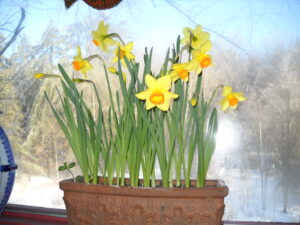
Forced daffodils blooming in early March
Once you bring your bulbs up into the house it will take two to four weeks more for them to bloom. Place the pot on a south or east windowsill and check daily. Water if the soil surface feels dry.
Will the bulbs bloom again next year? Tulips probably will not ever bloom again for you, even if you plant them outdoors in the spring. Daffodils can bloom again, but might take a couple of years to rebuild their energy enough to bloom.
Paperwhites are bulbs that can be forced without soil and an extended dormant cold period. These beauties are in the daffodil family and are sold for forcing in a bowl of gravel and water on a sunny windowsill. Most have a very strong fragrance, though not everyone likes it.
Select a deep bowl without a drainage hole. Place a one-to two-inch layer of gravel or small stones in the bottom, then place your paperwhites on it, shoulder to shoulder. Add water to the bowl until it just kisses the bottom of the bulbs. You don’t want water so deep the bulbs are wet, it is just for the roots that will grow.
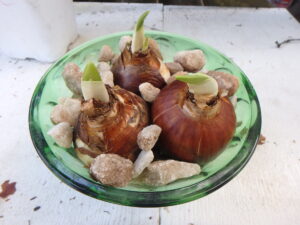
Paperwhites are easy to force in pebbles and water
Next add more stones or gravel up around the bulbs. This will help to keep your flower stems from tipping over. Another way you can do is to keep stems short by giving them some gin! Start them in water, and after a week drain the water, and add a mixture of five parts water to one part gin. That will stunt the growth. Paperwhites started by the third week of November should bloom by Christmas. They will never bloom again, so put them in the compost after blooming.
We all need flowers. Starting some now is a great way to do it economically, so get going!
Henry can be reached by email at
henry.homeyer@comcast.net or at P.O. Box 364, Cornish Flat, NH 03746. He is the author or 4
gardening books.
Vegetables I’m Still Eating Fresh from the Garden
Posted on Tuesday, October 27, 2020 · Leave a Comment
Granted, I have a vegetable garden mainly so I can have fresh, succulent tomatoes from July until some time in October. But I also have grown, I think, all vegetables that will grow in our climate. Right now, in late October, my saved tomatoes are all eaten, but I am enjoying plenty of other fresh veggies, and I am storing others for eating later.
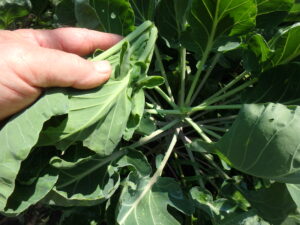
Remove top leaves of Brussels sprouts to get bigger sprouts
For late fall, nothing beats Brussels sprouts. The trick to having good Brussels sprouts is to cut off the top of the plant in early September. I say do it on Labor Day, but even a bit later is fine. If you fail to do that, the plants will use all their energy to grow taller and taller. If you cut off the top 3 inches and it stops growing taller, it sends its energy to bulking up those cute little green “cabbages” that pop out of the stalk. Some years I’ve continued picking until late December, despite snow and cold.
Now I realize that for many people, a serving of Brussels sprouts is as appetizing as dead skunk left on the side of the road for a couple of days before serving. Those are people who probably were served overcooked sprouts in public schools. Mushy, grayish-green sprouts are not appetizing.
If you cook your sprouts “al dente”, you may change your opinion. Steam them until just tender enough to spear with a fork, or cut them in half and sauté in butter or olive oil and walnuts, and you may change your mind. I happen to like steaming them, then sprinkling Marukan brand seasoned gourmet rice wine vinegar over mine – tasty, and without the calories of the butter preferred by many.
Kale gets tastier as the season goes on. A few hard frosts sweetens it up, and if the deer don’t get it after snowfall, I often have it until Christmas. I like it in a breakfast smoothie: in a blender I put 2 leaves of kale with midribs removed, a banana, a cup of orange juice and a cup of water, some fresh ginger (to taste), the juice of half a lime, and some frozen blueberries or raspberries from the garden and stored in the freezer.
Kale can also be used for salad. Our friend Eliza Bergeson makes a great kale salad: she removes the midrib and chops the kale. She then massages it for about 5 minutes with a dressing of olive oil and lemon. She adds honey mustard, salt and pepper. The massaging makes the kale tender, and works in the dressing. She adds feta cheese crumbs, dried cranberries, walnuts and fresh red peppers for color.
My broccoli continues to produce side shoots, despite the frosts. If you keep on cutting them off, they keep on flowering. Some years I grow non-heading broccoli relatives. One is called piricicaba, the other ‘Happy Rich’. Neither produces a big head, but both produce lots of little florets and persist well into the fall. I get seeds from Johnny’s or Fedco and start them in April, as these are not readily available as starts in most garden centers.
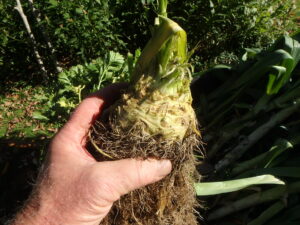
Cut away the fine roots of celeriac to expose the bulbous root to use for cooking and salads
I just harvested a 5-gallon pail of celery root, or as it is often called, celeriac. This is a celery relative that is grown for its roots, not stems. The leaves look and smell the same, but celeriac does not produce edible stalks. I clean and chop celeriac roots and chop them to use in soups and stews. It has a nice celery flavor.
I start celeriac in March by seed indoors. It is a slow grower at first, but once in the ground it takes off if in moist soil and full sunshine. Spacing is important, too. Crowd celeriac and you’ll get little. This summer I spaced them 6 inches apart in 3 rows 8 inches apart in one wide bed, and they did well. I watered in dry times.
I also just harvested a 5-gallon pail of leeks. Leeks are great, in my book, because you can use them in lieu of onions when cooking, and unlike onions, you can freeze them.
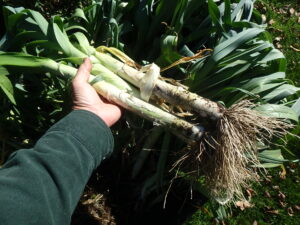
Leeks are easy to grow and a good substitute for onions when cooked
Leek and potato soup is one of my fall favorites. I just made some, and here is what I did. I started by dicing and frying 2 or 3 strips of thick cut bacon in a large cast iron, enameled pot. Of course, vegetarians can substitute butter instead. Then I added some olive oil and 4 cups of potatoes, cut into half-inch cubes. I browned the potatoes a little, then added 4 cups of leeks. Since I am rich in celeriac, I chopped up a whole one and added it to the mix.
Then I added 8 cups of water, and simmered slowly. I added 1½ teaspoons of a dried herb called ‘Herbes de Provence’. That is a mix of various Mediterranean spices (savory, marjoram, rosemary, thyme, oregano and lavender). And I added a couple of tablespoons of vegetarian vegetable broth powder (Seitenbacher brand) to give some added flavor. Then I added a handful of fresh chopped parsley.
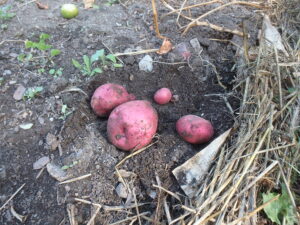
Fenway Red potatoes are productive and tasty especially for Red Sox fans
I cooked the soup until the potatoes were done. I used a red-skinned potato I grew this year, one called ‘Fenway Red’. It is a productive potato, and holds together well in a soup. Just don’t overcook it. I like a milky leek and potato soup, but don’t like to cook the milk, so I just added a quarter cup to each bowl at serving time. Yum!
As with any soup, I vary my leek and potato recipe whenever I make it. Sometimes I add dried cherry tomatoes, or peas. Kale would be good – it goes will with potatoes at my St. Patrick’s Day meal, colcannon. That’s the great thing about fresh vegetables. You can’t go wrong.
So when you plan your garden for next year, be sure to grow some veggies that survive frost and are tasty on a cold fall night.
Henry is the author of 4
gardening books and a longtime UNH Master
Gardener. Reach him at
henry.homeyer@comcast.net or P.O. Box 364, Cornish Flat, NH 03746.
Garlic Needs to Be Planted Now!
Posted on Tuesday, October 20, 2020 · Leave a Comment
When I was growing up, my mom served meat and potatoes nearly every night. Our vegetable was peas or cooked carrots, and once a week or so we had an iceberg lettuce salad with cucumbers, tomatoes and carrots with dressing from a bottle. So I don’t really know how I developed a taste for complex flavors. But I grow – and cook with – a lot of garlic, and find it adds depth and intensity to soups and stews. Now is the time to plant some for next year.
Growing garlic involves less work than anything else I grow. There really are only 3 steps: plant it, mulch it, and harvest it. Once you have an established bed of garlic, it’s also the least expensive crop. I planted this year’s crop from last year’s crop, and that one I planted from the crop of the year before. You really only have to buy garlic once – so long as you plant some extra and save it each year for planting. I choose my best looking, biggest garlic each year for planting.
The hardest part of planting garlic for the first time might be to find garlic sold for planting. You can’t just go to the grocery store to get garlic because much of it has been treated with chemicals to prevent it from sprouting, and most is the wrong kind for New England.
I went on-line to see about buying “seed” garlic. Many major suppliers are already sold out, and prices have sky rocketed since last year. Try your local farmer or farmer’s market – they may still have some.
There are basically just two kinds of garlic: soft neck garlic, which is what you probably get at your grocery store, and the stuff we grow here in the Northeast called hard neck garlic. Most soft neck garlic (the kind that is braided and hung on walls) comes from California and keeps nearly forever. It is less hardy than hard neck garlic, a bit bland, and less interesting to cook with.
Hardneck garlic has a stiff stem in the middle of each bulb. In my opinion it has a much more complex flavor. It will keep in a cool place until spring, but not much longer. Then it either sprouts or dries up. There are many named varieties of hardneck garlic- but all are excellent.
To plant garlic, take a bulb (or head) of garlic and separate it into the cloves that surround the hard “neck” or flower scape. Depending on the variety of garlic, you might have just five cloves, or as many as a dozen. I like big cloves, as they are easier to peel and use. So each year I select for big cloves and plant them. Over the years my crop has produced bigger bulbs and bigger cloves.
Garlic needs full sun (defined as 6 hours of sunshine) and rich soil. In a 30-inch wide raised bed I add a couple of inches of compost, and stir it into the soil, loosening the soil in the top 6 inches. To plant, I draw furrows 8- to 12-inches apart with my CobraHead weeder, a single-tine tool that is curved like a bent finger. Next I push cloves into the soil so that they are 3 or 4 inches apart and about 3 inches deep. Always plant them with the pointy end up. After covering them with soil I pat the soil down with my hands.
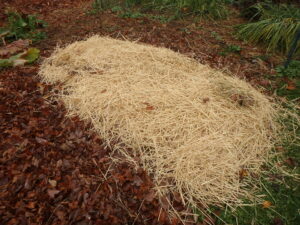
This thick layer of hay helps to prevent weeds in the garlic
The last step is to mulch your garlic. I use mulch hay or straw and put almost a foot of fluffy material over the bed. Fall rains and winter snows will cause the hay to settle – I end up with about 4 to 6 inches of material in the spring.
The mulch keeps the soil from freezing until January, allowing roots to get well established before the garlic cloves go dormant. It also prevents most weeds from germinating and growing next year, though I weed the bed well before planting, which helps, too. Garlic is tough stuff and will push right through my layer of mulch, though most weeds do not.
Depending on the weather and when you plant, your garlic may send up green stalks this fall. Don’t fret if it does. Those sprouts will die back in winter, but the garlic will send up new ones in the spring.
Next July the garlic you planted this year will be ready to harvest. Each bulb grows about 7 long pointy leaves that surround the cloves and protect them. When 3 or 4 leaves have turned brown and started to dry up, it’s time to harvest. If you wait too long, all the leaves will have dried up and the garlic will not store as well – it will dry out too soon.
You can store garlic best in a cool, dry place. Ideally 50 degrees with moderate humidity. You can also freeze garlic instead of storing it at room temperature, I’ve read (but I’ve never tried that). For freezing, separate the cloves, but don’t peel them. You can freeze them in a zipper bag or jar for a year or more. Don’t store garlic at room temperature in oil, as it can produce deadly botulism.
For centuries some cultures have believed that garlic helps ward off colds and the flu. Maybe it will even help to defeat Covid-19. Or maybe good garlic breath will just get that guy behind you in the check-out line with no mask to stand back a little!
Trees, Shrubs and Flowers That Bloom in October
Posted on Tuesday, October 13, 2020 · Leave a Comment
Summer has faded and gone. Autumn’s bright foliage does compensate, somewhat, for the dearth of flowers, but a few of my trees and shrubs (and several perennials) bloom in October, and I treasure them. Let’s take a look.

Heptacodium blossom
Starting in early September, but varying greatly from year to year, my Seven-Son Flower Tree ( Heptacodium miconioides) blooms. This year, in early October, its white flowers were in bloom, despite 4 hard frosts. Some years even one frost will ruin the blossoms, but not this year. The flowers are white, small (half-inch in diameter), and borne in clusters of flowers mostly near the top of the tree.
After the blossoms finish, the tree will often display small, purplish-red fruits (½” drupes) crowned by very showy, rose-pink sepals which elongate after bloom and can last into late fall. But frost usually interrupts that display in colder parts of our region.
The Seven-Sons Flower tree is typically a small one. Most sources refer to it as 15 to 20 feet tall and 8 to 10-feet wide. But it is fast growing, and can produce branches 5 to 8 feet long in a single season once it is well established. It has interesting bark – gray and dusty brown, variegated and exfoliating. In winter the bark stands out well against the snow.
Although this small tree was introduced to the United States from China in 1907, it was not readily available until it was re-introduced in 1980. I’ve had mine for more than 15 years and have not noticed any seedlings or root sprouts. I am always on the lookout for invasive tendencies for newly-introduced species, but this one has given me no reason to worry.
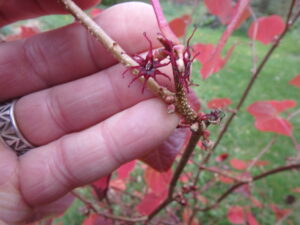
Disanhus flowers are small but interesting
A lesser-known shrub that blooms for me in October is disanthus ( Disanthus cercidifolius). This shrub likes rich moist slightly acidic soil in part- to full-shade. It is a polite shrub – it does not spread out and take over the area, and rarely needs pruning. During the summer is has nice dark green leaves similar to those on a redbud tree. But in fall the leaves turn an intense reddish purple and hold on well into the fall. I think the leaf color is better than that on burning bush, which is an invasive and no longer sold.
The blossoms on disanthus are tiny, and I didn’t even notice them for a couple of years after planting mine as they are right on the branches, and obscured by leaves. But it is fun to have something special to look for now, in autumn – and to show to friends. Mine haven’t appeared yet, but should appear soon.
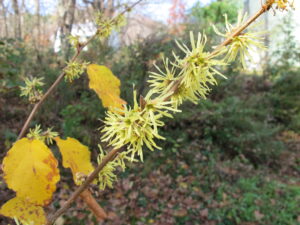
Witchhazel blossoms
Then there is the witchhazel tree ( Hamamelis virginiana). I remember the first time I encountered one. I was hiking in late October, and came upon a native tree covered in yellow blossoms. Although the blossoms were small, it had petals that were curly and bright – and I was not expecting anything to be blooming.
So of course I had to have one. The foliage turns yellow in September, and holds on, obscuring the blossoms a bit. But eventually the leaves drop, exposing the flowers. There are also early spring-blooming varieties as well. ‘Arnold’s promise is a nice one with red and yellow flowers.
Although I have never seen pollinators on the flowers, they are fragrant and brightly colored, so I assume they are trying to attract something. The only source for information I have found on this comes from Bernd Heinrich in a 1987 Scientific American article. He witnessed the night-flying owlet moth feeding on the nectar and pollinating the flowers in November when most other insects are no longer around.
Of the garden flowers blooming now, you must have seen big, bold New England asters and perhaps some of the more shy wild woodland asters. Some of my phlox are still blooming, as are some black-eyed Susans. Of those, a Rudbeckia called ‘Henry Eiler’ is the most dramatic. Over five feet tall, it will bloom all month in a huge clump. I just wish I didn’t have to tie it up to keep it from flopping.
I have an absolutely stunning goldenrod (Soldiago rugosa), a cultivar called “Fireworks”. It is one I purchased several years ago and it is now a nice tight clump 4 feet across and 3 feet tall. The blossoms arch over gently, and point in different directions, creating a stunning display, a little like the finale of a good fireworks display. Unlike wild goldenrod, it does not seem to spread quickly by root or seed.
Also in bloom for me now is Knautia macedonia with deep wine-red flowers reminiscent of Scabiosa or pincushion flower. It has been blooming for months, and is a delight. The stems are thin and tend to bend over a bit when blooming, but the blossoms never seem to fall to the ground. It is not a good cut flower, but earns its place in the garden because if its long bloom time.
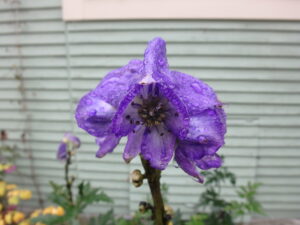
Fall blooming monkshood is a poisonous beauty
Most species of monkshood bloom in June, but I also have one species, Aconitum carmichaelii, which blooms now with intense blue flowers on 5-foot stems that do not flop. All monkshood species have poisonous sap, and some were said to be used to poison wolves in Russia. Agatha Christie probably had someone use it for tea, to get rid of an annoying relative, but I don’t recommend that.
I have always tried to expand the growing season here in my cold Zone 4 garden. I should have a few blossoms into November, and then there will be a hiatus until early March when my first snowdrops bloom. But I can buy flowers for my table in winter, and I do have plenty of houseplants.
Henry is the author of 4
gardening books, a lifetime organic
gardener, and a frequent public speaker on many
gardening topics. You may reach him at
henry.homeyer@comcast.net.
The Art of Japanese Pruning
Posted on Tuesday, October 6, 2020 · Leave a Comment
A few weeks ago I traveled to Shin Boku Nursery in Wentworth, NH to attend an all-day workshop on Japanese pruning techniques. Many of the techniques are useful to any gardener.
The workshop was organized and taught by Doug Roth, the publisher of Sukiya Living magazine (
www.rothteien.com), a journal about Japanese gardening that my wife and I subscribe to. It provides practical and aesthetic advice that I find useful anywhere. Mr. Roth lived for years in Japan, and apprenticed under a Japanese master, ultimately receiving accreditation as a journeyman gardener.
Shin Boku (
www.shin-bokunursery.com/) is a specialty nursery that offers trees and shrubs trained for use in Japanese-inspired gardens. The owner, Palmer Koelb, has been growing specialty trees pruned in the Japanese style there since 1986, and some of the larger trees (in 5-foot diameter pots) he has been training for even longer. There is a lovely Japanese garden there as well as specimen trees for sale.
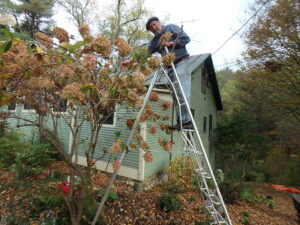
Henry on Japanese pruning ladder
The workshop began with a lesson on ladder safety. Japanese pruning ladders made by Hasegawa were present for us to see and use. These ladders are tripod ladders made especially for pruning. They are made of welded aluminum, and are very light.
Their 2 front legs flare, shaped much like a side of the Eiffel Tower, and a third leg is hinged so that it can be swung out and placed inside or behind a hedge or tree. Not only that, the third leg can be extended or shortened to work on hillsides. The feet are clawed, so they dig into the soil, but they come with rubber “sneakers” to use on pavement or stone. The steps are wide and comfortable on the feet, and some have an upper platform for working.
After a day of using the Hasegawa ladders, I was convinced that they offer safety and convenience way beyond what my old-fashioned step ladders and extension ladders offer, particularly on rough terrain and hillsides. When I got home I made arrangements to buy my own from Alan Bissonnette in Chichester, New Hampshire. He represents New England Ladders (
www.neladders.com), which has representatives and warehouses around the country. Visit
www.neladders.com/dealer-locator/ to find a dealer near you.
The ladder I selected is a 10-footer, one with a platform at the 8-foot level, and a grab bar on the top. I have been using it on hilly terrain, and love that not only can I adjust the length of the third (back) leg, it has a chain connecting the front legs and the back legs to assure that the ladder cannot splay more than recommended. I was tempted to get an 8-foot ladder, but have been pleased with the extra height. I like being able to look down on the top of a medium-size crab apple tree to see what needs to be removed. My new ladder weighs just 30 pounds.
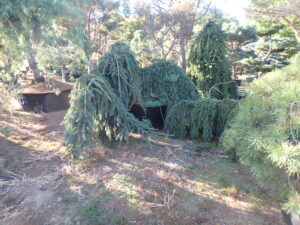
Large trees pruned in the Japanese tradition are available at Shin-Boku nursery
In Japanese gardens the trees are often trained to irregular shapes. That can be accomplished by regular pruning and understanding how to direct growth. The tip of a branch produces auxins, or plant hormones that control growth and fruiting. By cutting back a branch to a junction of branches, one can direct growth. Cut off the tip and one of a pair of side branches, and the growth will essentially follow the direction of the remaining branch. In this way, a tree can be made to twist and turn over time.
Some evergreens produce so many branches and leaves that the interior of the shrub or tree gets little or no light. The interior of those specimens can then lose their leaves (commonly called needles), leaving a dark interior that is unattractive if an outer branch is damaged or removed. You can prevent that with judicious pruning.
I recently worked on a “Bird’s Nest’ spruce. It was a large shrub that was getting too tall and wide, and the homeowner wanted it made smaller. This, I explained, is a multi-year project: if I just cut off the top branches, the brown interior would be exposed and unsightly.
Here’s what I did: First, I cut back this year’s growth to stop the shrub from getting bigger. Then I removed some small branches to allow punches of light to get inside the tree. That will stimulate dormant buds to grow new leaves. I did this primarily where two branches were growing parallel – I removed one, left the other. I did this not only on the top of the shrub, but on the sides as well.
In the workshop each of us received a copy of “Sukiya Living Textbook: Advanced Tree Pruning”. It is nicely illustrated with photographs showing several different styles of pruning techniques, mainly for evergreen shrubs and small trees.
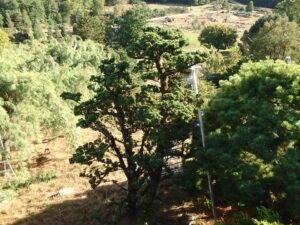
Pine shaped in the Japanese tradition at Shin-Boku Nursery
If you are interested in creating a tranquil corner of your property into a small Japanese garden, I suggest you subscribe to Sukiya Living magazine. It comes out bi-monthly and, according to their website, covers “various aspects of Japanese architecture, horticulture, art, and philosophy. Topics range from centuries-old design principles to modern, how-to construction and maintenance techniques.”
I hope one day to travel with Doug Roth on one of his tours of gardens in Kyoto, Japan. I just will have to wait until Covid 19 has been controlled and a vaccine is available. Meanwhile, I can dream.
You may reach Henry at
henry.homeyer@comcast.net or PO Box 364, Cornish flat, NH 03746. He is the author of 4 gardening books.
Getting Houseplants and Herbs Ready for the Indoors
Posted on Tuesday, September 29, 2020 · Leave a Comment
Most of us bring our houseplants outside for the summer. Now is the time to bring them in, or get them ready to make the move. It’s also the time to put herbs that you’ve had in the ground all summer into pots and get them ready for winter use in the kitchen.
Generally, plants outdoors don’t suffer much from aphids: the pests are kept in check by good insects that munch on them. But move a plant indoors, and they often get covered with those tiny aphids and their honeydew, which makes a sticky mess of your leaves.
The solution is an easy one. Before bringing a potted plant indoors, wash the leaves. I do this by placing the potted plant on its side, and washing it with a stream of water from the hose. I wash not only the tops of the leaves, but the underside, too. Roll the pot twice to wash all the leaves well.
In addition to the leaves, I wash off the surface of the potting soil to get any eggs or aphids hiding there. I then add half an inch of fresh potting soil to replace any I washed off. Then I stand the pot up and let it dry in the sun. For smaller plants, you can wash them in the kitchen sink.
Although spring is generally recommended for re-potting houseplants, it may be needed now if a houseplant has been in the same pot for a long time. If roots are poking out of the holes in the bottom of the pot, or if the plant leaves are smaller than previously, it’s time to re-pot. You can remove a plant from its pot to see if roots are matted and tangled at the bottom of the root ball, and pressed up against the side of the pot.
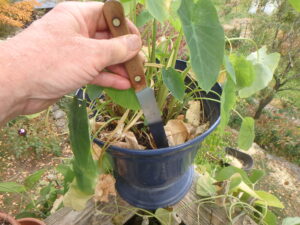
A bread knife can help loosen soil attached to a flower pot
Getting a plant out of a pot is not always easy. If the pot is small enough, hold it upside down, give a tug on the plant and it will slide out into your waiting hand. For bigger pots I use a long bread knife or cake spatula and slide it between the root ball and the pot, poking and pushing all the way around the outer edge to loosen the soil. Then I turn it upside down again and try to remove it.
For big pots, get someone to help you. Hold the plant, and ask your helper to tug and rotate the pot, pulling until the plant comes out. Plastic and fiberglass pots are generally more willing to give up their grip on plants than old fashioned baked clay pots.
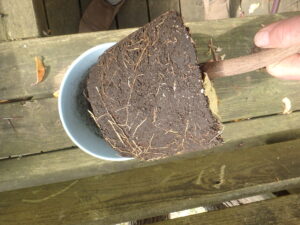
Loosen the soil by tickling these roots and you will have room for new soil
Once the plant is out of the pot, try to loosen up the roots. If they are a tightly tangled mess, you can use a serrated steak knife to cut off an inch or so of roots at the bottom of the pot. Roots on the sides can be “tickled” loose with your fingers, a kitchen fork, or a hand tool such as the CobraHead weeder. Let soil fall off the roots, as it is depleted and will be replaced.
Potting mix is generally based on peat moss, which is light and fluffy but not very nutritious for your plants. I like to mix it with high quality compost – my own, or purchased. I find Moo-Doo brand composted cow manure to be excellent, and readily available. It is made in Vermont.
I like to have an inch of two of my freshly made potting mix in the bottom of the pot, and half an inch to an inch of it all around the perimeter. To make space around the outside requires removing old soil – or using a slightly bigger pot
When adding soil mix around the outside of the pot, use your fingers to push the new mix down, but you may need a wooden spoon or paint stirrer to get it all the way to the bottom of the pot. Water after the job is done to be sure no air pockets are left in the pot.
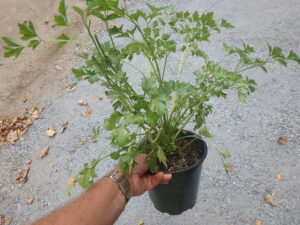
Parsley roots are long and need a deep pot
Some perennial herbs can be moved inside for the winter. These include chives, rosemary, thyme and parsley. Parsley has many deep roots, so an eight-inch deep pot is best. Chives are easy to pot up, and do well on a bright window sill. I will cut mine back in a week, as she looks a bit like Rapunzel now. Basil, no matter how hard we try, is not a good candidate to come inside. It attracts aphids and needs more light than a windowsill will normally provide. I’m going to try moving some dill inside this year, but have not previously tried it.
After you have potted up some herbs, leave them outside for a week or more. Why? It’s best to change just one variable at a time. There is always less light inside, so let the plants get used to being in a pot before moving them indoors. Be sure not to over-water your herbs: most are Mediterranean in origin, and do best in relatively dry soil. That said, please know that a completely dry rosemary is a dead rosemary.
On another note, a few days after a hard frost you should dig up your dahlias, calla lilies, gladiolas and cannas. Store them in a cool, dark place. A brown paper bag with some slightly damp wood shavings used in gerbil cages or sphagnum moss will keep them from drying out too much.
Henry can be reached at
henry.homeyer@comcast.net. He is the author of 4 gardening books, and is gardening consultant and long time UNH Master Gardener.
Planting Bulbs for Spring Blossoms
Posted on Tuesday, September 22, 2020 · Leave a Comment
Now is the time to buy your bulbs for spring blossoms. Winters in New England are long, cold and snowy, so by March I’m ready for spring. Most years I have bulb flowers pushing their way up through mushy snow and fallen leaves in early March, delighting me with their improbably delicate flowers.
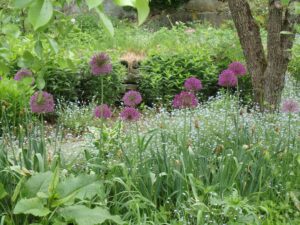
These allium bloomed in early June after the daffodils in the same bed
First the small bulbs bloom: snowdrops, glory of the snow, scilla, winter aconite and crocus. Next come daffodils, tulips and alliums. Finally come summer snowflake ( Leucojum spp.) and Camassia. You have plenty of time to plant bulbs as you can do so until the ground freezes. But I recommend that you get them now before they are sold out. Gardening has taken a big uptick in interest this year, and I predict bulbs will go the way of seeds and hoses – all sold out early.
Here are the basics: you plant bulbs in the fall and they bloom in the spring according to an internal clock. All need plenty of sun, though the little ones that bloom early can be grown under deciduous trees, as they will get enough sun to “re-charge” the bulbs by photosynthesis before the leaves are on. Don’t plant bulbs of daffodils or tulips in the lawn because you won’t be able to mow it until July (if you do, the bulbs will not get enough energy and they won’t bloom).
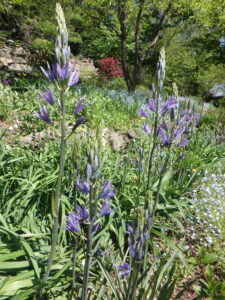
Cammasia is a lesser known bulb plant that blooms in May for me
Planting depth matters. The small bulbs only need 2 or 3 inches of soil cover over the top of the bulb; bigger bulbs like tulips and daffodils generally need 6 inches of cover. Follow the directions that come with the bulbs.
Tulip bulbs are loved as food by rodents like squirrels and chipmunk. Deer will eat the foliage and flower buds – often the night before you planned on picking some. Daffodils are vaguely poisonous, so not eaten by anything. Alliums, in the onion family, are not eaten by anything, either. Crocus are not generally bothered by anything, but this past spring we had a plague of chipmunks that ate the blossoms just before they bloomed. I’ve never had trouble with any of the other small bulbs.
I like to plant bulbs in big batches. Fifty daffodils will knock your socks off when they bloom, but five will hardly be noticed. I know that some stores sell tools that can be used to cut out and lift a circle of soil all in one motion. The idea is to dig lots of holes (3 inches across) and plant one bulb in each hole. I find that method tedious. The same goes for using an auger on a drill to dig holes for bulbs.
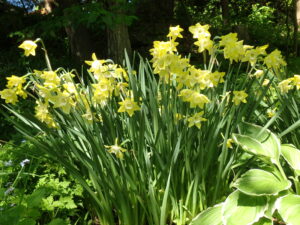
Daffodils look great planted in big masses
What I like is to dig a bulb bed for 25 or more bulbs. Dig down six inches, remove the soil in an oval or circle 24 to 36 inches across. I put the soil in a wheelbarrow or on a tarp so as to keep the area tidy. Once the hole is excavated, I add some bulb booster or slow-release organic fertilizer in the hole with my CobraHead weeder. I generally add some compost, too, and scratch it into the soil at the bottom of the hole, along with the fertilizer.
After all that, I just place the bulbs in the soil, pointy end up. Space them according to the directions, or a little closer than the directions indicate. Daffodils and tulips I space about three inches apart, small bulbs less. Then I take the soil I removed and return it to the hole, being careful not disturb the bulbs. I remove any stones that are the size of the bulbs or larger, and mix in some compost with the soil if it is a heavy clay or very sandy.
What about those rodents that want to eat your tulips or small bulbs? People try many things to deter them. Some sprinkle hot pepper powder on the soil surface, or crushed oyster shells, which are sharp and unpleasant. A variety of animal repellents are sold, and some may do the job. I like to hide the hole with a layer of fall leaves so it won’t be so obvious to rodents.
Back at the end of Bill Clinton’s time in office I got to interview the White House gardener in the fall. They had just planted, for the newly elected President Bush, thousands of tulips, a variety named ‘Hilary Clinton’. Huh. I asked how they would keep the squirrels away – I saw them everywhere.
Dale Haney, the head gardener, told me they keep the squirrels fat and happy – they give them all the dried corn they can eat. That reduces the desire for tulips. And, he said, they put a layer of chicken wire 2 inches below the soil surface after planting. Squirrels are deterred by the wire. I tried that method, and it is not easy to do – I needed to cut the chicken wire to fit my plantings, and it was like handling razor wire. I don’t recommend it.
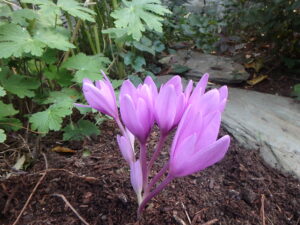
Autumn crocus
There are a few fall blooming bulbs, too. Saffron crocus and Colchicum need to be planted before this, but you might like to try them another year. Colchicum, generally planted in August, is also called “fall crocus” (even though it is not a crocus at all). But the blossoms look like giant crocus, and each bulb produces several blossoms. I love them.
Colchicum are leafless now, but put out leaves in the spring which disappear by mid-summer. Bulbs cost from $5 to $8 each, and are generally sold in packages of three. Good garden centers may have a few for sale potted up and already in bloom now.
I’ve been planting bulbs every year for decades, and find it one of my favorite gardening activities. Now, in fall, when the garden is declining, I plant something and dream of spring. I need that.
Henry is the author of 4 gardening books, and is a UNH Master Gardener. Write him at PO Box 364, Cornish Flat, NH 03746 or e-mail him at
henry.homeyer@comcast.net.
Putting the Garden to Bed
Posted on Tuesday, September 15, 2020 · Leave a Comment
Big yellow school buses are on the road again…or at least a few of them. Tree leaves in the swamps are turning red. Frost and cold weather are sneaking up on us. This year I resolve to get my garden put to bed early so that I am not wearing gloves and long johns as I cut back the daylilies and other perennials on cold, wet fall days. Here is what I am doing now – or will soon.
First on my list is the need to sow some grass seed. I have places where my lawn was killed when a torrential downpour dumped sand from my road onto the lawn. Fall is a better time to sow seed than the spring because the ground is warmer, and it will germinate quickly. In the spring, seed can rot during cold, wet weather.
I will spread some topsoil or compost to improve the soil, then mix it in with a short-tined rake. After spreading seed, I will cover it with a layer of straw. That will help to keep the soil and seeds from drying out, though I will water occasionally if the soil gets dry.
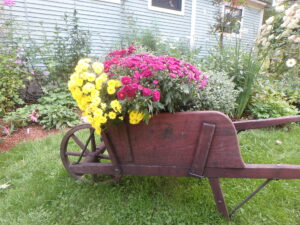
Chrysanthemums add color in the fall
Chrysanthemums are for sale now at farm stands, and I purchased a few pots of them to brighten up the front yard. I treat them as annuals, even though some of them are perennial. But the growers cut back the plants as they grow, causing them to branch out and produce hundreds of blossoms on bigger plants. If I let them over-winter, the plants would have some flowers, but never so many as what the professionals produce. It’s worth it to me to buy a few each fall.
Mums in pots tend to dry out quickly, so I have been soaking mine in my birdbath. That way the pots suck up water, getting it down deep. I could actually plant my mums in the ground, but I like them in pots on the front steps or in my wooden wheelbarrow. They need water every few days.
This is also the time of year when I move shrubs. I recently moved a Diervilla, one called ‘Kodiak’. It was given to me years ago, and it was crowded in between a crab apple tree and a red-veined Enkianthus. I decided it needed more space to grow, and I wanted to expose a stone wall behind it. So I dug it up.
This shrub is about 3 feet tall and wide, and had been in the ground more than 5 years. I used a shovel called a drain spade: a spade with a long, narrow blade. I pushed it into the ground at a 45-degree angle in 4 places around the bush. Each time I pushed the shovel handle down to lift the shrub slightly. Then, when I’d gone all around it, I got the spade under the middle of the plant, pushed down hard, and popped it right out.
I tugged on the plant, and pulled it loose, roots and all. Some were cut by my shovel, others not. I moved it to its new home, covered the roots and watered well. A week later it looks fine.
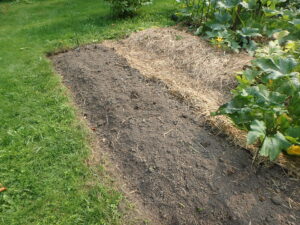
Never leave the soil bare. Cover with mulch to keep out wind blow seeds
The vegetable garden is winding down, and as each crop is harvested, I weed the row and apply mulch as needed it to keep wind-blown seeds from finding a home. My favorite mulch consists of chopped fall leaves: I run over leaves on the lawn with my lawnmower to chop them, and rake them onto a tarp which I drag down to the vegetable garden. It’s too early for leaves, so I’m using straw for now.
When cleaning up the vegetable garden it’s important to keep diseased plants separate from healthy ones (which go on the compost pile). I generally have a location for noxious weeds and diseased plants and do not use that material after it breaks down, or not for many years. It takes a pretty high temperature to kill weed seeds and fungal diseases, and I don’t want to chance getting either one back in following years.
I tend to get a little lackadaisical about the perennial flower gardens late in the season. Weeds and grasses have a way of showing up there, and by pulling them now, the work will be less in the spring. Cindy and I have done a pretty good job of mulching the flower gardens this year using a ground hemlock bark mulch, though some weeds push on through. This is a good time to get rid of those rascals.
Some gardeners cut back all flowers in the fall, others in the spring. Me? I cut back some, but like to leave some tall perennials with sturdy stems to stand proud above the winter snows. Birds enjoy their seeds. And some beneficial insects need places to lay their eggs, or to use as shelter. On the other hand, there is a lot to do in the spring, and cleaning up the flower beds now reduces the work later on.
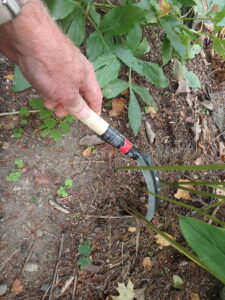
This harvest sickle will slice through stems quickly and easily
Cutting back perennials with a pair of pruning shears is very tedious work. I prefer to use a serrated harvest sickle that allows me to slice through a handful of stalks in one quick motion. I have one that costs under $10 (a Barnet model BLK 730) and is available from OESCOINC.com, or by calling them at 800-634-5557. Just wear gloves when you use it – it’s very sharp.
This is also a good time to divide perennials to make more plants. Peonies, for example, are best divided and moved in late September to mid-October. Dig up daylilies, phlox or asters now the way you would a shrub, and then use a small saw or root knife to divide it into two or more new plants. Most plants like being divided – assuming you give them some compost and a little fertilizer.
Putting the garden to bed can be an enjoyable time – so long as you give yourself enough time to do it in small chunks. So get to work before it gets too cold to enjoy yourself.
Henry can be reached at P.O. Box 364, Cornish Flat, NH 03746 or by email at
henry.homeyer@comcast.net. He is a lifelong organic gardener and the author of 4 gardening books.
Getting Ready for Winter
Posted on Tuesday, September 8, 2020 · Leave a Comment
Like a conscientious squirrel, I put away food for the winter in August and September. I freeze and dehydrate lots of vegetables, and store some in my cool basement. Here are some tips on ways to save food for later.
I grew about a dozen kale plants this year. The workhorse are those that end in “bor” – winterbor, redbor, starbor and others. I get seeds from Johnny’s Selected Seeds of Maine to start my own indoors in the spring, or find them at my local garden center growing in 6-packs. Most of the kale I grow is for winter use because it freezes so well. This week I put up 8 quart freezer bags of kale, and I still have more I may process later.
To freeze kale I wash it first and make sure it is free of (Ugh) slugs and bugs. Then I either pull the leaves off the midrib, or slice it off. I chop the kale into 1-or 2-inch squares, prior to blanching in boiling water.
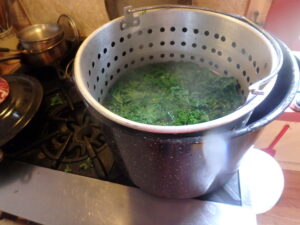
Blanching kale is worth the work
To blanch the kale I submerse it in boiling water for 30 to 60 seconds. This will kill the “aging” enzymes in kale, allowing me to keep it frozen and good to eat practically forever, if need be. Normally I eat all the kale within a year of freezing it, which is recommended. I could freeze kale without blanching it if I were planning on eating it all in 3 months or so. But blanching also allows me to pack more kale in each bag.
For the blanching of kale and other veggies, I use my big black tin pot that is sold for hot water bath canning – it is roughly 14 inches wide and 9 inches deep, and will hold 7 quart mason jars for canning tomatoes. I fill the canner half full, and bring to a full, rolling boil.
I have a special blanching pot that fits inside it – a metal pot with big holes in the bottom and sides, and handle for putting it inside my canning pot, and taking it out. You can buy a canner at any hardware store, but the inserts are harder to find – a restaurant supply stores should have them.
Then I drop in the kale– I do 15 leaves or so at a time. The water will just barely come to a re-boil in 60 seconds. Use a timer. If you use lots of water and not too many leaves, you can blanch for just 30 seconds.
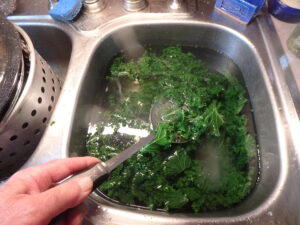
Cold water cools the kale and stops the cooking
Next you want to cool the kale quickly. Some people prepare an ice bath, but I just fill the kitchen sink with cold tap water. I lift the blanching pot and let the water drain back into the canner. Then, with the lid of the canner under the pot, I move from stove to sink, and drop the kale into the cold water. I stir, then scoop it out with a colander or slotted spoon, and put it into my salad spinner. The brand I prefer is Zylis, which has a pull string, not a crank. Sometimes I squeeze the kale to get some of the water out before spinning it.
Lastly, I dump the damp kale out of the salad spinner and onto a clean dish towel on the countertop. I pat it and roll it in the towel to remove more moisture. I fill bags, squeeze out some air, and then suck out as much air as I can with a straw inserted into the bag when it is closed right up to the straw. Still sucking, I pull the straw and snap the zipper shut.
Other veggies I blanch include beans, beets, broccoli, Brussels sprouts, cabbage, carrots, cauliflower, corn, kale, peaches, spinach, and Swiss chard. But not all veggies need blanching. Things I don’t blanch include apples, berries, pears, peppers, leeks, and tomatoes. And I bake or steam winter squash, then freeze it.
Summer squash for use as a side dish needs only 30 seconds of blanching, but squash for soup I don’t blanch at all. This week I put up 11 quarts of grated Romanesco zucchini for use in soups. Even big Romanescos are good, if you remove the seeds. I use the grater blade on my food processor to grate it – it would take forever by hand. One bag of grated zucchini with an equal amount of tomato (which I freeze whole), some onions or frozen leeks, vegetable bouillon, and spices makes a great winter soup.
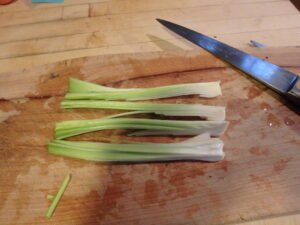
Leeks with leaves cut off and quartered before chopping and freezing
I grow a lot of leeks, in part because they freeze so well. I wash them, take off a layer or so of outer leaves, cut off the tops and quarter them lengthwise. I chop them, put them in freezer bags and suck out the air. They last forever in the freezer. I store lots of onions, but always run out before next year’s crop comes in. And onions don’t last forever, even in cool storage, so I use leeks in soups and stews when I run out of onions. I’ll put up a dozen quarts of leeks or more this year.
I haven’t harvested potatoes yet. I plant mine in June to avoid potato beetles. Didn’t have a single one this year! But it also means my potatoes are still growing now and are not ready to harvest. I have “stolen” a few by reaching under a plant and grabbing a few but not disrupting the others.
Potatoes store well in a spare fridge, or in a cement-block enclosure with a plywood lid in a cold space that stays in the 33- to 50-degree zone. Mice love them, so an old fridge really is best unless you are storing a lot of them. If I had to survive on what I grew, I’d grow a lot of potatoes and store them well.
So get to work. No point in growing a lot of produce and letting it go to waste. Of course, it’s fun to share with friends and the local food pantry.
Henry can be reached at
henry.homeyer@comcast.net or at PO Box 364, Cornish Flat, NH 03746. He is the author or 4 gardening books, and is a UNH Master Gardener.
Flowers Fit for a Much Loved Dog
Posted on Tuesday, September 1, 2020 · Leave a Comment

OLYMPUS DIGITAL CAMERA
Daphne mezereum was the registered name of my corgi, Daffy, who passed away on August 25 of this year. Born in 2006, Daffy was my constant companion who was always ready for an adventure – or especially, a meal or snack. When her back legs gave out, she figured out ways to propel herself forward with glee – ignoring the inconvenience, and trying to overcome the pain. Finally, when the pain was nearly constant, and we reluctantly called the vet.
We buried Daffy alongside her cat friend, Winnie, who passed naturally at age 23 in June of this year. And Abby and Stanley and Emily, all good dogs who have passed on and been buried in a quiet shady place on our property. Each had their graves decorated with flowers from the garden. Let’s take a look at some of the plants I grow, and that I used to commemorate Daffy and celebrate her life.
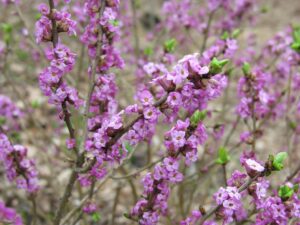
Of course I cut branches of her namesake,
Daphne mezereum or February Daphne. It is a fabulous shrub that blooms in May here in Cornish Flat, displaying pinky-purple fragrant flowers in abundance. It is slow-growing, so easy to maintain. No need to do much pruning – other than stems I cut to force in a vase each year in April.
And I put in her grave a couple of stems from a Harry Lauder’s walking stick shrub. A walking stick seems fitting for a dog that had trouble walking. It’s a curly hazelnut that would not really be good as a walking stick – there are no straight bits. Mine is a variety called ‘Red Majestic’ of the European filbert
(Corylus avellana).
In the spring the leaves are a deep red-purple but develop a greenish tinge as the summer progresses. I have mine in a flower bed, and have been able to keep it to a 6-foot wide and tall tree by annual pruning.
And I sent Daffy off with diamonds. ‘Pink Diamond’, that is. It’s a lovely variety of Hydrangea paniculata. I bought one that is a “standard”, meaning that it came with a straight trunk that had branches grafted on at the 4-foot high level. So it started out as a shrub with some height, and never suffered from the awkwardness common to many hydrangeas that start as multi-stemmed shrubs.
At the bottom of Daffy’s grave I placed boughs from a Canadian hemlock (Tsuga canadensis). This is a native evergreen tree that grows well in sun or shade. In 1972 I dug up several growing wild in a field nearby and planted them as a hedge. They are now 50 feet tall or so. My late sister, Ruth Anne, lived in Canada and loved Daffy fiercely, calling her “the dog of joy”. So these boughs commemorated them both. I no longer promote planting hemlocks because an insect pest, the wooly adelgid, is decimating them – though thankfully not in my area, as yet.
Of the woody plants, the last I placed in Daffy’s grave was a stem from my Bartlett pear. Daffy, always hungry, would gorge on the pears that fell on the ground beneath this tree, so it seemed fitting to put a branch in.
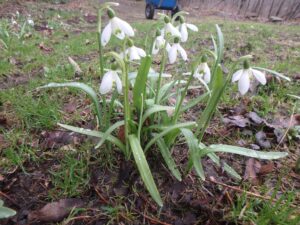
Snowdrops bloom in March and always delight me when they do
I cut fresh perennial flowers for Daphne’s grave, too. Phlox have been gorgeous this year, disease-free and fragrant. Daffy is the only dog I’ve had who noticed flowers. I have a picture of her checking out a vase of tulips. But phlox is in all its glory in sunny beds, so I cut some.
Daffy had a sunny disposition, even at the end when she was in pain, so I included a sunflower. Like Daphne, it was a short one, perhaps ‘Teddy Bear’. There are so many great sunflowers out there, many short and with multiple flowers branching off the main stem. They are easily started from seed. Chipmunks love them when they are just starting, so I grow them in 6-packs until they are tall enough to ignore the rodents. Deer love sunflowers, too, however, when they get bigger.
And roses went in the grave, too. My favorites are the ‘Knockout’ roses. Perhaps because they are not fragrant, they don’t seem to be attractive to the Japanese beetles that can plague old fashioned roses. They are fast-growing, and can reach a height of 4 feet in a couple of months even if all above-ground stems died over the winter. The one I selected for Daffy has had 25 blossoms most of the time this summer.

This tithonia blossom is about 2 inches wide on a 6 foot tall plant with many blossoms
Then we added some Shasta daisies, those wonderful, cheerful flowers with white petals around a central yellow button. My patch of those gets a bit bigger each year in full sun. And Mexican sunflowers (Tithonia rotundifolia), a 6-foot tall orange annual in the daisy or sunflower family. We start lots of these by seed each year, and I am always delighted by the results.
I suppose there were other flowers we picked for Daphne’s last day, though it’s all a bit of a blur. I do know that flowers always lift my spirits, and certainly they needed some lifting that day. But I’m doing better now, and being in the garden has helped. Later this fall I will plant bulbs on her grave – snowdrops. They are the first flowers to bloom in spring, and always bring me joy. And after all, she was the Dog of Joy.

 Click Here to buy from Cobrahead