Tips for Squeezing Out a Little More Food from Your Vegetable Garden
Posted on Tuesday, September 10, 2019 · Leave a Comment
Want to maximize the output of your garden? Now is the time to act. Here are a few things you can do that will help.
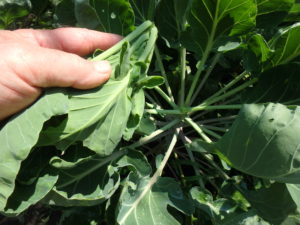
Remove top leaves of Brussels sprouts to get bigger sprouts
Brussels sprouts: Have you had trouble getting full-sized sprouts? These plants need to be topped in the fall to get the tiny sprouts to develop into full-sized ones. I do it each year on Labor Day, but you can do it now. Cutting off the top cluster of leaves means that the plants will no longer continue getting taller, and put all energy into beefing up those tiny cabbage-like sprouts to their full potential.
Brussels sprouts are very tough when it comes to frost – they will survive cold weather and snow without blinking. I’ve been known to wait until December to pick my sprouts, or to finish harvesting them. But be forewarned: deer love Brussels sprouts in the winter.
Swiss chard: Both Swiss chard and beets are in the species Beta vulgaris. Hundreds of years ago some plants were selected for their tasty roots, others for their leaves. But you can eat the roots of Swiss chard just as you do beets, and the flavor is almost identical. I like red-leafed Swiss chard roots the best. They are smaller, but sweet and tender – and a free dish you weren’t expecting when you planted them. Be sure to peel Swiss chard roots as they have fine roots that feel a little fuzzy if you don’t.
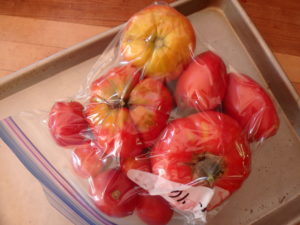
Freeze tomatoes to extend the season
Tomatoes: Right now I have more tomatoes than I can eat fresh, and don’t have time to make sauce. What to do? I freeze whole tomatoes raw, un-blanched. I just place whole tomatoes in zipper freezer bags. In winter when making a soup or stew I remove them from the freezer, run them under hot water in the sink. That loosens the skin, which I rub off. Moments later I chop the tomatoes and use for cooking.
Kale: In case you forgot to plant some, or the deer ate yours, there are alternatives. You can eat the leaves of any crucifer-family veggie (broccoli, cauliflower, cabbage, kale, bok choy, arugula, Brussels sprouts, collards, watercress and radishes). Pick newer leaves, as the older leaves may be tough. I recently used some Brussels sprouts tops in a smoothie, and they were fine!
Asparagus: Yes, I know the harvest is long over. But this is the time to maximize next year’s harvest. Weed your bed, rake off any mulch, and add an inch of good compost and some organic fertilizer. At the same time, pull out any new asparagus seedlings that have started from the little red “berries”, as they will compete with the mature plants.
Actually, modern breeding techniques have made better varieties available. Anything with “Jersey” in the name is all male, and will not produce berries that produce seedlings. Wait to cut back the fronds until they turn brown – green foliage is still feeding the roots.
Pumpkins and squash: Some vines will continue to grow until frost, but now is the time to rein them in. Cut back growing tips and let the existing vines feed your winter squash or pumpkins, and don’t let new blossoms remain on the vines. It’s too late for all but some fast-growing summer squash to produce food from blossoms appearing now.
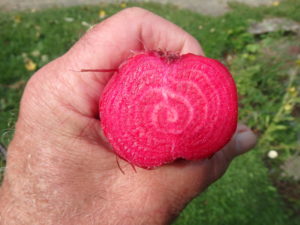
Sliced Swiss Chard root looks and tastes like a beet
Be sure to pick or cover your vine crops on nights when the temperature approaches 32. Last year I picked some small un-ripe pumpkins on a late afternoon when frost was forecast, and they ripened on my steps to a full orange. I brought them into the mudroom when frost was forecast, and by Halloween I had quite a nice display of orange fruits.
Cabbage: Instead of pulling your plants now, cut off the cabbages to harvest. Then cut an X into the stem. It’s a little late for this, but you might still get some small cabbages ranging in size from golf ball to softball. I have gotten 4 little cabbages from each stem by doing this.
Chives: This is the time to dig some up and leave outside in plastic pots (which won’t be damaged when they freeze). You can then bring them in, one at a time, and when they thaw, the leaves will be fresh and tasty. When finished harvesting, just put them outside until spring and re-plant. They will be no worse for wear.
Rosemary: Another good herb for winter use. I grow mine I pots and bring them in and grow on a sunny south or west-facing window. If you have some in your garden, pot it up now. But don’t bring it inside. Let it get used to being in a pot right where it has been growing.
Rosemary is hardy to about 25 degrees, and a little frost will help minimize problems with aphids when you bring it in. Do not fertilize when you pot it up, but do shake off some of the soil and pot it in potting mix to improve drainage. Don’t overwater, but never let potted rosemary dry out completely – it will die.
If you have some tips for squeezing out a little extra food from the garden, please send them to me either at P.O. Box 364, Cornish Flat, NH 03746 or at henry.homeyer@comcast.net. Thanks! And contact me if you are interested in going on a Viking River Cruise with me next June from Paris to Normandy and back, with a stop at Monet’s garden in Giverny.
Fall Color in the Flower Garden
Posted on Tuesday, September 3, 2019 · Leave a Comment
Big yellow buses are growling as they lumber down country roads, delivering their children to school. Soft serve stands are warning of imminent closure. Favorite flowers are finishing their blooms. Sigh. Fall is here. But don’t despair: there are plenty of colorful plants to fill vases and warm our hearts. Let’s look at a few I like.
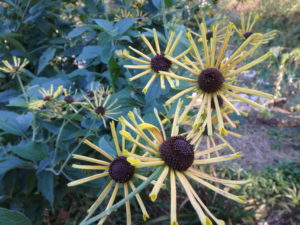
Henry Eiler Rudbeckia blooming in October
Most of us have black-eyed Susans (Rudbeckia spp.) of some sort blooming now, either wild or planted. ‘Goldsturm’ is one of end most common, a nice one that has branched stems loaded with blossoms. But do you know one called ‘Henry Eiler’? It is much taller, and has narrow petals spaced out around the blossom, giving it an airy look. For me it blooms well into October. I have a big clump several years old, and need to tie it to keep the 5- or 6-foot stems from flopping. ‘Prairie Sun’ is wonderful one with a green eye that blooms consistently from July to after Halloween.
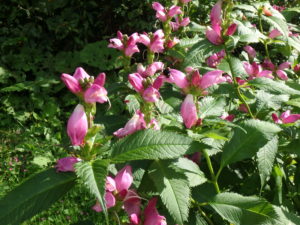
Turtlehead
Turtlehead (Chelone lyonii) is one of my favorite fall bloomers. Each stem has numerous pink helmet-shaped blossoms an inch long that resemble, well, a turtle head. I love it in part, because it attracts bumblebees that force their way into the blossoms and disappear. I can hear them buzzing inside the blooms.
It does best in rich soil that is consistently moist to wet, but will grow in less desirable soil. I recently saw it on the Maine coast growing in hot, dry sandy soil, though it was much shorter than the 4-to5-foot stems I have. I grow it in full sun and also light shade, and each year the clumps get bigger. I never have trouble with it flopping, but have read that can be a problem in shady locations.
Joe Pye Weed (Eutrochium purpureum) is a native wildflower that appears alongside streams and in wet places. It can be grown in average garden soil, but if it is a dry location, some shade will help it. The small flowers are a pinky purple arranged in panicles that are about 6-inches across. The stems, a dark purple to almost black, contrast nicely with the deep green leaves.
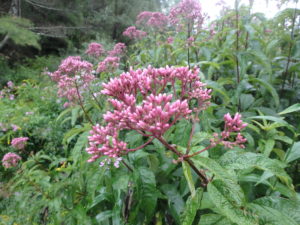
Joe Pye weed Gateway blooms longer and better than the wild forms
Joe Pye weed is a big plant that requires lots of space. I have one clump that is now more than 8 feet tall, though 6 feet in average garden soil is more the norm. ‘Gateway’ is the best of the named cultivars, I think, but I have heard that a smaller variety called ‘Baby Joe’ is only 3 to 4 feet tall and 2 to 3 feet wide. I’m looking for one to try, as Gateway is too big for most beds. Moving a mature clump is almost impossible without a back hoe – or dynamite. I did it once, and won’t again.
When find a flower I like, I collect other species of the same genus. So it is with the burnets. First I planted Canadian burnet (Sanguisorba canadensis), our native species that grows by streams and wet places. It has white bottle-brush flowers on stems 4- to 6-feet tall in a wet area near my stream. It will bloom well into November.
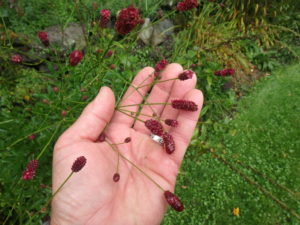
Burnet makes a good cut flower
Other burnets that I grow vary from a 6-inch tight cluster of variegated leaves and tiny burgundy blossoms to 6-foot tall plants with deep burgundy bottle-brush blossoms. Sanguisorba obtusa and S. stipulata are two of the species I grow, though the plant tags are long gone, so I’m not sure which is which. The foliage for most of the summer is very nice. I grow burnets in sun and rich garden soil.
Blooming now, obedient plant (Physostegia virginiana) is one of the least obedient plants I have grown. I have banished it to the edge of the woods in areas that would otherwise be just weeds. The pink or white flower spikes are great cut flowers, but the plant just won’t sit still. Its roots move fast, colonizing and pushing out well behaved plants. And it is tall: 3 to 8 feet!
The variegated form, however, is not a thug. It grows just to 3-feet tall; it does tend to flop, but it blooms later and doesn’t attempt to take over the world. It too, has pink flowers. Worth trying. Mine is yet to bloom this season.
Although I am a little far north to make my Arkansas amsonia (Amsonia hubrechtii) as big and bodacious as it is in places like Pennsylvania, it is still a great plant. Its steely blue flowers in June and July are nice, and the finely cut foliage is good all summer. But in the fall it excels: its leaves turn a lovely yellow that would make the plant worth growing, even without any flowers. Mine now stands nearly 3 feet tall and wide, and it gets even bigger in warmer locations.
Lastly I have to tip my hat to all those wonderful hydrangeas. Hybridizers have developed so many different named cultivars that I can’t keep track of them all. I’m not talking about the blue one, mysteriously called ‘Endless Summer’ which should be ‘Endless Disappointment’. It often fails to perform well after year one.
The classic PeeGee hydrangea has big white clumps of flowers that, if cut now, will look good in a dry vase all winter. And I love the pink ones like ‘Pinky Winky’ and ‘Pink Diamond’ (my personal favorite). ‘Limelight’ is a white blossom with green overtones, another great one.
So go to your local, family-run garden center and ask what they have that blooms now, and until late fall. Your garden doesn’t have to be dull now.
Next June I hope to help lead a Viking River trip down the Seine from Paris to Normandy. Interested? Just e-mail me at henry.homeyer@comcast.net. I’ll be giving garden talks in the evenings, and we’ll see Monet’s garden along the way.
Growing Flowers in Shade with Root Competition
Posted on Saturday, August 31, 2019 · Leave a Comment
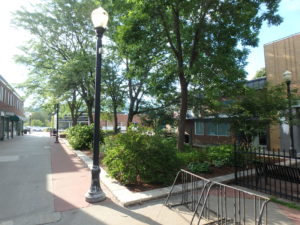
This shade garden has had 10 years of care
Folks who only have shade often give up on gardening because they cannot grow things like poppies and peonies, and only know “boring” shade plants planted for their foliage rather than their blossoms: hostas, pachysandra and myrtle. But even those plants don’t necessarily grow vigorously in shade. More often the not, the problem is not shade, but root competition.
Ten years ago my partner, Cindy Heath and I accepted the task of designing and installing a garden for the city of Lebanon, NH on the mall near two nice restaurants. The space is 30 feet wide and 60 feet long. When I took on the job it had 3 locust trees and 2 green ash trees which kept most of the potential garden in shade. The soil was covered with 3-4 inches of bark mulch, many weeds, and half a dozen hostas. We got the city to remove one tree, so there are sunny places now.
When I dug into the bark mulch I found roots from the trees everywhere; when I dug into the soil I found gravel, sand, bricks and rubble. Not a place conducive to gardening – even the weeds were struggling and undersized. Anything planted in the space would be competing with the trees for both minerals and water.
So here is what we did: we had good soil and compost brought in and spread out everywhere – 3 or 4 inches deep. We covered the mulched wood chips with soil to break down over time, adding much needed organic matter.
Next we built berms: mounds of soil and compost 8-12 inches deep arranged in large beds with curved lines. The tree roots eventually migrated into these “root free zones”, but by then the plants there had established themselves and were better able to compete with the tree roots.
At planting time we added plenty of slow release fertilizer and mineral supplements. I used a slow-release organic fertilizer, along with green sand and rock phosphate.
Green sand is a natural soil supplement that increases potassium levels and adds many micronutrients from the sea, where it formed millennia ago. It promotes strong cell walls, which helps plants withstand drought, heat and cold.
The rock phosphate, which is a finely ground rock containing significant quantities of slow-breakdown phosphorus-containing minerals, will not wash away and breaks down over a multi-year period. It promotes good root growth and flowering.
We top-dressed the plants most years with extra fertilizer and minerals, knowing that they are competing with the tree roots. A local volunteer waters during dry times, which helps a lot.
What did we plant? We had been given hostas and daylilies by local citizens, along with a few irises. I timed the sun traveling across the sky and saw there were places that got 6 hours of sun – enough for the daylilies, iris and few annuals. New Guinea impatiens and impatiens have done well most years, and in the sunnier spots zinnias, marigolds and cleome are welcome color.
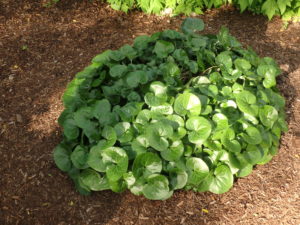
European has spread and thrived in deep shade and root competition
What plants have thrived, now 10 years later? Hostas did great. European wild ginger (Asarum europaeum), with its glossy green leaves has thrived, forming big clumps. We planted a small patch of snakeroot (formerly Cimicifuga racemosa, now Actea racemosa) that has done fabulously, with flower stalks standing 5 feet tall with white, bottle-brush, fragrant flowers. It has spread to fill in its bed nicely.
Bigroot geranium (Geranium macrorrhizum) has done fine, with spring flowers and nice leaves all summer long. I also planted fringed bleeding heart (Dicentra exemia), which also did fine.
What disappeared or failed to thrive? A ground cover known as spotted dead nettle (Lamium maculatum). Normally dead nettle thrives in shade, but the root competition was too great, and it is virtually gone. Also almost gone now is lungwort (Pulmonaria officinalis), another shade stalwart. Coral bells (Heuchera spp.), which does well in shade elsewhere, did not survive. Daylilies, even those tough common orange ones, have survived – but have not thrived.
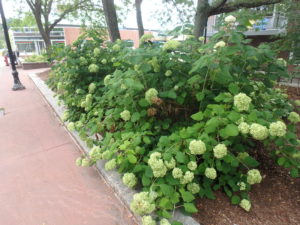
Snow Hills hydrangea aborescens
We also planted a few tough shrubs, and all have done well: a Miss Kim lilac, 2 shad bushes (Amelanchier spp.) and a pair of hydrangeas (Hydrangea arborescens), a variety called ‘Hills of Snow’. This has smaller blossoms than the popular ‘Annabelle’, but does well in shade and the small flowers do not flop so much on rainy days. When planting the shrubs I dug extra wide holes to keep the existing tree roots at bay a little longer. We cut back any tree roots we found at planting time.
So don’t despair if you lack a nice sunny spot for flowers. Even in dry shade you can have flowers – but you may have to try several to find just the right ones for your situation.
I am hoping to help lead a Viking River Cruise next June from Paris to Normandy and back with stops along the way – including Monet’s magical garden, Giverny. If there is enough interest, we might have 3 days in Paris looking at gardens there. If you are interested, e-mail me at henry.homeyer@comcast.net.
Beware the Purple Invader
Posted on Friday, August 30, 2019 · Leave a Comment
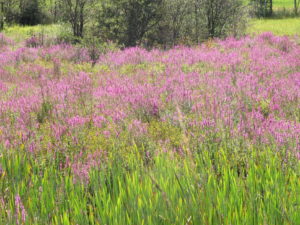
Purple loosestrife can take over a wetland, but will also grow in dry places if given a chance
This is the time of year when swampy areas often are ablaze with gorgeous pink-purple flowers that dominate the wetland. These are the flowers of purple loosestrife (Lythrum salicaria), an invasive plant that you should not encourage – but that you probably can’t get rid of once established.
Most invasive plants come from another continent, start easily from seed, are difficult to eradicate, and often have no natural predators away from their homeland. That is certainly true of purple loosestrife.
But why worry about this purple invader? It’s such an aggressive grower that it out-competes native plants. It moves into shallow wetlands where fish and frogs lay their eggs among native plants, creating a dense mono culture. Biodiversity is healthy for the environment, and purple loosestrife inhibits many other kinds of plants from growing.
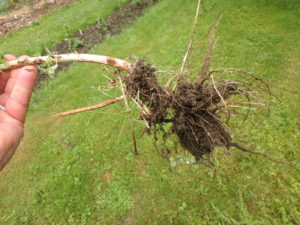
Roots of purple loosestrife spread and send up new plants
Mature plants develop massive root systems that will challenge even the strongest backs so they can’t be dug out. They also develop long side-roots that will easily break off and start new plants if you try to remove the clumps.
A big clump can produce up to 2.7 million seeds in a year. And like time-release cold capsules, the seeds become active over time, not all in one year. And since they grow in wetlands, you can’t use herbicides. So what can you do? There are steps you can take to reduce the problem.
If you have big, established plants the best thing to do is cut them down multiple times each summer, just above the soil line. This will prevent them from flowering and producing seeds. It will also reduce the vigor of the plants. It won’t kill them, so this is a lifetime job, like it or not. A string trimmer will do the job, if you have one.
You can, however, pull out or dig out first or second year plants, so need to be able to identify them. Look for plants with a square stem that quickly get 18 to 24 inches tall, and may have a reddish-brown tinge to their stems. Older plants get to be 3 to 7 feet tall or more. Leaves are long and narrow with a smooth edge, and they attach directly to the stalk – without an attachment stem. Leaves generally appear in pairs, across from each other on a stalk. Many flower stems arise from the main stem.
There is, perhaps, relief in sight. In some states, including Rhode Island, Connecticut and Massachusetts in New England, have programs to introduce non-native beetles that will eat the purple loosestrife. Two beetles, Galerucella calmariensis and Galerucella pusilla, have been introduced and found effective in reducing stands of loosestrife.
Will those beetles eat your peonies or tomatoes? No. The process for introducing a new species is carefully regulated by our government to protect our crops and gardens from new pests. These two species of beetles were tested on many crops while kept in quarantine before being released. They specifically eat purple loosestrife, but not other plants.
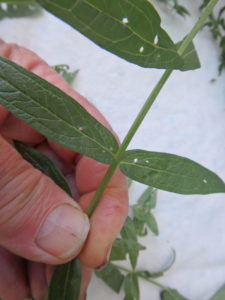
Loosestrife leaves attach directly to the stems and are opposite each other
The beetles will never completely eradicate loosestrife. As loosestrife populations dwindle, so do numbers of the beetles. If the loosestrife starts to spread, the number of beetles rebounds. The bad news? You can’t buy these beetles. I’m not sure why.
Purple loosestrife, like most problem plants, is from another continent – in this case, Europe and Asia. I’ve read that the seeds of purple loosestrife probably came on sailing vessels that used sand or soil as ballast to balance their loads in the 18th century. That soil was dumped on arrival and a few seeds found a foothold. Without any natural predators, the plants spread.
Birds are often agents of distribution of seeds of invasive plants. They eat the seeds, which are often covered with a non-digestible outer coating. The birds get little benefit, and the seeds are distributed to new locations. Waterfowl can carry seeds on their feet. So even if you don’t care about loosestrife on your land, or think it is pretty, be aware that leaving it to bloom and go to seed means that it will spread to other areas. You are doing a service to the environment if you inhibit the loosestrife from spreading.
Storm drains are another vector for spreading invasives, particularly in cities. Rains wash seeds into the drains, which take the water to a river or wetland which then spreads them further. So even if you live in a city, try to rid yourself of invasive plants like purple loosestrife. Each state has a list of prohibited plants that is available, with pictures, on-line.
I was shocked to read that seeds for purple loosestrife on-line. Most nurseries stopped selling them decades ago. And even if a cultivar is listed as “sterile”, I wouldn’t buy any. The chances of non-sterile seeds arriving in the mix are too great. Purple loosestrife is a plant I really don’t want in my garden – or yours!
I am hoping to help lead a Viking River Cruise next June from Paris to Normandy and back with stops along the way – including Monet’s magical garden, Giverny. If there is enough interest, we might have 3 days in Paris looking at gardens there. If you are interested, e-mail me at henry.homeyer@comcast.net.
Learning How to Identify 8 Common Ferns
Posted on Wednesday, August 21, 2019 · Leave a Comment
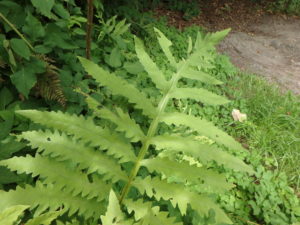
Sensitive Fern
Ferns are under-rated and largely ignored by gardeners, but should not be. They can add much to a garden. I recently went to Walpole, NH where I met with Michael Nerrie of Distant Hill Gardens and Nature Trail. He introduced me to many ferns and also sold me a copy of a wonderful book, Identifying Ferns the Easy Way: A Pocket Guide to Common Ferns of the Northeast by Lynn Levine. It’s published by Heartwood Press.
Unlike other books I have seen that identify ferns, this one doesn’t require you to learn a whole new vocabulary. And the illustrations and layout make learning ferns easy. There are just 28 common ferns in the book, and there are silhouettes of each at the beginning of the book. The silhouettes are divided into 6 groups based on how the leaves are “cut”. So a quick look will identify most ferns, and the straightforward descriptions quickly confirm which fern you are looking at.
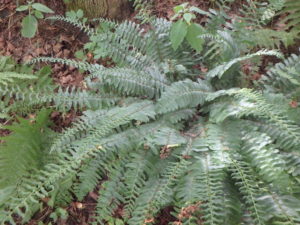
Christmas Fern
Imagine a frond of a fern that is all one big blade or leaf. Then imagine taking scissors and cutting that blade into leaflets. That is Group 1, once-cut ferns. Group 2 includes ferns that are twice-cut, and then divided into 2 groups based on how the fronds (stems) are arranged, either in a vase shape or in a random arrangement. And so on. There are five thrice-cut ferns, five ferns with 3 parts instead of one long blade, and one unique fern, the maidenhair fern which is unlike all the others. Pretty straightforward. Here are 8 common ferns you can easily learn to identify. Quotations below are from Ms Levine’s book.
Group 1: Once-cut
- Christmas fern (Polystichum acrostichoides). Unlike nearly all others, this fern stays green all winter, and has very dark green leaves. It grows in free-form clusters, and has simple leaves. The leaflets have “a little bump (ear) near the stalk” and are 1 to 3 feet long.
- Sensitive Fern (Onoclea sensibilis): Light green leaves. “Leaflet pairs are opposite each other (like a bow tie).” Topmost leaflets are smooth, others have wavy edges. It is very frost-sensitive, hence the name. Often grows in big colonies, either in sun or shade. Can be a pest in the garden as it spreads by root.
Group 2A: Twice-cut, Vase-like clusters
- Interrupted Fern (Osmunda claytoniana). A big fern with fronds up to 5 feet, this will grow in wet or dry shade. When spores are produced, they interrupt the arrangement of leaflets with smaller spore-producing leaflets that are not like the other leaflets. But not all plants will have an interrupted section, so look at a colony to find some that do (to confirm I.D.). The little leaflets that produce spores get dry and turn brown in mid-summer.
- Ostrich fern (Matteuccia struthiopteris). This is the fern that produces edible fiddleheads in early spring. It has a deep groove up the middle of the stem, like celery. Other ferns may have small grooves, but nothing like this. It is big: up to 5 to 7 feet tall, and shaped like a badminton birdy (vase-shaped). It is most common in moist shade, commonly along stream banks, but will grow in shady places in the garden. Can be very dramatic as an accent plant, but does spread.
Group 2-B: Twice-cut, Random placement of stems
- Silvery glade fern (Deparia achrostichoides): Frond is “very delicate for such a tall fern”. Can grow 2 to 3 feet tall. Lowest pair of leaflets point down. But for me, the identifying characteristics is that the spore cases of the leaflets are “arranged in a herringbone pattern on their undersides”.
Group 3: Thrice-cut
- Hay-scented fern (Dennstaedtia punctilobula). If you have crushed this fern and sniffed it, it smells like fresh-cut hay. It is finely cut and stays just 1 to 3 feet tall. It is one of the few that will grow in a hot, sunny location such as a west-facing, sandy hillside, though it will grow in partial shade or rocky slopes. It spreads, and will fill in an area, making a large colony. Sold in nurseries as a ground cover.
Group 4: Leafy parts in 3 distinct sections
- Bracken fern (Pteridium aquilinum). This grows in poor or barren soil in sun or shade. May form large colonies. Grows up to 3 feet tall. The blade (leafy part) is roughly horizontal to ground in 3 triangular leaflets, each with its own stem.
Group 5: Unique
- Maidenhair fern (Adiantum pedatum). This is often sold in garden centers as it is delicate-looking but sturdy and hardy on thin black stems that look like wires. In the wild it indicates good rich soil. The blade (the leafy part) is almost horizontal and is fan-shaped.
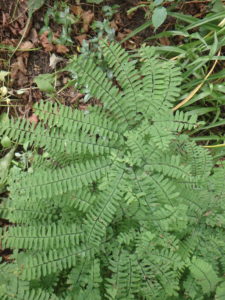
Maidenhair Fern
I found Lynn Levine’s guide easy to use – and it fits in the back pocket of my jeans. At $10.95, it’s a bargain. Distant Hill Gardens is full of wonderful plants to view and buy (including ferns), so pay them a visit. Open select weekends May to October, or by appointment (www.distanthill.org). Lynn Levine’s next fern workshop will be September 29 from 1 to 3:30 at Distant Hill Garden.
Henry can be reached at henry.homeyer@comcast.net.
Tips on How to Plant a Tree Properly
Posted on Monday, August 12, 2019 · Leave a Comment
I recently planted a couple of blue spruce trees on a nice cloudy day, and want to share with you what I did. First, and most important, I checked the position of the trunk of the tree in the pot. In the wild you will notice that trees bulge out at the base, creating what is termed the “trunk flare”. This must be visible above ground after planting.
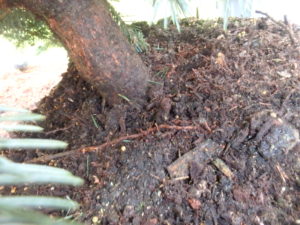
If the trunk shows not flare, you must remove some of the soil
Too often trees purchased at a nursery have the trunk flare covered with soil in the pot. Little seedlings are plucked from the ground and popped into pots without paying attention to the trunk flare. But, if the trunk flare and the bottom of the trunk itself is buried, the tree will not thrive or survive.
Why is this so important? Because unlike the roots, the trunk is not resistant to soil microorganisms that cause rot. Within 6 to 10 years, just when a tree should be well established, the vital cambium layer in the trunk rots and the tree sickens and slowly dies.
If you planted a tree in the past and wonder if you did it right, look at the top of the tree. Trees suffering from trunk flare rot will have few leaves at the top of the tree – what is called tip dieback. And deciduous trees will turn color well before others of the same species in the fall.
If you see tip dieback you may still save the tree. Get a hand tool and gently loosen the soil around the base of the tree. Pull away the soil until you see the trunk flare. The bark may already be rotted, but exposing it and letting it dry out may save the next layer, the cambium. You may need to re-grade the soil around your tree.
Mulch “volcanoes” can be just as deadly as burying the trunk flare. Bark mulch can be full of microorganisms that rot the bark, too. So leave a donut hole around the tree when you mulch – a space three inches or so bare of mulch.
The two spruce I planted came in big plastic pots – 7 gallons each. I tipped the trees over and tugged on the containers. They slid off, but I was prepared to slice them with a sharp knife if need be.
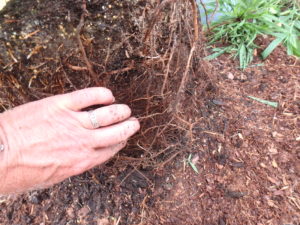
Loosen the roots before planting
Next I examined the roots carefully. Sometimes plants in pots with vigorous roots encircle the pot, and get so tangled up that they don’t easily grow out into the soil. So use my fingers or my CobraHead weeding tool to loosen the roots, especially any bigger ones that circle the root ball. And if I break some roots? I don’t worry much, as it will stimulate new growth.
I always dig a hole that is at least 3 times as wide as the root ball. The hole should be tapered so that it is deepest in the middle, and angles up to the edges. The bottom has to be flat, of course, and the size of the pot. I measure the root ball, and only dig the hole as deep as the root ball. I want the root ball on un-excavated soil so it will not compress and sink down later.
When the hole appears to be the right depth, I place the tree into the hole. I use a rake handle to go across the hole and over the root ball. The top of the root ball should be even with the sides of the hole.
I do not give trees fertilizer, not even slow-release fertilizer. I don’t want to push them to grow fast, as that is not healthy. I do add rock phosphate, which promotes good root growth, and Azomite, a commercial mix of minerals containing micronutrients missing in many soils, but no nitrogen (which promotes green growth).
It is important to have the “good side” of the tree facing the house or wherever you are going to see it from, so I rotate the tree until it is just right. I also look at the tree from the front and from the sides to see if it is vertical. If a tree has a kink in the trunk, that can be difficult to determine.
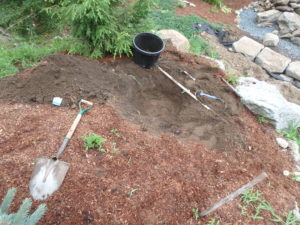
Dig a hole that is wider but not deeper than the rootball
When filling the hole around the tree, I use my fingers to poke soil down into the space around the tree. You do not want to leave air pockets, as the roots could dry out and be damaged. Some people like to fill the planting hole with water before planting a tree, but I don’t like to do that. I’m afraid of causing compaction if the soil is muddy.
Once the tree is planted, I like to build a ridge of soil in a ring around the tree to hold water. This is particularly important if you are planting on a hillside. Before planting on a hillside you need to create a small terrace, of sorts, on the hillside. Do this by digging out some soil on the uphill side of the site and moving it to the downhill side.
Once the planting is complete, I put 2 or 3 inches of bark mulch around the tree to discourage weeds and to reduce water loss by evaporation.
Planting trees at this time of year is fine, so long as you are willing to check the soil regularly to make sure it is not drying out. And hope for rain to make your trees extra happy.
Henry is a UNH Master Gardener, and the author of 4 gardening books. He can be reached by snail mail at P.O. Box 364, Cornish Flat, NH 03746, or by e-mail at henry.homeyer@comcast.net.
How to Grow Kangaroo Paws and Other Less Common Flowers in Containers
Posted on Monday, August 5, 2019 · Leave a Comment
Each summer I fill a big window box with annual flowers and vines to welcome all who approach the house. Some years it is bodacious, other years it verges on ho-hum. This year it is a delight: in the center is a black-leafed sweet potato vine that is surrounded with blue flowers of scavelola and chartreuse vines of licorice plant ( Helichrysum petiolare). All survive in hot and dry locations, and recover from getting dry.
I like to give each plant enough root space, but tend to crowd things a little. A six-inch cube of soil is what I’ve been told is best for potted plants, but plants in my window box don’t get that much space. The key, I’ve decided is to make a blend of potting mix with good compost in equal amounts, and to add a slow-release fertilizer. Straight potting mix has little nutrition for plants, so as the summer progresses it disappears. Of course liquid fertilizer can help with that.
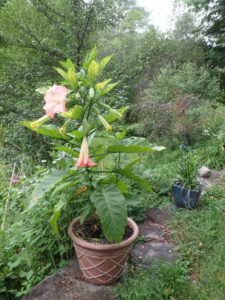
Brugmansia produces masses of huge flowers
This year Cindy splurged and bought a Brugmansia, a large tropical plant that we hope to winter-over in a large pot indoors. It has been displaying an amazing sequence of 12-inch bell-shaped blossoms in a delicate peach color. Other varieties have yellow blossoms. Some varieties of Brugmansia are deliciously fragrant, but ours is not. The plant is in a 20-inch pot and stands 4-feet tall with a main stem, and now two shorter stems. The stems will become woody with time. It is in full sun and needs a drink at sundown after each hot day.
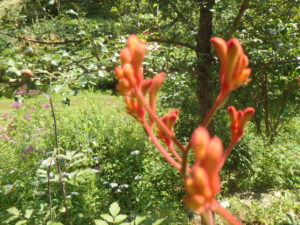
Also in a big pot is a plant I have never before grown: kangaroo paws ( Anigozanthos hybrid ). This is a plant from Australia and does best in a hot, dry location. I have occasionally purchased stems of kangaroo paws from my local florist to add to flower arrangements, so I decided to give it a try. It is doing very well.
Close up of Kangaroo Paws, the buds
Although they come in a variety of colors, the blossoms on mine are orange and really do not look much like flowers. They are fuzzy, and look, well, a bit like kangaroo paws. Eventually the “toes” (buds) produce small flowers. The foliage is similar to Siberian iris, and the flower stems stand up well above it. My flower stems now are nearly 4 feet tall and covered with flower buds. Mine has 2 stems, and a third one developing. It will come inside this winter.
Some years ago many of us suffered the loss of our shade-loving impatiens plants due to a terrible fungal disease. The “Chicken Little” people predicted that although the sky had not yet fallen, we were doomed when it came to growing impatiens. Fortunately, they were wrong. I see it thriving in many places, and I grow it each year in pots to decorate my shady deck. It does not like to be too dry, so I water it frequently in these hot times.
A few years ago I experimented with growing ferns in pots. I dug up two kinds from shady places in my garden: Ostrich fern ( Matteuccia struthiopteris) and maidenhair fern
(Adiantum pedatum). Both did very well on my north-facing deck that gets some morning sunshine, but no afternoon sunshine. I dug them in the spring, which is what I recommend, particularly for the ostrich fern, as the fronds are often 4 to 5 feet long and somewhat fragile.
In the fall, after hard frost, I cut back the fronds and brought the pots indoors. I kept them in a basement that stays around 32 degrees. I made sure they did not dry out too much, but did not want the roots to sit in soggy soil. They both survived nicely and grew again the following spring. Around the ostrich fern I grew some miniature hosta, which also over-wintered.
My mom and grandmother both loved growing red geraniums in pots, and I keep up the family tradition. Now days there are many colors of geraniums, and some with green and white leaves, but I go for the old fashioned ones. Of course you probably know that geraniums are not geraniums at all, but of the genus Pelargonium. Geranium is a genus of perennial flowers that are quite different. That’s why scientific names are all in Latin, so there will be no confusion.
Geraniums like full sun, and do not need to be watered every day, even in full, hot sun and fast-draining soil mix. If your geraniums don’t get enough sun, they will develop long, leggy stems and fail to flower well. But don’t give geraniums lots of fertilizer, as that will inhibit flowering, and promote long stems, too. I bring them in each fall and keep them as houseplants in a sunny, west-facing window. Even so, they get leggy and I cut them back hard in the spring.
Swedish Ivy is not a trailing vine but an upright plant
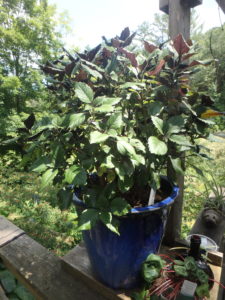
Last year a friend gave me a nice big potted plant with green leaves that are a deep purple, almost a black, on the underneath side. In the late summer it produced stems loaded with small lavender flowers. Its tag gave its name as Plectranthus ‘Mona Lavender’.
I looked it up for a common name and was surprised to see it is called Swedish Ivy. But it is not an ivy at all, but a robust vertical plant almost 2 feet tall and wide. I place it on the railing of my deck, as it is important to be able to see the underneath side of the leaves, which contrast so well with the dark green top sides. It gets morning sun and requires moderate watering. I overwintered it as a houseplant, cutting it back in the spring.
Each year I resolve to have fewer houseplants, but each year I get more as I try new things for my deck. I guess I’ll just have to build a sun room!
Henry Homeyer is a garden consultant, coach, and author of 4 gardening books. He can be reached at
henry.homeyer@comcast.net.
July Beauties in the Flower Garden
Posted on Thursday, July 25, 2019 · Leave a Comment
Prairie Sun
Every day in the warm months I take time to wander through my garden, often with camera in hand. I am always greeted by flowers in bloom that make my heart sing. Here are some blooming for me now, including a few you might not grow – or not yet. I include the Latin names of plants, as common names vary from region to region.
Astrantia does fine in partial shade
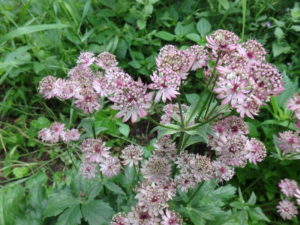
Great masterwort (Astrantia major) comes with flowers ranging in color from white to lavender to reddish-purple. Its flowers are dome-shaped umbels (shaped like the stays of an umbrella). In ordinary garden soil it needs some shade, but in moist soil it will thrive in full sun. The leaves are tidy and stay in a nice clump a foot tall and 18 inches across; blossom stems can reach 2-feet tall, It is a good cut flower.
I have planted 4 species of milkweed to attract pollinators and to support our monarch butterflies. The monarchs (or their mimic, the Viceroy) were out recently and swooping around as singles or in pairs, perhaps in a mating dance. The swamp milkweed (Asclepias incarnata) is in full bloom now and the 5 plants I planted last year make a handsome 4-foot tall hedge topped with white flowers. I have it in full sun with moist soil, though it will thrive in ordinary garden soil.
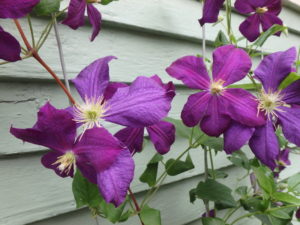
Clematis jackmanni
On the front of the house I have a vine climbing up 10 feet or more on wires I installed for it. Currently it has 50 or 60 deep purple blossoms, each three to five inches across. It is a clematis, a species called Clematis jackmanii. Like all clematis, it does best with plenty of hot sun, but needs shade on its roots. I have tall perennials growing in front of it to accomplish that. Jackman’s clematis, as Latin-name-adverse gardeners call it, is one of the hardiest of all – easily surviving winter temperatures to 40 below.
You probably have grown that lovely purple-pink biennial foxglove that blooms in its second year, and then dies (Digitalis purpurea). I love it and spread the seeds after it blooms to get a few new babies the following spring. Mine are just now coming into bloom. But there are also a couple of perennial foxgloves, including a nice yellow one that is just finishing up its bloom period for me now. It is simply called yellow foxglove or Digitalis grandiflora. It does well in partial shade in rich, well-drained soil. It may re-bloom if you cut off the flower stalks after blooming. On the other hand, if you leave the stalks and seed pods, you may get more plants next spring. The other perennial foxglove I have grown is the small yellow foxglove, D. lutea, though it has been less long-lived than the larger one.
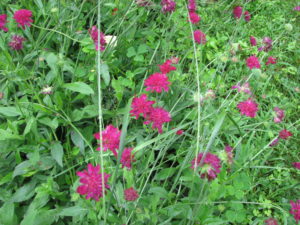
Knautia
One of my favorite perennials is called knautia (Knautia macedonica). I love the wine-red, domed, one-inch flowers on thin stems that seem to float above its foliage, or the foliage of nearby plants. It drops seeds and volunteers show up, which is a good thing as it is not as long-lived plant. It does fine in full sun and ordinary soil. It is not common in garden centers, but if you see it, buy it!
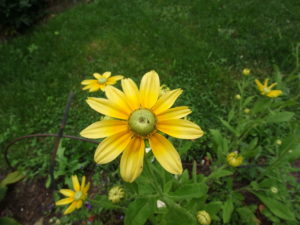
Everyone has some black-eyed Susans (Rudbeckia spp.), either those you planted or as wildflowers along your fence line. They are tough and cheery. But I also have a named variety that is my favorite, ‘Prairie Sun’. Prairie Sun is not black-eyed, but green-eyed. It blooms prolifically from now until mid-October or even later. Although it is sold as a perennial, my experience is that it usually dies during the winter, though some plants do last 2 or 3 years. I grow it in full sun, a hot and dry location. It is hard to find as a plant, so you may want to start some from seed next spring.
Another great plant that I have only had in recent years is betony (Stachys monieri ‘Humelo’). Unlike the well-known lamb’s ears (Stachys byzantina), this does not flop, and the flowers are fabulous. The flowers are a pinkish-purple in a bottlebrush arrangement on nice stiff stems – perfect for cutting and using indoors in a vase. The leaves are a deep green and look good all summer in a nice tidy clump. Flower stalks stand up about 18 inches tall.
Annual poppies are blooming right now, and all of mine are self-seeded. I have planted them on either side of my brick front walkway in the past, but this year I just let them show up. I have the common orange one, the yellow California poppy, a double red one and one called ‘Ladybird’ that I bought as a six pack last year. Ladybird is a light purple with some large dark purple spots inside.
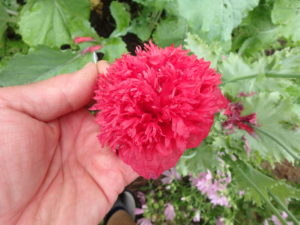
Double poppy
A few poppies seeded themselves between bricks in the walkway and bloomed! Save seeds this year if you have them, and sprinkle them on loose soil in the fall after cleanup, or in the spring. I have even sprinkled them on the snow in winter and gotten them to grow in spring.
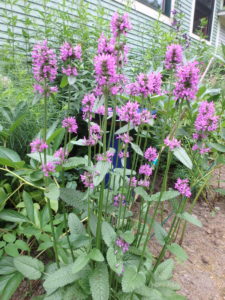
Betony is a good cut flower
And speaking of sowing annuals, I got a great mix of wildflowers from Renee’s Garden Seeds this year. I made a bed perhaps 5 feet by 2 feet and sprinkled the entire seed packet on the soil in the spring, just lightly covering the seeds and patting down. I now have a mass of color, mainly annual blue campanula and yellow calendula, with a few annual poppies. I like broadcasting annual flowers, letting them pop up in a random pattern, and have done it with zinnias and cosmos to great success. And if I save seeds, I can make my own mix.
Henry is a UNH Master Gardener and the author of 4 gardening books.
Weeds? Why Worry?: One Farmer’s Perspective
Posted on Thursday, July 18, 2019 · Leave a Comment
I recently went to Cochranville, Pennsylvania to visit relatives, and they brought me to visit a successful farm-to-table farmer. I learned some new and interesting ways of looking at gardening, and I think they are worth sharing with you.
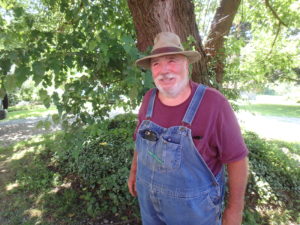
Glenn Brendle farms organically and tries many unusual techniques
For the past 40 years or so Glenn Brendle has expanded his operation until now it encompasses about 40 acres of veggies. He grows everything from herbs, tomatoes and squash to dent corn, celery root (celeriac) and parsnips. He pays his 9 employees a living wage and does well for himself.
This spring the weather has been challenging for farmers in his part of Pennsylvania. The rain has been above average, sometimes falling 8 inches in a week. That is good for weeds, but not so good for farmers who want to have “clean” fields that look good from the road. “”Generally you don’t have to keep your fields as clean as people think. A lot is cosmetic,” Glenn told me.
Wet soils mean that he cannot use a tractor to control weeds, and some days even farm workers cannot trudge through the mud to hand-pull them. Fortunately, Glenn is not hung up about looks – he is more interested in growing high quality vegetables that he can sell to high-end restaurants.
Since Glenn grows organic vegetables, he cannot use pesticides to control weeds, or use genetically modified seeds. He depends on using a tractor or tiller to cultivate the space between rows to chew up the weeds, or hand pulling them.
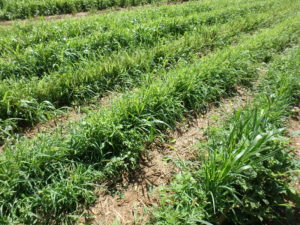
Carrots compete well with weeds and grasses here
He explained to me that if a row of carrots, for example, is clear of weeds on two sides, it is not too important if there are weeds in the bed with the carrots. This goes against everything most of us have been taught. But he pulled a few carrots to show me that they can compete with the weeds, and assured me that at harvest time they would be long and handsome.
In some fields we visited the weeds were taller than the vegetables. Glenn explained that the important thing is to prevent weeds from making seeds and dropping them in the soil. As soon as the fields dry out enough he will run a tractor with an attachment to mow over them with the blades set at a height that will top the weeds, but miss the vegetables. He suggested that home gardeners could accomplish that with a string trimmer.
Part of the reason his carrots and other crops can compete with weeds is that Glenn has worked hard at improving his soil every year. Among other things, he is a firm believer in the use of biochar.
Biochar is soil amendment from the partial burning of organic waste matter including branches or wood chips, leaf litter and dead plants. It is burned in a reduced-oxygen environment in a controlled process called pyrolosis, and results in a substance that resembles charcoal. It is available on-line, and from some garden centers.
Biochar is very stable – it can sequester carbon and store it for hundreds of years, or even longer. It is very porous with the innumerable small spaces available to hold bits of compost and microorganisms. Glenn mixes biochar that he makes himself with biologically active compost in water, allowing microbes to settle into the pores of the biochar. He spreads the mixture on the soil before planting. He believes that when a disease-causing microbe comes along, there is usually has a microbe that will inhibit its growth. And a healthy plant can compete with weeds better than a struggling plant.
What else did I learn? I have always insisted on keeping tomato plants off the ground, and most commercial farmers do so, even though that is a very labor-intensive and expensive to do. I use cages (54-inch, 4-legged heavy wire supports) for my tomatoes, or I tie them to wood stakes. But Glenn does not support his tomatoes. He lets them sprawl on the ground, sometimes smothering the weeds beneath them. Huh. He says his tomatoes do just fine.
Glenn grows lots of potatoes and says the best one he grows is a Dutch variety called ‘Bintje’. It is an early- to mid-season potato with yellow skin and flesh. It is resistant to some potato diseases, notably potato virus A and leaf-roll virus. It is susceptible to scab, however. Apparently it is the most commonly grown potato in France and Belgium, and was introduced for sale in 1910. He says it is the absolute best potato for making fries.
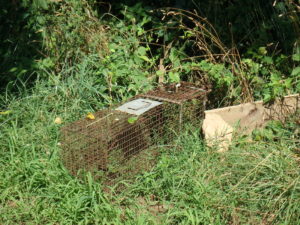
Boards guide woodchucks to the trap
Woodchucks can do a lot of damage but Glenn has figured out how to trap them. He places a large Hav-a-Hart near a woodchuck’s hole and uses 2 wide boards about 5 feet long and 10 inches wide to create a V-shaped chute leading to the open mouth of the trap. He doesn’t bother with bait. He said that they don’t see well, but will approach the trap and enter it as a way to proceed to the field. Clunk. The cage closes.
The old saying goes, “There is more than one way to skin a cat.” So I will try a little of Glenn’s methodology. I will remove the cages from 3 of my tomatoes and stop weeding around them and see how they do. I’ll experiment with biochar, but I hope I won’t have to try his woodchuck trick. I’ll report back at the end of the season, so stay tuned.
Henry is the author of 4 gardening books. He lives in Cornish Flat, NH.
Garden Thugs to Love or Hate
Posted on Thursday, July 11, 2019 · Leave a Comment
I’ve never subscribed to the old saying that “Children should be seen and not heard.” So it shouldn’t surprise you that I don’t insist that all the flowers in my garden stay in place each year, and that those that
do wander are not necessarily disciplined with a weeding tool. No, I recognize that rambunctious plants have a place in my garden, even if they wander from their assigned seats. Let’s take a look at a few.
Just coming in to bloom for me right now is pink or hollyhock mallow (Malva alcea). Each plant presents lots of bright pink blossoms over several weeks that are about 1½ inches wide. She is generous, offering babies that mysteriously pop up all over my garden. There is a big clump blooming in my vegetable garden right now that I definitely did not plant.
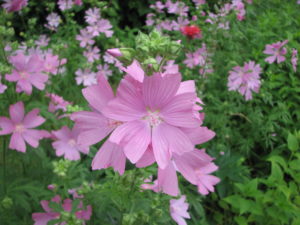
Pink mallow
Pink mallow grows to be 3 to 4 feet tall and 18 inches wide when grown in full sun. It is drought tolerant and not fussy about soil. It does tend to flop, however, so it often needs to be staked. It has a fleshy root and hates to be moved except when very young.
Beebalm (Monarda didyma) is one of my favorites, despite the fact that it spreads by root and cannot be contained. The blossoms are large and fragrant, and it is an excellent cut flower.
Beebalm is a tall plant (mine are 3 to 5 feet tall) on square stems. I have it planted up against a rock wall and fronted by a lawn, so it is contained on 2 sides. A lawnmower is a very effective tool against the spread of any flower. The good news is this: it is very easy to pull out volunteers.
Many gardening books list beebalm as a “full-sun” plant. My books do not. I recommend planting it where it gets morning sun only. I have found that full sun dries it out too quickly and reduces its bloom time and beauty. Hot afternoon sun is often too strong for this plant, particularly in sandy soils. For me it grows and blooms in quite shady places, and loves moist soil.
The “common” orange daylily (Hemerocallis fulva) is frequently disparaged by gardeners, but not by me. It really will grow anywhere, in any soil and is not deterred by bugs, slugs or predatory herbivores. Or at least not in my experience. I once dug out a clump from a flower bed at the end of the day and dropped it on the lawn. At the time I was an electrician working long hours all week and gardening only on weekends. By the next weekend it had dug its fingers into the soil (Okay, its roots) and I left it there. Now 20 years later it is still there and beautiful when it blooms.
The fancy varieties of daylilies stay in a nice clump that get bigger each year, but don’t really spread. The orange one does spread by root, and can be difficult to contain. But I have some growing right by the road in shade and truly awful soil, and they will be blooming shortly. I also have a double orange that spreads by root, but is a bit flashier.
Giant fleeceflower
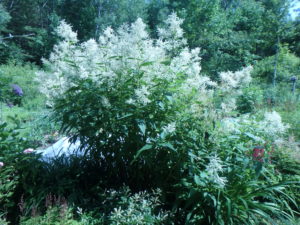
A plant you might not know is giant fleeceflower (Persicaria polymorpha). It is quite wonderful – it can get to be 8 to 10 feet tall with white fleecy flowers that persist much of the summer . It thrives in full sun and moist soil, but will grow almost anywhere.
Why might some consider it a thug? It gets bigger and the clump gets wider every year. And if you do not discipline it, it may well steam-roller favorite plants nearby. It has an amazing root system that will challenge most gardeners. So be sure you have a 6- to 8-foot wide space for it to dominate.
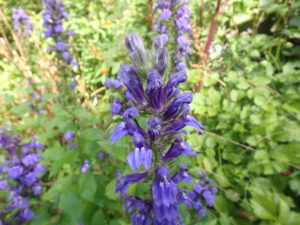
You probably know lobelia as a short annual plant (Lobelia erinus) that has intense blue or purple flowers and will bloom even in shade. Or perhaps you grow cardinal flower (L. cardinalis), a tall bright red, late-summer bloomer in wet places. But it has a cousin in the same genus that is a perennial with a wanderlust. Great blue lobelia (Lobelia siphilitica) is a great plant that moves around my garden at will. And I let it grow wherever it shows up.
Great blue lobelia
Like cardinal flower, great blue lobelia is a vertical plant with blossoms along its stem. It stands about 2 to 3 feet tall and blooms in August. It does well in moist soil, but I also find it in hot, dry places. It pulls easily if it grows where you don’t want it. There is also a white form, but it is not a clean white.
I know that many gardeners love lily-of-the-valley (Convallaria majalis) for its sweet fragrance. I consider it a thug as it spreads by root and is hard to remove. I was recently given one with striped green and white leaves, and have planted it in a raised wood-sided bed so I can see if it tries to take over. The foliage is very attractive, and generally plants with white in their leaves are less aggressive. If it behaves well, it will earn a spot in my garden.
Each of us has a different level of acceptance for flowers that spread or move around. I love the spontaneity of many of the flowers I mentioned here.
Henry can be reached at henry.homeyer@comcast.net. He is the author of 4 gardening books.

 Click Here to buy from Cobrahead