A Dozen Sweet-Smelling Shrubs
Posted on Tuesday, July 2, 2019 · Leave a Comment
Lilac season is about over. For the lasts two weeks I have been enjoying the amazing fragrance of ‘Miss Kim’, a species lilac (Syringa patula) with light purple blossoms. It was sold to me some 25 years ago as a dwarf lilac, but it is not. It’s just slow-growing. Mine is now 10 feet tall and wide. It was loaded with many hundreds of blossoms, and I was able to smell its fragrance from across the garden.
I have a gardening friend, Nelia Sargent of Claremont, NH, who specializes in fragrant plants. She is blind, so she cannot see their blossoms; she grows them, in part, because she loves their scent.
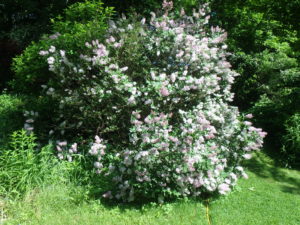
Miss Kim lilac
I called Nelia and asked for her list of fragrant shrubs. She told me that her goal is to have fragrance in her house and garden from spring until fall. “And I don’t want to have to put my nose in the flowers,” she said. “I want to smell them from 5 or 10 feet away, or even further.”
So she and I put together a list, roughly in sequence of bloom times. We agreed that even a shrub that should be fragrant, isn’t always sweet-smelling. So we recommend buying for fragrance when the plant is in bloom.
The earliest on Nelia’s list is a spring-blooming witchhazel (Hamamalis vernalis), one called ‘Arnold’s Promise’. It is hardy to Zone 4, but I have never grown it, but will. She has it and says it blooms in late winter. The frilly yellow blossoms are infused with red, and it is highly fragrant. She cuts blossoms and brings them in the house when snow is still on the ground, and they last in a vase for up to 2 weeks.
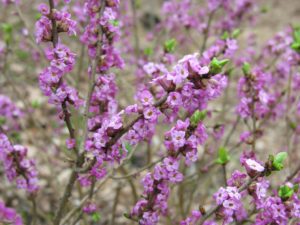
Close-up of February Daphne
Next comes February daphne (Daphne mezereum). I’ve had this for over 15 years, and like it so much I named my little corgi after it. It has nice sweet pink blossoms that bloom in April. Mine rarely needs pruning and is still not 5 feet tall and wide. Mine was winter damaged this year for the first time ever. I like to cut stems in March and bring them in to bloom indoors.
Then come the Viburnums. Many are fragrant, some very fragrant. Three that Nelia likes are Viburnum judii, V. carlessii, and V. burkwoodii. Many viburnums are susceptible to the viburnum leaf beetle, which can defoliate a shrub in a week or less. Nelia told me she has not had a problem with those three. Birds love the berries viburnums produce.
A nice fragrant understory shrub that I grew up with in Connecticut is spicebush (Lindera benzoin). Its flowers are negligible, but its leaves are fragrant. I learned this as a boy, pulling off a leaf and noticing the strong scent. As a teenager I chewed on the twigs, using them as a breath freshener! I was able to find one for sale and have been growing it in dry shade for 3 years now.
Nelia mentioned fothergilla (Fothergilla major) as a fragrant shrub with a pleasing subtle scent. I’ve grown it for 20 years or so, and love it for the white, bottlebrush flowers in May and fabulous fall leaf color; but I have never noticed the fragrance. Mine might be the exception, and once again proves it important to buy things in bloom if you want fragrance.
All lilacs have nice fragrance in bloom, I think. Nelia was once asked to judge their scent for the Arnold Arboretum at Harvard. She determined that there are at least 20 different lilac fragrances in their collection. If you select early, mid-season and late-blooming lilacs, you can have 5 weeks of fragrance and blossoms, she said.
Nelia Sargent noted that the Japanese tree lilac (Syringa reticulata) is very fragrant, but that it should probably be considered an invasive and not planted. Seeds are spread by birds, and this stranger from a foreign land can out-compete many of our native understory plants. The gardeners at Saint Gaudens National Park have observed this, and actively remove them whenever they see them.
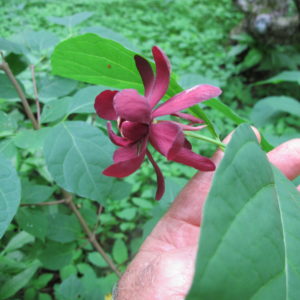 Carolina allspice or common sweetshrub (Calycanthus floridus) has been blooming for me since mid-June and has lovely deep wine-red flowers; it prefers a shady spot with rich moist soil. Although Nelia considers it fragrant, mine is not, or just barely. Still, a shrub that blooms in shade is always welcome in my gardens.
In August there is summersweet clethra (Clethra alnifolia). Nelia says a pink variety called ‘Ruby Spice’ is very fragrant. I have the wild white one, and it is fragrant, but not very.
In late August or early September the seven-son flower tree (Heptacodium miconioides) tree blooms. It is a very fast-growing tree – branches can grow 5 to 7 feet in a single season, but it slows down some when it reaches its full size of 25 feet tall or so. Mine has a pleasant, but not overpowering scent.It has wonderful exfoliating bark that is splendid in winter.
This list of fragrant shrubs cannot include them all. Mock orange, for one, is very strong smelling. Some rhododendrons are fragrant, particularly the native swamp azalea (Rhododendron viscosum). Please write me if you have a favorite I have neglected to mention. Perhaps I need to grow it!
Write Henry at henry.homeyer@comcast.net or P.O. Box 364, Cornish Flat, NH 03746. Please include a SASE if you wish a response by snail mail. Henry is the author of 4 gardening books.
Flowers in Bloom That Make Me Want to Swoon
Posted on Friday, June 28, 2019 · Leave a Comment
My earliest memory of a flower dates back to spring, 1948, when I was just 2 years old and living in Hingham, Massachusetts (we moved away that fall, so I know the year). My mother, sister and I were walking through a pine woods when we encountered a cluster of pink ladyslipper orchids. I was enchanted. I wanted to pick it. My mom restrained me, saying it was a rare and special flower. I am still overwhelmed by their beauty, and feel lucky I can grow 2 kinds of ladyslippers.
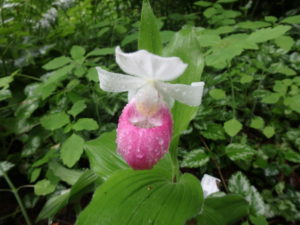
Pink showy ladyslipper
There are 3 main types of ladyslippers that grow in the Northeast. A yellow ladyslipper (Cypripedium parviflorum), the pink one that I saw when young (Cypripedium acaule), and a bigger pink one called the showy ladyslipper (Cypripedium reginae). I grow the yellow and the showy.
The pink ladyslipper is tough to grow – it requires very acidic soil and is nearly impossible to transplant. In the wild I have only seen them in sandy soil under white pines.
The yellow and showy ladyslippers do fine in moist, rich soil and moderate shade. It is now possible to buy them at specialty nurseries. Some nurseries grow them and divide big clumps to sell individual plants. Starting any ladyslipper by seed is generally considered nearly impossible.

Primula japonica
What other flowers now in bloom make my heart go Ka-Boom? My Japanese primroses, also called candelabra primroses (Primula japonica). I’ve grown these in the shade of some wild apple trees where the soil is rich, black and moist. Starting with just 7 plants, these have dropped seeds and self-planted so that I now have hundreds after 20 years. They are finishing up their bloom cycle now.
Candelabra primroses range in color from a deep magenta to medium pink to nearly white. They bloom up their stalks, presenting a ring of florets, then a second, third and sometimes even a fourth or fifth set of blossoms. Because they don’t all bloom at once, they flower for up to a month, depending on the heat.
Then there are the peonies. I have one, a division of my grandmother’s favorite, called ‘Festiva Maxima’. Grandmother died in 1953, and my mother dug it up and brought it to my childhood home. Then in the 1980’s I dug it up, divided it and brought some of it to New Hampshire. It is a double white with a speck of red in the middle. What makes it so special is the fragrance. It is enough to make the weak-hearted swoon.
If you don’t have a peony, or don’t have several, go buy one now when you can see the blossoms and judge the fragrance. Not all peonies have fragrance. Be sure not to plant it too deep. The ‘eyes’ or growing points need to be within an inch of the soil line. Otherwise they will grow and look healthy, but fail to bloom. Plant them with plenty of compost and some organic fertilizer added to a large planting hole.
I love roses. For ages roses bloomed mostly in June and suffered from black spot, Japanese beetles and other difficulties. No more. You can get roses that require no chemicals to stay healthy and bloom much of the summer. The only problem is that most of these modern hybrids have little or no scent.
Of the modern hybrids my favorite is the “Knockout” series. I have had singles and doubles, and find most are as hardy as a shovel (though much prettier). And I’ve had them bloom all summer and past Halloween.
But what I really love are the old fashioned roses. Many of them send up side shoots from the ground that can be dug and passed on. I have two of these, and I don’t know their varieties. I have a double white and a double pink, both with lovely scent. And despite the fact that I am an organic gardener who doesn’t spray them, they seem to stay free of pests and diseases.
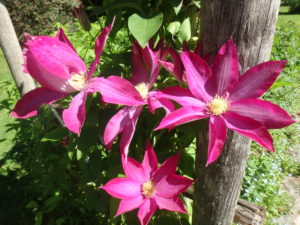
Clematis
I grow 5 kinds of clematis, and all are wonderful. Most clematis die back to the ground each winter, and start up in spring, though a few have hardy vines. Most grow 6 to 10 feet in length and need something tall to climb up. They have big, bodacious blossoms. Most are not particularly fragrant. They bloom in shades of pink and purple, along with white. The two I have in bloom right now have flat 6-petaled blossoms 4 to 5 inches in diameter. The most durable and vigorous is a purple one called Clematis jackmanii.
The trick to succeeding with clematis is to remember the old adage, they like “hot tops and cool bottoms.” The vines need to be in full sun, or full afternoon sun, and the roots need to be shaded. Plant something right in front of the clematis to help keep the roots cool.
June really is the best month for flowering plants. All those I mentioned above – and dozens of others – grace us with their presence. Go to a good family-run nursery where the staff really knows the habits of the plants and can tell you about each one. Most really enjoy educating you about the flowers, so ask questions. Of course, the best teacher is experience. So go get some new perennials and enjoy them.
Henry is a UNH Master Gardener, and the author of 4 gardening books. He lives in Cornish Flat, NH.
7 Things to Do to Improve Your Garden – and Your Life!
Posted on Tuesday, June 18, 2019 · Leave a Comment
If you’re like me, by now you have your garden planted, both vegetables and flowers. It seems like a good time to take a deep breath, pour a cold glass of your favorite beverage and watch the flowers perform. I have set up chairs by my Japanese primroses for viewing, and have invited friends to come see them and relax. But wait! There is still a lot to do, and you can make your life easier with some work now. Here are 7 garden activities I recommend.
- Weeds in the vegetable garden are little now, and easy to pull. Take 20 minutes a day – or twice a day – and just weed. All my weed-free beds are sprouting weeds, but the roots are small. It’s important to loosen the soil a little before pulling weeds. If you don’t do that and you hear a snap, you have broken a root. I like a CobraHead weeder for loosening the soil because it has a single tine, and is very precise.
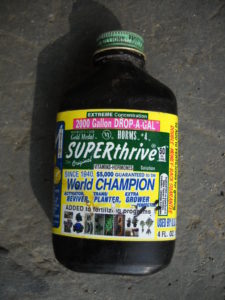
Superthrive is great for reducing transplant stress
If you are weeding in a bed with small seedlings – lettuce, for example – you may end up pulling up seedlings, too. Re-plant immediately, and water. I use an anti-stress liquid called Super Thrive, just a quarter teaspoon in a gallon of water, after weeding. It helps plants recover from having their roots disturbed. It has plant hormones and seaweed extracts, and I find it very effective.
- I like to mulch after weeding, and after the soil is nice and warm. If the soil is still cool and wet, wait for a few days of hot sun before mulching. Roots like to be warm.
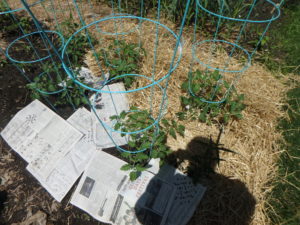
Mulching tomatoes with newspaper and straw
My preferred method of mulching is to put down several layers of newspapers around big plants like tomatoes, and in walkways. Then I cover it with straw, leaves I saved last fall, or even mulch hay. Mulch hay has seeds, but the newspaper keeps the seeds out of the soil pretty well. Leaves are the best, but always in short supply.
- Protect your tomatoes. Put tomato cages around them. They need to be kept upright, but will flop if you don’t support them. Get the 54-inch cages with 4 legs, not 3 legs. Tomato diseases are generally soil borne, so mulch the soil with grass clippings, leaves or straw to prevent splash-up.
This year I am trying an experiment with a biological control for blight on tomatoes. There is a bacterium, Bacterium subtilis, that feeds on fungi. It is now available as a commercial spray called Serenade. I have sprayed half my tomato plants with Serenade and marked them with labels. According to the directions, I will need to spray once a week. I will report back if I see a marked difference.
- Find and utilize unused spaces, both in the vegetable garden and flower beds. If you planted a few nice perennials this year, you probably left space for them when they get big. Instead of depending on mulch to fill the space, plant some annuals.
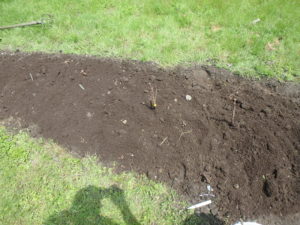
This newly plant raspberry patch has plenty of room for lettuce
The same works in the vegetable garden: Tomato plants won’t be big for another 4 to 6 weeks. Grow lettuce around them, and eat the lettuce before they get shaded out. Spinach and radishes are good candidates for those spaces, too.
- Think about cutting off branches of trees that are now shading out your gardens. Or remove trees altogether. I love my trees, but find they are interfering with my flowers and veggies that like full sun. I removed several large branches from a pear tree this winter because it was shading my peonies. You can do that now, too.
Weed trees like box elder and poplars should be the first to be removed. They pop up and get big before you know it. Elms will grow for 25 years or so, then die from Dutch elm disease, so I cut or yank those any time I find them on the property.
- Thin root crops like carrots, beets, rutabagas and parsnips. By the Fourth of July all those should be 1 to 2 inches apart. Carrots will compete with their brothers and sisters just like they do with weeds – and suffer.
- I don’t want to sound like Anne Landers, but get a gardening partner to help in the garden. It works for me! My life partner and sweetie, Cindy Heath, has lived 6 miles away for the past 10 years. But now she has moved in so we garden together here, instead of having 2 gardens.
If you already have a husband or wife, some re-training may be needed. Pavlov had it right: Make brownies or give back rubs as a reward for help in the garden. Soon there will be no more weeds!
Henry lives and gardens in Cornish Flat, NH. He is the author of 4 gardening books.
Weeds to Worry About, and What to Do About Them
Posted on Tuesday, June 11, 2019 · Leave a Comment
There are weeds to worry about. There is even one that I fear. But most weeds are just a nuisance and can be managed relatively easily. Dandelions, for example, are bright and cheerful. If they were named daffodil instead of dandelion, we would pay good money to have them in our lawn, returning each year and re-blooming after being mowed.
Yes, dandelions spread seeds willy-nilly on the wind. But if you pull them from your vegetable plot or flower beds when they are young, and after a good rain, you can keep them under control.
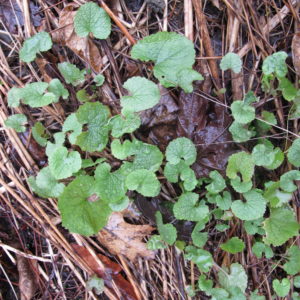
First year garlic mustard leaves
Let’s start with the worst weed: garlic mustard (Alliaria petiolata). I fear its arrival in my garden. This weed is a biennial, flowering in its second year and then dying. It is relatively easy to pull. So why worry? This plant exudes a chemical that kills the beneficial fungi that coat the roots of our maples, oaks and other hardwoods. Our trees depend on these mycorrhizal fungi to get minerals from the soil. Without the fungi they decline, and eventually die. This is not a quick death, but our forests are in danger if this invasive weed is allowed to spread. Garlic mustard also inhibits the seeds of many native wildflowers from germinating. I don’t have it, but fear it.
So what can you do? Learn to identify it, and then work hard at pulling it. In the first year it produces a low rosette of rounded leaves with scalloped edges an an indentation at the stem. The second year it sends up 18- to 36-inch flower spikes with pointy, heart-shaped leaves with jagged edges. The small white flowers have 4 petals and bloom in clusters about an inch or more in diameter. One plant can produce about 4,000 seeds. And although about 70% of the seeds will germinate the next year, some will remain viable in the soil for up to 10 years.
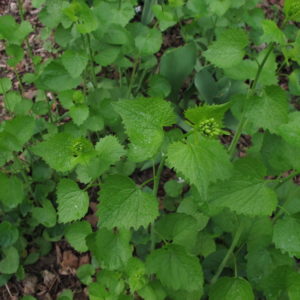
Garlic mustard leaves
Pulling garlic mustard is easy – and satisfying. Do it now, before the flowers produce seeds. I find a CobraHead weeder is good for loosening the soil and helping me get the roots. But you will have to keep on doing this every year for 7 to 10 years. That’s why the weeds so often win the battle with us – we give up. And do not throw the plants into your compost! Bag and send to the landfill or incinerator.
Another nasty weed is called goutweed (Aegopodium podagraria). There are 2 forms: an all green variety and a green and white variety often called ‘Snow on the Mountain’, which is sometimes sold by garden centers (though it should not be). The green and white one is possible to control, but the all green one is almost impossible to eradicate. I got goutweed when a friend gave me some iris with roots of it mixed in. The long white roots are insidious –they break easily and a scrap will generate a new plant.
Again, know the plant and recognize the roots. If you buy plants at plant sales, I recommend you bare-root the plants before planting. Look for thick white roots that are not from the plant you bought. Bare-root by removing all soil with a hose and carefully inspecting the roots. Do that in your driveway, not in the garden as scraps of root can start a disaster, so clean up the scraps carefully.
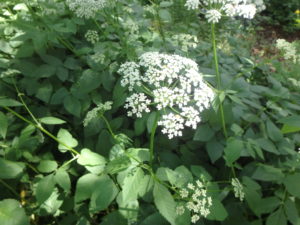
Cutting off goutweed blossoms prevents seed germination
Goutweed grows 12 to 24 inches tall and sends up stems with compound leaves: At the tip of each stem are 3 leaflets; two pairs of leaflets grow below that. Soon it will send up white flowers a bit like Queen Anne’s Lace. The roots spread fast and far. You can try to smother it with black plastic and mulch, but in my experience it just runs out from under the plastic before long.
Horsetail or Equisetum is a beautiful weed: very fine leaves arranged in whorls around a central stem. It has been growing for about 100 million years – perhaps it was fodder for dinosaurs. Instead of seeds, it produces spores. It can be quite persistent and difficult to eradicate.
Digging it and removing horsetail roots helps, but changing the soil type can be a big help. It tends to grow in compacted acidic clay soil. But according to one farmer I discussed it with, adding compost and limestone will make it less of a problem and other plants will compete with it better.
There are good weeds, too. Plantain (Plantago major) may use its broad leaves to smother grass in the lawn, but if you are stung by a bee you can reduce the pain by rubbing a leaf on the sting. It has been used as a medicinal for hundreds of years for a variety of ailments.
Chickweed (Stellaria media) blooms early when lady bugs need food before aphids appear. They survive on the pollen. It is shallow-rooted and easy to pull up.
Purslane (Portulaca oleracea) is a fleshy-leafed weed that prefers sandy fertile soil but will grow most anywhere. Like some other weeds, the flowers can produce seeds in the compost pile – or in a pathway after being yanked out. It’s virtue? It is edible. It can be used in salads, sautéed, or boiled. Every part of the plant is edible.
The bottom line? You can mow the weeds to reduce their vigor and their ability to produce seeds. You can smother them with a barrier and mulch. Or you can do it the old fashioned way: digging them out with a fork and a good weeding tool.
Henry lives and weeds in Cornish Flat, NH. Contact him at henry.homeyer@comcast.net. He is a UNH Extension Service Master Gardener and the author of 4 gardening books.
Tips for Building Raised Beds for Your Garden
Posted on Tuesday, June 4, 2019 · Leave a Comment
As an avid gardener I am always looking for new places to plant. I own a couple of acres of land, but over the past 49 years I’ve filled virtually every square inch of useable space with something – vegetables, flowers, trees and a little lawn. Recently I built a wood-sided raised bed to give me more room for flowers.
Raised beds are good for many reasons:
- The lawn can’t so easily creep into them.
- You can design/blend the soil to be anything you want – sandy, rich or heavy; acidic, neutral or alkaline.
- They drain well, even if built over a soggy base.
- You can place them on the lawn without needing to remove the sod (it will die off).
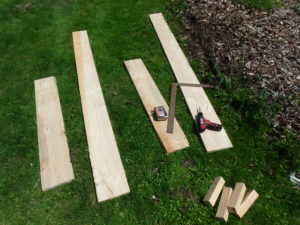
Materials for making a garden box
I built a raised bed recently using rough sawn hemlock I bought from a local sawyer. Rough sawn must means that the wood is cut, but not planed. So a 1”x 8” plank is a full inch thick, not the ¾ inch that you would get at a lumber yard or home center – and hence stronger, and longer lasting.
Hemlock is full or resins that resist rot. It is not as good as cedar, but it is much cheaper. You can buy planed cedar that is a full inch thick, it is called “five-quarter”, and is available at most places that sell lumber. But it’s pricey. You can use plain old pine boards from the lumber yard, but they tend to rot sooner.
Then there is pressure treated wood and synthetic boards made from re-cycled pop bottles that is said to last 50 years or so. Years ago pressure treated wood leached arsenic into the soil, but newer technologies have eliminated that as a problem, I have read. Still, I am personally leery of using it for any food or herbs. I try to avoid chemicals whenever possible.
What size bed should you build? That depends on your space and the reach of your arms. I am relatively tall, so I made my bed 4 feet wide. Smaller people might be more comfortable weeding or planting a bed that is just 3 feet wide. I made mine 8 feet long, but 10 feet or even 6 feet might suit you – or your space – better.
Here’s how I built mine: I cut 2 hemlock boards 8 feet long for the sides, and 2 boards 4 feet long for the ends. Then I cut a piece of wood 2 inches by 2 inches into 8-inch long sections, 4 of them. You can use a 2-by-4 instead of 2 by 2 if you have one.
Instead of using nails I find it easier to work with screws. I used some that were an inch and a half long. Driving screws into dense wood like hemlock or cedar can strain a drill. If you find that the screws don’t easily go all the way in, you can pre-drill holes a little smaller in diameter than the screws. Or you can lubricate the screws by dragging them across a bar of soap (moisten it a little to soften it). That helps a lot.
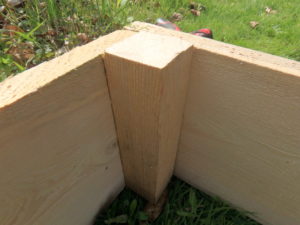
Corner of garden box
Those 8-inch pieces of 2 x 2 are for the corners, to make them sturdy, square, and to allow the screws to bite into something more substantial than a 1-inch plank. I screwed them onto the ends of the long planks, then stood up the planks and screwed the short planks into the corner pieces. That is easier to do if you have someone helping you, but you can always lean the long planks against something to keep them vertical if you are working alone.
If you don’t feel handy or don’t have a saw, you can buy brackets that will hold either a 2-inch or 1-inch thick planks. Gardener’s Supply Company sells a variety of brackets designed for 2-inch thick lumber, and Lee Valley Tools has just one type and it is for 1-inch thick lumber (from a lumber yard, so they won’t work on the thicker rough sawn lumber I used). Both companies make nice products, and will ship to your door. Your local lumber yard will cut the boards you need to the length you want. Just ask.
I started this project because I wanted to give perfect soil and sunlight to a new peony I bought from Cider Hill Gardens in Windsor, Vermont. It is one called “Garden Treasure”, an Itoh peony. These peonies are crosses of regular herbaceous peonies with tree peonies.
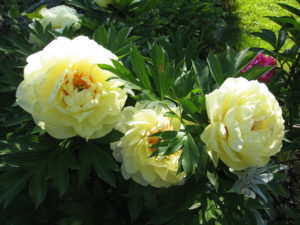
Garden Treasure at Cider Hill Gardens, Windsor, VTitoh
Itoh peonies can bloom in colors other peonies could not even dream of: yellow with peach, for example. And they can bloom for a full month, producing 50 blossoms or more at maturity. But they are expensive, so I have never gotten one – until this year.
In that same bed I am moving some old daffodils that have stopped blooming. Nearly 50 years ago I dug some old bulbs from my parents’ home in Woodbridge, Connecticut and moved them to my home in New Hampshire. In recent years the leaves have appeared, but not any blossoms.
Those daffodils have been growing in a place that is getting shadier each year and there is more root competition, too. So I will dig them up and move them into this new bed, which offers full sun. I will also treat them to a dose of Bulb Booster to enrich their soil. What I do to pamper my plants!
Reach Henry at henry.homeyer@comcast.net or P.O. Box 364, Cornish Flat, NH 03746. Please include a SASE if wishing a response by mail.
What Happened to Our Rhododendrons?
Posted on Tuesday, May 28, 2019 · Leave a Comment
Rhododendrons throughout New England are looking awful! It is common for “rhodies” to get shriveled leaves during the winter, but they normally recover in spring. Those shriveled leaves occur when warm winter days allow moisture to be given off when the ground is frozen solid – and thus unable to re-hydrate the leaves. Normally they look good again as soon as the ground thaws.
I’ve been getting e-mail from readers asking what happened this year, so I called an expert to learn more. Dr. Cheryl Smith is a plant pathologist at the University of New Hampshire in Durham.
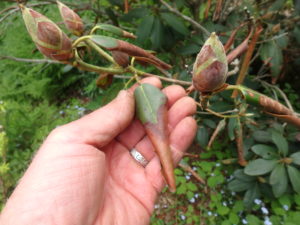
Rhododendron damage
Dr. Smith said that the winter damage this year was the worst she had seen in decades. Not only were rhododendrons damaged, she said, but also cherries, plums, Christmas trees, boxwoods, junipers, spruce, raspberries and blueberries. Yikes.
First, the good news: the damage you are seeing is not due to a pathogen. This is not a disease that is damaging your plants. And most plants will recover fully, given time. But you must have patience. Please don’t get out the chain saw and cut away everything that’s looking bad.
Most of the damage is due to fluctuating temperatures, said Dr. Smith. Usually in the fall evergreen trees like rhododendrons harden off their leaves as the temperatures slowly descend. This past fall was a warm one, with temperatures in the sixties in December, followed by low temperatures in January. Then in February the temperatures again went into the sixties for a day or two, sending signals to plants that spring was on the way. But then it dropped below zero within a week.
Throughout the winter there were high winds, and repeated freeze-thaw cycles. But the ground was frozen and during the thaw cycles plants could not take up water to replace that lost due to respiration.
So what should you do now? You can test any given twig by scratching it with your thumbnail. If you see green, the branch is still alive. If a branch is brittle and brown, and shows no green when you scratch it, the branch is dead and should be removed. Branches with brown leaves will eventually send out new leaves.
I recently visited a site where I had overseen the installation of some rhododendrons last fall. Some looked much worse than others – even though they are growing in close proximity.
I wanted the plants to look better, so I removed dead leaves, or leaves that were mostly brown. Some came off with a gently tug, others needed a snip from my pruners. Obviously I wouldn’t do that if the shrub was 20 years old, huge, and badly damaged, as it would take too long. Mother Nature will eventually replace the leaves.
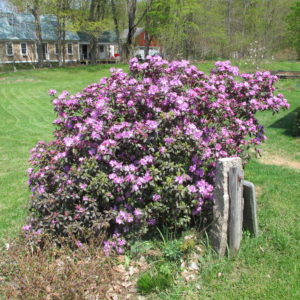
PJM rhododendron
Many, perhaps most, of the flower buds on those rhodies were damaged and will not bloom this year. On the other hand, some rhododendron varieties are tougher than others. The most common rhododendron variety, the PJM, is tough as nails.
The PJM is a pink-purple color and is planted everywhere. It was developed at Weston Nurseries by Edmond Mezitt, and named after his father Peter J. Mezitt (his initials = PJM) when it first bloomed in 1945. Apparently nurseryman Peter Mezitt gave $50 to some friends traveling in China in 1939 to collect some nice seedlings for him.
Edmond collected pollen on a paint brush from one very nice rhododendron of a species known as Rhododendron dauricum, and used it to pollinate a Rhododendron carolinianum which they were using as seed stock. He saved seeds, and planted them. The first hybrid cross bloomed beautifully when it was just 6 or 8 inches tall, and it was evident right away that this hybrid was special.
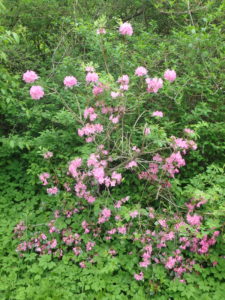
Olga Mezitt rhododendon
The parent plants of the PJM are still alive and well in front of the offices of Weston Nursery, and Wayne Mezitt (of the third generation of Mezitts in the nursery business) showed them to me when I visited Weston Nurseries some years ago.
The “mother’ plant of the PJM is a cultivar known as ‘Olga’, named after his grandmother. Wayne gave me an Olga about 15 years ago, it has done well, and it showed no damage this winter. It is currently finishing its bloom cycle. It is much pinker than the PJM.
Gardening is the slowest of the performing arts. You plant a seed or a seedling and wait to see how it performs. Wayne Mezitt told me that you can hybridize thousands of plants and grow them out before you get something special. I guess that’s why I don’t have any plants named after me!
Henry is a 20 year veteran of the UNH Master Gardener program and a lifetime organic gardener. His e-mail is henry.homeyer@comcast.net. He is the author of 4 gardening books.
Tips for a Successful Vegetable Garden
Posted on Sunday, May 19, 2019 · Leave a Comment
Depending where you live – a cold hollow, a hilltop, or near a large body of water, you may be ready to start planting the vegetable garden – or not. In any case, there is much to do before your plants go in the ground. Here are some tips to consider. In my opinion, there is not much point in planting seeds or seedlings until the soil has warmed up sufficiently. A soil thermometer will tell you when it hits 60 degrees a few inches the soil surface; 60 degrees is good even for cold weather crops like spinach and peas, although you can plant them into cooler soil. Cold, wet soil may rot seeds and discourage seedlings.
Last fall I covered my garden with leaves and straw; I start work in the vegetable garden by raking those off. This will allow the soil to absorb the sun’s heat directly. If I’m in a hurry, sometimes I will cover a few rows with clear plastic and seal the edges with soil or mulch so the heat will build up.
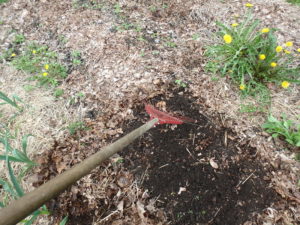
Its time to brake off the mulch over the vegetable garden to the soil can warm and dry out
On a sunny day it will get up over 100 degrees under clear plastic, which will also cook and kill many germinating weed seeds. It won’t kill perennial weeds or grasses, as the roots will survive even the hottest of days under plastic. Black plastic also holds in the heat, but is slightly less effective in heating the soil.
I don’t believe in rototilling, except perhaps when mixing in a thick layer of compost to a new bed, and even then I recommend a shallow tilling. Rototilling makes the garden look good, but it is not good at killing weeds. It just cuts up those perennial roots and spreads them around. Instead of having a hundred weeds, you can have a thousand. Soil organisms each have found the perfect place to live; stirring up the soil only disrupts their habitat.
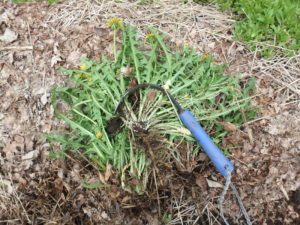
The CobraHead weeder loosened the soil allowing me to get the entire root
After raking off the mulch into the walkways, I weed. Yes, I weeded last fall. But I will have missed plenty of little ones, and others have germinated from seed by now. I like the CobraHead weeder best. This curved tool gets under weeds, loosens the roots, and lets me get the plant and its entire root system easily. Of course, you probably have a favorite tool and whatever works best for you is the right tool. CobraHead makes a long handled version, but I don’t mind bending over to weed.
Meanwhile, I have been hardening off my vegetable starts, and will continue to do so. Just as you would not put a baby in the sun without sunscreen, I won’t put my baby tomatoes out in the garden without preparation.
I start by putting out the flats of seedlings on a deck that only gets morning sun for a few days. Then I give them morning sun and a couple of hours of afternoon sun. After a few days of this, they are ready for all day sun. The stems have gotten stronger, the leaves are used to wind and sun, and they are ready to plant.
When do I plant? I planted spinach seedlings around May 8 or 10. Lettuce and kale seedlings are growing in my cold frame that warms up the soil and keeps them cozy at night. But my tomatoes? I wait well past the last chance for frost to plant. I also know that they will sulk – and stop growing – if the soil is too cold or if the nights too chilly. I have been carrying them inside at night during the hardening off process.
Plants that do well in cooler temperatures include the following: arugula, beets, broccoli, Brussels sprouts, cabbage, carrots, celeriac, kale, kohlrabi, lettuce, leeks, onions, parsley, peas, potatoes, radishes, rutabagas, spinach and Swiss chard. All the rest, especially sweet potatoes, tomatoes and all the vine crops can be seriously set back by chilly nights and killed by frost.
Now is a good time to plant some vine crops in small pots inside. I have a terrible time with the striped cucumber beetle. If I plant seeds outdoors, the beetles miraculously appear the night the seeds germinate and eat those first two little leaves. That kills the plant. But if I get vines 6 inches long with a few real leaves, the beetles can chew on the leaves, but won’t kill them. Cukes, squash, watermelon and pumpkins all are attractive to those nasty critters.
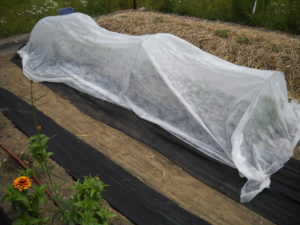
Row cover with hoops helps to keep insects off and keep plants warm
Another way of protecting crops from marauding insects and furry critters is to cover them with a thin agricultural fabric called row cover – also called Reemay or Agribon (trade names). This stuff will let sun through, as well as moisture and air. You can drape it right over the plants, or stretch it over wire hoops that are sold for the purpose. It comes in 5-foot wide rolls, which is perfect for a wide raised bed. You need to buy earth staples to pin it down. It comes in varying thickness; thick ones will keep things warmer, but allow less light to come through.
Later, when your cukes and squash start to flower, you need to take off the covers as insects pollinate the plants. Peppers and eggplants benefit from the extra heat contained by the row covers, and are wind pollinated. Generally they do fine under row cover.
One last piece of advice: ask at the greenhouse if the seedlings you are buying have been hardened off. Being inside a greenhouse is much less stressful than being outside directly in the sun. Leaves can actually get sunburned if not hardened off outside. They will recover, but slowly. So you may need to harden them off before planting.
Memorial Day weekend is the traditional day for planting warm weather crops in my area. But I never hesitate to wait a bit longer. The plants will always catch up.
Write Henry at PO Box 364, Cornish Flat, NH 03746 or e-mail henry.homeyer@comcast.net.
7 Wildflowers You Can Grow
Posted on Sunday, May 12, 2019 · Leave a Comment
Recently I was asked about plants for shady places. Wildflowers, I said, are wonderful in the woods or at the edge of the woods. Most show up early, before the leaves are on the trees. They are the perfect antidote to a long winter and rainy spring. They bring color and brightness just when we need it most.
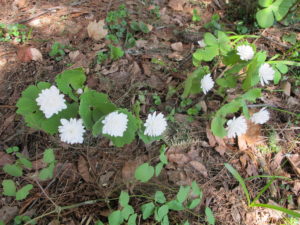
Double bloodroot
Among the early wildflowers, blood root (Sanguinaria canadensis) is one of my favorites, and it is early. First it sends up a leaf rolled up like a cigar. Then the leaf opens to display a brilliantly white flower that is an inch or two inches across. The flowers stay closed on cool, cloudy days but open up for business when the sun comes out – and the pollinators.
If you have bloodroot in your woods and want some in your shade garden, the rhizomes (root structures) can be dug up and moved easily. But wear gloves! The roots produce a red sap which has been used for dyes, but it is highly toxic.
According to an article by Susan Mahr of the University of Wisconsin Master Gardener program, blood root sap is “an escharotic, a substance that kills tissue, and external application is a skin irritant causing severe burning pain and disfigurement.” She says to move bloodroot in mid-summer as the plants begin to go dormant, but before the leaves disappear.
A friend gave me a small clump of double bloodroot about 15 years ago, and it has spread nicely. It is a tetraploid, meaning it has double the number of chromosomes, and is sterile, making it rare and expensive. I have divided mine and now have it in several places. Each blossom looks like a tiny white peony.
Another one of my favorite wildflowers is Jack-in-the-pulpit (Arisaema triphyllum). Some are fully up now in my woods, while others are just poking up their noses. The flower is not very flower-like. There is a purple phallic-looking projection that looks up from the center of the plant that is sheltered by an overhanging flap of leaf-like growth. The two large leaves are distinct on tall stems. It does well in rich soil and dappled shade.
I’ve had great luck planting seeds of Jack-in-the-pulpit in mid-summer. They are bright red when ripe. If you want to harvest some, wear gloves as the seeds of Jack-in-the-pulpit, like bloodroot, contain toxic chemicals. The seeds need to be cleaned by mashing the pulp and washing it away before drying and planting. If you do so, you should see germination the following spring (but it will be 2 to 3 years before you see flowers).
Both bloodroot and Jack-in-the-pulpit seeds produce eliasomes. These are organs that are attractive to ants, who drag the seeds – complete with the fleshy white eliasomes – back to their nests. The ants eat the eliasomes, then dump the seeds in an ant trash pile, where they can germinate. That way the seeds can travel some distance. Clever!
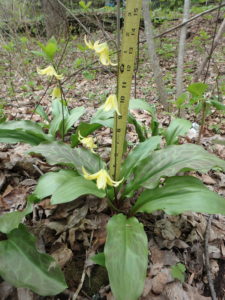
Western Trout Lily. A bulb plant that is much bigger than our native trout lily.
Trout lily or dog tooth violets (Erythronium americanum) were common in the spring woods where I grew up in Connecticut. Each plant has one or two small canoe-shaped leaves that are spotted, like the belly of a trout. Younger plants have just one leaf and do not bloom. Mature leaves bloom now, or even earlier, with yellow lily-like blossoms with the petals and sepals bent backwards. The flowers stems grow about 6 inches tall.
Three years ago I bought bulbs for a western form of trout lily that is much more dramatic than our native one. I neglected to label the bulbs other than to say they were Erythronium. Studying examples on the web I see Erythronium grandiflorum as one possibility, or a hybrid called ‘Pagoda’. My blossoms are on 12 inch stems, and each plant produces multiple blossoms. Definitely a fine addition to my woodland garden.
Trillium is a genus (botanical group) that includes several nice, easy-to-grow wildflowers. The red or purple trillium (Trillium erectum) is also known as wake-robin or stinking Benjamin for its earthy smell. It does well in dappled shade and rich, dark soil. I also grow a white trillium (Trillium grandiflorum) that grows alongside it. The white one turns pink later in the spring. Several other species exist, and are available from nurseries and specialty nurseries on-line.
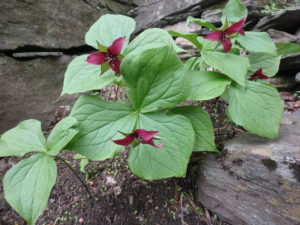
Trillium is often sold in nurseries
One of the best sources for all of these wild flowers is from The Garden in the Woods in Framingham, Massachusetts. The Garden in the Woods is a garden, education center and plant nursery run by The Native Plant Trust, formerly called the New England Wild Flower Society. They sell potted perennial wildflowers, native trees and shrubs, and much more. Now is a great time to visit them to see what you might grow in your own woods.
Henry is the author of 4 gardening books. You may e-mail him at henry.homeyer@comcast.net.
Magnolias for New England
Posted on Tuesday, May 7, 2019 · Leave a Comment
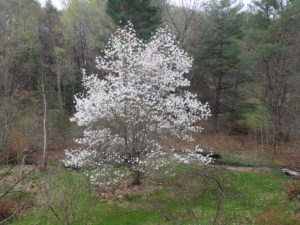
My Merrill Magnolia
One of my yearly high points occurs when my Merrill magnolia blooms. This year, and most years, mine blooms on my birthday, April 23. This year it opened that afternoon; some years it starts a week earlier and is fully in blossom; once or twice it has held off until May. Only once in 25 years has it failed to put on a great show, when there was a hard frost just before the buds were to open.
The Merrill magnolia is a “Loebner” hybrid, created by crossing the star magnolia (Magnolia stellata) with a Kobus magnolia. There are many Loebner varieties, and most are hardy from Zone 4 or 5 to 7 – fine for all of New England. Mine is white, with a soft light pink stripe on the outside of the petals (though technically they are tepals, not petals). And the blossoms are large – 4 inches or so – and fragrant. What more could you want? Other Loebner hybrids are pink or dark pink.
The Merrill magnolia does best in full sun and rich, moist soil. The literature says it needs well drained soil, but mine has thrived near my brook. The water table is near the soil surface all winter and spring, and only a couple of feet down in a dry summer. So I was not at all sure that mine would succeed. In the twenty years or so since I planted a 4-foot tall specimen, it has grown to an estimated 40 feet tall and 30 feet wide.
It really is a 4-season tree. The leaves are handsome all summer, turning a nice yellow in fall, and the flower buds are large and furry all winter, like pussy willows on steroids.
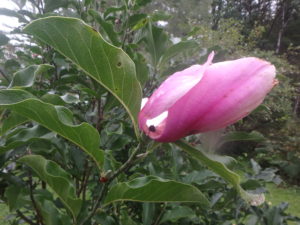
Jane Magnolia bud on September 28
I also have a smaller magnolia, a cultivar named ‘Jane’, that blooms later and stays smaller than my Merrill. It is one of the “Little Girl Hybrids”, a cross between a Magnolia liliiflora and M. stellata. Jane only gets to be 12 feet or so tall, and perhaps as wide. Her blossoms are deep pink in bud, and whitish inside when open. Like the Merrill, the leaves are shiny, glossy and beautiful.
One of Jane’s best characteristics is that she re-blooms throughout the summer and into the fall. Not a lot of blossoms, but a few. Just enough to make me stop in my tracks and exclaim every time I see a blossom. But frankly, the buds are better than the blossoms – perfect, each one. But the blossoms often develop a brown color once they open.
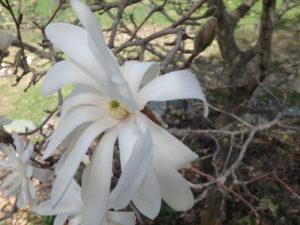
Star Magnolia
The star magnolia is a species magnolia, not a hybrid. It stays smaller than my big Merrill – perhaps to 15 or 20 feet tall and nearly as wide. So for smaller landscapes, it is a good choice. It is rated at hardy to Zone 4, but some grow in Zone 3. The blossoms are white, and come earlier than the Merrill – so they can be damaged by late frosts. There are single blossoms and double blossoms with extra petals.
Then there is the saucer magnolia (Magnolia x soulangiana). These are rated as Zone 4, but are most successful in Zone 5 or warmer. They are small trees, to a height of about 25 feet. The blossoms are amazing: up to 10 inches across in white, pink or purplish. Unfortunately, they bloom early and are often devastated by frost. These are commonly planted in Boston, probably because the heat of the buildings protects them against frost damage.
A neighbor of mine has a cucumber tree magnolia (Magnolia acuminata). This can get to be a huge tree – 50 to 80 feet tall. It is fast growing, perhaps 10 to 15 feet in six years. Its distinguishing characteristic, aside from size, is that is has yellow blossoms. Unfortunately, the blossoms are generally near the top of the tree, and can be masked by foliage. It does not do well in very dry or very wet soils, but will grow in full or partial sun.
When I interviewed the White House gardener many years ago I asked about the two huge southern magnolias (Magnolia grandiflora) that frame the back of the White House. They are magnificent. Dale Haney, the head gardener, told me that President Andrew Jackson brought them up from Tennessee as tiny saplings, on horseback. He planted them in 1830 in memory of his late wife and they have survived and thrived for nearly 200 years.
The southern magnolia is only hardy to Zone 6 or 7, so I can’t grow one here. Too bad. The flowers are 8 to 12 inches across, creamy white and superbly fragrant. But the trees grow to be 50 to 80 feet tall – and live forever, it would seem. They bloom in May or June.
Magnolias, in general, have fleshy roots and few root hairs. They do not transplant well, once established. So find the proper place before digging the hole. As with any tree, do not plant them too deep.
In nature, tree trunks flare out at the soil line. This trunk flare should never be buried at planting time or the bark, if covered with soil, will rot and destroy the cambium layer and eventually kill the tree. Many trees come from the nursery with the trunk flare buried, and it is important to remove the soil from the trunk flare before planting.
If could only bring one tree with me to a remote island, I suppose I’d have to take an apple tree for the food. But for beauty? I’d take a magnolia.
Henry Homeyer is the author of 4 gardening books.
Creating a Great Garden: It’s More Than Just Plants
Posted on Tuesday, April 30, 2019 · Leave a Comment
If you’ve visited any great gardens, you know that they consist of more than just flowers. They have fine trees and shrubs, pathways, perhaps stonework or pottery, maybe a bit of whimsy, or walls and great views. Now, before your trees are fully leafed out and the perennials have begun to distract you with their blossoms, this is a good time to think creatively about what you can do to make your garden spaces better.
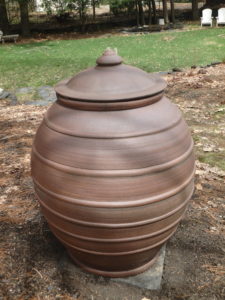
Pottery by Stephen Proctor adds a lot to a garden
I recently visited the Inn on Putney Road, a B&B in Brattleboro, Vermont. This is a majestic old white brick building with lots of formal gardens. I went to see it because I had seen the outdoor pottery of Steve Procter (https://www.stephenprocter.com/) at the Vermont Flower Show, and he maintains a wide selection of his pottery on display in the garden at the Inn.
Steve Procter makes pots that are high-fired and impervious to the elements. Unlike flower pots, his pots are fully vitrified, and will not absorb moisture. Most are not designed for use as flower pots, but for their amazing looks. The come with lids and a drainage hole. In the summer, they may be displayed without the lid, and rain will not collect inside. In the winter lids are recommended to avoid any ice building up.
These pots would make my garden look even better than it does. But a 5-foot tall pot takes Steve about 3 weeks to make and a full day at 2300 degrees F to bake – and days to cool it slowly. These are not inexpensive, obviously, and not in my budget just now.
Steve told me that although people are used to placing 2-dimensional art work on the walls of their homes, 3-dimensional art is less common and not everyone is comfortable placing big pots in the garden, He generally delivers the pots and helps to find a perfect spot for each. The pots are placed on a square of bluestone or concrete to keep them steady.
Whether you are placing a pot, a sculpture or perhaps a tall standing stone, 3-dimensional art can provide a visual destination, something that draws a visitor down a path. And if you partially conceal the pot or art with a shrub or tree, Steve Procter pointed out that it can create a sense of mystery. Or provide a surprise when you turn a corner.
Large flower pots filled with plants add much to a garden, too. I have a fig tree and a Frangipani (the tree that provides flowers for Hawaiian leis) in ordinary big pots – but have to bring them in each winter. That can be a struggle. But they can add a lot to my landscape.
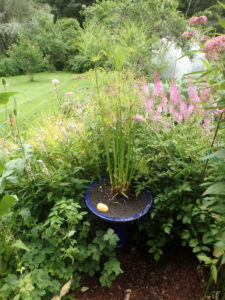
Birdbath used as a planter in my garden with papyrus growing in it
What else can one do to provide 3-dimentional interest? A simple ceramic bird bath adorns my garden each summer. Since the birds showed no interest in taking baths in it (I also have a stream nearby), I use it as a pedestal for a plant in a pot, or even as a shallow pot. Last summer I grew papyrus in it. Papyrus grows in standing water, which is good as a bird bath collects water and would drown many plants in a rainy time.
Standing stones are also wonderful. A significant part of the stone must be buried in order to achieve stability. I think the perfect stone is long and relatively narrow with a base that is wider than the exposed portion when installed. I prefer stones that are 4 to 6 feet from end to end and just a foot to 18 inches wide.
To make a standing stone stable, I dig a hole 18 to 24 inches deep and 2 to 3 feet wide. Once I have the stone standing in the hole and vertical, I place stones around it in the hole. I choose stones the size of a loaf of bread or bigger to hold the stone in place. Then I pour into the hole a bag of ready-mix concrete, dry. The concrete will harden up and cure nicely over time. I finish filling the hole with topsoil.
When I install standing stones in public places I make each even more stable by digging a mushroom-shaped hole. I dig the hole, then dig out laterally at the bottom to create a pocket under the un-excavated sides of the hole. This space gets filled with concrete mix, making a nice anchor. I use a hand tool called a CobraHead weeder to pull the soil out of the pocket area.
What else can you use to spiffy up your garden? Benches are nice. Wooden benches are probably the most comfy. Stone benches look great, but are cold and hard to sit on for more than a few minutes. But any bench will draw the eye, and encourage visitors to approach the bench.
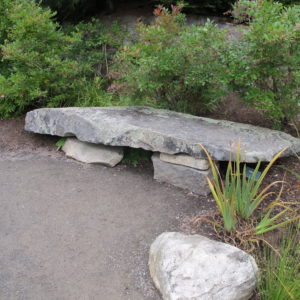
Stone benches are handsome, but not comfortable to sit on for long
I have a marble bench next to my brook where there is a nice planting of umbrella plant (Darmera peltata). I placed some of my late sister Ruth Anne’s ashes under the umbrella plant at planting time, and it has been a nice quiet place to sit and remember her, particularly when it blooms in the spring with tall pink flowers.
So look for some three-dimensional objects to enhance your garden – whether pots or standing stones or even an old fashioned gazing ball. And remember: you don’t have to prune or weed them!
Henry Homeyer is a garden writer, consultant, gardening coach, and the author of 4 gardening books. He can be reached at henry.homeyer@comcast.net.

 Click Here to buy from Cobrahead