Fall Is a Good Time to Plant (Some) Seeds
Posted on Tuesday, September 18, 2018 · Leave a Comment
Most of us think about planting seeds in the spring, but there are lots of plants that can be planted by seed now, especially wildflowers.
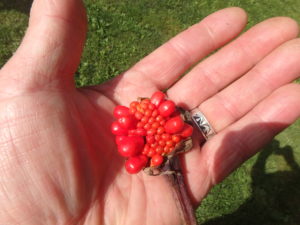
Jack-in-the-pulpit seeds
One of my favorite wildflowers is Jack-in-the Pulpit (Arisaema triphyllum). In the spring it produces a single well-hidden blossom beneath its large leaves. The plants are either male or female, and it is only the females that produce seeds. Right now in my woods and shade gardens the bright red seeds are visible in nice clumps and are ready to harvest and plant.
The seeds of Jack-in-the Pulpit contain calcium oxalate that can be an irritant to your skin. So you may want to wear latex gloves to handle the seeds. The easiest way to prepare seeds for planting it to put them in a blender with a cup of water and give them a quick whirl. The red mushy part comes right off, leaving clean white seeds. Once the seeds are clean and dry, they are fine to handle with bare hands. Removing the pulp on seeds removes compounds that inhibit seed germination.
Pat the seeds dry with a paper towel and plant immediately. Don’t let them dry out. I use my CobraHead weeder to loosen the soil, then place the seed on the surface and lightly cover with soil and forest duff. Next spring each seed will produce just a single round leaf, and it will be 3 years before a plant will blossom.
If you like eating ramps or wild leeks (Allium tricoccum), you should start a patch of your own. Go out now to the forest where you have harvested wild ones in the spring to see if you can recognize the plants and harvest seeds.
These tasty onion-family wildflowers show their leaves in early spring, then after the leaves die back they flower with dainty white clusters of blossoms just 5 inches above the ground. When the seeds turn black and the stems start to turn brown, they are ready to harvest in August to September. By now, most of my plants have dropped their seeds, but I found a few still good to pick this week.
I plant them by raking off the leaves of the forest floor, scratching the soil surface, and sprinkling the seeds. I pat the soil, and put leaves over the seeds. That’s roughly what Mother Nature would do (except the part about scratching the soil with a CobraHead weeder).
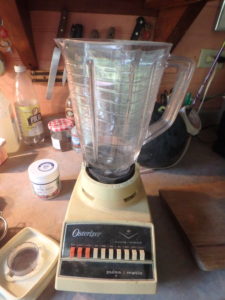
An old fashioned blender is good for cleaning seeds
Blue cohosh (Caulophyllum thalictroides) seeds are ready to harvest and plant now. I have one big clump that I transplanted a decade or more ago, and it has gotten bigger every year, but no new plants have shown up. This year I decided to get proactive. The deep blue seeds are ready to pick.
According to my wildflower bible, Growing and Propagating Wildflowers by William Cullina, what appears to be a berry is actually just a seed with the fruit being the extension of the seed coat. He advises removing that by cleaning in a blender or to ferment the seeds in water for a few days until it falls off. The advantage to the blender is that it will nick or scratch the hard seed coat, making germination easier. Like Jack-in-the-pulpit, blue cohosh will produce just one leaf the first year, as it uses its energy to develop its roots.
Other wildflowers that I am collecting seeds from now include Japanese mayapple (Podophyllum peltatum) and false Solomon’s seal (Smilacina racemosa). I bought my Japanese mayapple from The Fells, a nice non-profit garden and historic estate in Newberry, NH on Lake Sunapee. They offer a good variety of unusual plants each summer.
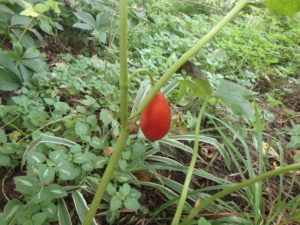
Japanese mayapple fruit with seeds
I particularly like the Japanese mayapple because, unlike our native mayapple, the blossoms appear above the foliage instead of hidden below the large leaves. By collecting and planting seeds I may be able to significantly increase my display with no added expense – so long as I have patience. Most wildflowers take 3 years from germination to flowering.
Wildflowers often require a period of “vernalization”. This means that they need a cold period between the time they are planted and when they germinate. This ensures they don’t start growing now, when winter is just around the corner.
Aside from wildflowers, this is a fine time to plant seeds from annual poppies and foxgloves. Just harvest the seed pods of poppies and check to see if they still have tiny black seeds – just tip a pod upside down and the seeds should fall out into your hand. I sprinkle them now, or in mid-winter, and they always produce some flowers the following summer.
At this time of year I often pick foxglove stems and shake them over bare soil where I would like more plants. Since foxgloves (Digitalis purpurea) are biennials, it’s a two-year process. Next year a few of the hundreds of seeds I disperse will produce rosettes of leaves, and the following year they will flower.
Starting flowers by seed does take patience, and knowledge about how and when to do it. For more on the techniques and requirements of growing wildflowers I highly recommend Bill Cullina’s book, mentioned above. He notes that you should be careful not to harvest too many seeds of rare wildflowers, just gather a few. Good luck!
Henry is the author of 4 gardening books and is a UNH master Gardener. His e-mail is henry.homeyer@comcast.net.
Red-Leafed Trees and Shrubs
Posted on Monday, September 3, 2018 · Leave a Comment
Everyone seems to go wild for sugar maples trees in the fall because, here in New England, their leaves turn wonderful colors – yellow, orange and, best of all, red. But some trees and shrubs have reddish or purplish leaves all summer, and these, too, are very popular. Let’s take a look at a few of these.
My all-time favorite is the Japanese red maple. I grew up with a huge one in Connecticut, a great climbing tree for a young boy. The leaves are a deep wine red all summer and into the fall. It was probably 50 feet tall and wide.
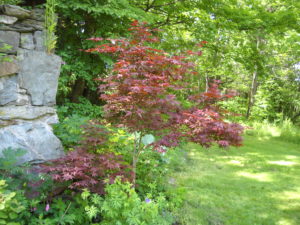
Young Japanese Red Maple at my house
In 1970 I dug up a small specimen from under my parents’ tree and brought it to my newly-purchased home in Cornish Flat, NH. Now, 48 years later, I still have the tree, but it is only about 10 feet tall and 8 feet wide. Our cold winters have kept it small – less than a quarter the size of the parent tree.
The Japanese red maple does best in full sun and rich soil, but will survive in part shade and less than perfect soil. Mine now gets just a few hours of sun each day as other trees nearby have grown tall. The hardiest variety for northern gardens is one called ‘Bloodgood’.
So what else can we grow? I like the copper beech (Fagus sylvatica purpurea). This is a variety of European beech and starts out in the spring with deep purple leaves. As the summer progresses, its leaves become more green. It is hardy in Zones 4 to 7, and is much more tolerant of poor soils than the American beech, our native species of beech. I do not have one, but wish I did.
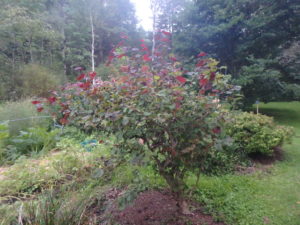
Red Majestic curly hazelnut
I do have a wonderful red-leafed curly hazelnut or Harry Lauder’s walking stick. It’s a variety called ‘Red Majestic’ of the European filbert (Corylus avellana). In the spring the leaves or a deep red-purple but develop a greenish tinge as the summer progresses. I have mine in a flower bed, and have been able to keep it to an 8-foot wide and 6- to 8-foot tall tree by annual pruning. Even in August it has wonderful color – all this year’s growth is a rich purple-red.
As beautiful as my Red Majestic hazelnut is, it is even better in winter against the snow. It has curled and contorted branches that stand out wonderfully against the snow. But it does not produce hazelnuts: these trees are either male or female, and both are needed to produce nuts. Mine is a male, lonely and unfulfilled. Sigh.
I have a purple smokebush (Cotinus coggygria) that I planted one in memory of a friend, Fritz Hier, who passed away in 1999. It is still small, and I often cut the branches to the ground in late winter. This stimulates it to send up long shoots with more colorful leaves than normal extensions. It does best in well-drained loam and sunny locations, but is tolerant of crummy soils.
Smokebush is named for the flowers, which are quite ethereal. Actually, the flowers themselves are not remarkable, but the pedicles and peduncles (stems of the flowers) develop hairs which create an open, airy mass of pink or purple haze. Because I cut mine back, I have never seen it blossom, but the leaves are wonderful.
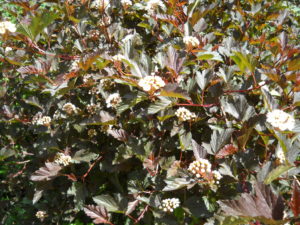
Ninebark Diablo
Common ninebark (Physocarpus opulifolius) is a fast-growing multi-stemmed shrub that has a cultivar, ‘Diablo’ with deep purple leaves. I had two, but got rid of one because they grow so fast, and it was blocking a view I liked. They can easily send up stems 3 to 5 feet in a year. It blooms in June, so don’t prune it in the early spring or you will lose the blossoms.
Ninebark does best in full sun but will tolerate some shade and will grow in any soil – acid or alkaline, wet or dry. Do not give it any fertilizer – ever! It is so vigorous it does not need any help. I understand there is a miniature form of ‘Diablo’ called ‘Little Devil’ that only grows to 3- to 4-feet tall and wide. I haven’t tried it yet, but plan to.
Another nice reddish-leafed tree is a crabapple called ‘Prairie Fire’. It starts in the spring with prolific pinkish-red blossoms, followed by purple-maroon foliage. Later in the summer the foliage fades to a reddish green. The fruit persists into winter, bright red “berries” that are good food for birds.
I have not grown old fashioned weigela (Weigela florida), a medium-sized early summer shrub, but I know it comes in varieties with reddish or purple-tinged leaves. ‘Wine and Roses’ is one variety; other include ‘Fine Wine’ and ‘Midnight Wine,’ both compact varieties. In general old fashioned weigela is a Zone 5 plant that can get 6 to 9 feet tall, with a spread of up to 12 feet wide.
Last but not least is a purple-leafed rose, Rosa glauca. I had one years ago, but something happened to it – I’m not sure what. It is said to be hardy to Zone 2, much colder than where I am. The single pink blossoms in June were nice, but the real attraction was the foliage which was almost a gray-purple. The orange rose hips were nice in the fall.
So if you crave purple or red leaves, visit a garden center and see what they have. Fall is a good time to plant trees and shrubs because they extend their roots then, and the climate is less hot and dry.
Henry is a UNH Master Gardener, and the author of 4 gardening books. He is away this week and not responding to e-mail.
It’s Time to Harvest and Store Root Crops
Posted on Saturday, September 1, 2018 · Leave a Comment
I sometimes wonder if I’m part squirrel. No, I don’t bury acorns for winter, but I do love putting up food for winter, especially potatoes. They’re the ultimate “comfort food” as far as I am concerned, and I rarely have too many. If you haven’t already done so, now is the time to harvest and store your potatoes for winter.
If you haven’t dug your potatoes yet, don’t worry. Potatoes store well in on ground right up to frost, and even after frost. But don’t try to overwinter them in the ground – they’ll get soft and unappealing. By now the leaves on my potato plants have yellowed and begun to die back, so there is no point in waiting- they won’t get any bigger. And if I wait too long, the mice may find them.
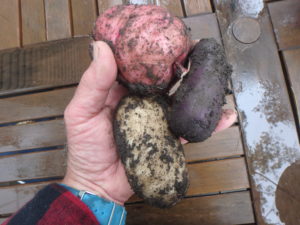
Kennebec Red Pontiac and Magic Molly potatoes just harvested
It’s important to be careful when digging potatoes so that you don’t damage any. I use a potato fork that has been in my family for decades. It’s like an ordinary garden fork, but the tines are at a right angle to the long handle, and are sharp and long. To harvest I pull the soil to one side with the potato rake. Then I plunge my fingers into the loose soil to find the spuds. If I spear a potato it goes into a pile destined for immediate consumption.
It is generally accepted that one should not wash potatoes fresh from the soil. Their skins are soft and easily damaged right after digging them. Most experts suggest hardening the skins by spreading them out in a cool place out of the sun for about a week. I do this on a north-facing deck, and turn over the potatoes after 2 or 3 days so both sides get hardened off.
Storing potatoes is best done by keeping them in a dark location with high humidity that stays between 35 and 50 degrees. Storing them in a warmer place will turn some of the starches in the potatoes into sugars. This will cause the potatoes to burn easily if you make French fries, so commercial growers keep them cool.
Potatoes need to breathe while in storage. They are living organisms that respire, so putting them in a sealed plastic bag will suffocate them, ruining them. Traditionally potatoes were stored in a cool basement with a dirt floor, but losses to mice or rats was often a problem.
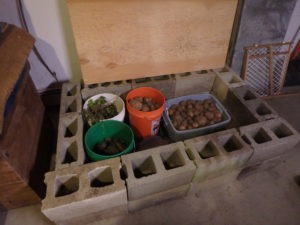
Cool box storage bin
I have a cool basement with a cement floor, and I have built a box there to contain buckets of potatoes and other root crops. It consists of two layers of blocks arranged in a rectangle, three blocks long and two wide. On top I have a piece of half-inch plywood. I call this my cool box, or root cellar. It will hold 6 buckets at a time. And so far, the rodents have not found a way in.
Carrots store well in my cool box. Like potatoes, they need a cool humid location for storage. I put an inch of moist sand in the bottom of each bucket to keep up the humidity.
Unlike potatoes, however, carrots will store well in the ground. In the past I have covered my carrots in the garden with a layer of straw or hay, then leaves. This acts as insulation and keeps the ground from freezing, allowing me to go out, shovel away the snow, and dig carrots in winter. Mice or voles have been an occasional problem, however. I put a stake in the ground at each end of the carrot bed so that I can find it in deep snow.
What else stores well in my cool box? Rutabagas, kohlrabi and celeriac – three less common root crops that I like – all store well cool, with high humidity. But onions do not store well in my cool box. They like a cool environment, but low humidity.
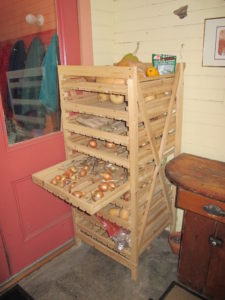
Orchard rack from Gardener’s Supply Co.
I store my onions and garlic in an area near the mudroom that stays cool but dry. I use a wooden “orchard rack” that I got from Gardener’s Supply many years ago. I also use it for winter squash. It has 6 large slatted drawers that pull out, allowing me to select what I need for dinner. It has excellent air circulation.
An old Vermont farmer I knew stored his winter squash upstairs under the bed in the guest room. He said he kept the radiator turned off so the room stayed cold, but above freezing. The humidity is naturally low in winter in most houses.
Last but not least, I have an ancient General Electric refrigerator in the basement that is not “frost-free”. This vintage fridge does not remove the moisture the way modern ones do, so ice will sometimes build up, requiring me to defrost it. But any vegetable that stores well in high humidity will do much better there than in a modern fridge which creates low humidity except in the two drawers at the bottom.
Part of my joy in gardening is spending time outdoors growing flowers and vegetables. Each fall I get busy putting up the vegetables for use in the kitchen all winter. And each time I make a stew with food I grew, I know my food is chemical-free and it tastes better to me because I grew it.
Henry Homeyer is a UNH Master Gardener and the author of 4 gardening books. See his blog posts at https://dailyuv.com/henryhomeyer.
Espalier Fruit Trees
Posted on Sunday, August 26, 2018 · Leave a Comment
When traveling in France and England I have often admired the fruit trees that have been pruned and trained to stay low and follow a wall or building. Their branches, like the extended arms of a scarecrow, travel horizontally – and are often loaded with fruit. I have wanted to try training a tree like this, a form called “espalier”. The word espalier is French, and comes from Italian meaning “something to rest the shoulder against”. It has come to mean not just the support, but the tree itself.
Trees in the espalier form are, essentially 2-dimensional. The branches are usually tied to wires or bamboo poles, often a foot or so in front of a wall. Branches growing towards or away from the wall are pruned off, as are most vertical branches. They save space and keep fruit low for easy picking. Walls protect the trees from high winds, and often reflect sunshine and heat to hasten ripening.
I was delighted to find an espalier apple tree for sale at Gardeners Supply Company in Lebanon, NH. Someone had already done a lot of the work training it for me, though it had many small water sprouts (shoots) that needed to be cut away.
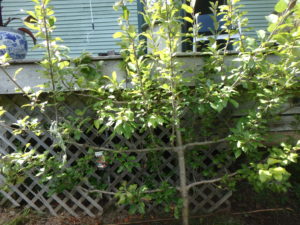
My Espalier apple needs much pruning
My tree stands about 6 feet tall and has 3 pairs of parallel horizontal branches. Not only that, the branches are from three different varieties of apple – Zestar, Sweet 16 and Honey Crisp. That’s right, the branches were grafted on to the main stem so that, if all goes well, the tree will produce 3 different flavors of fruit.
Soon after planting my tree I heard about a workshop on espalier techniques, and I decided to go. Margaret Roach, a well-known author and blogger (www.awaytogarden.com) in Copake Falls, in upstate New York, was opening her gardens to the public through the Garden Conservancy, and she had asked Lee Reich, a well-known garden writer, to teach a class on espalier fruit trees. Lee is also the author or many books, including the best book on pruning that I have seen, The Pruning Book.
Lee began by explaining how plant hormones control growth and fruiting. It is essential to understand this if you wish to create an espalier, or even to prune a fruit tree to the size and shape you want.
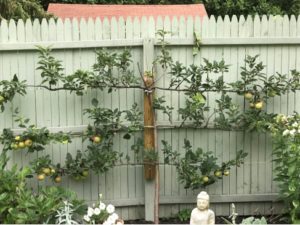
Espalier apple with 3 kinds of apples
The tallest branch on a tree produces plant hormones called auxins that control growth, branching and flowering (and hence fruit production). If you cut off the tallest part of the tree, the apical tip, a tree is more likely to produce side branches, and these tend to be more fruitful and less vigorous. Vertical branches such as watersprouts rarely produce fruit. They seem to want to grow fast and tall, competing with the leader, or tallest stem on the tree. In general, the horizontal branches of espalier trees should produce lots of fruit.
Lee Reich explained that some fruit trees do better than others when creating an espalier tree. Asian pears do wonderfully, and are almost always a success. But we are much farther south than England and northern France where espaliers do so well. We are at about the level of Madrid, and creating espalier is tougher for us. No, we can easily shape our trees in the form of espalier, but getting them to flower and fruit is tougher- our length of day is different.
There are apple trees that bear on fruit spurs – little gnarly branches just 2 or 3 inches long. Others produce fruit mainly on the tips of branches. Spur-type varieties are the best candidates for espalier. Macintosh is a spur-type apple, and there is one that is even better, MacSpur. Anything with “spur” in the name is good, according to Lee Reich. But other spur-type apples include Zestar, Red Delicious, Honeycrisp, Jonagold, Fuji, Jonathan, Chieftain and Winesap.
The tree I bought has no fruit spurs as yet. And when I bought it, it had lots of watersprouts growing straight up. I was afraid to cut them all off now, as a tree needs leaves to support the roots, and to create the energy the plant needs in the spring to grow new leaves and flowers. According to Lee Reich, an apple tree needs 40 leaves to bring an apple to maturity.
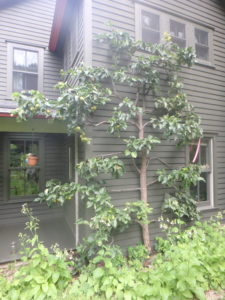
Asian pear espalier at Margaret Roach garden
You can create an espalier starting from a whip – a simple bareroot plant with no side branches. Get one in the spring, plant it, and cut off the top third of the whip. That should stimulate it to set out at least two side branches in its first year. You can tie these to a bamboo, or along a horizontal wire. But in my opinion it is easiest to buy a tree that someone else has already shaped in the espalier form. Then all you have to do is cut off vertical sprouts, and keep the “arms” out to the sides.
Red currants and gooseberries work very well as espalier plants, according to Lee Reich. They are fast growing and flower well on horizontal branches. But not everyone is fond of their fruit. You can’t beat an apple.
I don’t know if my espalier will produce much fruit. But it is going to be fun trying to train it, and I look forward to winter when I will take off the rest of the vertical watersprouts that, right now, somewhat obscure the shape I’m hoping for.
Henry lives and gardens in Cornish Flat, NH. He is the author of 4 gardening books. His website is www.Gardening–Guy.com. He is away this week and not responding to e-mail.
Tomatoes: Getting the Best from Your Harvest
Posted on Tuesday, August 21, 2018 · Leave a Comment
This is my favorite time of the year. Tomato time. Tomato sandwiches for breakfast and lunch, Tomato, basil and cucumber salads with dinner. Tomatoes in stir fries. Tomatoes going in the freezer, dehydrator and jars of sauce. Oh my, I do love my tomatoes. I grew 35 plants this year, as I usually do.
Many gardeners complain that blights are reducing their harvests. It’s true that 30 years ago we had little blight. We covered our plants against the frost, and they kept on producing until October. Now tomato leaves turn yellow and brown in July, and by August many plants are pretty much bare of leaves. Why, people ask, do the early blossoms produce fruits, but then the plants just stop producing?
I don’t know all the reasons. I do know that most common tomato diseases are caused by soil-borne fungi that winter-over, coming back year after year. You can minimize the problems by rotating your tomato patch each year, or by planting in a new garden space that was lawn. Usually a new garden in full sun will have few problems, but in the following years, the blight will find your tomatoes.
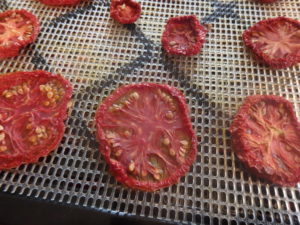
Dehydrated Tomatoes
I have had a good, but not perfect tomato season. I spaced my plants farther apart than I have done in the past, centering them 30 inches or more apart. I planted in the sunniest part of the garden. I cut off diseased branches early and often. And Mother Nature cooperated: June and July were relatively hot and sunny, with low humidity. I had to water early on, but diseases were inhibited by the weather. But now, in August, humidity is high and rain is common. Sigh. My tomatoes are getting blight.
So what do I do with the fruit from 35 plants? For starters I should explain that the trees around my garden have gotten bigger every year, and now my garden only gets sunshine from around 10am to 5pm. That’s considered full sun, but 12 hours is a lot better for production.
The easiest, quickest way to save tomatoes is to freeze them whole for winter. Wash them, make sure they are dry, and put them in gallon freezer-rated zipper bags. I suck the air out of the bags with an ordinary drinking straw. The frozen tomatoes can be used in soups and stews just like canned tomatoes. If you wish to remove the skins, just run the frozen tomato under a stream of hot water and rub off the skin.
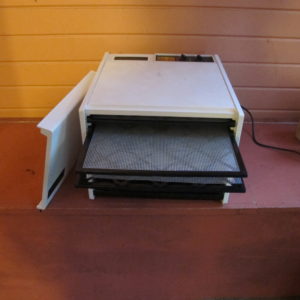
Excalibur dryer
Tomatoes also store well if you dry them in a dehydrator. I plant 6 or more Sun Gold cherry tomatoes each year that produce a lot of fruit. I cut them in half and place them on the racks of a dehydrator and dry them at 130 degrees for 18 hours or so. When they are dry I stuff them into quart zipper bags and keep them in the freezer, though freezing is not really needed. I use the dried nuggets of summer in soups, stews and stir fries. I have even put them in winter sandwiches.
You can also dry full-sized tomatoes. Slice them about 3/8 of an inch thick and place them in a dehydrator. I have two kinds of dryer: the Excalibur, a $300 deluxe model that blows warm air sideways equally over all 8 trays, and the NESCO American Harvester, a serviceable machine that pushes air up or down through a stack of trays.
The downside to the NESCO model is that you must rotate the trays to get equal drying. And it uses 1000 watts of energy per hour, and the Excalibur uses only 660 watts. Still, at about $125 for the basic machine, it is more affordable.
A sandwich is not really a sandwich, for me, without slices of tomato. One way to save slices of tomato for winter use is to roast them. I do so in the oven at low heat until they are caramelized and soft, not tough and dry. Then I place them in zipper bags and freeze them – but just one layer of tomatoes per bag. When I crave a tomato in my sandwich, I pull out a few slices and heat in my toaster oven until warm. Not a fresh tomato, but better than most sold in the grocery store in January.
I also make tomato paste. Lots of paste. I store it by freezing it in ice cube trays, and then putting it in zipper bags when frozen. No more half-used cans of purchased paste going fuzzy in the fridge for me.
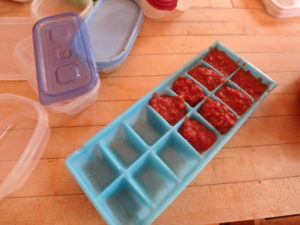
Freeze tomato paste in ice cube trays
To make paste I use imperfect tomatoes, of which I have plenty. I cut out the bad spots, then core them. I squeeze the cored tomatoes in the sink, which gets rid of most seeds and lots of juice. Then I quarter them and place in a food processor. I puree them, then add to a large enameled iron pot and cook them slowly for hours. I know they are done when I can literally stand up a spoon in the pot. I let it sit all night, uncovered, to cool and lose some more water. In the morning I spoon the paste in the ice cube trays.
Canning tomatoes is the old fashioned way. I still put up a few jars of sauce each year, but it’s a lot of work and must be done just right in order to avoid getting sick. Mostly now I make a big batch of sauce and freeze it in plastic freezer containers. But I like seeing jars of canned sauce lined up on a shelf in the pantry- and it connects me to my mom and grandmother.
Henry is the author of 4 gardening books. E-mail him at henry.homeyer@comcast.net. Read his blog posts at https://dailyuv.com/henryhomeyer
Creating a Pollinator Garden
Posted on Tuesday, August 14, 2018 · Leave a Comment
I recently helped prepare and plant a pollinator garden. Bees, butterflies and other insects need pollen and nectar for food, and suitable native plants on which to rest and lay their eggs. Unfortunately, many landscape plants have been introduced from foreign shores, and the plants may be less interesting to our native pollinators, or have less food value. A good pollinator garden is stocked with native plants for best results.
There certainly are plenty of seed mixes available to plant a “Meadow BURSTING WITH COLOR all summer long!” Unfortunately, seed mixes are not as easy to use as you might think. I know people who have rototilled or plowed a space, spread seed and been disappointed after year one.
After the first year, a few plants will dominate, and some of your favorites will disappear – because you often get a lot of annual flower seeds in a mix that will bloom in year one, but depend on self-sowing to come back in later years, and that doesn’t always happen.
So if you wish to have a healthy pollinator garden with plants that come back year after year, buy perennial plants from a knowledgeable source of native pollinator plants. This can be expensive, but doesn’t have to be. Most perennials at a garden center cost $8 to $15 a pot – and true natives are often hard to find.
We bought a mix of first-year perennial wildflowers in flats, each plant in a peat pot that is about 4 inches deep and 3 inches wide – for less than $5 a plant. We got ours from Northeast Pollinator Plants (NEPP) in Fairfax, Vermont. (www.northeastpollinator.com). They also sell individual plants, including common milkweed for monarch butterflies.
Why pick true natives? They co-evolved with our native insects. A named perennial cultivar often has brighter colors or more petals than a native of the same species – which may affect how our insects are attracted to it, or what they get from it. Timing is important to pollinators, too, and cultivated plants may bloom earlier or later than true natives.
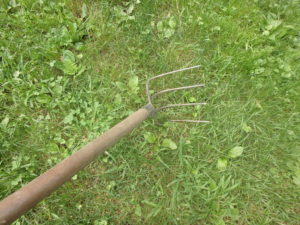
A potato rake is good for pulling turf and weeds
I don’t recommend trying to rip out all your lawn and turning it into a pollinator garden all at once. That’s too much work. Four hundred square feet is a good size to start with – roughly 20 by 20 feet. We didn’t want a square, so we used 80 feet of garden hose (which would enclose a 20 foot square) and created an irregular, curvy shape with the hose. Then, using an edging tool, we cut the border of the space.
We removed all the grasses and weeds in that 400 foot garden space. It took 4 of us about 4 or 5 hours. We sliced through the grass and weeds with shovels, tipping the shovels back and loosening the soil. Then we used either a CobraHead hand weeder, or an old fashioned potato rake to pull out the chunks of sod. For big tap-rooted weeds, we used a garden fork to loosen the roots before pulling. Because the soil was sandy, weeds pulled relatively easily.
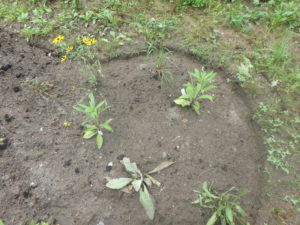
Spacing wildflowers 2 feet apart is about right
Then came the fun part: planting. I spoke recently with Jane Sorensen of Northeast Pollinator Plants and River Berry Farm. Jane is co-owner of NEPP and a professor at UVM. According to Jane, it is important to resist the temptation to add compost, manure and especially fertilizer, even if the soil is very lean – devoid of the dark organic material that our veggies and cultivated flowers are given for best results. The wildflowers in our selection from NEPP do well in poor soil and get too tall and flop if given fertilizer or much compost.
We got 84 plants for the 400 square foot garden – roughly one plant for each 2 foot-by-2 foot space. I cut 2-foot sticks to remind us how far apart to space our plants. These little plants were mostly just a foot tall, but some will end up being 4 to 6 feet tall, and creating large clumps in the future.
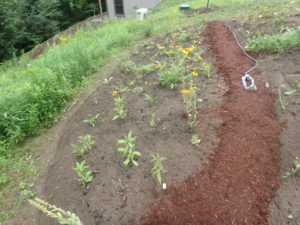
Watering is important for the first 2 weeks
We planted 10 species of perennials and one grass. Early plants included penstemon, purple cone flower and baptisia. Mid-season plants were anise hyssop, wild bergamot (Monarda fistulosa, a relative of the beebalm we all know), boneset (Eupatorium perfoliatum) and blazing star (Liatris spicata). For late blooming flowers we used NY Ironweed (Vernonia noveborancensis), sneezeweed (Helenium autumnale) and New England aster. We planted little bluestem, a grass beloved by pollinators. Most all of those are good for full sun to part shade.
Jane suggested planting wildflowers in groups of 3 to 5 plants. Many native bees, she said, like to work one species of flower before moving on, so don’t spread them out too far.
Although we love to clean up our gardens in the fall, Jane said it is best to let the wildflower stems stand all winter, then clean up in the spring. That allows native pollinators, or their eggs, to overwinter in the plant stems. She credited that idea to Annie White in a talk for the New England Wildflower Society. She also said to save the stalks, setting them aside after clean up – so that eggs can hatch. Wait until you have had at least 3 consecutive days over 50 degrees in the spring before cleaning up.
Think about adding native wildflowers to your property, even if you don’t dedicate a huge swath to it. Plants used for pollinators may not be as showy as peonies and roses, but the bumblebees and butterflies they attract will be the icing on your cake.
Read Henry’s blog at https://dailyuv.com/henryhomeyer Henry is the author of 4 gardening books.
Growing Lesser-Grown Vegetables
Posted on Tuesday, August 7, 2018 · Leave a Comment
Each year I try to grow some new things in my vegetable garden, varieties that I’ve never tried before. Sometimes my efforts are a bust, and I never grow them again. Then sometimes something new becomes an instant favorite, as happened this year.
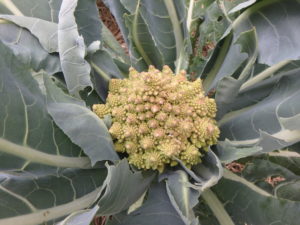
Romanesco Cauliflower
This year I grew Romanesco cauliflower, a plant that I absolutely love! This is something like a pointy cauliflower, but with a different taste: it has overtones of broccoli. In fact, some call it a Romanesco broccoli or just plain Romanesco. Some say it has a nutty flavor.
The tiny florets spiral around in something described by a mathematical relationship called a Fibonacci sequence. That sequence is 0, 1, 2, 3, 5, 8, 13, 21, 42…. Do you see the relationship between the numbers? Each number is the sum of the two previous numbers. It is a gorgeous, spiraling pointy vegetable. When I picked my first one it was 5 inches across and weighed 9 ounces. Perhaps I could have let it get bigger, but I was afraid it might spoil if I waited too long.
I cooked my Romanesco by slicing it in half and steaming it for 6 minutes. At that point I could poke a fork into it without difficulty. I served it with butter, though a little Parmigiana cheese might be good on it, too.
Unlike broccoli, most cauliflowers don’t usually produce any more food after the first head is picked – though some purple ones will produce small florets as an afterthought. Will my Romanesco produce anything else? I don’t know. If you know, please e-mail me (henry.homeyer@comcast.net). If it shows no side shoots in 2 weeks, I shall pull the plants.
Rutabagas were once an experiment for me, but now I grow them almost every year. They are mild-flavored and store for months in the fridge or a cool basement. I’ve never had trouble with diseases or pests – and they are a good substitute for potatoes, which are sometimes plagued by beetles and fungal diseases. Flea beetles can bother them, I’m told, but I’ve never had the problem.
Kohlrabi is another lesser known vegetable that I grow. It looks like a root crop, but grows above the soil line as a big, fat round ball. The leaves come off the top of the ball, and some people say it looks like a space alien.
This year I grew purple kohlrabi only. These are best eaten soon after being picked, though there are some green ones, most notably Kossak, an F-1 hybrid that will store for 4 months or more with no loss of flavor or texture. And they get to be 8 inches in diameter!
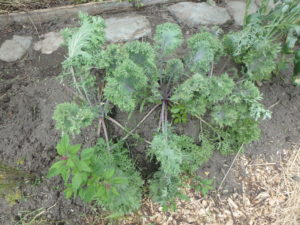
Bear Necessities Kale
Of the leafy greens, I tried a new variety of kale that I love. I got seeds from Fruition Seeds in Naples, NY for a kale called Bear Necessities Kale. That’s right, bear, not bare. It is a frilly kale and very tender. What it has to do with bears is a mystery to me, but Petra Page-Mann, the founder of the company, is a young woman with a good sense of humor, so I guess it’s just a pun. I use the leaves in my breakfast green smoothies, and they’re delicious. Fruition Seeds offers many unusual and organic seeds including heirlooms.
Magenta spreen is another unusual leafy vegetable that I tried some years ago, and it shows up like a weed every year. I let some grow, and pull some out. It is in the scientific genus Chenopodium which includes quinoa and a weed known as lamb’s quarters. What I love about it is that it has top leaves that are, indeed, magenta – one of my favorite colors. It can be steamed as a green, added to a salad or added to a smoothie. Seeds are available from Johnny’s Selected Seeds.
This year I had some extra space, having reduced my potato plantings, so I planted watermelons, cantaloupe and luffa (or loofa). All spread like crazy, and like hot weather. They were slow getting going, but now, with the current heat wave, they are growing so fast I have to step back to avoid being run over when I visit them.
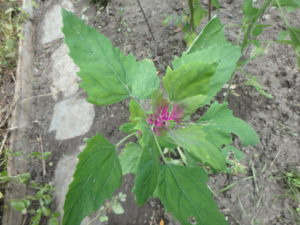
Magenta Spreen
Unlike tomatoes or beans, it’s not obvious when your watermelons or cantaloupe are ready to pick. Melons require one to use all senses, including hearing. Yes, I thump on watermelons and listen for a hollow sound to see if they are ready to pick. Watermelons that are white where they sit on the ground are probably not ready – they should be yellowish. Size counts, too. Bigger is riper.
Cantaloupes are sometimes a little soft at the attachment point when fully ripe, and should smell slightly sweet at the flower end (opposite the attachment point) when dead ripe.
I have never grown luffa before, but it’s not an edible, so I imagine I’ll just let it grow until it stops growing. I’ve read that when it gets lighter in weight and color, it’s ready to pick. Peel off the skin, which should be loose by the time you pick it, and knock the seeds out. Dry until it’s ready to use as a scrubby. Some people smash the gourds against the ground, and then peel off the skin.
Let me know if you have grown something weird and wonderful. I’m always looking for new garden adventures.
Read my blog posts at https://dailyuv.com/gardeningguy. E-mail me, or write me the old fashioned way at P.O. Box 364, Cornish Flat, NH 03746. Send a SASE if you want a reply.
Getting Ready for Guests in the Garden
Posted on Tuesday, July 31, 2018 · Leave a Comment
Summer is the time for spending time in the garden – and for sharing your love of the garden with others. If you want to invite friends – your mother-in-law or perhaps the entire bowling team – to see you garden, here are a few tips.
First, cut the lawn. I know that doesn’t sound like a gardening tip, but your outdoor space looks neater and tidier if the lawn is kempt. I like to cut the lawn on the day of the visit, or the night before. Lawn is the background of the garden, and helps flowers stand out.

Mowing the lawn makes everything look better
And if there are lumps of grass because the lawn was long when you cut it, rake them up. It really only takes a few minutes. You wouldn’t leave towels on the bathroom floor when company was coming, so do the equivalent for your lawn.
If you have as much garden as I do, you can’t make every bed totally weed-free. So here’s what I do: first, I get the tall weeds. Anything taller than the flowers or veggies is going to stand out. And by late summer, tall weeds are present.
Next, get weeds at the front of beds. Try to establish sharp lines for your beds. This can be done with a weeding tool, or even better, with an edging tool. Edging is tedious for me, so I only edge beds at prominent places, such as those in front of the house.
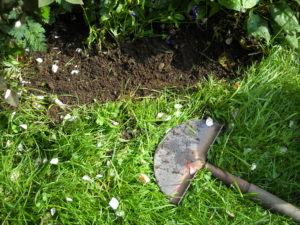
An edging tool helps create clean lines
An edging tool is a steel half-moon on a 5-foot handle. You step on it to slice through the lawn, then tip it back, away from the bed. That lifts up a little soil (and weeds, if they are present) and creates a little moat once you lift out the soil that you just loosened with your edger. This moat or trench prevents grass roots from extending into your bed. The weeds sense a precipice, which could be the Grand Canyon, and the roots stop growing in that direction.
After weeding there may be some big holes in the flower beds. You have a few options. You could put in a piece of garden art or whimsy, or a pot of annual flowers. Most garden centers and nurseries are sold out of annual flowers by now, so you may have to move something from your deck or steps to the garden.
I’ve been growing impatiens in pots on my deck ever since the scientists told us in 2012 that impatiens was subject to impatiens downy mildew, and we could never grow it again. I fear that warning was a “Chicken Little” warning. I did see impatiens devastated by the fungal disease that summer, but I’ve been growing it without trouble since. I can move a pot or two into a shady place that needs color.
Brightly colored geraniums are wonderful for a punch of color for sunny locations. A friend recently gave me 3 pots of geraniums when she moved, and I love them. I set one in my front walkway garden, right in the pot. It picks up a temporarily tepid bed.
Staking flowers that flop is another tough task, but one that makes a big difference in the garden. Bamboo garden stakes and string help, but for tall heavy plants I end up using hardwood grade stakes. I run green plastic tie-up tape around the perimeter of a big plant to contain it. I put the tape about two-thirds of the way up the plant. It is good to tie up plants a week or more before a garden party, as floppy things need time to look good after straightening up.
Mulch. There will always be spaces in the flower and vegetable beds, and mulch will fill in and prevent weeds from coming along. And it looks good, so long as you don’t have bare oceans of it. For flower beds I buy finely ground hemlock mulch by the pick-up truck load. An inch or two of this will keep many seeds from germinating, though it will not exclude grass shoots coming up from roots that escaped my weeding tool.
If you adhere to organic techniques in the garden, be advised that some bagged mulches have been chemically altered. Look for the words “Color Enhanced” on the bag, and avoid those bags. Who knows what they used to color the mulch, and I have seen some leach color in the rain.
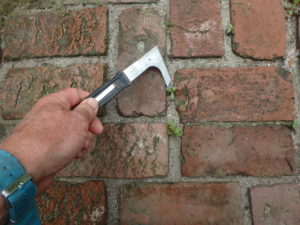
Patio weeder
Clean up walkways. Sweep them, and if needed, weed them. I have a 10-foot brick walkway to my front door. The bricks are set in sand, and ambitious weeds try to sneak in. Some gardeners take the easy route, and spray the weeds with herbicide. But then the brown weeds look awful, and they have to pull them anyway.
I don’t use chemicals, so instead of spraying I use a “patio weeder” to get between bricks. It is an L-shaped tool, thin and flat. It’s great for getting between bricks and generally very inexpensive.
Trimming around rocks and posts with a string trimmer really tidies things up. I now have a battery-powered one. It is so much easier to use than a gas-powered one, so I use it more. It’s a nice way to finish off cleaning up a garden. Then it’s just get out the snacks and drinks – which always improve your guests’ opinion of your garden!
See Henry’s numerous blog posts and photos at https://dailyuv.com/henryhomeyer. You can sign up for an e-mail alert and link to them. His e-mail is henry.homeyer@comcast.net.
Mid-Summer Tasks in the Garden
Posted on Wednesday, July 25, 2018 · Leave a Comment
Oh I how I love the sunny weather we’ve had this summer! It reminds me of the years I spent as a young man working with the Peace Corps in West Africa. There were often 7 or 8 months of sunshine between rainy seasons. And, like there, we need to do some watering if we want to keep our tomatoes happy and healthy.
The best judge of plant water-needs are your eyes. Yes, a finger in the soil will tell a lot, but learning to judge a thirsty plant by the looks of the leaves is an important skill. A thirsty plant has leaves that are dull looking and a little limp. By the time lettuce or leafy greens collapse they are in deep trouble, so pay attention.
I like watering with a watering wand. It is a 30-inch aluminum extension to my hose, with a “rose” or nozzle at the end. By regulating a valve on it you can adjust how much water flows. I walk down the rows of my vegetable garden giving drinks to the tomatoes and lettuce, but not watering the leaves or walkways. Much more efficient than using an overhead sprinkler that waters everything. And it’s very gentle.
It’s not too late to plant seeds. Even if you plant in early August, you have all of August, September and half of October to grow things like lettuce, beans, broccoli and even some annual flowers.
It’s true, for example, that most carrots are 75 days, but some are just 55 to 60. Same for broccoli. Dig out an old seed catalog and look carefully at how many days are needed to reach maturity. We still have at least 75 days of frost-free weather, under normal conditions.
Seeds germinate more quickly now than in the spring because the soil is warm. Just be sure to water every day until they are of a size that can survive a little dryness. Mulching is good to help hold water in the soil.
This year I planted my tomatoes, or most of them, farther apart than I usually do. That, along with the dry weather, has contributed to the nearly disease-free leaves on my tomatoes. Early blight, which turns leaves yellow, brown, then black, has not been much of a problem for me.
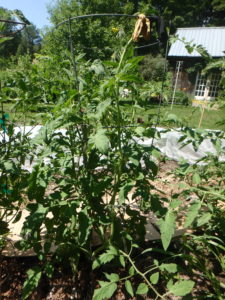
Tomato in need of pruning
If you see tomato leaves yellowing up, cut them off. Open up the bushes by cutting off any branches that are growing in a downward direction, or into the middle of the plant. Those never produce fruit anyway. By cutting them off, you reduce chances of disease spreading and open the middle of the bush to more sunshine. And when a plant gets tall enough, cut off the tips of growing branches to keep it a manageable size- even if it means cutting off a few flower buds.
I contain my tomatoes in cages. I get the 54-inch tall ones, with 4 legs. They are expensive – $7 or $8 each, but worth the money as they last 20 years or so. Of course it’s too late now to cage your plants. But branches of tomatoes laying on the ground are very susceptible to diseases, even if you put down hay for them to lie on.
If your tomatoes are growing out of control and are outside their cages, you have get to work: tie the recalcitrant branches to the outside of the cages. I like strips of old bed sheets, as they are very soft, and much better than twine. I also use green plastic tie-up material sold on rolls. The strips come in half- and three quarter-inch wide rolls.

Tomato after pruning
You can also tie tomato stems to grade stakes. These are hardwood stakes that come as 4-to 6-foot stakes. Push them into your soil, then smack them a few times with a sledge or ordinary hammer. These are good, too, to keep cages from tipping over if you have a heavy load of tomatoes. One word of caution: if you want to work on your tomatoes, only do so when the leaves are dry. Fungal diseases spread more easily when wet.
Many of us get lackadaisical in late summer. August is a hot month, and often humid. Plants are established, and less likely to get elbowed out by weeds, so we don’t always pay attention to weeds. But we should. We never want to let weeds go to seed.
Around the edges of my garden I recently notice lots of 3- to 5-foot tall weeds loaded with seeds. I dug many, using a garden fork to loosen the soil. But when I’m in a hurry, sometimes I just cut off the tall stalks and their seed heads. I always do that with purple loosestrife near my brook, as the roots systems on a mature plant are impossible to pull out. Cutting off the stems helps to prevent the spread of that invasive weed. Don’t put stems with seeds in the compost pile.
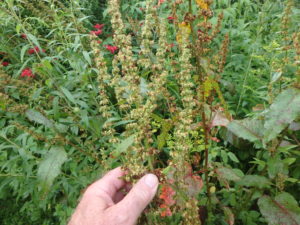
Curled dock is a tall weed that shows up along the edges of my garden
On those days when my list of tasks in the garden seems to get longer, not shorter, I like to pause and remember that gardening is supposed to be fun, not a chore. If I don’t get those weeds pulled today, or my tomatoes pruned, I can do it tomorrow. It’s okay to sit in an Adirondack chair and admire the scenery – even if there are chores to do.
Read Henry’s blog posts at https://dailyuv.com/henryhomeyer. You can get an e-mail alert each time he posts something if you sign up. Henry is the author of 4 gardening books. Reach him at henry.homeyer@comcast.net.
Tips for Building a Stone Retaining Wall
Posted on Tuesday, July 17, 2018 · Leave a Comment
Many years ago, when I was young and foolish, I decided to build an 80-foot long terrace for fruit trees, and to edge it with a nice fieldstone retaining wall using stones I could find on my property or on the nearby property of a friend. It was a lot of work, a lot of fun, and I made a lot of mistakes. That wall still stands 30 years later, but I’ve had to fix it many times.
If you want to build a retaining wall, do your homework! Read up on the process before you start. This article will give you a few basics, but taking a workshop, or working with an expert waller, or reading a book or two will help a lot.
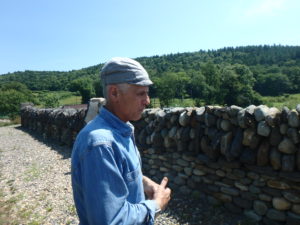
Dan Snow
I recently went to Dummerston, Vermont to talk to master dry stone waller Dan Snow. He is one of the founding members of The Stone Trust on the Scott Farm in Dummerston. Here are a few of his suggestions.
Building a wall that withstands the test of time, it is important to start the wall on a good base that drains well. He recommends digging out a trench and filling it with half- to three quarter-inch diameter crushed stone. This is not gravel, which contains “fines”, meaning sand and clay particles, which is not what you want.
The taller the wall, the deeper the base of crushed stone should be. The general rule he suggested is that the depth of crushed stone should be one half the height of the wall. Building a 3-foot retaining wall? An 18-inch ditch filled with crushed stone is a good start.

Retaining Wall
The exception to the rule of starting with a footing of crushed stone is if you are placing the wall on a heavy clay base. Clay can insinuate itself into the spaces between stones, and clogging the drainage. Sand, however, won’t do that, and can be used as the base. If the wall sits on a base that floods in spring, you may have to install drains to carry away the water.
Dan Snow suggested the 1-2-3 rule for retaining walls. These numbers refer to the proportions of the wall: top width to bottom width to height. A 3-foot tall wall should be roughly 2 feet wide at the base, and one foot wide at the top.
When building any wall, free standing or retaining, it is important to have each course of stone level. And a gentle slope or pitch to the outside of the wall is needed, too. Many wallers use strings and a wooden framework to establish the batter, or pitch of the wall. In general, for every 12 inches of wall height, 2 inches of tip backwards is good.

Free Standing Wall
Another basic principle of building walls, as explained on the website of The Stone Trust (www.thestonetrust.org) is to turn long stones into the wall instead of placing them along the length of the wall. That was a mistake I made many times when building my retaining wall. A nice 30-inch stone placed lengthwise along with wall gives you a nice look, but it is not holding the wall in place the way it would if inserted from front to back in the wall.
Dan Snow also reminded me of the old saying, “Two stones over one, one stone over two.” Which means, never stack similar sized stones over each other. You want each stone to be in contact with more than one stone above and below.
I asked Dan about using landscape fabric behind a retaining wall. I thought that this was a good practice, as it can keep soil from washing into the wall, filling spaces and clogging drainage. If a wall holds water behind it, and it freezes, he explained, the frost can push a wall forward. But Dan is not big on landscape fabric; he would rather just establish very good drainage so that it is not an issue.
Many gardeners who have a hilly site want stone steps to facilitate going up or down hills without slipping on wet grass. We looked at steps at The Stone Trust, and Dan explained the basics: Start at the bottom, and build upwards. Be sure that each subsequent stone sits on the back of the stone below it. The weight of the upper stone will hold the lower stone in place. Finally, be sure that the front of each riser is either vertical, or hangs over any stones supporting it. He said that it is important, when you step down, that your heel not hit a piece of stone that is forward of the lip of the step.
For the past 9 years The Stone Trust has offered classes and multi-day workshops for home gardeners and dry stone wallers to learn the skills needed to work with stone. I wish I had taken a workshop before I ever tried building a wall.
Dan Snow has two excellent books on stone work: Listening to Stone: Hardy Structures, Perilous Follies and Other Tangles with Nature, and In the Company of Stone: The Art of the Stone Wall. Much of what he builds is art or whimsy, and the photos by Peter Mauss are remarkable. Dan’s web site is https://www.dansnowstoneworks.com
Another excellent resource for working with stone is by Gordon Hayward, who is a neighbor and friend of Dan’s, an excellent garden designer, and the author of many fabulous books. His book Stone in the Garden: Inspiring Designs and Practical Projects is full of great photos and very specific, useful advice. I highly recommend it.
Don’t be daunted by stone. Learn to use it well and it will please you every time you go to your garden – even if your walls are not perfect.
You may reach Henry at henry.homeyer@comcast.net or P.O. Box 364, Cornish Flat, NH 03746. He is the author of 4 gardening books, and loves good stone work.

 Click Here to buy from Cobrahead