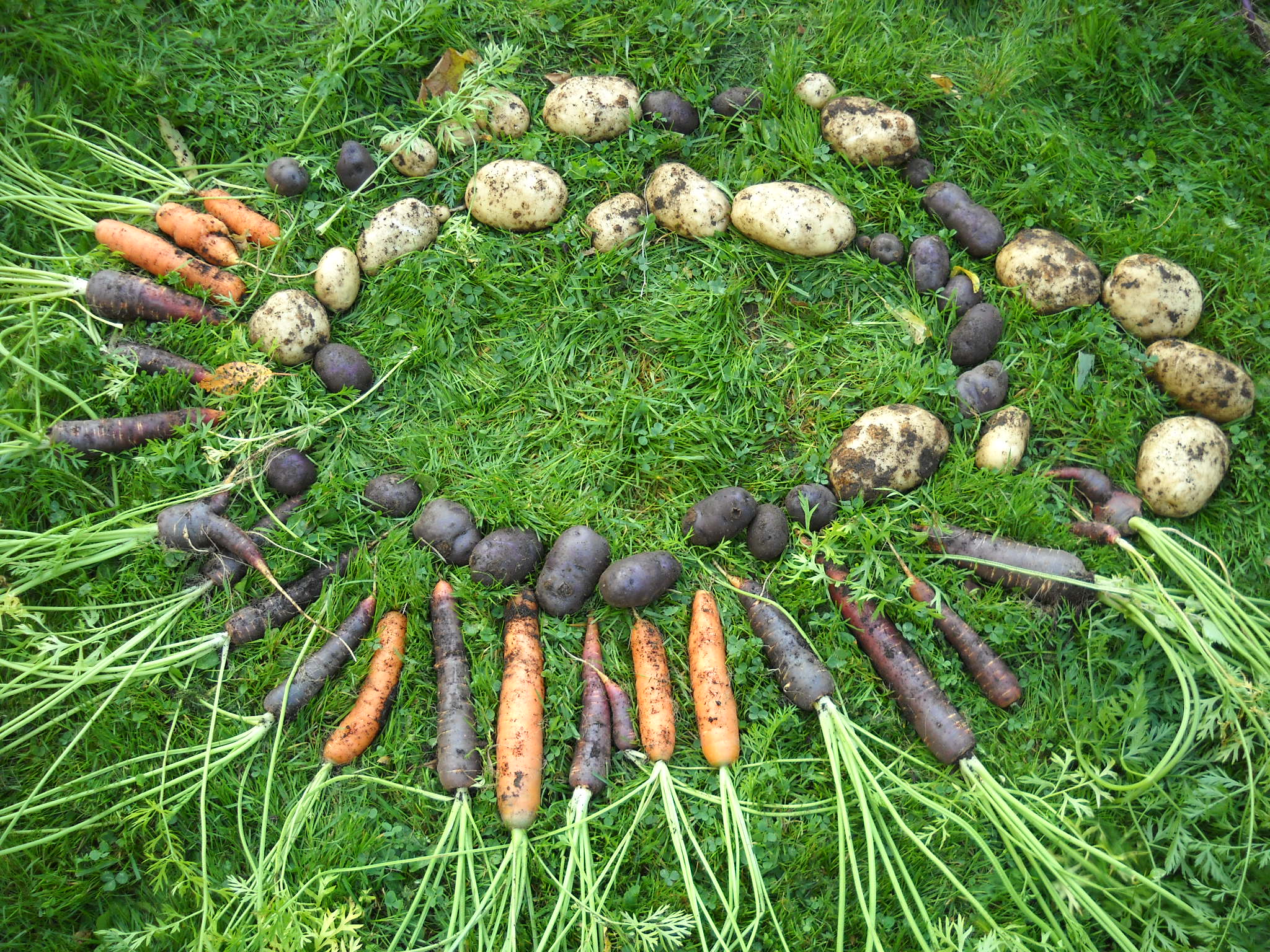
Keeping Hedges Looking Good
Posted on Saturday, August 11, 2012 · Leave a Comment
If you haven’t gotten your hedge clippers out yet this season, it’s not too late to do some work on hedges. And even if you have done some trimming, this is a good time for a tune-up. You can keep hedges to a constant size, but it requires some work once or twice a year – every year.
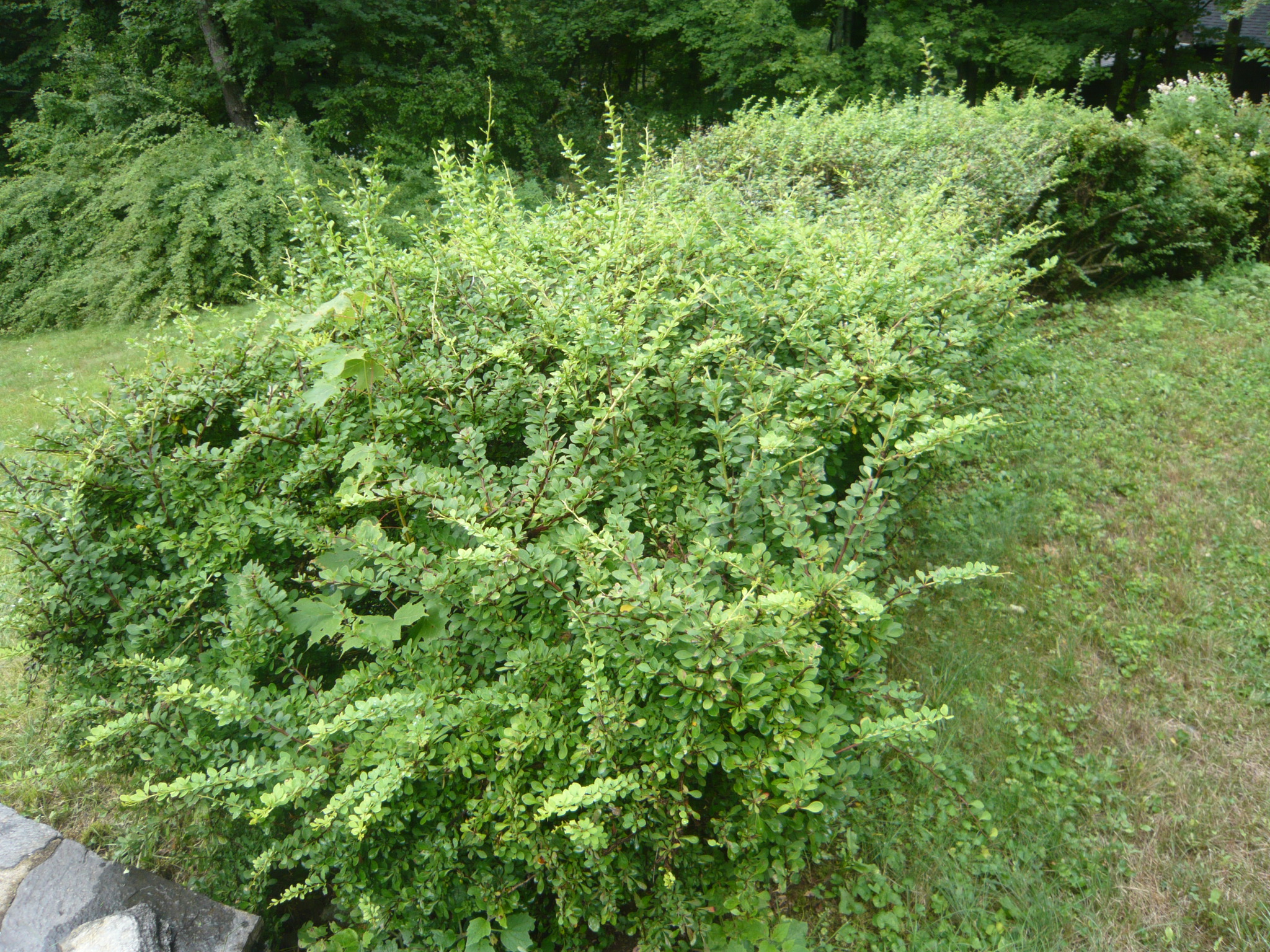
I recently worked on a barberry hedge that had been given a buzz cut with electric clippers last summer, and again this spring. The job last summer was to bring down the height of the hedge by a foot or more, which meant that most foliage was cut off. It looked pretty gawky, like a teenage boy in shorts, all leg. But I knew that would not seriously harm a barberry. Barberries are tough as nails, almost impossible to kill. They are also on the invasive species list in most states.
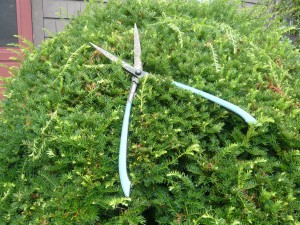
Old Fashioned Hedge Clippers
I decided to use old fashioned hedge clippers, the manual kind, to work on this hedge. I like them because, unlike the powered ones, you can’t do much damage, or at least not quickly. These look like big scissors with 14-inch blades. My goal was to snip off the 6 to 8-inch new shoots that had popped up erratically since its last pruning in May or early June. I wanted to contain the hedge, not change its basic size or shape.
One of the first things I did was to cut out dead branches. These were most prevalent down low, branches that had been shaded out. Then I looked it over to see what kinds of other things had invaded the hedge since its planting. Hedges are great places for birds to rest and nest, away from hungry cats and foxes. That means that birds also drop seeds near hedges, seeds that go through their digestive systems unharmed – and start new plants.
There is an invasive introduced rose called the multiflora rose. These were introduced by highway departments back in the 1950’s, before people understood their potential to take over the understory. Sure enough, there was a multiflora rose that had grown 3 feet above the top of the hedge – in just a couple of months! I crawled into the hedge and cut it off at the base. If I’d been more courageous I would have dug the roots out, too, but that barberry is a pretty prickly customer.
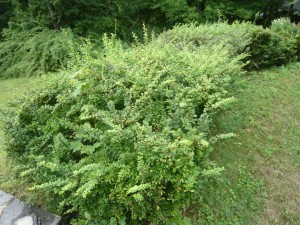
Barberry Hedge in Need of Tune Up
Then I snipped off all new growth that had grown up since its last haircut. I like a hedge that is quite even, so in low spots along the top or holes along the sides I let new growth remain, or trimmed it lightly to encourage it to branch out.
Experts tell us that a hedge is healthiest if it is tapered: it should be narrowest at the top and spread wider as it gets to the ground. That way all the branches get sunshine, even the lowest ones. But most people don’t trim their hedges that shape, so the lower branches die out from lack of sunshine. Hedges spread out at the top, so that before long they are shaped like a “V” – unless you really work at preventing that.
I called Cal Felicetti, a consulting arborist who works for Chippers, Inc in Lebanon, NH and asked him how much a hedge needs to taper. He said an 8-foot tall hemlock hedge should be about a foot wider at the bottom than it is at the top. That way, not only do all branches get sunshine, the hedge sheds snow better – particularly if the top of the hedge is gently rounded. Stand at the end and look down the hedge, he said. The taper should be obvious, and the lines straight.
Cal also said that if you have a tall hedge, consider investing in a good orchard ladder. These ladders have a hinged leg that you can plunk right into the hedge, allowing you to get to the top of the hedge and do a good job of shearing it. A standard step ladder puts you far away from the top of the hedge, encouraging you to take risks leaning over to reach it – or to just give up.
Cal’s last bit of advice was to buy good tools and keep them sharp. I agree. If you buy good tools they’ll last a life time, and longer. Pruning tools need regular sharpening, but once you learn how to do it, it’s easy.
If you like a formal looking hedge, prune now or even later. Hedges are pretty much done growing until next spring, so they’ll stay smooth and even. If you like a more informal look, prune earlier next year and allow your hedges to get fuzzy all over. The main thing is consistency- you can’t afford to skip a year or two, and hope to catch up later. And remember to taper those hedges, they need to be widest at the base.
Henry Homeyer is the author of 4 gardening books. His Web site is www.Gardening-guy.com.
Garden Wimsy
Posted on Wednesday, August 1, 2012 · Leave a Comment
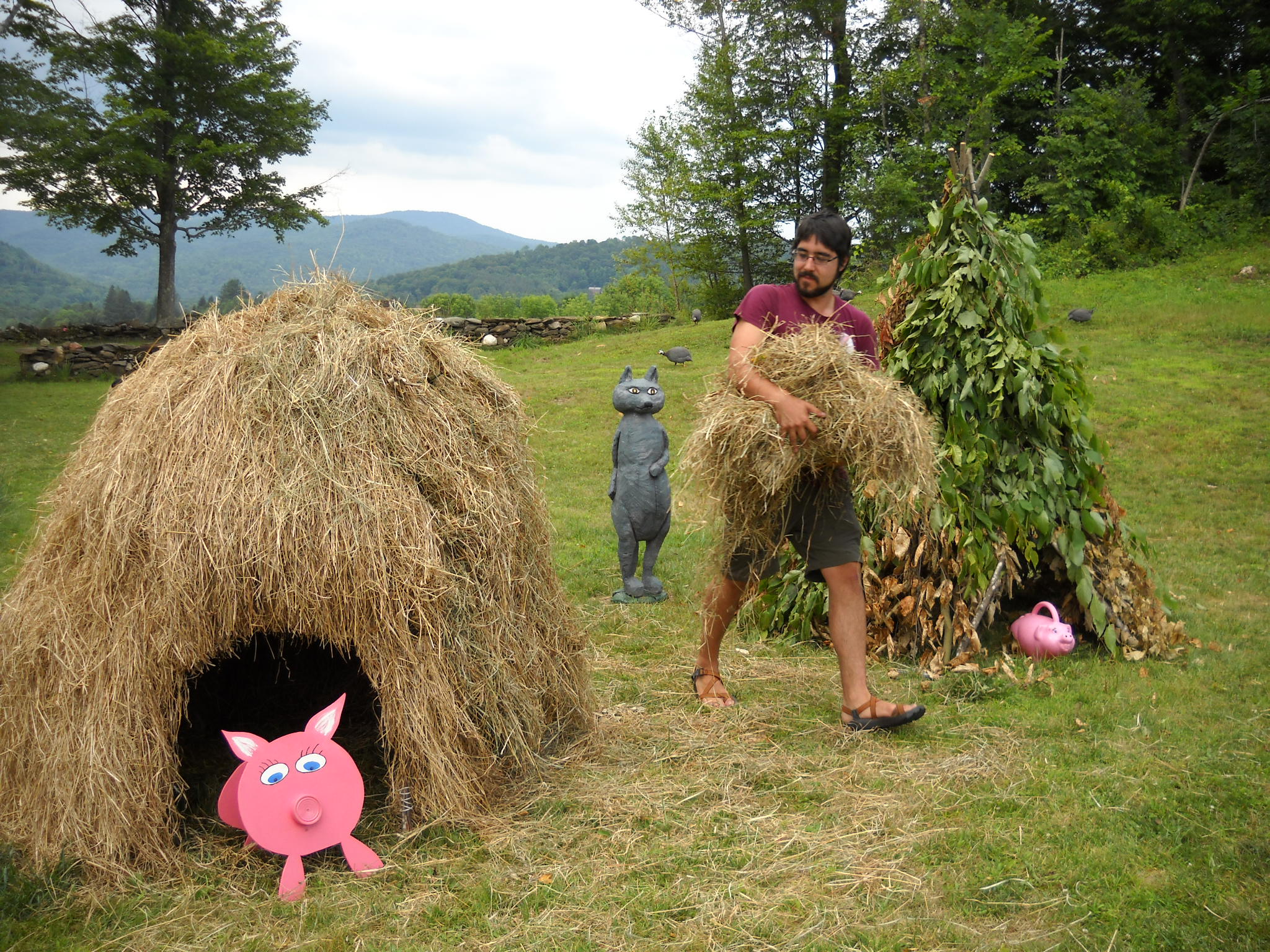
If you ask my grandchildren, they would probably tell you that “Silly” is my middle name. George may remember the time Grampy showed up at his house wearing one red high-top sneaker, one purple. Or Casey might tell you about the Superman cape on the scarecrow that is currently in my garden. So they were not surprised to see that, with some help, I have put together a full-sized representation of the story of the Three Little Pigs, complete with pigs and a wolf. I love garden whimsy, and encourage you to think about creating outdoor art for your own garden. It doesn’t take great skills to create something fun.
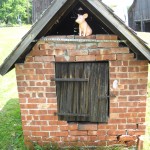
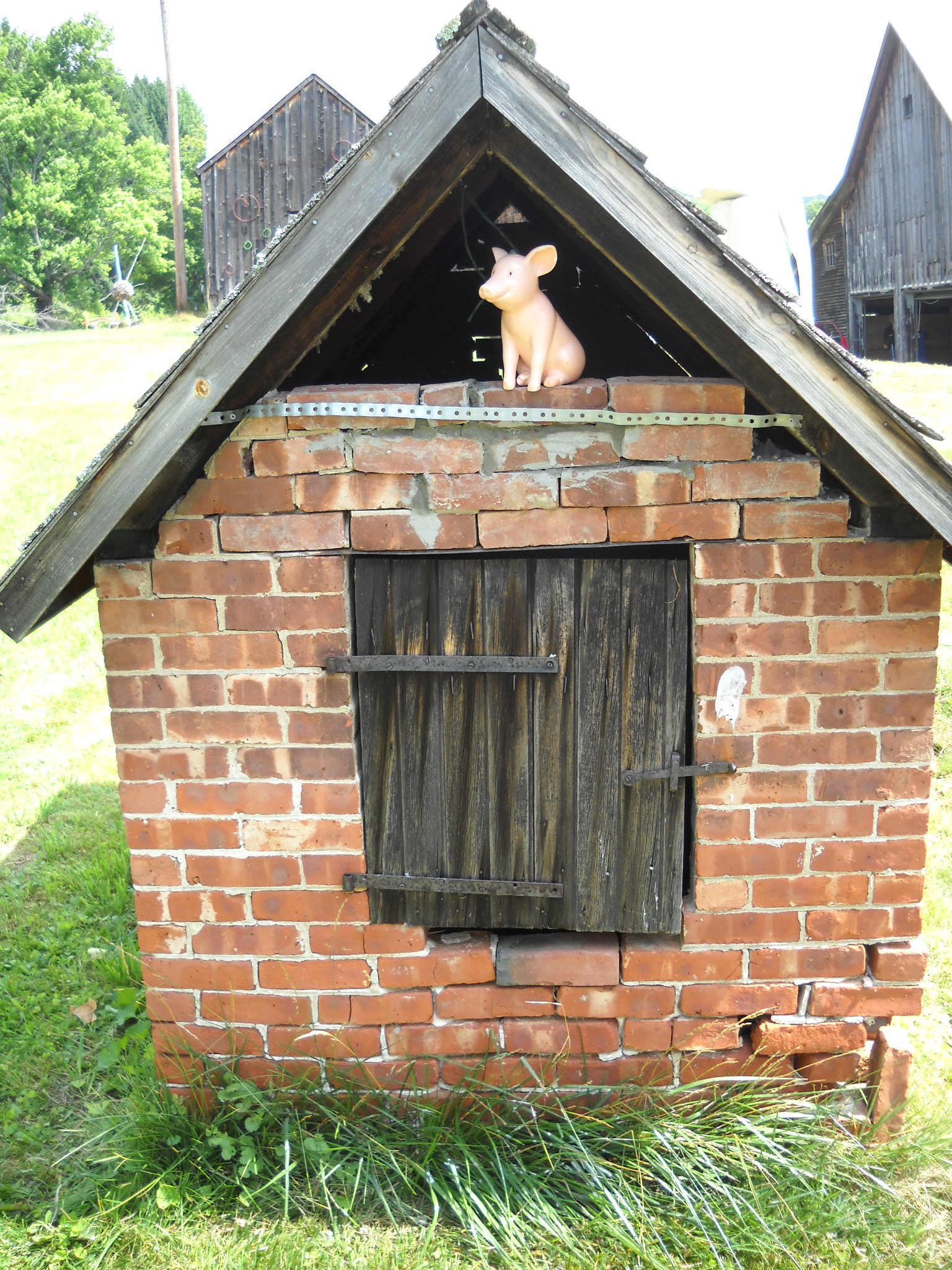
Brick house
This particular whimsy is on public display in Woodstock, Vermont at the Vermont Land Trust offices on Hunt Farm Rd, off Rose Hill Rd. It is part of an event called Bookstock – a one day event that has already passed by. But the Poet’s Trail, which is under the auspices of Bookstock, will continue into the fall, overlapping with Sculpture Fest which is held nearby. It features poems by Mary Oliver selected by Woodstock High School students that are posted along the trail, and lots of fabulous sculpture along the trail, in the fields, and around the old farmhouse. There’s a little whimsy, too.
At the farm there is a tiny old brick building (just 5 feet square and 6 feet tall) built long ago to store ashes, presumably for making soap. Charlet Davenport, the organizer of the Poet’s Trail event, told me she thought the brick house would be great as part of the Three Pigs story, but needed someone to build a straw house and a stick house. I agreed to do so.
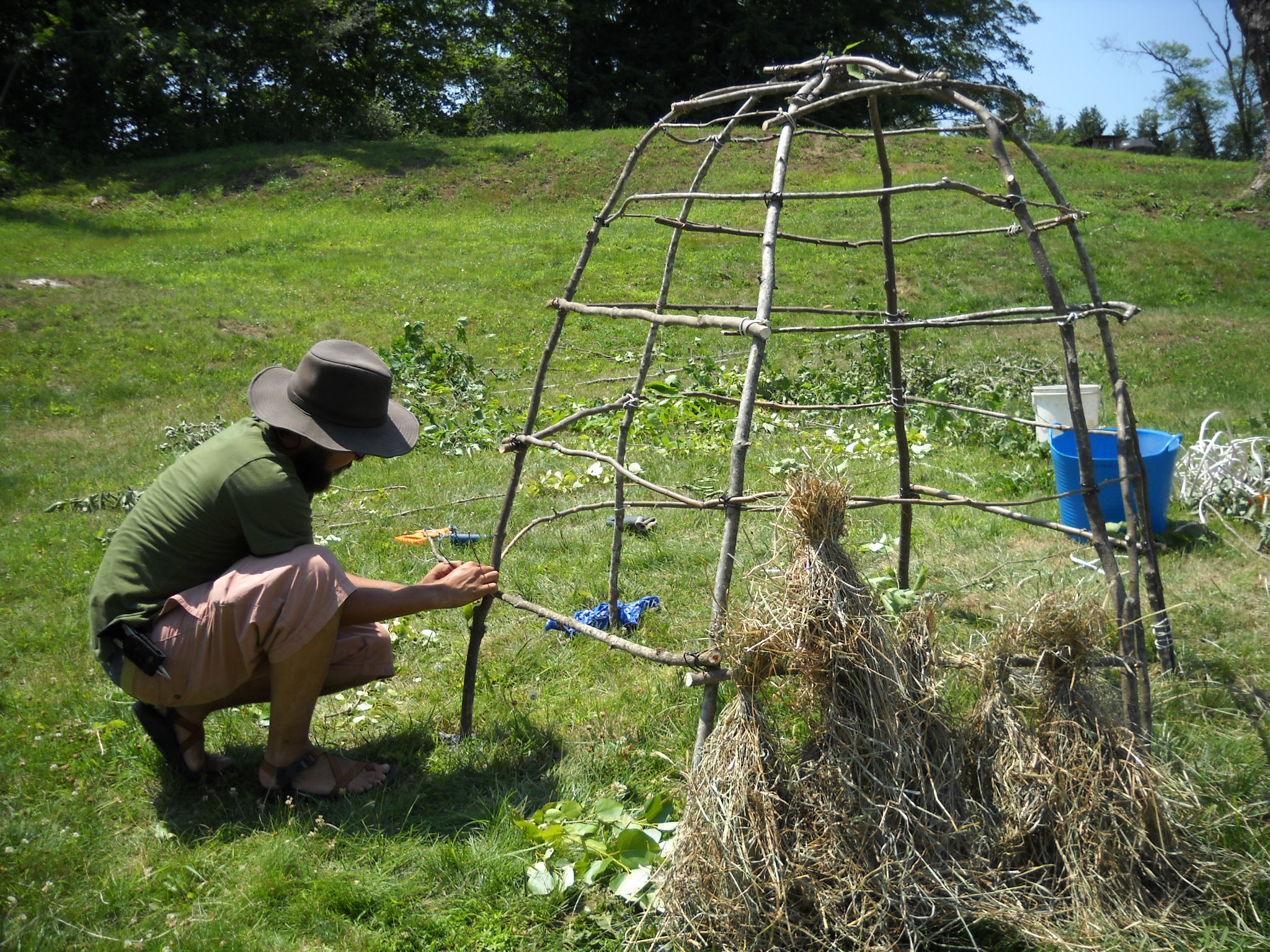
I built the houses with the help of my summer intern, Gordon Moore. They are circular and 6 feet in diameter at the base. The straw house has a rounded top and the stick house is built like a teepee.
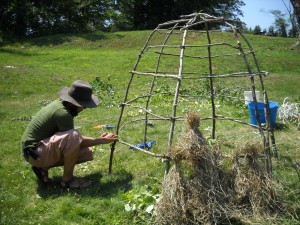
Framework for straw house with Gordon
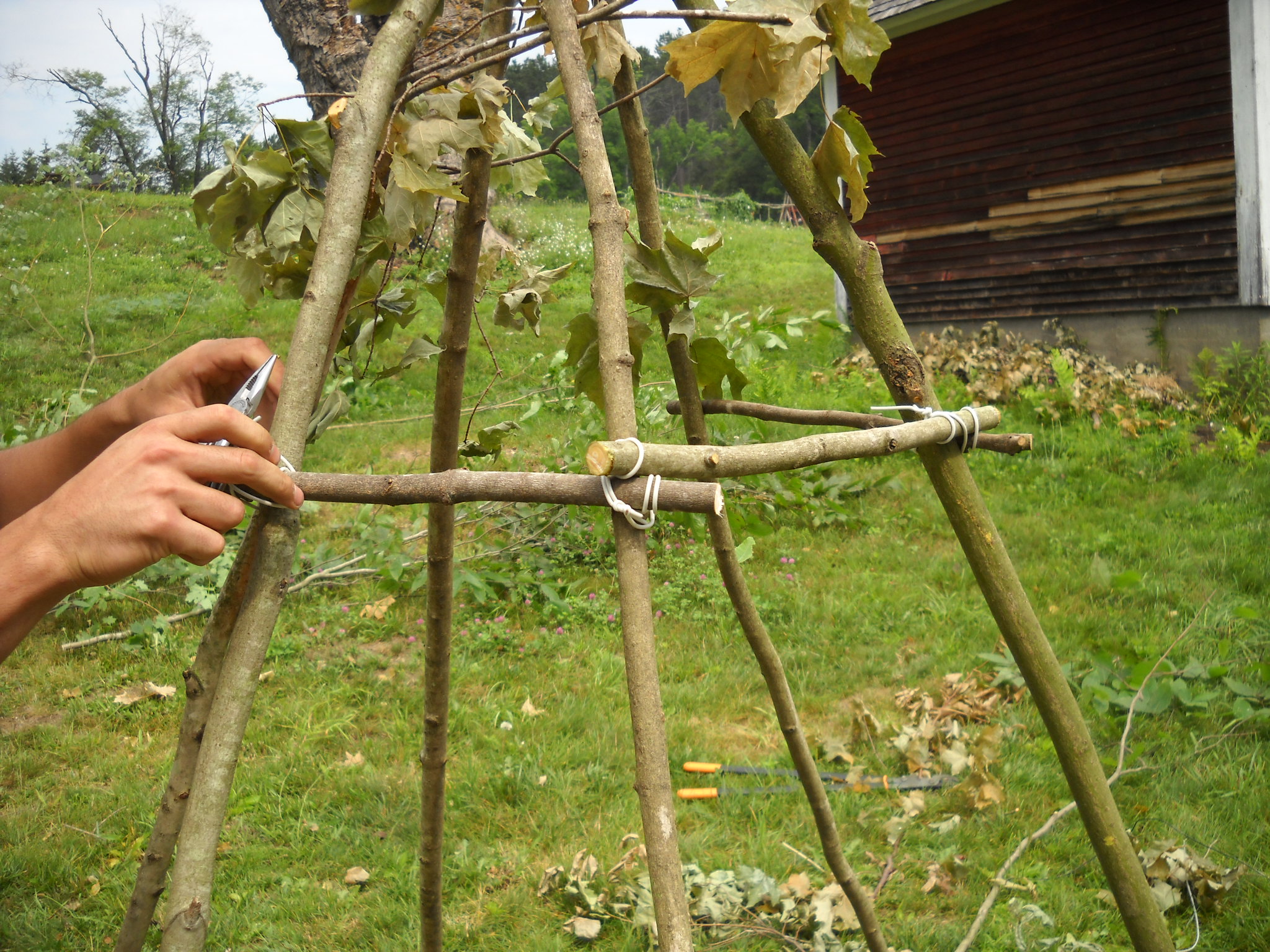
The houses are made with freshly cut saplings, each an inch or two in diameter and 8 feet long. We stripped off side branches and leaves, and then dug 6-inch deep holes for each sapling. After placing the sticks in the holes we tied them together at the top using copper wire that we stripped out of scrap #14 building wire that I had left over from the days when I was an electrician.
For the straw house we bent over opposing sticks, overlapping them and tying them together for a foot or more, creating a domed top. For the stick house we tied 3 together as if we were building a teepee, then added 3 more in between the first three. Once that was done, we filled the holes in the ground with soil and some gravel to firm it up and keep each stick in place – just in case a wolf wanted to huff and puff at our pig homes.
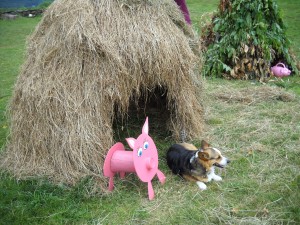
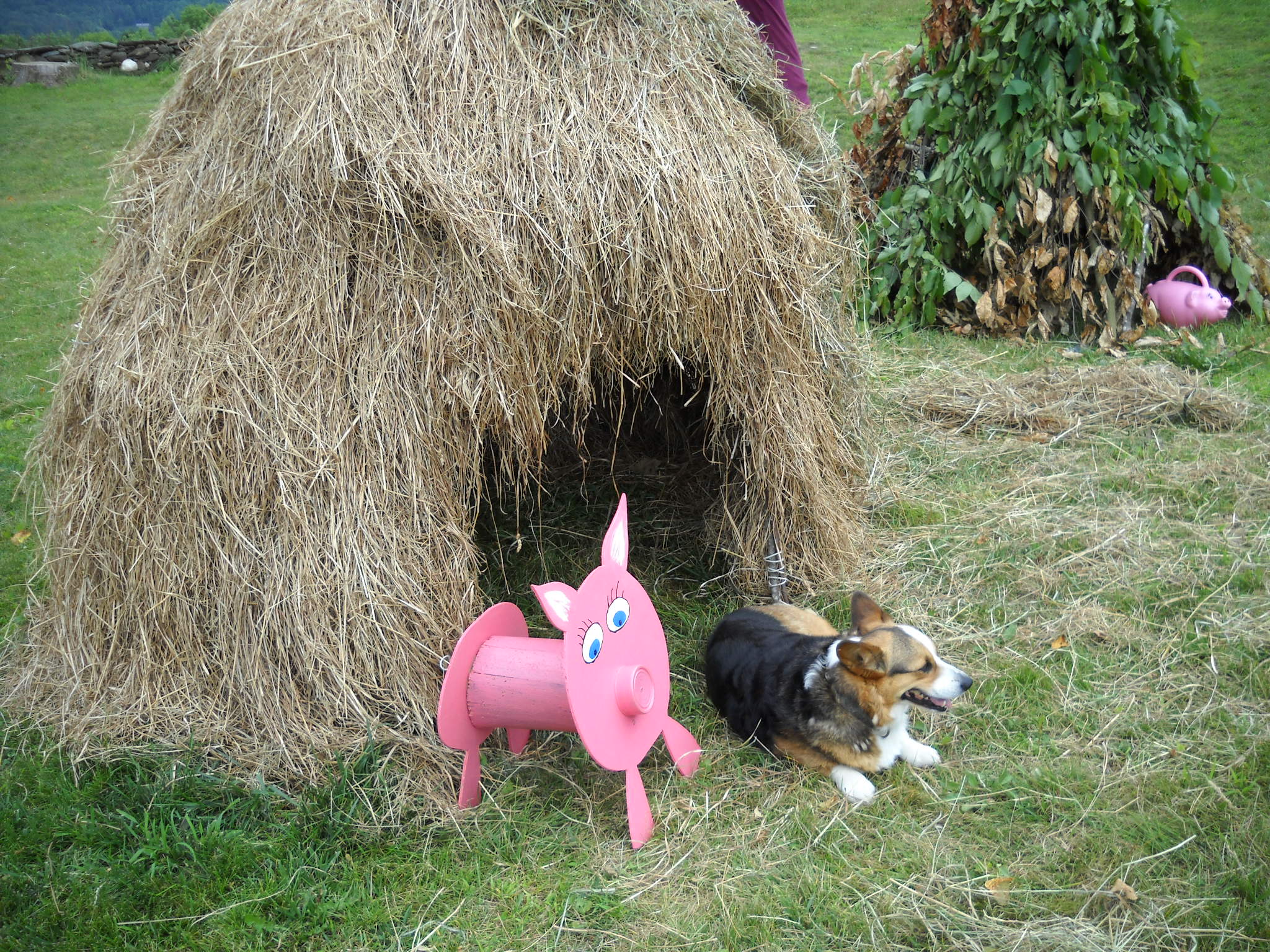
Straw house with pig and Daphne, the writer’s dog
Then the real work began. We took small diameter sticks (half to quarter-inch) and tied them around the outside of the houses with wire. We did 5 or 6 concentric circles descending around the outside of our little pig houses. That provided stability and places for us to tie on bundles of straw (actually, we used hay, not straw, nearly 2 bales of it) or clumps of twigs with the leaves left on. We needed to create something that enclosed our structure but was not so solid as to deter the mythological wolf.
For the straw house we tied more than 150 clumps of hay. We used ordinary 3-stranded garden twine, which was strong enough to tie our bundles together without breaking when we cinched them together. For the stick house we made similar bundles, using the side branches, leaves and all, that we had cut off our saplings that we used for the framework. The stick house was easier – we could make 2-foot long bundles that quickly covered the exterior of the stick house. I found that using a knot I learned in Boy Scouts, a clove hitch, to tie the bundles together worked best.
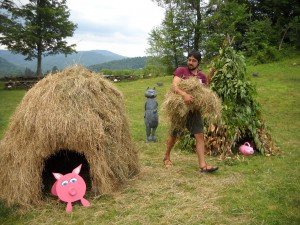
Three Little Pigs
I had a nice pig watering can (made of plastic) and a ceramic piggy bank, but needed a good-sized pig for the straw house. My partner, Cindy Heath, sketched out the face and front legs of a pig onto a piece of quarter-inch birch plywood, and I cut it out with a jig saw. Then we made the back end of the pig, and I screwed each end onto a short pine log about 6 inches in diameter. We painted it pink, Cindy painted on eyes, and I attached a tuna can for a snout. It looked great – and undoubtedly tasty to passing wolves.
I called the former mayor of Hanover, Marilyn “Willy” Black to ask if I might borrow a wolf. She is a chainsaw artist, and agreed to lend me the original wolf she made many years ago. She re-painted it, and I installed it in a menacing pose behind the houses. Beware, pigs!
All together Gordon and I spent about 15 hours each making the 2 houses, and Cindy and I spent another hour each on the pig.
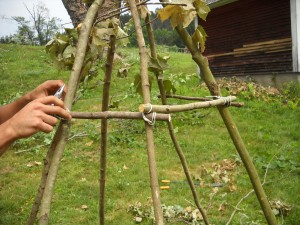
Detail, frame of stick hous
One could look at this as a colossal waste of time, or perhaps as a worthy endeavor – given that this exhibit will create plenty of smiles and a few giggles from my grandkids. Think about creating something fun (or silly) for your own garden – especially if you have kids or grandchildren.
Henry’ Homeyer lives and works in Cornish Flat, NH. You may write him at P.O. Box 364, Cornish Flat, NH 03746 or henry.homeyer@comcast.net.
What to do in Hot, Dry Weather
Posted on Wednesday, July 25, 2012 · Leave a Comment
We New Englanders are pretty lucky. Much of the country is saddled with a hot dry spell reminiscent of the dust bowl era of the 1930’s. I’ve seen pictures in the paper of wizened corn and unhappy farmers scratching their heads and looking up at a cloudless, unforgiving sky. We’ve had more than our fair share of hot days – in the high nineties, even – but so far I’ve had at least a thunderstorm once a week. Each week vegetables (and many flowers) need one inch of water –either from the sky, or from your watering can – but we don’t always get that.
Recently I went to water the garden of a friend who was away for a week. The soil was as dry as powder. She had planted pole beans before she left, and they should have sprouted, but had not. I watered the bean plot, but water from the hose wouldn’t penetrate the soil. It just ran off. So I scratched the surface to loosen up the crust on top, and re-watered a few times using a watering can, giving it a slow sprinkle. Finally it worked: when I poked a finger into the soil it was dark and moist for at least 2 inches. Then I spread a light layer of straw over the soil to shade it.
Imagine yourself marooned on a desert island. No shade? You bake. Add a palm tree or two, and you survive nicely. Same for your lettuce and tomatoes. The plants love the sun, but their roots need some shade in hot, dry times.
In the vegetable garden I favor a layer of newspapers – 4 to 6 sheets thick – covered with straw, hay or leaves. I keep the newspapers away a little from the stem of each plant, as I want moisture from light rains to reach the soil. Straw comes from grain crops that have been threshed, so it is not supposed to have seeds (though it always has a few). Mulch hay always has seeds; it is grass grown for fodder for cows and sometimes it gets spoiled as feed (by rain) and sold cheaply to gardeners. The price difference is considerable – $3 for hay versus $10 or more for straw, so I generally use hay. The newspapers help to keep seeds out of the soil.
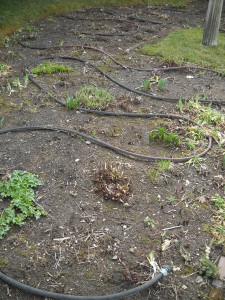
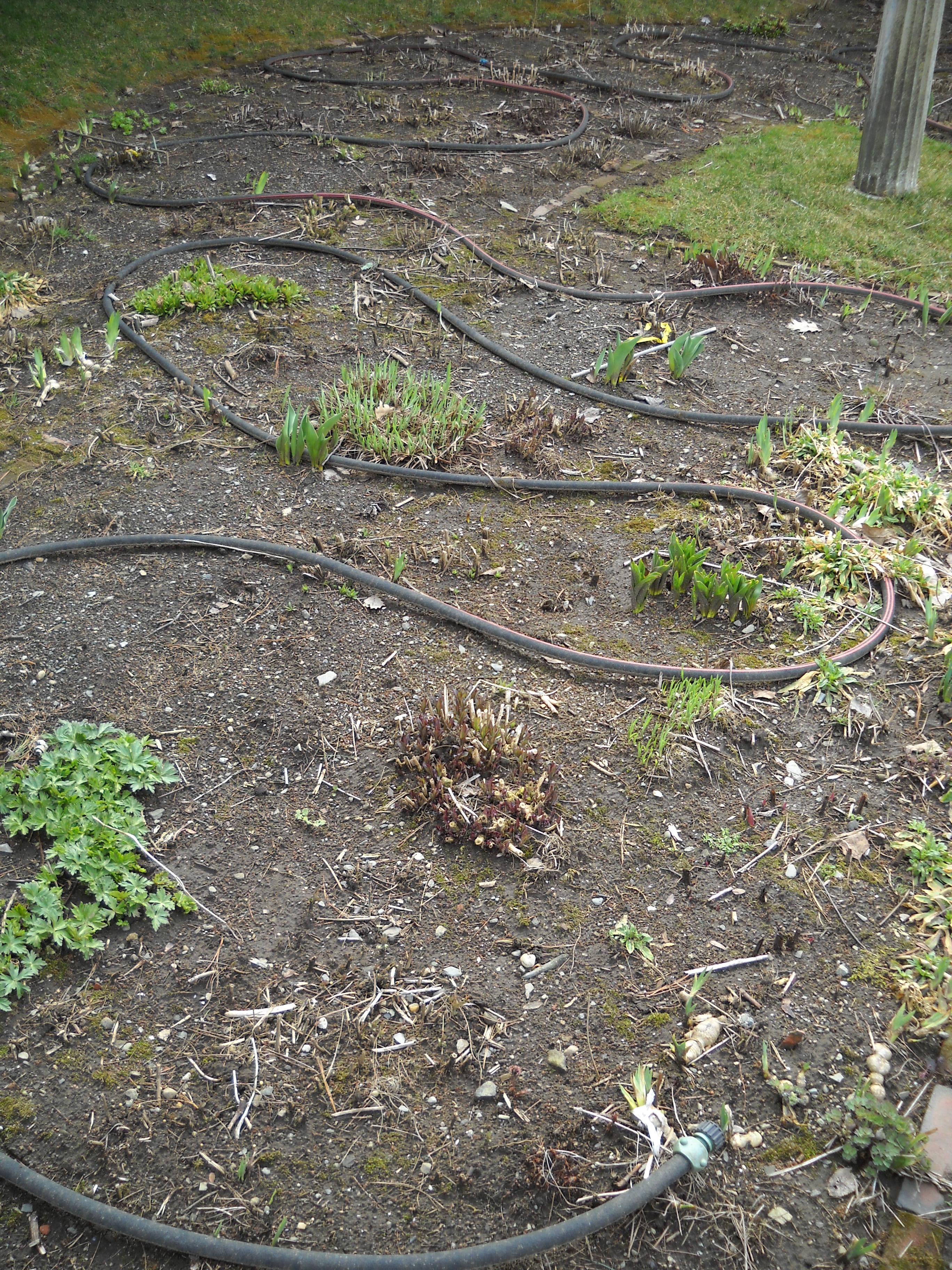
Soaker hose in flower garden in fall after clean up
What kind of watering device is best? I’ve tried plenty of them, most recently soaker hoses. Soaker hoses are designed to leak. They are a rubber-like substance that is somewhat porous. They ooze water their entire length, and that water spreads out for about 6 inches around each hose. I installed a pressure regulator and a filter to keep particles from the water source (a pond) from clogging the pores of the soaker hose. Still, some rows – or sections of a row- got more water than others – and not in a predictable way. So some plants got little or no water, some got too much; a few rows had perfectly even distribution.
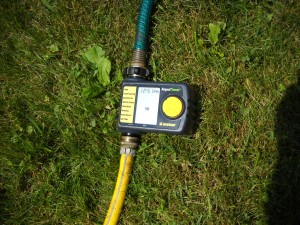
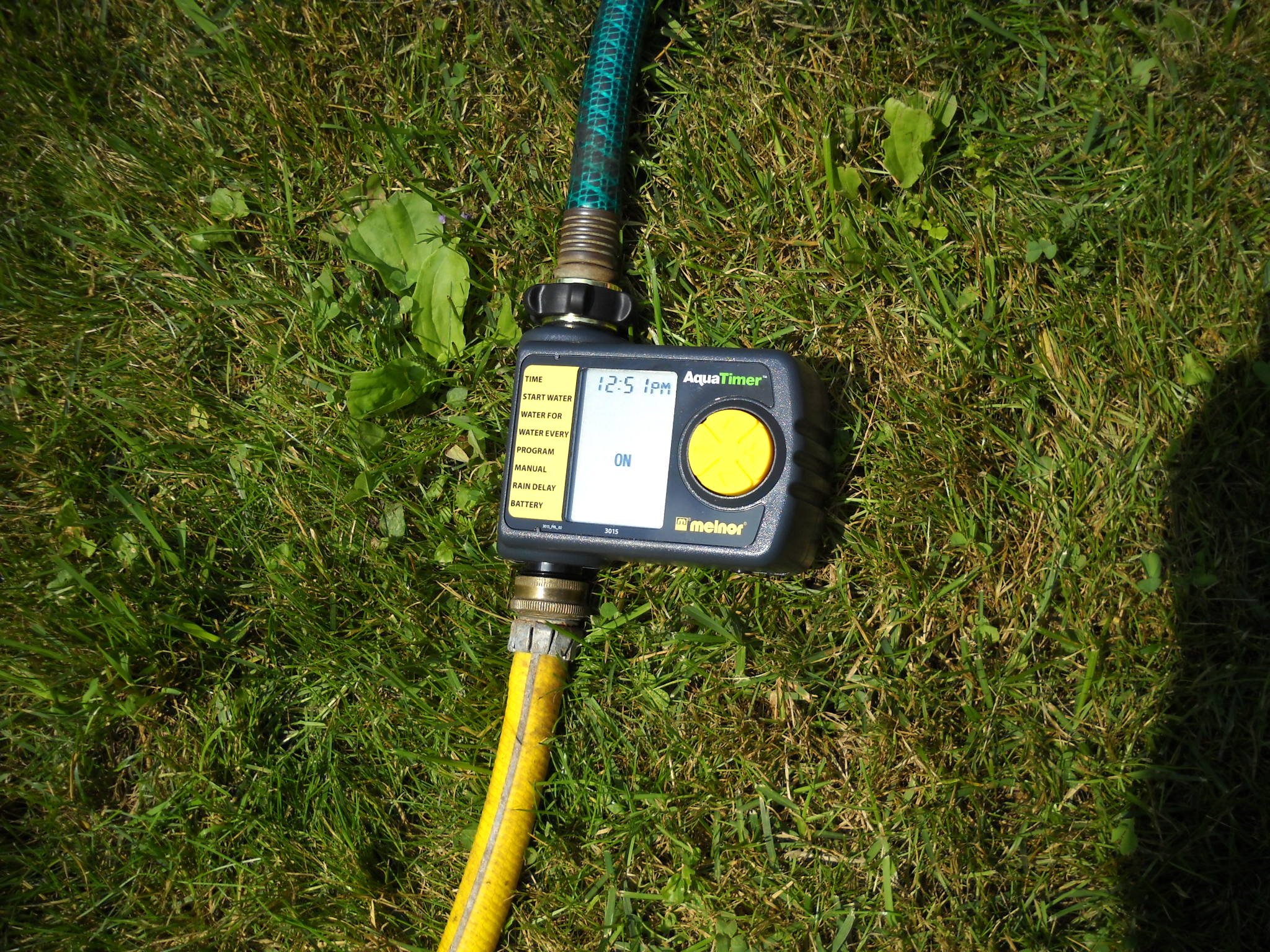
I also installed a timer, which allowed my client to go away and know her beets or tomatoes were being watered in her absence. Timers work, but get the simplest kind possible. I have installed some that you have to program, and find those can be aggravating. I like a simple one that comes on every day at the same time, but allows you to set how long the hose will run. Test it well – before you go on vacation.
While working as a WWOOFer on a willow farm in France a few years ago I set up an emitter watering system; it worked a lot better than the soaker hoses. (WWOOF stands for Willing Workers on Organic Farms; see www.WWOOF.org for details). The system ran three quarter-inch plastic feeder lines down the rows of plants. I used a special tool to punch holes in the feeder line and inserted barbed connectors that attached to quarter-inch lines. Each small line went to an emitter that delivered a measured amount of water per hour, depending on plant needs. Some emitters just oozed water, other types sent out a spray to cover 2 square feet or so.
 One nice thing about an emitter system is that you don’t end up watering the weeds: if you put an emitter at each tomato plant, for example, the space between plants is not watered the way it is with a soaker hose. And you can see (and replace) an emitter that gets clogged and does not deliver water. I can’t figure out why most garden centers on the East coast don’t sell these systems –every hardware store in California does.
Lawns in August can look pretty brown if a watering ban is put in place – especially if you only use chemicals on your lawn. Lawns that are given compost every year and have biologically active soil seem to do much better at staying green in dry times. It also helps to keep the grass longer in August – taller grass helps to shade the soil, like those palm trees mentioned above.
We’re all largely dependent on the heavens to provide our lawns and gardens with rain. But if we treat our soil well and provide plenty of organic matter, everything does better in times of stress – including the gardener.
Henry Homeyer is a garden designer and the author of 4 gardening books. His Web site is www.Gardening-guy.com.
Mid-Summer in the Vegetable Garden
Posted on Wednesday, July 18, 2012 · Leave a Comment
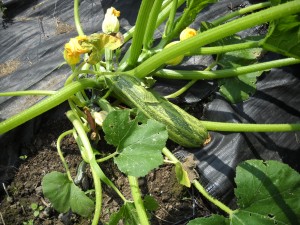
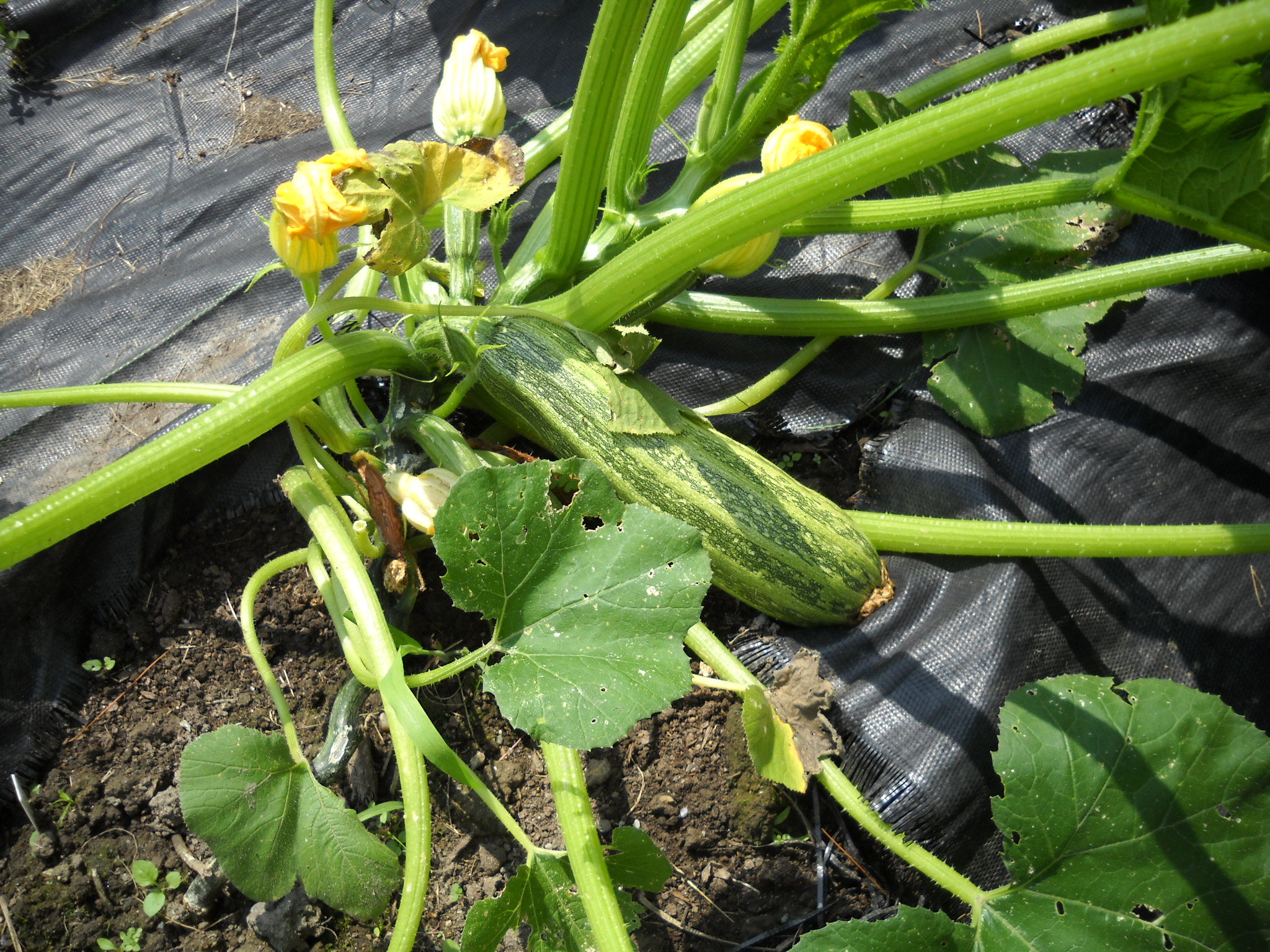
Romanesco Zucchini
Summer squash of all sorts are ripening up nicely, so I know it’s mid-summer in the vegetable garden. Soon gardeners will be dropping off bags of squash in unlocked cars, on porches, and, occasionally, on seats of buses and in public libraries. When you’re not distributing the booty in creative ways, here are some suggestions for tasks in your vegetable garden now.
If you see lower leaves of tomato plants browning up, snip them off with a sharp pair of scissors and dispose of them in your trash, not the compost. It’s a good year for tomatoes, so far. No late blight, not much early blight for most of us. On a recent tour of my 32 tomato plants, I only found a few that had any discolored leaves at all. This may be due to the fact that when I installed tomato cages in June, I cut off lower leaves that might touch the ground. Most leaf diseases are soil-borne and spread by splash-up. So removing lower leaves, even now, is a good practice. Mulching with leaves, straw, hay, pine needles or grass clippings helps prevent disease, too.
I’m eating edible-pod peas and freezing some for the winter. I blanch them briefly – about 60 seconds- and drop them into cold water before patting them dry on cotton towels, and then freezing them in zipper bags. Once the crop is finished I’ll have a nice 10-foot section of wide raised garden bed for planting late season veggies. Here are some possibilities of ways to use that bed:
1. Fall radishes. I buy seeds for one called ‘Red Meat’ in the Johnny’s Seeds catalog that I love. It only works if you plant it in mid-to late-summer. It is very mild, and pretty on a plate. Pink centers are surrounded with a band of white, then green – just like a watermelon. It is tasty even if grown 3 to 4 inches in diameter. I serve it with a vinaigrette sauce. At the Cornish General Store I found seeds by Agway for a fall radish called Chinese White Winter; the packet says to plant after August 15. It grows to 5 inches long or more, stores well, and is mild. I shall try it.
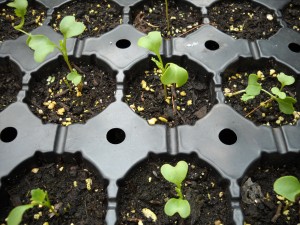
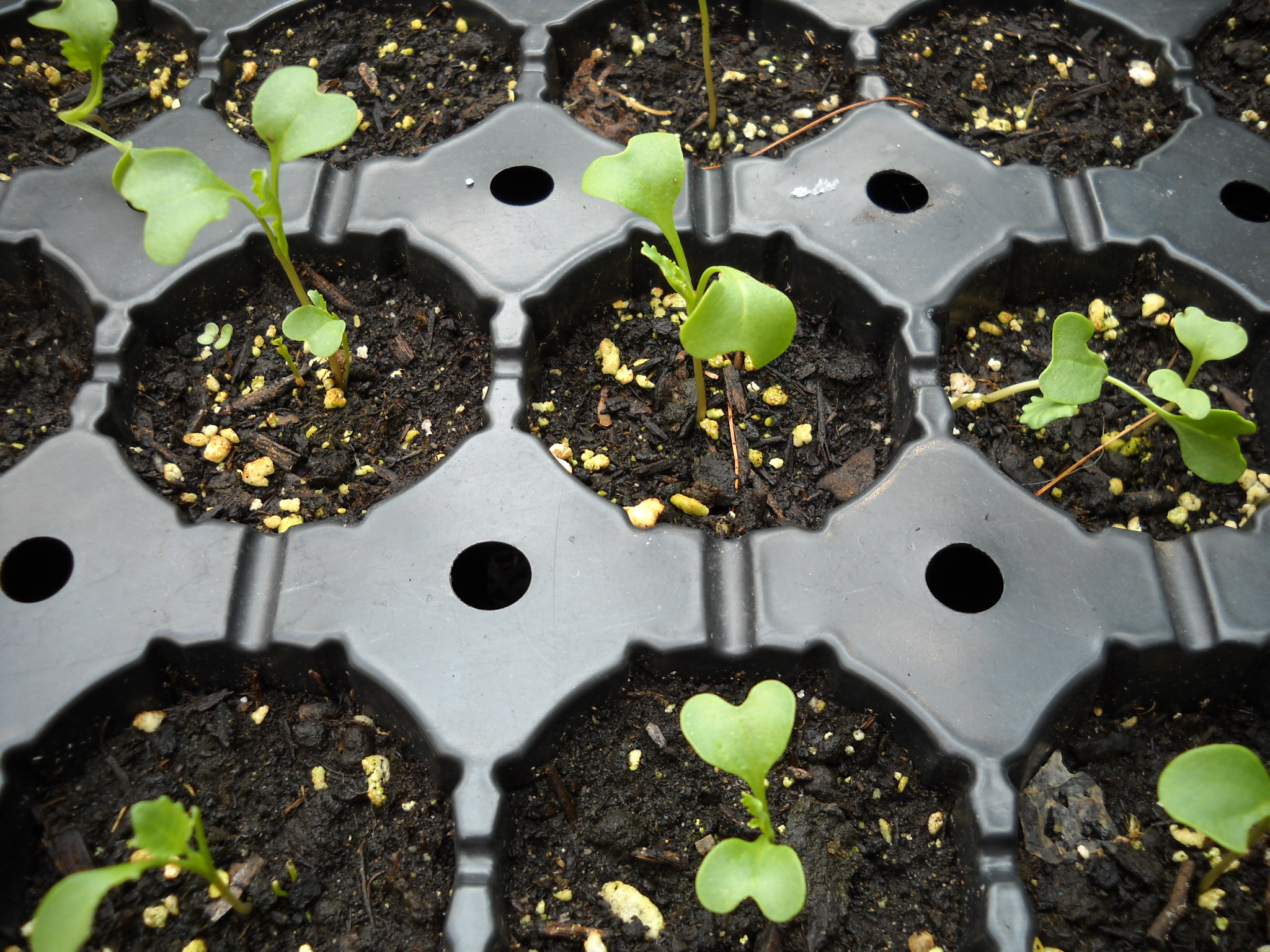
Broccoli Starts
2. Late season broccoli. Start some by seed now in cell packs, transplant into the garden when they are 2-3 inches tall. You’ll have full sized heads in 55-65 days. Or buy seedlings now if you can find them. Broccoli produces well into the fall as it is very frost hardy.
3. Bush Beans. I have 2 plantings already, but I could do a third planting for the freezer. ‘Provider’, a reliable variety, takes just 50 days from planting to harvest, and will produce for 3 weeks or more. If you plant today, you should be able to harvest plenty before frost.
4. Lettuce. Fall lettuce is crisp and tasty. Plant directly in the soil, or if you have no space now, plant in cell-packs, and plant when you have space.
Other tasks now? Scratch in a little rock powder or wood ashes around pepper plants. Peppers produce late in the summer, and can be stimulated to be more fruitful, sooner, with a dose of rock powder now – a quarter cup per plant. For more information on rock powders, see my latest book (Organic Gardening (not just) in the Northeast: A Hands-On, Month-by-Month Guide), which should be available at your local library or bookstore. Azomite is the name of one commercially available rock powder.
Your asparagus patch should not be ignored, just because the season is over. Make sure grasses and weeds don’t take over the bed, and water weekly in dry times. I mulched mine with ground branches I got from a local arborist. The chips keep down weeds and hold in moisture.
Make pesto. Basil is more productive if you keep picking leaves or even cutting off the top third of the plant. There is only so much basil you can put in a salad or on a sandwich, so make some pesto and freeze it for the winter when we all crave green things from the garden. The basic recipe contains basil, garlic (lots), parmesan cheese, olive oil and pine nuts. In recent years, pine nut prices have peaked over $20/pound, so I have been using walnuts or hazel nuts, both of which taste just fine.
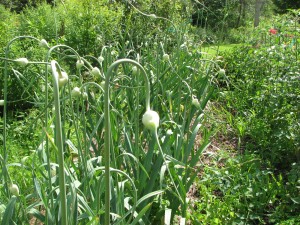
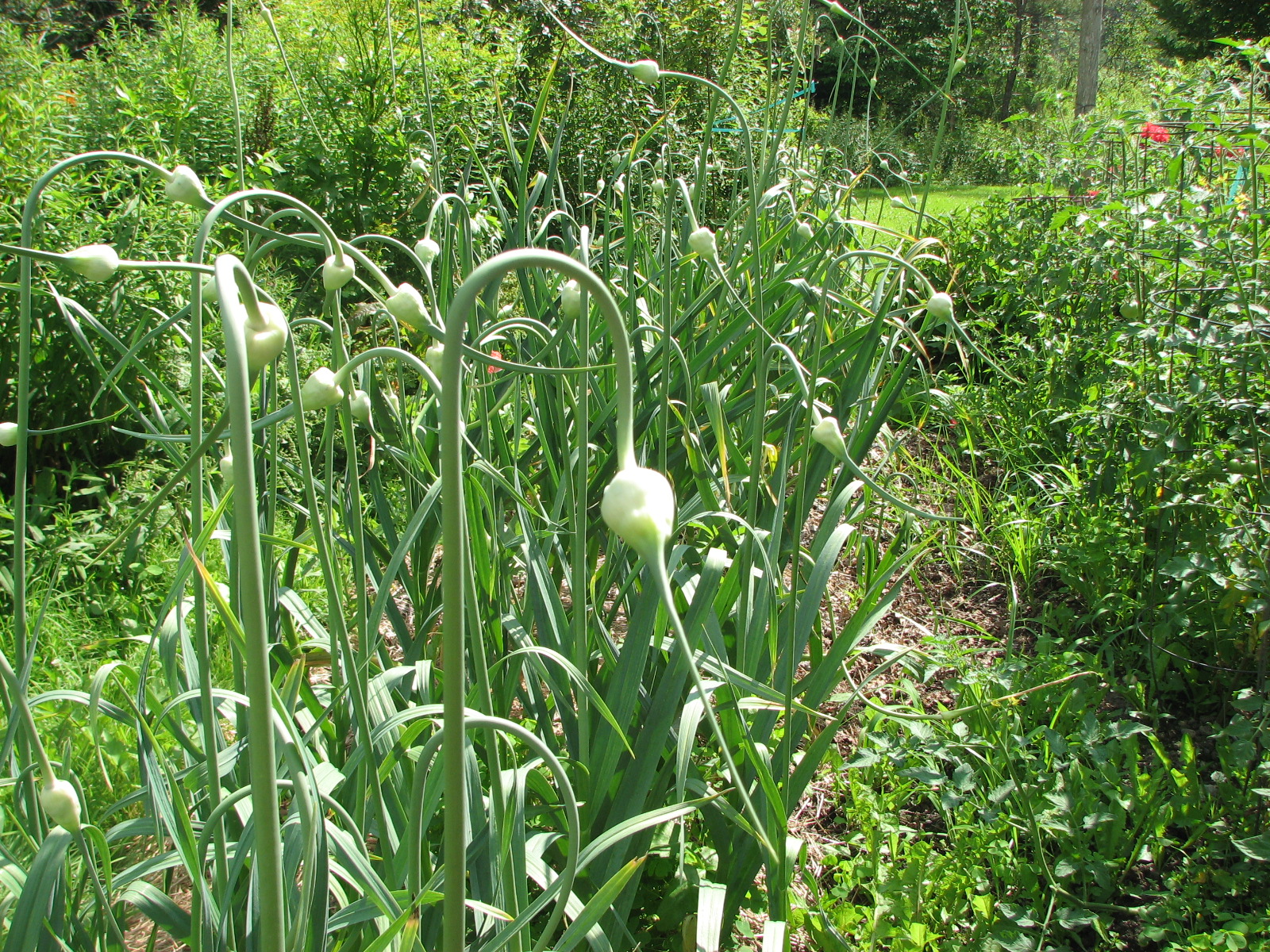
Garlic Scapes
My garlic is getting mature earlier than usual this year. When the tops, called scapes, curl around in loops it is time to harvest those scapes and use in stir fries. Chop and sauté in olive oil to add to other vegetable dishes. The heads, or bulbs, will continue getting bigger for a few more weeks- but I have already nabbed a couple to use now. When you do harvest your garlic, it is best to let it cure for a couple of weeks in a shady, breezy location before you cut off the tops.
It’s easy to get lackadaisical in the heat of the summer, but weeding is still important if you want your best production. It is also important to keep weed seeds out of the soil to minimize your work next year. So keep weeding, but at the end of the day settle into an Adirondack chair near the garden and admire your handiwork as the sun goes down.
Henry Homeyer is a garden consultant, teacher, coach and the author of 4 gardening books. His web site is www.Gardening-Guy.com.
Mid-summer in the Flower Garden
Posted on Wednesday, July 11, 2012 · Leave a Comment
I love George Gershwin’s Porgy and Bess, particularly that song about summertime, when the living is allegedly easy. Fish are jumpin’ and the cotton is high, and all that. Well, it’s mid-summer and the gardening is just as busy as ever, the weeds are high and who has time for fishing? But I’m not complaining. I love the garden and the weeds give me an excuse to avoid cleaning the basement. Here are some of the mid-summer tasks I’ve been working on.
Watering: Pots and planters need daily attention. I poke a finger in pots to verify that the soil mix is still lightly moist. I bought a hanging basket full of supertunias at a fundraiser, and it needs watering every day. The basket is filled with a peat-based potting mix, which loses moisture fast. So the leaves shrivel and it looks awful by the end of the day unless I water daily. I give it some liquid fish fertilizer a couple of times a week, as the potting mix is devoid of much in the way of minerals.
New plantings in the ground that are still establishing themselves also need water every day or two, depending on the weather. But mature flowers rarely need watering if they are planted in the right place. I only water if they go limp.
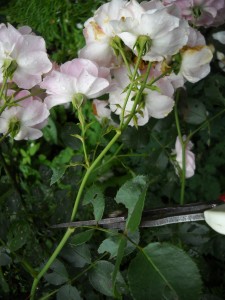
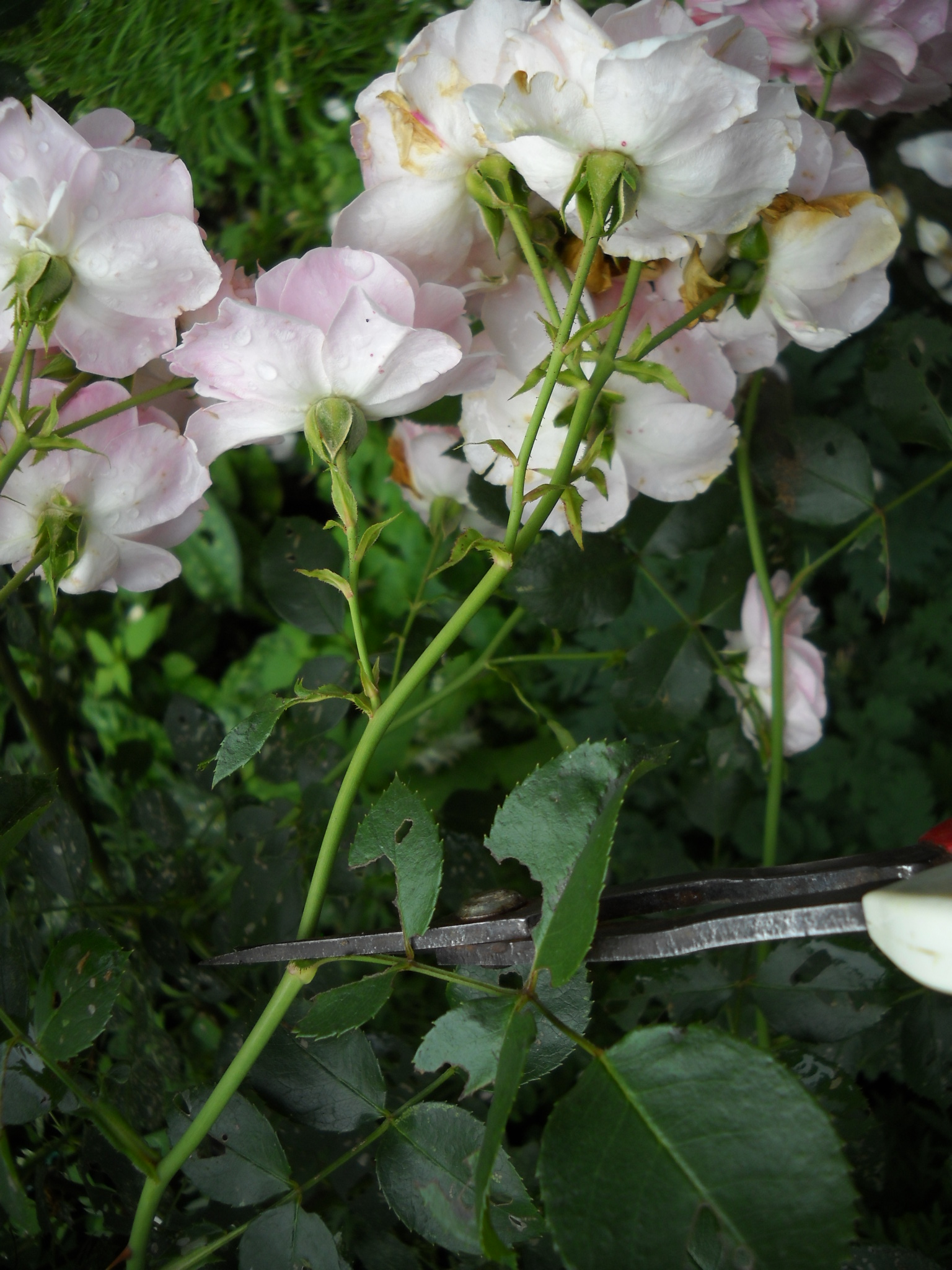
Deadheading roses
Cutting back, pruning. Now is the time to cut off spent flowers. This has been a splendid year for roses, perhaps to compensate for the poor lilac show. Some roses re-bloom, some do not, but cleaning off the dead flowers will improve the looks of the plant. Cut back not just the dead blossom, but all the way back to the next stem that has 5 leaves.
Other plants such as peonies will look better if you cut off the spent flowers, and some (such as and perennial bachelor buttons) will re-bloom. Cut off the flowers and stems of delphinium right to the ground after blooming is done, scratch in some fertilizer, and you should get another stem with blossoms in the fall.
Spring and early-summer blooming shrubs need to have their blossoms cut off now. I recently have worked on forsythia, common ninebark, lilac and spirea. If you cut these back in the fall, you will lose blossoms. Forsythia and ninebark can really grow fast, up to 3 to 4 feet in a season if you let them go at their natural pace, so cut them back before they are totally unmanageable.
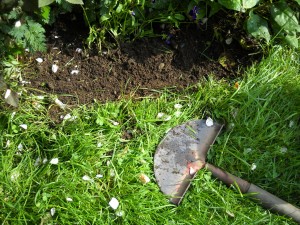
After edging
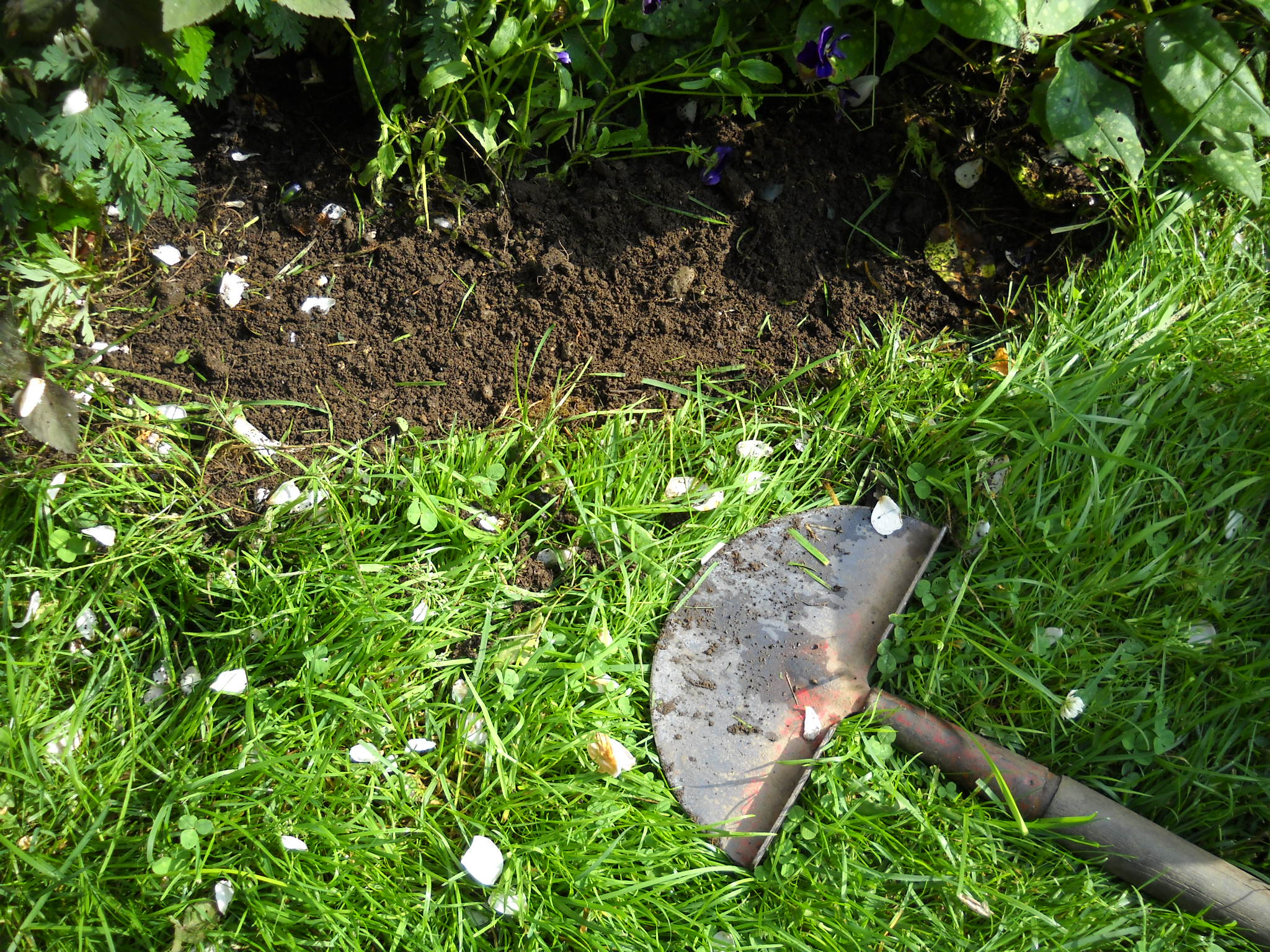
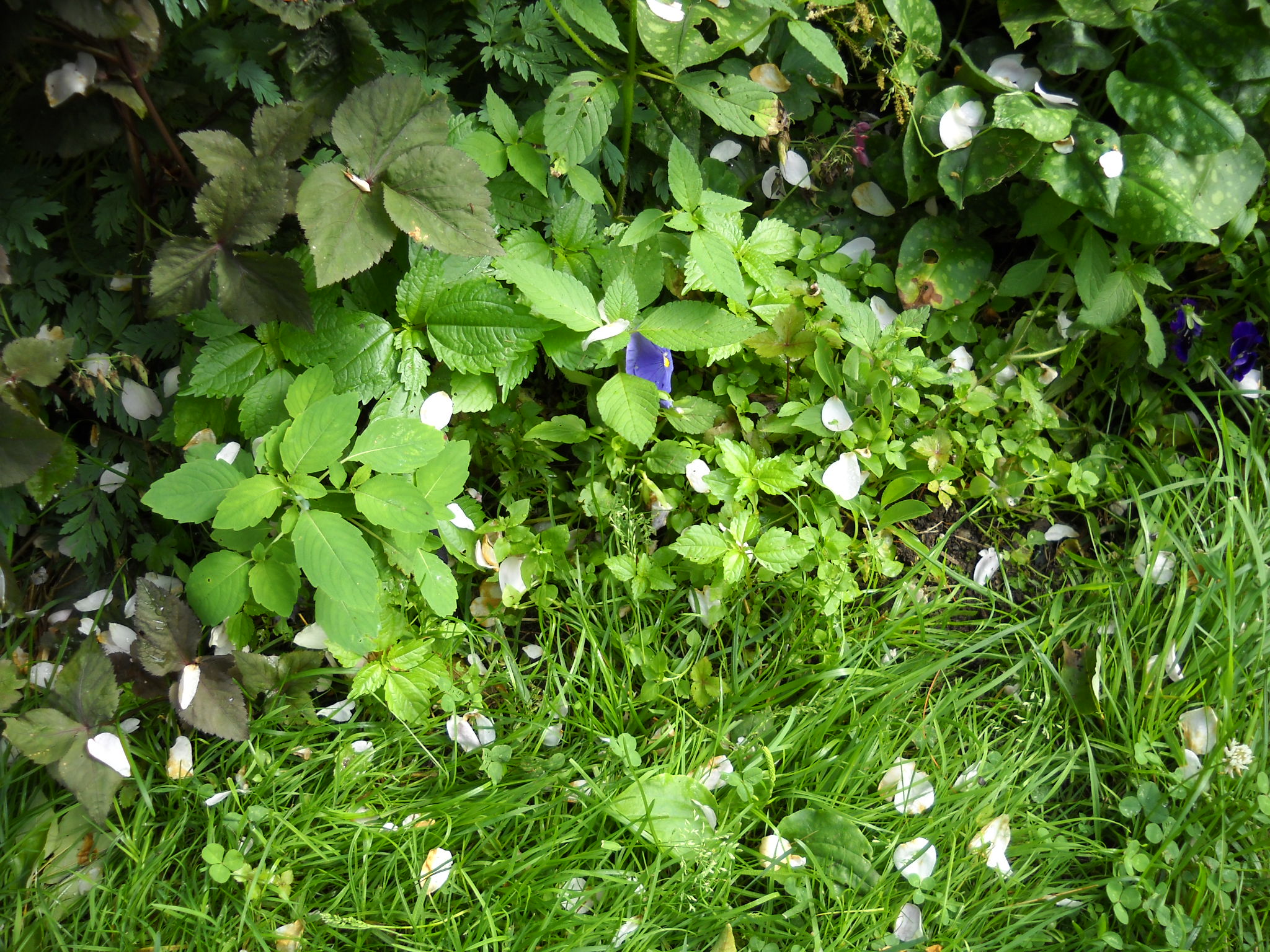
Weeding. Weeds, those sneaky rascals, get discouraged if you keep pulling them out. But left alone now, midsummer? They grow like crazy. Grasses are trying to sneak in to the garden, too. Keep the grasses at bay by digging a trench at the edge of the lawn. Use a shovel or an edging tool to dig a 4-inch deep, V-shaped trench between the lawn and garden beds. Grasses grow to the edge of the trench and don’t know if it is the Grand Canyon or something smaller, so they stay back.
If you see weeds blooming, stop whatever you are doing and pull the weeds. Or, as the Red Queen would say, “Off with their heads!’Snip off the weed flowers before they can set seeds and sprinkle them into your soil. Then deal with the weed when you have time. Don’t throw weeds with flowers into the compost. Some (most?) can morph from flower to seed even after being pulled, and those weed seeds in the compost can come back to trouble you later.
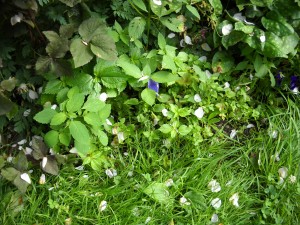
Weeding before edging
Use a good weeding tool when you weed, so that you can get all (or most of) the roots of weeds and grasses. You probably know that my favorite is the CobraHead weeder (www.CobraHead.com). I like the fact that it is so easy to get its single tine under a weed, loosening the soil so that when I tug the weed, it comes out, roots and all.
Mulching. Mulching really reduces weed problems if you weed carefully, and then apply mulch. What to use for mulch? That depends on your budget and your aesthetic sense. Most gardeners use bark mulch of some sort, though many use “color enhanced” wood-based mulch. Not me. I am skeptical of what companies use to enhance the color of their mulch, so I only buy natural, organic mulch.
I also like to use chopped leaves as mulch. Leaves are fantastic sources of organic matter and nutrients that microorganisms can break down and share with our plants. Pine needles, too, are excellent mulch. I know that many gardeners think that pine needles are too acidic to use, but I have never had a problem with them.
Last but not least, this is the time to plant some new daylilies. These are workhorses in the garden. Bugs don’t eat them and they don’t get mildew or blight. They come in different colors, blossom shape, and bloom time. Go to a family-owned garden center or nursery to see what’s in bloom. You just might be amazed.
Henry Homeyer can be reached at P. O. Box 364, Cornish Flat, NH 037476 or by e-mail him at henry.homeyer@comcast.net. His Web site is www.Gardening-Guy.com; you can find his past articles there (including the one you missed because someone wrapped up the fish remains in it).
Filed under Article · Tagged with deadheading roses, edging, fish fertilizer, Henry Homeyer, mid-summer garden tasks, mulching plants, peat moss, porgie and bess, pruning roses, watering flowers, weeding, when to plant daylilies
Saving Money in the Flower Garden
Posted on Wednesday, July 4, 2012 · Leave a Comment
My house sits on a couple of acres, most of which is growing something. There is a big vegetable garden, some trees, berry bushes and decorative shrubs, a little lawn and lots of flowers. I could spend a fortune, I suppose, if I bought flowers for every square foot of flowerbed that I have. Over the years, however, I have learned how to transplant small plants that started on their own from seed – “volunteers” – and how to divide existing perennials.
Let’s start with the volunteer plants. The first thing one must do is learn to recognize the young seedlings – and not pull them as weeds. I do this mainly by the color and texture of the leaves, but shape is important, too. And of course, you can’t use bark mulch in the flower beds if you want volunteers. I grow perennials close together so that they shade out weeds, and try to pull any weeds that do grow before the go to seed.
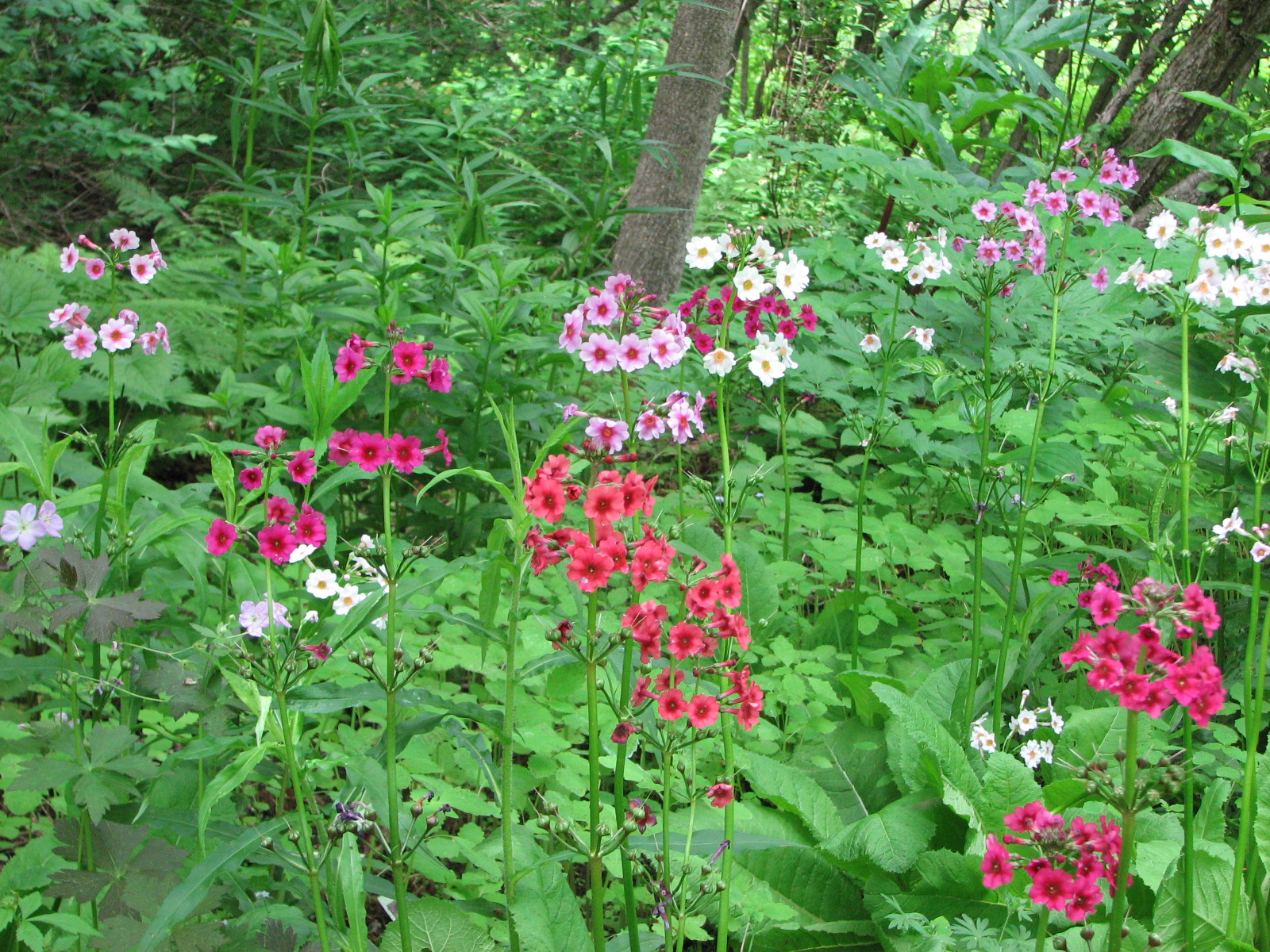
Twenty years ago a neighbor pulled up in front of my house and handed me a cardboard box with 8 candelabra primroses (Primula japonica). I accepted them with pleasure, and went directly to a good reference book to find out what they needed: rich soil, light shade, consistent moisture. I had those conditions under a small grove of wild apple trees, and planted them there.
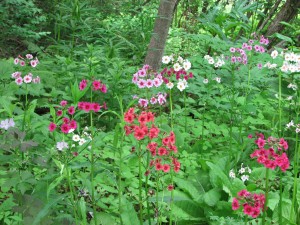
Primula japonica
Now I have hundreds of candelabra primroses and many other kinds. Once I realized that one primrose would grow there, I tried other species, and all but one (P. vialii) have done well there – and spread. Most spread by seed, and one (P. kisona) by root, like a groundcover. I regularly dig primroses and move them or give them to friends.
Giving excess plants to friends, especially lesser known varieties, is a great way to save money. I find that if you give a person a nice clump of flowers, you are most certainly going to go home with 2 or 3 new plants for your own garden.
Dividing plants is easy, once you get the hang of it. But you have to know what kind of root each perennial has, and that generally means some experimentation. The only book I have found that describes dividing for most common perennials is The Well-Tended Perennial Garden: Planting & Pruning Techniques by Tracy DiSabato-Aust. That’s a book that should be in every gardener’s library because it tells you how to prune, deadhead, get to re-bloom, divide and more. It’s in hardback at $34.95 (Timber Press, 2006) and worth every penny.
It is best to divide most perennials in the spring when the foliage is just 3-6 inches tall. Tough characters like hostas and daylilies can be done anytime, though preferably on a cool cloudy day if doing so now. I recently divided a few hostas and took off a section from a large bugbane or snakeroot (Cimicifuga ramosa), and none showed signs of stress.
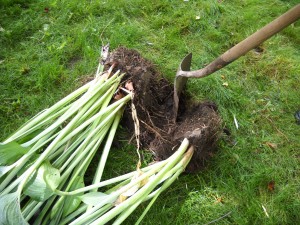
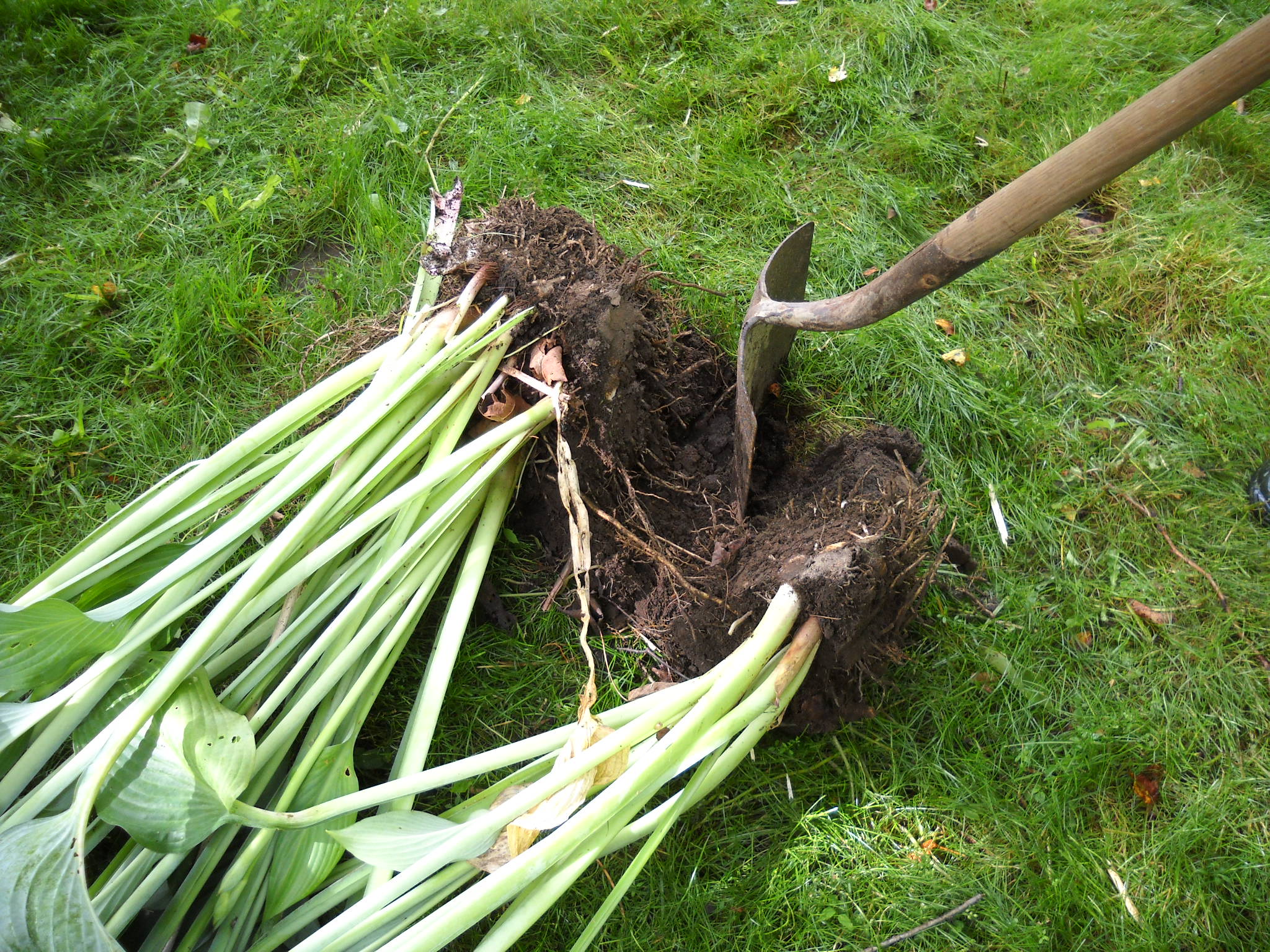
Dividing hostas
You can cut out a section of a large hosta or daylily by cutting out a wedge with a spade or even a long knife. I sometimes use a serrated root knife I got from Lee Valley Tools. Tracy DiSabato-Aust prefers a non-serrated knife, so I guess either will work just fine. Get down on your hands and knees and try to see natural division points before you cut.
Alternatively, you can dig up a plant, place it on the ground and then use 2 spading forks to separate it. Just insert them into the middle of the clump, back-to-back, and work the forks back and forth. It’s a lot of work for a big clump of daylilies. I prefer just to cut up a clump with a sharp spade. The spade lets me stand on it with all my weight to slice through the tough roots. I once divided a 4-foot wide clump of Joe Pye weed (Eupatorium maculatum) and ended up using a pick ax to whack it apart. Not a pretty sight, but I was determined to remove and divide it.
Groundcovers send out roots and can be divided anytime. Just dig up a plant, sever the root from the mother plant, and move it to a new location. Easy.
Some plants have fleshy taproots that are easily broken, and these are not good candidates for division. Peonies, Oriental poppies, bleeding heart and pink mallow fit in that category. They should be divided in the fall –though little seedlings move easily, spring or fall. Siberian iris should be divided in fall.
Some plants go downhill and become less vigorous if they are not divided on a regular basis. Have you lost a nice Shasta daisy? If so, please try again – but divide it every 3 years. That allows you to add compost and slow-release organic fertilizer to the soil, which rejuvenates the plants.
The easiest, least expensive method for getting more flowers is just to save seeds and plant them. I plant when the seeds are ripe, just scratching them in where I want more plants next year. I do this with Jack-in-the-pulpit, annual poppies, foxgloves and rose campion, and they generally reward me handsomely.
So don’t spend a fortune. Divide, trade with friends, start things by seed. In no time you’ll have all the plants you need – even if not all the plants you want.
Henry Homeyer is the author of 4 gardening books. His Web site is www.Gardening-Guy.com.
Berries
Posted on Monday, June 25, 2012 · Leave a Comment
By now my vegetable gardens is all planted, annual flowers are in, the weeds are pretty much under control. Time to relax and smell the roses? Well, maybe not. There are always tasks for the gardener. This is a good time to plant some berry bushes.
The first thing to do, if you want a good berry patch, is to test the soil to find out if you need to add specific nutrients. Go to your university extension Web site, or Google “soil testing”. You should be able to download a form and get instructions on how to collect a soil sample, and where to send it. All berry patches will also need some added organic matter such as compost, aged manure, or leaf mold.
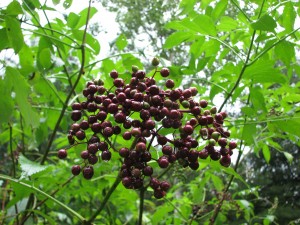
Elderberries
Competition from weeds is an important issue for berries. You can’t just use a rototiller to chew up a patch of field or lawn to plant your berries. You really need to dig out the sod – or smother it this year to plant next year. A layer of 4-mil black plastic spread out over a lawn that has been cut short will kill the grass, roots and all, by the end of the summer. Landscape fabric will do the same, but is more expensive. Next spring the dead grass will add organic matter when you mix it in.
If you want to plant this year you have two choices: dig out the sod by hand, or rent a sod lifter – I reject the idea of using chemicals to nuke the grass. The sod lifter is powered by a gas engine; it sends a blade under the sod and along the edges to slice it loose. You still have to pick up the sod and lug it away. And you can’t roll it up like a rug – it’s too heavy. I slice the long strip of sod into 1- or 2-foot sections. Or, for small areas, you can just use a shovel to slice sod into one foot squares to pry out by hand, which is very labor intensive. Ugh.
All berries like sunshine. Six hours per day is the minimum for a good crop. More is always better. Berries do not like root competition, so keep your berry patch away from trees. I planted a rose recently that was more than 50 feet from a Norway maple, and found the soil full of tree roots coming from the maple. So pick a site far from trees if possible.
Raspberries are a great choice for the home gardener: they are expensive at the store and do not keep well. Better to grow your own and eat some every day in season. What are the best varieties? I asked Alicia Jenks, the owner of Green Dragon Farm, a pick-your-own blueberry and raspberry farm in Weathersfield, Vermont. She suggested getting ‘Prelude’ or ‘Killarney’ for an early crop. Then ‘Encore’ or ‘Latham’ for mid-season berries and ‘Heritage’ for late-season berries.
Alicia Jenks suggested planting raspberries 3 feet apart in a staggered double row in a 5 or 6-foot wide bed. Add plenty of compost to the soil and work it in well – a 4-inch layer is a good. She adds Pro-Gro, an organic, slow-release fertilizer to the soil at planting time in each hole. Although you can buy bare root plants early in the spring, most sellers of them are sold out by now. Potted bushes are still readily available at garden centers.
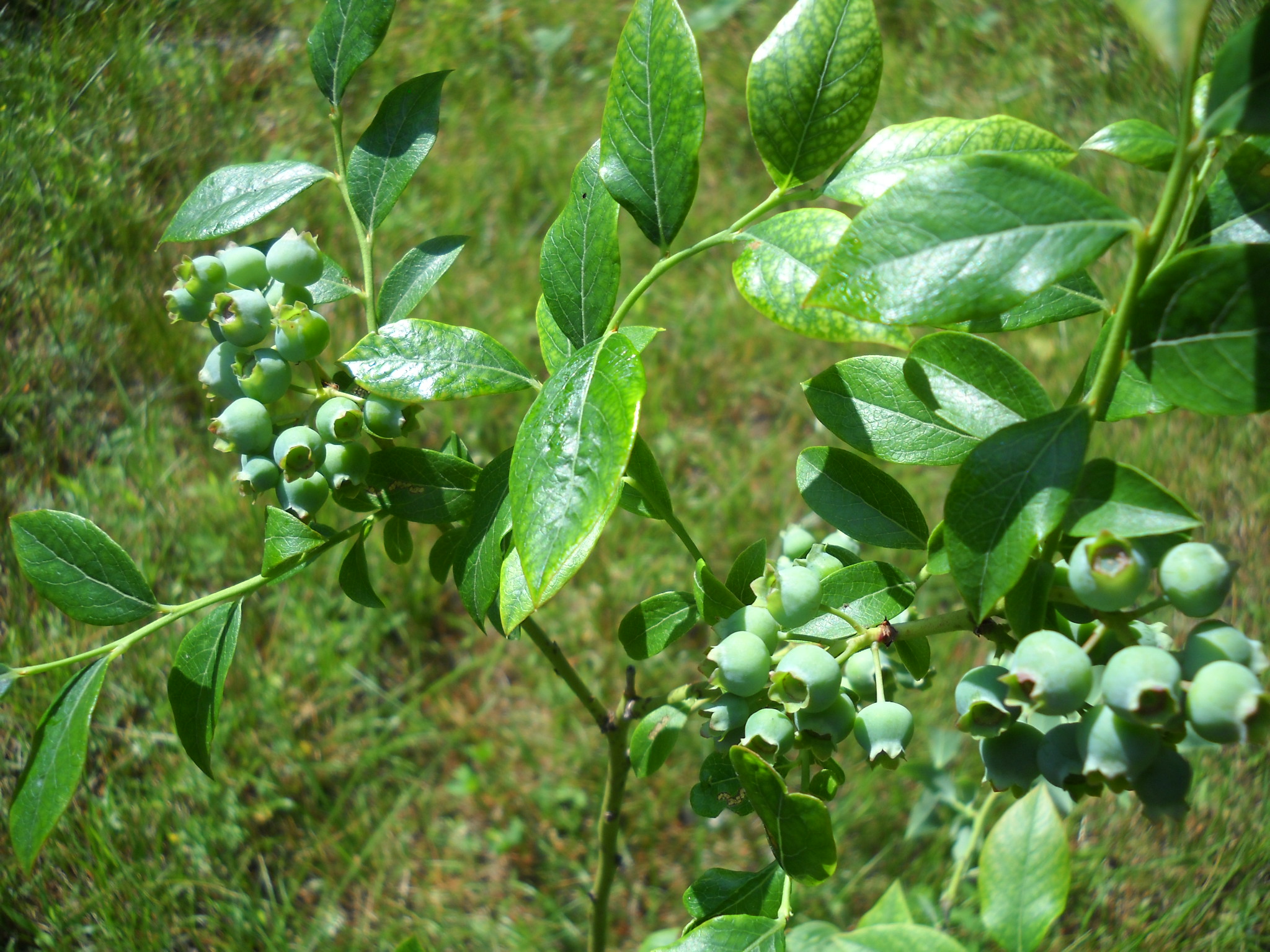
Blueberries are another good choice for every home gardener. The soil requirements for blueberries are very different than for raspberries, however. Paul Franklin of Riverview Farm, a pick-your-own apple, pumpkin
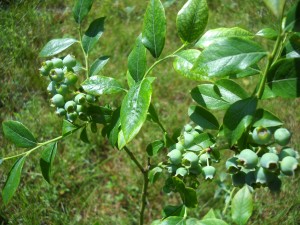
Blueberries
and berry farm in Plainfield, NH, told me that there are just three important things to get right in order to have a good crop: proper pH, proper pH and proper pH. He went on to explain that the soil must be very acidic in order to get a good crop – in the range of 4.0 to 5.5. So get your soil tested and add a soil acidifier such as elemental sulfur to get the soil pH right. Pro-Holly or Holly-Tone (organic acidic fertilizers) are good for blueberries, too, and can be added around existing bushes now.
Blueberries should be spaced about 5 feet apart in rows that are far enough apart to allow mowing. Most commercial growers mulch with woodchips to keep down weeds. The roots grow close to the surface, so you can’t dig out weeds willy-nilly – you may damage roots. So get grasses and weeds out in a 5-foot circle before you plant, and mulch well to keep them out. Weeds will steal the water and nutrients your blueberries need.
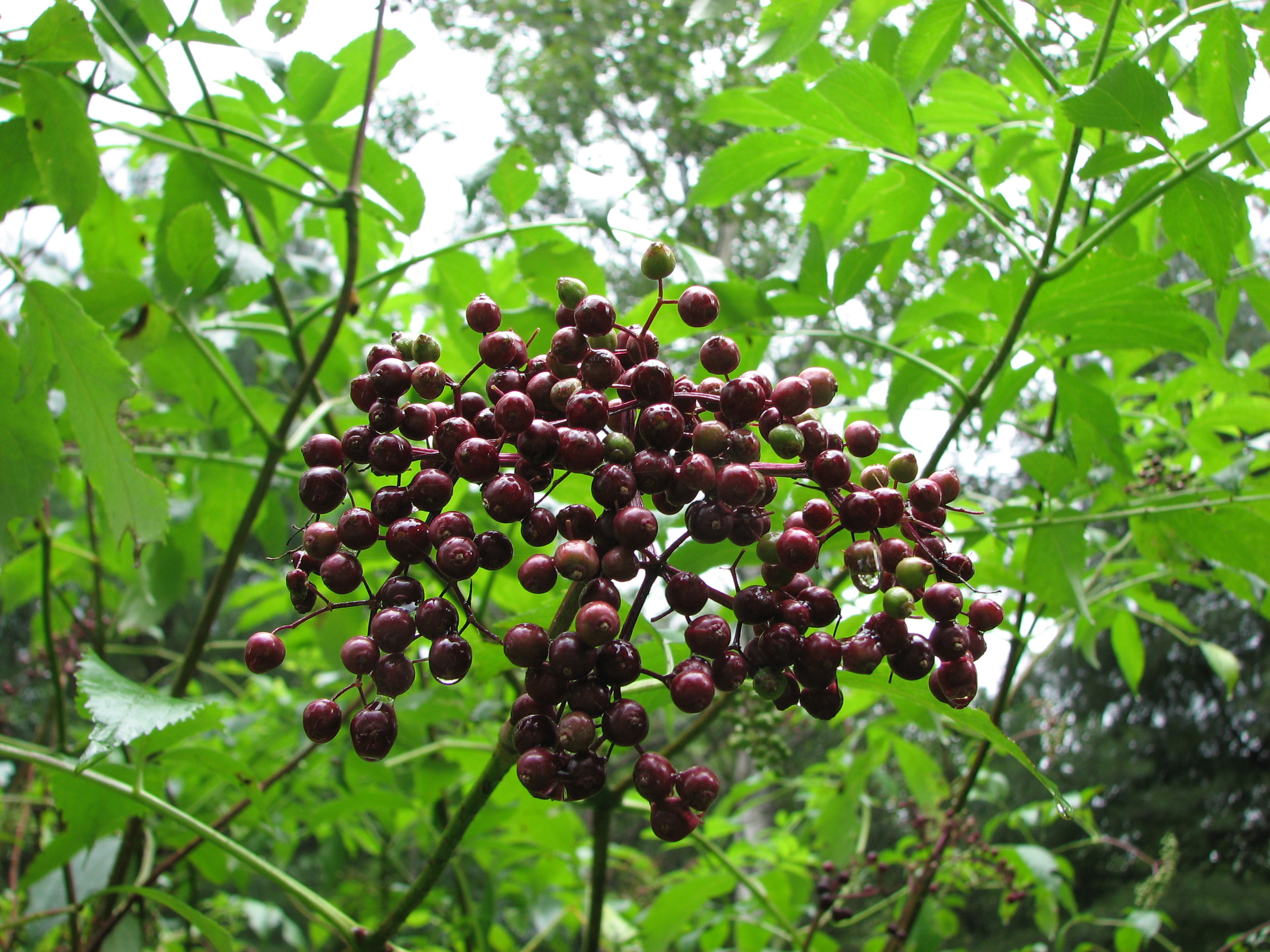
Elderberries
Elderberries are an easy crop if you have a moist location on your property. I grow 3 varieties on the bank of a little stream, and they do well. Pollination is better if you have 2 or more different varieties. The white, fragrant flowers form big clusters at the top of the bushes and are decorative right now. In the late summer I harvest elderberries by sniping off clusters of berries; later, in the house, I pull the berries off their stems and freeze them. I like to sprinkle them on hot oatmeal in winter and I also make an elderberry syrup to ward off colds.
So go plant some berries, or more berries, or different kinds of berries. You’ll be glad you did.
Henry Homeyer is a gardening consultant and Master Gardener living in Cornish Flat, NH. Contact him at henry.homeyer@comcast.net. His Web site is www.Gardening-Guy.com.
Gardening in the Rain
Posted on Wednesday, June 20, 2012 · Leave a Comment
I’ve always preferred sunny days, both as a boy and now, as a quasi-geezer. I remember reciting this ditty as a small boy, “Rain, rain, go away, come back some other day!” And it did, eventually – but usually not as quickly as I wanted. Now as a gardener I appreciate the rain for what it does for my plants, but I still think to myself, after a few hours of rain, “Rain, rain, go away …”
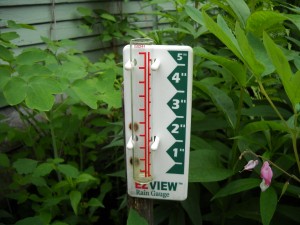
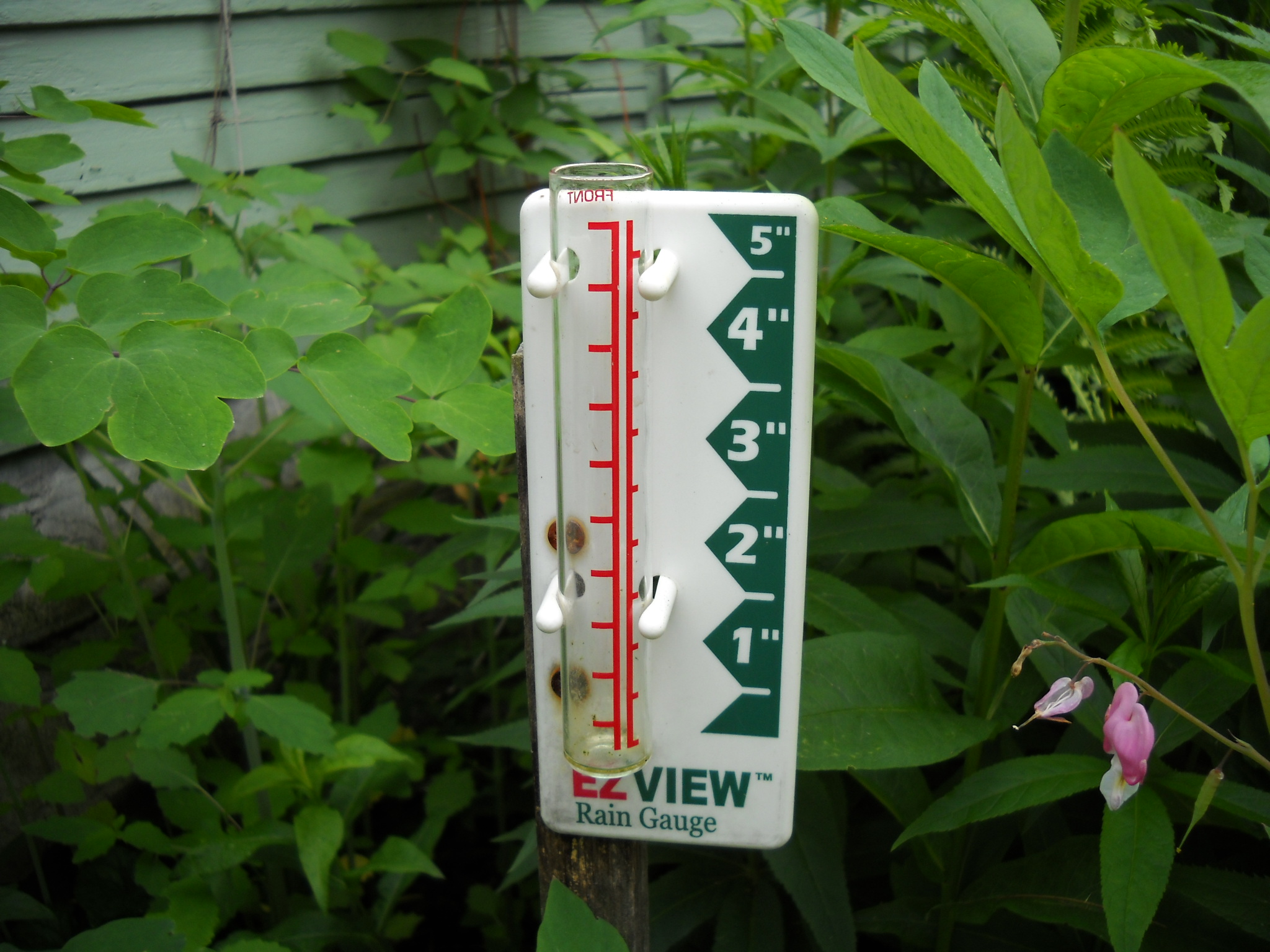
Rain Gauge
If you don’t have a rain gauge, you should. It doesn’t have to be one of those fancy electronic ones that sends signals to you from outdoors. A simple $5 device that consists of a cylinder with marks on the side to show each quarter inch of rain is just fine. And, if you really want to be frugal, an empty cat food or tuna can will work. Most of our plants need an inch of rain – or water from your hose – each week.
Plants are generally the most susceptible to death by dehydration right after planting. Their roots have been disturbed and frequently delicate root tips have been broken off. A hot, dry day can wreak havoc on a newly planted seedling. If your plants are growing in potting mix, it is best to submerse the plants in a bucket of water before nestling them into their growing holes. Hold the plants under the water until they stop bubbling. It can be hard to saturate a large root ball by top watering.
Rainy days are much better than sunny days for transplanting. You can minimize shock by preparing the new hole before you dig up the plant so that it can go right to its new home. My grandfather liked to say that you should move enough soil with a transplant that “it will remember where it came from.” Modern soil scientists would probably agree, saying that the soil microbes you move with a plant are important to its future health. After moving a plant, create a ring of soil around your transplant to hold water. Then, using a watering can, gently fill the ring and let water seep in. Repeat several times.
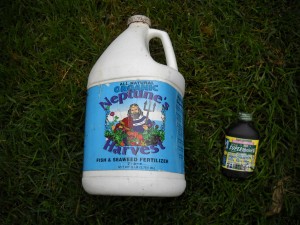
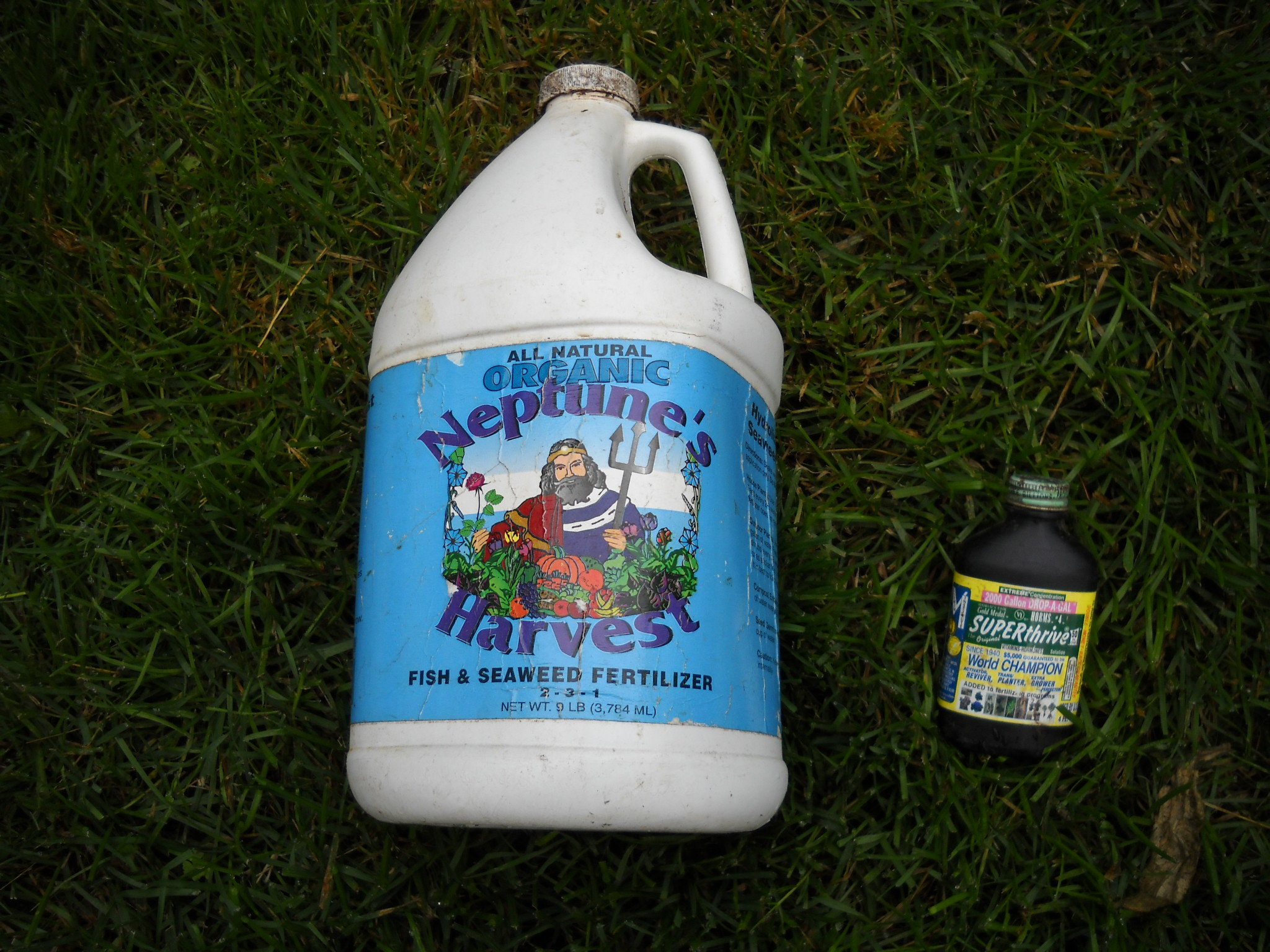
Soil Additive - Fish Fertilizer & SUPERthrive
I add two solutions to my watering can that help to minimize transplant shock. The first is called SUPERthrive. It comes in a little 4oz container but it only takes a quarter of a teaspoon of the solution for a gallon of water to treat plants against transplant shock. It contains vitamins and minerals; in my experience it reduces transplant shock and helps stressed plants (like those 6-packs of annuals I forgot to water on a hot day).
The other solution I use is a liquid fish and seaweed fertilizer. Neptune’s Harvest makes a very nice product, though there are plenty of others. The fish “juice” gives new plants nitrogen, phosphorous, potassium and trace minerals at a time when they need a quick burst of soluble fertilizer.
But back to those rainy days: if you don’t mind working a warm rain, go outside and weed. Weeds pull much more easily when the soil is wet. But avoid a lot of digging in wet soil. I like my CobraHead weeder (www.CobraHead.com), in part, because it is a low-impact tool. I can use its single tine to stir up the soil enough to plant a small lettuce plant or make a furrow for carrot seeds without making a big mess of the soil on a rainy day.
I never walk on beds when they are wet. Wet soil compacts easily, especially soils with a high clay content. Clay that is compacted and then allowed to dry out can be as hard as concrete. And don’t even think of rototilling wet soil. You can ruin the soil texture by doing so.
Most of us have plants in pots on the front stoop or on the deck. Be attentive to them when it rains. If they have drainage holes (as they should), they will collect water in their saucers below. Roots can rot if left sitting in water for days on end. So remove the plants from their saucers in a deluge, or shortly thereafter. If you notice that the runoff is brown, you are probably losing good nutrients. Pour that water in a bucket to use on a dry day to water your plants.
Want an indoor planting project on a rainy day? Get out your potting soil and a few leftover 6-packs from spring planting. Plant some lettuce seeds in those 6-packs for use in the garden once they get to be an inch or two tall. I find that starting lettuce in 6-packs and growing them on the deck is better than direct seeding in the garden – no weeds, and they are easier to monitor for water. I try to remember to plant lettuce every 2 weeks for a good supply all summer. And you can start fall broccoli by seed in mid-July- so mark your calendar today, and do so on a rainy day.
There are times in early summer when I get bone tired from doing so much gardening, day after day. I can’t seem to get it through my thick skull that I’m not a kid anymore. So a rainy day is a good thing. It usually forces me slow down a little. And my plants love them – in moderation.
Henry Homeyer is a life-long organic gardener, a UNH Extension Master Gardener, and a gardening coach. Contact him at henry.homeyer@comcast.net or P.O. Box 364, Cornish Flat, NH 03746.
Lilacs
Posted on Wednesday, June 13, 2012 · Leave a Comment
Chris Wilson loves lilacs. He grows about 200 of them including more than 100 varieties at his home in West Newbury, Vermont. Like many gardeners, he was a little disappointed with the showing of his lilacs this year. There were fewer blossoms, and many were smaller than normal. I recently met with Chris, who works at E.C. Brown’s Nursery in Thetford Center, Vermont to discuss lilacs – and this year’s less than stellar performance.
First, Chris noted that many lilacs tend to follow two-year cycles of abundant bloom. Like apple trees that produce a heavy fruit load, producing a heavy crop of blossoms and seeds draws down on the energy of a lilac; the next year the lilacs tend to be less productive. I understand that phenomenon, but can’t imagine that all lilacs everywhere would be on the same cycle. But it does make me want to cut off the spent flower panicles on my favorite lilacs before they expend all the energy of making seeds.
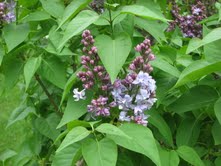
Lilac
The next possibility that Chris and I discussed was the extreme variations of temperature this spring. The early heat caused buds to swell and prepare for opening. That was followed by several hard frosts. Some of the buds may well have been damaged or made more susceptible to fungal diseases that have also attacked some lilacs this spring. He showed me some blackened stems and buds that were blighted and unproductive.
I have noticed that later-blooming lilacs are doing better than the earlier blooming lilacs did. That would make sense. Later blooming lilacs probably would not have buds that were ready to open during a week of high temperatures. Miss Kim, for example, is a very popular later-blooming lilac that is blooming quite well for me.
But my personal theory, unsubstantiated by any independent tests, is this: Last August was cool and rainy. I have read that lilacs set their spring buds in late summer, which I define as August- though the literature does not specify. I think that since lilacs got less sun than usual, they didn’t set as many buds. Then the hot/cold/hot weather this spring reduced even those numbers. And who knows what the lack of snow meant to lilacs. Gardening is full of unanswerable questions.
Conventional wisdom has it that lilacs need a top-dressing of ashes from the woodstove (or a dose of limestone from your local feed-n-grain store) each March. I disagree. Yes, lilacs do best in neutral or slightly sweet (alkaline) soil. For most of us, that means counteracting our acid rain by applying lime or wood ash once a year. But March? I think the timing has more to do with when farmers of past years were not too busy and had the time to spread some ashes. I believe that any time of year is just fine. It takes time for limestone to be incorporated into the soil. The key is to do it annually. I spread two quarts of wood ashes around a big lilac – whenever I get a chance. Do it now, before you forget. It really will make a difference next year.
Lilacs need annual pruning in order to look good. Most lilacs sucker, or send up new shoots from the roots. If you do not cut some of these back to the ground, the clump will get wider and wider. One way to keep your lilac vigorous is to remove a couple of the older stems each year, allowing the smaller and middle-sized stems to get larger. And unless you want to get on a ladder to cut blooms, you need to control height. Cut back tall stems to a fork, reducing height. The time to do it? Now, after the blossoms have finished.
It is often difficult to prune back stems to the ground as lilac stems grow very close to each other. But if you only cut back a stem to 2 or 3 feet above ground, you are left with stubs that are unsightly and that will sprout new shoots – often several new ones – that will clog up the center of the shrub more than the stem you cut off. My weapon of choice is a folding saw with a pointy end. I get on my knees and work the point into the clump as near the base as possible, and saw through a big stem. It takes time and energy, but is worth it.
After all the standard lilacs have finished blooming comes the show put on by Japanese tree lilacs. These are medium-sized trees, not shrubs. They have white flowers that are quite fragrant. But they may be invasive: the personnel at the Saint Gaudens National Historic Site in Cornish, NH, have found lots of young tree lilacs in the woods, and at the edge of the woods near their site. They have started pulling them as they decided that these visitors from the Far East have the potential to take over the understory. They are not, however, listed on any invasive species lists of prohibited plants.
The standard lilac is a wondrous plant. When I cross-country ski I sometimes see them by cellar holes of homes abandoned a century or more ago. Their flowers are beautiful and fragrant. What more could I we ask for?
Henry Homeyer is the author of 4 gardening books. His Web site is www.Gardening-guy.com.
Potatoes
Posted on Wednesday, June 6, 2012 · Leave a Comment
Why is it that some people use nicknames for their children that are the names of vegetables or flowers? I’m sure you are familiar with “sweet pea” as a loving epithet (even for kids who are not sweet), or “pumpkin” for children who are neither round nor orange. The French, I am told, call their lovers “petit chou” which translates as “little cabbage”. But I have never heard anyone refer to a loved one as a potato. I wonder why, since potatoes are some of the easiest of vegetables to grow. I suggest you plant some now if you haven’t already.
I always wait until June to plant my potatoes, even though I could have done so in early May. I have found that later planting decreases problems with the Colorado potato beetle. That is an observation that I have previously reported here, and other gardeners have told me that when they planted later they, too, had fewer problems. I like to joke that by planting later all the beetles have gone next door.
If you have those nasty potato beetles, what should you do? The first line of defense is hand-picking. Look for the yellowish larvae or striped adults on leaves, and pop them in soapy water. Look for orange eggs on the underside of leaves, too. Check daily as soon as you have leaves on your plants. Don’t let a second generation get started, and you will have fewer problems.
You might also try an organic spray to control beetles. It is called Bt, which stands for Bacterium thuringiensis, a naturally–occurring soil bacterium that is available at garden centers as a powder. Dilute it with water and spray on leaves. When larvae eat leaves with the bacterium, a protein in the bacterium makes them sicken and die. It is not a contact poison, and will not harm us or our critters – nor will it kill adult beetles.
Potatoes are grown from sprouted pieces of last year’s crop. I generally save potatoes from one year to the next for planting. I went 25 years without buying potatoes until we got late blight in 2010. Blight can overwinter in potatoes, so it is not advisable to keep potatoes for planting if you’ve had late blight. If you want to plant potatoes, don’t buy them at the grocery store. Most conventional potatoes are treated to prevent them from sprouting. Buy ”seed potatoes” sold for planting – they are guaranteed disease-free.
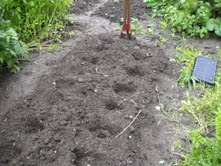
Planting Potatoes
I have tried three different planting techniques, and all work just fine. Let’s start with the easiest. Loosen the garden soil with a spading fork and stir in some bagged organic fertilizer and compost to the soil. Place on the soil surface some seed potatoes (or pieces of seed potatoes) with at least two “eyes” (buds). Then cover them with six inches of hay. Add more compost or soil on top of the hay so that no light gets to the chunks of potato. As the plants grow, add more hay and/or soil. The potatoes themselves grow above the seed potato; they need 6 inches of covering to have adequate space to develop.
I have also planted potatoes in a trench 6 inches deep. I loosen the soil in the trench and add some compost and bagged organic fertilizer. I place the seed potatoes 8 to 12 inches apart, push them into the loose soil, and cover them with 2 inches of soil. As they grow I add more soil until the trench is full. Some people hill up the soil over the trench to create even more growing space.
The third way to plant is to use a post hole digger. Dig holes 6 to 9 inches deep, add compost and fertilizer in the bottom of the hole and stir. Place your potato in the hole and cover with 2 inches of soil. As the potato vine grows, it is easy to push a little soil down the hole – in fact, rain often does it for me.
If you mulch your plants with straw or hay it will help keep down the weeds and keep the soil lightly moist. I wait to mulch until plants are a foot tall.
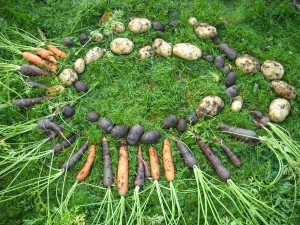
There are many varieties of potatoes available to choose from. One of the most productive is Kennebec, the classic white Maine potato. Also very good is Red Pontiac, which has red skins and a white interior. Both are excellent keepers, staying tasty all winter and into the spring. I also grow purple-skinned potatoes; they are called All Blue or Peruvian Blue, though they are smaller and less productive than some. And I usually grow Yukon Gold, a yellow-fleshed potato that is very tasty and quite productive. Fingerling potatoes are tasty, but much less productive than those listed above.
Harvesting With Grandkids
Harvesting potatoes is one of the high points of my garden year. I start in mid- to late summer, stealing a few by reaching down under a plant and pulling up a potato or two for dinner, but not disturbing the plant. Digging potatoes in the fall is like digging for treasure, and is great to do with kids.
So plant a few potatoes this summer – and start a new trend by calling your loved one your “little potato”. As far as I am concerned, that would be a compliment!
Henry Homeyer is a gardening consultant and the author or 4 gardening books. His Web address is www.Gardening-Guy.com.

 Click Here to buy from Cobrahead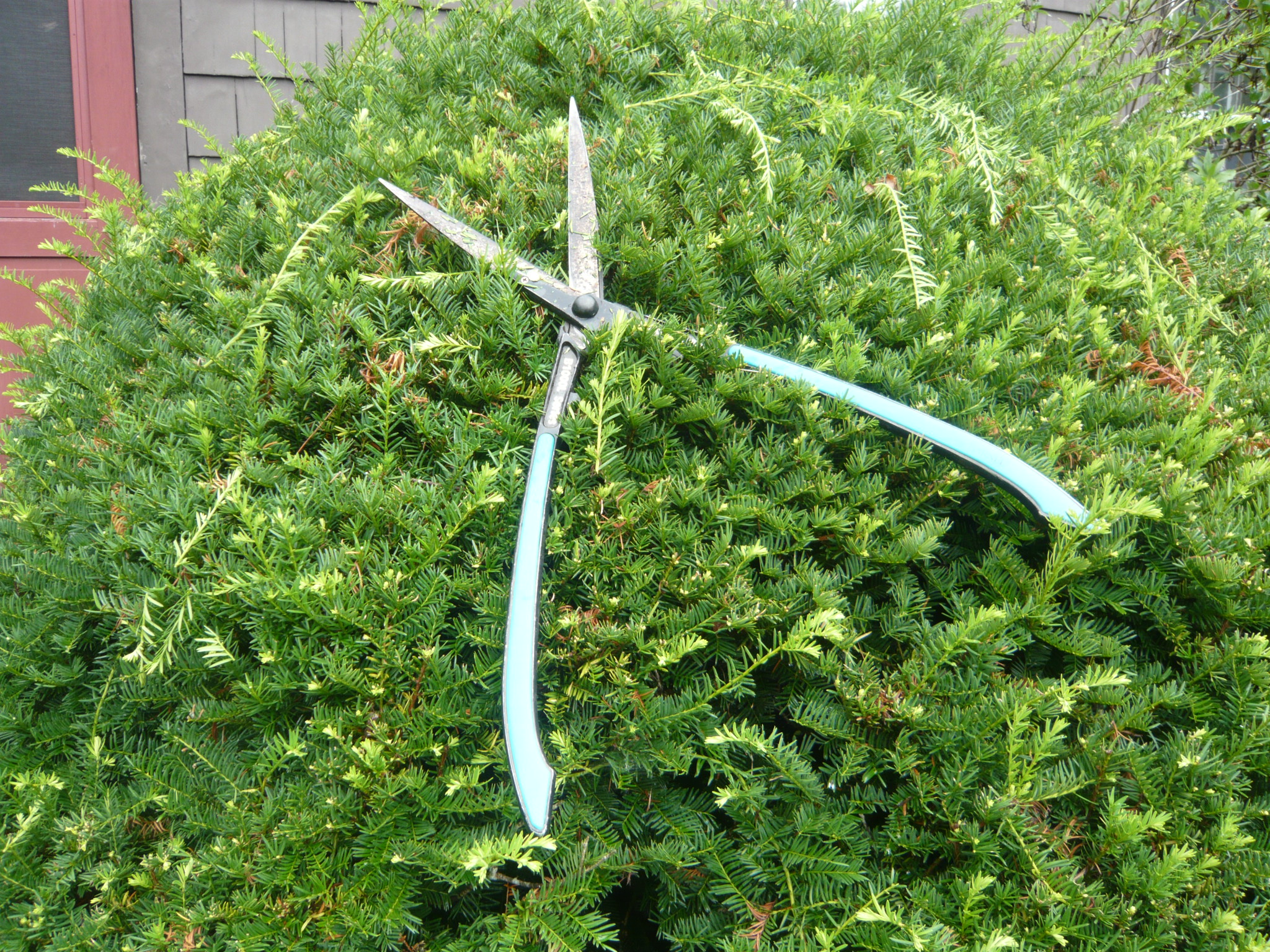
 One nice thing about an emitter system is that you don’t end up watering the weeds: if you put an emitter at each tomato plant, for example, the space between plants is not watered the way it is with a soaker hose. And you can see (and replace) an emitter that gets clogged and does not deliver water. I can’t figure out why most garden centers on the East coast don’t sell these systems –every hardware store in California does.