-

Now available for $24.95 including shipping. -
Now available for $21.00 including postage. Vendors I Like
 Click Here to buy from Cobrahead
Introducing Art, Whimsy and Laughter into Your Garden
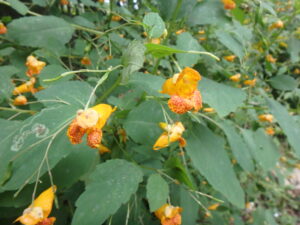
Jewel weed can be aggressive but a few add fun to the garden
When I was a small boy my older sister, Ruth Anne, introduced me to jewel weed, also called touch-me-not (Impatiens capensis). It is an annual weed that grows is shady, moist areas and has small bright yellow and orange flowers. But the best part for a kid are the seed pods. Each little canoe-shaped pod is spring loaded with seeds, and when ripe, these pods can throw seeds several feet. Pick one, and it explodes in your hand. Guaranteed to make a child – or this old guy – laugh. Mind you, I try hard to eradicate 98% of the jewel weed I see in our gardens, but I leave a few at the edges to amuse and delight kids of all ages.
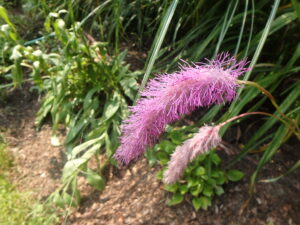
Lilac squirrel Sanguisorba blossoms are delightful to touch and see
Fuzzy plants are great for getting visitors to smile. Right now I have a variety of burnet (Sanguisorba spp.) that is named ‘Lilac Squirrel’. If you are of a certain age, you may remember when bicycles sometimes were adorned with real squirrel tails on the ends of the handlebars. These flowers, a lovely pink-lilac color, hang down like those squirrel tails, hence the name. I always am delighted when I see them. They make me smile. As do pussywillows in the spring.
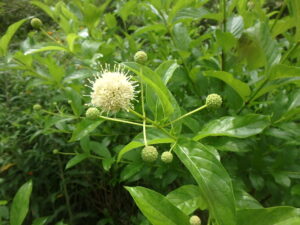
Buttonbush flower
A shrub I grow next to my little stream is called buttonbush (Cephalanthus occidentalis). This full-sun to part shade shrub is a native, often growing in standing water in swamps – I just saw some in bloom down in Connecticut in the wild, but have never seen it up here, except in my garden. Why is it worthy of a giggle? When blooming it has one-inch spherical blossoms with many tiny white florets coming out of it, sort of like what I always imagined Sputnik to look like, with little antennae sticking out. You will want to touch it, sniff it. But it is not a handsome shrub most of the year. Although rated as a Zone 5 plant, for me it dies back to the ground most years in winter – even though we’ve been moved from Zone 4 to Zone 5.
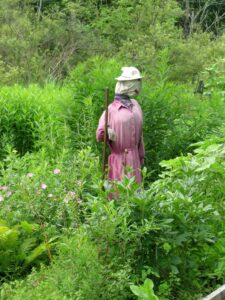
Sister Mary-Lou, the, Scarecrow, lived in the garden for a few years.
and old rubber barn boots. She was not made to scare away crows (as her ancestors were), but for the fun of seeing her. Even when I knew she was there, she was real enough to startle me early in the morning. Which then made me laugh at myself. She went traveling to the Tunbridge, Vermont “World’s Fair” in the late 1990’s and won Best in Show in the scarecrow competion, though she declined to brag about that. She has long been retired. A good scarecrow is always three dimensional, not just some clothes hung on a pole and a cross bar.
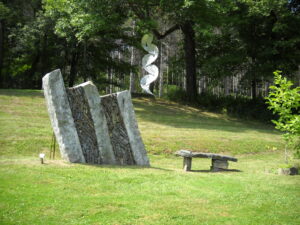
Sculpture Fest has both whimsical and serious sculpture
So what whimsy might you add to your garden? I remember when pink plastic flamingoes were popular on front lawns. Then they became passé. Recently I saw a few poking their noses out of a field of tall grass – and had a chuckle. Yard sculpture can be almost anything. I have a rusty toy truck from the 1940’s sitting atop a stone wall. I like seeing it there, and have had nice comments about it from visitors.
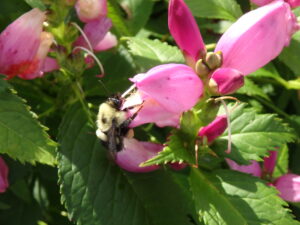
Turtlehead is loved by bumblebees
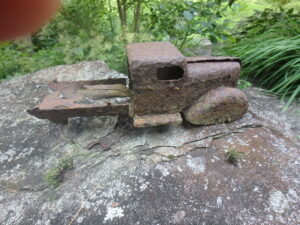
Toy truck as whimsy
Fall Chores
I love writing this weekly column. I do it 52 weeks of the year, and have been writing it since the fall of 1998 when I wrote my first column about putting the garden to bed. And the nature of gardening is such that I can write a column a little ahead of time so that I can, for example, go hike the Chemin de St Jacque de Compostelle in southwest France, which I am. Lucky me.
Here are some of the tasks I’d be doing at home this week, if I were there. First, I’d be weeding. Yes, weeds like to set their seeds in the ground in the fall for a new start in the spring. They seem to know that we are tired of pulling weeds now. But don’t let them get away from you. Pulling weeds now will save you lots of work next year – both in the vegetable garden and in the flower garden. A single weed might only produce a few hundred weeds – or up to a million for a mature purple loosestrife.
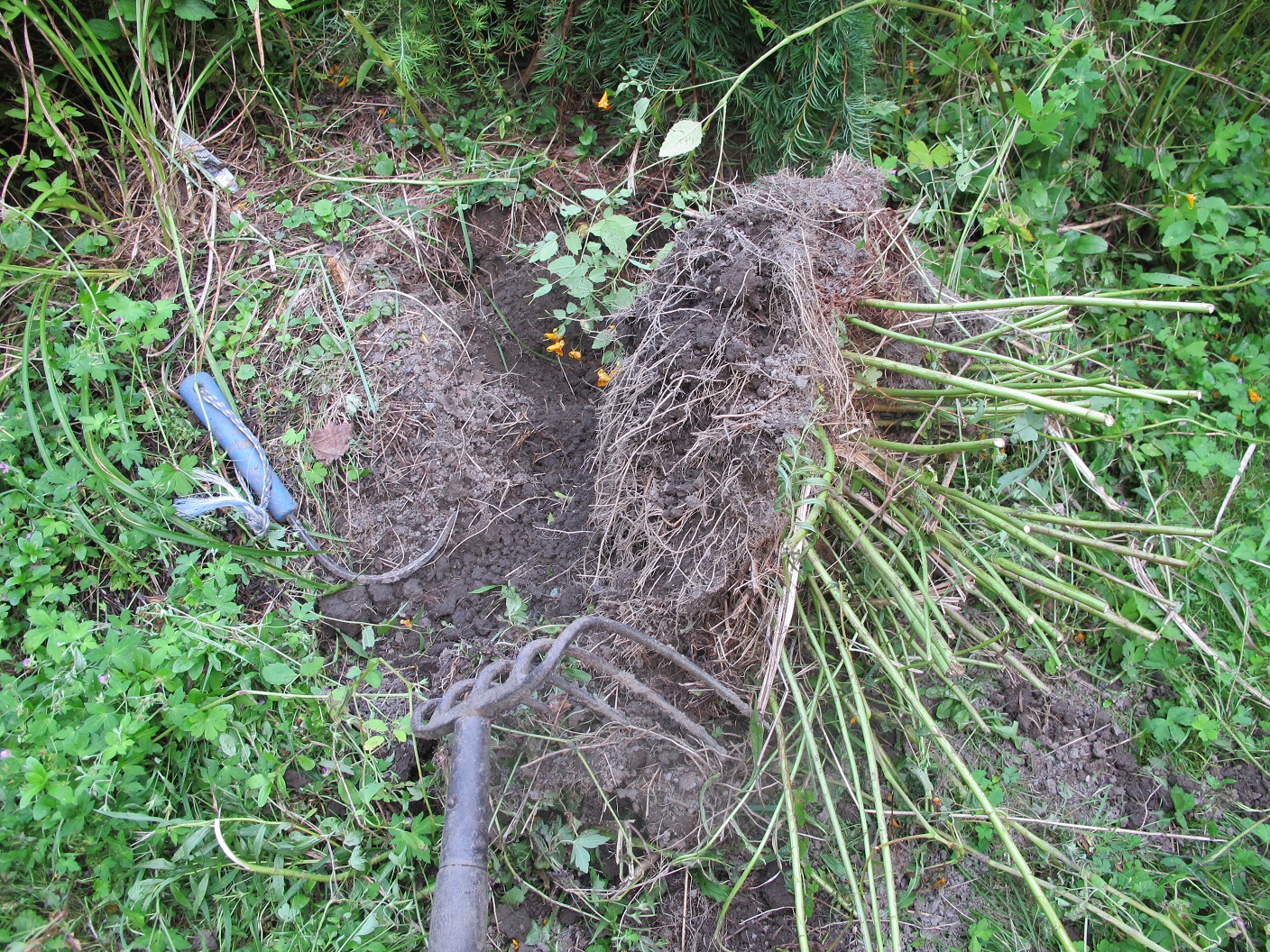
Removing goldenrod
Before I left I did extra weeding. I love goldenrods, and actually planted some short ones last year, and some shade-loving ones. But the big boys, those goldenrods that get to be 6 feet tall, are too big to co-exist with most garden plants, so they had to come out. I had been leaving them in the ground as bees and other pollinators love the pollen. But before I left they had finished blooming and I dug some out before the seeds got distributed.
A big clump of goldenrod is not something that you can easily just pull out – unless you have a backhoe. First I take my pruners and cut back the stems so I am not fighting them or getting poked in the eye. Then I go around the perimeter of the clump with a shovel or drain spade and try to get under the clump. I push the shovel in on angle, then push down on the handle to see it I can get it to lift a little. When I have gone all the way around, I push down hard, and (hopefully) the clump tips over and I can drag it aside. For purple loosestrife, which has a massive root system, it is better to cut off the tops and burn them (or put in the household trash) than to let the seeds be distributed.

Jewel weed takes over August
Before I left I also pulled out a lot of jewel weed (a.k.a. touch-me-not). Jewell weed has seed pods that explode when they are ripe, or if you touch them when they are almost ripe. Spring loaded. It is in the genus Impatiens, the same genus as our beloved shade annual. But this one will grow in the sun or shade. I let mine go to seed in recent years so my grandchildren could have the fun of touching them and seeing them explode. But now the population has exploded, so this year I worked hard to get them before seeds were set. They are an annual weed that is easy to pull.
Each fall I like to weed and prepare the beds in the vegetable garden for planting in the spring. I grow my veggies in wide, mounded beds. I like to loosen the soil in the walkways and then rake the soil into my beds. Then I add a layer of compost on top and stir it in. Finally, and I won’t do this until I return, I cover the beds with leaves and grass clippings collected by the lawnmower.
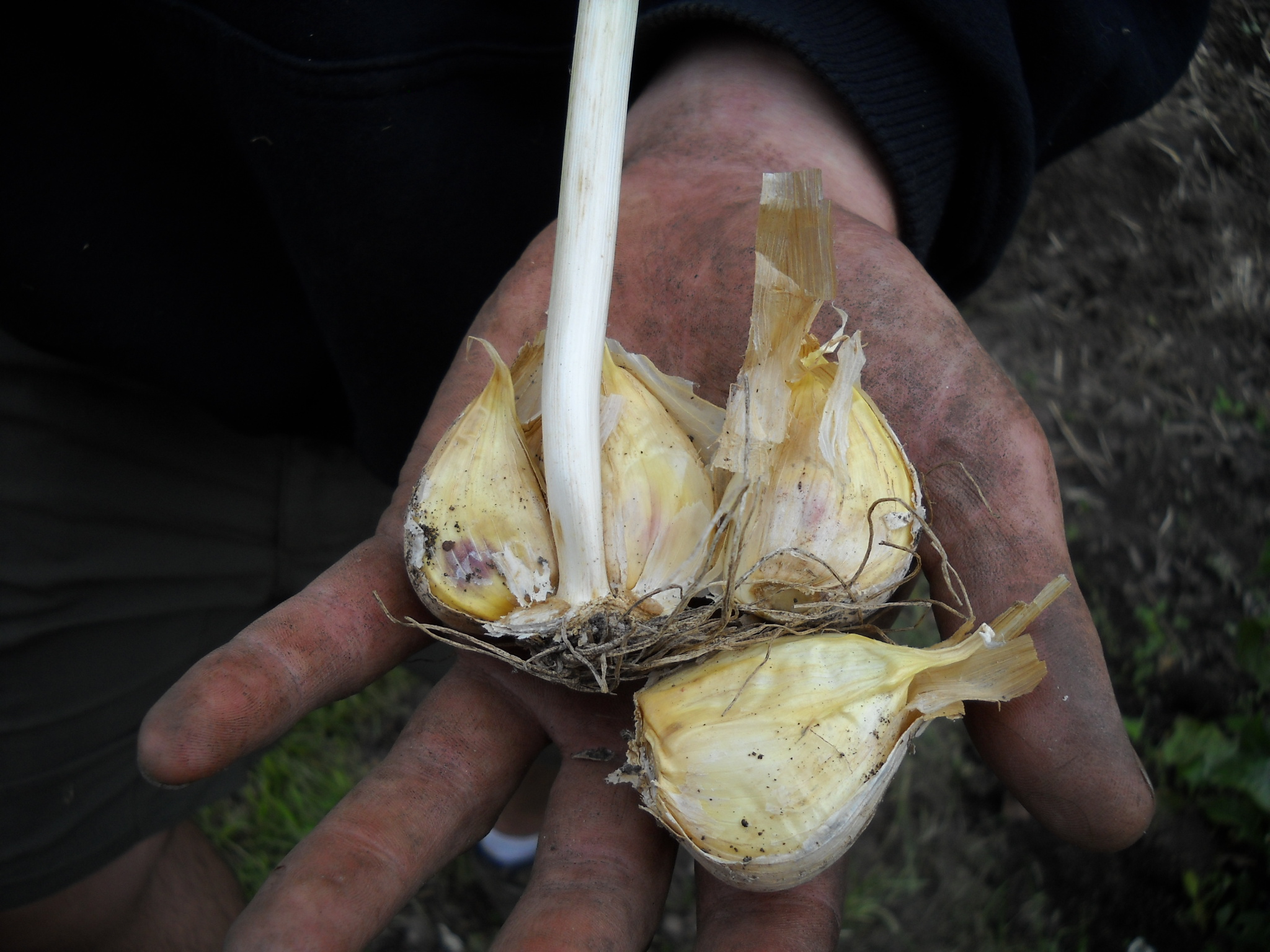
Hardneck Garlic ready for planting
Every October I plant garlic for the next year, and you should, too. Buy seed garlic from your local farmer or get some at the local garden center. Grocery store garlic probably has been chemically treated to keep it from sprouting, so is not good. It is probably not the type we can grow here, which is called hard-neck garlic. Buy it as soon as you can, as many farms run out. I don’t need to buy garlic as I save my biggest and best bulbs of garlic to use as seed garlic.
If you’ve never planted garlic, here is what you do: Prepare a bed and enrich it with plenty of compost. I use my CobraHead weeder, which has a single tine, to make a furrow and then sprinkle in some organic bagged fertilizer, and stir that in. I take a bulb of garlic and separate the cloves – usually 5 to 7 per bulb. The roots are at the fat end, and the pointy end goes up. I plant the cloves about 3 to 4 inches apart and a couple of inches deep. Rows should be about 6 inches apart.
The final, most important thing to do –in terms of saving labor – is to heavily mulch the garlic bed. You can use mulch hay or straw, a layer of the fluffy stuff a foot thick will pack down to 4 inches by the end of winter. Garlic will pop right though that layer, but most weeds will not. And don’t worry if some garlic sprouts before snow flies, it will still re-sprout in the spring.
Last winter I managed to avoid killing my rosemary plant that I had brought in last fall and potted up. So this spring I planted it in the garden, where it has thrived. Now I need to pot it up again. Pot it up in potting soil mixed with compost.
Here’s the trick about bringing in rosemary: Do it now, and let it stay outside in the pot just where it has been all summer. That way you are changing only one variable at a time. If you dig it up and bring it in right away, it not only must get used to life in a pot, but life indoors. In a week or so, bring it inside. . Rosemary should survive temperatures down to 24 or 25 degrees.
And speaking of life indoors, on the next warm day wash all your houseplants with the hose to get off aphids and their eggs. Then let them dry in the sun and bring them in. You’ll have fewer aphids that way.
Henry is on vacation this week and will not be answering questions. His website is www.Gardening-Guy.com
Labor Savers
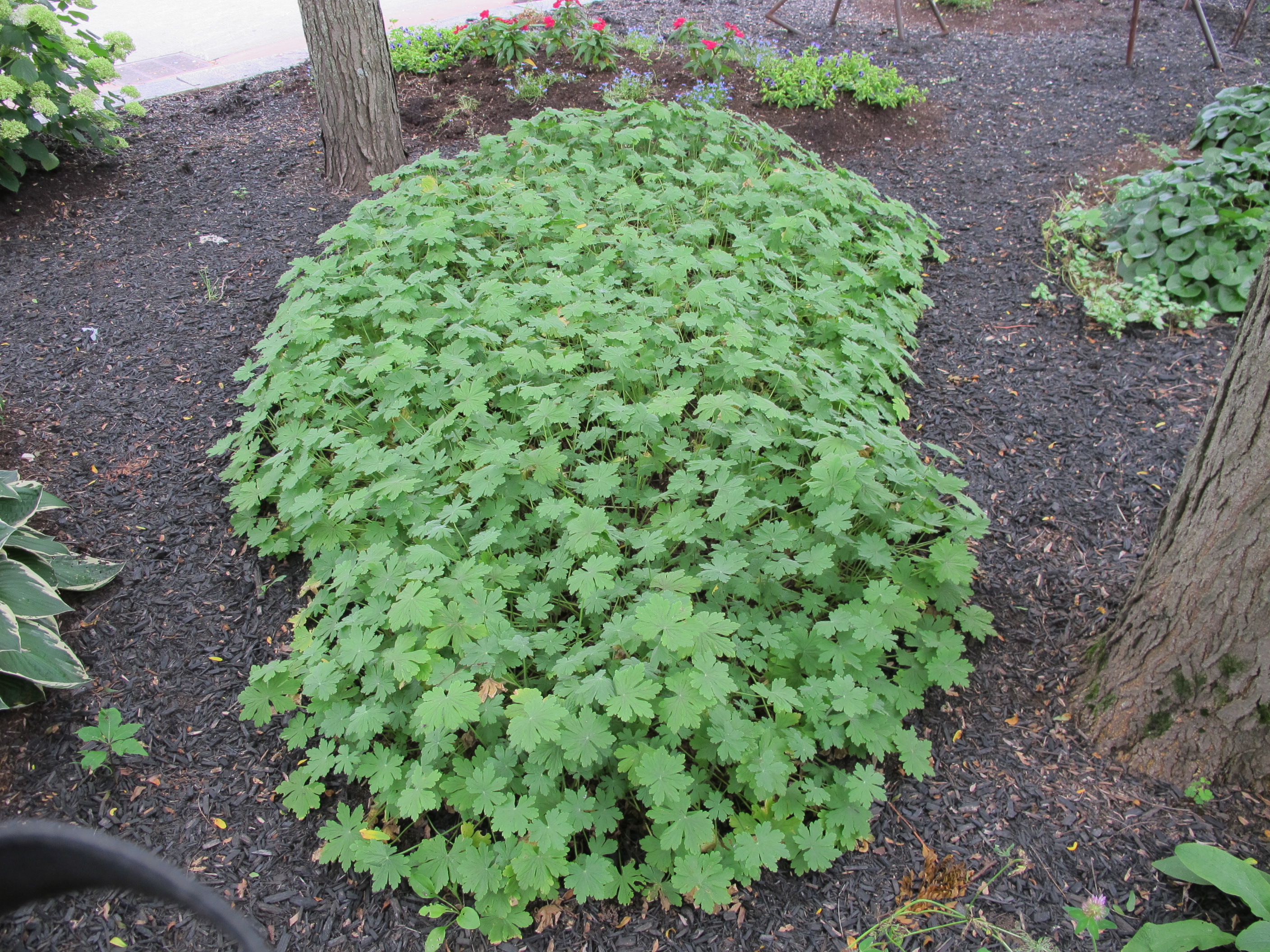
Geranium macrorrhizum
As I get older – I’m 67 – I sometimes wonder how long I will be able to keep on gardening at the level I do now. I have a large vegetable garden, fruit bushes and trees, many flower beds, a variety of decorative trees and shrubs – and some lawn. I have already accepted that it makes more sense to have a teenager mow the grass and to help me with some of the heavier drudgery of the garden. I am looking at ways to make less work for myself, and thought I might share a few labor-savers with you.
In the vegetable garden, mulch is my friend. It’s mid-summer, and some beds I have weeded more than once because I have not paid attention to my own dictum that mulching saves a lot of labor. But this has been a soggy summer, and there have been many days when I could not get in the garden because the ground was water-logged. And some days I almost could have kayaked down the pathways of my garden. So I did not get my mulching done early. Even when I could have mulched, I didn’t because soil looses more moisture when exposed to the sun, and I needed to let the soil dry out.
This past week I have made a real effort to weed the vegetable garden and put down mulch. My basic technique is to weed, then cover the area weeded with something to keep the sun from reaching weeds that surely will germinate. I like newspapers covered with straw or mulch hay. Six pages of this paper covered with straw will prevent most weeds and grasses from growing. This year I got some jute coffee bags to use for mulching the pathways, and I like them, too.
Weeds in walkways can spread to the beds by root or seed, so keeping them weed-free is a great boon to the tired or over-ambitious gardener. Last fall I planted grass seed in some rows, and mow it. But the width of the mower required that I space beds farther apart than I usually do. And it is awkward to get the mower around corners of rows. So it is not a perfect solution, though it looks great if you have the space to maintain nice mowed paths.
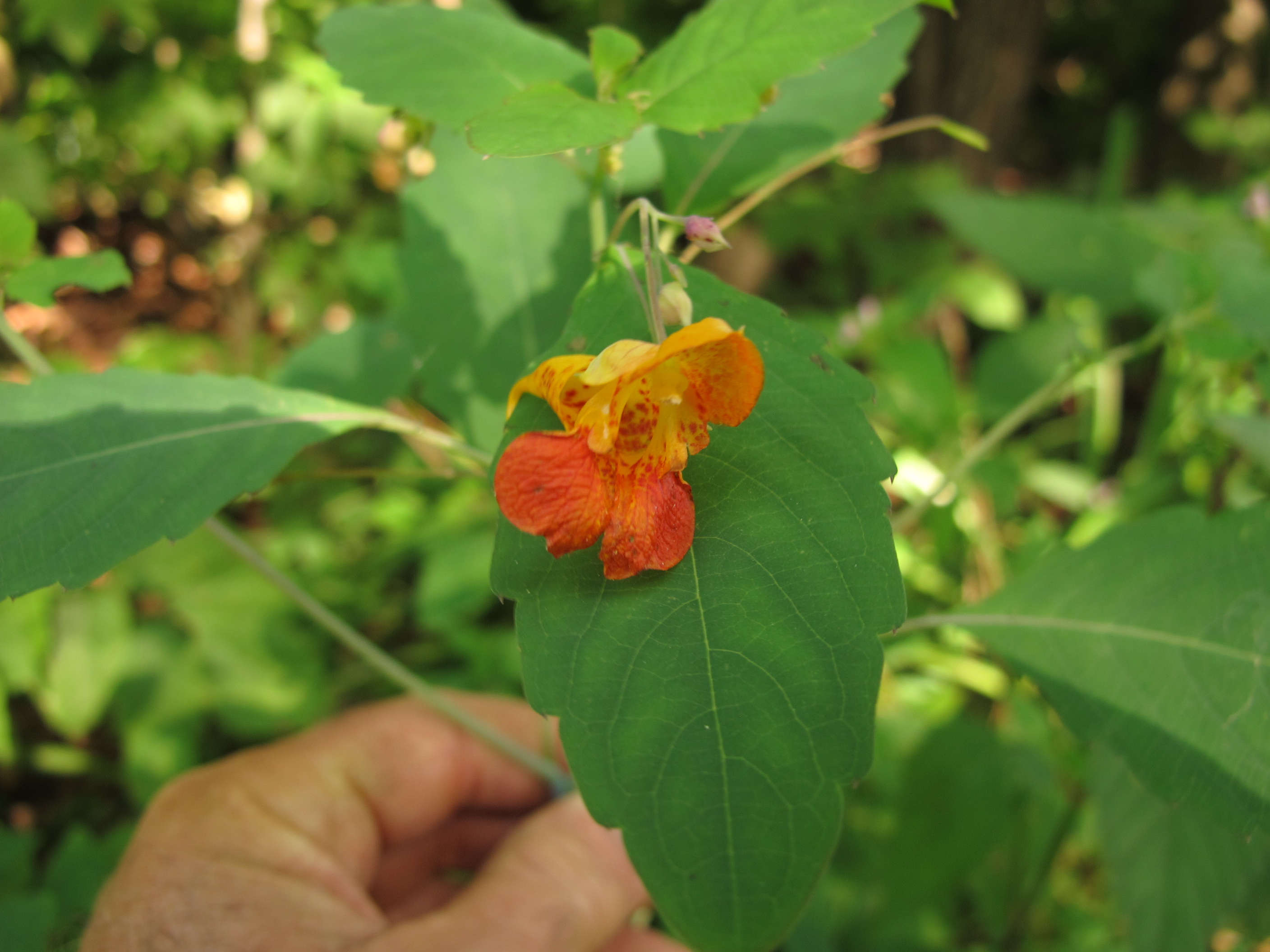
Jewelweed
It’s tough to find good weeders to help. But a teenager can do a nice job if you just teach her to identify and pull one or two particular species of troublesome weeds. So I have someone just working on jewelweed, also called touch-me-not (Impatience capensis). It is a tall weed with orange or yellow flowers and a hollow, watery stem. It generally grows in shade or part shade. It’s not a perennial so it has a relatively small root system that pulls easily.
Jewelweed’s other common name, touch-me-not, does not indicate any poisonous properties. It has to do with the fact that ripe seed pods have built-in springs that will propel seeds some distance. Lightly squeeze a pod, and good-sized green seeds go flying.
For the past decade I‘ve been ignoring touch-me-not because my grandchildren enjoy squeezing the pods. Doing so always provokes a giggle. But over time, more and more touch-me-not has appeared, and recently I declared war on it. The plants are just starting to bloom for me, so I must get them – now! This will not preclude having some plants next year or the year after, as most seeds of garden plants are good for 3 years (and weed seeds may last even longer). There must be plenty of seeds already in my soil. So Rule #1 of reducing work in the garden: Get rid of weeds before they scatter their seeds.
Some groundcovers can be great weed inhibitors in flower beds. Others spread so fast that they become weed-like themselves. If you want to plant groundcovers, be sure to weed the area well before planting them. Get not only the tops of your weeds, but their roots as well. Use a weeding tool that can get underneath a weed, loosen the soil, and lift the entire root system. I like the CobraHead weeder for that task.
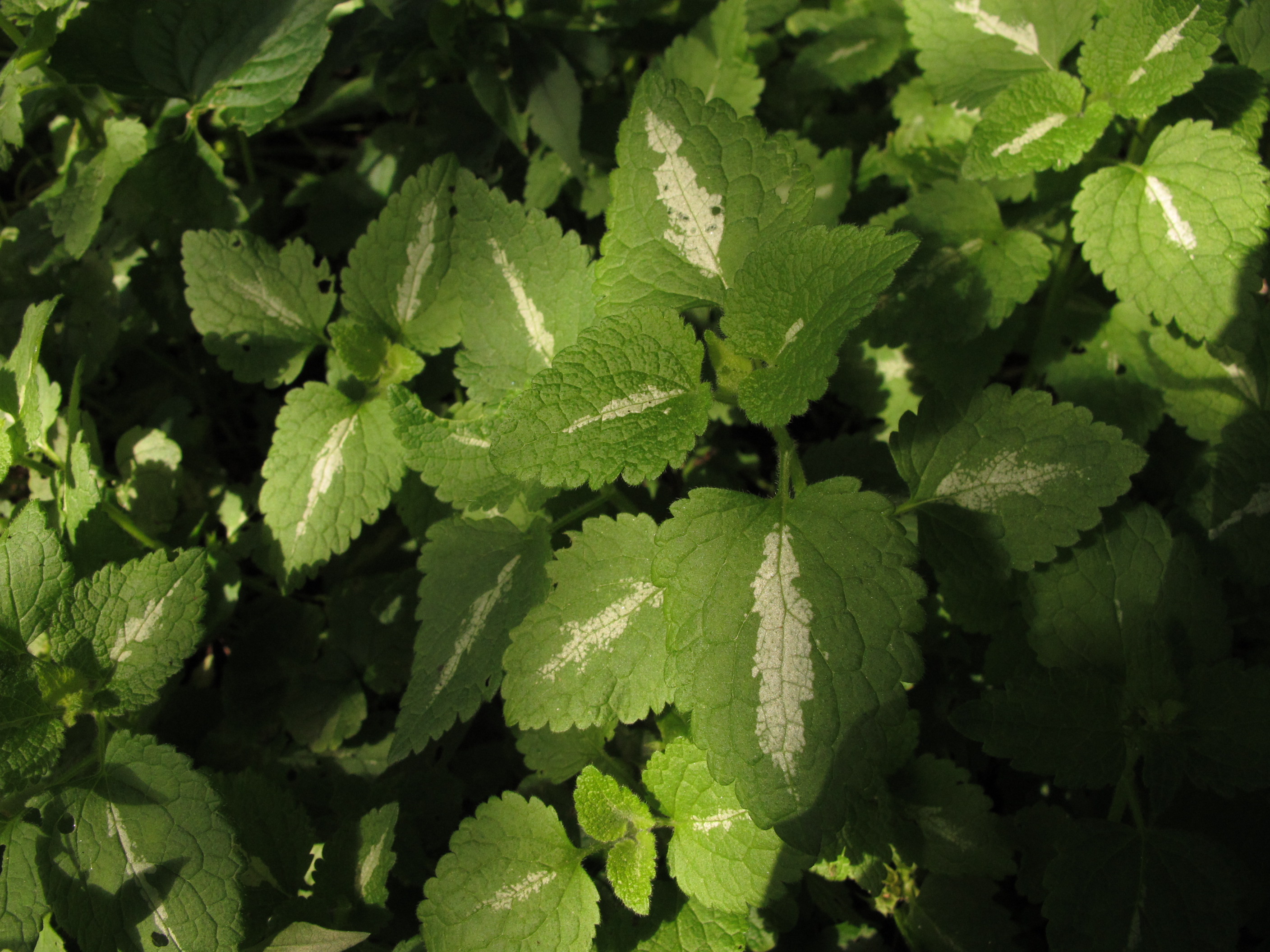
Lamium
There are lots of good groundcovers – too many to mention them all here. For dry shady areas, I like dead nettles (which I call by its scientific name, Lamium, because it is not related to stinging nettles). It has pink or white flowers reminiscent of snapdragons, and some varieties have nice silver and green leaves. It spreads and grows densely enough to keep many weeds from starting up under and between the plants.
Bigfoot geranium (Geranium macrorrhizum) is another good one. It’s not related to your mother’s potted red geranium (which is actually not a geranium but a Pelargonium). It makes a very dense mound of leaves a foot tall or more. It blooms in early summer, but I grow it for the foliage and because it shades out most things. And it will grow in dense, dry shade – or full sun.
Lungwort (Pulmonaria spp.) spreads by root in either sun or shade, as does lily of the valley (Convalaria majalis). I like the former, but find the latter a bit too aggressive to keep.
There are many ways to save labor, but most important of all is getting rid of any weed that is blooming now. It will save you labor later.
Henry Homeyer is a gardening consultant and the author of 4 gardening books. His Web site is www.Gardening-Guy.com.