-

Now available for $24.95 including shipping. -
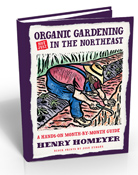
Now available for $21.00 including postage. Vendors I Like
 Click Here to buy from Cobrahead
Seed Catalogs
Before we launch into this week’s article…
Gardening Classes with Henry
Lebanon College: Gardening: A Practical Workshop. Garden writer Henry Homeyer will teach you the basics of organic vegetable and flower gardening. From garden design to seed-starting , planting, watering, weeding, mulching, and harvesting, this course will give each student practical knowledge of gardening. Tuesday nights from 6:30-8:30 for 5 weeks, April 3-May 2.Contact Lebanon College to reserve a spot for this5-part workshop www.lebanoncollege.edu or call 603-448-2445.
AVA Gallery, Lebanon. Henry will teach 3 classes at AVA Gallery this spring. You may sign up for one or all of these workshops:
Sculpting the Living Landscape: Starting Flowers from Seed
April 9; Monday, 6:30–8:30pm; One 2-hour class
Sculpting the Living Landscape: Perfect Perennials for the Upper Valley Garden
April 23; Monday, 6:30–8:30pm; One 2-hour class
Sculpting the Living Landscape: Organic Techniques for Enriching Soil and Managing Pests
May 7; Monday, 6:30–8:30pm; One 2-hour class
For more information go to www.avagallery.org or call 603-448-3117.
Seed Catalogs
I love thumbing thought the seed catalogs, and look forward to their arrival every year. On the other hand, I do wonder about the environmental impact of having so many seed companies sending thousands upon thousands of catalogs through the mail. So I have resolved not to request any more catalogs and I have started searching for seeds on-line.

Seed Catalogs - Just Say No!
I was inspired to shop on line this year, in part, by Renee’s Garden seeds, which only sells seeds from its Web site (www.reneesgarden.com). Her Web site is very easy to use. Click once, you have a basic description, cost and a drawing. Click on “How to Plant and Grow”, and you get lots of info. Click on “Photos”, and there they are – especially helpful for flowers. I have learned from her articles that are also on the Web site. (see Kohlrabi, for instance)
In my on-line search for interesting catalogs I found an old friend, Dan Nagengast, who now owns a seed company in Kansas called Seeds from Italy. (www.GrowItalian.com). Dan was in the Peace Corps in Mali, West Africa, when I was there. I called him right up and learned that he and his wife have been market gardeners for 20 years, and recently bought the company. He told me that seeds from Italy do well here, and that his company has seed racks throughout New England.
I use lots of fennel seeds in cooking (they add a nice licorice flavor), and love fennel bulbs for use in salads, but have not grown fennel in ages. Dan confirmed that there are 2 different kinds of fennel – bulbing fennel and a wild fennel that produces flowers and seeds that are wonderfully powerful, adding a licorice flavor to soups and stews. I shall order seeds of the wild one, Fennel Sylvatico. I’ll also try their chickory, a green that Dan recommended, and a few kinds of beans – they sell 35 named varieties!
I grow lots of heirloom seeds – varieties that have been around for a long time and that are good for seed saving. Baker Creek Seeds (www.rareseeds.com) is one of the leading companies for heirlooms – their online catalog boasts of 1400 varieties this year. But, quite frankly, finding what you want with that many varieties is a bit overwhelming for me. A paper catalog would be easier to manipulate. Their honesty is overwhelming. Describing one called “Big White Pink Stripes Tomato”, they write “Lovely big, globe fruit … a sweet tropical taste with hints of melon. A lovely tomato with low yields; yes, low. But who cares? It is so gorgeous!” I’ve never seen a catalog admit to low yields.
A great source for organic tomato seeds is in Carmel, CA: Tomato Fest (www.tomatofest.com). Gary Ibsen grows about 600 varieties of tomatoes. Like Renees’ Seeds, they only sell from their web site. They have a PDF file that you can print out to read if you must –but it’s 82 pages. They have been growing tomatoes for many years (and until 2008) they had a tomato festival each fall, hence the Web address. I like the fact that the web site allows you to search for things like “Cooler climate varieties”, or” Gary’s Personal Favorites”. Unlike almost all other seed companies, they grow all their own seeds.
Then I spent some time on the Seed Saver’s Exchange Web site. The Seed Savers Exchange is a non-profit organization that is ”a member supported organization that saves and shares the heirloom seeds of our garden heritage, forming a living legacy that can be passed down through generations.” Anyone can buy seeds from them. If you become a member you get the seeds savers exchange yearbook which connects you to other seed savers who grow and save heirloom seeds (and you can sell your seeds, if you wish). This year there are over 20,000 kinds so seeds available to you. You also get a quarterly magazine and other benefits, including a 10% discount on seeds.
I love the names of heirloom seeds, they tell a story, or the opening line, if you have an imagination. There is the Lazy Housewife Bean, a tomato called Black from Tula (which turns out to be from Russia, not Auntie
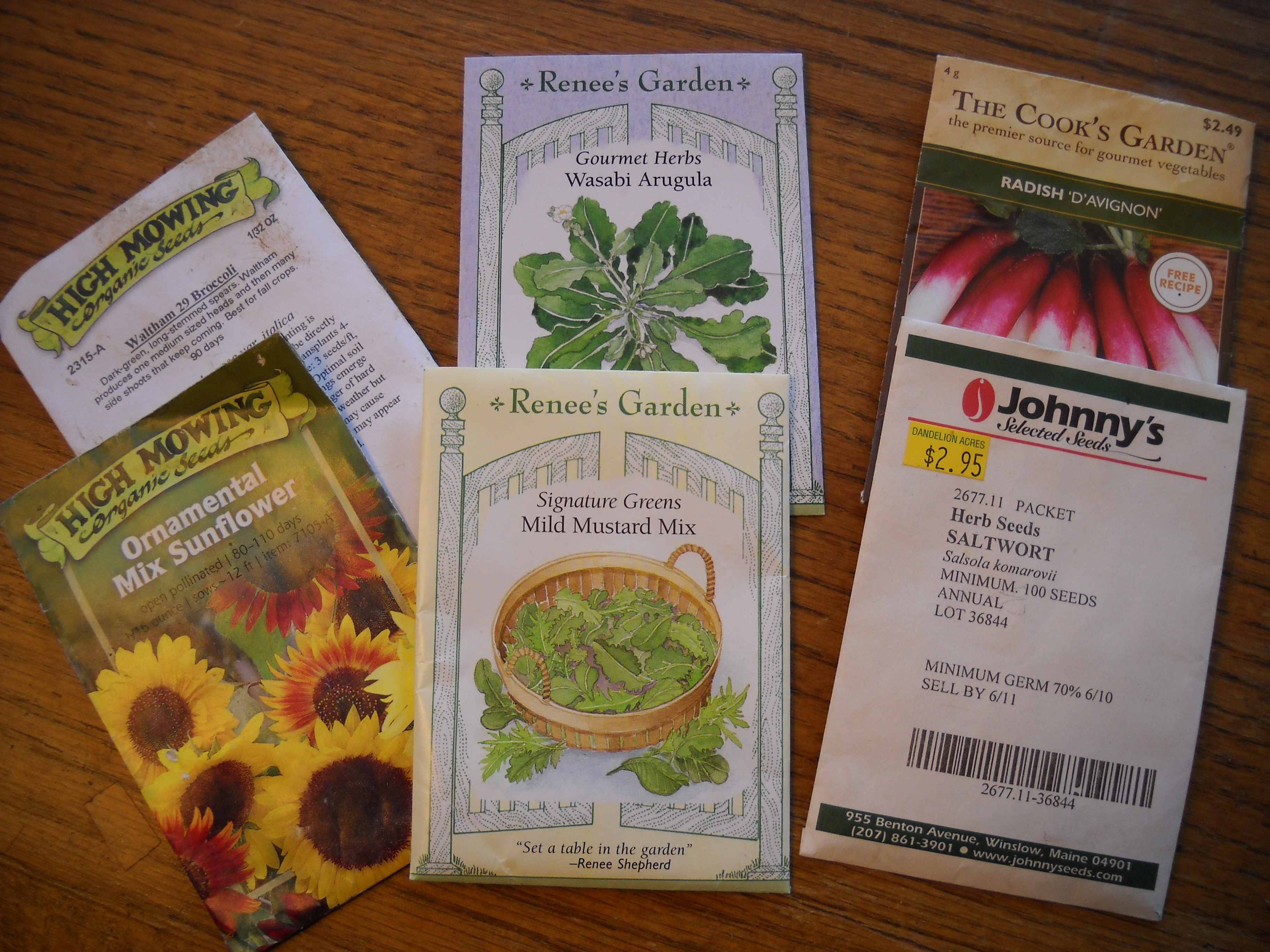
Seed Packets
Tula), or the Rat Tailed Radish (Native to South Asia. Grown for the crisp, pungent, edible seedpods (up to 6 inches long) and not for the roots. Pods should be gathered before fully mature and eaten raw, pickled, or chopped in salads. 50 days.). The Seed Saver Exchange Catalog online is not overwhelming – they only have a tiny percentage of the varieties offered by members. About 40 kinds of beans, for example, not hundreds. It gives planting specifications and a photo for each.
And of course, seed racks are great for purchasing seeds. I am a big fan of supporting local businesses and of course, there are no shipping charges for seeds purchased at your local feed and grain store. I like buying seeds of known companies, not the cheapie seeds of some big box stores as I have no idea how they were grown, or where. And of course, organic seeds are better even if sometimes a tad pricier.
For a list of seed companies Henry likes, visit www.Gardening-guy.com. Henry is the author of 4 gardening books. His latest, Organic Gardening (Not Just) in the Northeast, is available online and at bookstores throughout New England.
Web Extra: In addition to the catalogs mentioned above, I buy seeds from lots of companies, but here are some I like best, and what I like about them:
Johnny’s Select Seeds (www.johnnyseeds.com): This is a company that has been selling seeds under the same management for more than 35 years. It’s now an employee-owned company based in Winslow, Maine, and the founder, Rob Johnston is still running it. They supply a lot of farmers I’ve interviewed, which tells me that their seeds are top quality, reasonably priced and reliable year-after-year. They have a great selection of seeds as well as tools, row covers and other gardening/farming supplies. They sell both organic and conventional seeds.
High Mowing Seeds (www.highmowingseeds.com): These folks only sell organic seeds, and are located in Wolcott, Vermont. I like buying seeds from them because they test seeds in Vermont – over 800 varieties every year. I’ve talked to the owner, Tom Stearns, who is in the business not just to make money, but to help change the world. Their Web site explains their philosophy, which says, in part: “We believe in a hopeful and inspired view of the future based on better stewardship for our planet. Everyday that we are in business, we are growing; working to provide an essential component in the re-building of our healthy food systems: the seeds.”
Seeds of Change is another nice company (www.seedsofchange.com). They are fully organic.