Late Fall Color in the Garden
Posted on Tuesday, September 15, 2026 · Leave a Comment
In baseball terms, this is not the last inning for our gardens. It’s more like the seventh inning stretch. Many flowers have finished up and are dying back, but a few are yet to come.
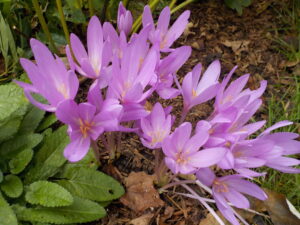
Colchicum or fall crocus
Let’s take a look, starting with two bulb plants that have not come up yet in my garden, but will soon: Autumn crocus (Colchicum speciosum) and saffron crocus (Crocus sativus). The first are not true crocus, but resemble crocus on steroids. They send up big leaves in the spring to provide the bulbs with the energy needed for fall blooming, then they die back and disappear. In September the blossoms appear, but without any leaves. Their blossoms resemble crocus blossoms, but are 4- to 5-inches long and appear on 5-inch stems. For me, these pink or white blossoms usually flop over but still look good. And they can last in a vase for a few days.
Planted in August, saffron crocus blooms that same year in October or November. Each beautiful little blue flower has 3 stamens, which when picked and dried, is used in cooking and is fabulously expensive.
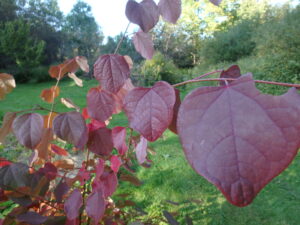
Disanthus blooms in a reddish purple
The crocus bulb that blooms this fall produces several little bulbs around the “mother corm”, then dies. Those little corms may bloom the next year, but might not. I’ve grown them, but haven’t had luck getting blossoms in year two, probably because they need full sun and I planted mine in part sun.
But on to the reliable fall bloomers. Grocery stores and garden centers are selling pots of annual chrysanthemums many pots with 100 blossoms or more. They are a sure antidote for the end-of summer blues! They’re bright and colorful – good for the front steps or to replace annuals that melt after the first timid frost. Be sure to water them regularly if they’re on your front steps in a peat pot, as they dry out quickly.
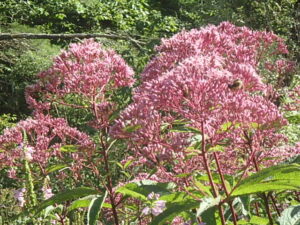
Joe Pye weed is a fall bloomer and provides nectar to Monarch butterflies
Then there are the perennials, most of them tall and bold. Right now, in bloom, a few I have are white mugwort, goldenrod, Joe Pye weed, sneezeweed and black-eyed Susans,
Although its cousin, common mugwort (Artemesia vulgaris) , is a pernicious weed that spreads vigorously by root and seeds, white mugwort (Artemesia lactiflora) stays in tidy clumps three-feet tall with masses of delicate white flowers. My mugwort is finishing up its bloom cycle now.
Goldenrod can be weedy, but there are certain species that are not. ‘Fireworks’ is a named variety that is a clumper, and is very lovely, 3- to 4- feet tall. Pollinators love goldenrod, so don’t dismiss it. Those sold at garden centers are probably not weedy.
Most of you know Joe Pye Weed, a tall, spreading native plant that has been blooming for since mid-August and still looks good and attracts pollinators. Last year a large flock of Monarchs stopped in one day to fill their gas tanks with nectar before the flight to Mexico! It does best with rich, moist soil in sun or part sun.
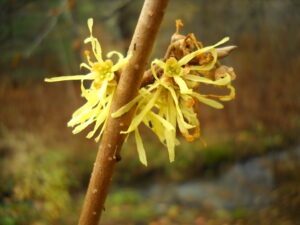
Common witchhazel flower
There are now shorter cultivars available for sale, though I haven’t tried any. ‘Little Joe’ sounds good, but is still 3- to 5-feet tall in 2- to 3-foot wide clumps. I have a full sized variety called ‘Gateway’ that is 6-to 8-feet tall and has spread over the decades, to a 10-foot wide clump. Not for the small cottage garden!
Sneezeweed (Helenium autumnale) is a lovely 3- to 6-foot tall flower in the aster family that does not make you sneeze, though it was used as snuff long ago, hence the name. It comes with pure yellow flowers, or with orange, red or brown petals mixed in. It needs full or part sun and is best in the back of a perennial bed as it has “bad legs”, meaning the leaves on lower parts of the stem tend to brown up early.
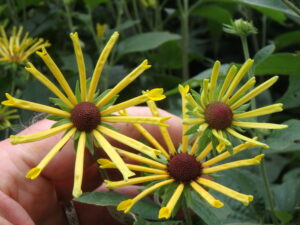
Blossoms of the Henry Eiler are unusual for a black eye Susan
You all know the black-eyed Susans, so I will only mention a variety called ‘Henry Eieler’, which is very tall and has petals separated by spaces like the teeth on a Jack-O-Lantern. Six-feet tall in an ever-expanding clump, it needs to be staked.
Some shrubs and trees have leaves with wonderful fall color, a few even bloom in late fall. Of the bloomers there are many kinds of hydrangeas, seven-son flower tree (Heptacodium miconioides) and the witch hazel tree (Hamamelis virginiana), which blooms in October and November with ribbon-like flowers.
Of the hydrangeas, I like ‘Pink Diamond’ best for its big conical panicles on stiff, non-flopping stems. At age 20, mine is 15-feet tall and wide. But ‘Quick Fire’ is a great smaller one – I keep mine pruned to 4-feet tall and wide with an annual cutting back of last-year’s blossoms in the spring. That also stimulates more blossoms. They start out white in early summer, mature to pink and red in the fall – and look good all summer. And of course, the Pee-Gee hydrangea is an old favorite that does get big.
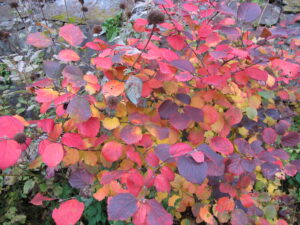
Fothergilla leaves are wonderful in late fall
For foliage color, you can’t beat fothergilla (Fothergill major). A slow-growing native, fothergilla displays red, yellow, orange and purple leaves late in the fall. In spring it has early white bottlebrush flowers.
But if you lament the demise of burning bush, now on the invasive species list, look for a disanthus (Disanthus cercidifolius). The leaves turn a rich purple and holds on to them till late in October. It is hard to find in nurseries, so if you see one, grab it! It stays as a medium to large shrub that likes sun to part sun.
Enjoy the fall, and make sure you have some plants that will make you want to stroll your gardens, camera in hand.
A Few Chores for the Early Fall Garden
Posted on Tuesday, September 1, 2026 · Leave a Comment
We’ve already had some chilly nights here in Cornish Flat, NH. Frost is still a long way off, but a few leaves are already turning and I’m thinking about my fall chores and getting a few done now. Let’s take a look at some chores you might wish to add to your list.
First, have a good look at your lawn. If you have bare spots or areas where your grass is thin, this is a good time to “over-seed” those places. You’ll be helped by temperatures that are cooler and rain that is usually more frequent.
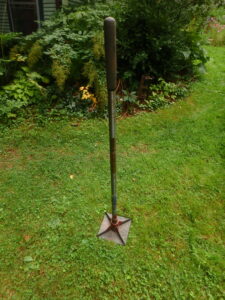
A tamper like this is good for getting good contact between grass seeds and the ground
I recently called Paul Sachs, a lawn expert and the owner of North Country Organics, a Vermont-based organic fertilizer producer. Paul suggested scratching up the area that needs help with a rake, sprinkling some seed over the area and tamping it down to ensure good contact with the soil. I use a metal tamper that does this well: it is a thick metal plate 8-inches square on a 4-foot handle. Lift it a few inches, drop it. Thud. Done.
Lawn seed needs light to germinate, so don’t cover your seed with soil. You can mulch lightly with straw to shade it and reduce evaporation. Seed needs to be kept lightly moist in order to germinate. In hot dry times, water daily. I generally use a “conservation mix” for the seed – it’s a good mixture of grass types. Paul Sachs told me you can over-seed through the end of October. I say do it sooner rather than later, preferably right after a rain.
If you haven’t harvested your potatoes yet, do so soon. If they have bloomed, or if the leaves are yellowing and dying back it is time to do so. Try to avoid damaging your potatoes when digging. If your soil is loose and fluffy, you can tug gently on the main stem while loosening soil from around the plant with your other hand. If your soil is heavy, push your shovel into the ground at a 45 degree angle to get well under the plant, and pry upwards. Potatoes store best unwashed and cured in the shade for a couple of days before putting in a storage fridge or a cool, dark basement. Mice love potatoes, so make sure they can’t to them.
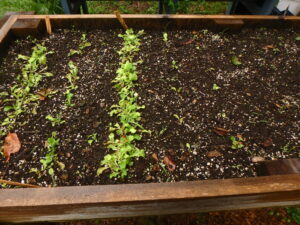
It’s not too late to plant lettuce in September
Recently I planted another batch of lettuce, and recommend you do, too. Lettuce seeds need sunlight to germinate, so you shouldn’t cover them with too much soil. A sprinkling of agricultural vermiculite (instead of soil) works fine. But if you plant seeds directly in the ground and you press down the seeds, it can form a little gully that fills up with soil when watering. I did that once this year and got only three seeds to germinate in a double 4-foot row. (Shame on me, I know better). When I planted seeds in my waist-tall raised growing bed I was able to water gently and had germination in 5 days! I thinned out some seedling and replanted, but I need to thin the rows some more.
Fall is a good time to move things around in the garden, including trees and shrubs. Scientists have determined that woody plants extend their roots after leaf drop in the fall. If you transplant now, be sure to water daily for the first week or so, and at least weekly after that – or more often if it’s hot and dry.
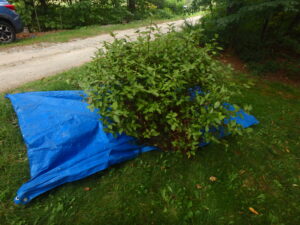
The honeyberry went off to a new home
I recently dug a mature honeyberry shrub (Lonicera caerulea) and gave it to some new friends. It was about 5-feet wide and 30-inches tall. It had provided birds with nice snacks in early summer, but I got only a few berries since birds eat them earlier than I do, and I refuse to use netting.
I pushed a long shovel (sold as The Root Slayer) into the soil and pried up the soil all the way around. I tried the get the shovel under the middle of the plant from all four sides before gently lifting it and placing on a tarp we used for moving it to my friend’s truck. Fortunately honeyberry has no tap root, which would have made the digging more difficult. Oaks (and most nut trees) grow deep tap roots making transplanting difficult after their first year and requires severing the tap root.
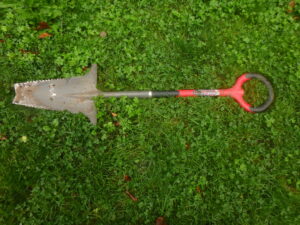
The Root Slayer has a stell handle great for prying out heavy trees or shrubs
This is good time to do a little planning: if you plant to plant spring-blooming bulbs or garlic, buy or order them soon. Seed garlic often sells out long before planting time in October. Visit your local farmer’s market or gardening center to buy garlic now unless you plan to sacrifice some of this year’s harvest for planting.
Lastly, take a walk around your property and ask yourself, “Do I really like this plant? Should I pull it and replace with something else?” I’ve run out of space in my garden, so I am doing that now, and sharing plants with friends to make space for new plants.
Henry has been gardening in Cornish Flat since he bought his home in 1970. You can reach him at
henry.homeyer@comcast.net or PO Box 364, Cornish Flat, NH 03746.

 Click Here to buy from Cobrahead