-

Now available for $24.95 including shipping. -
Now available for $21.00 including postage. Vendors I Like
 Click Here to buy from Cobrahead
Late Fall Color in the Garden
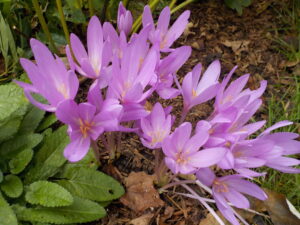
Colchicum or fall crocus
Let’s take a look, starting with two bulb plants that have not come up yet in my garden, but will soon: Autumn crocus (Colchicum speciosum) and saffron crocus (Crocus sativus). The first are not true crocus, but resemble crocus on steroids. They send up big leaves in the spring to provide the bulbs with the energy needed for fall blooming, then they die back and disappear. In September the blossoms appear, but without any leaves. Their blossoms resemble crocus blossoms, but are 4- to 5-inches long and appear on 5-inch stems. For me, these pink or white blossoms usually flop over but still look good. And they can last in a vase for a few days.
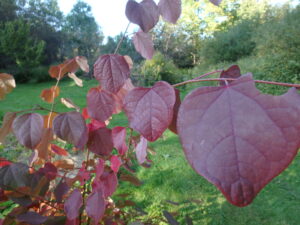
Disanthus blooms in a reddish purple
The crocus bulb that blooms this fall produces several little bulbs around the “mother corm”, then dies. Those little corms may bloom the next year, but might not. I’ve grown them, but haven’t had luck getting blossoms in year two, probably because they need full sun and I planted mine in part sun.
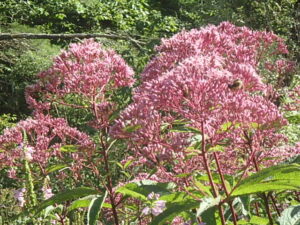
Joe Pye weed is a fall bloomer and provides nectar to Monarch butterflies
Then there are the perennials, most of them tall and bold. Right now, in bloom, a few I have are white mugwort, goldenrod, Joe Pye weed, sneezeweed and black-eyed Susans,
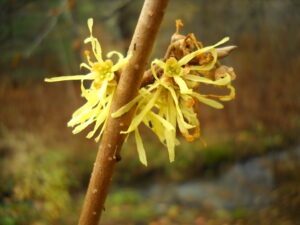
Common witchhazel flower
There are now shorter cultivars available for sale, though I haven’t tried any. ‘Little Joe’ sounds good, but is still 3- to 5-feet tall in 2- to 3-foot wide clumps. I have a full sized variety called ‘Gateway’ that is 6-to 8-feet tall and has spread over the decades, to a 10-foot wide clump. Not for the small cottage garden!
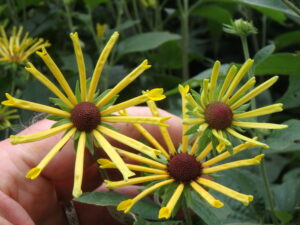
Blossoms of the Henry Eiler are unusual for a black eye Susan
You all know the black-eyed Susans, so I will only mention a variety called ‘Henry Eieler’, which is very tall and has petals separated by spaces like the teeth on a Jack-O-Lantern. Six-feet tall in an ever-expanding clump, it needs to be staked.
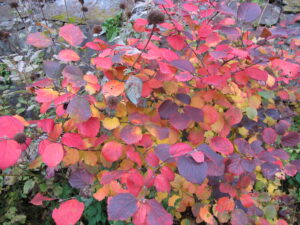
Fothergilla leaves are wonderful in late fall
For foliage color, you can’t beat fothergilla (Fothergill major). A slow-growing native, fothergilla displays red, yellow, orange and purple leaves late in the fall. In spring it has early white bottlebrush flowers.
Trees, Shrubs and Flowers That Bloom in October

Heptacodium blossom
Starting in early September, but varying greatly from year to year, my Seven-Son Flower Tree ( Heptacodium miconioides) blooms. This year, in early October, its white flowers were in bloom, despite 4 hard frosts. Some years even one frost will ruin the blossoms, but not this year. The flowers are white, small (half-inch in diameter), and borne in clusters of flowers mostly near the top of the tree.
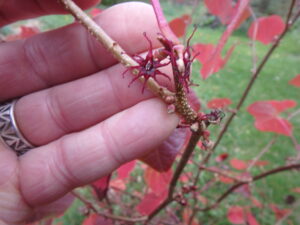
Disanhus flowers are small but interesting
A lesser-known shrub that blooms for me in October is disanthus ( Disanthus cercidifolius). This shrub likes rich moist slightly acidic soil in part- to full-shade. It is a polite shrub – it does not spread out and take over the area, and rarely needs pruning. During the summer is has nice dark green leaves similar to those on a redbud tree. But in fall the leaves turn an intense reddish purple and hold on well into the fall. I think the leaf color is better than that on burning bush, which is an invasive and no longer sold.
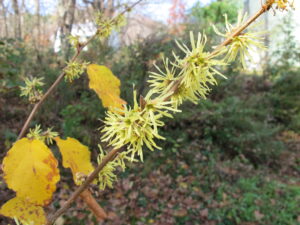
Witchhazel blossoms
Then there is the witchhazel tree ( Hamamelis virginiana). I remember the first time I encountered one. I was hiking in late October, and came upon a native tree covered in yellow blossoms. Although the blossoms were small, it had petals that were curly and bright – and I was not expecting anything to be blooming.
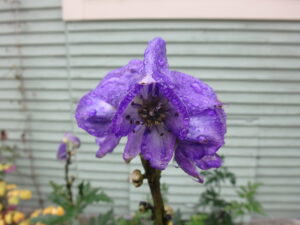
Fall blooming monkshood is a poisonous beauty
Most species of monkshood bloom in June, but I also have one species, Aconitum carmichaelii, which blooms now with intense blue flowers on 5-foot stems that do not flop. All monkshood species have poisonous sap, and some were said to be used to poison wolves in Russia. Agatha Christie probably had someone use it for tea, to get rid of an annoying relative, but I don’t recommend that.