Everything You Wanted to Know About Peonies, but Were Afraid to Ask
Posted on Tuesday, June 8, 2021 · Leave a Comment
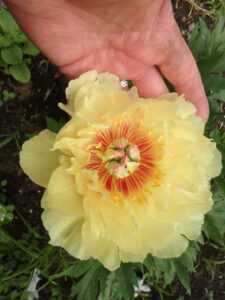
Itoh peony ‘Garden Treasure’ in my garden last June
If you don’t have a peony, I’m surprised. If you don’t have three, you should. They are blooming now, and this is a great time to buy them. Go to your local garden center or family-run plant nursery and buy some more, no matter how many you have. Buying in bloom means you can see the color of the blossoms, and sample the fragrance. Not all are very fragrant, but some are so lovely they might make you swoon.
When my wife Cindy Heath moved in with me in 2019, she insisted on bringing many plants – including her Dad’s favorite peonies and several others. I walked around recently to count how many peonies we have together. We have 44 between us, including my grandmother’s favorite,’ Festiva Maxima’. Grandmother died in 1953, but her peony lives on.
I regularly get questions about peonies. “Why did my new peony bloom once, but never again?” It‘s probably planted too deeply in the ground. In the fall, cut back your stems and feel for the “eyes” which are next year’s growth. To get blossoms, they should not be covered with more than about an inch of soil. If your peony is too deeply planted, or covered deeply in mulch, don’t dig it up, just pull back some soil and mulch to fix it.
Another question I get: “Why are there ants on the blossom buds?” Some write saying their grandparents told them the ants are involved in opening the buds. Is that true? No. The ants are attracted because there are aphids on the buds, and aphid droppings are called honey dew. Honeydew is sweet and attracts ants.
Gardeners are often frustrated by the fact that after a rain, many gorgeous flowers flop over or even break. Peony cages are sold in garden centers, but often these are much too short to prevent the problem.
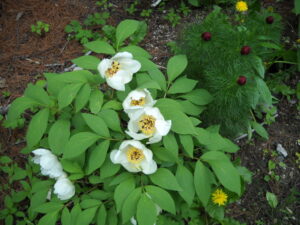
Peony Woodland (P. obovata with red buds of the fernleaf peony
What is the solution? Buy bamboo stakes that are 3 or 4 feet tall place two to four around each clump of peonies, pushing them deep into the soil. Then encircle the plant with twine, tying the string to each stake with a clove hitch. If you didn’t learn how to tie a clove hitch in the Scouts, U-tube will teach you. The encircling twine should be set about two-thirds the height of the plant. Do this when the buds have not yet opened.
Some gardeners write asking if it is okay to move peonies, and when should they do it? Conventional wisdom is that peonies do not like to be moved, but if you must, do it in the fall when they are starting to go dormant. That’s good advice, but peonies can be moved anytime. I once moved 50 peonies in June, and they all bloomed the very next year.
But I do agree that there can be problems moving peonies. The roots are fleshy, a bit like long, thin sweet potatoes. And they are easily broken unless you take great care. I would only dig them after a long, soaking rain – or if I had watered well a few days before and the water had soaked down deep. Some roots go 18 inches into the soil or more. And remember: be sure not to bury them too deeply. Look for those pointy little nubs and keep them near the soil surface.
Do peonies have diseases to watch out for? Rarely. The only problem I’ve ever had is with botrytis, a fungal disease that blackens leaves and kills them and the blossoms. And that only happened once. I removed the blackened leaves and sprayed with a solution of a product called ‘Serenade’.
Serenade contains a soil bacterium that kills fungal diseases including botrytis, but has no ill effects of humans, pets, fish, insects or birds. It stopped the infection, and it has not recurred. Serenade is commonly sold at garden centers, and has a shelf life of 3 years if properly stored.
I have peonies that bloom starting in late April some years, others that bloom in May and June. My earliest are woodland peonies: the fernleaf peony, Paeonia tenuifolia and the obovate peony, Paeonia obovata. The first is bright red, with single blossoms and finely divided leaves. Both have just a single layer of petals. My obovate peonies are cream colored, but produce blue seeds in red seedpods. The seeds are vigorous self-sowers.
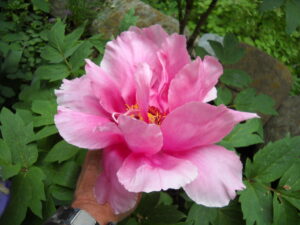
Tree Peonies are larger than most
Then there are tree peonies. These are small shrubs that produce huge flowers, up to 8 or 10 inches across. The blossoms are short lived, but spectacular. I had one for 20 years, but it died after a cold winter. Then a few years ago I bought an Itoh peony. This is hybrid of a tree peony crossed with a regular peony. The Itohs generally have yellow blossoms and produce many, many large blossoms over several weeks at maturity. But they are pricey: expect to pay $50 or more for a young plant.
Lastly, gardeners ask me, “Can you grow peonies in a shady garden?” Yes and no. Given good rich soil and plenty of moisture, you will get some blossoms with just four hours of sun per day, which is considered a shade, or part-shade garden. They really like full sun, and do best with six hours of sun or more. Those two woodland peonies I mentioned will do fine in shade, but are nearly impossible to find for sale.
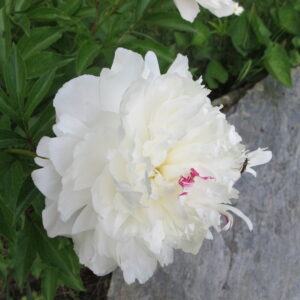
Peony ‘Festiva maxima’ that my grandmother grew
One last bit of advice: Since peonies live so long, be sure to add compost and a little slow-release organic fertilizer at planting time. Then every few years, top dress the soil around your peonies with some fertilizer and compost to get best results.
If I were to be exiled to a remote island and could only choose just one perennial flower to take with me, I don’t know if I would take a ‘Festiva Maxima’ peony. I do know that it certainly would be high on my list. How about you? Send me the name of your favorite flower. Let’s compare notes.
Reach Henry by e-mail at
henry.homeyer@comcast.net or write a letter to Henry at PO Box 364, Cornish Flat, NH 03746. He is a UNH Master Gardener, and the author of 4 gardening books.
The” No Work” Garden
Posted on Wednesday, June 2, 2021 · Leave a Comment
I saw a friend recently who was bubbly and excited about her garden. “It’s full of color and stays that way all summer!” she exclaimed. “And it is NO work! All I have to do is water it daily, and give it a little fertilizer every few weeks.” She invited me to come see it, so of course I went.
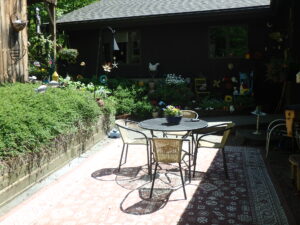
Annual flowers and found objects have transformed this space into an outdoor room
What my friend has is a small outdoor courtyard that she has transformed into an outdoor room, complete with a small metal table and chairs sitting on an outdoor carpet. She has purchased lots of annuals and is growing most in pots (hence the need for daily watering), along with a few easy perennials.
The house is L-shaped and defines two sides of the space, with a low railroad tie retaining wall for the third side; the front is open and once allowed her to park her car right by the side door to the house. No more.
In addition to the annual flowers, she has a few perennials growing in the ground and lots of whimsy. She stops whenever she sees a “FREE” sign by the side of the road. A chair with no seat? Bring it home, paint it bright blue, and put it in the garden. See a sculpture of a head, or an interesting vase at a yard sale? Get it!
The annual flowers she generally buys as hanging baskets because they have well established plants with blossoms from day one. Lots of color. Supertunias, verbenas, and marigolds of various descriptions are some of her favorties. When she gets them home she takes them out of their horrid plastic pots, and puts them in nice ceramic pots. If she goes away for a few days, she has someone come by to water.
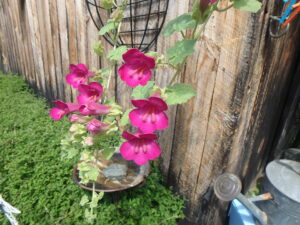
Lofos red wine attracts hummingbirds
A vining or trailing plant she likes this year is one I have never seen before. It has bright red trumpet flowers and is a Proven Winner trademarked plant called Lofos Wine Red, a Lophospermum hybrid. Keep it in sun with mostly dry planting mix, and it blooms all summer, attracting hummingbirds. In general, trademarked plants like this offer good results with minimum effort.
Right now she has a big pink bleeding heart (Dicentra spectabalis) in full bloom, though that will bloom only for a few of weeks. She has a groundcover that I use in shady areas called sweet woodruff (Galium odoratum) that serves as a nice filler near it and is blooming right now. It has fragrant white blossoms and delicate lacey foliage that stays green and handsome all summer. Later an astillbe will blossom nearby.
Hosta is another important plant in her garden. She has many with large, green leaves. And although hostas are generally grown for their foliage, later in the summer they will send up flower stalks with white blossoms.
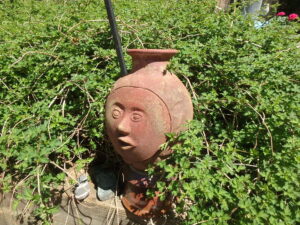
A vase nestled in a planting of lacebush or Stephanandra
The side of the space that gets the most afternoon sun is filled with Stephanandra incisa or lace shrub. This is a deciduous woody shrub that spreads by root and roots in wherever the tips of branches touch the ground. It only gets a couple of feet tall, but has very dense foliage – dense enough that grasses and weeds do not come through. It blooms in June, with small white star-shaped flowers. The leaves are shaped a bit like maple leaves. Her stepanandra was planted 25 years ago and still looks great – it covers the bed that is over 50 feet long and 4 feet wide.
More than a dozen years ago I planted bulbs for my friend in another part of the property. My goal was for her to have blossoms from March until late May from spring bulbs, and the bulbs are still going strong: first snowdrops in March, followed by crocus, then daffodils. I selected daffies for their bloom time: some early, some mid-season, some that are bloom in late May. Like everything at this property, the goal was to have no-labor or low-labor beds, so the beds were well mulched with chipped bark.
What other plants grow at this garden? She had a steep rocky hillside with gravelly, poor soil. Grass grew on it, but it was impossible to mow. Someone suggested a creeping sumac, and she had it installed. It is variously called skunkbush sumac, creeping three-leafed sumac, or Rhus trilobata ‘Autumn Amber’.
The Autumn Amber sumac is a trademarked variety, and boasts of ”a profusion of small chartreuse-colored flowers that bloom in delicate clusters before new foliage appears.” In fall the leaves transform into “striking hues of ambers, yellows, oranges and/or reds before dropping for the winter”. I have only seen it but once before, even though it is hardy to Zone 4. It is supposed to be very good for tough, hot dry places. It is dense enough that I saw no grass growing through it.
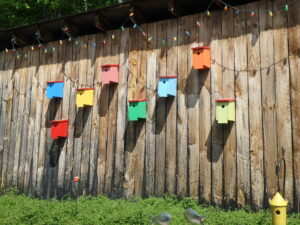
Bird houses add color to the garden
Each year my friend picks a theme for her garden by the kitchen door. This year she focused on birds: metal birds, colorful bird houses, hummingbird feeders. She likes to find flourishes for the plants at yard sales and thrift stores, trying to keep her purchases to under $5.
I asked my friend how she would describe herself as a gardener. “I’m a lazy gardener who doesn’t like to weed. I love color and whimsy and like to re-purpose everyday objects.” Nothing wrong with that – it gives her more time to volunteer, and take walks on her woodland trails.
Henry is a UNH Master Gardener and he author of 4 gardening books. Contact him at
henry.homeyer@comcast.net. His website is Gardening-Guy.com.
The Art of Weeding
Posted on Thursday, May 27, 2021 · Leave a Comment
When you face a flower bed and can’t immediately tell what’s a weed and what’s a flower, you have a situation my wife, Cindy Heath, calls Code Red. It happens to the best of us at times, myself included. So what does a gardener do?
My wife, Cindy Heath, likes to begin a weeding project by edging the bed. She has a pair of wooden pegs 12-inches long that anchor a 50-foot piece of twine. She unwinds the twine and stretches it between the two pegs when edging a straight bed. Curved beds have to be edged by eye.
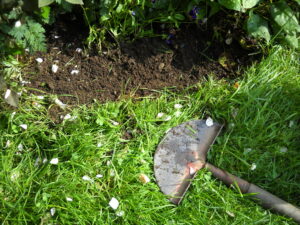
An edging tool helps create clean lines
The edging tool Cindy uses is a half moon-shape on a long handle. She pushes it into the earth with a foot, then tips the handle back to create a little moat when she removes the soil and grasses. Edging discourages lawn grass from creeping into the bed.
Next, she said, find the flowers. At this time of year weeds and rambunctious spreaders like Forget-Me-Nots may be taller than some of your perennials. Get close, and paw through the foliage. Pull a few weeds around your perennials so that you can see them, and so that you will avoid stepping on them or inadvertently pulling them.
If you pull a “weed” you don’t recognize but see that there is potting soil in the roots, you know you just pulled a flower you bought. Oops. Get it right back in the soil. If you have an inexperienced gardener helping you, you could flag the plants with bright orange surveyor’s tape.
Cindy said she likes knee pads because she likes to weed on her hands and knees. I personally find them hot and uncomfortable, but you may wish to try some. Me? I like something to kneel on, a foam cushion, or such.
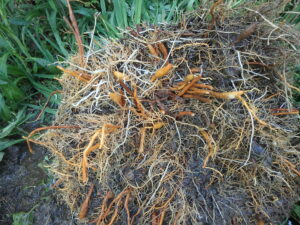
Day lily roots are orange to brown and have fat portions
In this season, Cindy says bug spray and a good hat are essential – black flies can be real pests, reducing your willingness to continue. Some gardeners like beekeepers hats to keep black flies off their faces, but I don’t. I spray the top of my hat, which does a pretty good job of repelling biting bugs without getting repellent on my face.
A good hand tool is essential for loosening the soil and teasing out roots. I think I have tried every weeding tool made, and like the CobraHead weeder best. It is like a steel finger: a single curved tine with a sharp, widened tip. Made in the USA and with a blue handle made from re-cycled plastic, it never seems to get dull and lasts forever.
If I have a large clump of grass to remove, I loosen the soil around it, then push the tool into the soil; the curve of the tool allows the blade to get under the clump. Then, pulling from above with one hand and below with my weeder, I can pull the clump right out. It is great for loosening tree roots that have invaded a bed, too.
When should you weed? Whenever you have the time and inclination. I recommend doing a little weeding every day. Sort of like brushing your teeth or washing your coffee cup. Just make it a habit so the weeds don’t get ahead of you.
Clay soils are heavy and sticky when wet, and much like concrete when dry. If you have them, work when they are moist, but not soggy. If dry, water moderately with your hose. Keep a bucket of compost with you and mix it in as you go along. Compost will lighten the soil, making it easier to weed or to plant things to fill in the spaces where the weeds were.
Sandy soils can be weeded any time, but I recommend adding compost as you go along. Nice loam is what we all want, and even that can benefit from some compost. I buy a 3-yard dump truck-load once a year and it has helped my soil become close to perfect.
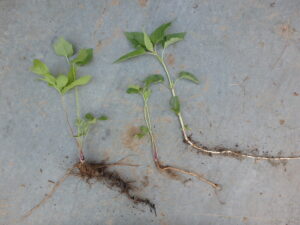
Weed roots are often long and able to send up new weeds at each node
But back to Code Red. If you have weeds that spread by root, things like goutweed or witch grass, you may need to “bareroot” the flowers that have been invaded. That means digging up a clump of flowers and washing all the soil off so that you can identify and separate the weed roots from the roots of your perennial flowers. Then replant.
Learn to recognize the roots of your garden flowers. Many invasive weeds have long, whitish roots with nodes along them and can send up new leaves from any of those nodes.
Lastly, after weeding it is advisable to either mulch your bed, or install a ground cover that will shade out any weeds that try to establish themselves. If you grow your flowers close enough together, weeding will become a minor chore.
It does take time to establish most ground covers, so you may wish to plant some annual flowers in the spaces between your peonies or phlox. Buy six-packs of common annuals like snapdragons, cosmos and zinnias at your local garden center. Plant them six-to eight-inches apart, stand back, and let them grow! They will delight you with blossoms for much of the summer and into the fall.
Henry is the author of 4 gardening books. He can be reached at
henry.homeyer@comcast.net or P.O. Box 364, Cornish Flat, NH 03746. Please include a SASE if you wish a response by mail.
Arrangements for Early Spring
Posted on Sunday, May 23, 2021 · Leave a Comment
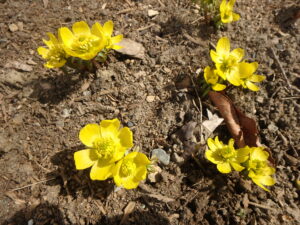
Winter aconite blooms about the same time as snow drops
I miss being able to go to my garden and pick flowers for the table. Yes, spring is on the way and even feels present on good days now. But it will be awhile until my daffodils and tulips bloom. My winter aconite, small yellow bulb flowers, are blooming, and little white snowdrops have pushed through frozen earth. Those mini-flowers aren’t really suitable for a bouquet, but I’ve picked a few things that please me.
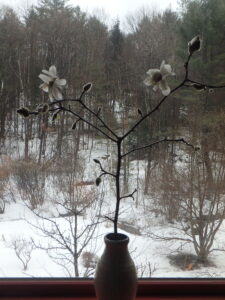
Forced flowers of my Merrill magnolia took 6 weeks to bloom
First, I picked some stems from my ‘Merrill’ magnolia. It is loaded with fuzzy buds for its late-April blooming, and these look good in an arrangement. Magnolia branches tend to fork and grow in different directions, so placing stems in a vase can be tricky. I put some in a dry vase with dried flowers and seed-bearing stems and one in a vase with water to put on a windowsill. The buds I picked on January 31 bloomed on March 17.
Beech branches are good for arrangements, too. The young trees, anyway, hold onto their light brown leaves, filling spaces in a vase. And the stems are a smooth gray, with cigar-shaped, pointy buds.
Of course red- or yellow-twigged dogwood stems add color to a winter arrangement. Each year one must cut back the plants in spring or winter to get the color on the new stems. They are fast-growing plants, so they can grow 5 feet of new stem in a single summer. They grow best in moist or marshy places.
For contrast in my vase I like to have some dark stems. Trees in the cherry family ( Prunus spp.) do well there. Chokecherry, pin cherry and black cherry look good in a vase. Young white birch have dark stems, as does hop hornbeam. But basically, you can pick any tree branches if you like their look.
Greenery is nice for contrast with bare stems. I recommend white pine for greenery. I has a nice weeping tendency, and is great around the outside of the vase. Unlike Canadian hemlock, it holds onto it needles quite well, but hemlocks are more common on my property, so I often use them.
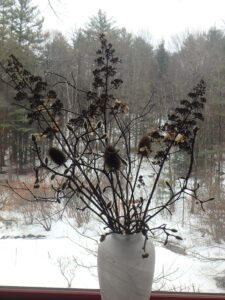
A dry vase with Pink Diamond hydrangea, teasel, beech, and magnolia stems
Then there are the hydrangeas. Many species and varieties hold onto their flower panicles well into winter and can be quite nice in a vase. My favorite is one called ‘Pink Diamond’. It has long stems and it holds onto the fertile and infertile inflorescences, showing contrast between white and black florets on the panicles. Although the blossoms are pink toward the end of their bloom cycle, they are not pink after frost.
Winter weeds can be interesting, too. One of my favorites for winter picking is teasel. Technically, this is a biennial weed. I harvested some seeds from a corn field in Ohio years ago. The corn farmer thought I was a total nut case because to him, teasel is a noxious weed. But I have learned its habits and allow just half a dozen plants to flower and produce seed every year, and it is a delightful addition to winter arrangements.
The key to keeping teasel in check is to recognize the first year plants. They are rosettes of light green leaves. I pull most, but leave half a dozen to mature and bloom in year two. The second year plants are loaded with thorns, and have a deep tap root, so if you pull them then, you must wear gloves. I rub the thorns off while wearing gloves as I pick them, and can then handle them with ease when arranging them in a vase.
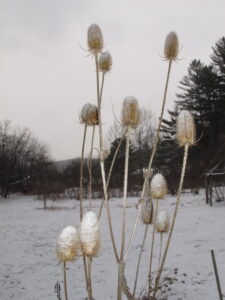
Teasel stands out nicely in winter, both in the garden and in a vase
Astilbes bloom magnificently for me, and their winter stems are great in a dry vase. I have many different species and varieties ranging from short (12-inch blossom stems) to tall (48-inches). Their chief requirement is moist soil, and I have plenty of that. If you don’t have moist soil, the leaves will brown up in the heat of summer. One trick I have tried in dry locations is to bury a plastic bag a foot or so deep in the soil before planting. That will act like a little bathtub and hold some water in dry times. They like a half day of sunshine, and prefer morning sun.
Snake root or black cohosh (formerly called Cimicifuga spp. Now in the genus Actea) holds on to dry blossoms long after summer has passed. They look good in dry arrangements if you have any still standing.
Winter arrangements tend to be fairly monochromatic – tan or brown colors are most common. I have seen gardeners use dry allium (onion-family) blossoms to bring color to the table by spray painting them with red, blue, purple and yellow spray paints. I have never done so, but if I think to harvest some next spring or summer, I may do so. I have even seen them sprayed while still in the garden!
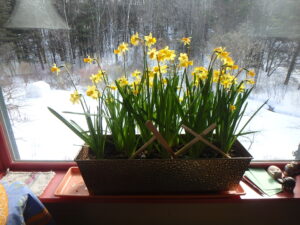
Forced tete-a-tete daffodils
Of course, the best color in the house for me right now are my forced daffodils. Last fall I potted up plenty of “tete-a-tete” daffodils and kept them in my cold cellar until recently. Each bulb provided many blossoms and even now, after the flowers have gone by, they are still pleasant looking with green leaves and dried yellow flowers.
Gardening with Children
Posted on Thursday, May 20, 2021 · Leave a Comment
Okay, all you parents and grandparents, it’s time to garden with your beloved little ones. That’s right, start them young, make it fun, and they will garden forever. The key part is fun. Never make a child pull weeds. Digging in the dirt is fun. Playing with a hose or a watering can is fun. Picking flowers and eating cherry tomatoes warm from the sun is lots of fun.

Newspapers on the bottom of a raised bed help to smother the grass
When my grandchildren were small, I created little gardens at my house for them. I used boards to create distinct little beds, one for each. What size? I made them their height by their wingspan – the span of their arms – about three and a half feet square. I actually had them lie on the lawn with their arms out to set the dimensions. That’s good for a giggle.
The boards were just six inches wide, and were made of ordinary lumber – definitely not of pressure treated boards, which even now are full of chemicals, albeit not as toxic as those produced when pressure treated lumber first came out. But remember, they will not be that size long, so you don’t need the beds to last forever.
The simplest way is to build a sturdy bed is to cut pieces of two-by-four as long as your boards are wide. Put one in each corner, and use a cordless drill to screw the boards on to them in the corners. Screws that are two inches long are fine, and much easier to work with than nails if you are not accustomed to building things. Two screws are needed on each end of the boards to make it sturdy. Work on a flat surface such as your driveway, or inside the garage to make work easier. Metal brackets are also available to help make sturdy garden boxes.
Pick a spot for the garden in full sun. That means six hours of sunshine at a minimum, but preferably all day sun, from morning to late afternoon. Choose a site that is flat, or nearly so. If you are giving the kids garden beds in your garden, be prepared for it to be weedy and messy at times – unless you intend to weed it yourself. Some kids will want to weed, but most won’t. So you may want to place the little gardens somewhere on the back lawn.
If you choose to place the garden box on the lawn, you don’t need to remove the sod. Just cut the grass as short as you can, then cover it with 6 pages of this newspaper, and fill it up. The soil will kill the lawn. The first year carrots may stop or bend when they hit the bottom of the bed, but after that the soil will loosen up with the action of the microorganisms, and you can grow deep-rooted things without a problem.
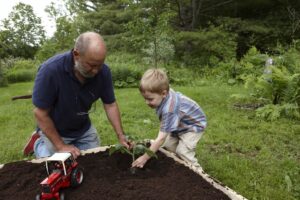
A child’s garden can accommodate planting and playin
What should you use for soil? I like to mix plenty of compost with ordinary garden soil, roughly a 50-50 mix. You can buy bags of compost and top soil, or raid your compost pile and your garden for soil – you don’t need but a couple of wheelbarrows of soil.
When the bed is first built, your kids may want to just play in the fresh earth. Soil smells good, is pleasant to touch, and is ideal for making little roads for trucks or mounds for castles, just as it’s fun to make sand castles at the beach. I suggest you don’t be too goal oriented, telling the kids they need to stop now and plant their carrot seeds. Let them see you planting things, both seeds and plants, and they will want to, too.
Ask your children about their favorite vegetables. Have they ever seen a purple or red carrot? Would they like to try growing some? Where do French fries come from? In my experience, planting potatoes is great for all kids – the seed potatoes are a size even the littlest ones can handle, and later on the harvesting is like going fishing and knowing they’ll catch fish. Very exciting.
Maybe take them with you to a garden center. Look at the marigolds, which are already blooming. Encourage them to smell flowers, and if they find something they like? Buy it. I like the idea of kids growing flowers with their veggies, and my grand kids did, too.
Remember, success is important. That means you will have to be attentive to their gardens. Weeding and watering will be your responsibility unless they live nearby and want to do these tasks.
By the way, it’s important to have a few child-sized tools and especially watering cans. Ours watering cans are too heavy for them, and a hose can easily blast a tomato seedling from here to Milwaukee.
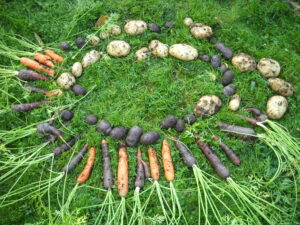
My grand kids grew these and arranged them to show off their harvest
What if your grandchildren want to grow pumpkins or watermelons? Those vines will quickly exit the mini-garden you have lovingly prepared. Are you willing to let the vines run, making it impossible to mow the lawn there? Perhaps you can convince them to grow something else, and together plant the pumpkins in your vegetable garden.
My maternal grandmother died when I was seven, and my parents sent me to stay with my grandfather that summer to keep him company. I took the train by myself from New Haven to Worcester, Massachusetts – complete with a change of trains in Springfield. It was a bit scary the first time, but I refused to let my mother put a name tag on me! Grampy and I had a lot of fun so I went every summer until he died when I was 21. I learned to garden by observing. He never lectured. That’s probably a good recipe for success.
Planning for Spring Flowers
Posted on Tuesday, May 18, 2021 · Leave a Comment
Spring puts a spring in my step, quite literally. I bounce out of the house in the morning to see what is blooming, and since early March I have never been disappointed. You know the regular cast of characters in early spring: first snowdrops with their tiny white blossoms, then glory-of the snow in blue, white or pink, and winter aconite in brilliant yellow – all blossoming near ground level. But there are lots of other plants to consider, especially now, in May.
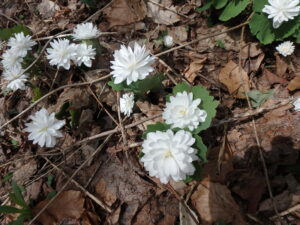
Double blood root is rare and not usually found in the wild but is sold in specialty nurseries
One of my favorites is a wildflower called bloodroot (named for its irritating red sap when the roots are disturbed). It has white blossoms that stay closed at night, or on cold, wet mornings. It has broad light green leaves that can curl around the blossoms like cigars when they first come up. The leaves can serve as a nice groundcover most of the summer.
I also have a double bloodroot. This was given to me by a friend, and it is quite rare. I found it for sale on line when writing this, but it is quite expensive. It does not produce viable seed because it is a tetraploid, meaning it has double the number of chromosomes that the ordinary one does. But mine has spread by root over the years, allowing me to dig plants to move to new spots. The blossoms look like miniature double peonies, and it stays in bloom longer than the common one.
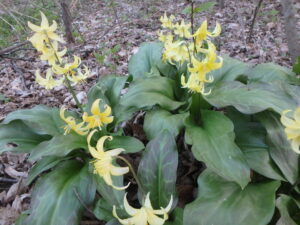
Pagoda trout lily
I grew up in Connecticut where we had masses of trout lilies (Erythronium americanum) blooming in our hardwood forest. The small yellow lily-like blossoms nod and look down. Here I see plenty of them, but few blossoming. I have learned that only once they have two leaves will they blossom, and mostly I see those with just one leaf.
A few years ago I ordered bulbs from K. Von Bourgondien bulb company for a hybrid Western trout lily that is much bigger than the wild ones. The hybrid Erythronium ‘Pagoda’ has been an amazing success! The leaves are large and each plant produces two to four flowers on each tall stalk. The blossoms are yellow, but much larger than the wild form I grew up with. They are blooming now, but bulbs are shipped in fall.
Lungwort (Pulmonaria spp.) is a perennial flowers that starts blooming very early in the season, and persists for many weeks. Not only that, the leaves are interesting all summer long: they are a nice green and most varieties are decorated with white spots. The flowers on any given plant may be blue, pink or peach. Often a patch will have flowers of all three colors – even appearing on a single plant. It spreads by root, and some gardeners avoid it, thinking it will take over the garden, but I love it.
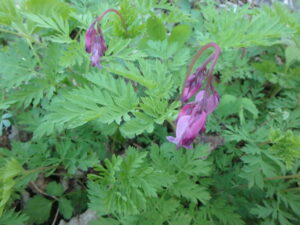
Corydalis
Corydalis or fumewort is a delicate flower that blooms for me in lavender or yellow, spreading by seed to serve as a groundcover. I have never heard anyone call it fumewort so I invite you to use its scientific name. It does well in shade or part shade, and tolerates moist soils well. The leaves are finely cut, almost fern-like, and each blossoms is small and downward looking. Some varieties will re-bloom later in the summer.
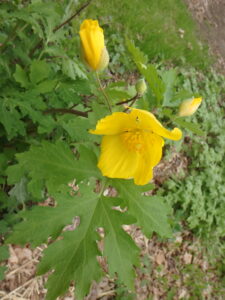
Celandine poppy
Our celandine poppies (Stylophorum diphyllum) are starting to bloom in shady areas now. These are not true poppies, but are in the poppy family. These are native to North America, and do well in shade or part shade, exhibiting bright yellow one- to two-inch wide 4-petaled flowers. The leaves stand up about 20 inches, and are handsome all summer. Celandine poppies do best in moist, humus-rich soil, but will perform even in dry shade, once established. There is a weedy relative that pops up all over in my garden. Celandine poppies will re-bloom if you cut off the stems after flowering.
One of my favorite early summer flowers is the Forget-Me-Not (Myosotis sylvatica). It is a rambunctious spreader, but pulls easily if it gets where you don’t want it. It stands 6 to 12-inches tall, and has lovely bright blue, upward-looking flowers less than half an inch across, with yellow and white eyes. It does best in rich, moist soil in either sun or shade, but will bloom in dry shade if it has to.
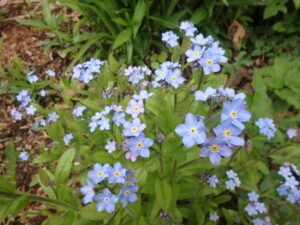
Forget-Me-Not
It is not clear to me if Forget-Me-Nots are annuals, biennials or perennials. They self-seed readily, and I generally treat them as annuals. They transplant easily and can serve as a ground cover. But I pull them often to plant other things, and more will show up in the general area the next summer. They even appear along the banks of my brook, where they bloom much of the summer.
I love primroses of all sorts, and my dramatic candelabra primroses (Primula japonica) have their own bed under old apple trees. But they will not bloom until June, so right now I make do with early yellow primroses (Primula eliator) that have been blooming for weeks and show no signs of finishing up their bloom cycle. They stay in tidy clumps.
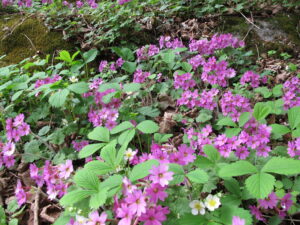
Primula kisoana
Now starting to bloom are my Primula kisoana, with lovely pink or magenta- colored flowers. They have no common name, unless you call them, as my wife does, “I wanna kiss-ya”, which is not found in books. The spread vigorously by root in shade, either moist or dry. Probably most vigorous in moist, rich soil, they are polite, going around other plants as they spread, not pushing them out of the way.
Visit your local nursery to see what is in bloom now, or ask your friends for divisions. There are lots of great flowers out there blooming now!
Henry is a UNH Master Gardener and the author of 4 gardening books. He can be reached at henry.homeyer@comcast.net.
Insects: Friends or Foes?
Posted on Thursday, May 13, 2021 · Leave a Comment
It’s spring, and insects are hatching, flying, and munching. Contrary to what you may think, most are not a problem for your garden. There are over a million named insect species and many – perhaps most – co-evolved with flowering plants. They pollinate our crops and do many wonderful things for us.
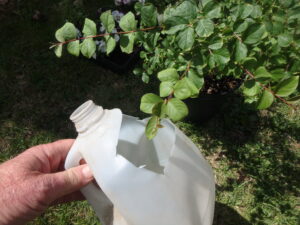
Catch Japanese beetles with a milk jug and soapy water
One of the most hated insects is the Japanese beetle. These beetles, as the name suggests, are originally from Japan, and were first observed in New Jersey in 1916. In just over 100 years they have become omnipresent in Eastern United States. Why? They have very few natural predators – even birds don’t want to eat them.
As larvae, these pests generally live in lawns, feeding on grass roots. They are whitish grubs of various sizes, but up to an inch long. If you cut open a square foot of lawn with a sharp shovel and peel back the sod, you are likely to see a grub or two. If you count 10 or more in that sample, you have an infestation that will be a problem.
The U.S. Department of Agriculture) developed a remedy in the 1940’s called milky spore, which is a bacterium that can be suspended in water and sprayed on lawns. It is not a miracle cure, and is quite expensive. Not all entomologists believe that milky spore is an effective cure, at least not in New England where cold winters can kill the bacterium.
Not only that, those darn Japanese beetles fly. So you can treat your lawn with milky spore only to have your neighbor’s beetles fly over the fence to attack your roses. I did talk to an enterprising gardener once who convinced her neighbors to treat, too, and she feels it made a significant reduction in beetle numbers.
What else can you do? There are beneficial nematodes (unsegmented worms) called Hb nematodes that will attack Japanese beetle larvae and are said to be 96% effective in eliminating Japanese beetle and rose chafer larvae if applied properly. The best time to apply these nematodes is July and August when the grubs are feeding in your lawn. If you buy them, follow the directions carefully: they need to be applied to moist lawn at dusk, and then watered in. These are live worms, and as such need to be used soon after purchasing them. They are not generally available at garden centers, but are available on line.

Hand pick Potato beetles and look for orange egg masses on underneath side of leaves
What about those Japanese beetle traps? Give them to neighbors you don’t like. They attract lots of beetles, but only capture some – so they attract more hungry beetles to your property if you use them. Really, just don’t buy them.
I am a firm believer that the best method of insect control for most bad bugs is hand-picking them and dropping in soapy water. Insects often have several life cycles in a summer, so try to reduce numbers before they reproduce.
Hand picking works for potato bugs, for example, if you check your plants early in the season, before large numbers have appeared. Look under the leaves: if you see orange egg masses, scrape them off and drown them in soapy water, along with the beetles and larvae. If you grow too many potatoes for hand picking bugs, try something called “Bt”, another beneficial bacterium. It is readily available at garden centers. It does not act as a contact poison, but sickens the larvae so they stop feeding and don’t reach adulthood.
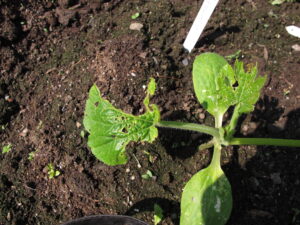 My insect nemesis is the striped cucumber beetle. It is a small striped beetle that can devour an entire small plant in one night. It eats not only cucumber leaves, but anything in that family including squashes and pumpkins. I do two things to help prevent their destruction: I grow my seedlings in pots until they have 3-4 leaves so the beetles can’t kill the plant in one night. And I cover my plants with row covers (breathable garden fabric) to physically keep those darn beetles off the leaves. Which is not to say that they can’t come up under the covers through the soil, but the method does help. And when the blossoms come, I’ll have to remove the row covers to allow pollination.
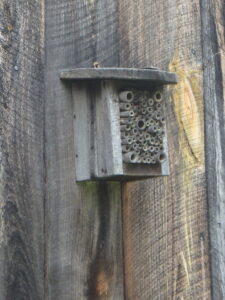
A simple house for solitary wasps made with bamboo pieces in a box hangs on my barn
Can you create habitat for beneficial insects? Sure. Don’t manicure every inch of your garden. Leave a few dead branches or decomposing flower stems in piles at the edge of your property. Allow fallen leaves to serve as mulch. Consider putting up a simple structure for solitary wasps (such as those that control those pesky tomato hornworms). They are sold next the birdhouses at the garden center.
I’m afraid that mosquitoes, black flies and deer ticks have given all insects a bad name, but most are beneficial. They pollinate, serve as food for baby birds, they help to keep vigorous plants and other insects from taking over. And please remember this: if you decide that spraying pesticides is easier than the organic methods described here, know that those same sprays will kill small beneficial insects that you probably never even notice.
It’s Time to Buy Your Strawberry Plants!
Posted on Tuesday, April 27, 2021 · Leave a Comment
Traditionally, June is the month for eating strawberries. I dream of big, fat, juicy local berries that melt in my mouth and swim in juice when cut and made into strawberry shortcake. But you can, in fact, grow varieties of strawberries that produce berries all summer, or that produce berries in June and again in the fall. In any case, now is the time to buy your strawberry plants before they are all sold out.
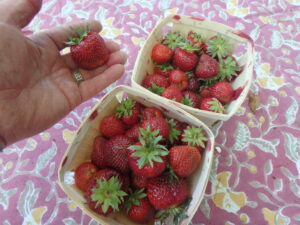
Day neutral strawberries first picking
First, some basics: there are three basic types of strawberries: June-bearing strawberries, so-called ever-bearing strawberries, and day-neutral strawberries. Plant June-bearing berries this summer, and you will need to wait until next summer for your first berries (pick off any blossoms this year so they develop good roots). Ever-bearing berries are not really ever-bearing: they will deliver a load of fruit this fall, and again in future years in June and the fall. Day-neutral berries are not affected by day length, and are truly ever bearing. The first year, however, you will not get any June berries from them.
Strawberries are sold in clumps of bare root plants, usually 25 per bundle. They should be planted when the soil is at least 50 degrees, and when risk of hard frost has passed. A hard frost is one that is colder than 28 degrees, and lasts for 12 hours or more.
You can buy plants starting in early May at your local garden center or feed-and-grain store. You can also go on-line and order from seed companies, but many varieties were already sold out at Fedco Seeds and Johnny’s Selected Seeds when I checked in late April. Nourse Farms in Massachusetts prefers that you order in the fall, but still had several varieties available when I checked.
Strawberries in spring mulched with straw
All strawberries like rich, well-drained soil. If you have a heavy clay you will need to make raised beds and add lots of compost. Work the compost in with a fork or shovel to make the soil fluffier. Even average soil needs compost for best results, as does sandy soil. Sandy soil will hold moisture much better if you stir in plenty of compost.
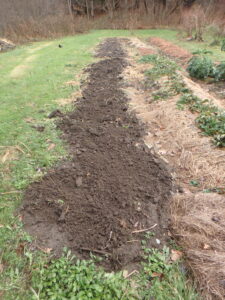
You do not need to create wood-sided beds. Just mound up the soil to create a bed about three and a half feet wide that is four to six inches taller than your walkways. For 25 plants, a wide bed twenty feet long should do. For day-neutral berries, you can plant a two rows of plants 12 to 18 inches apart in a bed. June berries need more space, so plant just one row per bed, and space 18 to 24 inches. But always read the directions that come with the berries and space accordingly. Don’t crowd your plants or they will produce smaller berries.
I recommend the day-neutral berries. They do not require as much work as June bearing plants, which send out runners that need to be rooted in or pinched off. The day neutral plants stay in nice tidy clumps. And they produce berries all summer long, starting in the second year. Their berries are smaller than June berries, however.
Assuming you have just average soil, you should work in some minerals and fertilizer in addition to compost before planting the berries. Five pounds of an organic, slow-release fertilizer in a 20-foot wide row should be adequate. A good organic bagged fertilizer will add the three most necessary minerals – nitrogen for green growth, phosphate for strong roots and good flowering, and potassium for strong cell walls and resistance to drought and cold.
Organic fertilizers also add other nutrients that do not come in a bag of chemical fertilizer, things like calcium, magnesium, sulfur, manganese, chlorine and iron. Organic fertilizers are made from things like seaweed, chicken manure, peanuts hulls and cotton seed meal. These break down over time and supply nutrients to your plants.
There are a number of ways of planting your strawberries, but the main thing to focus on is getting good contact with the soil. To plant your berries, I smooth the soil surface, then dig shallow holes with small mounds of soil in the center of each. I spread out the roots over the mound, and then cover the roots with soil and pat it down. It’s important not cover the crown, (the growing point where the leaves begin).
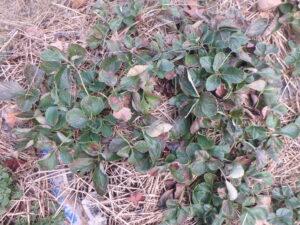
Strawberries mulched for winter
An alternative way is to just cut a slice in the soil with a putty knife and push the roots into that slice with the putty knife. The crown needs to be at the soil surface, and the soil well patted down. Nourse Farms ( www.noursefarms.com) has a video on how to use that method.
After planting, water well and then water two or three times a week until they are well established. All berries are high in water content, so don’t let the plants dry out if we have a drought again this summer.
Strawberries hate weeds, so always plant into a weed-free bed. Grasses will compete with your berries, reducing the size and number of your berries. One way to minimize the labor of weeding is to mulch well. I put down 4 to 6 sheets of newspaper over the soil between beds and cover it with straw, mulch hay or dry leaves.
Strawberries are a relatively easy crop to grow, and will reward you nicely. Most varieties will come back for a few years, but eventually they lose vigor. Still … strawberry shortcake anyone?
It’s Time to Reflect on Our Gardens
Posted on Tuesday, April 13, 2021 · Leave a Comment
This is a good time to look carefully at your garden, and to decide what you might do to make it better. Spring is upon us, trees and shrubs are waking up in my garden, but perennials are still mostly dormant and woody plants are just beginning to leaf out. It is a good time to look at “the bones” of the garden and decide what needs to be done.
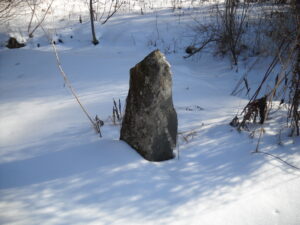
Standing stones are wonderful in winter
The bones of the garden are the trees, shrubs, stone walls, sculpture, water features and pathways. These are visible in winter, though often covered in snow. In summer they can become focal points, or almost disappear as flowering plants shout out for attention.
Each of us reacts to spaces a little differently. Some want an enclosed garden that is quiet and private. Others want a long view of the sea, a pond, or a distant mountain. If you are lucky, you might be able to divide your garden up so that you enjoy more than one type of garden: sunny, shaded, private or open to the view of passers-by. If you have just a city lot, you may have to choose just one kind of garden to focus on.
Making a garden private means creating visual barriers. You can do that overnight by hiring a company to put up a wooden 8-foot fence. Your neighbors may not like this and walls are generally monochromatic and boring. Of course you can then grow vines up them, or plant trees and shrubs in front of them, but plants take time to fill in and disguise the fence or wall. Still, if you have a new puppy or a bouncy four-year old child, you may opt for the immediate enclosure provided by fencing.
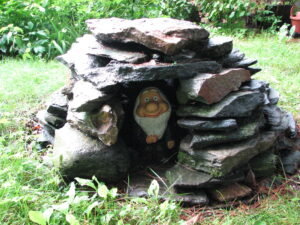
This garden gnome in his stone igloo that was sturdy and fun to build enhanced my garden for years
Alternatively, you can plant trees. There are advantages to this: trees get bigger and better every year. They provide habitat and food for birds, pollinators and all sorts of small animals. They reduce water runoff. And although some require occasional pruning, most of Mother Nature’s trees do just fine on their own. Some are fast growing, others will just inch along, holding place without shading the understory.
The street side of your house is important. What you show the world says something about you. If you plant a tall hedge, it can send a signal to others that you wish to remain undisturbed. If you have just lawn, it says you are not a gardener. If you plant beds and islands of color, you are saying, “Welcome, and enjoy!” Of course, lawns are the easiest to maintain, especially if you accept my mantra, “If it’s green and you can mow it, it’s a lawn.” I love a few dandelions, and love my clover which fixes atmospheric nitrogen into the soil – it’s free fertilizer.
Trees and shrubs are important on the front lawn as much as in the gardens behind the house. You can break up the straight lines of driveway and front walk. When thinking through your plans, take a garden hose and curve it around to define spaces. Create beds with bump-outs, and drive stakes to indicate where you might add trees, and use shorter stakes to indicate shrubs. And instead of lawn between the trees, imagine groundcovers. It will soften the look of your home, and invite birds and pollinators. You can keep some lawn, just reduce its footprint.
What other bones can you add to your property? Stone is wonderful in all its forms. The simplest stone additions are just boulders or tall, narrow standing stones. One and done. Stone walls are delightful, but expensive.
You can also build a cairn – a pile of stones similar to the markers seen on mountain trails above the tree line. The key, if piling up stones to create a pyramid or cairn, is to ensure that each stone is resting on two stones below it. And be careful that when you touch a stone it does not tumble. The earth does move a bit with the seasons, so building a sturdy structure is important.
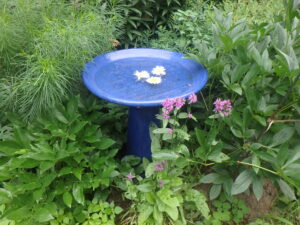
A simple bluebird bath can add color and interest
Water features are nice, too. A simple birdbath can add interest and provide water for insects and birds. I have a blue ceramic birdbath that adds color and height to a flower bed – even though the birds seem to ignore it. I was told to put a stone in the water for them to perch on, but even that has not lured them in. Of course, I have a brook nearby, so that is probably their choice instead.
I love sculpture in the garden. One of my favorite sculpture gardens is the deCordova Sculpture Park and Museum in Lincoln, Massachusetts. It’s 20 miles outside of Boston and has 30 acres of gardens chock full of delightful art, and it’s worthy of a visit. A place like that might inspire you to make or buy some art. So long as it gives you pleasure, it’s worth garden space. Found metal objects can be turned into art – if you think outside the box.
Sculpturefest in Woodstock, Vermont is an annual outdoor exhibition of sculpture made by local artists and is always worthy of a visit. See more at
https://www.sculpturefest.org/
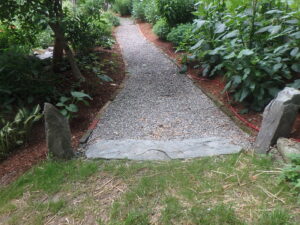
Our pea stone walkway keeps the garden neat
Pathways are important to gardens. They can keep your shoes out of mud and protect the soil from erosion. Flat stones are great, as are pea stone or small gravel. Chipped branches or bark mulch can be used for walkways, too. Pathways naturally lead one forward to other parts of the garden. Grassy paths are simple, and work well so long as they are not worn bare by too much foot traffic.
So go outside and do some planning – even if it is too early to do much now.
How What We Grow Helps Our Feathered Friends – and the Environment
Posted on Tuesday, April 6, 2021 · Leave a Comment
By now birds are finding their own food and have less need for that sunflower seed we have been providing during the cold days of winter. So what can we do to help our birds as they go into the season of having young? Growing native trees and shrubs on our property can be a huge help to our bird friends.
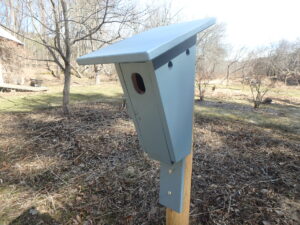
Bird houses are nice but we need to do more for our baby birds including growing native plants
Let me explain. It is not enough to put out birdhouses, we need to help birds find food for their chicks. The diet of baby birds is about 90% composed of caterpillars. Caterpillars – the larvae of Lepidoptera (moths and butterflies) – are high in fat and protein that developing birds need to grow and be healthy. One clutch of chickadees can, according to entomologist Doug Tallamy, a PhD researcher from the University of Delaware, consume 6,000 to 9,000 caterpillars in the 16 days from hatching to fledgling. And most parent birds continue to feed their chicks even after they have fledged.
In Tallamy’s new book, Nature’s Best Hope: A New Approach to Conservation That Starts in Your Yard, he explains that not all trees and shrubs are created equal. Those that evolved alongside the butterflies and moths are palatable to them. Those that were imported from Asia or Europe mostly are not of interest to them.
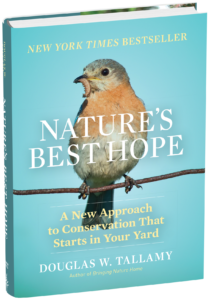
Nature’s Best Hope
Most woody plants create toxins or bad-tasting chemicals to keep all sorts of animals from eating them, but caterpillars have developed ways to eat most native tree leaves – they have adapted to eat what was available to them. It’s as if they learned to eat things, the way we learned to eat Brussels sprouts.
Although caterpillars eat the leaves of our native plants, they rarely damage or defoliate their host plants. Tent caterpillars and a few other imported species will defoliate trees, but that’s rare. It’s just that most of us never notice the little holes chewed in the leaves that are supporting the caterpillars.
In fact, I rarely notice caterpillars in the trees and shrubs at all – but our bird friends certainly do. They evolved along with the caterpillars and are genetically programmed to recognize them and bring them to their young, even birds that are seed eaters.
As Dr.Tallamy explains in the book, not all native plants are created equal. Some native species may only feed a few. Some, like our oaks, feed many hundreds of species of caterpillars. These “keystone species” are critical to supporting our wildlife. Five percent of the native species support over 70% of our Lepidoptera, according to Tallamy.
So what plants are best to feed the caterpillars that support our birds?
According to Tallamy’s research, native oaks, cherries, willows, birches, poplars and elms are best, and goldenrods, asters and perennial sunflowers “lead the herbaceous pack.” The National Wildlife Federation’s Plant Finder website (
https://www.nwf.org/NativePlantFinder) allows you to enter your zip code and see what plants are best for your zone, and how many pollinators are served by each.
Tallamy did a study in Portland, Oregon and found that of 1176 trees he identified on the streets there, 91.5% of them were from other continents or ecoregions, mainly Asia. What does that mean? Portland is a pretty city with lots of trees, but it is largely a wasteland for caterpillars that feed our baby birds. The birds need to nest where they can get food for their young.
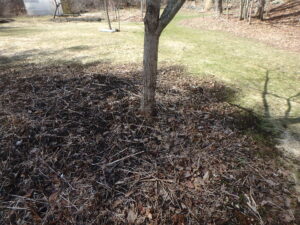
Leaf litter and native plants are better under a tree than lawn
If you wish to improve your landscape and plant native species that will support wildlife, think about reducing lawn size. Tallamy explains that there are 40 million acres of lawn in America, an area the size of New England. Thirty percent of our water is used to water lawns, and 40 to 60% of all fertilizer ends up in our waterways and drinking water, he wrote.
Doug Tallamy proposes that we all join him in creating, a “Homegrown National Park”, by reducing our lawns by 50% and growing native plants. This will create wildlife corridors and improve our environment in many ways. The plants will sequester carbon in ways that lawn does not. It will help to save endangered species of insects and birds. It will reduce pollution of our air and water. Who could argue with such an idea?
According to one study, in newer housing developments lawn covers about 92% of space not covered with driveways and buildings. If we were all willing to reduce our lawns and add trees, shrubs and native perennials, that would make a big difference in helping to reduce species extinction of Lepidoptera, birds and small mammals. It does not require eliminating lawn, just reducing it. Think of lawn as area rugs, not wall-to-wall carpeting.
What else can you do to help our birds? Add a water feature. Even a small pool with a re-circulating pump will attract birds, especially migrating birds that need water and food for their long journey.
Instead of lawn, add native groundcovers. Lawns get compacted by lawnmowers, making it difficult for caterpillars and native bees to burrow in the ground. Most caterpillars pupate in the ground or in leaf litter, but lawns are not suitable. Other than honeybees, most bees burrow into the ground or into decaying wood to lay their eggs and hatch their young.
I love the idea of us all of linking our properties together to support our butterflies and bees. You can go to
www.homegrownnationalpark.org to register your property as part of this movement. Thanks!
Henry is the author of 4 gardening books and a UNH Master gardener. You may reach him at
henry.homeyer@comcast.net or PO Box 364, Cornish Flat, NH 03746.

 Click Here to buy from Cobrahead