Glorious Hydrangeas Are in Full Beauty Now
Posted on Monday, August 24, 2020 · Leave a Comment
When I was a boy, I always took note of cemeteries as we drove by them. I’d lost a beloved grandfather, the original Henry Homeyer, and my mother’s mom. I was taken with a shrub or small tree in cemeteries that I called either “the snowball bush” or the “cemetery bush”.
Back in the day what I now call the PeeGee Hydrangea
(Hydrangea paniculata ‘Grandiflora’) was present in every cemetery. They bloom for months, require no work other than planting, and will grow anywhere. Now there are dozens of species and varieties of Hydrangeas, offering a great choice for small gardens – these never get huge, like a maple or an elm.
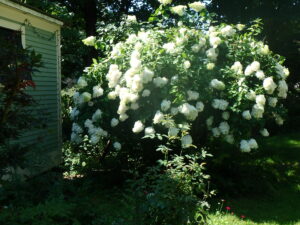
My PeeGee hydrangea after 25 years
In the nursery trade the PeeGee hydrangea has fallen out of favor, mostly. Now ‘Limelight’, ‘Pinky Winky’ and others with jazzy names and bigger flowers are more popular. But I love my PeeGee that I planted some 25 years ago. It is blooming with over a hundred large white flowers now. It’s about 9 feet wide and 8-feet tall. Like most hydrangeas, if I wait until just before frost and cut some flower stems to put in a dry vase, they will look good all winter – and longer.
Most hydrangeas like full sun or part shade, good soil, and adequate moisture. Some, like the panicle hydrangeas, bloom on new wood, while others – those that bloom early in the summer – bloom on buds developed the summer before, also called “old wood”.
The blue hydrangeas (H. macrophylla or big leaf hydrangeas) generally bloom on old wood, and for those of us in the northern part of New England, that is unfortunate. Our tough winters ruin the flower buds, so the plants don’t bloom in June as desired. Nurseries in the south grow them, ship them to us in full bloom, but after Year One we are lucky to get three blossoms in September. Period.
Then along came ‘Endless Summer’, a bigleaf hydrangea that promised to bloom all summer long. I tried it, and called it Endless Disappointment. It died back in the winter, grew, but rarely flowered. Newer varieties are out there, and may be tougher, but in Zone 3 or 4, I say buy them in bloom and use as annuals. Not only that, blue hydrangeas produce pink or insipid colors if the soil pH is not acidic enough. ‘Nuff said.
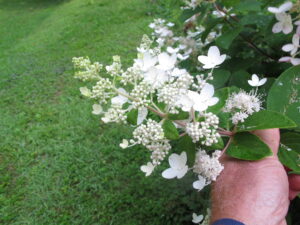
Pink Diamond blossoms are well spaced and not as heavy as many others
I like my ‘Pink Diamond’, a panicle hydrangea with strong stems and fewer florets per flower head than the PeeGee. That means it doesn’t get weighed down by rain, and droop to the ground like many other hydrangeas. It starts out white, then gradually turns pink. It is an excellent cut flower, too.
What about shade-growing hydrangeas? There are two nice ones. H. arborescens ‘Grandiflora’, also known as ‘Hills of Snow’ does well in shade. Its pompoms are much smaller than those of Annabelle, another of the same species, so it does not flop much after a rain. I like it better. It gets to be 5 or 6 feet tall and wide if left to its own, but many people cut it to the ground in late winter. The vigorous new growth will be shorter, and the pruning invigorates the plant.
My PeeGee hydrangea after 25 years
My favorite shade hydrangea is the climbing hydrangea (H. anomala ssp. petiolaris). This tough vine will grow on the north side of a wall and can attach itself to brick or stone. It is slow-growing when young, but after 5 years or so becomes quite vigorous. I attached the stems of mine to the side of my barn when young, but later the stems slipped through cracks in the barn and hold on. Mine has even bloomed inside the barn!
Climbing hydrangea has showy white, sterile, petals on the outer rim of each flower panicle, and less showy, fertile flowers in the center. It blooms in June and the white petals stay white all year, so the flowers always look good. The vines have shaggy, exfoliating bark which is interesting in winter, too.
I recently attended a Hydrangea Walk at the home of Chris Wilson of Newbury, Vermont. Chris is a nursery professional, having worked at EC Brown Nursery in Thetford, VT for over 35 years. Chris collects hydrangeas, lilacs and daffodils and opens his gardens 3 times a year to view them. This time, we all wore masks and practiced social distancing. We didn’t want, as Chris said, “to die to see a hydrangea.” Chris has at least a couple of dozen different kinds of hydrangeas – and a good sense of humor.
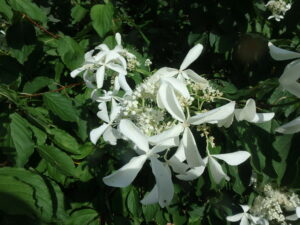
Hydrangea Great Star
Chris had two hydrangeas I had not ever seen before that I like. The first, called “Great Star’ (H. paniculata ‘Great Star’) was first discovered in the gardens of Princess Greta Sturdza in Varengeville Sur Mer, Normandy, France. It appeared as a naturally occurring branch mutation of an unnamed seedling of Hydrangea paniculata. It has very prominent wide, strap-like sterile florets that are star-like. I hope to find a specimen and plant it in my garden.
The other hydrangea I saw there is another that does well in shade, H. paniculata ‘White Moth”. Chris had it tucked in near a large tree, and it was blooming nicely.
Don’t have a Hydrangea? I highly recommend them. Most have blossoms now, when most flowering trees are done for the year. So go to your local family-run garden center and see what they have. I bet you’ll find something you like.
Henry is a UNH Master Gardener, the author or 4 gardening books and a gardening consultant. Reach him at
henry.homeyer@comcast.net.
Re-Wilding Your Lawn
Posted on Tuesday, August 18, 2020 · Leave a Comment
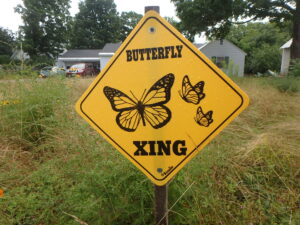
A sign like this lets neighbors know you are not lazy, but letting the lawn grow for a reason
Tired of mowing your lawn, but afraid to stop? What would it look like, and what would the neighbors say? I was on a panel discussing “re-wilding” the lawn on New Hampshire Public Radio recently. Here are a few of the points we discussed.
First, a lawn is the easiest, least time-consuming way to maintain your property. If you want a meadow of flowers for birds, bees and pollinators of all kinds, lots of work is involved. You can’t just quit mowing, or rototill the lawn and broadcast some wildflower seeds, and then step back to enjoy. You would get some nice flowers, but your yard would also fill up with weeds – and invasive trees.
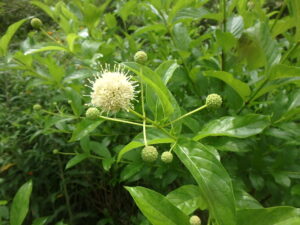
Buttonbush flower
My advice? Start small. A little corner of the yard, say something 4 feet wide and 15 feet long would be a good start. Decide how much time you can commit to it, and how often you want to work in the garden. Can you dedicate half an hour each morning before work? An hour after work? Good gardens are built by people who do something in the garden every day.
Get a soil test done. New Hampshire and Rhode Island have stopped doing tests, Vermont will do them for Vermonters, and Maine, Massachusetts and Connecticut accept samples from out of state. Get a home gardener test with as much info as possible.
Next, you have to remove the grass. That means slicing through the lawn to create one-foot by one-foot squares that you can remove and take away to your (new?) compost pile. Don’t try to do it all at once, do a little at a time.
Do your homework. Read books and go on-line to see what will work in your yard. Do you have full sun (6 hours or more each day), part sun, or shade? Is your site hot and dry or cool and moist? Select flowers that will work in your climatic zone, and get a variety of bloom times: some for spring, others for early summer, late summer and fall.
Improve your soil. All soil can be improved with compost. Buy it by the truckload, not the bag. Get it delivered if you don’t have a truck. Work the compost into the soil after the grass is removed.
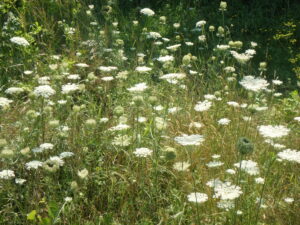
Queen Anne’s Lace is loved by bees and other pollinators
If you want to support butterflies, birds and bees, think native plants. Native plants are those that co-evolved with the wildlife. And let wildflowers be part of the mix. Right now Queen Anne’s lace is in bloom along the roadside. It’s a biennial in the carrot family and is loved by the bees. Learn to recognize the small first year plants, dig up a few and plant them. Once established, the flowers will drop seeds each year.
But what about the neighbors? One of the panelists had done a study in Springfield, MA. She asked homeowners to mow their lawn either weekly, every two weeks, or every three weeks. So that the neighbors would be more understanding, they put signs in the yards telling others that they were part of a scientific study.
They counted insects and found a two-week schedule for mowing was best for bees and pollinators: clover and dandelions had time to bloom, and to provide food without being hidden in tall grass.
To create a sustainable non-lawn, you need to introduce not only those tall, bright flowers like black-eyed Susans and purple coneflower, but groundcovers that will fill in between plants.
One of the panelists, Thomas Rainer, is the co-author with Claudia West of the book, “Planting in the Post-Wild World: Designing Plant Communities for Resilient Landscapes.” In their book they explain that in nature there are plant communities: plants that need roughly the same soil and light, and that co-exist nicely. If you want a balanced plant community, you need a diverse, supportive collection of plants, including groundcovers.
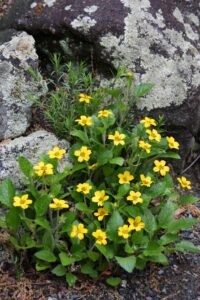
Chrysogonum virginianum is a nice groundcover
Groundcovers can act a bit like mulch: they can prevent soil erosion and suppress weeds. It is often tough to find good native groundcovers like groundsel (Packera obovata) or goldenstar ( Chrysogonum virginianum) for sale, but they are available if you look hard enough. Winecup (Callirhoe involucrata) is a good groundcover for hot dry, sunny places, and is often available. Oregano and thyme can be used as an understory groundcover that bees love, and they are readily available.
And Creeping Charlie (Glechoma hederacea)? It’s that “weed” hated by lawn-lovers because it can “spoil” a nice lawn and spread like crazy in part shade. But it is a native plant with nice flowers and is loved by bees. Think about letting it proliferate in your “non-lawn”.
Lastly, if you want a landscape that is beautiful and low maintenance, think about planting trees and shrubs. Many bloom nicely and all are useful to wildlife. Some native shrubs that I grow and love are fothergilla (Fothergilla major), blueberries, elderberry, buttonbush (Cephalanthus occidentalis) and our native rhododendron and azalea.
If you stop mowing the grass and want flowers, put up a sign. I recently saw one that was very simple: it said “Butterfly Crossing.” Hopefully that appeased the neighbors a little.
Henry is the author of 4 gardening books, and a frequent speaker at garden clubs and libraries, even now, using Zoom or at outdoor venues. Contact him at
henry.homeyer@comcast.net.
Three Plants to Avoid
Posted on Tuesday, August 18, 2020 · Leave a Comment
Three plants you don’t want on your property are wild parsnips, purple loosestrife, and Norway maples. The first causes severe skin reactions in many people, the second can take over our wetlands, and the last can out compete our native sugar maple – and eventually take over our woods.
Wild parsnip is in bloom now. It’s a tall plant, 24 to 60 inches, and has yellow blossoms arranged in flat flower panicles at the top of the stems. It looks a lot like Queen Anne’s lace. It is, genetically, the same plant as garden parsnips, but has escaped and become a weed. Some people are horribly allergic to its sap. Here’s how you and your kids can stay safe.
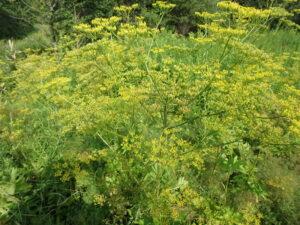
Wild parsnips often grow along the roadside. Many people are easily burned by the sap.
Learn what it looks like, and avoid it. Sap from the stem, if on the skin and exposed to direct sunlight, can cause horrible burns. Not everyone reacts, however. Assume you do. If you get sap on you, go inside IMMEDIATELY and wash the affected area thoroughly.
Wild parsnip has a 2-year cycle. The first year it stays low and develops a deep tap root. The second year it bolts and produces a tall flower stalk. If you have a field of wild parsnip, get it mowed before the flowers set seeds. And re-mowed until it gives up. The sooner you mow it, the less likely the flowers are to produce viable seeds after they are cut down.
First year plants growing now will send up flower stalks next year. And each year, for a while, seeds in the ground will grow new plants. But each year there will be fewer, and eventually they will be gone.
This is the time of year when swampy areas often are ablaze with tall, pink-purple flowers that dominate the wetland. These are the flowers of purple loosestrife ( Lythrum salicaria), an invasive plant that you should not encourage – but that you probably can’t get rid of once established.
But why worry about it? It’s such an aggressive grower that it out-competes native plants. It moves into shallow wetlands where fish and frogs lay their eggs among native plants, creating dense monocultures. Biodiversity is healthy for the environment, and purple loosestrife inhibits many other kinds of plants from growing.
Mature plants develop massive root systems can’t be dug out. They also develop long side-roots that will easily break off and start new plants if you try to remove the clumps.
A big clump can produce up to 2.7 million seeds in a year. And like time-release cold capsules, the seeds become active over time, not all in one year. And since they grow in wetlands, you can’t use herbicides.
If you have big, established plants the best thing to do is cut them down every summer, just above the soil line, preferably more than once. Do it now, and this should prevent them from producing seeds this year. It will also reduce the vigor of the plants. It won’t kill them, but it will keep them from spreading. A string trimmer will do the job, if you have one.
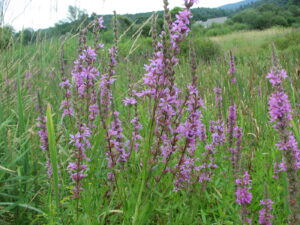
Purple Loosestrife can take over a wetland.004
First or second year plants often show up in my garden near my stream, but can be hand-pulled. Look for plants with a square stem that quickly get 18 to 24 inches tall, and may have a reddish-brown tinge to their stems. Older plants get to be 3 to 7 feet tall or more. Leaves are long and narrow with a smooth edge, and they attach directly to the stalk – without an attachment stem. Leaves generally appear in pairs, across from each other on a stalk. Many flower stems arise from the main stem.
Beetles from Europe have been introduced in some places to eat purple loosestrife, reducing populations by as much as 90%. But those beetles are not available for purchase – at least not yet. So if you have it, cut the plants down. Today!
Lastly, there is the Norway maple, a maple that will thrive anywhere – wet, dry, shady or sunny. It sends roots long distances, sucking up water and soil nutrients. It produces massive numbers of seeds, seeds that blow or wash away and end up in our woods. It can out-compete our native sugar maples, and will. Fortunately, it is now against the law to propagate, sell or transport these bad boys.
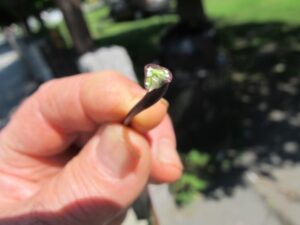
White sap oozes from Norway maple leaf stems
The most popular Norway maple is a cultivar called “Crimson King’. It has leaves that are a deep purple – almost black. Many cities and homeowners bought these 50 years ago and installed them. Removing them is difficult and expensive.
Here’s another problem: Crimson King is a hybrid, and its seeds rarely produce trees with that distinctive purple color. So they pass themselves off as sugar maples.
The leaves are a bit bigger and wider than sugar maples, but you can I.D. a Norway maple by picking a leaf. Look at the place where it snapped off: if it oozes a white sap, it is a Norway maple. If you have one, please consider having it removed. Your great grandchildren’s maple syrup depends on it!
Saving the world starts with small steps. If we each do what we can, we can leave the world a better place.
Henry is a longtime Master Gardener and the author of 4 gardening books. Write him at
henry.homeyer@comcast.net or P.O. Box 364, Cornish Flat, NH 03746.
Queen of the Garden: the Tomato
Posted on Tuesday, August 4, 2020 · Leave a Comment
Update 8.18.20
I mention garlic and onions in my sauce, but it has been pointed out to me that sauce with those ingredients needs to be cooked in a pressure cooker at 240 degrees for 10 minutes to avoid botulism.
My mother and grandmother slaved over a hot stove in August and September to can whole tomatoes or to make sauce and store it in jars. I rarely do. Mainly I freeze tomatoes whole. I call them my “red rocks” and store them in zipper bags for use in soups and stews.
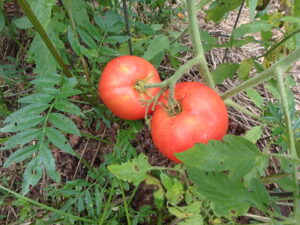
My first slicers are Jet Star and early hybrid
To prepare red rocks I simply rinse them off, allow them to dry, and slip them into gallon freezer-grade plastic bags. I use a straw to suck the air out of the bag after I have the zipper closed 99% of the way. That minimizes frost on the tomatoes in the freezer.
To use frozen tomatoes, I just run hot water from the faucet over them. The skin thaws quickly, and rubs right off. Or I’ll drop a few in a pan of hot water. That helps to thaw the tomatoes and makes them easier to chop up for use. If I freeze cherry tomatoes, I don’t bother removing the skins before cooking with them.
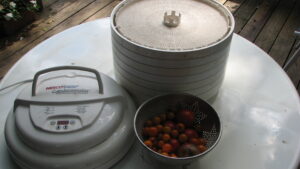
NESCO Dehydrator
I have a couple of food dehydrators that I use to dry tomatoes, too. The Cadillac of dehydrators is the Excalibur. Mine is a $300 deluxe model that blows hot air sideways equally over all 9 trays. My other is the NESCO American Harvester, a serviceable machine that pushes air up or down through a stack of trays.
The downside to the NESCO model is that you must rotate the trays to get equal drying. And it uses 1000 watts of energy per hour, while the Excalibur uses only 660 watts. Still, at about $125 for the basic machine, it is more affordable. You can stack up to 30 round 15-inch trays over the fan and heating element, but the more trays you add, the longer it takes to dry all the food. I find about 8 trays is as many as I want to stack.
Most summers I grow 8 to 12 Sun Gold tomato plants, and each is prolific. Most of the fruit I dry in my dehydrators. I cut them in half and dry, cut side up. I store them in zipper bags in the fridge or freezer, and use them in soups and stews. Dried tomatoes can be stored in the pantry, too.
Sometimes I dry plum or slicing tomatoes. I cut them about 3/8 of an inch thick. They tend to stick to the trays, so be sure to buy the special no-stick screens to put on the trays. That makes clean up much easier.
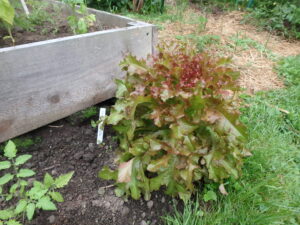
It’s time to plant more lettuce to go with the tomatoes
A sandwich is not really a sandwich, for me, without slices of tomato. One way to save slices of tomato for winter use is to roast them. I do so in the oven at low heat until they are caramelized and soft, not tough and dry. Then I place them in zipper bags and freeze them – but just one layer of tomatoes per bag. When I crave a tomato in my sandwich, I pull out a few slices and heat in my toaster oven until warm. Not a fresh tomato, but better than most sold in the grocery store in January.
I also make tomato paste. Lots of paste. I store it by freezing it in ice cube trays, and then putting it in zipper bags when frozen. No more half-used cans of purchased paste going fuzzy in the fridge for me.
To make paste I use imperfect tomatoes – and I usually have plenty. I cut out the bad spots, then core them. I squeeze the cored tomatoes in the sink, which gets rid of most seeds and lots of juice. Then I quarter them and place in a food processor. I puree them, then add to a large enameled iron pot and cook them slowly for hours. I know they are done when I can literally stand up a spoon in the pot. I let it sit all night, uncovered, to cool and lose some more water. In the morning I spoon the paste in the ice cube trays. When frozen, I empty the trays and put cubes in zipper bags.
Canning tomato sauce the old fashioned way is hard work and takes hours of work. Part of that work is blending the tomatoes and herbs, salt and pepper to get the flavor and consistency just right. In addition to pureed tomatoes I use onions, garlic basil, oregano, parsley and thyme. I cook it for 45 minutes or so, as I like it nice and thick.
But then there is the canning itself. First you have to boil the jars and lids to sterilize them. Once filled with cooked sauce, one needs to boil the sauce in sealed jars to kill botulism, a potentially fatal disease. Forty minutes at a rolling boil is recommended. All in all, making 7 jars of sauce – which is what a canning pot can hold – takes an evening.
The Lazy Guy technique for making sauce is to freeze it, not can it. I have an aversion to using plastic for storing food, but make an exception for tomato sauce. I have quart plastic containers with screw tops, though one can also use zipper bags. Since I have 2 large freezers, I have plenty of space for garden produce.
People raise their eyebrows when I tell them I grow between 35 and 50 tomato plants each year. But since I eat my own stored tomatoes all year, I can barely grow enough of the Queen of the Garden.
Henry lives and gardens in Cornish Flat, NH. He is the author of 4 gardening books, and is a 20-plus-year veteran of the UNH Master Gardener program. Reach him at
henry.homeyer@comcast.net.
Perennial Flowers That Like Moist Places
Posted on Tuesday, July 28, 2020 · Leave a Comment
I’m lucky. Even though my property is relatively small – just over 2 acres – I have all the possible growing conditions a plant could want: wet, dry, sunny and shady. And I’m willing to try almost anything that will survive 20 or 25 below in winter.
That said, there are some challenges. There is a small stream behind my house, and my water table is high: dig down a couple of feet in spring, and much of my land will have standing water. It stays a bit wet, summer and winter – even now, in the heat and dryness of summer. But here are some wonderful plants that love moisture.
Each spring I write about my Japanese or candelabra primroses (Primula japonica). They bloom for 6 weeks or so in magenta, pink and white with a yellow eye. They love moisture. During their “show”, I try to get friends who are gardeners to come visit, and we sit in the late afternoon, watching their display under a group of ancient wild apple trees.
This spring I added another species of primrose, Primula sieboldii, which I got at EC Brown Nursery in Thetford, Vermont. I was told that, like the Japanese primrose, it seeds freely and spreads easily. It is an ephemeral, meaning that after blossoming the leaves disappear until next spring. It forms clumps up to 12 inches across, and blooms in pure white, blue, purple and pinkish. I can’t wait to see if I get any new plants – and colors – next spring.
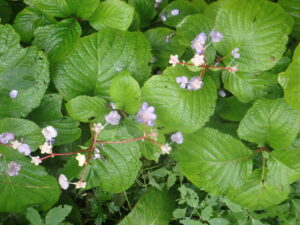
False hydrangea comes in blue or white blossoms
This year I have some new plants in my primrose garden given to me by a new friend and fellow garden writer, Judith Irven of Goshen,Vermont (https://northcountryreflections.com). It is called false hydrangea (Dienanathe spp.) and comes in 2 colors, blue (D. caerulea) and creamy white and (D. bifida). I planted them in the primrose garden last fall, and both survived and thrived. They have been blooming now for a few weeks.
I had never heard of or seen the false hydrangea until visiting Judith last fall. The leaves are a bit like some hydrangeas, but the flowers are not. But these beauties are quite an addition to my moist shade garden.
Another genus (botanical category) of plants that like moist soil are the burnets (Sanguisorba spp.). I have several species, starting with our native wildflower, Canadian burnet (Sanguisorba canadensis). This is a fall bloomer that produces flower stems 4 to 6 feet tall with white bottlebrush flowers. It starts to bloom in late August, and some years bloom into November. I have it growing in a marshy area near my stream.
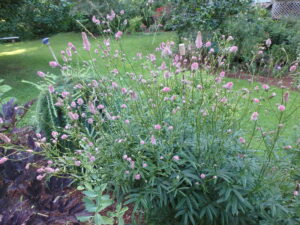
This sanguisorba tends to flop unless tied up
I have at least 4 other kinds of burnet, starting with a little one with variegated green and white leaves and deep maroon flowers (Sanguisorba officinalis var. microcephala ‘Little Angel’). I have others that grow 2-feet tall, and one that is 4 feet tall, both probably varieties of S. officianalis. The taller ones I tie up with stakes and strings by mid-July to keep them from flopping. A single plant will grow to be a big clump, taking a space four feet wide.
I am still looking for a burnet called ‘Lilac Squirrel’, a variety of S. hakusenensis. The name, and blossoms that resemble pink boas, are too outrageous not to want one. If you have one, please email a photo. Like all burnets, it likes moist soil and sunshine, from what I have read. It is hardy to Zone 5 – minus 20 in winter.
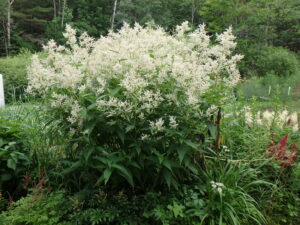
Giant fleece flower Persicaria is a dramatic addition to the garden
Another interesting genus is Persicaria, the fleece flowers. I have two species, P. polymorha or giant fleece flower and red bistort or mountain fleece (S. amplexicaulis). Giant fleeceflower makes a clump 6 to 8-feet tall and wide, with white blossoms a bit like astillbe blossoms – on steroids. The stems are an inch wide or more, but hollow like Japanese knotweed. The nice thing about it is that the flowers look good even after they have gone by, so 2 months of beauty is a given. Moving one is hard work, so plant it where you have plenty of space for it.
I have mountain fleece under the apple trees in my primrose garden, and the red bottle-brush flowers are just coming into bloom on 3- to 4-foot stems. The leaves are large, pointy and heart-shaped. Like its cousin, the bloom time is long: from now through much of the fall.
There are plenty of wildflowers that do well in moist shade. Prime among them are Jack-in-the-pulpit, red baneberry, trillium, and ramps. I grew up in Connecticut where there was skunk cabbage growing by our stream, and I bought a small clump some 25 years ago at The Garden in the Woods in Framingham, Mass. What a difference a couple of hundred miles makes. This early-spring bloomer has only recently achieved full size! I attribute that to the climate.
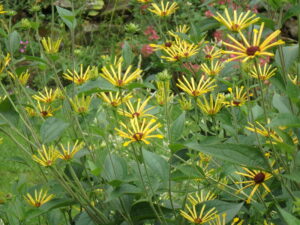
Henry Eiler rudbeckia does well in moist sunny locations
Many plants that grow well in ordinary garden soil will thrive in moist soil, too. I have Black-Eyed Susans (Rudbeckia spp.) that love my moist, sunny gardens but would be equally at home in drier soil. My favorite is Henry Eiler, one that blooms late and has very distinctive blossoms with the petals unnaturally far apart.
If you want to grow a shade-loving plant in a sunny location, you will have a better chance of success if the soil is also moist. Even then, not all succeed. But if you have space, and a willingness to experiment, your flowers may surprise you.
Henry lives in Cornish Flat, NH. His e-mail is henry.homeyer@comcast.net.
Beyond Perennials: Making Your Garden a Very Special Place.
Posted on Tuesday, July 21, 2020 · Leave a Comment
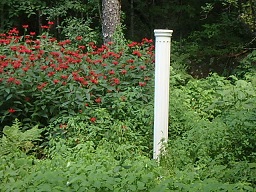
This Doric column was a good get by the side of the road – not sure of final placement
My garden is the place I go in times of sadness, worry or stress. It makes me feel better. I took a few moments one morning recently to really look at what was in my garden to see what made it so special. I saw that in addition to the plants (and who cannot be happy snacking on red raspberries or Sun Gold cherry tomatoes?), I have many things that remind me of friends, and of good times. Let’s take a look at my garden, and perhaps you’ll get some inspirations for what to do in yours.
I’ve been working on my gardens for about 40 years, and have created some nice stone projects. As a young man I built a low 80-foot stone retaining wall to create a terrace that would allow me to plant some fruit trees – most of my full sun space was near a small stream with a high water table, which is not good for fruit trees.
I worked with my stepson, Josh Yunger, who was a young teenager at the time. It was fun working with him, finding stones on the property and from a tumbledown wall a neighbor, George Edson, had allowed me to pick through. I knew little about walls, but had the basics. One stone over two. We mostly found stones with rounded shapes, not flat stones.
And I didn’t know to use crushed stone, not round pebbles to act as drainage and support for the wall. So those round stones sitting on round pebbles, over time, moved and wall has slipped and fallen in places. But now it is mostly hidden by plants, and its ramshackle appearance doesn’t bother me. And I feel good when thinking about the work Josh and I did.
If building a stone wall is too much for you, how about placing a long, thin stone standing vertically as an accent in the garden? If have a few of those, and they look great – all year round. Just stand up a 36 to 60 inch long pillar of a stone in a hole 18- to 24-inches deep. Add some loaf-of-bread sized stones in the bottom, and dump in a bag of dry concrete mix. Fill in the rest with soil, and pack it well.
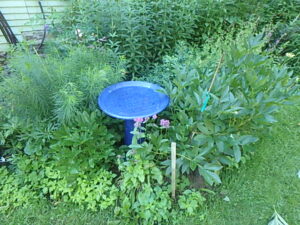
A simple bird bath can add color and interest with little work
I have three nice Japanese red maples that bring fond memories. Two came from my parent’s home in Connecticut, another from a friend. I dug 2 them as foot-tall saplings, one bigger. The one I planted in the early 1970’s and it is now 10 feet tall and wide with a 6-inch diameter trunk at the base. I see it and often think of the 60-foot tall “mother plant” I climbed as a boy.
Other things are easier than stone projects. I have two nice blue ceramic bird baths. They contrast nicely with the flowers around them, even though no birds ever bathe there. But I love the water in them, and that my wife Cindy Heath floats cut flowers in them. (Yes, my longtime partner and I finally got married July 1 in a Zoom wedding attended by loved ones all over.)
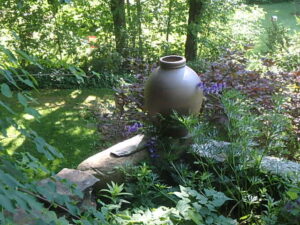
This urn gives me pleasure every time I walk past it
I have a lovely high-temperature fired urn in the garden, a birthday present from Cindy this year. It makes me happy every time I see it. It has a drainage hole and the potter, Stephen Proctor of Brattleboro, Vermont, tells us that it can stay outside all year. Always a bit of a worrier. I will bring it inside before Christmas. It’s too nice to risk having it crack.
A new garden this year is just on oval 7 by 10 feet. I put in a “Y” shaped path, so it looks like a peace sign from the 1960’s. One section is dedicated to milkweed plants for the monarch butterflies. The milkweed will, I suspect, eventually take over the entire garden. But for now? I love seeing the peace symbol – it reminds me of my activist youth.
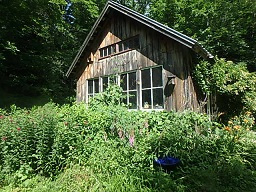
This barn was largely built in a day as a barn raising
Then there is my 16- by 20-foot barn. I had a barn raising event in the late 1990’s and had more than 30 friends show up. My late friend Bernice Johnson, then in her eighties, showed up with a little hammer in her hand. It makes me happy when I think of that day, and that we got the walls up and rafters on in one day. And now Cindy keeps it tidy inside – something I never managed to do.
Speaking of Cindy, this year she decided to build a gravel walkway down that 80-foot terrace I built for fruit trees in the 90’s. She did an amazing job, lining the path with old bricks I had salvaged from chimneys I removed. The path has a crushed stone base, landscape fabric and then a pea stone layer on top. And of course, Cindy has removed the weeds along the sides, and mulched the beds nicely. It makes me happy to walk along it.
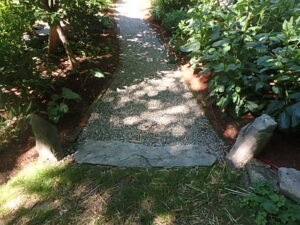
This pea stone pathway starts with two standing stones
I love the perennials I have gotten from friends and from gardeners I have interviewed. I remember every plant given to me, who gave it to me, and often when I got it. It’s part of what makes my garden so special to me. Now I tend to add little white plastic tags labeled with that information so it will be available even if I am not always around to provide that information.
I recently saw two Doric-style white wood columns free by the side of the road. I stopped. Garden art? Sure. I was in my old green truck, so I loaded them in, and now I have a new project. Not sure how I’ll use them, or where. But they’ll make me happy and remind me of traveling through Europe back when I was a young man. Gardens are good that way. Mine provide plenty of happy memories.
Right Plant, Right Place: Tips for Growing Great Mid-Summer Flowers
Posted on Wednesday, July 8, 2020 · Leave a Comment
It is mid-summer now, and my garden is full of gorgeous flowers, some finishing up their display, others just beginning. Here are some I love, and what I do to make them happy.
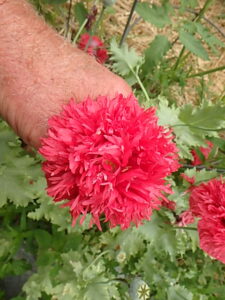
This double poppy comes back every year in my vegetable garden
The first flowers I see when I walk out my front door are poppies. Annual poppies ( Papaver somniferum). I didn’t plant most of them, or not this year. Each year I let them bloom and drop seeds after they’re done. They reward me with dozens of blossoms the following year. Sometimes I pick the pods and save to sprinkle seeds on the snow, an easy way to plant them in the dead of winter.
My poppies are in full sun and soil that is not particularly rich. I like these poppies because they ask nothing of me and each year the palette is a little different as they hybridize, offering some new colors and sizes. I have a nice deep red double annual poppy that blooms every year in one row of my vegetable garden. This year it is with the tomatoes.
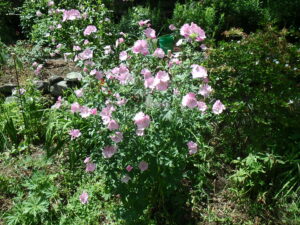
Pink mallow is an enthusiastic plant showing up everywhere
Another favorite of mine is pink mallow (Malva alcea). This is a big, often floppy perennial with lots of pink blossoms that resemble those of a hollyhock. In my garden it pops up anywhere and everywhere. I have to treat it a bit like a weed to keep it in control. It does best in full sun and rich soil that stays lightly moist.
Pink mallow has a tap root and does not transplant easily, unless you do so when small. I often stake mine to keep them upright – it can grow to be 2- to 5-feet tall. Not often seen in garden centers, get a seedling from a fellow gardener, and let it go to seed so you’ll get more plants.
Another flower that moves around the garden, appearing by
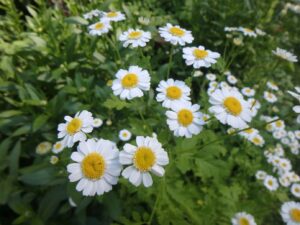
Feverfew volunteers to grow everywhere
whim, is feverfew ( Tanacetum parthenium). Feverfew has white daisy-like flowers with a yellow center, each blossom just three-quarters of an inch across, but appearing in vast numbers. It is a short-lived perennial that sows seeds freely, so if you don’t want more plants, cut off the flowers before the seeds are dropped.
Feverfew will grow in average soil, but prefers moist, rich soil. It’s blooming for me now, and will continue for the rest of the summer, or nearly. The flowers do well in a vase.
My beebalm ( Monarda didyma ) is just coming into full bloom now, and is deliciously fragrant. It is in the mint family, with a square stem that is relatively fragile. But they make great cut flowers, in part, because of their fragrance. Bees love them (hence the name), but hummingbirds do, too. Mine grow to 5 feet tall.
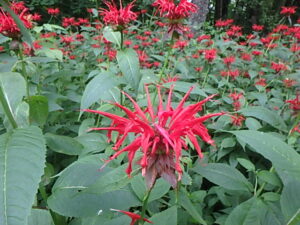
Bee balm does best in part sun and rich, moist soil
Many books claim beebalm is a full sun plant, but I disagree. It does best in morning sun or partial shade in rich, moist soil. It goes by quickly in hot, dry areas. The best blossom colors are red and purple, though cultivars in white and bluish are sold. Recently short varieties have appeared in the marketplace, but I have not found that they are very hardy. Beebalm spreads by root, but pulls easily if it gets too rambunctious.
Daylilies ( Hemerocallis spp.) are in bloom now, too. The common orange daylily is the friend of anyone who thinks they can’t grow flowers. You cannot kill a common orange daylily. I have dug them out, placed them on the lawn without any soil preparation, and they have thrived where placed.
Each blossom of a daylily blooms for just one day, but each scape, or flower stalk, has several buds that bloom in succession. The buds will open in a vase, too, so don’t be afraid to use them in flower arrangements. Unlike true lilies, these beauties are not eaten by lily-leaf beetles. They come in many colors from deep red to light yellow. I have tiny daylilies, and one variety that blooms on scapes as tall as me.
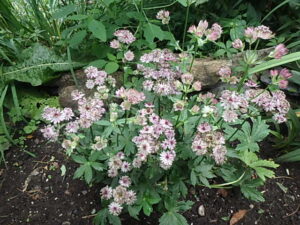
Astrantia does well in part sun
Great masterwort is an awkward name, so I prefer the scientific epithet, Astrantia major. This is a medium-height flower in the carrot family, along with Queen Anne’s lace, a wildflower or weed I love, too. The flowers range from white to purple-white, and bloom in great profusion. It is good cut flower, too. Each blossom is just an inch across, and resembles scabiosa.
Astrantia does well in part shade, but will grow in full sun if adequate moisture is present. The foliage is attractive even when the plant is not in bloom, and it is very well behaved – it stays as a nice clump and does not take over the garden.
I love knautia ( Knautia macedonia) both for the smallish (3/4-inch) purple-red, domed blossoms, and for its willingness to keep on blooming from now until fall. Most perennials have much shorter bloom periods, but knautia is a real trooper.
It has thin stems and delicate leaves, so is hard to display in a vase, but it is worth mixing with daisies or something else that will hold the blossoms up in a vase. I grow it in full sun with average soil, and it does well – and will occasionally provide volunteers from seed.
Each garden has its own winners and losers. Good gardeners try a lot of plants to find those that do best for them. So go buy some or trade with a friend.
Henry is a long time UNH Extension Service Master Gardener and the author of 4 gardening books. He is available for consultations near his home in Cornish Flat, NH.
Watering in Dry Times
Posted on Tuesday, July 7, 2020 · Leave a Comment
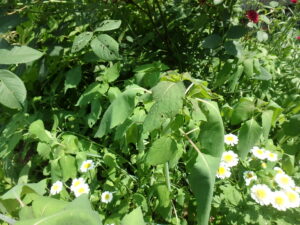
These limp leaves tell me it is time to water
June, for most of us, was a very dry time. When weeds and established perennials started to droop, I knew it was time to water, and I did. But watering done well takes time and, done poorly, wastes a lot of water – or doesn’t do the job. I have no crystal ball to know what the rest of the summer will be like – July started well with plenty of rain – but it’s good to plan ahead
First, how much rain do we need each week to be able to avoid watering? About an inch. If you have sandy soil, water runs right through it, so you need more. Clay soil has tiny soil particles and holds onto moisture nicely. But if clay goes bone dry, it can turn into something like cement that will let water run off the surface and downhill instead of soaking in.
In either case, you can make watering easier and your plants more vigorous by adding compost to your soil. That is easiest to do before planting, of course, but you can top dress the soil with compost and let earthworms, roots and rain work it into the soil over time. Half an inch of compost on the lawn each spring and fall will help a lot. And mulching with compost, an inch or so, will help your flowers and veggies considerably.
In general, I don’t like overhead watering systems. Yes, they do mimic a rain storm, but they waste a lot of water, and water the walkways and weeds as well as the plants. So long as the soil is not parched, I like to water plants using a watering wand.
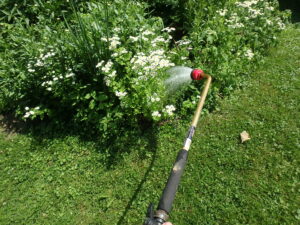
A watering wand directs a soft spray just where you want it
My watering wand is a 30-inch long aluminum tube with a watering rose on the end and a shut-off valve that allows me to increase or decrease the flow of water. I like those made by Dramm, a company that specializes in watering devices and has figured out how to deliver lots of water while not disturbing young plants.
In the vegetable garden, I walk up the rows directing the water around my tomatoes or irrigating the lettuce. The wand allows me to spray water close to the ground level – it’s not falling from waist high, the way a nozzle on the end of a hose would. I place hardwood grade stakes at the end of each row to guide the hose and keep it from damaging plants
But during an extended period of hot and dry weather, I know I need to water each bed entirely, from side to side, but not the walkways. If I just water right around the tomatoes, for example, the surrounding soil will wick away the moisture that you gave to your plants. So you need to soak the soil around your plants, not just at the stem.
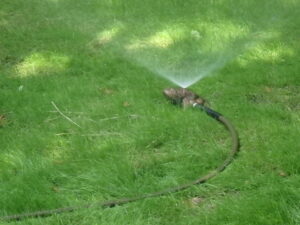
This simple, stationary watering frog waters a circle 20 feet across
When watering newly planted trees, or those planted last year, water in a circle around the tree or shrub that extends at least to the drip line. Later on, when a tree is mature, the roots can go far beyond that. If the soil is dry, you might be surprised how long you need to water around a tree in order to get water to get down 6 or 12 inches – which is where the roots are.
Another way to keep your plants happy in dry times is to mulch them well. This will keep the soil moisture from evaporating and will minimize those thirsty, greedy weeds.
In the vegetable garden I put down 4 to 6 layers of newspapers or a single layer of cardboard or large brown paper bags, and then cover that with straw. To make sure a light rain gets to my plants, I don’t mulch right up to the plants. Or I’ll mulch with chopped fall leaves or grass clippings right next to the plants. Leaves or grass let rain pass through more easily than paper and straw, but keep down weeds.
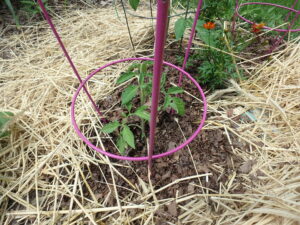
This young tomato is mulched with a circle of chopped leaves, paper, and straw
Why use straw instead of hay? Straw generally costs more than straw – $10 a bale or more versus $5 or less. Mulch hay has seeds, that’s why. Straw is not supposed to have seeds, though occasionally it does. I was told that even if you see seeds in straw, they are immature and won’t germinate.
I don’t like to use black plastic in the garden. It does keep down weeds and holds in moisture, but it ends up in the landfill a year later. And it may interfere with the beneficial microorganisms in the soil – it gets pretty hot under the plastic. It can also create pools of water, a good breeding place for mosquitoes. So I avoid it.
In flower beds I prefer to grow plants so close together that few weeds grow there. But in new beds I use finely ground bark mulch. Never the colored kind, orange or black, as they have chemicals I don’t want.
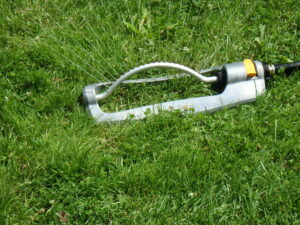
A flip flop watering device can cover a lot of space
For big areas of new plants or lawn, a sprinkler of some kind is good. I like a Melnor brand flip-flop sprinkler, model XT360 M. It is easy to use, and comes with a lifetime warranty. For small areas, I like a fixed sprinkler like my brass frog that waters calmly in a 20-foot circle.
Plants will usually recover from getting dehydrated, but it takes a week or more, so you lose valuable growing time. I want my tomatoes sooner, not later. So I make sure they don’t dry out too badly in dry times.
If you pay attention to your plant, if you really look at them, you will see when they start to wilt. That’s the time to water. So get a good watering device, and be ready!
Henry can be reached at
henry.homeyer@comcast.net. He is the author of 4 gardening books, and can make house calls to offer advice about your garden if you live nearby. He lives in Cornish Flat, NH.
Roses 101: They Are Easier to Grow Than You Might Think
Posted on Tuesday, June 30, 2020 · Leave a Comment
I love roses, but avoided planting any for a long time. They had a reputation for being fussy. I thought they would attract Japanese beetles, and carry black spot and other diseases. In recent years I have been enjoying growing roses and find that modern breeders have come up with many fine roses that are easy to grow, and not fussy.
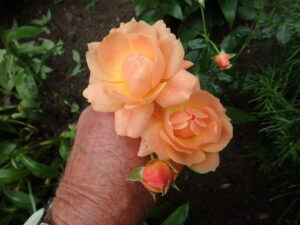
At Last is a re-blooming hybrid developed by Proven Winners. It’s a Zone 5 plant that I’ve had for 4 years in Zone 4
So what have I learned? First, roses love full sun, but will grow in part shade. But the more sun they get, the better they do. Six hours of sunshine is considered full sun by most authorities. Afternoon sun is more potent than morning sun, so the west side of the house is better than the east.
Second, roses need good, rich soil. If you have sandy soil or a heavy clay, you will need to improve it in order to succeed. What does that mean? Dig a hole that is at least 3 times as wide as the pot it was in when you purchased it. If your rose came in an 8-inch pot, a 24-inch hole should be the minimum you dig.
The late Mike Lowe, a rosarian who grew 2,000 kinds of roses in Nashua, NH, told me to dig a hole 36 inches wide and 24 inches deep – if possible. If you have heavy clay, he said, put a couple of inches of pea stone in the bottom of the hole for drainage. The fill it with an equal mix of topsoil and compost.
When planting a tree, it is important to dig a hole shallow enough so that the tree does not get its trunk flare buried. The trunk flare is the portion of the tree that was above ground when it was growing before it was potted up for sale. Often that trunk flare is covered with soil when you buy it, and needs to be exposed.
Not so, for roses.
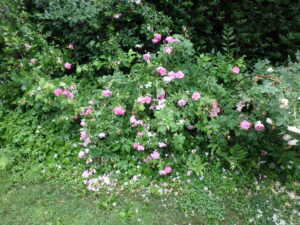
This old fashioned fragrant rose blooms but once but it is lovely
Many roses are grafted onto rootstock. The bud union – a scar – should be buried in the soil. The colder the climate, the deeper that graft line or bud union should be. For Zone 4, it should be about 4 inches below the final soil line. Zone 5? 3 inches. Zone 6? 2 inches.
Third, roses like soil that is just slightly acidic – pH 6.0 to 6.8. If you have acidic soil, say somewhere in the 5.0 to 6.0 range, you should add limestone to bring up the soil pH and make it less acidic. Mike Lowe suggested burying a 3-inch square of gypsum wallboard directly below each rose to provide limestone over the long haul. I’m not sure just how effective that is.
Don’t know your soil pH? You can get an inexpensive pH testing kit at your local garden center. Or you can send a sample to your State University Extension Service.
Roses need more water than most other things, but do not want to sit in soggy soil. They should get an inch of water per week from rain, or a couple of watering cans of water applied slowly so it can soak in. A deep watering once a week is better than a little sprinkle every day.
I called Mike and Angie Chute of East Providence, Rhode Island to pick their brains about roses. They have been growing roses for 25 years, and are the authors of
Roses for New England: A Guide to Sustainable Rose Gardening. They are well known speakers at the spring flower shows. Their web site is www.rosesolutions.net , and it’s worth visiting.
I asked them what they thought of the new roses that have been developed in the last 25 years, and how they rate them against the old heritage roses. Mike explained that the trademarked “Knock Out” roses have become immensely popular. I have some, and agree that they are wonderful. They bloom most of the summer and well into the fall, seem to get no diseases and do not attract pests.
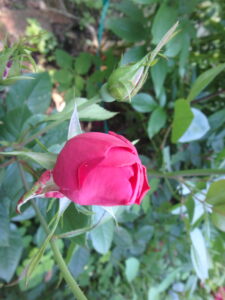
This Knockout rose blooms all summer
On the other hand, most of the Knock Out roses have no fragrance, and do not have the long stems that lovers want to present to their sweeties. Mike and Angie grow them, along with 150 other kinds of roses, and said that the “Easy Elegance” series of roses is at least as good, and maybe better.
Want more blossoms? Mike said that roses do better if they get some fertilizer a few times during the course of the summer. They use chemical fertilizer, a 10-10-10 for a “kick in the pants”, and mulch with chopped seaweed. They like an organic, slow-release bagged fertilizer called Rose Tone, and sometimes use liquid fish and seaweed fertilizers made by Neptune’s Harvest.
My roses grow in good soil, and I have been neglectful of them – I rarely fertilize. But I understand that a dose of liquid fish and seaweed fertilizer 2 or 3 times in the summer might help. I’ll do it this weekend.
Want to learn more? The Chute’s book, mentioned above, is excellent, and worth reading. I also like one published by Rodale Press in 2002, Growing Roses Organically: Your Guide to Creating an Easy-Care Garden Full of Fragrance and Beauty by Barbara Wilde. It has a half-page description with a photo of each of 100 roses that will do well with organic care.
June is over, but roses are not. Now days, many roses will re-bloom every 45 days or so, and some bloom almost constantly. Just be sure to cut off spent blossoms, and down to another shoot with 5 leaves or more.
Henry is the author of 4 gardening books and is a veteran of the UNH Master Gardener program. His email is
henry.homeyer@comcast.net.
Where to Begin: How to Design a Garden
Posted on Tuesday, June 23, 2020 · Leave a Comment
Let’s say you have recently purchased a house and want to create beautiful gardens. How should you begin? I recently visited Gordon and Mary Hayward, both garden designers, at their home in Westminster West, Vermont. Their gardens are as nice as any private gardens I have seen, and I wanted to understand their thought process.
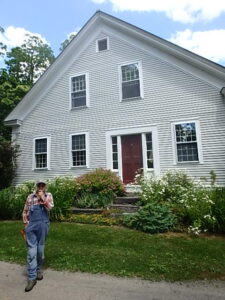
It’s important to have views of the garden from the windows
The Haywards bought a 1790’s farmhouse 36 years ago that needed a lot of work. The landscape was full of brush and abandoned cars. But they were undaunted. They explained that they wanted a house in a garden, not a house with gardens you walk by. They wanted to be surrounded by gorgeous flowers and trees, with sculpture and walkways. They wanted gardens all around them.
The first thing they did was establish the central axis of the gardens. They did this by tying a string to the front door plate and running it straight out to the trunk of a mature apple tree, thereby creating a focal point. All the main beds are either parallel or perpendicular to that string. I’d estimate that the pathway along the central axis extends from the house for a couple of hundred feet.
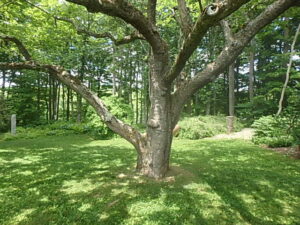
This old apple tree served to establish an axis from the front door of the house
At the end of that central path is a magnificent old apple tree, surrounded by an 80-foot circle of lawn, because the drip line of the apple tree is circular. Flowers in curved beds surround the lawn. As Mary Hayward said, “Curves need to make sense.” Most of the paths and lines in their garden beds are straight, only occasionally curving or meandering to go around a fixed feature.
“Pay attention to views from the doors and windows because they’ll suggest garden placement,” said Gordon. Look out them, make sure what you see pleases you. Not only that, he said you gain confidence in your design if you pay attention to the house. There needs to be a relationship between the house and the garden spaces. “The garden is an extension of the house and the people in it,” he said.
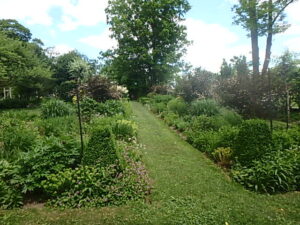
Garden paths should be the same width for their entire length
What else should one consider? The north-south orientation is important, Gordon said. You can grow roses on the south side of a barn, for example, but not on the north side, as there is much less sun. Where is sunset? Most of us like to rest at the end of a day in the garden to watch the sun go down. You can design that – and maybe steal a view of distant hills owned by others. You may need a chain saw to accomplish that.
Mary Hayward grew up near Hidcote Manor Garden, one of England’s finest old gardens, and visited often when growing up. Those visits shaped her view of how a garden should look: a series of connected rooms. Gordon Hayward grew up on apple orchard, and so he wanted apple trees on his landscape as an adult. It makes sense to have elements of a garden that resonate with each person, based on personal history.
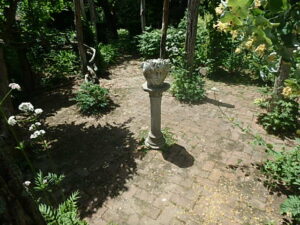
Sculpture adds beauty and interest to a garden
“Every decorative element in a garden should have a story, a reason,” Gordon said. “Don’t go buy a cute elephant. Consider what your grandmother or grandfather had.” In the long run, that will resonate with you better.
When Gordon designs a garden for someone, he always asks what their parents or grandparents had for gardens. Are there special plants that bring back memories of simpler times? So, for example, I have a piece of a peony my grandmother (who passed away in 1952) grew called “Festiva Maxima”, and I would hate to be without it. It’s my favorite flower.
Mary and Gordon spent time researching the farm they bought, learning about how it operated and where long-gone outbuildings were located. They have three old milk can where the milking parlor once stood, and other features that remind them of the farm’s history. They unearthed granite fence posts and old bricks, and put them all to good use.
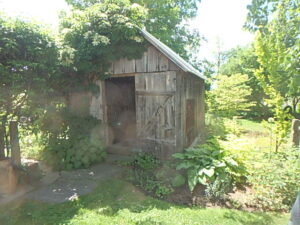
This old shed adds interest to the garden
There is an old tobacco-drying shed in the gardens, and they used the proportions of that to determine the size of beds near it. The door of the shed is eight feet tall, so they used multiples or fractions of 8 for beds around it. The barn itself is 16 feet long – the same measure as the dirt road in front of the property, an old unit of measurement called a rod.
Gordon pointed out that for five months of the year there are no perennials visible in their garden. It is thus very important to have stone walls, trees, sculpture, pottery and outbuildings that are handsome and clearly visible from key windows of the house all year long. Designed properly, a garden can be as beautiful in winter as it is in summer. And since trees and shrubs take time to reach maturity, they are a logical early step when designing your garden.
This old apple tree served to establish an axis from the front door of the house
I bought my house fifty years ago this August. It’s an old creamery, a butter factory built in 1888. It came with an acre of land, though I have since added more land. It had no perennials or shrubs, just a big native cherry tree, a few sugar maples and two huge elms, now long gone. Lawn surrounded the house.
If I were starting all over again, I would begin by designing a garden layout. To help me in that endeavor, I would study good gardens in glossy books and by visiting as many fine gardens as I could. I would take classes and go to arboretums to learn about trees and shrubs that might be used to improve the landscape. I would join a garden club and go on garden tours. And I would certainly want to read all of Gordon Hayward’s wonderful gardening books.
Henry is the author of 4 gardening books. He is now offering Zoom presentations to garden clubs and library groups. E-mail him at
henry.homeyer@comcast.net for more information.

 Click Here to buy from Cobrahead