Understanding Flowers
Posted on Tuesday, April 23, 2019 · Leave a Comment
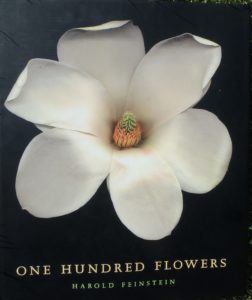
Book cover 100 Flowers
At a recent used book sale I purchased a copy of a lovely book called One Hundred Flowers by Harold Feinstein (Bullfinch Press, 2000). This large-format book includes not only 100 amazing, huge close-up photos of flowers against black backgrounds, it has a lovely introductory essay by Sydney Eddison, a dear friend and fellow gardener writer. Sydney’s introduction is thought-provoking, and worthy of discussion here.
Ms. Eddison begins by explaining the purpose of flowers: to allow plants to reproduce and set seed. For annuals, flowers like cosmos or sunflowers, have but one chance to extend their genetic line. Failing to create seed and have that seed planted – by gravity, an animal or by a gardener – an annual is lost forever at the end of the season. It is generally an advantage for an annual to produce lots of seeds, in hopes that at least one will grow and extend the lineage.
Annuals must reproduce, and consequently they are excellent advertisers – they often have bright colors or strong scents to attract bees or other pollinators. Other annuals depend on the wind to pollinate them, and they need not be so bright – think wheat or corn. Still, the genetic lineage of an annual plant ends if seeds are not produced. Of course many seeds will remain viable for years, and most species have plenty of specimens trying to extend the lineage each year.
Perennials, trees and shrubs, by contrast, can go dormant, and live through winter for another chance to get their genes spread. Perennials generally die back at the onset of winter, but their roots go dormant until spring. Biennials, things like foxgloves, are more like annuals – they only flower once, in their second year.
In her essay, Sydney Eddison did a concise Anatomy and Physiology 101. Most flowers, but not all, have both male and female reproductive organs, generally on the same flower. But it is to the advantage of plants to cross pollinate with other flowers of the same species, and they have evolved to do so. Just as we don’t generally marry our sisters or cousins, flowers get vigor and new traits by crossing with other flowers.
How do plants insure that they are not self-pollinating? One way has to do with timing. Sydney Eddison gives the example of sunflowers. Each “flower” is actually a collection of hundreds to tiny flowers all jammed together, but using one set of bright yellow petals to attract pollinators. That’s efficiency personified.
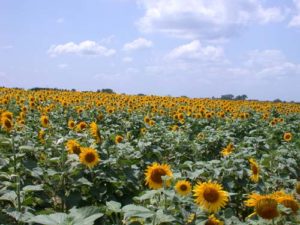
Each sunflower is made of hundreds of flowers
The stigma, or the female part of the sunflower that is receptive to male pollen is delivered by bees or other pollinators, but it stays closed while a particular sunflower is shedding pollen. Later, another pollinator, attracted by those bright yellow petals, will deliver pollen from a different plant.
Many flowers seemingly make pollination difficult. Nectar or pollen is hidden away deep inside a flower. An industrious bee must crawl inside to get at the goodies. In so doing, the bee or other insect delivers pollen, the male gametophytes, from one flower to another. In the fall I love the sound of bees grumbling about their hard life after they finally force themselves inside turtle head, which is one of my favorite flowers of the season.
Flowers entice us just as readily as they do butterflies, bees and moths. We love them and we grow them for beauty as well as for the food they might produce. Humans have been hybridizing plants for eons – long before genetic engineering was even imagined. Creating hybrids can be as simple as breaking off a pollen-laden anther from one variety of flower and touching it to the female stigma on another. Then saving seed, planting it, and seeing what you get.
But once again, timing can be key. If the wind or a big, fat bumblebee has already pollinated a flower, your efforts may not create anything different. But, as Ms. Eddison points out, hybridizers have been dreaming of blue lilies and black gladiolas, and trying their best to produce them – for decades without luck so far.
If you want to try hybridizing flowers, you can “bag” a flower before it opens to prevent accidental pollination. Daylilies are easy to do this with – just use a small paper or wax bag that you place over an unopened flower and secure with a rubber band or piece of yarn. Not every daylily, even ones you pollinate, produce seeds, however. And a friend who has done this hundreds of times explained that most crosses don’t produce anything of interest.
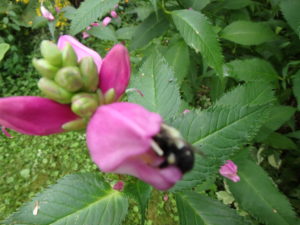
Turtle head with bumblebees emerging
Genetic engineering –made possible just within the last 25 years – allows scientists to add genes to the make-up of organisms in ways unfathomable to Gregor Mendel, who proposed the laws of genetic inheritance in 1865. So for example, back in 2003 I interviewed scientist, Dr. Mark Brand at UConn who introduced genes from a frog into a rhododendron to help it be less susceptible to a fungal root rot. That is not something you or I could do – or would I want to.
Green plants first appeared some 400 million years ago. They evolved from aquatic algae to mosses to ferns to flowering plants. The first flowering plants appeared about 300 million years ago and now there are estimated to be 400,000 distinct species. And remember: all animals on this planet depends on plants, either directly or indirectly. They are not just decoration, they sustain us all. So go garden. Your plants depend on you as much as you depend on them.
Henry Homeyer is a UNH Master Gardener with over 20 years’ experience, and an organic gardener for well over 50 years. You may reach him at henry.homeyer@comcast.net or P.O. Box 364, Cornish Flat, NH 03746.
The Spring Bulb Flowers
Posted on Tuesday, April 16, 2019 · Leave a Comment
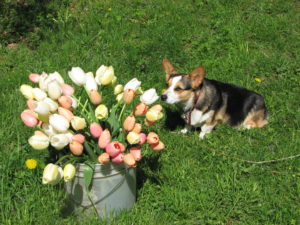
My dog Daphne
Now is the time to decide where you should plant bulbs next fall. Here’s what I do: I wander around my property each year in the spring to see what spots are bare of bulb flowers. I bring along those white plastic markers used for labeling, and write “add crocus here”, for example. Then in the fall, when it’s time to plant more bulbs I don’t have to rely on my memory to know what to plant, and where.
When planting bulbs, I label what I‘ve planted. That way I’ll see what has performed well, and remember to buy more of the same. For example, I’m always eager to get color in the garden at the same time that the white snowdrops bloom. Two purple-blue bulbs bloom about the same time: Glory-of-the-snow is one plant that overlaps with snowdrops, but is a bit later, as is scilla.
This spring I saw a crocus that was labeled ‘Blue Pearl’, that is blooming with my snowdrops – and before those other two. So I’ll buy 100 of those for fall planting. I bought them at Brent and Becky’s Bulbs– I know because they include tags with each bag of bulbs. And I can order them now for delivery then.
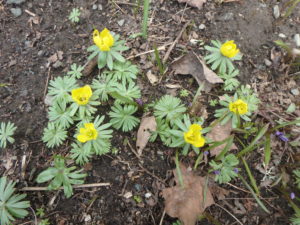
These winter aconite self-seeded
This year I am delighted to see that the winter aconite that produced seed 2 years ago is going to bloom. Last year I recognized the leaves, but it did not produce blossoms. It is a very early bright yellow flower that has one-inch wide, six-petaled flowers. I’ve grown it before but lost it to cold or rodents or poor drainage, and re-planted in other spots. This new patch will give me 50 or so “free” flowers.
I tend to blame bulb failure on drainage problems, not rodents. I mix in lots of compost at planting time and favor hillsides, which helps with drainage. Wet soil is hard on bulbs. Our cats tend to keep rodents away. South facing hillsides are great for early bulbs as the snow melts off weeks earlier than north-facing plots, and drain well.
A bulb plant that I’ve considered fussy is a low-growing iris, Iris reticulata. It is just a few inches tall and has medium-sized blue, purple or (sometimes) yellow flowers. Doing some research I found out why I thought they are fussy: after they bloom, the bulbs divide, producing several little bulblets. These won’t bloom for a few years. So I need to plant some every year until I have a mature colony of them. I also read that they like soil that dries out well in summer, such as in a rock garden or sandy hillside.
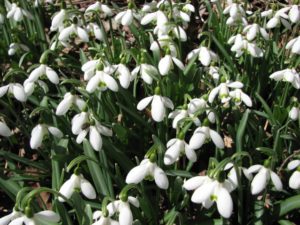
Snowdrops are the first flowers to bloom for me
My lawn is full of snowdrops that have planted themselves. I assume that they produce seeds that wash into the lawn during summer rains. The bulk of my snowdrops are planted on a hillside above the lawn. But you can plant early spring bulbs in the lawn, too. Just don’t plant daffodils or anything with large leaves because you won’t be able to mow the lawn where they are growing until the leaves yellow and dry off – around July 4th. Bulb plants need to re-charge their batteries, if you will, by getting sunshine and storing energy.
Little bulbs like snowdrops, crocus and grape hyacinths have short leaves that disappear early and won’t disrupt your early mowing. You can always set the lawn mower blades high to protect the leaves if they are still green when you need to cut the lawn.
Grape hyacinths (Muscari spp.) are great little flowers that come in many different shades of blue and purple. I’ve planted many dozens in my day, but find they tend to lose vigor and disappear with time. So I plant them again. Whenever I see grape hyacinths for sale in pots at the grocery store, I buy them. I enjoy them immensely in the house. Later, when the soil is thawed, I plant them outside. I keep the pot in a cool space indoors, as if they get too warm, they flop over.
Tulips I treat like annuals. Why? They do well the first year, but quickly go downhill or disappear in subsequent years no matter what I do. I plant 100 most years in a bed that I reserve for them. Later I plant zinnias in the same bed, so I don’t bother to coddle them. My corgi, Daphne, keeps the deer away.
Daffodils are slightly poisonous to deer and rodents, so they aren’t eaten – and can bloom for years. You can plant them in open woodlands and they will do fine. By the way, if you forced paperwhites this winter, don’t bother planting them outdoors – they’re not hardy here.
I’ve been paying attention to bulb flowers at least since I was 9 years old. I recently found entries in my diary that tell me so. My entry for March 7, 1956, in its entirety was this: “Spring is getting here at last the snow drops are in bud + will bloom in a few days.” Then on April 5 I wrote,” Today our first crocus was in bloom it is very pretty.” As a guy who makes his living writing, I no longer keep a daily journal. I tend to document my life now with a digital camera – and this column. Thanks for keeping me writing!
Henry lives and gardens in Cornish Flat, NH. You may reach him at henry.homeyer@comcast.net. He is the author of 4 gardening books.
Early Spring Chores in the Garden
Posted on Tuesday, April 9, 2019 · Leave a Comment
With sunny warm days upon us, we all want to start gardening. But beware: if you leave footprints in the soil, or feel it go squish, it’s not time to be doing anything. Plants get their oxygen from their roots, not their leaves. If you compact the soil, you can seriously harm your plants by damaging soil texture and tilth.
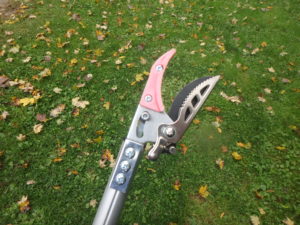
This 5 foot pole pruner will cut and grab
Even your lawn is susceptible to compaction. If you must go across it, don’t hurry across it and keep your feet flat, to maximize the surface area of your shoes. And don’t follow the same path each time you cross the lawn. Game trails in the forest can be created by animals as small as house cats if they follow the same path each time they go visit the neighbors. Compaction kills plants.
Raking the lawn seems like a good activity now, but again, depending on where you live, your lawn might not be ready for you. Wait until the lawn has “greened up”. If you rake a dormant lawn vigorously, it is easy to pull up plants, roots and all.
The plow guys dump a lot of sand and gravel on my lawn. I can clean it up now because I can stand in the road and rake it towards me without compacting the soil. I like to use a lawn rake with bamboo or plastic tines for that job, to be gentler on the lawn. Metal lawn rakes are great, but not at this time of year.
If your lawn feels fairly dry and you don’t leave foot prints, perhaps you can get to your flower beds to do a little spring cleanup. I don’t generally rake leaves out of my flower beds in the fall, as I like the extra protection against erosion and cold temperatures they provide. But that means that bulb plants are covered now, and the ground is insulated from the spring sun. I want the soil to warm up.
So I try to clean up places where I know there are spring bulbs as early as possible. If the daffodils are poking through, I use my fingers to pull back the leaves. I fear that a rake will damage the tender stems and flower buds. In other places where bulbs are not up yet, I use a rake and gently rake off the leaves. Sometimes I will bring along a scrap of plywood or a 6-inch plank to stand on as I work, minimizing compaction.
What else can you do? I’ve been cutting branches from early spring-blooming shrubs. This is one of my favorite spring tasks. I’ve had forsythia blooming in the house for over a week now. As an early bloomer, it doesn’t take long in a vase to get blossoms. Select stems that have fat buds and put them in a sunny window until they open. Then move them to a cooler place to prolong the show.
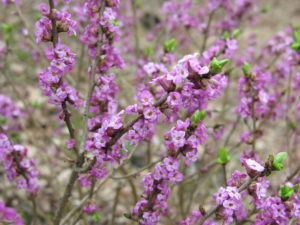
Daphne is not blooming outdoors yet this year
Another spring favorite of mine is called February Daphne (Daphne mezereum). I suppose it blooms somewhere in February – Virginia, perhaps. Here it generally blooms for me in late April, but in 2012 it bloomed in late March. The blossoms are bright pink-magenta, and are fragrant. I like it so much that I named my corgi after this shrub.
I’ve had my February Daphne for 15 years or more and is still a nice compact shrub about 4 feet tall and wide. It is originally from Japan, and I watched it closely when I first got it, as I was worried it might be invasive. I had seen it growing wild on the roadside, so worried it might take over the understory. Nope. I have never seen a single offspring elsewhere on my land.
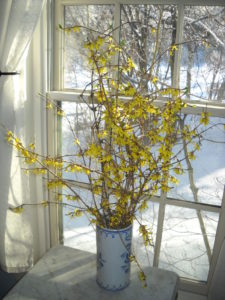
Forsythia forces easily indoors now
Pussy willows are opening in the swamps, and I shall go out with my “cut-and-hold” pole pruner to get some soon. This pruner cuts through a stem, and grabs it at the same time. That is particularly nice when gathering branches in a swamp. The one I have is made by the Wildflower Seed and Tool Company of Napa Valley (https://wildflower-seed.com/). It is telescoping and has a pistol grip that I can work with one hand, while directing the pole with the other.
If you don’t have any pussy willows, you should –especially if you have an area that stays wet or damp most of the year. They are very easy to propagate, particularly in the spring before they leaf out. Just cut 12-inch long stems and push most of each stem into the soil. It will send out roots in the ground and leaves above ground.
If the pussy willows you cut are for display in a vase, you don’t need to add water to the vase. They will stay “frozen in time” seemingly forever. If they haven’t fully opened, put them in water until they are cute and fuzzy, then drain the water.
I recently picked a stem of hobble bush, a native viburnum (V. lantanoides), and put it in a vase where it is blooming beautifully. All viburnums would probably force well. Lilacs are early, but I’ve never found them as dramatic when forced as when I let them develop on the bush.
Last spring chore? Clean out your garden shed or barn. Throw away garden gloves with holes in them. Get some steel wool and light sewing machine oil or WD-40, and get the rust off your tools. Sharpen shovels and pruners. Summer will be along soon enough. Enjoy the spring before the bugs come along.
Henry can be reached at henry.homeyer@comcast.net or P.O. Box 364, Cornish Flat, NH 03746. Please include a SASE if asking for a reply my mail. Henry is the author of 4 gardening books.
Tips for Good Garden Design from Piet Oudolf
Posted on Tuesday, April 2, 2019 · Leave a Comment
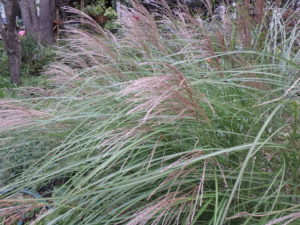
Miscanthus ‘Morning Light’ in my garden in October
I was out in my garden recently and noticed that my tall decorative grasses are looking quite bedraggled. I have a clump of fountain grass (Miscanthus sinensis) a variety called ‘Morning Light’. It’s time to cut back all the stems and flowers that stood up, largely, to the winter winds.
Looking at it made me think of Piet (pronounced Pete) Oudolf, a Dutch garden designer who works all over the world. Oudolf loves decorative grasses and uses them often, including in the High Line Gardens that he designed in New York. I had a chance to meet him and tour his personal gardens outside of Amsterdam in 2007, and I recently re-visited my notes from that time.
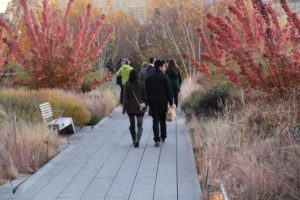
High Line Garden photo credit Gordon Hayward
Piet Oudolf primarily designs gardens on a grand scale. The High Line project in New York City transformed a mile and a half of abandoned elevated railway into a garden. He is the designer of the memorial gardens just blocks away from the former site of the World Trade Center in Battery Park at the tip of New York, at The Gardens of Remembrance. He has done gardens in Chicago and Stockholm and elsewhere. He is the author of several books, including “Planting Design: Gardens in Time and Space.”
I visited him at his home in Humelo, Holland and we talked about gardening. Asked about his philosophy of gardening, Oudolf told me that he doesn’t have one, but, he said, “I know what I like.” Early on, he said had felt trapped by English gardening –“I’m not a color gardener” – and he tried to find a way to escape. Tall decorative grasses and prairie plants appealed to him. We walked through his personal gardens, and his love of plants that provide winter interest was obvious.
Oudolf has a couple of acres of gardens surrounding his house. I visited in January, a time when only a few early hellebores were blooming. I noticed that he used sharply clipped evergreen hedges as counterpoints to the tall grasses that waved in the wind, and to the array of summer plants that had been left to show off their seedpods during the winter. I wondered aloud what he would do in an urban setting, say something 30 meters (100 ft) square.
First, he said you need to plan a space that is comfortable year round – some place where you’d like to spend time. Start by taking up most of the sod, and getting a soil test done before doing any planting. Amend the soil with compost and minerals as needed. Select easy-to-care for plants, things that are tolerant of a variety of conditions. It’s important, he noted, that you choose plants that need the same basic conditions if they are to grow together and do well. So, for example, don’t try to plant heather (which needs acidic soil) right next to lavender (that needs slightly sweet soil).
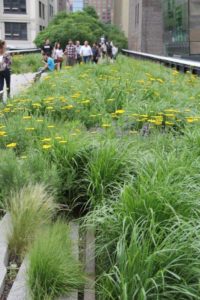
High Line Garden Photo Credit Gordon Hayward
Oudolf believes in mass plantings, not a hodge-podge of individual plants of many different species. He pointed out that you also need to have an array of plants that bloom in different seasons. He suggests 30% spring plants, 40-45% summer bloomers, and 25% plants that are best in autumn. And he believes in cleaning the garden in late winter or early spring so that those tall grasses and perennials will be interesting all winter long.
It is important to separate your garden space from that of your neighbors, according to Oudolf, either by planting a woody hedge or by building a fence. He likes iron fences that can be used as support for climbing plants like clematis, or be used to train woody plants into shaded tunnels. In his own gardens he created raised beds to change the level of the flat garden, building 30 inch tall brick circles filled with soil and planted with tall decorative grasses.
Pathways are important for gardens, Oudolf explained, as they lead the viewer through the garden. He believes that you shouldn’t be able to see the entire garden at once. You can create tension by placing tall plants and hedges in the front of a garden, he said. He likes hard surfaces for walkways in small gardens, either stone or brick, but grass as the path in larger gardens. Obviously in public gardens he uses concrete or stone to keep the foot traffic from wearing down the grass.
Places to sit should be included whether in a public or private garden, Oudolf said. His own gardens have benches for relaxing, though I suspect he has little time to use them. One of my favorite features in his garden were the sheep. No, not live sheep. He has a sense of humor, and has nice carved marble sheep resting on the lawn. Unfortunately my photos have all disappeared.
I have been to the High Line Gardens a couple of times, and they are definitely worth a visit. I understand they are now one of the most-visited tourist attractions in New York City. Meander along the path and you will see how Piet Oudolf incorporates all the design principles mentioned above. Go see the High Line, and then incorporate some of his ideas in your own gardens.
Henry Homeyer can be reached at henry.homeyer@comcast.net or P.O. Box 364, Cornish Flat, NH 03746. Please include a SASE if requesting a mailed response.
Five Perennial Fruits and Vegetables for the Edible Landscape
Posted on Tuesday, March 19, 2019 · Leave a Comment
When I make a new friend I always ask, “Are you a gardener?” Often younger people with kids say, “I want to, but I’m too busy.” If you have limited time and space, you may wish to consider growing a few perennial plants that produce lots of food – whether you do much for them or not.
If you are considering adding landscape plants to your yard, try thinking outside the box: instead of choosing traditional shrubs like hydrangeas or rhododendrons, what about blueberries and dwarf apples? What about strawberries to border the front walk instead of flowers?
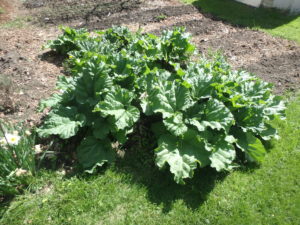
Rhubarb likes rich moist soil in full sun
Perennial fruits and vegetables generally require at least 6 hours of sunshine a day to succeed. Remember when planning that the arc the sun makes on July 4th is different than the arc in winter. And trees that are bare of leaves now may produce lots of shade in August when your berries are ripening.
Good soil is important for success. A soil test performed by your state Extension Service is a good investment. You need to know if you have adequate organic matter and minerals, and if the pH (a measure of acidity) is appropriate for what you want to grow.
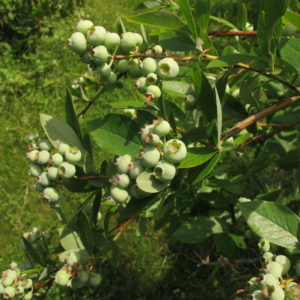
Blueberries produce best in acid soil
If you have crummy soil – heavy clay, or very sandy – you may wish to grow your plants in raised beds so that you can build the soil needed. A 50-50 mix of compost and top soil is, in general, a good mix. Perennial plants tend to have deeper root systems than annuals like lettuce or tomatoes, so go with the deepest boxes possible. Eight-inch deep beds are good for almost anything.
Your perennial fruits and vegetables need about an inch of water per week- either from Mother Nature or from your hose. Traveling a lot? Forgetful? Think about an automatic timer and a drip system. Watering wands are great if you have to limit water use – you can direct the water directly to the plants, not to the walkways – or weeds! The soil should be well drained, but retain moisture after watering.
OLYMPUS DIGITAL CAMERA
One of the easiest ways to keep down weeds and hold in moisture is with mulch. My favorite mulch is one I make myself: in the fall I mow the lawn, chopping up leaves and grass. I collect it and apply right on garden beds. After the first rain it is not likely to blow around. Or you can bag it in contractor trash bags, and store to use in the spring.
You can also buy bark mulch in bulk or by the bag. Avoid any that are colored, as they may have chemicals you don’t want on your fruits or veggies.
Here are some of my favorite perennial food plants:
- Asparagus: Modern cultivars in the “Jersey” series produce all-male plants, which produce much higher yields than older varieties (Washington series). Weeds are terrible enemies of asparagus, so mulch and weed carefully to keep weeds at bay. I use newspapers covered with bark mulch to keep down the weeds.
- Blueberries: The keys to success are a) to have the proper pH or level of acidity, and b) to keep the weeds down. Blueberries need very acidic soil, so test yours, and then add garden sulfur to bring the soil to a pH of 4.0-5.5. Top dress with sulfur or a fertilizer for acid–loving plants yearly right after blooming.
- Rhubarb: This can be grown with less sunshine than the berry plants – 4 hours of sunshine is sufficient, although more is better. Add a bucket of compost and a cup of organic fertilizer with each plant. Plant it where the soil stays lightly moist for best results.
- Raspberries and blackberries: If you like these berries, they are a must for your landscape: they don’t travel well and are expensive to buy. Because the plants tend to multiply and spread by root, this is a good plant to grow in a raised bed that will contain it. Plant in full sun in rich soil amended with compost and organic fertilizer.
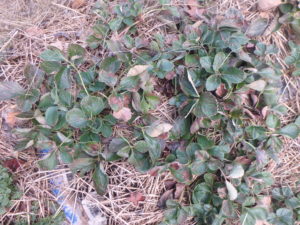
- Strawberries: All season strawberries produce a few white blossoms and red berries all summer long, with a nice big crop in the fall when standard strawberries come from far away. Plant in full sun in rich, well-drained soil. Amend the soil with compost and organic fertilizer at planting time.
You don’t have to be a garden wizard to grow these things. Nor do you have to dedicate your life to them. So plan on doing some planting, come spring, and you’ll enjoy the benefits for years to come.
Henry started gardening with his Grampy some 70 years ago and still has the gardening bug. His books will guide you to success, just e-mail him for more info: henry.homeyer@comcast.net.
Tips for Starting Seeds Indoors
Posted on Tuesday, March 12, 2019 · Leave a Comment
By mid-March I generally am getting a bit squirrelly. Winter is nearly over but mud season is ahead. It is still many weeks until the snow is gone, the soil warm and dry enough that I can work in my garden. This is the time I like to start a few seedlings indoors to keep my spirits up.
If you’ve never tried starting plants indoors, there are a few things you should know:
- Lights are essential. Growing on a windowsill will only result in long, lanky and dispirited plants. Four-foot fluorescent or LED fixtures will provide plenty of light and help you to grow good plants.
- You can’t grow seedling indoors in soil. You need a potting mix to grow them in those little 6-packs available at the garden center.
- Temperature is important, too. Electric heat mats under your flats of seeds will help them to germinate earlier and better. After that? Not too hot. 65 degrees or less during the day and 50 to 55 at night are good temperatures.
- Plants quickly use up any fertilizer that comes in your potting soil. If you are an organic grower, you can water with a dilute fish or seaweed fertilizer to provide what is needed for healthy growth. But don’t make your dilution too strong. More is not better, so read the directions. Fertilize once or twice a week.
- Don’t let your seeds or seedlings dry out. Check daily.
- Timing is important. Most seedlings only need 6 to 8 weeks of growth indoors before going outside. You don’t want your plants to get root bound. Most seed packages or catalogs will give you information about timing.
- Seedlings need their rest, too. Don’t run your lights all the time. They need 10 hours or more of rest – no lights – each 24 hours.
Start the process by setting up a growing area in a spare bedroom or bathroom or perhaps in the basement. Depending on your budget and how many seedlings you wish to start, you can use a card table and a fluorescent or LED fixture hung from the ceiling – or something more elaborate.
Years ago I built a simple A-frame plant-starting frame that I use every year. I used one inch-by two-inch pine boards. The legs are each 6 feet long and each pair of legs is joined using a small gate hinge at the top. The two pairs of legs are five feet apart, and connected on 3 levels with 1-by-2 inch wood to support lights and plywood platforms.
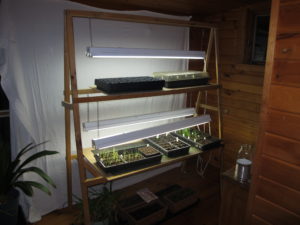
Homemade plant stand
The A-frame has 3 growing areas: top shelf, middle shelf, and the floor. I used thin plywood for the two shelves, one piece 16 by 48 inches for the top shelf, the other 24 by 48 inches for the middle shelf.
I used short sections of 1-by-2 to brace the structure, including a piece between the side supports of the wider shelf, which might droop if not supported.
I placed cup hooks on the cross pieces to support the fluorescent lights on jack chain, one 2-bulb fixture for the top shelf, 2 two-bulb fixtures for the other growing areas. This system will handle up to 10 flats of seedlings. Of course, you don’t have to use it all, especially when you are just learning how to manage growing seedlings indoors.
The jack-chain mentioned above is a light-weight chain that is sold in hardware stores. You can open up the chain on each end with needle-nose pliers to attach it to a hook or to poke into slot on the back of the fixtures. It’s important to have something you can easily adjust in length, as you will want to keep the lights about 6 inches above your plants. My tomatoes get more than a foot tall, so I keep shortening the chain to pull up the lights.
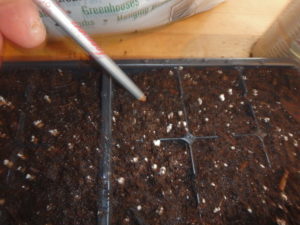
Making a divot for the seed
Fill your 6-packs with potting soil, wipe off any excess, and then water. The material will settle. Let it drain, and then plant. Make a divot with a pencil for each seed. The bigger the seed, the deeper the divot, per directions on seed packs. Or you can drop the seed on the surface, and push it into the potting mix with the eraser end of a pencil, and cover with more potting mix. Lightly water again.
What to plant indoors, what outdoors? Root crops should always be direct seeded outdoors, with the possible exception of beets. Although many plant cucumbers and squash by seed outdoors, I plant then indoors in May to prevent beetles from decimating them when they are small. I put them out when vines are about 6 inches long.
Tomatoes I usually start around April 10. The biodynamic calendar I use,
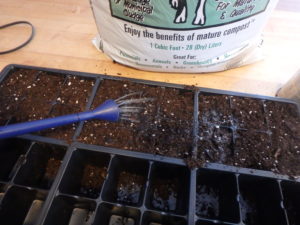
Moisten potting mix before planting seeds
Stella Natura, tells me to plant fruit crops this year on Saturday afternoon, April 6 or Sunday afternoon, April 14th. I believe the sun and moon are good guides, and that calendar helps me.
Right now? I’m planting peppers, hot and sweet. Onions are good to plant by seed indoors in March, too, though you can buy plants or sets to plant outdoors later.
Try a few things indoors by seed this year if you haven’t before. I think you’ll enjoy it.
Henry can be reached at henry.homeyer@comcast.net or PO Box 364, Cornish Flat, NH 03746.
Trees and Shrubs Are Important for Pollinators
Posted on Tuesday, March 5, 2019 · Leave a Comment
When I say “Pollinator”, you think bee, right? Honeybee, bumblebee, wild bee. But what about moth, butterfly, beetle or fly? Many of those are pollinators, too. I recently read an interesting article about pollinators by Dan Jaffe and Jane Roy Brown in the “Native Plant News,” a magazine put out by the New England Wild Flower Society.

Choke Cherry is a good pollinator plant.
The authors’ basic premise is that moths and butterflies are the unsung heroes of pollination, and important part of a balanced ecosystem. Of the 700 or so species of butterflies and moth (Lepidopterans) found east of the Mississippi, 500 species are supported by five native trees: oaks, cherries, willows, birch and poplar or aspen. In comparison, our perennial flower bee balm (which is loved by bees) supports just 11 species of butterflies and moths.
I called Dan Jaffe and asked this: what is the value of Lepidopterans to the average gardener? Can’t bees take care of our fruit trees and veggies? Yes, he said, bees are great pollinators, but butterflies and moths feed our baby birds – and birds are great at controlling insect pests and moving seeds around the landscape to create a biologically diverse environment.
It works like this, he said. Baby birds need a high protein diet, so parent birds serve them caterpillars as 95% of their diet, even birds that are seed eaters as adults. If there are no caterpillars, fewer baby birds will survive. And, he noted, our native species of trees are much better at feeding them than introduced decorative species.
Many butterflies and moths depend on specific species of plants to survive. Most of us know about monarch butterflies: they only will lay their eggs on milkweed. As adults, however, the monarchs will feed on many flowers including asters, goldenrod and a variety of other flowers. The endangered Karner blue butterfly depends on sundial lupine (Lupinus perennis) – and will not even feed on other related lupines. Planting to support specific butterflies is a worthy endeavor.
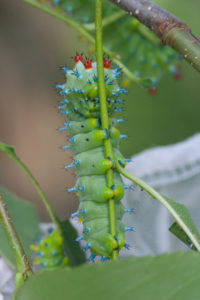
Cecropia moth larva, good food for birds. Dan Jaffe photo
Dan Jaffe emphasized to me that planting native species is important: they are trees and shrubs that evolved with our butterflies and moths, so that is what they are programmed to find and eat. Native trees and shrubs provide the leaves needed to feed caterpillars and to make their chrysalises. Pollinators need not just pollen, but food and habitat throughout their life cycles.
According to the article by Jaffe and Brown, willows are “the unsung heroes of the lepidopteran world.” The native black willow (Salix nigra) supports over 400 different species of butterflies and moths. I planted one 25 years ago near my brook and it is now a full-sized tree, perhaps 35 feet tall and 25 feet wide. Early on I kept it pruned as a shrub, but I skipped pruning for a couple of years – and it became a tree!
I also grow three kinds of pussy willows, including our native one, Salix discolor, which grows wild along my stream. I also grow rosemary willow, a curly willow, and a variegated-leafed, non-native willow (Salix integra ‘Hakuru nashiki’). All of those have stayed under 20 feet tall and thrive in the sunny moist area near my stream.
All my willows are fast growing and some will spread by root, although the rosemary willow (Salix elaegnos) has not spread. The rosemary willow has leaves that look almost identical to rosemary leaves. I have to admit that, until now, I had never thought of willows as food for caterpillars or adult butterflies.
Also mentioned in that article are the cherries. They support some 400 species of butterflies and moths. I have a huge black cherry (Prunus serotina) growing next to my house and overhanging my deck. It was there as a large tree when I bought my house 49 years ago, and is huge now – 60 feet tall or more, and the trunk is 4 to 6 feet in diameter at its base. I see lots of caterpillars on it each summer, and butterflies around it. Still, it is a messy tree dropping berries, leaves and twigs. I wish it were elsewhere on the property, but I won’t cut it down.
Choke cherry (Prunus virginiana) is common in disturbed areas as a shrubby volunteer growing in full sun and poor soil. It is often a multi-stemmed shrub that blooms in May or June with small white flowers followed by red berries in July and August. Again, it supports pollinators with nectar, pollen, and leaves to munch on – and birds like the berries, too.
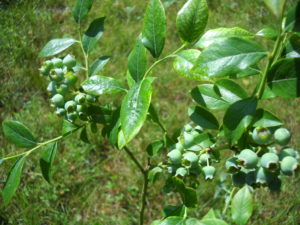
Blueberries support nearly 300 kinds of pollinators
One last plant to consider for pollinators and birds is the ordinary blueberry. It has lovely flowers in June, berries we all like later, and colorful leaves in fall. So what if the birds get most of the berries? Consider it your part of supporting a diverse and healthy ecosystem – including some 294 species of butterflies and moths.
To learn more about native plants, visit the Garden in the Woods in Framingham, MA next spring, where you can buy native plants. Visit their web site now, http://www.newenglandwild.org, for more information.
Henry can be reached by e-mail at henry.homeyer@comcast.net. He is a lifetime Master Gardener and the author of 4 gardening books. He lives and gardens in Cornish Flat, NH.
7 Resolutions We Can Keep
Posted on Tuesday, February 26, 2019 · Leave a Comment
The holidays have come and gone. Resolutions have been made and broken. Now we New England gardeners are faced with that long, dismal wait before we can start our gardens, and it’s a good time to think about those resolutions we never made: the garden resolutions. If you make – and follow – some of the resolutions below, you’ll not only feel virtuous, you’ll be a better gardener.
Resolution #1. Take the pledge to be an organic gardener. That means using NO CHEMICALS in the garden, no matter how dire the circumstances. Japanese beetles devouring your roses? Get up earlier and handpick them every morning. Weeds in the walkway? No herbicides. Pour boiling water with salt on them, or yank ‘em. Burn them with a blow torch. And forget 10-10-10: no chemical fertilizers, either. There are lots of easy solutions – if you know what to do.
Resolution #2. Read more about organic gardening in this down time before we plant spring seeds. Go to your local library or family-owned bookstore and see what’s available.
Are you a vegetable gardener? Get a copy of Ed Smith’s The Vegetable Gardener’s Bible (Storey Publishing). Ed and his wife, Sylvia live in Vermont and largely live on what they grow. It is well illustrated, and full of fabulous information. They are all, organic, too. This book has stayed in print for 19 years and sold over a million copies.
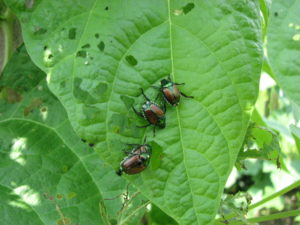
Japanese Beetle
Another good book to obtain is “Insect, Disease & Weed I.D. Guide” by Cebenko and Martin, Editors (Rodale Press). It came out in 2001, but is still readily available. Organic gardeners have to be a little bit smarter and better educated than chemical gardeners, and this book will not only help you identify pests and diseases, it will offer organic solutions. It’s easy enough to spray a pesticide on a bug, and it will die. But knowing what the bug is, a little about its life cycle, and how to combat it without resorting to chemicals is better.
Resolution #3. Use more compost. Instead of looking for a bagged fertilizer to improve your soil, think long-term. Although bagged organic fertilizers have their place in the scheme of garden things, nothing is better for your soil than compost. Compost is not high in nitrogen, but it introduces beneficial microorganisms to your soil. A teaspoon of compost can contain up to 5 billion bacteria, 20 million filamentous fungi, and a million protozoa. No bagged fertilizer can do that.
Compost also improves the tilth of your soil. Most of us have soil that is either too sandy or too full of
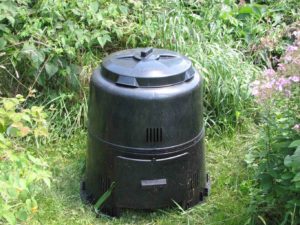
You can make your own compost in a bin like this, or just in a pile.
clay. Who do you know that has the “rich, well-drained soil” that every plant book prescribes as the appropriate soil for your favorite plant? We have to make our own soil. We have to nurture it, and improve it until we reach the age of 99, when either it is perfect, or we no longer recognize perfection. Compost helps your soil get there.
Resolution #4. Resolve to mulch more. Mulch will help to smother weeds, add organic matter to the soil as it breaks down, and reduce water loss from evaporation or run-off. Leaves are great anywhere, bark mulch is good in flower beds, and straw, grass clippings and compost are good in the vegetable garden.
Resolution #5. Decide now that you will not let any weeds flower and produce seeds. That means that you have to yank the weed or cut off any seed heads of weeds when you see them – even if you all dressed up and are leaving for the airport. You have to grab the seed heads off that big weed on your way to the car. Stuff it in your pocket, or put it in the trash. But don’t let the weeds spread their seeds.
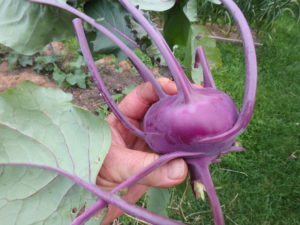
Try growing kohlrabi this summer. They’re tasty!
Resolution #6. Experiment. Every year plant something new, whether a new flavor of tomato or type of zinnia. Try veggies you’ve never grown, and learn to love eating them. Kohlrabi and rutabagas are actually delicious. Try a new type of watering device, or get a new weeding tool (such as the CobraHead, my favorite). Plant a new species of tree, one that flowers.
Resolution #7. And last but not least, resolve to keep gardening fun. Don’t bite off more than you can take care of. Try not to get discouraged if beetles eat your lilies or the phlox gets moldy. Gardening is supposed to be fun – that’s why so many of us do it. Accept that organic gardeners suffer some losses and that no gardener can have success with everything. In the meantime, enjoy the winter, and learn more about organic gardening now – so you’ll be ready come spring.
Henry lives and gardens in Cornish Flat, NH. E-mail him at henry.homeyer@comcast.net.
Around the World in 80 Trees
Posted on Tuesday, February 19, 2019 · Leave a Comment
I love trees, and find them endlessly fascinating. Each is unique, much as we are. One winter I attempted (and failed) to read all of Michael Dirr’s authoritative Dirr’s Encyclopedia of Trees and Shrubs – all 950 pages of it. I only read about trees that are hardy here, and still only found time to read about half of it.
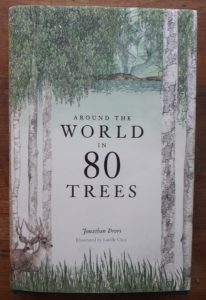
Around the World in 80 Trees
Recently I found a more manageable project, reading Jonathan Drori’s Around the World in 80 Trees. At just over 200 pages, and nearly half of that illustrations, it gave me the satisfaction of a project easily completed. And it provided countless bits of information that I didn’t know.
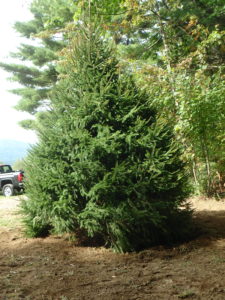
For example, I never knew that the great violin builders Stradivarius and Guarneri used Norway spruce for their sounding boards. Apparently Norway spruce, particularly old ones that grew on the mountains of Switzerland, are very dense but lightweight – and perfect for violins.
And alders were important for the development of Venice, Italy. Apparently it is highly resistant to rot if submerged in water. Their engineers drove stakes of alder (9 per square meter) and filled in around them and over them with rocks and broken bricks. Then they built bridges and buildings on them – many of which still are solidly in place, up to 700 years later.
Also the Venetians used alders to make the best charcoal for gunpowder, allowing them to advance militarily. Even today the best gunpowders use charcoal from alders. And I thought alders were junk.
Norway Spruce Scaled
I recently bought some shampoo which touted that it contained “argan oil”. Huh? I’d never heard of argan, and it sounds to me like something from a factory along I-95 in New Jersey. Nope. It is a tree that grows in North Africa.
Argan produces a fruit the size of a plum with a nut inside with 1 or 2 hard, oil-rich seeds. Traditionally women in Algeria and Morocco harvest the seeds and grind them to a pulp and extract the oil. Amazingly, 3 million people depend on the oil for their income. It is used as cooking oil and in cosmetics. And goats love the fruit, often climbing the trees to get at it – despite the numerous thorns on the branches.
Then I read about the tree that produces quinine, Cinchona spp. Originally from Ecuador and Peru, it produces alkaloids that kill malaria parasites in humans, despite the fact that those two countries had no indigenous malaria. But quinine allowed explorers of tropical malarial zones to survive the ravages of this terrible fever.
And of course, quinine is key to the development of the gin and tonic, invented by the British in India. My grandfather got malaria living near the swamps of East Boston in the early 1900’s and probably resorted to quinine when it recurred – which may have given him an excuse for a gin and tonic from time to time.
I was fascinated to learn that the quaking aspen trees (Populus tremuloides) spread largely by root, and that huge forests of this aspen are all connected by roots, and are essentially one tree. The largest living thing in the world, by this definition, is a single quaking aspen that has 45,000 stems and covers 100 acres of ground. The tree, though not any individual stem, is thought to be 80,000 years old. It is the most widely distributed tree in North America – so you probably have one.
As a teen I read a book by Betty Smith called, A Tree Grows in Brooklyn about a family there. She used the tree as a metaphor for the immigrants struggling to grow in poor conditions, as the tree does. The tree in the title is the invasive Tree of Heaven (Ailanthus altissima).
Originally from China, Tree of Heaven was introduced to New York State in 1820. It grows fast, grows most anywhere, and is nearly impossible to get rid of. Cut one down, and the roots send up new shoots all over – even through a crack in the sidewalk. It is hardy to Zone 4 (minus 30 degrees in winter) but I have never seen one here in New Hampshire.
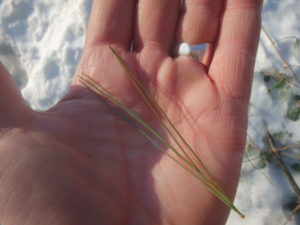
We all know the Eastern White Pine, but I did not know that it sucks up nitrogen from the soil and saves it for use later. And that in so doing, the pine helps to discourage other trees from competing with it.
Sugar Maple
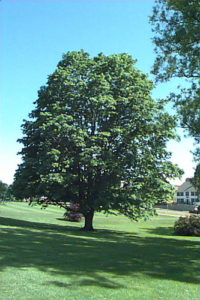
I also learned that our sugar maples, when grown in Europe, do not have the bright red leaves we love in autumn. Their fall climate is gray and cool, and maples need bright sun and cold nights to get those red colors. Maybe that is why some years our maples are less impressive – if we’ve had a rainy fall.
I visited a friend in Florida this winter, and went to a mangrove swamp. I learned from this book that the red mangrove (Rhizophora mangle) gives birth to live young while they are still attached to the mother tree. The seeds germinate and grow, eventually dropping off as seedlings. Amazing.
So if you’d like an entertaining read, get a copy of Around the World in 80 Trees. There is plenty more to learn.
Henry is the author of 4 gardening books. His e-mail is henry.homeyer@comcast.net.
Cleaning Up Your Landscape
Posted on Tuesday, February 5, 2019 · Leave a Comment
Winter is a good time to look at the trees and shrubs on your property. Even though the snow may keep you from working on your trees, study your landscape now to see if you need to do some judicious tree removal or pruning before summer.
White pine needles come in clusters of 5 one for each letter in “white”
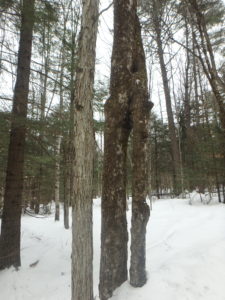
In nature trees grow willy-nilly. Where a seed lands is largely determined by chance. It is unable to know if it is 6 inches or 6 feet from another tree. If it germinates and grows it might be in a good place, or it might be smack-dab next to another tree – or your house.
If you have a wooded area on your property, it probably needs some help from you if you haven’t done any thinning or grooming of trees in recent years. Here’s what you can do – your garden project for the week: go outside and really look at the trees growing on your property with a critical eye. Take note of spacing, in particular.
Three trees growing where only one can survive and thrive
Ask yourself these questions as you walk around your property (or look out the window) at your trees: what is the future of this tree? How big do examples of this tree grow to be? What will this one look like in 10 years? In 50? Is it too close to its neighboring trees or to the house? Are there trees crowding it that you need to remove?
I’m a tree-hugger but I have no problem with cutting down trees when judicious thinning is beneficial. Now is the time to plan on some careful thinning of trees, and marking those that need to be removed to improve the health of others. A roll of bright colored surveyors tape to tie around trees will help you find any that you plan to remove.
Before you start tagging trees for culling you need to learn to identify the trees on your property, another good winter project. “A Guide to Nature in Winter” by Donald Stokes is a wonderful book that will help you with that. Because there are no leaves on most trees out there now, the Stokes book is great – it identifies trees by their bark, shape, branching and buds.
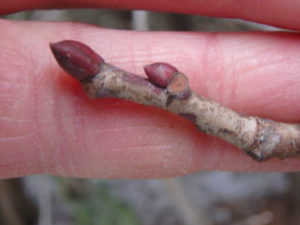
Buds like these basswood buds help identify trees in winter
Stokes notes that if you learn a few common trees, you will be able to identify 80% of all trees in the New England landscape. Those trees are oak, maple, ash, beech, birch and poplar, along with hemlock and white pine. It also teaches much about all the other living things out there in the woods – from snow fleas to deer and everything in between.
Trees that I cull from my woods include poplars (Populus spp.), boxelder (Acer negundo) and alders (Alnus spp.). These are fast-growing trees that are short-lived and that produce lots of seedlings. They lack majesty.
Trees that I revere are sugar maples, oaks, beech, birches and hophornbeam (Carpinus caroliniana). I would think long and hard about cutting down one of them. But trees need plenty of space to do well, so sometimes it is necessary to remove a young one.
Invasive shrubs I remove include bush honeysuckle, barberry and burning bush. Those are on the list of invasive in most New England states. All of those can choke out native shrubs and even many native wildflowers. I work on eliminating those two every spring, but they are still ahead of me. Learn to identify them and tag them for spring removal.
So put on your snowshoes and get outside. And if you can get a copy of the Stokes Guide to Nature in Winter, you’ll learn much and have a grand time.
Henry lives and gardens in Cornish Flat, NH. His e-mail is henry.homeyer@comcast.net.

 Click Here to buy from Cobrahead