-

Now available for $24.95 including shipping. -
Now available for $21.00 including postage. Vendors I Like
 Click Here to buy from Cobrahead
July Flowers Worth Growing
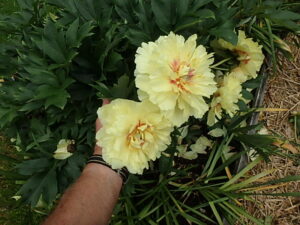
Itoh peonies are great in a vase
The most dramatic of my July bloomers are my Itoh peonies. These are hybrids of herbaceous and tree peonies that were developed in the mid-twentieth century by a Japanese plant breeder named Toichi Itoh. Unlike their parents, the blossoms of the most commonly sold ones are yellow, not pink, red or white. In fact, I’ve never seen anything but yellow ones for sale.
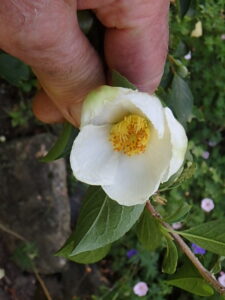
Stewartia blossom
Another favorite July bloomer is a small tree called Stewartia. I only got mine four years ago as it is a Zone 5 plant, and I was previously in a cold Zone 4 location – and unwilling to take a chance on it. I’m still here in Cornish Flat, NH but our winters “ain’t what they usta be”, so I got one four years ago. It has a plethora of 1-inch creamy-white flowers with yellow centers that are lightly fragrant, and exfoliating bark with patches of gray, orange, white and brown that is pleasing all year. I plan to prune mine to keep it around 12 feet tall, though it could go to 20 feet tall or more if I let it.
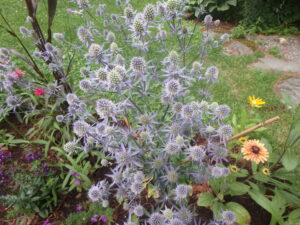
Sea holly or Eryngium
This year my two wisteria vines started blooming on June 19, though they usually do not bloom until July 4th. For decades gardeners in northern climates lamented they could grow wisteria, but couldn’t get any blossoms. That is because those vines bloom on buds set the previous summer. But ‘Blue Moon’ and ‘Amethyst Falls’ bloom on new shoots that grow in the spring. Wisteria need trellises or supports, and are vigorous growers. In southern climates, some wisteria can be invasive, spreading out everywhere, but I have never had a problem with mine. They produce hundreds of blue flowers, though to me, the blossoms smell vaguely of cat pee. Blue Moon re-blooms again for me later in the summer, though not profusely.
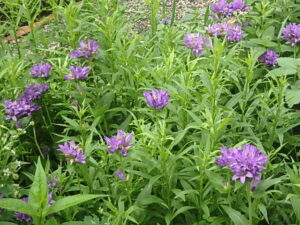
Campanula glomerata spreads by root but is not a thug
For exuberant perennials that spread, bloom well in July in sun or part sun, and serve as great cut flowers, it is hard to beat the clustered bellflower (Campanula glomerata). Yes, some people consider it a thug as it can spread by root or by seed, but I find it easy to remove if it oversteps its welcome. The clusters of small blue-violet blossoms form 2-inch balls on 24-inch stems and are a delight to grow.
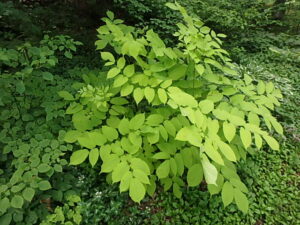
Sun king aralia
A great shade perennial I grow for its foliage is called ‘Sun King’ Aralia. This plant has bright yellow-green leaves that just pop in a full or part shade garden. Mine gets bigger every year. Now, five-years old, it stands almost 5-feet tall and more than 5-feet across. It’s in rich, fairly dry soil and gets some morning sun.
Picking Flowers in Winter
I’m planning to go pick some flowers today. Yes, we got a foot of snow recently and the temperature as write this is well below zero with the wind chill. And no, I am not crazy. I’m going to go pick them out at my local florist, food coop and grocery stores. I will cruise the flowers, picking out things that will brighten the house – and my spirits. Buying flowers does not have to cost a fortune.
Cut flowers are among modern America’s true bargains. For the price of a bottle of wine – or a couple of cups of fancy coffee – you can buy a bouquet of flowers that will grace your table for up to three weeks. But there are some things you should know about getting good table-life for your investment.
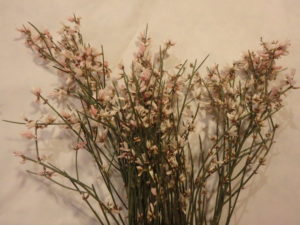
Two stems of Ginestra
There are advantages to buying flowers from a florist. Cut flowers need to take up water to stay fresh and healthy. Stems tend to scab over after a day or two, which means they cannot take up replacement water, or not much, so they suffer. A floral shop has trained personnel who trim each stem in the store every other day. And someone who regularly changes the water to keep to keep it fresh. Chain grocery stores probably count on you buying their flowers before the flowers need to be trimmed or their water changed, but that depends on the store.
And keep your arrangement cool if you can. Putting it near a radiator or wood stove will shorten its life. If you have invested in roses or tulips, you may wish to move the vase to the entryway or mudroom at bedtime to keep the flowers extra cool during the night.
Some flowers are better picks than others if you’re on a budget and can’t afford to buy new flowers every week. Here are my recommendations for pleasing, long-lasting cut flowers:
- Miniature carnations: Each stem has 2-4 blossoms. They come in a variety of colors. Mix dark red “minis” with red roses to make a bouquet of roses look fuller. And even after the roses go to Valhalla, the carnations will still be good!
- Chrysanthemums: These come in a variety of sizes and colors, from the huge spider mums to little guys. I love the scent of the flowers –it’s not overpowering, but it’s there if you sniff them.
-
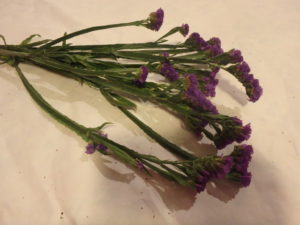
Statice
Statice: I grow these for use as dry flowers, which tells you that they really do last forever – even out of water. They come in blue, purple, pink and white.
- Ginestra: Less commonly known, this fragrant flower has tiny blossoms in white, yellow or light pink that are a little like forsythia blossoms. Good as filler.
- Spray roses: Instead of a single blossom per stem, these have 2-5 blossoms, giving you more bang for your buck. Will last about a week with proper care
- Alstromeria: Each long stem has clusters of 2-inch lily-like blossoms in pinks and reds, with yellow throats. Very long-lived. Great value.
- Orchids: While not cheap, orchids can last up to a month. I love dendrobiums, though they are not common, even in floral shops. Cymbidiums have bigger blossoms but also last extremely well. And you can buy a Phalaenopsis orchid in a pot that will keep blooming for a couple of months if you pick one with lots of buds.
- Kangaroo paws: These Australian natives are fuzzy and cute. They come in pinks, reds and browns, and last very well. Not every florist will have them.
-
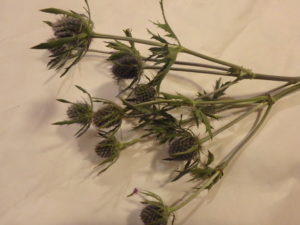
Sea Holly
Sea holly or Eryngium: Light purple or green, these look a bit like thistles. They can be dried or used fresh.
- Baby’s breath: A single stem can have up to a hundred tiny white pompoms. Great for contrast with other flowers.
So what else do you need to know? Get the store to wrap up your flowers in paper or cellophane. Some are quite fragile when it comes to cold temperatures, so don’t shock them if you can avoid it. And if you have lots of errands to run, buy your flowers last so they spend less time in a cold car.
What about those little packets of powder they give away with flowers? Are they worth the bother? Absolutely, especially if you lead a busy life and don’t change the water every few days. The powder kills mold or fungus that can grow in the water, and clogs up the stems. A teaspoon of bleach in a quart of water will do the same thing.
Cut off three quarters an inch of stem before placing your flowers in a clean, washed vase. And cut back the stems a little every couple of days. Also important is this: pick leaves off the lower stems. Leaves will rot in the water, clogging up the stems.
So yes, cut flowers are an extravagance, but can last well if handled properly. And you’re worth it. It’s still a long time till flowers bloom in our gardens, so treat yourself.
Henry is a Lifetime Master Gardener and a lifelong organic gardener. You may reach him at henry.homeyer@comcast.net.