Five Tips for Building a Garden Arbor
Posted on Tuesday, July 10, 2018 · Leave a Comment
When I was a beginning gardener, I just planted vegetables in one place, flowers in another, and never spent 2 minutes thinking about the overall design. I was growing veggies to eat, flowers to admire or to cut and arrange in bouquets. But reading gardening books and and visiting fine gardens made I realize that overall design is important.
One feature of an alluring garden is a dramatic entrance. For the past 20 years or more I‘ve had a series of garden arbors that invite visitors to pass through to see what lies on the other side. I’ve made bentwood arbors of saplings and, more recently, simple Japanese-style arbors of cedar or striped maple (Acer pennsylvanicum).
You can build a nice entrance to your garden, or a garden room, for virtually no cost. If you have a supply of 2-inch diameter hardwood saplings, you can build one for the cost of a few wood screws and a scrap of plywood. But it will only last a couple of years. I built one recently for a wedding using saplings, as it only needed to be perfect for a day.

This cedar arbor supports wisteria and clematis vines and is over 10 years old.
Alternatively you can buy cedar posts and build something that will last for 10 years or more. I’ve done both, and favor the investment in cedar, particularly if you are going to grow perennial woody vines over this arbor/trellis.
The type of cedar posts I’ve used have been made round with some sort of big machine, and have narrower cylindrical tips on each end designed to fit into vertical posts. I cut off the tips, making them about 8 feet long. Unlike rustic cedar posts used for attaching fencing, these have the bark removed, which is good. Bark promotes rot.
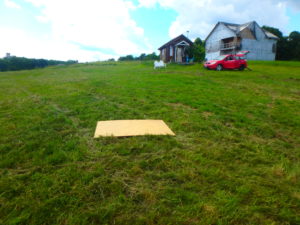
Plywood establishes the size and insures the angles are all 90 degrees
Tip #1: Decide on the size you need, and cut a piece of scrap plywood to that size. The plywood guarantees that the finished product will have the vertical posts arranged in a rectangle or square, and not a diamond or a rhombus. If you are making a permanent structure and it is surrounded by lawn, be sure it is wide enough for your lawnmower to pass through, with a little extra space for plants.
Tip #2: Get a post hole digger. This is a dandy 2-handed device that allows you to scoop out soil relatively easily. It makes a 6- or 8-inch diameter hole, which you could not do with a shovel. Dig holes a foot deep to give a nice sturdy feel to your arbor. I put a few small stones (the size of golf balls) in each hole alongside the posts and jam them in with a hand tool.

A post hole digger is a necessary tool for building an arbor
You can build an arbor with 4 or 6 upright posts. For smaller diameter posts (using saplings), I prefer using 6 posts. The more substantial cedar posts only need 4 posts, one on each corner. Something 4 to 5 feet wide and 4 feet from front to back is a nice size.
Tip # 3: You are not building a violin. It is easy to get obsessed with making every post absolutely vertical, and every horizontal precisely level. But, especially for arbors made of saplings, each piece is slightly different. Some have little curves, others have lumps and bumps. Work with a helper so one of you can adjust your posts to look good – standing straight up, with roughly level cross pieces. So long as it looks good to your eye, it is fine.
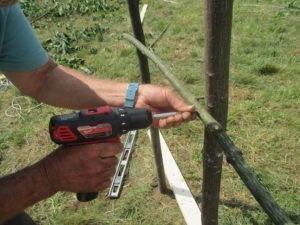
Cordless drill is used for screwing pieces together
Tip #4: Pre-drill where you want to screw 2 pieces together. Borrow a second cordless drill, so you have one with a drill bit, one with a driver bit for Phillips screws. Use screws long enough to go through one piece, and at least an inch into the other. Have a variety of lengths available.
Each side needs 3 horizontal braces that are held in place with screws or lag bolts. Install one a couple of inches below the top, to hold the rafters; one at waist height, say 36 inches off the ground; one 8 to 10 inches off the ground. I usually add a few pieces running vertically from the middle to the lower cross pieces.
If you can’t get smaller-sized cedar posts for the rafters and cross pieces, you can use 2 by 2 inch rough-sawn lumber, either cedar or hemlock. Once vines are growing on them, you will never notice that they’re not round. The alternative, using maple branches, looks great, but the wood will fall apart in a much shorter time, probably 3 years.
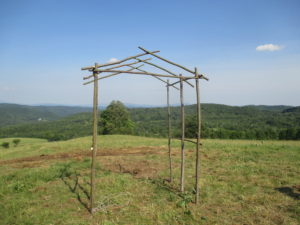
A low angle for the roof line is good
Tip # 5: To build the top, where I have 3 pairs of rafters, join 2 rafters together with an 8-inch overlap. Hold 2 pieces in place to see how long your rafters need to be. Then screw through the two pieces 8 inches from the top. With a helper on one side and you on the other, hold the rafters in place. I like a “tail” that hangs over the top cross piece- anywhere from 8 to 16 inches. Then screw down through the rafter on one side, measure the tail to be the same on the other, and screw it down. I like a nice low “roof angle” for a Japanese look.
This all may sound difficult, but it really isn’t, and it will please you for years to come. If you build one, please send me a photo. Depending on your skills, you can build an arbor like this in a day – or perhaps a weekend.
Two workers certainly make sense, though I have built one by myself. I love building things, and this type of arbor is elegant and pleasing to the eye.
You may reach Henry at henry.homeyer@comcast.net or P.O. Box 364, Cornish Flat, NH 03746. He is the author of 4 gardening books and is happy to coach new and experienced gardeners.
Three Trees You May Have, But Probably Shouldn’t
Posted on Tuesday, July 3, 2018 · Leave a Comment
Tree-huggers to the contrary, not all trees are good. Yes, they all take carbon dioxide out of the atmosphere, reducing global warming. Yes, they provide shade, keeping us cooler during hot stretches in summer. Most trees are great.
But some are invasive, crowding out others and sucking up water and nutrients other plants need to survive. Some have no chance to live to maturity because of pests or disease – so you eventually have to have them removed. Others are weak-wooded and attract insect pests that plague us. Let’s look at three culprits.
A maroon-colored variety of Norway maple (Acer platanoides) known as ‘Crimson King’ was introduced from Belgium in 1948, largely to replace the elms that were dying from Dutch elm disease. It will grow in sun or shade, wet or dry in almost any kind of soil. It is big, fast-growing tree that can grow 2 feet per year. Sounds good.
Here’s the problem: Norway maples produce large numbers of seedlings and can out-compete our native maples and most other trees. They have wide-ranging and aggressive root systems that can suck the water and nutrients out of the soil far beyond their canopy. And they can shade out native species with their broad-reaching branches and large leaves.
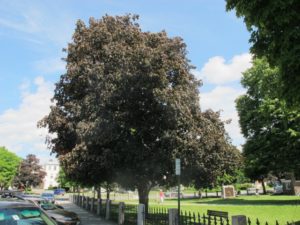
Crimson King Norway maple
Crimson King is a hybrid, and the numerous seedlings it produces are mostly green-leaved – which means that most gardeners just assume that the maple seedlings they see in their woods are native maples, even if there is a Crimson King on the property, or at a neighbor’s house. In general, Norway maple leaves are broader and larger than those of sugar maples.
There is a simple way to test a maple to see if it is a Norway: snap off a leaf and look at the base of the petiole (leaf stem). If it oozes white sap, it’s a Norway maple.
For most of the 20th century the American elm was the most prominent street tree in the United States. It was tall, tough and stately. But Dutch elm disease, which ironically is not from Holland but Asia, was first identified here in 1921. By the end of the century most elms were dead, infected or dying.
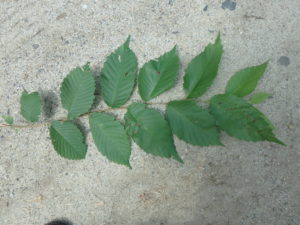
Branch of an elm with lots of leaves
Elms continue to pop up everywhere. Learn to identify their toothed leaves with prominent ribs, and their rough bark. You may as well pull them out or cut them down when they are small. They will not survive, succumbing at the age of 25 or 30 years – big enough that only the most intrepid of chainsaw-wielding gardeners will want to remove them. It’s “Call the tree guy!” for most elm removals.
There are hybrid elms and “resistant” elms that are said to survive despite the prevalence of the disease. I have seen some, and interviewed a home owner who had one – for a while. My thought? The replacements are not nearly so stately as the originals, and not worth the investment.
Boxelder (Acer negundo) is another “No!” on my list of trees. It is weak-wooded, meaning that branches break easily in storms. It produces hundreds of seedlings each year, and they pop up everywhere.
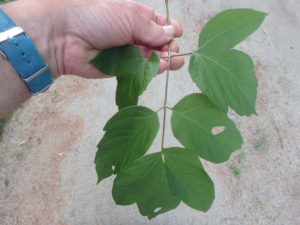
One boxelder leaf with 5 leaflets
It is in the maple family, but the leaves don’t look much like the common maples we know. The leaves are composed of 3 to 9 leaflets, mostly commonly long and light green. My favorite tree expert, Michael Dirr, writes it may “appear as an unkempt shrub, a gaunt tree, or a biological fright.” I agree. But he notes that it will grow in places where nothing else wants to grow.
The worst part of having boxelders is the Eastern Boxelder Bug (Boisea trivittata), which are attracted by boxelders. These half-inch long bugs are dark brown to black with red or orange decorations. The nymphs are all red.
In some places thousands of these pests climb all over the outside of houses, even crawling inside to spend the winter. They can emit a nasty odor if provoked, and may leave stains and smells behind. Birds leave them alone, given their nasty smells. They mainly subsist on seeds of boxelder, maple and ash, but suck juices out of the leaves, most notably maples. They don’t seem to take enough to damage the plants. The nymphs are currently all over many kinds of plant leaves, and seem to be feeding on them.
I’ve read on-line that making a solution of 1 to 2 tablespoons of dish soap in a quart spray bottle will make an effective boxelder bug killer. I’ve never had the problem, so haven’t tried it.
So how can one get rid of these less desirable trees? Learn to recognize them and uproot them when they are small. I have elm suckers that have been coming up from a stump of a tree I cut down more than 10 years ago. I need to keep it from producing green leaves as they are the source of energy that feeds the roots and starts new shoots. But it’s never at the top of the list of things to do in the garden … so the weed tree wins!
Read Henry’s blog at https://dailyuv.com/henryhomeyer. E-mail him at henry.homeyer@comcast.net. Henry is the author of 4 gardening books.
How to Have a Better Lawn
Posted on Tuesday, June 26, 2018 · Leave a Comment
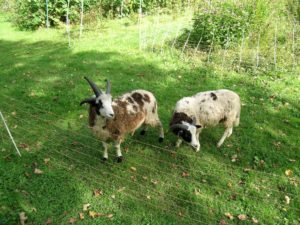
Sheep as Lawnmowers
Believe it or not, I once ate my lawnmower. No, not the Briggs and Stratton kind. I had purchased a pair of Jacobs sheep to keep my lawn trim for a season. At the end of the season they were off to the butcher, and came home freezer wrapped. It was an interesting experience, but not one I would recommend.
These rascals didn’t do an even job of cutting the lawn, and loved to butt me when I entered their pen.
To keep sheep as lawnmowers, I used a portable electric fence. It worked, but the sheep were always looking for trouble – they were teenage boy sheep, after all. They tried to (and did) reach through the fence to eat my flowers, get out of their enclosure, and trick me into thinking they were not interested in my trees and shrubs – only to attack them when I least expected it.
What is it with our fascination with lawns? Historically, lawns were maintained largely by the landed gentry. Peasants had neither the time nor the land for cultivating lawns. Maybe we all, deep down, want to be part of the nobility. But I think we like lawns because they promote tranquility and they are, with the advent of mowers, the easiest part of our landscape to maintain.
I am a minimalist when it comes to lawns. I don’t want a chemical-dependent lawn to fuss over. No fertilizers, fungicides, insecticides or moss killers for me. That said, there are things you can do to improve your lawn without too much trouble, and I think I have tried them all.
Over-seeding is one way to help your lawn. If you have places where the lawn is thin, first put down half an inch of fine compost or top soil. You will have to purchase this, I suspect, as homemade compost usually contains lumps like egg shells and undigested orange peels. Many garden centers have nice compost for sale by the tractor scoop ready for your pick-up truck, and all have bagged compost.
Fling compost over the lawn with a shovel, and spread it out with a lawn rake. Then apply lawn seed, and drag the lawn rake over the seed and compost – with the rake tines up, not down. The tines will mix the seeds and compost or soil.Where you have shady lawn, buy lawn seed for shady places.
Watering is key. Seeds need moisture to germinate, and a hot sunny day will dry out seeds quickly. Some people like to spread a thin layer of straw over the seeded area to shade the seeds and minimize drying. At this time of year it will take about a week for grass to start growing (but much longer in the spring when the soil is cold.) Water every day unless it rains. I generally plant when 3 days of rainy weather is forecast.
What about fertilizer? Most states prohibit using phosphorous-containing fertilizers on lawns (to protect streams and ponds). ) On a bag of 5-10-5 fertilizer, for example, it’s the middle number (10). There are now special fertilizers for lawns, but if you are adding compost, it will help provide adequate nutrition for your lawn.
Grass grows best when the soil is around neutral.
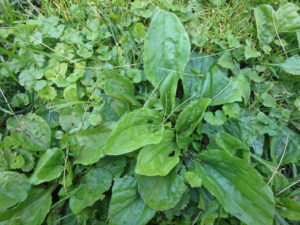
Plaintain has broad leaves and is common in lawns
For about $5 you can buy a soil pH test kit to see if yours is in the range of 6.0 to 7.0, which is ideal. The kits are easy to use: put some soil into a glass vial, add their magic powder, then add water. Shake, and the water will change color. You just decide which of the pictures on the kit best matches the color of your solution. They say to use distilled water, as it won’t affect the results. It’s available at the pharmacy.
If your soil is acidic (technically below 7.0), you may want to add some limestone to the lawn. But don’t bother unless the soil is quite acidic, say in the 4.5 to 5.9 range. Read the directions on the bag, and add the appropriate amount. I just use a can and sprinkle it over small areas.
Height of the grass is important to a lawn, too. I once got to interview Joe Mooney, the head groundskeeper at Fenway Park, home of my beloved Red Sox. He maintained the infield at a height of three quarters of an inch! Lawn that short stresses the plants, so he also had a dungeon under the stands full of chemical fertilizers and fungicides.
The longer you keep the lawn, the more food a grass plant can make, so the healthier it will be. Cutting grass at three inches is good. Yes, shorter looks neater, perhaps, but taller grass will also help shade out annual weeds and crabgrass.
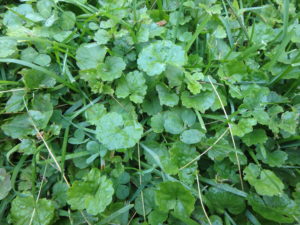
Creeping Charlie is a pest but not awful
What about those weeds? Does it really matter that you have some? People write to me all the time complaining about Creeping Charlie (Glechoma hederacea) in their lawns. Charlie is like death and taxes, you can’t avoid him without killing everything else, including your lawn grasses. So ignore Creeping Charlie. I also ignore plantain, dandelions and other weeds.
Accept weeds, and your blood pressure will go down, and your summer will be better. “If it is green and I can mow it, it’s a lawn.” That’s my motto. The only weeds I dig out are thistles, as they hurt bare feet! Chemicals? I don’t want my grandkids and pets absorbing them as they walk barefoot across the lawn.
Read Henry’s blog athttps://dailyuv.com/henryhomeyer. Signup and you will get an e-mail with a link to it each time he posts.
Thinning, Weeding and Watering Made Easy
Posted on Tuesday, June 19, 2018 · Leave a Comment
With the advent of summer, it is time to buckle down and get a few tedious jobs done in the garden. But there are ways to lighten your load.
First, it is time to thin out extra plants that are crowding each other. Carrots and beets are two common culprits of crowding, and if you want sizable root crops, you need to thin them.
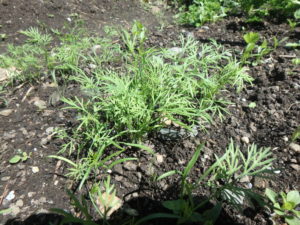
These small carrots need thinning
Carrot seeds are tiny, so we don’t often plant them one-by-one. Instead we tend to sprinkle them and –by gum- most of them grow. I maintain that thinning carrots needs to happen by the Fourth of July, so get to work. If they are real close together, you may want to use scissors to cut off the extras at the soil line to avoid pulling up carrots you are trying to save.
One way to minimize the need to thin carrots is to buy pelleted seeds next time. These are seeds that come coated with a thin layer of clay. Each is the size of a BB and can be individually planted. Plant them an inch apart and you can skip the July 4th job. As they get bigger, you can eat the carrots you thin, giving them a 2-inch spacing by mid-summer.
Beet seeds are large and easy to plant. So why are there clumps of beets that need to be thinned out? It’s not that you forgot your reading glasses when planting. The answer is that those “seeds” are not really seeds. They are clusters of seeds wrapped in a package like an apple, or a pear. Johnny’s Selected Seed Company, and a few others sell ‘Moneta’ beet seeds, which have just one embryo per seed. Those, if you space them well at planting time, need not be thinned.
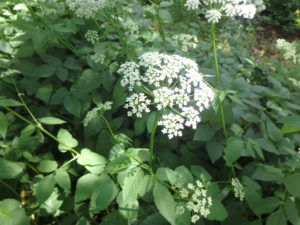
Cutting off goutweed blossoms prevents seed formation
I like to be efficient at whatever I do, and that includes keeping a relatively weed-free garden. Many weeds quickly mature, flower, and produce seeds. Your job is to keep them from producing seeds. Right now goutweed – my nemesis – is blooming in various pockets around my garden, and I don’t have time to dig it all out. But I have a 16-year old helper who uses scissors to cut off all the flowers and bag them. We send them to the dump in black plastic bags.
Other weed control methods? Keep weeds from getting the sunlight they need to grow. You can do this by mulching. In the vegetable garden I spread out newspapers over the soil and cover them with straw, hay or leaves. Four to six pages of newspaper keeps out light, inhibiting weeds. Earthworms eat the paper over the summer, and newsprint is done with soy-based inks, so you are not adding heavy metals to your soil (which was the case years ago).
This method works well on walkways and around big plants, but is more problematical for onions and carrots which are small and closer together. I use grass clippings or chopped leaves, without the newspaper, around small plants.
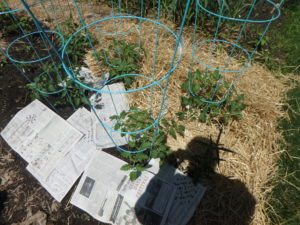
Mulching tomatoes with newspaper and straw
Mulching in the flower garden is good, too. It keeps down weeds and holds in moisture. But beware: too much mulch can keep rain from reaching the roots of your perennials. An inch or two of ground bark helps a lot, but 3 or 4 inches will keep light showers from getting to the soil.
Some gardeners use landscape fabric under bark mulch, but I do not. I find pernicious weeds eventually send roots through the fabric and this makes weeding very difficult. Landscape fabric can also constrict perennials as they expand over time, choking them.
What about plain old black plastic? I don’t use it. Sunshine breaks it down over time, and makes a mess. It also keeps air and water from getting to the soil, which must affect soil microorganisms. But it will keep weeds down in a pumpkin patch for a single season. Still, the plastic ends up in the waste stream, which I want to avoid.
If we have a dry summer, you may need to water. Established perennials should not need added water, but your vegetable garden might. I don’t favor overhead sprinklers because they water everything: plants, walkways and weeds. I prefer a watering wand, which is a device I attach to my hose. It is a 30 inch aluminum wand with a sprinkler head and a valve. I can direct the water exactly where I want it. I like a brand called Dramm because the sprinkler head allows fast, gentle watering.
Watering cans are good, too. They allow you to see just how much water you are applying. This is important for new trees, which need 5 gallons a week or so. A sprinkler hose might seem like it is delivering a lot of water, but may not be.
A good timer will deliver water while you are away on vacation. They attach to your spigot and allow you to use an overhead sprinkler or a soaker hose. I have a soaker hose I like made by Water Right and available from Gardeners Supply Company (www.gardeners.com). It’s a round polyurethane hose, and much easier to use than the old fashioned flat ones I had tried previously.
So don’t let your garden dictate your vacation schedule. With mulch and a watering system you can come back from vacation with nothing worse than a lawn that needs cutting!
You may reach Henry at henry.homeyer@comcast.net or P.O. Box 364, Cornish Flat, NH 03746. Please include a SASE if you wish a reply by mail. Read Henry’s blog at https://dailyuv.com/gardeningguy
Six Summer Beauties
Posted on Tuesday, June 12, 2018 · Leave a Comment
I love the song “Summertime” by George Gershwin. Yet I fail to comprehend why Gershwin didn’t include any flowers in the song. Yes, the cotton was high and the fish were jumping. So what? There’s no mention of peony or iris. Let’s look at some great flowers of summer he might have included.
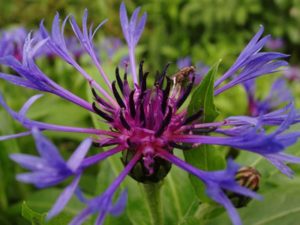
Bachelors button close up
Starting in late May, bachelor buttons (Centaura montana) adorn my landscape. Big, bold blue flowers, each a work of art. Actually, they now come in more colors than blue: white, purple, pink, bi-color and more. They love full sun but are not too fussy about their soil, though good drainage is important. Divide them in the fall every 2 or 3 years to keep them vigorous, and cut them back after blooming if you want a second show in the fall.
Bleeding heart (Dicentra spectabalis) is another early summer favorite. The stems are 2 to 4 feet long, arching over on hollow stems that originate in a central point and go in all directions. Pink heart-shaped blossoms hang down from the stems. Morning sun or part shade is best for this one, and rich soil. Hot afternoon sun will yellow the foliage early, so avoid it.
June is peony season for me. They come in pink, white, red and more. They come as singles (with just one circle of petals) or as doubles (with many petals). Yes, they flop when it rains, so I install stakes around them, and surround them with string to keep them upright. Singles can stand up to rain, most times.
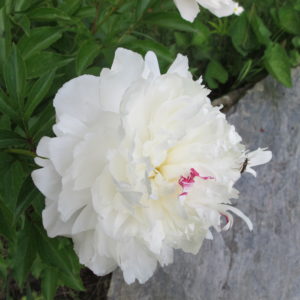
Peony Festiva maxima that my grandmother grew
Peonies last forever. I have one of my grandmother’s, and she died in 1953. If yours doesn’t bloom, you have buried the growing point, or eyes, too deep. They should be covered with just an inch of soil, not more. And keep back the mulch, which will act as soil in discouraging blooming. Peonies need lots of sun – 8 hours or more for best results. Some of mine were getting shaded, so I removed a lot of branches from a nearby tree last summer, and this summer they are much more impressive.
Iris pair up well with peonies. Many types of iris will bloom with peonies, and their purples and blues go well with them. There are several species including Siberian, bearded, and Japanese iris. Each has its own benefits and needs.
The Siberian iris (Iris sibirica) I grow are very intense purples and blues, though whites are available. They have long narrow leaves that are 2 to 3 feet long and stay handsome all summer. They will bloom in part shade, but prefer full sun. Older clumps tend to die out in the middle, largely because the plants have used up all the nourishment in the soil. To avoid this, sprinkle organic fertilize over the clump once a year, or divide and re-plant clumps in the fall.
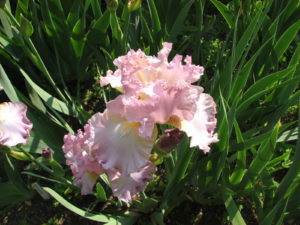
Bearded Iris
Bearded iris (Iris hybrids) can produce very showy larger blossoms in a wide variety of colors, some of them quite flashy. Their leaves are wider than those of Siberian iris, up to and inch and a half wide, and a lighter green color. When dividing or planting the rhizomes (roots), be sure not to bury the rhizomes or they will rot. Just settle the rhizomes into the soil with the top half above the soil line.
Japanese iris (Iris ensata) love moisture. They can grow in standing water, or moist soil in full sun or partial shade. These have wide flowers, up to 6 inches across. These are great cut flowers but do not last too long in a vase.
Two other summer beauties aren’t blooming yet for me, but will soon: hollyhocks and beebalm. Both are worth having.
Hollyhocks are biennials or, sometimes, short-lived perennials. They are easy to start from seed – the seeds are large enough to handle individually, and I have found their germination rates near 100%. Last year I planted 32 seeds in 4-packs, one per cell, and every one grew! I scattered the small plants around the flower garden, and this year they will reward me with 5-foot tall stalks that bloom from bottom to top.
As biennials, hollyhocks should die after blooming in the second year. I have found that if you cut the stalks down after blooming is finished, you are much more likely to get the plants to come back and bloom again the following year. On the other hand, if you let the stalks stand, they will drop seeds – some of which will grow the following year.
Beebalm is another favorite of mine. I love the minty fragrance of the blossoms and the leaves, which can be used in herbal teas. Hummingbirds love them, too. Most of mine grow 4 or 5 feet tall and spread by roots that adventure off into nearby spaces. Fortunately, the wandering plants are easily uprooted if you don’t want them.
Two years ago I discovered miniature beebalm. There is a trademarked series of beebalms, “Balmy Pink” is one. I also have purple, rose and lilacs miniatures. As trademarked plants, one cannot propagate them. For me it has not spread by root, though each clump gets bigger across each year. It grows to be 12 to 16 inches tall. A nice, tidy plant. Other companies have trademarked miniatures, including the “Petite Delight” series.
It’s true that I want to try every new variety of perennial that appears on the market, but sometimes the old favorites are best. I still love my grandmother’s ‘Festiva Maxima’ peony and feel lucky to have it.
Read my blog at https://dailyuv.com/henryhomeyer. My e-mail is henry.homeyer@comcast.net.
Three Keys to a Successful Garden
Posted on Tuesday, June 5, 2018 · Leave a Comment
Being a great gardener is pretty simple. Know what your plants need in terms of sun, soil and water. Do that, and make adjustments as necessary, and your plants will thrive. Of course, that is often easier said than done.
Sunshine is what drives plant growth. Vegetables and many flowers do best with full sun. Full sun is generally defined as 6 hours of direct sun. But not all sun is equal. The sun at noon is much stronger than sun at 6am. An hour of afternoon sun is, in my opinion, worth nearly 2 hours of morning sun.
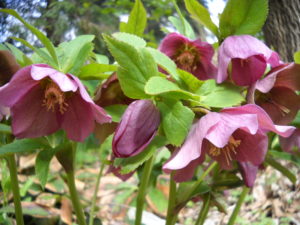
Hellebore
But many trees, shrubs and perennials want part sun or light shade. That’s where the gardener must decide. Put those hellebores on the north side of the barn? Or perhaps under the dappled sun that filters through a maple? That’s why I like to buy perennials in multiples. Try some here, some there. To do so, starting some by seed makes sense as you have more plants to play with – without breaking the bank.
Starting perennials by seed is easier than you might think, but requires patience. Unlike annual flowers, most perennials will not flower the same year they are planted. Biennials like hollyhocks and many foxglove will bloom the year after you start the seeds, then die. But some hollyhocks defy the odds and come back to bloom, year after year – for good gardeners who cut them back right after they bloom.
The right soil is key for most plants. Some want sandy soil that drains quickly and stays relatively dry in winter because wet soils will rot their roots. Others need moist soils all summer or they go limp on hot days. You can learn by trial and error, but I try to minimize errors by reading up on a plant to see what soil it needs. My go-to book for this is Steven M. Still’s book, Manual of Herbaceous Ornamental Plants. It is over 800 pages of great information.
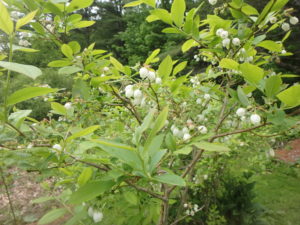
Blueberry blossoms tell me the soil is acidic
Soil pH, a measure of acidity, is important to plants. Most perennials do best in soils with a pH of 6.2 to 6.8 which is just shy of neutral (7.0). Know your pH by testing every 3 to 5 years, as pH is easy to adjust. Want blueberries? You must have very acidic soil, in the 4.5 to 5.5 range. You can spread elemental sulfur around the bushes, or add an acidic fertilizer made for holly and rhododendrons. Do that right after blooming.
I recommend getting a soil test done by a good lab every three years. Cooperative Extension in your state can do that for a fee. It will give you useful information about everything except nitrogen. Nitrogen levels vary considerably over the short term, so most labs do not measure them. But if you have good levels of organic matter, your probably do not have a major deficit. Organic fertilizers applied at planting time will boost nitrogen and add some for later in the form of slow-release nitrogen components in the mix. But don’t add too much fertilizer, especially chemical fertilizers that can burn roots and push fast, unhealthy growth.
Soil tilth and texture is important too. That’s what an experienced gardener learns by picking up a handful of soil and feeling it. Excellent soil is fluffy and does not compact easily. It has space for water and air. Moisten some soil and rub it between your fingers. If it feels sticky, it’s dominated by clay. If you feel many sharp bits, it’s sandy. A good loam is somewhere in between the two. You can improve clay or sandy soils but adding compost, lots of compost.
I make compost, but also buy it each year. I add some to every planting hole and every new bed. I mix it in with potting soil for container growing. I spread it over the lawn to improve it, and to nourish the roots of an aging maple with roots under the lawn. Earthworms will work the compost into the soil, so I don’t have to.
Moisture is key for all plants. For most, all growth stops when the soil dries out. And watering a plant that is flopping over and gasping for breath does not fix the problem immediately. Yes, most plants will look better within a day of watering, but it can be a few days or a week before they recover fully and start growing. In hot times, monitor moisture by eye or finger, especially for seedlings just planted.
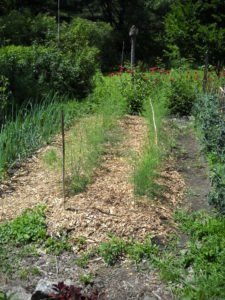
Asparagus, newly mulched
Mulch is great for holding in moisture. It protects the soil from the sun’s desiccating heat. It minimizes evaporation. It helps to prevent weeds from growing.
An inch and a half or two inches of finely ground bark mulch will do a good job of preventing most annual weed seeds from growing – but will not deter roots of pernicious weeds from sending up sprouts. Heck, I’ve heard stories of Japanese knotweed growing right through asphalt driveways, and I know witch grass and ferns will pop up through most mulches.
One of the great things about getting older is that I’ve made plenty of mistakes – and learned from them. We all kill plants. But doing your homework and paying attention is really important. Learning from our errors and omissions makes us great gardeners.
Henry’s website is www.Gardening-Guy.com. You can reach him by e-mail at henry.homeyer@comcast.net or send a letter to P.O. 364, Cornish Flat, NH 03746. Please include a SASE if you want a mailed response.
Gardening As We Get Older
Posted on Tuesday, May 29, 2018 · Leave a Comment
I reached the age of 72 recently and have been thinking about the future. What will my gardens be like when I’m 82? Will I be gardening at 92? I realize I won’t always have the strength, stamina and energy to manage all I do now. Here are some thoughts about how I shall cope – and my ideas about what to do, starting now.
First, I’ll need to make choices about what flower and vegetable beds I want to keep. Growing lawn is the easiest of all gardening activities. I can see myself riding around on a mower when I can’t bend over easily to weed. And there are plenty of people who will cut the grass for a price. No special knowledge about plants is needed.
So at some point, I can let some beds revert to lawn. There are plenty of people who would be glad to come dig up and take away peonies or delphinium. If I put an announcement in the town list serve, I will find takers. Last fall I dug up some big clumps of phlox and offered them free and I found homes easily. When I want to downsize, I will make the takers do the digging!
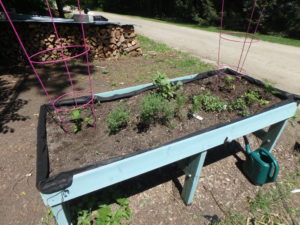
Veg Trug
Right now I grow 35 to 50 tomato plants a year. I start them indoors, plant them, tie them to tomato cages, cut off diseased leaves, and harvest them. Do I really need so many? We have plenty of good growers in the region, and a number of great food co-ops. I suppose in 10 years I could downsize to a dozen plants or less.
For two summers I’ve had a garden trug, a planting box on legs that I got from Gardeners Supply Company (www.gardeners.com). I have it near the front door, next to the woodpile, with quick access to the kitchen. I grow one or two tomato plants each summer there, along with plenty of lettuce and herbs. It’s waist high, so no bending is required. It’s made of cedar, and I can see using it in perpetuity. It is 6 feet long by 32 inches wide, and 16 inches deep in the middle – fine for tomatoes.
Shrubs are less work to maintain than perennials or annual flowers. Plant them, or have someone plant them, and they will require little – so long as they are not varieties that grow inordinately fast. There are plenty that can go several years without pruning.
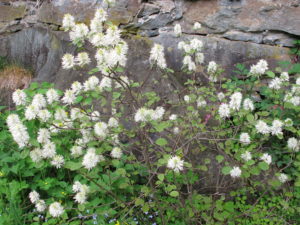
Fothergilla
One of my favorites is called fothergilla (Fothergilla major). It has nice white bottle-brush blossoms in May and spectacular fall foliage. Mine, after 15 years and very little pruning, is only 5 or 6 feet tall and wide. It’s hardy to Zone 4.I love my weeping larch tree (Larix laricina ‘Pendula’) that grows in a flower bed. Weepers flow and bend, but do not get tall. Mine will never get more than 3 feet tall. The foliage is soft to the touch. Larches do well in wet soils, and are quite salt tolerant.
There are, in fact, dozens of trees and shrubs sold as miniatures. Some of these are just very slow growing (like the lilac ‘Miss Kim, which can get large), while others really will never get tall, even in 25 years. These miniatures do well in flower beds.
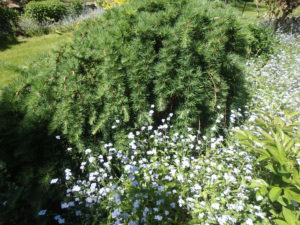
Weeping Larch
Purple foliage is great to add color to a flower bed but I wouldn’t recommend common ninebark (Physocarpus opulifolius) ‘Diablo’ – it grows too fast and gets to be 10 feet tall before you know it. Now there are a couple of miniatures on the market, ‘Tiny Wine’ and ‘Little Devil’. I shall try one or both of those.
Of course, as we get older, it makes sense to hire some help in the garden. I have been lucky to get a teenager who not only likes being outdoors, but likes gardening and knows the difference between a weed and a flower! Even 4 hours a week makes a big difference.
If you can’t afford to have someone helping all summer, perhaps you can get someone to help clean up the gardens in spring and fall. Once beds are weeded out and mulched, the work of maintaining a garden is not too onerous – even for geezers.
I recently re-read Gardening for a Lifetime: How to Garden Wiser as You Grow Older by Sydney Eddison. Sydney is a friend of mine who lives in Connecticut, and has written many fine books. She has lots of good ideas, including the necessity to accept imperfections in the garden.
Many good gardeners are perfectionists. But as we get older, we have to accept that we can’t keep the garden perfect, or at least not without lots of help. It’s important to change one’s attitude as one ages.
Sydney also recommends getting rid of high maintenance plants and letting easy plants dominate. Daylilies, for example, have nice foliage all summer, great blossoms, and are not overly ambitious (Most don’t try to take over space allocated for other plants.) So grow plenty!
As we get older, so do our trees, creating more shade. Embrace shaded areas as weeds are sun-lovers and there are plenty of fine perennials that will do well in shade.
Some day perhaps I’ll retire and have more time for gardening. In the meantime, I’ll just try to downsize a little every year.
Follow Henry’s blog posts at https://dailyuv.com/henryhomeyer. His e-mail is henry.homeyer@comcast.net.
It’s About Time to Plant the Vegetable Garden
Posted on Tuesday, May 22, 2018 · Leave a Comment
One of the highlights of my year is planting my vegetable garden. It’s a time full of hope and anticipation as I nestle seedlings into the soil and sow seeds. I started many seeds indoors, growing tomatoes, peppers and more under lights. They are the right size now to plant.
Traditionally, Memorial Day weekend is the time many New Englanders plant things that are frost-sensitive. I prefer to plant tomatoes, peppers, squashes and other cold-adverse plants in June, even up to mid-June. I find that it’s better to wait until the soil really is well-warmed, and nights are warm, than rushing to plant. A night in the mid-thirties won’t kill your tomatoes, but it does set them back a bit. I find that tomatoes planted in June easily catch up with tomatoes planted earlier.
Of course, I have already planted some plants that don’t mind cold weather: lettuce, kale, onions, Brussels sprouts, broccoli and lettuce. These went in the ground in early May and are well established by now.
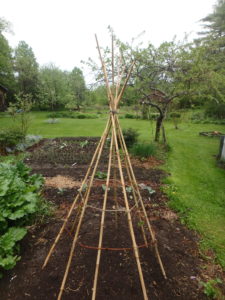
Bean Teepee
I built a nice bean teepee while waiting for summer to arrive, and will plant some Kentucky Wonder pole beans around it. I’ll wait until after any chance of frost has passed, as beans are frost-sensitive. I like pole beans because they keep on producing beans for many weeks if picked regularly. Bush beans produce beans for about 2 or 3 weeks, then are done.
To build the bean teepee I prepared a plot about 5 feet square, removing weeds and adding some compost. I had purchased 8 bamboo poles, each 7 feet tall. With one hand I held the poles together near their tops- say a foot from the top – and with the other I splayed out the bottoms of the poles one at a time. I tried to place the poles evenly, about 20 inches apart on the ground.
This project would be easier with 2 people working together, but I was alone in the garden and got the teepee made. I used a 2-foot length of thin copper wire to wrap around the place where all the poles crossed near the top of the teepee. String would also work fine.
In order to stabilize the teepee I then ran a string around each pole about 4 feet off the ground. I made sure the string was snug and then tied it to each pole using a clove hitch I learned in the Boy Scouts eons ago.
I did a second loop around the teepee with a flexible piece of grape vine, weaving in and out between poles, and then tying the vine to each pole with a short piece of string. I used grape vine because I had some, and I liked the way it looked, but you could stick with string if that is all you have.
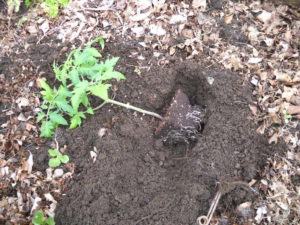
Planting tomatoes sideways
When the time comes to plant my tomatoes I will take steps to ensure their roots develop well. Often tomatoes I start get long and “leggy” by the time I’m ready to plant. If I just planted the root ball, those tall stems would flop over. But I can convert that long stem into a root-bearing portion of the plant by burying it.
This can be done either by burying the root ball about 6 inches deep in a raised bed, or by planting the stem sideways. In either case I snip off the lower 2 to 4 branches, leaving leaves just at the top of an 8 to 12 inch stem.
To plant a tomato sideways, I dig a hole for the root ball and a trench for the stem. The top I bend and turn up, so those leaves are above the soil line. I cover the stem and root ball with soil, and I’m all done. You might fear you will break the stem when bending it, but that has only happened to me once in many years.
When planting tomatoes, don’t crowd them! Fungal diseases are a real problem most years, but can be minimized if the plants get good air circulation and lots of sunshine.
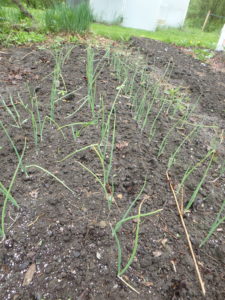
Onions are frost hardy and growing now
“Harden off” your tomatoes (and all plants) before putting them out. Ask at the garden center if the plants have been hardened off. If they’ve been in a greenhouse and never been outside in the sun, you’ve got to get them used to the sun. Greenhouse plastic reduces the sun’s ultraviolet rays and also protects plants from dehydrating in the wind.
If you buy plants that haven’t been hardened off and really, really want to get them in the ground, remember this: if you sunburn your plants, or dehydrate them, you will lose 2 weeks of growing time. You won’t kill them, but they will sulk. So don’t plant this weekend if the plants you buy aren’t hardened off.
Here’s how I harden off my tomatoes: I put them out for morning sun on my north-facing deck for 2 to 3 days, then in afternoon sun for 2 to 3 hours for a couple more days. Then they go out in the garden all day and night in their pots. Finally, I plant. I water the plants each day so they won’t dehydrate.
Gardening should be fun. It’s most fun when everything works and you harvest great vegetables. Don’t rush to get your plants in the ground, keep them well watered, and you should do just fine.
Follow Henry’s blog posts at https://dailyuv.com/henryhomeyer. His e-mail is henry.homeyer@comcast.net.
Spring Wildflowers
Posted on Wednesday, May 16, 2018 · Leave a Comment
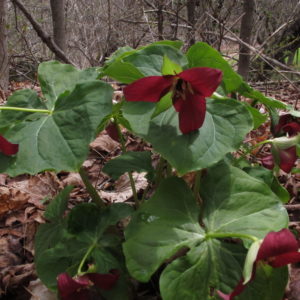
Common Red Trillium
Every spring Mother Nature gives me gifts. Or that is how it seems when she sends the blossoms of trillium, hepatica, Jack-in-the Pulpit, bloodroot, trout lily, blue cohosh, Dutchman’s breeches, squirrel corn and more to my woods and shade gardens. Of course, I have helped nature by planting wild flowers in places where I know they will be happy.
Some wild flowers I find elsewhere on my property and move to more visible locations. Others I dig from the woods of friends who are willing to share. For the rarer things, I have found garden centers and bulb companies that have sold me plants, bulbs or roots.
One of the best ways to succeed in the garden is to do your homework. Know what an individual plant needs, and what other plants grow in the same environment as the plants you wish to grow. If trillium grows in my woodlands, I can be pretty sure that Jack-in-the pulpit will do well there, too, for example, because they grow together in the wild.
In nature plants live in communities, and when designing gardens it’s important to consider that. I plan to attend a hands-on design workshop with author Claudia West in Windham, Vermont about this topic on June 9. If you are interested in attending this all-day workshop, e-mail cheath58@gmail.com. It’s a Master Gardener workshop, but open to all who are interested. Fees apply.
But what can you do if you are just starting a woodland garden, and don’t know what plants grow in areas like those you have? Visit other gardens. Walk in the woods, and observe what grows together. A maple and beech forest is quite different than one dominated by hemlocks and pines, even if a few of the others are there. Pay attention. Learn names.
I recently visited an amazing display of spring wild flowers at Garden in the Woods, in Framingham, Massachusetts. This 45 acre site is 20 miles west of Boston. The month of May is the peak bloom time, but many wildflowers continue to bloom in June, and throughout the summer. Not only that, they have an extensive nursery that sells wildflowers that I have never seen and only dreamed of growing.
My partner Cindy Heath and I walked around the property with Mark Richardson, Garden Director, and the co-author of the lovely paperback, Native Plants for New England Gardens. We were there on May 9, smack dab in the middle of Trillium Week. Garden in the Woods grows 21 of the 30 species of trillium that are native to the United States, Richardson told me. Not all were in bloom, but I saw several spectacular types.
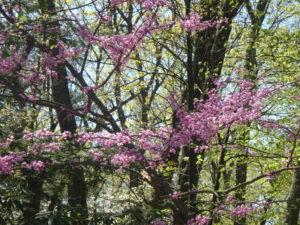
Redbud
Of the trees in bloom, two trees nearly made my heart stop with their beauty. First was the redbud (Cercis canadensis), a fine specimen of which was blooming right at the entrance. This tree, Richardson explained, exhibits cauliflory, meaning that it flowers directly on the trunk or branches of a woody plant. It has small fuschia-colored flowers that seem to pop right out of the trunk at random.
Redbud is hardy to zone 4, and is an understory tree, or one that blooms at the edges of woods. I had purchased one the week before coming to The Garden in the Woods, so seeing it there, in the woods, gave me a better idea of where to plant it in my garden.
The other tree in bloom that I saw (and bought) at Garden in the Woods is Carolina silverbells (Halesia tetraptera). Like redbud, this is a small tree for part shade and hardy to Zone 4. It has small white flowers that hang from branches before leaves appear. Mine has yet to flower or show leaves, but I am hoping to see flowers soon.
I asked Richardson to name a few of his favorite spring flowers. He explained that he liked some of the common ones, that rare flowers are not necessarily the most alluring to him. He mentioned blue cohosh (Caulophyllum giganteum), moss phlox (Phlox subulata) and pinkster bloom azalea (Rhododendron periclymenoides).
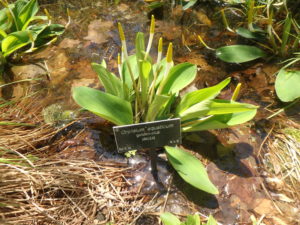
Golden club
I also asked Debbi Edelstein, Director of New England Wild Flower Society, what her favorite spring flowers are. She e-mailed her response, saying, “My favorite part of spring isn’t the reappearance of particular plants, but the explosion of different shades of green and the layers of textures and colors.” I agree. I look forward each spring to the day the sugar maple on the east side of my house first displays its leaves. When the morning sun comes through the leaves I feel so lucky to be alive.
Edelstein continued, saying “That said, who doesn’t love a redbud (Cercis canadensis) in full bloom? At the Garden this time of year, I’m also drawn to the golden club (Orontium aquaticum), which is rare in New England and is weird and elemental and probably overlooked by most people; and Trillium erectum (red trillium or red Wake-robin), because it’s a deep red and is more delicate and less glamorous than, say Trillium grandiflorum.
So go out, look for wildflowers, and plant a few.
Read Henry’s blog posts at https://dailyuv.com/gardeningguy. His e-mail is henry.homeyer@comcast.net.
What Your Roses, Peegee Hydrangeas and Lilacs Need Now
Posted on Thursday, May 10, 2018 · Leave a Comment
My roses are waking up, and starting to show leaf buds along their stems. This is a good time to cut back dead stems, which will stimulate new growth and start them off well for the summer season. It’s time to shape your roses so that they are as good-looking now as they were when you bought them.
When I was a boy, roses were fussy. My parents bought a house in the country in June, when all the roses were in bloom. Those roses, I imagine, helped clinch the deal. But within a few years they were gone. Diseases, bugs and beetles had ravaged them. We didn’t spray with toxic chemicals, and many of those roses depended on toxic sprays, I suppose.
Now breeders have created roses that rarely get black spot, and are not very attractive to rose chafers and Japanese beetles because they don’t have a strong floral scent. Sure, Japanese beetles sometimes find my bodacious pink or red blossoms, but I just pull them off the beetles and drop them in soapy water – or crush them.
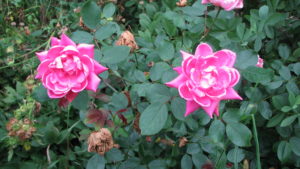
Knockout rose in summer
My favorite series of roses are the ‘Knockout’ roses. These beauties start blooming in June, and continue to produce blossoms until hard frost. It’s not unusual for my plants to be blooming at Halloween. There are others that are probably just as good, so ask at your local family-owned garden center. ‘At Last’, a Proven Winner rose, is another favorite of mine, in part because it is lightly fragrant, too.
On a recent sunny afternoon I took my pruning shears and went outdoors to give my roses a haircut. It was a harsh winter, and many stems were dead near their tips, and a few canes were dead all the way back to the ground.
I took time to really look at the stems of the roses. What I wanted to do was remove the dead material back to the highest bud that was alive and active – and outward facing. I looked for signs of life, which were buds starting to produce leaves. Dead stems are generally brown, and live stems are green or reddish.
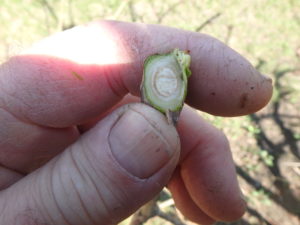
Cut back until you see green beneath the outer bark
How should you make your cut? On an angle, just a little above a bud. Look at the piece you cut off. If it is brown all the way through, you are looking at dead wood. You should cut lower down the stem until you see a layer of green just beneath the bark.
If you had a stem or two last year that grew more vigorously than the others, you may wish to cut them back past the first green bud. What I want is a well-balanced plant, not a lopsided plant, or one with a very tall leader. Some rosarians (rose-obsessed gardeners) like to cut back most stems to within 6 inches of the ground, and let the entire bush grow up each year from the ground.
Some roses bloom on old wood, not new growth. Rugosa or beach roses are like that, as well as some once-a-season old fashioned roses. Those are best pruned for shape of the bush after blooming, but dead wood can be taken out now.
This summer you will want to snip off spent blossoms. After blooming, cut back the stem to a mature leaf cluster which has 5 or 7 leaves. Cutting back to clusters of only 3 leaves won’t stimulate the rose to re-bloom.
A word on fertilizing. I am not keen on fertilizing roses, as it tends to make them grow too fast. Often fast growth is weak, with stems that flop. But if you feel you need to fertilize, do so after the first flush of blossoms, not now. Re-blooming roses like the Knockouts tend to re-bloom every 5 to 6 weeks.
I admit to being negligent when it comes to pruning back my PeeGee hydrangea, so this year I have given it a good hard prune. It’s best to do while the plant is still dormant, or just waking up. I cut last year’s stems that blossomed back to big, fat older stems. These hydrangeas bloom on new wood, and pruning now will stimulate new growth – and lots of blossoms. The PeeGee is a shrub, but can get too tall and wide unless you prune it.
When pruning, you will find some stems that are dead near their tips. Cut those back until you see a layer of green beneath the bark. That indicates that it is alive there. As with roses, always cut back to just above a bud, or to a bigger branch.
Remove any spindly, weak branches, or any that aim back into the middle of the plant. If you have branches that have the potential to poke someone in the eye, cut them back!
Do not hesitate to prune your hydrangeas hard. Decide what size plant works best in the space you have, and prune until you have reached the right size. You won’t kill your plant by pruning. Opening up the middle of a shrub allows more sunlight to reach the leaves, which helps prevent fungal diseases.
Lilacs will be blooming soon, so you may want to wait until after they bloom to prune them. Pruning now just means that you will have fewer blossoms this spring. But if you want to help your lilacs to have better blossoms next year, spread some limestone or wood ashes in a circle around them. Lilacs like neutral or slightly alkaline soil, and limestone helps to achieve that.
Pruning, to me, is like sculpting. Done well, it creates plants that are gorgeous – even when they are not in bloom.
Henry can be reached at henry.homeyer@comcast.net. Read his blog posts at https://dailyuv.com/gardeningguy.

 Click Here to buy from Cobrahead