-

Now available for $24.95 including shipping. -
Now available for $21.00 including postage. Vendors I Like
 Click Here to buy from Cobrahead
Looking Back on 2025, and Forward to 2026
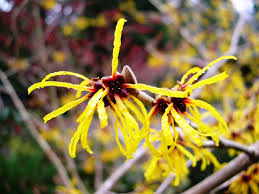 Each year I plant a few more trees and shrubs, even though my list includes over 100 different kinds that I have planted since I bought my house in 1970. Last spring I planted a spring-blooming witch hazel, one called ‘Arnold’s Promise’. I’ve had the native witch hazel for decades – they bloom late in the fall with lovely yellow blossoms. This new one is a Zone 5 tree, only hardy to minus 20 F. I’ve been in a Zone 4 area for decades, but have been trying Zone 5 trees for the last few years, and they have all survived our winters. Hopefully, “Arnold” will, too.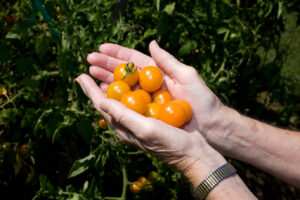
Sungold cherry tomatoes
Looking ahead, I will soon be studying the catalogs and websites of my favorite seed companies. It’s good to order seeds now, as some popular seeds will sell out – especially small packets of tomato seeds of things like ‘Sun Gold’, my favorite cherry tomato.
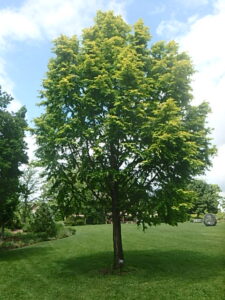
Young dawn redwood at New England Botanic Garden in Boylston, MA
Although we have large populations of native plants that support pollinators and birds, in 2026 I hope to locate and plant a wider diversity of plants. I am on the list to get the Massachusetts Master Gardener on-line newsletter called The Dirt. In the January issue it lists native plants that are important to support our pollinators that are “at risk” and declining in numbers.
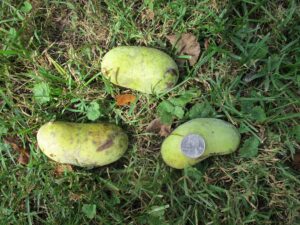
Pawpaw fruit has a tropical flavor but a texture that is mushy.
Last year my friend Mark planted five little pawpaw trees that he got from another friend. Pawpaws send up lots of root sprouts, but they will not produce fruit if they are genetic clones (all from a single mother tree, as his probably are). I have some from another source, so he’ll trade me one of his for one of mine. Most small trees move easily. Pawpaws are a native tree common in Appalachia, but hardy here. Their fruit tastes tropical!
Native Plants for New England Gardens
It’s rare that I find a book that is as useful, accurate and easy-to-read as Native Plants for New England Gardens by Mark Richardson and Dan Jaffe, both on staff at the New England Wild Flower Society in Framingham, Massachusetts. This book presents over 100 species of wildflowers, trees and shrubs, grasses, ferns, vines and lianas (woody vines). And even though I grow the vast majority of plants in this book, I learned so much that I felt like a third grade boy on an outing with a PhD.
First, the authors define native plants: those that were growing in North America when the first colonists arrived. They stress, right off the bat, that it is important to put the right plant in the right place. Instead of shopping for pretty flowers, they recommend knowing about plants and seeking them out. The glossy photos of the book will help you put together a plant list; their instructions will help you decide if you have a place for a particular plant.
I have always enjoyed eating wild harvested plants. The book covers ramps, which I grow, but also other wild edibles I grow – including two that I didn’t know are edible.
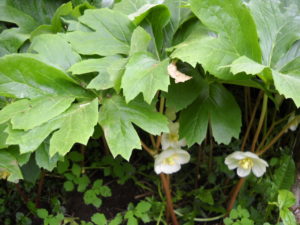
May apple
I have a large patch of Mayapple (Podophyllum peltatum). As the authors point out, it spreads robustly and shades out other plants. The blossoms appear beneath the big, wide leaves and are not easily seen; they suggest planting it on a steep incline, so that one can see them – and the fruit, bright red “apples” when standing below the planting. I have seen the fruit, but never knew it was edible until reading about it. Apparently the fruit is also eaten by box turtles. Who knew? Note: “Since writing this, I read elsewhere that that the seeds and rind may be toxic, so better to avoid eating May apples.”
Another edible fruit described in the book is produced by American spikenard (Aralia racemosa). The authors note that spikenard gets big enough to serve as a handsome shrub, but since it dies back to the ground each fall, it won’t be damaged by snow falling off your roof if you plant it near the house. I grow it in part shade and it gets to be 6 feet tall and wide, and produces masses of berries each fall. The berries start off white, change to red, and end up a deep purple. I shall taste them this fall.
I grow all 3 of the milkweeds described in the book: common, swamp or rose, and butterfly milkweed. The authors explain the pluses and minuses of each, where to plant them. “If you are looking for a well-behaved garden plant, then common milkweed is not the best choice.” It spreads by root, they explain and is suited for “meadows, hell strips or as competition against invasive species.”
Yes, I knew that milkweeds are essential for monarch butterflies, but they point out that they also support tussock moths, swallowtails, and a variety of beneficial beetles. “The plant (swamp milkweed) seemingly supports whole ecosystems on its own, often playing host to bees, ants, and various spiders waiting to eat an unsuspecting pollinator.”
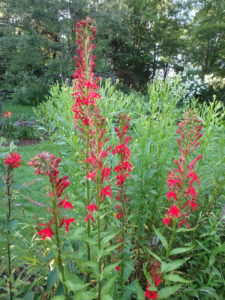
Cardinal flower
I love cardinal flower (Lobelia cardinalis) and have grown both the native species and modern hybrids varieties in a moist, full-sun garden. I no longer grow the hybrids, as they are less hardy than the native species and have all died out. The authors refer to work done at the University of Vermont that showed that at least one of the hybrids produced only 20% of the nectar energy produced by the wild species. So hummingbirds, who love these bright red flowers, get something akin to diet nectar if you grow the hybrid variety. It’s best to avoid planting them, so read the plant tags carefully before buying.
I love the bright red leaves of staghorn sumac (Rhus typhina) growing by the side of the road, but would never consider planting it on my property. Although a native plant with fruit beloved by returning migratory birds in early spring, it can spread very aggressively and is hard to remove. But the authors introduced me to another variety, fragrant sumac (Rhus aromatica), that is smaller, “much slower growing, and fairly easy to control even in a formal garden setting.” I shall look for it, and try to learn from others who have grown it (Please e-mail me if you have grown it).
I grew up in Connecticut where spicebush (Lindera benzoin) was a wild shrub with tasty leaves and twigs that I chewed as a breath freshener. But it is hardy to Zone 4, and I got one two years ago. According to the book, it is an understory shrub that does well in moist soil. I knew it as a plant for dry shade, and hence planted it here in a dry location, and it has done fine.
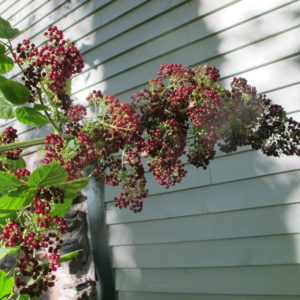
Aralia berries
What I did not know, until reading Native Plants for New England Gardens, is that spicebush is dioecious – there are male and female plants. That would explain why I have not gotten any of the bright red berries used by the authors in a tea that is “magical for fighting off the common cold and is packed with vitamin C.” I shall get another, and hope for pollination.
One last tip from the book: if you want to grow wintergreen, a low-growing ground cover with tasty red berries, plant it under your blueberries. The sulfur you give your blueberries will make the soil right for wintergreen.
I loved this book. I predict you will, too. And come spring, I’ll go to the Garden in the Woods in Framingham, MA (where the authors work) and buy some wildflowers in the nursery there.
You may e-mail Henry at henry.homeyer@comcast.net or write him at P.O. Box 364, Cornish Flat, NH 03746. Please include a SASE if you want a response by USPS mail.