Early Spring Chores
Posted on Thursday, May 3, 2018 · Leave a Comment
The snow is gone, and I am ready for gardening. And although I have been able to do a few things in the garden, the soil is wet and easily compacted, so I can’t do much until it dries out.
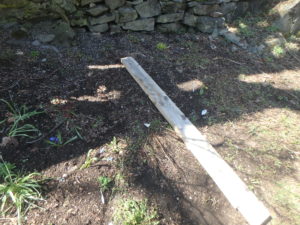
A plank can be used to distribute your weight on wet soil to minimize soil compaction
Many of my flower beds are six feet or more deep (from front to back). This means I can’t stand on the lawn and reach to the back to remove leaves or sticks. I don’t want to walk into the beds and risk compacting the soil. Plants get their oxygen through their roots, and compacted soil has little space for air. The solution? I place a plank on the soil and walk on that. It spreads out my weight.
I generally advise gardeners to wait until the lawn gets green before raking out the sand and dirt that was dumped by the snowplows. I say this because dormant grass is easily pulled up by vigorous raking. But this year I had a lot of sand, and I feared the mess would choke out large sections of lawn near the road. So I used a plastic rake, and raked gently, and I was able to clean up with very little damage to the lawn.
Other chores? If you have decorative grasses in your perennial border, it is important to cut back last year’s stems now, before new growth occurs. I don’t cut back decorative grasses in the fall: I like to see them standing up in the snow, waving in the winter wind.
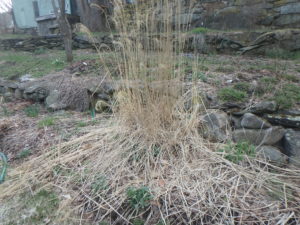
Cut back decorative grasses now before growth starts
I have a big clump of tall maiden grass, Miscanthus sinensis, a variety called ‘Morning Light’. Last year it had started growing before I got around to cutting it back, and there was no way to remove the bottom 8 inches of dead grass, which was unsightly. This year I cut it back low to the ground early and won’t have that problem. Hand pruners work best for cutting back the stems.
The moles and voles always make a mess of the lawn, digging up soil and leaving lumps and squiggles of soil they displaced in winter. I’ve been cleaning that up now, too. I have an aluminum grain scoop/shovel that is 14 inches across and very lightweight. I use a short-tined rock rake to dislodge the lumps and get them onto my shovel. I consider this soil a gift from the rodents. It is good soil that I use to fill holes and top-up raised beds that need some added topsoil.
Although I know people have already started their peas and spinach, my soil is awfully cold for them. Yes, you can plant the seeds when the soil is 50 degrees F, but waiting until it is 60 degrees makes sense to me. Seeds germinate much more quickly in warmer soil, so there is less chance of the seeds rotting.
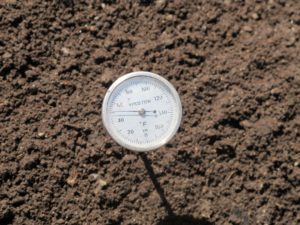
Soil thermometer
A soil thermometer is not an expensive item and will last a lifetime. I have a few, and they all have dials like old-fashioned oven thermometers. The sensor is right on the tip. Keep that in mind when checking soil temperatures. If you push the tip down 6 inches, the soil will be cold at this time of year – but you are not planting seeds that deep. Instead measure the soil temperature an inch down, which means holding the thermometer upright for a couple of minutes while it adjusts. Otherwise it will fall over – hence the impulse to push it down deep.
Near the end of April I moved my cold frame out of the barn and into the garden. This is a cedar box with polycarbonate lids that allow sunshine into the box, and hold heat in. The polycarbonate helps diffuse the light, reducing chances of cooking the plants. The lids are on a slant, and open on hinges.
After a couple of sunny days the soil inside the box had warmed up, and I planted seeds of lettuce, kale and carrots inside. Once they sprout, I’ll lift the lids a little each sunny day to allow air circulation and to moderate temperatures. The box itself is 8 feet long and 2 feet across. I got mine from Gardeners Supply (www.gardeners.com or 888-833-1412).
Meanwhile, indoors, I have 5 flats of seedlings growing under lights. These require daily attention, though not much. I water, and I pluck out or snip off extra seedlings that grow. I want just one tomato plant per cell, for example, though I always plant 2 per cell just to be sure that I get one to grow. It’s hard to kill a cute little tomato plant, but I know that the survivor will do better if it’s not competing for water and nutrients.
Other early plants I have started include lettuce, kale, purple cauliflower, 3 kinds of flowers and Happy Rich. Happy Rich is a non-heading broccoli I get from Johnny’s Seeds. It produces the equivalent of side shoots on regular broccoli, but it is quicker to produce, and keeps on cranking out its green blossoms well into the fall. The part we eat is really the buds of its flowers. I have never seen Happy Rich seedlings for sale in a nursery, so I start my own each year.
Another recent chore involved taking the straw mulch off my strawberry plants. Once the plants and the new plants started by runners are awake and growing, I’ll cut any runners connected to the mother plant.
There will still be frosty nights here, and raw rainy days. But I know the worst is over, and summer is just around the corner.
Read Henry’s blog posts at https://dailyuv.com/gardeningguy. Henry is the author of 4 gardening books, and is a Lifetime Master Gardener. E-mail him at henry.homeyer@comcast.net.
Harvesting Now from the Vegetable Garden
Posted on Wednesday, April 25, 2018 · Leave a Comment
It occurred to me as I walked up from my vegetable garden recently with a dozen fat parsnips, that gardening has something in common with fishing: you never know if you’re going to come home with something for dinner or not. Those parsnips, which were planted last summer, had spent the winter in the garden. Mice or voles might well have eaten them up – but they didn’t.
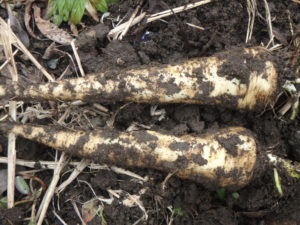
Parsnips fresh from the garden in mid-April
Parsnips, carrots and potatoes can spend the winter in the ground without injury –other than the risk of rodent damage. In fact, I leave most of my parsnips in the ground each fall because they taste sweeter in the spring. I mulched them well with straw in the fall.
Once the soil has dropped below 50 degrees F some of the carbohydrates turn to sugars. That’s why commercial potato growers store their spuds in temperature-controlled places that are above 50 degrees. MacDonalds and other big buyers of potatoes don’t want potatoes with high sugar content – they burn, or darken, when frying. So they carefully monitor temperatures, ensuing they stay a little above 50 degrees.
It’s not time to plant parsnip seeds yet, but I bought my seeds this week. Parsnip seeds are only good the year you bought them, so if you have left over seeds from last year, toss them out and buy new seeds.
Parsnip seeds take forever and a day to germinate – I have been known to wait a month to see them appear, even though the seed package might say they’ll start growing in 2 weeks. Wait until the soil warms up well before planting – late May or even early June is best.
Plant parsnip seeds half an inch deep and an inch apart in rows that are 6 inches apart. In a wide raised bed you can plant multiple short rows across the bed. Then, after your parsnips are a couple of inches tall, thin them to 3 to 4 inches apart. Even though they tend to grow straight down into the soil, they send tiny roots laterally and don’t like to be crowded.
If you are not familiar with parsnips, go to your local food co-op and buy a few and cook them up. After you’ve tasted them, you’ll know if you want to grow them or not. They are related to carrots, but have their own distinct flavor. You can steam or boil them like carrots, and serve with butter and a little hot maple syrup if you like.
Another recipe I like uses potatoes, parsnips and sorrel, an early-season green. Just peel and chop a pound of potatoes and 3/4 pound of parsnips; boil them until soft. Cut up a cup of sorrel and sauté in 2 ounces of butter until soft and mushy. Mash the root crops when cooked, add the sorrel and some heavy cream. Yum!
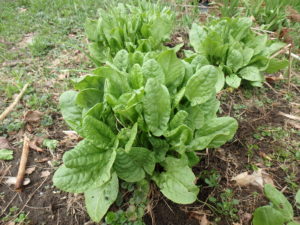
Sorrel
My sorrel is up now, and will be ready to harvest in early May. Sorrel is a great favorite of French cooks who make a soup with it. Although I grow it, I sometimes forget it’s there and overlook it. It’s a bright leafy green that comes back, year after year. It has a sharp lemony flavor, a bit like wood sorrel.
My problem with it is that when you cook it, it practically disappears. It has little substance. But it’s easy to grow, and adds a unique flavor if added to a salad or even a sandwich. Plants are often sold at garden centers in the herb section.
What else is coming up in the garden? Rhubarb. This sharp-flavored perennial stalk is a favorite of mine. Some varieties have deep red stems, others are green with just a hint of red. All will make you pucker up if you take a bite raw. The leaves contain oxalic acid, and are said to be poisonous.
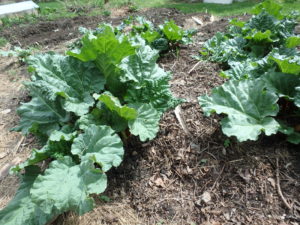
Rhubarb
I love rhubarb pie, strawberry-rhubarb pie, rhubarb sauce and rhubarb tea. You know the pies and sauce, I suppose, but the tea? It’s easy to make. Chop up a few stems and boil in an equal quantity of water. Once it gets mushy you can strain it and add more water and some sugar until you have a nice drink. I just use a little sugar – I like the tea plenty tart. I like to use red stems for the tea, as it looks so nice in a glass or cup. I drink it cold, too.
Chives are another perennial vegetable or herb. Mine are just up now and a couple of inches tall, despite the snow nearby in the same bed. This tasty fellow is best known as a garnish for baked potatoes, along with sour cream. It is one of the few things that will winter over easily in a pot on the kitchen window sill. But look for yours now, when there is little fresh in the garden to harvest.
I also grow garlic chives, but mine aren’t up yet. Garlic chives are bigger than chives and the flavor is bolder. I like them for their fuzzy white flowers that appear in early summer. The leaves are not hollow like chives, but flat. They are commonly used in Asian cooking. They’ll be along shortly.
I wish I had more perennial vegetables. Wouldn’t it be great if our tomatoes and squash came back like rhubarb, year after year?
Henry is a UNH Master Gardener and a gardening consultant. He is the author of 4 gardening books. His web site is www.Gardening-Guy.com.
What to Do About Those Wile Woodchucks!
Posted on Wednesday, April 18, 2018 · Leave a Comment
Woodchucks, alas, are out and about. Fortunately I don’t have lettuce or green beans growing in my garden yet, as I saw my first one lounging in the sun on April 11 in a neighbor’s field. It was looking relaxed and happy. If you’ve have had woodchucks in the past, now is the time to take action to remove or repel them – before they have a litter of babies to join in the carnage of our gardens. They know danger and are willing and able to relocate – at least as far away as the next-door neighbor’s house.
When my corgi, Daphne, was a youngster I was working in a garden in Woodstock, Vermont when I saw a woodchuck sunning by my client’s barn. I let her out of the car and told her to “Go get it.” That was a new command, but she got the idea immediately and took off at a dead run.

Woodchucks are waking up from winter Mary Holland photo
The woodchuck was not paying attention – and barely made it down its hole before Deadly Daphne got there. Daffy tried to go down the hole, and got her front end in, but then perhaps a turn in the tunnel blocked her way. But I could hear the terrified woodchuck squealing inside the hole. My client reported that she never saw a woodchuck again. Not that summer, not the next. Perhaps, like 1930’s hoboes, the woodchuck left an “X” on the barn to warn the next marauding woodchuck that the place was not safe.
Woodchucks have 2 to 6 babies which are usually born in April or May. Females are generally have one litter in their second summer, but occasionally they will have young their first year of life. It is important to encourage woodchucks to relocate now, before they have babies. Since I have snow on the ground and little for them to eat, I am confident they haven’t had babies yet. Farther south? Who knows?
If you’ve had woodchucks in the past, you should check to see if their dens are active. Put strips of newspaper or stuff some hay in the openings, loosely plugging them, and check them daily. Each den will have 2 to 5 openings, each hole about 8 inches across. The back door(s) may be well hidden. I once saw a woodchuck disappear into a stone wall, but that may have been a temporary move – my dog was chasing it.
Once a mother woodchuck has had babies, it will be hard or impossible to get her to leave her den. For humane reasons you should defer relocating woodchucks until 3 weeks after the babies are born.
So how do you evict a woodchuck? According to the Humane Society Website, You can scare it away by partially digging out the opening and cutting away any vegetation near it. Or you can put urine-saturated cat litter down the hole, and then shovel some dirt in to loosely seal the burrow. They also suggest reflective Mylar strips hanging near ground level in the garden.
To keep woodchucks from returning to their burrow, close off the entrances with wire mesh screening with openings no bigger than 3 inches across. Cut a 3-foot square and stuff it into the entrance. Woodchucks have been known to return to a good home up to several years later.
What other options do you have? You can fence your garden with 3 to 4 feet of metal fencing such as chicken wire. Leave the top 18 inches floppy so that even an ambitious ground hog will find it hard to get over the top. Bury the bottom in the soil, and pin it down with landscape staples.
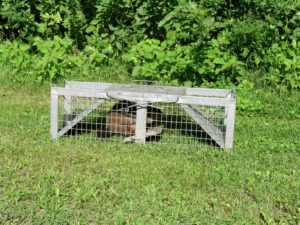
Only use a Hav-a-Hart trap to relocate a woodchuck if all attempts to get it to relocate have failed
If you’ve tried everything else and want to use a Hav-a-Hart trap to catch one, bait the trap with something fruity and fragrant. Sliced apples or watermelon work, though I know someone who used green beans. It makes sense to use something not available outside the trap. And place the trap along the pathway from the den to the garden.
According to Vermont naturalist Ted Levin, catching a rodent (woodchucks included) in a Hav-a-Hart trap and moving it away is generally a death sentence. When they land in new territory they are likely to fall prey to a fox, coyote or other predator. Food is uncertain, too, especially if yours is dependent on your garden produce. So please, only use Hav-a-Hart traps as a last resort. In some communities trapping wild animals is prohibited, so check with your town clerk or animal warden before investing in a trap.
I happen to like woodchucks. They remind me of fuzzy little bears. I love seeing them standing up and looking around like miniature grizzlies. I just don’t want them on my land. So if one turns up, I’ll try to scare it away. Daphne can earn her kibbles!
Read Henry’s blog posts at https://dailyuv.com/gardeningguy. His e-mail address is henry.homeyer@comcast.net. Henry is a UNH Master Gardener and the author of 4 gardening books.
Native Plants for New England Gardens
Posted on Saturday, April 14, 2018 · Leave a Comment
It’s rare that I find a book that is as useful, accurate and easy-to-read as Native Plants for New England Gardens by Mark Richardson and Dan Jaffe, both on staff at the New England Wild Flower Society in Framingham, Massachusetts. This book presents over 100 species of wildflowers, trees and shrubs, grasses, ferns, vines and lianas (woody vines). And even though I grow the vast majority of plants in this book, I learned so much that I felt like a third grade boy on an outing with a PhD.
First, the authors define native plants: those that were growing in North America when the first colonists arrived. They stress, right off the bat, that it is important to put the right plant in the right place. Instead of shopping for pretty flowers, they recommend knowing about plants and seeking them out. The glossy photos of the book will help you put together a plant list; their instructions will help you decide if you have a place for a particular plant.
I have always enjoyed eating wild harvested plants. The book covers ramps, which I grow, but also other wild edibles I grow – including two that I didn’t know are edible.
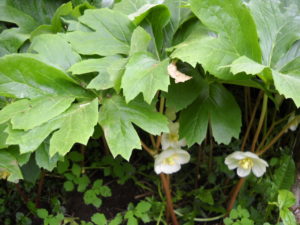
May apple
I have a large patch of Mayapple (Podophyllum peltatum). As the authors point out, it spreads robustly and shades out other plants. The blossoms appear beneath the big, wide leaves and are not easily seen; they suggest planting it on a steep incline, so that one can see them – and the fruit, bright red “apples” when standing below the planting. I have seen the fruit, but never knew it was edible until reading about it. Apparently the fruit is also eaten by box turtles. Who knew? Note: “Since writing this, I read elsewhere that that the seeds and rind may be toxic, so better to avoid eating May apples.”
Another edible fruit described in the book is produced by American spikenard (Aralia racemosa). The authors note that spikenard gets big enough to serve as a handsome shrub, but since it dies back to the ground each fall, it won’t be damaged by snow falling off your roof if you plant it near the house. I grow it in part shade and it gets to be 6 feet tall and wide, and produces masses of berries each fall. The berries start off white, change to red, and end up a deep purple. I shall taste them this fall.
I grow all 3 of the milkweeds described in the book: common, swamp or rose, and butterfly milkweed. The authors explain the pluses and minuses of each, where to plant them. “If you are looking for a well-behaved garden plant, then common milkweed is not the best choice.” It spreads by root, they explain and is suited for “meadows, hell strips or as competition against invasive species.”
Yes, I knew that milkweeds are essential for monarch butterflies, but they point out that they also support tussock moths, swallowtails, and a variety of beneficial beetles. “The plant (swamp milkweed) seemingly supports whole ecosystems on its own, often playing host to bees, ants, and various spiders waiting to eat an unsuspecting pollinator.”
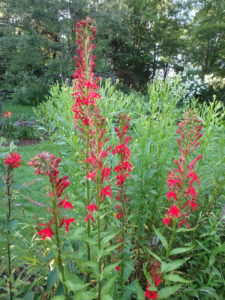
Cardinal flower
I love cardinal flower (Lobelia cardinalis) and have grown both the native species and modern hybrids varieties in a moist, full-sun garden. I no longer grow the hybrids, as they are less hardy than the native species and have all died out. The authors refer to work done at the University of Vermont that showed that at least one of the hybrids produced only 20% of the nectar energy produced by the wild species. So hummingbirds, who love these bright red flowers, get something akin to diet nectar if you grow the hybrid variety. It’s best to avoid planting them, so read the plant tags carefully before buying.
I love the bright red leaves of staghorn sumac (Rhus typhina) growing by the side of the road, but would never consider planting it on my property. Although a native plant with fruit beloved by returning migratory birds in early spring, it can spread very aggressively and is hard to remove. But the authors introduced me to another variety, fragrant sumac (Rhus aromatica), that is smaller, “much slower growing, and fairly easy to control even in a formal garden setting.” I shall look for it, and try to learn from others who have grown it (Please e-mail me if you have grown it).
I grew up in Connecticut where spicebush (Lindera benzoin) was a wild shrub with tasty leaves and twigs that I chewed as a breath freshener. But it is hardy to Zone 4, and I got one two years ago. According to the book, it is an understory shrub that does well in moist soil. I knew it as a plant for dry shade, and hence planted it here in a dry location, and it has done fine.
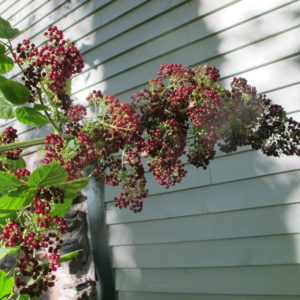
Aralia berries
What I did not know, until reading Native Plants for New England Gardens, is that spicebush is dioecious – there are male and female plants. That would explain why I have not gotten any of the bright red berries used by the authors in a tea that is “magical for fighting off the common cold and is packed with vitamin C.” I shall get another, and hope for pollination.
One last tip from the book: if you want to grow wintergreen, a low-growing ground cover with tasty red berries, plant it under your blueberries. The sulfur you give your blueberries will make the soil right for wintergreen.
I loved this book. I predict you will, too. And come spring, I’ll go to the Garden in the Woods in Framingham, MA (where the authors work) and buy some wildflowers in the nursery there.
You may e-mail Henry at henry.homeyer@comcast.net or write him at P.O. Box 364, Cornish Flat, NH 03746. Please include a SASE if you want a response by USPS mail.
Tips for Growing House Plants
Posted on Wednesday, April 11, 2018 · Leave a Comment
Even the best vegetable gardener can struggle to keep house plants alive. A champion rose gardener sometimes kills her fiddle-leafed fig or “mother-in-law’s tongue” (also called the snake plant or Sansevieria). Why? Because the growing conditions are really very different. And indoors plants really do depend on us to keep them alive much more than outdoor plants.
I recently received a review copy of a new book from Button Street Press, Don’t Repot That Plant and Other Indoor Plant Care Mistakes by Will Creed. Creed has 35 years of professional experience caring for indoor plants for businesses and homes in New York City, and has been answering questions on-line and on the phone for many years. I like the book, and learned from it.

Pony tail palm needs little water and bright light
Creed starts out by explaining that most houseplants do not need to be re-potted very often, that most thrive with roots that are crowded in a pot. His test for re-potting is based on how long it takes for the soil medium to dry out after a good watering. If the plant dries out in less than three days, it’s time to re-pot. He points out that it takes years for a plant to use up the minerals in a soil mix, and an occasional application of fertilizer is usually better than (and easier than) re-potting.
When re-potting you only want to step up one pot size, so choose a pot that is about an inch wider at the top than the existing pot. Creed suggests watering a plant well 24 hours before re-potting – a trick I did not know.
Select a potting mix that is suitable for your particular type of plant. Orchids, for example, need a very loose material with large chunks of bark. A cactus soil needs a sandy mix, and many plants do well with a peat-based mix. Try to match what the plants came with. Various potting mixes are sold at garden centers.
Creed warns against putting pebbles or pot shards at the bottom of the pot, a practice that was common in the past. Add about an inch of new soil mix in the bottom of the pot, but never any on the top of the root ball. Using your fingers or a table fork, push new material down along the sides of the root ball, and water the mixture in. Never pack it too tightly.
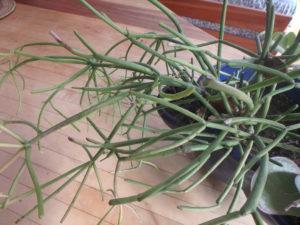
Sticks of fire does best in direct sun
Most houseplant owners understand that too much water will kill potted plants. Why? Two reasons: 1. Roots that are constantly wet are prone to rot, and 2. Soggy soil doesn’t allow roots to get oxygen. That’s right, green plants do not get their oxygen through their leaves, but from their roots. Too much water can drown a plant.
For many houseplants a once-a-week watering that reaches the bottom of the pot and leaks out a little is just right. Keep your houseplant in a saucer or on a plate, but never let it sit in water.
Creed does not like the technique of using ice cubes as a water source. Yes, they melt slowly and allow water to be absorbed, but rarely will you see water drip out of the pot – his test to see if water has reached the roots at the bottom of the pot. And although there are moisture meters, he does not recommend them either. They can be inaccurate if you use fertilizer, or if you have hard water. A finger poked into the soil is his preferred method for testing moisture levels.
Another factor for success with houseplants is to know how much light a plant needs. Many house plants are tropicals that are shade plants in their native habitat. I remember hiking through the jungle in Cameroon where the light levels were so low that even on a sunny day my camera required a flash!
Creed defines the various indoor light levels carefully and gives examples of plants that thrive in each category. Generally, of course, the plant tag will tell you if a plants needs indirect bright light, direct light in a south –facing window, or low light. He says if you can’t read a newspaper in the light you have, you can’t grow any plant there!
If you aren’t attentive to house plants, you want low-light plants. Creed says “Plants in low light must be neglected. Do not repot them; don’t fertilize them; and let the soil become quite dry before watering. Remember the needs of low light plants are minimal.” What are some low light plants? Heart-leafed philodendron, various Dracaena, peace plant (Spathiphyllum) and cast iron plant (Aspidistra).
Fertilizer is another mystery for many houseplant owners. Creed’s rule? Less – or none- is generally better. Always dilute the fertilizer to half the recommended amount. He explains that plants need more nutrients when they are in a growth spurt, not when they are sick or relatively dormant. Don’t think that fertilizer will fix what’s wrong with your plants. Adjusting light or watering patterns is more likely to help them. I know, for example, to give my rosemary plants more water in the spring to avoid losing them.
In addition to chapters on all the topics above, Creed’s book includes chapters on many good indoor plants, complete with photos. So if you’re having trouble with your plants, you might want to check out this book.
Read Henry’s blog at https://dailyuv.com/gardeningguy. Reach Henry at henry.homeyer@comcast.net.
10 Ways to Become a Great Gardener
Posted on Wednesday, April 11, 2018 · Leave a Comment
If you want to become a great gardener, you can. It’s really not that hard. Here are 10 things you can do that will help you achieve that goal.
- Take classes. The flower shows are starting up, and they all have classes with speakers who have been selected for their knowledge and life experiences. Yes, it’s great fun to wander up and down the aisles buying things and ogling flowers. But take a break: get off your feet, sit down and attend a nice talk. Bring a notebook and take notes.
- Read good gardening books. Yes, the internet has millions of people who want to tell you things. But real books that are published by reputable publishers are dependable in ways the internet may not be. Go to a bookstore on a cold February day and spend an hour or two in the gardening section. Buy a book, and bring it home.
- Improve your soil. Okay, you can’t work on this one now. But, come spring, think about what you can do to improve your soil. Adding compost or aged manure is a great way to improve your soil. Chemical fertilizers are, at best, a quick fix.
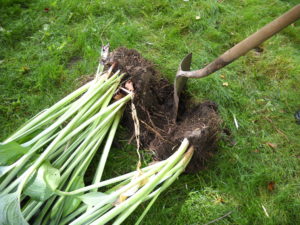
Dividing Hostas
Decades ago I turned a field of brambles and alders by my brook into a vegetable garden. I cut down the brush by hand, mowed it, and dug out roots. But most importantly, I had a farmer bring in truckloads of aged manure. I worked it into the soil, and then did it again the next year. And the next. And so on. Now my soil is rich and black, and my potatoes voted me their favorite gardener many years running!
- Pay attention. Being a great gardeners means that, in part, that you spend lots of time in the garden, and that you really look at what is happening. Are there insects laying eggs on the underneath side of leaves? If so, are they good bugs or bad bugs? Are new tomato transplants showing signs of dehydration on Day 2 in the garden? Of course you may not know the signs of dehydration. But gardening is not rocket science. You can figure it out.
- Go on garden tours. Most garden clubs sponsor a tour of their best members’ gardens in the summer. Join a garden club – you can do this now and attend lectures and slide shows. Then, come summer, go to as many “Open Garden’ events as you possibly can. See what a mature specimen of a tree looks like. Ask questions. Find out who did their stonework, or what local nursery has the best perennials. Need someone to help you in the garden? Ask your host if she can make a recommendation.
- Learn to plant seeds. Start seedlings indoors in flats and nurture them until you can plant them outdoors in late spring. Starting from seeds does a couple of things: First, success at this gives one great confidence. See that tomato? I grew it from a seed. You really feel like a serious gardener, which is important.
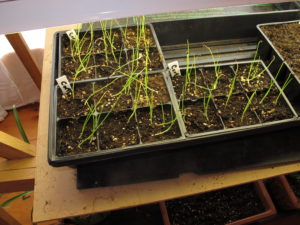
Starting Onion Seedlings
Second, starting plants from seeds allows you to have many more plants. Starting an English cottage garden from scratch can be expensive if you buy every plant as a mature perennial at $10 each. Last year I planted a packet of hollyhock seeds and got 100% germination. I then had 32 hollyhocks to fit in my flower beds for about $3. They bloom in their second year, and I can’t wait to see them this year.
- Learn how to divide perennials. This is a way to create more plants for free. But you must do your homework and know which ones can be divided, and when. Go back to #2 and read up. A book like Tracy DiSabato-Aust’s The Well-Tended Perennial Garden will give you that information.
- Learn to prune trees and shrubs. This is a skill you must have if you want to be a great gardener. Trees and shrubs are the bones of a garden. But an un-pruned tree is as messy as an unmade bed.
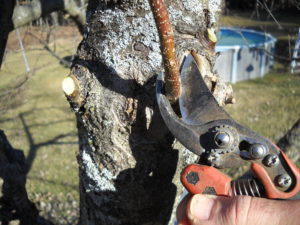
Learn to prune!
Think of pruning as sculpting. There are some very basic rules that you can learn from a book, or you can take a class. Trees and shrubs are healthier and more beautiful if you prune them. And anyone who tours your garden will compliment you if you’ve done a good job pruning. Pruning season will soon be upon us.
- Take chances. Not every plant I buy will survive in my climate, or with the soil that I have. But if I love a plant, I will buy it, and see if I can make it flourish. I use the baseball guide: if I kill a perennial 3 times, it’s out! Trees and shrubs, I often give just 2 tries. I have had 2 peach trees die in cold winters, and I have given up on the idea of growing my own peaches. One lived 5 years before a bad winter killed it.
- Give away plants and vegetables. I think of my grandfather as a great gardener. He had a regular vegetable route – as a widower he visited the widows in town each week in the summer, sharing tomatoes, peppers, cucumbers and flowers. They all loved him. Give plants to friends and acquaintances and they will sing your praises every time those flowers bloom! And you really will be a great gardener.
Henry may be reached at henry.homeyer@comcast.net. See his blog posts at https://dailyuv.com/gardeningguy.
Getting Ready to Plant Seeds
Posted on Wednesday, April 11, 2018 · Leave a Comment
Ground Hog’s Day has come and gone. That means we’re coming down home stretch. Winter is more than half gone. It’s time to think about ordering seeds, if you haven’t yet.
I know that many great gardeners just don’t bother starting seedlings indoors. They say it takes too much time and effort. And now days, there are great nurseries in most areas that produce all kind of fine heirloom tomatoes and crunchy red lettuces. But I love to pamper my little tomato seedlings under lights, watering and fussing over them every day. It helps me stay sane. Of course it’s still too early for most things.
I love ordering specialty seeds and trying new things each year and look forward to the catalogs. Many of the seed companies are now depending on our ability to choose seeds and order them on-line. I love the old fashioned seed catalogs, catalogs I can hold in my hand and study at my leisure – even in the bath tub.
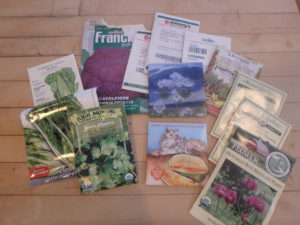
Seed Catalogs
I recently got a catalog from Seeds of Italy, an importer in Nebraska. Dan Nagengast, the co-owner, worked in West Africa with me decades ago so I decided to give him a call to talk seeds. What are some of his best tasting tomatoes, I asked? He says his most popular tomato is one called Red Pear. Unlike American pear tomatoes, this is a big one: 8 to18 ounces. Great flavor, and meaty with few seeds.
Another tomato I am ordering from Seeds of Italy is an old French one called Marmande. It’s said to have good fruit set even in cool weather, and is described as “semi-determinate”. Determinate tomato plants grow to a certain size, set fruit, and stop growing. Indeterminate tomatoes keep growing until frost or disease kills them. But semi-determinate? I’ll grow these, and find out just what they do. Dan said another favorite is St Pierre, an indeterminate heirloom with great flavor.
As you go through your catalogs or read them on-line, you might be confused by the term heirloom. Heirloom means that the plant stays true to its characteristics year after year. They breed true, so you can save seeds. Baker Creek Heirloom Seeds is the biggest heirloom seed producer in America, offering some 1800 heirloom varieties. They have more weird veggies than you can shake a stick at!
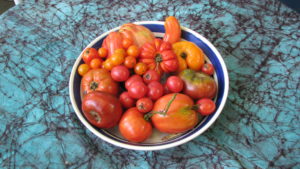
Heirloom tomatoes 2010
Hybrid tomatoes, in contrast, result from crossing two different varieties of tomatoes. The first generation after crossing them yields a plant that has characteristics of both parents and is generally superior to both. If you save seeds, you’ll get progeny that are like the original parents as well as some of the hybrid you wanted. But you can’t tell what the seedlings will produce, so it’s not recommended.
Another seed company I like is Hudson Valley Seed Company. They are new in the marketplace, just eight years in existence. Co-owner Ken Greene started it as a seed library – a service offered to library patrons in Gardiner, NY. Library members could get free heirloom seeds, grow plants, save seeds and then pay back the library with seeds they saved. Obviously, an important education component was part of the process as many plants will hybridize on their own unless spaced appropriately.
No longer a seed library, Hudson Valley Seed Company is certified organic. When Ken Greene came to my part of the world this winter, I bought a few seeds including one for cold-weather watermelons that originally came from Russia. Watermelons are not usually a big success in New Hampshire, so it will be good to see what they will produce.
Johnny’s Selected Seeds of Winslow, Maine is one of my favorites. They are the go-to company for many farmers around the country because their seeds are always top quality, and they have just about every type of seed one could want. Home gardeners can benefit from the extensive cultural information they provide on their website or in their catalog.
Unlike some seed companies, Johnny’s does research and development at their home base in Maine. Obviously they have growers who produce much of their seed, but I am confident that their seeds are good for my climate, not somewhere down south. It is also an employee-owned business. The sell both organic and conventional seed.
You may wonder about the advantages of buying organic seed. Yes, it costs a little more, but by buying organic seed you are supporting farmers who treat the soil and environment with care and respect – just like you do. If you are an organic gardener, you probably will want organic seeds because the mother plants have survived and thrived without chemicals – just like they will have to do at your house.
High Mowing Seed Company of Vermont is a company that only sells organic seeds. And unlike many seed companies, they ship free if you order over $10 worth of seeds. Renees Garden Seeds is another one of my favorite seed companies, with many organic seeds.
Lastly, check out the Seed Savers Exchange. This is a non-profit that since 1975 has been collecting, saving and selling heirloom seeds. Join so you can access their amazing collection of heirloom seeds.
Henry may be reached at henry.homeyer@comcast.net. See his blog posts at https://dailyuv.com/gardeningguy.
Plants I Do Not Like
Posted on Wednesday, April 11, 2018 · Leave a Comment
There are a few plants I just do not like. Yes, I’m known as the Gardening Guy and have the website to prove it (www.Gardening-Guy.com). So I should love – or at least like – all plants. But I don’t. Now, in mid-winter, it’s a good time to reflect on what we like and want to grow – and what plan to avoid.
Weigela reminds me of an elderly auntie who wears too much perfume, too much rouge, and leaves lipstick on her old fashioned glass – or any unfortunate nephew she meets up with. Of course I have never grown it, and some forms of it may be lovely. But the colors seem artificial to me, the shrub coarse. It blooms in May, and many new colors have been created in recent years, which may include some beauties.
I often use Michael Dirr’s books to inform me about woody plants. His classic is Manual of Woody Landscape Plants: Their Identification, Culture, Propagation and Uses. It is nearly 1200 pages long and tells everything you might need to know – and his opinions. Here is what he says about Weigela’s landscape value:“Best used in the shrub border, for grouping or massing; have seen it used frequently as a foundation planting in older sections of cities; really appears forlorn in the winter landscape; looks like it needs a place to hide.”
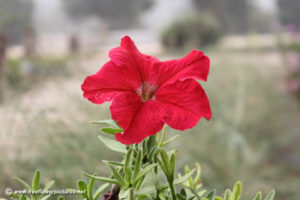
Petunia Flower
Old fashioned petunias are not my cup of tea. My mother grew them and in the beginning of the summer they looked fine. This annual plant produces flowers and makes seeds in sequence up its stem. It blooms first from the base of the plant, then grows a longer stem, and blooms again while the first blossoms make seeds. And so on.
Once the petunia has produced enough seeds to ensure the continuation of the family name, it dies. No ifs, ands or buts. My mother was not good on pruning back the spent blossoms and stems, to keep them nice looking. They got leggy and bare, then died by late summer.
The good news, for all of you with happy memories of old fashioned petunias is that plant breeders have developed petunias that don’t need to be pruned or cut back. These so called “Supertunias” are often trademarked hybrids that bloom all summer. Most have smaller blossoms, but really are quite nice and bloom all summer. There is even one called Bubblegum! I have used Supertunias in planters.
By the way, there is a book similar to Dirr’s book mentioned above. It’s Steven Still’s Manual of Herbaceous Ornamental Plants. It is over 800 pages, and equally useful. It tells you, for example, what soil a plant likes, what the roots are like, how much sun is needed– even the pH if important. I trust it more than internet info, though obviously it doesn’t get updated with new cultivar names the way blog sites do.
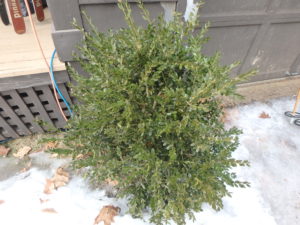
Boxwood in Winter
A perfectly nice little shrub that is used widely, especially in formal gardens is boxwood (Buxus spp.). But I don’t like it. In contrast to Weigela, this one is too austere and formal for me. And the real reason I don’t like it is this: the foliage smells like cat pee. Why grow something that offends my nose?
I live in a cold zone 4 garden so for much of my career as a plantsman, boxwood was really “iffy”. The standard English boxwood (Buxus sempervirens) was all that was available. But now there are plenty of hardy cultivars of hybids designed for Zone 4 gardens, many crossed with Korean boxwood. Many of the best hardy varieties have “Green” in their names such as ‘Green Gem’, ‘Green Mound’, ‘Green Velvet’, and ‘Green Mountain’; those were developed in Ontario at Sheriden Nurseries. But I have never tried one.
Sweet Mockorange (Philadelphus coronarius) is another shrub I have never tried, and probably won’t. This is an old-fashioned shrub that blooms in early summer, producing masses of highly fragrant blossoms. Actually, there are plenty of new cultivars, and not all are fragrant. Buy in bloom if scent is important to you.
Working as a landscaper years ago I encountered mockorange and found that it is a vigorous grower 10 to 12 feet tall and wide, that will grow in full sun or light shade. Unfortunately it has a tendency to spread by root, and can easily take over an area. Dirr says, “does not have much to recommend it for the modern landscape” and I agree. An old-fashioned shrub that should be left to the few gardeners who remember Grammy’s mockorange and want one of their own.
Cotoneaster (Cotoneaster dammeri) is pronounced co-tone-EE-aster. It is a fast growing woody groundcover. But it does not work as a groundcover for long. After 3 to 5 years it begins to look ratty. It roots easily, but when I see it, I often point and say, “Cotoneaster Disaster!” Does best on banks in full sun, and in Zone 5 or warmer, though I often see it in Zone 4.
Lastly, another groundcover, creeping juniper (Juniperus horizontalis) is on my no-no list. It is, according to Dirr, the most common woody groundcover used in America. But, as he and I know, it browns out, portions die, and grasses grow up through it. Not a winner.
So send me an email or an old fashioned letter and let me know what’s on your list of plants you do not like, and why. Or tell me why you like some of these. You may reach me by e-mail at henry.homeyer@comcast.net, or at PO Box 364, Cornish Flat, NH 03746.
Identifying Trees in Winter
Posted on Wednesday, April 11, 2018 · Leave a Comment
Despite their lack of leaves in winter, it really is not too difficult to identify most trees now. You just have to look at other characteristics such as branching patterns, bark, overall shape, seeds or fruit, where they grow, and what their buds look like. I recently went to Goffstown, NH to attend a workshop on tree I.D. in winter run by forester Ethan Belair of UNH Cooperative Extension. It was worth the trip across the state to attend.
For mature trees, I tend to use the overall shape and branching patterns to identify trees in winter. Sugar maple? White pine? Hemlock? I can generally identify those from a distance while in a moving car just by their shape. But for young trees it is harder, particularly for trees that are less common.
According to Ethan Blair, bark is the best way to identify trees. Summer or winter, if you know the look of a tree’s bark, you can identify it. It takes practice, of course, and careful observation.
Some bark is very distinctive. Beech (Fagus grandifolia), for example, has a smooth gray bark that you can learn in moments. I love to run my hands over the bark, as if petting an elephant. (And yes, I have hugged trees on occasion). Young beech, particularly, hold onto their leaves in winter, which is also a good clue.
Many beech trees now are marked by a fungus that produces cankers, blackening and open wounds. It will eventually kill infected trees, and ruins that gorgeous bark.
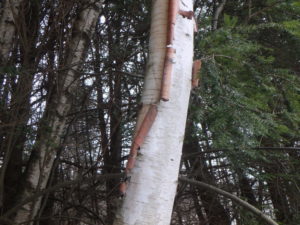
White Birch Bark Peels Naturally
Most everyone can identify white or paper birch (Betula papyrifera) by its white, peeling bark that is easily removed from a tree by enthusiastic Boy or Girl Scouts anxious to start campfires fires. I learned from Belair that emoving the bark by hand will not hurt the tree, though you should never use a knife or ax to do so, as you can hurt the tree.
Gray birch (B. populifolia) is similar to white birch, but it does not peel like its cousin, and has a dirtier look. Yellow birch (B. alleghaniensis) peels like white birch but is a golden or silvery gray color.
But did you know that young white birch are not white at all? They have a deep reddish black color and are spotted with small white dots or short white lines, lenticels, that feel rough if you rub your hand over them. Eventually, after 7 or 8 years, white birch saplings will start to turn white.
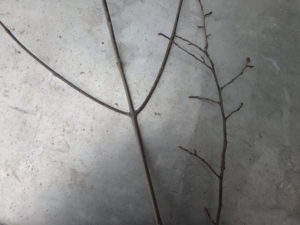
Opposite Branching (R); Alternative Branching (L)
Branching patterns help to identify trees at any time of the year. Most species of trees and shrubs have what is called alternate branching. That means that as your eye follows a branch, the twigs and leaves alternate from one side to the other. A limited number have opposite branching with twigs facing each other across a branch. Of course – just to confuse us – sometimes twigs or leaves have broken off on a tree like a maple that should have opposite branching.
There is a mnemonic for trees that have opposite branching: MAD Cap Horse. Translated, that means maple, ash, dogwood, member of the Caprfoliacea family (honeysuckle, viburnum and elderberry, among others) and horse chestnut. So if you see opposite branching, you can eliminate lots of possibilities.
Where a tree appears in the forest is a clue, too. Some trees need lots of light, while others do fine in shade – the understory. Of the understory plants, beech is one, basswood, yellow birch and hemlock are others.
Poplars, in contrast, show up in open fields after clear cutting or a fire. Their branches reach upward, as if trying to grab the sun. They are short-lived trees that die out in 30 or 40 years – about the time they are shaded by canopy trees like maples, oaks or ash.
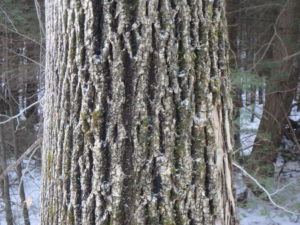
White Ash Bark
White ash is an easy tree to identify by bark: it has prominent ridges with deep furrows. It is dark brown or deep gray. Unfortunately this wonderful tree will probably disappear from our woodlands due to a foreign invader: the emerald ash borer. Ethan Belair suggested cutting down white ash trees now, before they succumb to the blight.
Buds at the end of a branch are another distinctive characteristic. Red maple (Acer rubrum) and sugar maple (A. saccharum) can be distinguished by their buds, for example. Sugar maple terminal buds are sharp and pointy, red maple buds are blunt and reddish in color, especially as we approach spring. Sugar maple buds are grayish or purplish-brown.
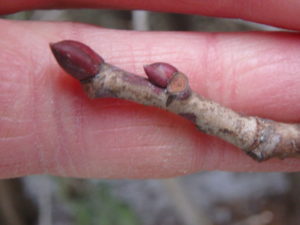
Basswood Buds
Last spring while hiking in the woods I spotted a tree with bright red buds that I couldn’t identify right away (it stumped me!). It was a basswood or American linden (Tilia americana), which is a native relative of a European shade/street tree called the little-leafed linden (Tilia cordata). I am at the northern limit of basswood, but in Goffstown where the workshop was held, it was common. So I got to see mature specimens. Their branches reach out and often bend down; they often they grow in clumps. Belair said they are “locally common, regionally rare.”
One of my favorite guides to trees is spiral-bound, water-resistant guide written by a Trevor Evans, Forest Trees of Vermont. It even comes with ruler and magnifying glass!
So if you are bored being indoors this winter, get outdoors and learn your trees!
Henry is a UNH “lifetime” Master Gardener and the author of 4 gardening books. Read his blog at https://dailyuv.com/gardeningguy.
The Flower Shows Are Coming!
Posted on Wednesday, April 11, 2018 · Leave a Comment
Each winter, just as I am about to give up on life in the North Country and move to an island in the Caribbean, I am saved by the arrival of the spring flower shows. If you think that life is nothing by shoveling walks and wearing so many layers of wool that the Pillsbury Dough Boy looks scrawny in comparison, you will delighted with the flower shows. Read on … and mark your calendars!
The first – and smallest – of the shows is New Hampshire Orchid Society Show on February 9 to 11 at the Courtyard Marriot Hotel in Nashua, NH. This is a specialty show, but has been happening for 27 years and is a delight for both novices and orchid geeks. There will be lectures, displays and vendors. Admission is $10 or less, and kids under 12 are free. Get those grandkids and bring them along.
Of the big shows, the first is the Connecticut Flower and Garden Show in Hartford at the Connecticut Convention Center February 22 to 25. This show used to compete with the Rhode Island Flower Show that was held the same weekend. Sadly, that one ran out of steam and disappeared like some of those Zone 6 perennials I planted in my Zone 4 garden. I used to try to see both shows, but now I don’t have to race from one to the other.
The Connecticut Show is a 4-day event with plenty of displays and speakers. I always recommend going on Thursday or Friday while the crowds are smaller and the flowers fresher. The theme for this year’s show is “Breath of Spring”.

Philly Show
The next show is the biggest of the season, the Philadelphia Flower Show at the Pennsylvania Convention Center in downtown Philly from March 3 to 11 – 8, a full 9 days of flowers. The theme this year is “The Wonder of Water.” When you enter you will pass through a rainforest environment with a 25-foot waterfall and a jungle of tropical flowers. Other exhibits will focus on other environments, from jungle to desert.
I called the show offices and learned that the show covers 10 acres of indoor displays and involves about 40 floral and landscape displays. The Marketplace will have over 100 vendors selling just about everything related to gardening from seeds and bulbs to umbrellas and scarves with floral patterns.
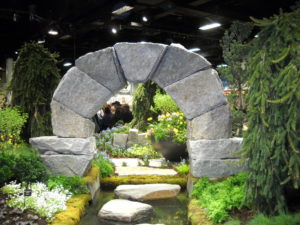
Boston Flower Show
Next comes the Boston Flower and Garden Show at the Seaport Convention Center on March 14 to 18. The theme this year is “Savor Spring”. Like the Philly Show, it has lots of displays and workshops. If I go, I’ll want to hear an editor of Fine Gardening Magazine talk about “Plants Every Northeast Garden Should Have” to see if there are any I DON’T have. Or perhaps I’ll attend “Garden Design 101 Class: Creating an Ever-Blooming, Low-Maintenance Garden” with Kerry Mendez.
The following week is the Portland, Maine Flower Show from March 22 to 25. This is in a new location since I last attended, on the waterfront. The theme this year is “Rooted in Maine.” There will be 14 display gardens, 115 exhibits of plants, hardscape, arbor and garden supplies, and many workshops and seminars.
A show I only recently heard about is near Albany in Troy, NY. In its 31st year, it is called the Capital District Garden and Flower Show and will be held March 23 to 25 at Hudson Valley Community College. I hope to go. From their photos and write-up, I imagine it will be similar in size and scope to the Vermont Flower Show – which is now an every-other year show, and is not occurring this year.
Bangor, Maine has an annual flower show, though I’ve never attended. This year it will be held in the Alfond Arena in Orono, ME on April 20 to 22. If you go, please contact me so I’ll learn more about it.
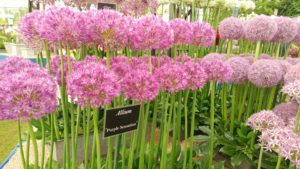
Alliums at Chelsea
Last year I crossed one more item of my “Bucket List”. My partner Cindy Heath and I flew to London and attended the Chelsea Flower Show. It is in a league by itself, both in size and scope. Mostly outdoors, it includes displays with full-sized trees planted for the week. Under a big tent are displays of flowers of every ilk: hellebores, alliums, iris, narcissus, tulips, vegetables, carnivorous plants and much, much more. To see my article about the show and see a dozen photos, go to https://dailyuv.com/feed/905682
The Chelsea Show is held this year May 22 to 26. If you plan to go, join the Royal Horticulture Society to get reduced prices and access before the rest of the world (the first 2 days are just for RHS members). One member can bring in 3 guests. The Brits love their flowers, and know how to celebrate them. Bring a flowered dress or vest and bowtie, and walk around drinking champagne if you wish – many people do.
I called my friend Jill Nooney of Bedrock Gardens in Lee, NH to talk about the flower shows. Jill has exhibited at the Boston Show 7 times, winning many awards for her garden designs. I asked her, why go to the flower shows? “Nobody can resist the smell of humid mulch-filled air in the middle of March,” she said. I agree. We all need that taste of spring before all the snow has gone.
To read Henry’s blog posts or sign up to get them, go to https://dailyuv.com/gardeningguy.

 Click Here to buy from Cobrahead