Paperwhites and Amaryllis: Start Some for Easy Blossoms Indoors
Posted on Tuesday, December 19, 2017 · Leave a Comment
The winter months can be a bit depressing for me. As a gardener there is very little to do, and my supply of colorful flowers indoors is limited. I combat this by buying cut flowers, and better yet, getting flowers to bloom in pots or dishes for me. Two of my favorites are paperwhites and amaryllis. I have both blooming right now, and will continue to start more.
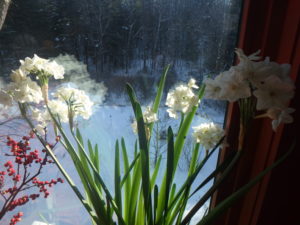
Paperwhite blossoms look good for 2 weeks or more
Paperwhites are in the daffodil family in the genus Narcissus. There are many named cultivars, but most purveyors of the bulbs do not tell you their names. Commonly sold in grocery stores and garden centers, paperwhites are easy cultivate and quick to bloom. Some varieties will bloom in a couple of weeks, others take up to a month.
To get your paperwhites to bloom, all you need is a sunny windowsill, a dish or bowl that will hold water, and some small stones. Garden centers sell bags of attractive pebbles or chips of white marble that is suitable, or you can go out to your driveway and pick up stones.
Start by rinsing off the pebbles and placing them in a wide, low bowl. Then arrange your paperwhites so that the fat end of each bulb is nestled into the stones and surrounded by them. Add enough water so that it just “kisses” the bottom of the bulbs. You don’t want the bulb sitting in water – the bulbs can rot if they do.
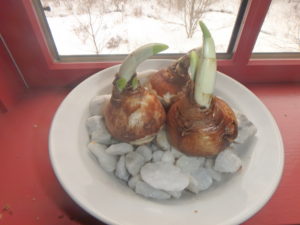
Start paperwhites in a bowl with gravel and water
I like to select paperwhites from the bin that have green sprouts already emerging at the time of purchase. They will bloom sooner than those that are entirely dormant at the time of purchase. If you buy them in a mesh bag, look at the bulbs carefully to make sure they are not dried out or are mushy when you squeeze them.
Paperwhites have a distinctive fragrance which can be quite strong. I love the sweet scent, but not everyone does. At this time of year any flower scent is a blessing, as far as I am concerned. The odor can often be smelled from quite a distance. One variety that does not have an odor is a bright yellow one called ‘Grand Soleil d’Or’.
Unlike the ordinary daffodils that I pot up in soil each fall and force to bloom indoors in the spring, paperwhites cannot be successfully planted outdoors, even if you kept them watered and green until the ground thaws. They are a Mediterranean species, and will not survive our winters. I don’t believe they will bloom again next year indoors, either. But that means there is one less chore to do.
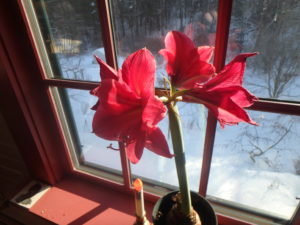
Amaryllis
Amaryllis is another easy, bright and wonderful flower that you can plant at this time of year for indoor blooms. The bulbs are available in grocery stores, Big Box stores and garden centers. Some come already planted in pots, but most come with a bag of planting soil, a pot, and a bulb – so some assembly is required.
The flowers of amaryllis bloom on a 16-inch stem and are shaped like Oriental or Asiatic lilies. The come in red, white, pink and striped varieties. None are particularly fragrant. As with most things, you get what you pay for. If you get the least expensive, smallest bulbs you will get one stem with 4 blossoms on a single stem. If you buy a bigger bulb, you will probably get 2 flower stems, one growing after the first has finished blooming. I’ve even heard of bulbs that gave 3 flower stems, but never had one.
If you are planting your amaryllis yourself, be sure that this big bulb is not buried up to its neck as that can encourage rot. Plant so that between a third and a half of the bulb is in the soil mix, not more.
If the soil mix comes in a plastic bag and is very dry, as it often is, moisten it well before you plant, but don’t get it soggy. Then keep an eye on it. Don’t let the soil mix get overly dry, especially as the flower buds are developing.
After blooming (and sometimes before), amaryllis will grow nice green, glossy leaves. And they can be made to re-bloom. If you keep them watered and in a sunny window until summer, you can put them outside and let them re-charge their batteries. Then, in the fall, put the amaryllis, pot and all, into a paper bag and place in a cool, dark place for a month to six weeks. Then bring it up in mid-November and begin watering. It should soon produce a flower stem.
In her book, ‘Making Things Grow: A Practical Guide for the Indoor Gardener’ the late garden writer Thalassa Cruso wrote that amaryllis hate to have their roots disturbed. I trust her advice and recommend any of her books. The one mentioned above really will help turn “Houseplant Killers” into “Green Thumb Mavens”. It is readily available at used book stores.
So get some paperwhites or amaryllis or both, and pot them up. Give them to friends and relatives for the holidays. You really can’t go wrong.
Henry is the author of 4 gardening books. His website is www.Gardening-Guy.com. Read his blog at https://dailyuv.com/gardeningguy.
Winter Pruning
Posted on Tuesday, December 12, 2017 · Leave a Comment
This is a time of year when little is happening in the garden. Weeds either have been pulled, or won’t be – until next spring. I’ve cut back most flowers, both perennial and annual. The ground is starting to freeze and we’ve had some snow. It’s a good time to be lazy. But … I don’t like to be lazy.
So what can a gardener do? Prune. Trees and shrubs are dormant now, and it is fine to do some pruning. You can see the structure of deciduous woody plants easily now, as their leaves have dropped.
Before you start hacking away, be advised that shrubs that bloom in spring or early summer already have their flower buds ready and waiting for spring. So if you prune heavily, you will lose blossoms. On the other hand, if you have the time now and the plants need work, get to work.
In fact, most shrubs and fruit trees have both their leaf and flower buds. A few exceptions exist, of course: hydrangeas, summer sweet clethra, seven-sons flower tree, witchhazel and franklinia come to mind as woody plants that set their blossom buds on new wood in the spring for summer or fall blooming.
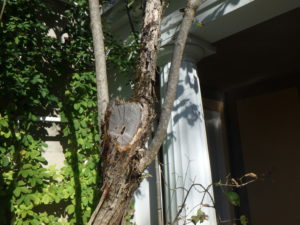
Shoots develop on a Lilac pruned hard a few years ago
On a recent day I went out to do some radical pruning. I have a white lilac that had gotten too tall. It was 15 or 20 feet tall, and the blossoms were out of reach – and largely out of sight when blooming. It was like that when I bought my house, eons ago, and I cut it right to the ground back then, every bit of it. I didn’t care if it died. In fact I kind of hoped it would because it was so out of control. But the roots sent up new growth and if was a nice sized shrub a while. But life gets busy and all of a sudden it was too tall again. This time I was a bit more controlled.
I have been observing old lilacs to see what others have done with them, and how the plants have responded. At Saint Gaudens National Park I saw that the groundskeeper had cut back old lilacs to about 5 or 6 feet above ground, and that new branches had sprouted from dormant buds on those stems. I’m sure they looked pretty gawky for a year or two, but vigorous new growth had filled in. I decided to try the same.
So I cut back the lilacs, reducing their height to 4 to 6 feet. There will be no blossoms this year, and probably not next year. But there are a few root sprouts that have stems an inch thick, and those may produce blossoms. I just have to make sure those stems don’t reach for the sky.
You might wonder why my lilacs have gotten so tall. I think the answer is that they don’t get enough sunshine. There is a row of sugar maples only about 25 feet away from them, and these create more shade on my lilacs every year. Plants tend to grow tall and lanky if they are sunshine-deprived. They reach for the sun.
Elsewhere on my property that day I cut back my seven sons flower tree (Heptacodium miconiodes). This is a very vigorous fall-blooming tree I’ve had for 15 years or more. It can grow a shoot 6 feet in a year, once established. It is within eight feet of my house, and some of the branches were acting like voyeurs, trying to peak in my bedroom window. They needed some attention.
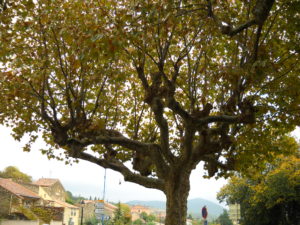
Pollarded plane tree in France
On one 10-foot stem I cut off all the branches. I am experimenting with a pruning technique called pollarding. This technique is commonly employed with English plane trees in Europe, and I like the look. Every few years trees are cut back to their trunks. The branch locations get scarred, and develop big lumps that then produce multiple new, vigorous branches.
Pollarding is particularly good for fast growing, weak-wooded trees. If those English plane trees were not cut back from time to time, the branches would likely break off from their own weight. That would be dangerous, as they are commonly planted along town streets and in parks. They are great shade trees.
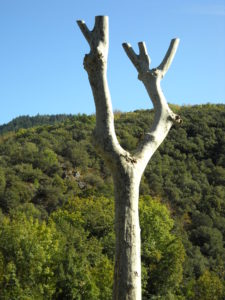
Pollarding in France
I wouldn’t recommend cutting off all limbs on a tree and leaving just the trunk until you have tried pollarding part of the tree to see how it responds. I have read, for example, that one can pollard maples, oaks and beeches, but I wonder if they would perform well. They don’t grow as fast as some trees, and might take too long to develop an interesting appearance. Or try pollarding a small tree in a not-so prominent place to see how it does.
Fruit trees are most often pruned in late winter or early spring, but you can prune them now if you wish. We have some snow now, which makes ladder work more difficult, but a well-pruned apple tree can be a pleasant sight all winter. So have at it!
Henry’s gardening books are available from his website, www.Gardening-Guy.com. You may read his blog posts at https://dailyuv.com/gardeningguy.
How to Build a “Cold Cellar” or Vegetable Storage Bin
Posted on Tuesday, December 5, 2017 · Leave a Comment
I had a banner year for root crops this year, and storage is a problem. For the past few years I had been storing root crops in a spare fridge, or in an old 25-gallon crock with a plywood lid in my cold basement. This year I went back to using a cement block bin that accommodates more produce. I call it my “cold cellar”.
There are two impediments to storing root crops for winter: maintaining the proper temperature, and keeping mice from getting at the food. My house was built in 1888 as a Creamery, or butter factory, and has a stone foundation – which will always make it possible for determined mice and squirrels to get in.
The building was built into a hillside and 3 sides are above grade level – which makes for a cold basement in winter months, as I only heat it when the temperature outside is below zero.
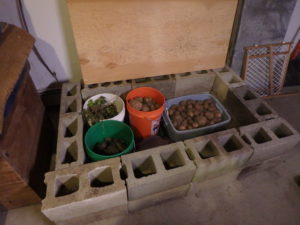
Cold Cellar Storage Bin
This year I built a cold cellar for potatoes that uses 22 cement blocks. Cement blocks are readily available and relatively inexpensive. Blocks that are 16 inches long, 8 inches wide and 8 inches tall generally cost about $2 each. In addition to the blocks all you need is a piece of plywood to cover it.
So here is what you need to do if you want to build a bin for storing vegetables. First, select a place where the temperature can be kept above freezing. Your garage might work, or a cold basement like mine. But you need to make sure it isn’t too cold, as you don’t want produce to freeze.
If temperatures drop below freezing during the coldest part of winter, you have a couple of options: you can carry your buckets of produce to a mudroom or unheated pantry for a few weeks, or you can add heat.
In an earlier version I used a drop light with a 75-watt incandescent bulb to provide heat in my storage bin. I kept an indoor-outdoor remote sensor in it that I could read upstairs, and plugged in the drop light when temperatures inside the bin dropped to 35 degrees.
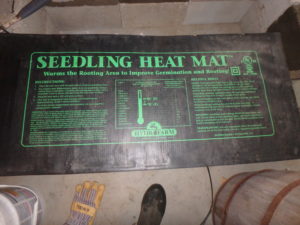
A seedling heat mat can provide heat if needed
Another alternative, and probably a better one, is to install a heat mat. I have one that is designed for helping seeds to germinate by providing a gentle bottom heat. Most heat mats are small, just big enough for one flat, but I have one is 48 inches by 21 inches and uses 107 watts of energy. It should provide plenty of heat for the coldest of times. These are available at garden centers or from Gardeners Supply Company (www.gardeners.com) on-line.
Don’t set up a cold storage bin on a dirt floor. The mice will dig under the fortifying cement block wall, and get to your potatoes and carrots. Build it on a smooth cement floor. You can build any size you want, but I made mine 3 blocks long (4 in the front) and 2 blocks wide. And mine is 2 courses of blocks high, so I used a total of 22 blocks. It is big enough to accommodate six 5-gallon pails, but of course you can make a smaller one.
Root crops store best with high humidity. Winter air in New England is very dry, so I put an inch or two of moist sand in the bottom of each bucket. I do not use plastic lids on the buckets because the vegetables are living organisms that breathe slightly. They need air circulation, too, to keep mildew at bay.
For a lid to the storage bin, you can use plywood. Three quarter-inch plywood would be best, as it is least likely to warp. But five-eighths or even half inch will work. I recommend placing a few heavy objects or extra blocks on the outsides of the plywood to weight it down and minimize warping. Mice can get in through the smallest imaginable spaces.
Bernice Johnson of Cornish Flat, may she rest in peace, once told me a funny story about an elderly and mentally impaired neighbor who grew a lot of potatoes. He had a basement that was full of mice and rats. He stored his potatoes in a pile on the dirt floor and placated the rodents by going to town once a week and buying as many packages of week-old donuts as he could. He’d stand at the top of the stairs and then throw down donuts to feed them, making them promise to leave his potatoes alone. And it worked, he claimed!
Even in a dark, cool storage bin, potatoes somehow know when spring arrives. So I try to finish up eating – or sharing – most of my potatoes by the end of March. But I will save some until June so that I can plant them and start next year’s crop with them. I once went 20 years without buying potatoes, though that meant I had none during the early summer months. When my first new potatoes were ready to eat, I felt like a king at a royal banquet.
You may reach Henry at PO Box 364, Cornish Flat, NH 03746. Please include a SASE if you wish a reply by mail. Better yet, e-mail him at henry.homeyer@comcast.net. You may read his blog at https://dailyuv.com/gardeningguy.
Five Plants for Adding Indoor Color
Posted on Monday, November 27, 2017 · Leave a Comment
This is the dark time of the year. The sun sets early, and is often obscured by clouds dripping rain and snow. For that reason, I string bright lights on trees outdoors, decorate a tree indoors, place candles in my windows – and lots more. I buy cut flowers, too, but I can’t afford to buy armloads of bright flowers every week. Fortunately the outdoors provides me with many nice things to brighten my living space.
Winterberry
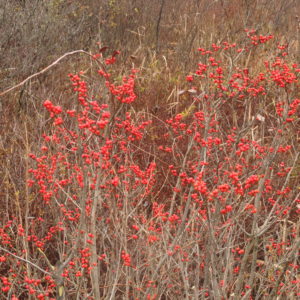
One of my favorite shrubs at this time of year is winterberry (Ilex verticillata). You may have seen the bright red berries of wild winterberry growing alongside the road in wet places, often in standing water. It favors wet places, but can be grown in the average garden. In the wild it is an understory shrub, one that grows in partial shade. It produces the most berries, however, in full sun.
As a landscape plant, the winterberry is best in fall and winter when the red berries are prominent. The spring blossoms are small and white, and hardly noticeable. These shrubs are either male or female, and you need one male for every 6 to 10 females within about a 50-foot range. So when you buy winterberry, plan on having several. Unlike puppies, you can’t lift a tail and know what sex you are buying, but have to depend on the nursery to label them properly.
When you bring cut branches into the house and place them in a vase of water you will notice that they regularly drop berries. There is a solution: spray with a clear lacquer. Last year I sprayed branches that I used on my door wreath, and for the first time ever, most berries stayed on until I took down the wreath. Previously some of the berries fell off every time the door was closed.
Evergreen boughs are commonly used for indoor arrangements, sprays, kissing balls and garlands. If you plan to harvest evergreen branches on your own property for this, be sure to use branches that will hold onto their needles. Balsam fir and spruce, commonly used for Christmas trees, hold onto their needles well even when not in a vase of water. But most of us don’t want to cut off branches if we have balsam or spruce on the property.
Ground Pine
What most of us have growing in our woods are white pine and Canadian hemlock. White pines hold their needles, hemlocks do not. The hemlocks have short needles arranged flat along the stems; they have 2 white stripes on the underneath side of each needle. White pine needles are long and pointy, but soft. They grow in bundles of 5 needles (one for each letter in the word ‘white’).
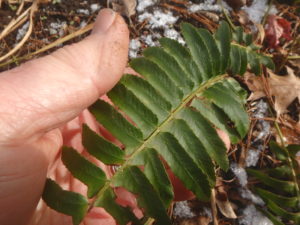
Of the ferns you might see in the woods now, only the Christmas fern (Polystichum acrostichoides) is suitable for use in a vase. These have leathery green leaves with leaflets arranged in an alternating pattern. Some think the leaflets resemble a Christmas stocking, with a toe or heel at the end near its attachment point. I do not. I think they are called Christmas fern because they are still nice at Christmas and other ferns have largely disappeared by now.
Christmas Fern
Christmas ferns grow in shade or partial shade, and prefer somewhat moist locations. If you pick some, do not completely defoliate an individual plant. Take a few stems from one, and then a few from others. These plants are tough, but slow-growing.
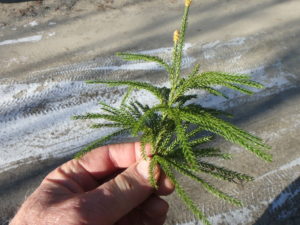
What else is green and will do well indoors? Ground pine (Lycopodium obscurum) grows in deciduous forest in many of the same places as Christmas ferns. It is not a pine at all, but a club moss, a group of primitive plants that fed the dinosaurs when club mosses got to be 30 feet tall. These poor relatives only grow a few inches to a foot tall, but have handsome foliage in winter. They spread by rhizomes or roots. Each plant has leaves that come from the central spine of the plant, and lie parallel to the ground – like little Christmas trees. Please be judicious in picking these.
Back to the reds: red-twigged or redosier dogwood (Cornus sericea), a native of moist areas here in the Northeast, looks good in a vase. The color brightens up considerably in the winter, especially on this year’s growth. If the town road crew brush-hogged the roadside this summer, the new growth on red dogwood will be very bright.
Of course the plant nursery business has been working hard and breeding the reddest, brightest varieties and touting each of them as the very best. But all are good, and are very fast growing – especially in wet areas. I favor pruning out at least half the stems each year to get new stems with bright winter color, and have been known to cut a bush right to the ground.
So don’t feel bad if you can’t afford big vases of roses at this time of year. Get outside and pick some nice things that will brighten the house.
Read Henry’s blog at https://dailyuv.com/gardeningguy. Henry is a UNH Master Gardener and the author of 4 gardening books that make great presents. His website is www.Gardening-Guy.com.
Holiday Gifts for the Gardener
Posted on Monday, November 20, 2017 · Leave a Comment
By the time you read this, Black Friday will have passed us by. I know that some people stand in line that day, starting before the sun comes up to get special deals on electronic games and various widgets, but I have never done so. And won’t. My love ones get good, practical presents that will last. Here are my ideas for gardeners to give – or get.
Actually, not all my presents will last. Some are edible presents. Each year, for example, I dehydrate cherry tomatoes, apples, pears and hot peppers. A pint bag of dried cherry tomatoes represents a lot of work – and love. First I had to start the seeds and raise the seedlings. Then plant, stake and weed the plants. Harvest when ripe, cut in half, dry for 18 hours or more, and then bag them up. A pint of these babies is about 240 dried cherry tomato halves. A delectable gift.
Apple Tool
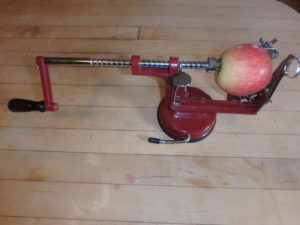
Dried apples and pears are easier presents. I have a kitchen tool that will peel, core and slice apples and pears. You skewer the apple, turn a crank, and it’s ready to use in a jiffy. Much less time consuming than cutting cherry tomatoes in half and arranging on a tray. And of course, a few dried apples will fill up a quart bag, and a good tree will last a lifetime. The slicer I have is called the Triple-Action Apple Machine and it’s available from King Arthur Flour (www.king arthurflour.com) for about $25.
As to the dehydrators, those are serious presents. I have 2 kinds, and like both. The Cadillac of dryers is the Excalibur. Mine has 9 trays, a timer and a thermostat. The hot air blows across the trays, so all dry in equal time. Mine, Model 3926T sells for around $300 (www.excaliburdehydrator.com).
For a more economical price you can get a NESCO American Harvester dehydrator. They come with heat and blowing units either on the top of the bottom of a stack of trays. Those closest to the heat dry first, so you have to keep checking them and moving trays around. But they only cost $130 to $150 from the manufacturer. (www.nesco.com). I like the dehydrator with bottom heat best. But they take longer and use more electricity than the Excalibur (1000 watts per hour of use versus 660 watts per hour for the Excalibur).
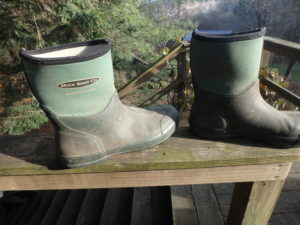
Muck Boots
I spend a lot of time working outside when the grass is wet or paths are muddy. I like dry feet, and nothing compares with my Muck brand boots. I’ve had them for over 10 years, wear them nearly every day in spring and fall, and they are not even thinking of wearing out. Mine are 10 inch high slip-ons, green, insulated. Warm. Looking on line, I think it is called the scrub boot. They cost $60-70 a pair. Of course I bought mine on sale for less.
At this time of year I’m battling mice and squirrels that want to get in the house to find food and lodging. My old house has a stone foundation, so it lets them in, here and there. Recently I got something called, “Mice Magic” from Gardeners Supply (www.gardeners.com) which claims to repel them – avoiding the need for trapping them.
Mice Magic comes in sachets like tea bags that are very fragrant – with spearmint and peppermint. Each lasts, it says, for 30 days. And one only needs one in a room to discourage the mice. So I have them in my basement and in the attic storage areas that tend to accumulate rodents. So far, they seem to be doing a good job, and these would be good presents. A box of a dozen (item # # 8592441) costs $29.95.
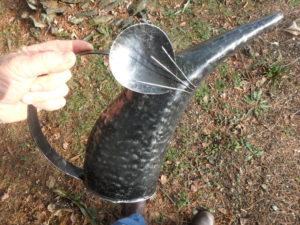
Mouse Watering Can
Speaking of mice, I recently got a watering can shaped like a mouse – complete with ears and whiskers! This is a metal watering can for indoor plants that makes me smile every time I use it. It pours nicely and holds a nice amount of water. Available from Gardeners Supply for $19.99. (item # 38-315)
Every Christmas when I write this column I mention tools, including the CobraHead weeder. This is, simply, the best weeder in America. It’s a single-tined weeder shaped like a bent finger – or a rising cobra. It can get under weeds and grasses, and tease them out. Available at garden centers everywhere and most seed companies, it is also available on line at www.CobraHead.com for $24.95.
Other tools I’d recommend? A collapsible rake. These can be adjusted to open widely, to 24 inches, or closed down to just 8 to 12 inches. There are several brands, and prices range from under $10 to about $25. All metal.
Books are great for gardeners, too. This fall I attended a lecture by Thomas Rainer and bought his book, Planting in a Post-Wild World: Designing Plant Communities for Resilient Landscapes, co-authored by Claudia West. It’s an interesting read, presents many provocative ideas, particularly for urban and suburban gardeners. They explain, for example, that we often plant gardens with plants that would never be together in the wild – they have entirely different needs for sun, water, pH – and we could do better planting those that have similar requirements. (Timber Press, $39.95).
Last winter I attended a talk by Celeste Longacre and bought her self-published book, Celeste’s Garden Delights: Discover the Many Ways a Garden Can Nurture You (available for $25 at www.celestelongacre.com). It’s a nice book that not only gives tips for growing vegetables, but also for storing and using them. I got some good tips from it, including a better way to store beets.
So Santa, I don’t really need anything this Christmas, but if you want to drop off a load of reindeer droppings, they’d be great for my compost pile.
You may reach Henry at henry.homeyer@comcast.net or by mail at PO Box 364, Cornish Flat, NH 93746. Please include a SASE if you want a response by mail. Read his blog at https://dailyuv.com/gardeningguy.
Forcing Bulbs
Posted on Tuesday, November 14, 2017 · Leave a Comment
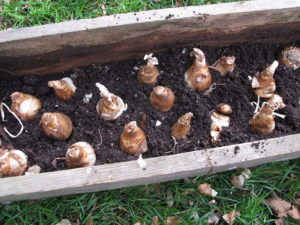
Daffodils for forcing
Each fall I pot up daffodils, tulips, crocus and other bulbs for indoor blooming. Now is the time to do it. It takes a long time for bulbs to establish roots and get ready to bloom, come spring, so the sooner you do so the better. Most bulbs need three to four months before they are ready.
Most bulb packages will specify early, mid-season or late blooming times. When selecting bulbs for forcing, choose early-blooming or mid-season varieties. Species tulips like Fosteriana and Kaufmanniana are both early. The Darwin hybrids are early- to mid-season varieties that force well. Triumph tulips are also good.
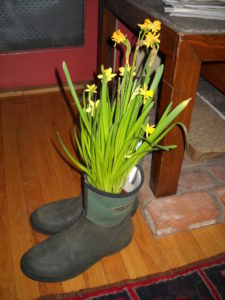
Forced Tete-a-tete daffodils
Of the early daffodils my favorite is Tete-a-Tete which produces small gold flowers, 2 or 3 blossoms per bulb. These are readily available in grocery stores in early spring and I buy them already blooming in small pots for under $5. One of my favorite things to do with them is to put a pot in a rubber boot in the mudroom, their blossoms poking out of the boot. It always evokes a reaction from visitors.
So how do you force bulbs? Plant them in ordinary potting soil in pots and keep them in a cool spot that stays slightly above freezing, and never more than 50 degrees. I have a cold, above-ground basement that is perfect for that. But you can keep them in the garage or perhaps the bulkhead.
No harm is done if temperatures drop below freezing for part of the time they are getting ready, but no growth occurs when they are frozen, so keeping them above freezing is better.
Bulbs have everything they need to bloom already packaged inside. You don’t need to fertilize the bulbs when you plant. Each fall I clean out all the pots that had annual plants on the deck and save the potting mix in a big contractor bag. I use that potting material to fill other pots for forcing bulbs.
Mice can be an issue if planting tulips or crocus, though daffodils and alliums are of no interest to them. I cut squares of plywood large enough to cover any pots I use for tulips. I put a brick on top of the plywood to keep mice out – they can squeeze through incredibly small spaces.
Most gardening books warn against watering the soil mix in which you have planted bulbs. They say bulbs will rot if too wet. That may be true, but I’ve found that in winter my problem has been more with the soil drying out too much. Humidity is very low in winter, and the potting mix, which is peat-based, loses moisture quickly by evaporation. I check the soil once a month and water if the soil feels dry. One year I let the mix dry out to much and did not get many blossoms. Always start with lightly moist soil mix.
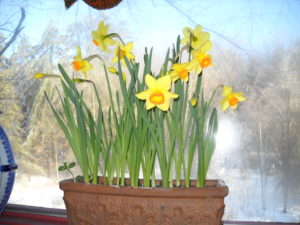
Forced daffodils
Clay pots may look good to you, but they can allow moisture to evaporate quickly from the sides of the pot. Plastic, fiber glass or porcelain containers are better for bulbs because they hold the moisture of the potting mix, minimizing water loss.
So how close can you plant your bulbs? Basically as close as you want. I have some nice Italian pots that I use each year for forcing. They are rectangular, roughly 14 inches long, seven inches wide and six inches deep. I put 8 to 10 bulbs in each one. In a 10-inch round pot I put 10 daffodils. An inch or two between bulbs is fine.
Most pots do not allow the same planting depth you would have outside. Instead of 6 inches of soil covering a tulip or a daffodil, two or three inches is fine. I put a thick layer of soil in the bottom of the pot, then arrange the bulbs on it. I push down on each bulb to set if firmly in place, and then cover with soil mix. A light watering is good after patting the top of the soil to firm it up a bit.
If you do have a deep pot – 10 inches or so – you can plant 2 layers of bulbs. Plant daffodils near the bottom of the pot, add soil mix, and then add some small bulbs like crocus or snowdrops near the soil surface. Just leave a little more space between the small bulbs than you might otherwise so that the daffodils can grow up between them.
How do you know when your bulbs are ready to bring into the warmth of the house? Make a tag for each pot that tells you what is planted, and when it was planted. Eight to twelve weeks is fine for daffodils, and 16 weeks for tulips. But look at the pots. If buds are up and craving light, bring them up a little early if you wish. But never bring tulips up before the end of February or they won’t bloom.
Winter is often a hard time for gardeners. We crave working in the soil and seeing things grow. Forcing bulbs indoors is one way we can satisfy our need to have flowers – even with snow on the ground.
You may reach Henry at PO Box 364, Cornish Flat, NH 03746. Please include a SASE if you want a written reply. Better yet, e-mail him at henry.homeyer@comcast.net. You may read his blog posts at https://dailyuv.com/gardeningguy.
Tips for Fall Transplanting
Posted on Tuesday, November 7, 2017 · Leave a Comment
Now is a good time to divide and transplant some of your perennials. I recently dug up and moved Shasta daisies, Siberian iris and snakeroot (Cimicifuga spp). Most perennials can be divided in either spring or fall, and experience is the best way to know what season is best for any given plant. Most plants are not too fussy.
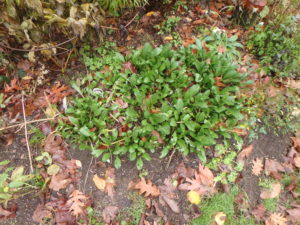
Shasta daisies in need of division
Shasta daisies tend to die out if they are not divided every 3 to 5 years. And you probably have seen iris with a big dead section in the middle of a clump. It’s my belief that the center dies out because the plants have used up all the needed minerals in the soil. This starts in the middle where the original plant began its life.
Why bother digging up and dividing flowers? Some develop into huge clumps that overwhelm a garden bed, or elbow out nice plants next to them. This is particularly true for plants that spread by root like beebalm (Monarda didyma), common orange daylilies and obedient plant (Physostegia virginiana). Those plants can be quite aggressive.
Other plants, heavy-feeders, need to be divided in order to enrich their soil. Once a year I generally sprinkle some slow-release organic fertilizer like Pro-Gro or Garden Tone over Siberian iris to help replenish minerals that get used up. This minimizes the need to divide and re-plant. But digging up and adding compost and fertilizer will help considerably to re-energize a plant.
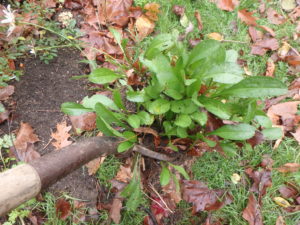
Slide a fork under the plants and lift
Here is what I do: I use a garden fork or drain spade (an extra-long spade) to loosen up the roots of a plant by sliding it in under the plant at a 45 degree angle and prying upward. Some plants – daylilies and Siberian iris, for example, hold on tightly. Others, like Shasta daisies and bearded iris have roots near the soil surface and come up easily. You may have to go all around the perimeter with your fork, or just on 2 sides.
I lift the plant out of the ground and place it in a wheelbarrow or on a tarp to minimize soil loss and messiness. Then I use my hands, a shovel or a sharp serrated knife to divide the plant. I like to just split it into several smaller chunks with my hands if possible. But a big chunk of Siberian iris will not pull apart, so cutting through the roots is necessary. I know that seems brutal, but the plant will survive nicely.
If you have invasive weeds or perennials growing near the plant you are dividing, you should be very attentive to the roots. Know the color and texture of goutweed roots, for example. If you see even a smidgen of goutweed root in with the plant you are dividing, STOP! You don’t want to move it to a new area of your garden.
If you are receiving plants from friends, always ask if they have invasives. I got goutweed from a dear friend who kindly gave me some iris – with goutweed roots mixed in. Twenty years later I am still fighting a losing battle with that goutweed.
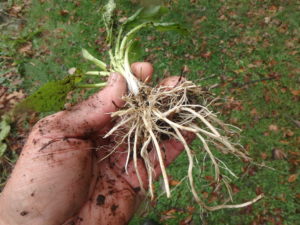
Bare rooted plant
If you think there might be roots of an invasive plant, either throw it out or bare-root it. Bare-rooting a plant means removing all the soil from the root mass. I do this with a sharp stream of water from my hose. It’s a messy procedure, but getting rid of the soil will allow you to see what roots are part of the plant you want, and what else may be mixed in. Most invasives have distinctive roots.
When you bare-root a plant it is important, when re-planting it, to make sure you get soil to cover all the roots. I will make a hill of soil in the planting hole and drape the roots over it. With my fingers I press soil around the roots, and cover them well. Then I water to get soil to fill in air pockets. Even though air is needed by roots, air pockets will dry out roots, damaging them.
After your plants are lovingly tucked in for the winter, spread some mulch over them. This will slow the soil from freezing, and give the plant more time to establish its roots. I like chopped leaves or pine needles, but chopped bark mulch is fine, too.
When you are cleaning up your flower beds this fall, think about cutting back annual flowers instead of pulling them. If you pull a big sunflower or zinnia, you are leaving an open space that will practically invite weed seeds to infiltrate your garden. If you leave the roots and a little stem, those may decompose over the fall and spring and add organic matter to your soil. And if your flower bed is on a slope, even a gentle one, a bare spot of soil will allow heavy rains to wash off some of your precious topsoil. You can pull those roots when you are ready to plant next spring.
This is also a good time to dig up and get rid of plants that you don’t like, are too aggressive, or are just not thriving. You don’t have to keep every plant. If you don’t like it, get rid of it!
Cold weather is on the way, so if you need to divide plants, you’d better get going!
You may reach Henry at henry.homeyer@comcast.net or by mail at PO Box 364, Cornish Flat, NH 93746. Please include a SASE if you want a response by mail.
How to Minimize Garden Pest and Disease Problems Next Year
Posted on Wednesday, November 1, 2017 · Leave a Comment
As an organic gardener, I am always looking for ways to minimize the chances of pests or diseases in my garden. I don’t use fungicides or insecticides, even those that are all-natural and are approved for use by organic farmers and gardeners. I want it all: tasty veggies and healthy plants – but no interventions. And generally, I get that.
How do I avoid pests and diseases? Give plants what they need for optimal growth. Plants growing in great soil with appropriate amounts of sun and moisture are generally healthy plants. It has been scientifically proven that healthy plants are less attractive to pests and diseases.
A corn plant that is pumped up with chemical fertilizer, for example, is more attractive to corn borers than one has been raised organically and had its soil amended with manure.
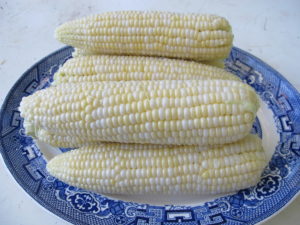
Organic Corn from my Garden
I attended a lecture by Dr. Larry Phelan of Ohio State University in which he presented results of trials comparing conventional corn with organic corn. His data was convincing. Yes, chemical fertilizers can produce big yields, but excess nitrogen from chemical fertilizers will attract borers.
Then there is the problem of tomato hornworms. These nasty, aggressive critters are a real problem for some gardeners, but I have not seen one in my tomato patch in years. Why? I’m not sure, but the last time I saw one, it was being parasitized by small wasps.
If you see what look like grains of rice on a tomato hornworm, they are being attacked by a braconid wasp. The “rice” grains are larvae that are slowly sucking the hornworm dry. If you see this happening, don’t kill the hornworm. Just remove it (wearing gloves) and carry it far from the tomatoes. The larvae will do the rest.
How can you encourage parasitic wasps to live in your garden? First, do not kill them – though they are not very noticeable. And do not use chemicals to kill other pests such as Japanese beetles or potato bugs.
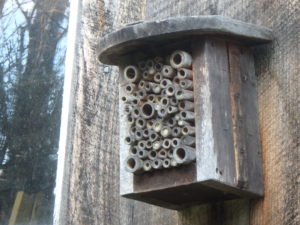
A home for solitary wasps
I have a small “home” for solitary wasps attached to my barn. It is a box filled with bamboo tubes of different sizes, their ends facing out. These tubes offer shelter for insects and places where they can lay eggs or stay out of danger. I don’t see it used much, but I know that solitary wasps do need such places. Nature offers the best places, I’m sure, so if I don’t rake and manicure every inch of my property. A naturalistic setting offers many sites for good bugs. Mother Nature, left to her own devices, tends to have a balance of good critters and bad. I try not to second guess her too often.
But what about introduced species that are a problem with our crops? They can easily cause damage and get out of control. One such pest is the spotted winged drosophila (SWD), an Asian fruit fly that arrived in 2011. Instead of just eating overly ripe fruit laying on the ground (as most native species do), this one will attack good fruit on the bush. Mushy fruit (complete with bugs) is the result. Blueberries have been severely affected in some places.
I recently phoned Dr. Alan Eaton, the state entomologist for New Hampshire, to see if any progress has been made in controlling this pest. No, he explained, they are still in the learning phase at present. Early reports had suggested that early-ripening crops of blueberries and strawberries were less susceptible to SWD. But he told me that this year they were finding earlier and earlier reports of damage. And this year they had reports of SWD on cherries for the first time.
These fruit pests are just one twelfth of an inch in size, so netting (always a friend to organic gardeners) musts be very fine to keep them off our crops. Most commercial growers are resorting to chemical sprays. Me? I’m rooting for the birds and other insects to take charge.
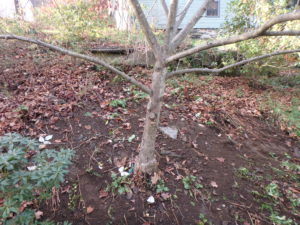
It is important to clean up under you apple trees
So what can you do to reduce chances of pest and disease problems next year? Clean up your garden well this fall. Apple scab, for example, causes deformed, inedible fruit. The disease can be minimized by simply raking up leaves and fruit- right now. This year I took it a step farther and used a pole to knock off any apples left on the tree, and raked them up, too. Many of those left on the tree were clearly rotten. I’ve read that spreading compost under apple trees introduces beneficial microorganisms and may help control diseases, too.
According to Dr. Eaton, destroying vines and leaves of plants in the squash family – cucumbers, squash, pumpkins, melons etc. – is important at this time of year. Striped cucumber beetles over-winter in plant debris, so getting your garden clean is important. I put vine and tomato plants on my brush pile and burn it once snow has fallen, but you can also bag it and send it off with household trash. Composting is not usually an effective way of ridding your garden of these pests.
Remember: well-tended plants are less susceptible to diseases and less attractive to pests. I am always amazed at how healthy my garden is despite – or because – I use no chemicals – and have always used organic methods. It takes a while to develop a good supply of beneficial insects, I suppose, but get started!
Henry is a UNH Master Gardener and the author of 4 gardening books. He is available to give talks at garden clubs and libraries. Reach him at henry.homeyer@comcast.net or P.O. Box 364, Cornish Flat, NH 03746.
How to Eat From Your Garden All Year
Posted on Tuesday, October 24, 2017 · Leave a Comment
This was a good gardening year. Adequate rain, adequate sun. I know that I will have food from the vegetable garden that will allow me to eat something from it every day all year. Eating something every day from my garden is a bit of an obsession, but not all that hard to do. I am putting my root crops away for the winter now, and drying herbs.
My best crop this year was potatoes. In a 30-inch wide (double) row that was nearly 50 feet long I harvested about 125 pounds of potatoes including 5 different varieties. I had no potato beetles even though I used no pesticides, not even the organic Bt bacterial spray. My tip for doing so? Plant late. By mid-June potato beetles have started eating something, somewhere else. Maybe they were munching my neighbors’ potatoes, I don’t know.
When researching a book project in 2002 I drove around the country visiting farms and talking to farmers. In Idaho I worked for 3 weeks as a farm hand on an organic farm that grew potatoes, among other things.
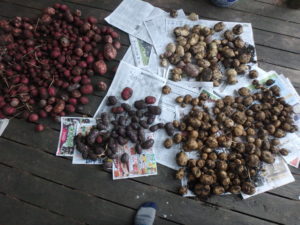
Potato harvest 2017
I learned that potatoes need to be stored in a cool environment with high humidity. Commercially that meant storing them right at 50 degrees. At cooler temperatures some of the starches are converted to sugars. That would mean that French fries – America’s favorite potato product – would tend to darken up too much. I don’t make fries, and store my potatoes in a cold basement where they stay between 33 and 50 degrees. They’re very sweet.
Before I store my potatoes I harden them off outside for a few days. I place them on my north-facing deck where they get a good breeze, but not too much sun. I roll them over once a day so that all sides face up for a while.
If you don’t have a cold basement, get a spare fridge. These are often offered for sale used at $100 or less – and over the years I have gotten a couple free. They will keep root crops cool and keep mice from nibbling the harvest. If you keep it in the garage it will never run all winter, though you may need to add some heat inside it in January. A seed-starting heat mat will provide low heat for just a few pennies a week. Keep a thermometer inside it to monitor the temperature.
What else will store well in a fridge? Beets, carrots, rutabagas, kohlrabi and celeriac. Leeks should store well, but don’t. Those I clean, cut up, pack in zipper bags and freeze. Carrots will store well in the ground, but are targets for mice, so I pull them now.
Dried foods last all year, too. I dry tomatoes, herbs, apples, pears, berries and hot peppers. Cherry tomatoes, cut in half, are easy to dry and add great flavor to soups, stews and stir fries. Hot peppers I grind in the coffee grinder so that I can add just a little pepper powder to spice up a dish gently.
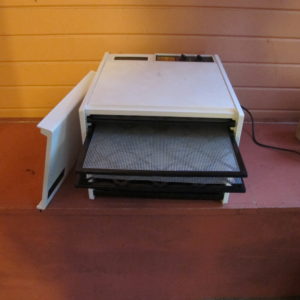
Excalibur dryer
Any type of dehydrator will work fine, but the two I like best are the Excalibur and the NESCO American Harvester. The Excalibur is more efficient, but also more expensive to buy.
A cool dry location is good for storing garlic, onions and winter squash. Winter squash like Waltham butternuts and blue Hubbards will store until next summer under the right conditions. A cold spare bedroom is a good spot – 50 degrees is great. Some kinds of onions store better than others. Yellow onions store well, but start to sprout by spring. Then I use my frozen leeks to substitute for onions in cooked dishes.
Freezing garden produce is good, but a bit time consuming. The easiest vegetables to freeze are tomatoes because they’re so easy to freeze. I just put clean tomatoes in a zipper bag and freeze whole, removing them to use in soups and stews like canned tomatoes. And running hot water over a frozen tomatoes will separate the skin from the flesh in just a moment.
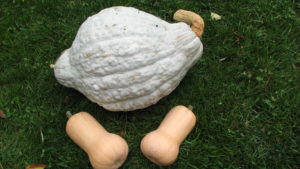
Blue hubbard squash with Waltham butternut squash
Most vegetables need to be briefly boiled before freezing – a minute or less. That is called blanching. But tomatoes, leeks, berries and peppers do not require blanching. Some gardeners blanch kale, while others do not. Blanching kills aging enzymes in food, so if you are going to eat frozen vegetables within 3 months it probably is not needed. But if you want to eat kale, beans, broccoli or summer squash 6 months from when you picked it, blanching is recommended.
One last word on freezing. I recently read a paper from University of California at Davis that explained that I could freeze garlic. Just separate the cloves, put in a freezer bag and freeze. I’ve never done that, but I will try that this year as garlic tends to dry out or sprout after a few months. I have also dehydrated garlic and ground it into a powder.
However you store your food, having something from the garden to eat during a February blizzard will bring a smile to your face- or at least it does from me.
Read Henry’s blog posts at https://dailyuv.com/gardeningguy You may reach him at henry.homeyer@comcast.net or PO Box 364, Cornish Flat, NH 03746.
Life After Frost: Gardening Is Not Over
Posted on Tuesday, October 17, 2017 · Leave a Comment
Frost was late this year. It was nearly mid-October before we had a hard frost, one that murdered the zinnias and blackened the basil. For me, hard frost is a day to mourn a little, to spend a few moments missing the summer that passed, for the tomatoes that brought me such great pleasure and the flowers that graced my table.
But autumn is grand, too. I still have plenty of garden veggies to harvest and process, and those fall days full of sun and a few monarchs are full of surprises and delights.
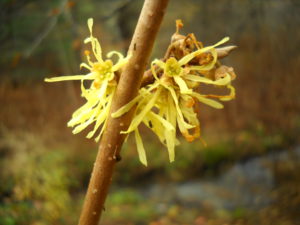
Common witch hazel
I’m always delighted by plants that bloom now –especially woody plants. I have two witch hazels (Hamamelis virginiana) that bloom subtly each fall. The blossoms are not obvious because they are small, yellow, and their leaves are yellow (and green) and have not yet fallen. But those curly blossoms will persist even after the leaves have dropped. Witch hazel is a native tree that lives in shade or part shade. It’s a small tree or a shrub, depending on the variety. It blooms either now, or in very early spring.
Another interesting shrub in bloom now is disanthus (Disanthus cercidifolius). Although most books describe the flowers as “insignificant”, I disagree. They are small – just half in inch across, and close to the stem – but they are in pairs, back to back, each like a small purple starfish. I‘ve had my disanthus for 4 years, and this is the first time it has bloomed, or at least the first time I have seen it bloom. So I yelped with excitement when I first saw the blossoms.
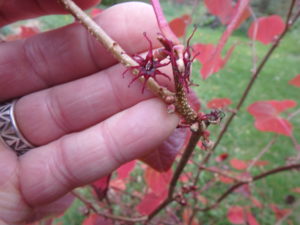
Disanthus flower
The best thing about disanthus is the leaf color. The leaves are deep red and purple, and have been so for many weeks. The color is better than that of the now prohibited invasive, burning bush (Euonymus alatus). But unlike burning bush, disanthus doesn’t litter the countryside with babies like a stray, unspayed dog. It stays in one place, and grows slowly to a 6 to 10 foot height and width.
In the flower garden my fall asters are about done, but I still have one Rudbekia or black-eyed Susan looking great. It is Rudbeckia subtomentosa, a variety called ‘Henry Eiler’. It’s taller than I am. Its petals are very delicate and are spaced apart in an airy fashion. The stems of this plant are quite thick, but not thick enough to stand up to fall winds without staking.
Grasses are nice now, too. They generally bloom in fall, producing subtle green flowers that most people don’t recognize as flowers. My favorite grass is a Chinese feather grass (Miscanthus sinensis), a variety called ‘Morning Light’. The leaves have a central white stripe and each stem stands up 4 to 6 feet, or even more. This grass will look good all winter waving above the snow.
Each stem of feather grass has 20 or so thin strands of flowers that will produce seeds. This plant does not reproduce from seed, however. The clump gets bigger each year, and can be divided to create more plants. I’ve read that the time to divide it is in the spring, not now.
The milkweed plants I started from seed this year stayed small and did not flower. But I will harvest some seeds elsewhere and plant some more. The seeds need a cold period before they will germinate, so planting outside now makes sense. Last spring I planted seeds in flats indoors, then put them in the fridge for 6 weeks before they would grow. The red milkweed I planted the year before did great this year, blooming and attracting pollinators. I will plant some of their seeds when I see the pods are ripe and ready to burst open.

Henry Eiler Rudbeckia
I’ve cut down some of my perennials, and pretty much all are ready for the knife or shears. I’ll leave things with stiff stems and interesting seed pods for winter viewing and as food for the birds. But the more I can do now, the better. One landscaper told me she figured that every hour of fall clean up reduces spring work by three hours.
One of my last tasks each year is to run over the lawn with my lawnmower, chopping leaves into perfect mulch. I rake it onto a tarp and pull the tarp to my vegetable garden where I spread the leaves over the by-then weeded beds. It keeps weed seeds from germinating in the spring, and adds organic matter to the soil as it breaks down and is eaten by earthworms.
My gardening friend and fellow garden-book writer Sydney Eddison of Connecticut always saves her chopped fall leaves in contractor bags and uses them in the spring on her flowers. I have filled up 6 huge plastic bags with grass clippings and leaves another friend gave me, and have stored them in the barn for use in the spring. Sydney Eddison has the best soil I’ve ever seen after mulching with chopped leaves for 40 years or so.
Don’t forget to plant your spring bulbs now, too. You can plant into November, but it will be cold by then, so get going!
Read Henry’s blog at https://dailyuv.com/gardeningguy Youi may reach him at henry.homeyer@comcast.net and see his web site at www.Gardening-Guy.com

 Click Here to buy from Cobrahead