Planting Garlic
Posted on Wednesday, October 11, 2017 · Leave a Comment
Growing garlic involves less work than anything else I grow. There really are only 3 steps: plant it, mulch it, and harvest it. It’s also the least expensive, once you have an established bed of garlic. I will plant this year’s crop from last year’s crop, and that one I planted from the crop of the year before. You really only have to buy garlic once – so long as you save some each year for planting.
There are basically just two kinds of garlic: soft neck garlic, which is what you probably get at your grocery store, and the stuff we grow here in the Northeast called hard neck garlic. Most soft neck garlic comes from California and keeps nearly forever. Hardneck garlic has a stiff stem in the middle of each bulb, and has a much more complex flavor (in my opinion). It will keep in a cool place until spring, but not much longer. Then it either sprouts or dries up.
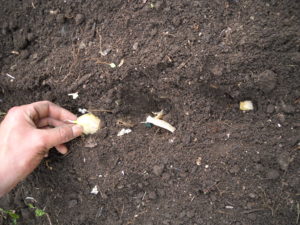
Planting Garlic
October is the time to plant garlic. If you don’t have any seed garlic, you might be able to get some at your farmers market. Don’t plant grocery store garlic, even if you can find hard neck garlic, because it is often treated so that it will not sprout. By now most catalog-sellers of garlic have sold out.
Take a bulb (or head) of garlic and separate it into the cloves that surround the hard “neck” or flower scape. Depending on the variety of garlic, you might have just five cloves, or as many as a dozen. I like big cloves, as they are easier to peel and use. So each year I select for big cloves and plant them. Over the years my crop has produced bigger bulbs and bigger cloves.
Garlic needs full sun (defined as 6 hours of sun) and rich soil. I always add compost to my garlic bed and some organic bagged fertilizer. I rake soil from the walkways into a raised bed that is perhaps 30 inches wide and six inches higher than my walkways. Ideally, by adding compost, your soil will be rich and fluffy.
To plant, I draw furrows about 8 inches apart with my CobraHead weeder, a single-tined tool that is curved like a bent finger. I loosen the soil about 6 inches deep withit, than push cloves into the soil so that they are 3 inches apart and about 3 inches deep. Always plant them with the pointy end up. Afterwards I pat the soil down with my hands to firm the soil.
The last step is to mulch your garlic. I use mulch hay or straw and put almost a foot of fluffy material over the bed. Fall rains and winter snows will cause the hay to settle – I end up with about 4 to 6 inches of material in the spring.
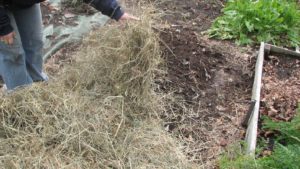
Garlic Mulch
The mulch keeps the soil from freezing until January, allowing roots to get well established before the garlic cloves go dormant. It also prevents most weeds from germinating and growing next year, though I weed the bed before planting. Garlic is tough stuff and will push right through my layer of mulch, though most weeds do not.
Depending on the weather and when you plant, your garlic may send up green stalks this fall. Don’t fret if it does. Those sprouts will die back in winter, but the garlic will send up new ones in the spring.
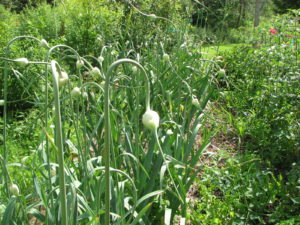
Garlic Scapes
In early summer the scape, or flower stalk, will perform for you, “dancing” to create loops, swoops and circles of green. I use these in flower arrangements. Each scape produces a flower on top of the scape that will, if left, produce seeds. Those seeds are not useful for the average gardener, as they will not produce edible garlic for 2 years. But the stems and flowers are great for early summer stir fries. Garlic scapes are a taste treat.
Some believe that cutting off the scapes early on will produce bigger cloves of garlic, but I have never been able to tell if that is true or not, though it makes sense. Producing flowers and seeds uses energy that might otherwise go to producing bigger bulbs.
Next July the garlic you planted this year will be ready to harvest. Each bulb grows about 7 long pointy leaves that also surround the cloves and protects them. When 3 or 4 leaves have turned brown and started to dry up, it’s time to harvest. If you wait too long, all the leaves will have dried up and the garlic will not store as well – it will dry out too soon.
I’ve been told that after harvesting that garlic should be cured in a cool shady place for a week or two before you cut off the tops. Why? Because nutrients in the leaves – some of which are allegedly good for preventing cancer – will migrate to the bulbs and be absorbed.
You can store garlic best in a cool, dry place. Ideally 50 degrees with moderate humidity. I recently read an article produced at the University of California at Davis that you can freeze garlic instead of storing it at room temperature. Separate the cloves, but don’t peel them. You can freeze them in a zipper bag or jar for a year or more. I shall try that. Don’t store garlic at room temperature in oil, as it can produce deadly botulism.
Garlic may or may not repel vampires and viruses. I do know it makes food taste better, and is full of vitamins and minerals. So I grow it, and you should, too.
You can reach Henry at henry.homeyer@comcast.net. Read his blogs at https://dailyuv.com/gardeningguy.
Planting For the Birds
Posted on Wednesday, October 4, 2017 · Leave a Comment
I’ve never calculated how much I spend each year on bird seed, but it’s considerable. I know people some spend a lot more, who think nothing of buying big bags of 2 or 3 kinds of specialized seeds for the birds every few weeks, and who maintain half a dozen feeders much of the year.
Does Mother Nature buy bags of booty for birds? No. We can reduce our expenditures and help the birds through judicious management of our wild spaces and our gardens. Now is a good time to plant a few things for the birds.
To support birds, it’s important to provide them with food all year, nesting places, and safe places out of the reach of cats, foxes and hawks. Agreed, it is easier to feed black oil sunflower seeds to provide food in winter than to plant trees, but there are trees and shrubs that do provide fall and winter food.
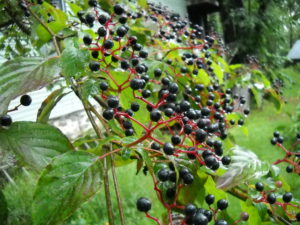
Pagoda Dogwood berries
Shrubs are great for summer and fall treats. Pagoda dogwood (Cornus alternifolia) provides berries that are eaten voraciously in mid-August, but are long gone now. Same for blueberries, which, alas, are enjoyed by the birds as much as they are by us.
Three shrubs that produce fall berries are silky dogwood (Cornus amomum), red osier dogwood (Cornus sericea) and gray dogwood (Cornus racemosa). The first two grow wild in wet areas in part shade to full sun. Gray dogwood appears at the edges of dry forests. All produce berries enjoyed by birds. I went out in early October and found just a few berries left on silky dogwood growing wild near my stream. All have berries from August to October.
For winter food, nuts and cones are the best source of bird food. It’s true that most birds cannot break open a walnut, chestnut or acorn – though I have seen crows feeding on walnuts broken open on the road. But as the winter progresses, nuts soften and the interiors become available to birds. Squirrels are messy eaters, and often leave parts of nuts scattered on the ground and available to birds, too.
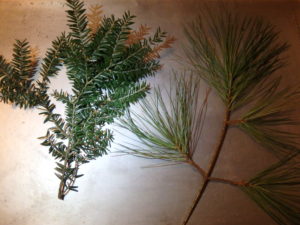
Hemlock left, White Pine right
Two of the most popular trees with birds are the white pine and Canadian hemlock. Not only do they provide food – seeds from their cones – they provide shelter and nesting places. The eastern white pine is used by more than 40 species of birds, and Canadian hemlock is used by more than 25 species.
If you are interested in learning more about trees and shrubs used by birds, I highly recommend a book by Richard M. DeGraaf, Trees, Shrubs and Vines for Attracting Birds (University Press of New England, 2nd edition, paperback at $24.95). This book lists, for each common species of woody plant, the birds that use it, and how they use it.
Is this a good time to plant trees and shrubs? Yes. Actually there are two schools of thought about this. Scientists have determined that trees and shrubs extend their roots in the fall, even after leaf drop. So many plantsmen, myself included, vote for fall planting. Not only are roots going to grow, the climate is usually cooler and wetter, so the chances of drying out are smaller.
The other school of thought maintains that planting in spring is better. They say that so long as you are attentive to your plants, and keep them watered, they have more time to get settled in before the stress of winter. I’m a careful gardener, but a busy person, and I know how easy it is to forget about watering for a week or two – which in august can be deadly. So I say plant now – or in September, but not after early November.
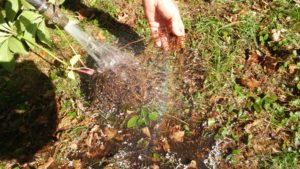
A stream of water is good for loosening roots
I recently went to a gardening workshop where one of the presenters advocated removing much of the soil from perennials purchased in pots before planting. The idea is that plants grown in pots get their roots all snarled up over time, and have roots circling the plants. I have always teased out plant roots with a finger or a tool, but have never used her suggestion – a stream of water.
So recently I tried using the hose to loosen plant roots, and, much to my surprise, it worked very well. I thought I’d be holding a handful of mud and a disintegrating root ball, but it worked fine. So next time I plant a tree or shrub, I shall try using a sharp stream of water to wash away some of the soil and to allow me to tease out the roots more easily – without breaking them.
But back to the birds. Here is a list of plants that DeGraaf’s book list as helping 20 or more species of birds: balsam fir, sugar maple, serviceberry (Amelanchier spp.), birches, flowering dogwood (Cornus florida), beech, Eastern red cedar, apples and crabapples, red mulberry, black tupelo, spruces, pitch pine, cherries of all kinds, oaks and American elm. That list includes some Zone 5 and 6 trees, so not all are appropriate everywhere.
Of the shrubs, here are some of the best: dogwoods of all kinds, hawthorn, huckleberry, bayberry, staghorn sumac, roses, brambles of all sorts, elders and blueberries. Common grapevine is also highly useful for birds.
It’s true most of us do not have garden space for more big trees, but there is always space for a few more shrubs along the edges of our space. So get out your shovel and get to work!
You may reach Henry by e-mail at henry.homeyer@comcast.net. Read Henry’s regular blogs at https://dailyuv.com/gardeningguy.
Putting the Garden to Bed
Posted on Tuesday, September 26, 2017 · Leave a Comment
Early autumn is a great time to work in the garden, and it’s not too early to start putting your garden to bed. I can work early in the morning without layers of wool, and my hands don’t need gloves to stay warm. Too often we gardeners wait until later, when frost is on the garden, to clean up. Start now, do a little each day, and the job will not be onerous.
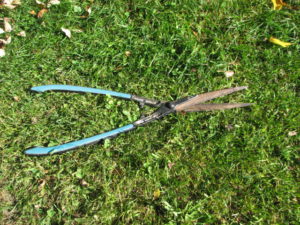
Hedge shears
Start by removing anything that is ugly. Your bleeding hearts (Dicentra spectablilis) has foliage that is yellow and has collapsed. Cut it out! Peonies may have dark blotches on the leaves – a potential sign of a fungal disease called botrytis – and should be removed.
Anything that looks like it is diseased should not go in the compost pile, but in the household trash or on a burn pile for winter. Be sure to cut right to the ground when removing foliage. Yes, you have to bend down a little lower, but the close to the ground, the better. That way you will be more likely to remove any diseased portions, and it will look better in the spring.
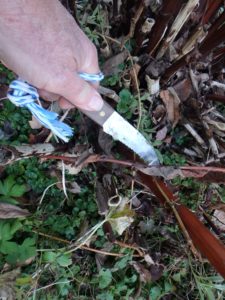
Serrated knife is good for cutting down flower stems
I know many gardeners like hand pruners to remove foliage, but I find that a bit tedious. I like a serrated knife. I hold a handful of tops, and with one swipe of my knife I cut through it all. The same group of stems might take a dozen snips. I’m all for speed and efficiency when working in the garden.
Other techniques? Hedge shears will make quick work of a big clump of iris leaves. But make sure they are sharp. Modern electric hedge clippers work, too, but I have been known to cut off the cord. Be sure to plug into one of those special outlets with reset buttons (GFCI) if you using electric hedge clippers – they’ll save you from getting electrocuted!
I have one 50 foot bed that is 8 to 10 feet wide. I call it my Darwin bed, as plants compete for space. No weeding. It’s full of tall plants like Joe Pye weed, turtlehead, phlox and more (including goldenrod for the pollinators). In late October, but before snow, I will run over the entire bed with a riding lawn mower, blade all the way up, engine racing at full throttle. It works!
You may wish to leave some flowers for the birds. Nice seed pods on purple cone flowers and black-eyed Susans will please the finches in winter, and look great above a thin layer of snow. Decorative grasses will sway in the winter wind, and look good for at least a month or two. You can always clean them up in the spring, or during a winter thaw if so inclined (and wearing wool).
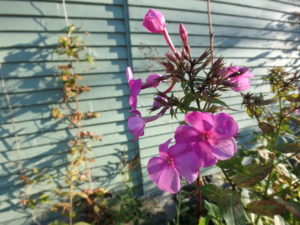
Phlox in November
As you cut back your perennials you will notice some volunteer plants. Phlox is forever planting itself around my garden, as is great blue lobelia and (dis-) obedient plant. It is natural to say, “Oh, how nice, the phlox is spreading.” But do I really want more phlox? NO, if I did want more, I would have planted more. I’d really like a new color, not more of the same. So I’ll dig it up and put it at the end of the driveway in a throwaway plastic pot. “FREE” will stop traffic.
As you cut back, weed! That will require different body motions – and fewer aches and pains. You probably already know some weeds by name, and by root. Some are perennials or biennials with deep tap roots. Others have lateral roots with nodes that send up more weeds. Annual weeds pull up with little effort and have small roots – but thousands of seeds. Try not to shake out seeds from weeds that have bloomed and set seeds. They will be back to annoy you for years to come.
I bring 2 tools with me for weeding: a garden fork and a CobraHead weeder. The fork is great for deep-rooted weeds. I plunge it in or step on it to force it into hard soil, then tip it back, loosening the soil. The weed, along with the deep root, will come right out, particularly if the soil is moist.
The CobraHead weeder has a single curved tine with a widened tip. It has become an essential tool for me; it’s like a curved finger. I use it to get under a weed. It allows me to lift and loosen soil beneath a weed while I tug on the top. If there are lateral roots, I tease them out, tugging and loosening until I have the entire darn thing.
Nothing beats crawling on your hands and knees for finding weeds. You are at their level. But if it’s hard for you to get back up, maybe you’d like to sit on something, particularly if the soil is cold and wet. I sometimes use a 5-gallon pail, but have seen some nice kneeling seats designed for gardeners, and have heard nice things about them. But to each her own.
Mulching? That can be the last step of fall clean up. Finely ground bark mulch or chipped leaves can be good for keeping down weeds, but don’t use too much. And try to keep it back from the crown, or center growing area of the plant. You can ruin peony’s ability to bloom by covering it with 3 inches of bark mulch. And avoid buying bagged mulch that is “color enhanced”. It has chemicals in it.
Me? I like flower gardens that have big clumps of perennials and lots of groundcover plants to cover bare spaces. That’s what Mother Nature does. I don’t like big swaths of bark mulch, though I use some in newer beds.
So go get to work on a nice day. It will save you time in the Spring.
Read Henry’s blog posts at https://dailyuv.com/gardeningguy You may e-mail him at henry.homeyer@comcast.net.
When – and How – To Plant Bulbs for Spring Blossoms
Posted on Tuesday, September 12, 2017 · Leave a Comment
When the soil drops to 60 degrees Fahrenheit at proper planting depth, you can plant bulbs. You’ll need a soil thermometer, but that’s a handy device anyway – they’re useful in the spring to see if the soil is warm enough to plant tomatoes or eggplants without making them recoil in shock like a sixth grader wading into a chilly pond.
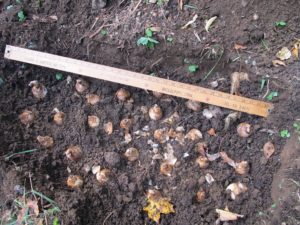
Daffodils planted in a 36-inch diameter hole, about 6 inches deep and 3 inches apart
Soil thermometers are similar to the probes sold for testing turkey temperatures in the oven. A steel probe with a dial on top. You just poke it into the soil and wait a moment. Sometimes I put a pieces of tape at different locations: 3 inches for crocus, 6 inches for daffodils, 8 inches for tulips. Then I can easily see the temperature without digging. They are available at garden centers, or on-line.
Why sixty degrees? In soil warmer than that, your bulbs may sprout, thinking it’s spring. That’s not lethal, but not desirable. You do want the soil warm enough so that the bulbs will establish roots now, getting them ready for action in spring and holding them in place against frost heaves.
I tested the soil in a few places recently to see if it’s ready to plant. In full sun in my vegetable garden, the soil was slightly above 60 degrees, but in a shady flower bed the soil was in the high fifties. And down 8 inches it was 4 or 5 degrees cooler. I’ll plant crocus later, as the soil at crocus depth (3 inches) is warmer than deep down.
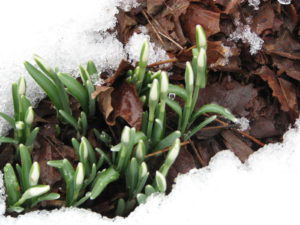
Snowdrops in bud on March 1
I bought my house 47 years ago, and I’ve been planting bulbs most years ever since. Most places suitable for bulbs, have bulbs. So this year I shall plant some in the lawn. Not daffodils, as the foliage can’t be cut back until July, and that would keep the lawn looking unkempt. But I could plant small bulbs like crocus, snowdrops or scilla. Their foliage dies back early enough that I’ll be able to mow the lawn when needed without compromising the bulbs. I’ll plant them by poking holes in the lawn with my CobraHead weeder (www.CobraHead.com).
Some years ago I was visiting a garden in Wales. The gardener had a bucket of tennis balls, and was tossing them onto the lawn. “What in the world are you doing,” I asked. He explained that he wanted to plant bulbs in a random pattern. Wherever a ball landed, he planted a bulb. Maybe I’ll try that.
I like to consider tulips as annuals. They do come back in year two at about 50 percent of year one, and year 3 is usually about 50 percent of that. So in general I buy 100 tulips, plant them all in the vegetable garden, and enjoy a big burst of color. I cut most and use in the house, or as gifts. I plant right over them after blooming, not worrying at all if they survive. A few will pop up in the lettuce the following year.
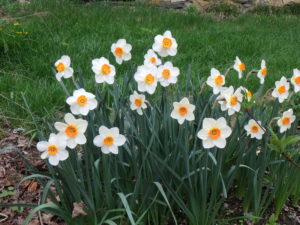
Daffodils are deer-proof
Daffodils are not attractive to rodents or deer as bulbs or as flowers. In fact, they are vaguely poisonous. But tulips are tasty to critters. Last year I planted a few cloves of garlic in with my tulips to repel rodents. I don’t generally have trouble with deer – I have a ferocious corgi who scares them off. They think she is a wolf, I suppose.
If you have deer problems, you probably will want to plant tulips in big swaths and then surround them with a temporary fence before they bloom. Even a 4-foot chicken wire fence should deter them, I think. There are repellents, of course, but I’ve never used any with tulips.
I have 3 books in my personal library about bulbs. All say to plant tulips and daffies 6 inches apart. I don’t. It uses too much space. I plant them three inches apart, and they do fine.
There are two keys to success when planting most spring-blooming bulbs: First, plant in full sun. Yes, in principle, you can plant daffodils in the woods if there are no evergreens and they will get enough energy from the sun before the maples leaf out. But they will do better in a sunny border. Root competition from trees diminishes their vigor.
Second, plant bulbs in soil with good drainage. Soggy soil is a death knell to most bulbs. If you have a heavy clay soil that holds water, plant your bulbs on a slope. Toss away half the soil you dig out and mix a light, fluffy compost with the other half. Dig deeper than needed, and fill with that same fluffy mix.
I don’t regret a penny I’ve spent on bulbs. Yes, some can be expensive. Yes, some don’t perform well. But by the end of a long New England winter I am so ready for blossoms I am willing to do almost anything (short of a deal with the devil) to get flowers blooming outdoors.
So go buy bulbs now. Later, when it’s time to plant, the best ones will be sold out. Start at your local garden center and look on-line for a few fancy things. Do this every year, and you’ll be delighted!
Is it okay to prune shrubs now? Learn which ones can be pruned by reading Henry’s blog post at https://dailyuv.com/news/920694. His e-mail address is henry.homeyer@comcast.net.
Six Fall Chores to Do This Weekend in the Vegetable Garden
Posted on Tuesday, September 5, 2017 · Leave a Comment
Labor Day has come and gone. Big yellow buses are slowing traffic twice a day. But it’s not time to give up on gardening and move on to watching football and waiting in a Lazy-Boy for the maple leaves to turn red. Your gardens still need you. Let’s look at the vegetable garden.
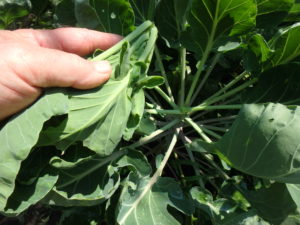
Remove top leaves of Brussels sprouts to get bigger sprouts
My Brussels sprout are the size of peas, very small for the time of year. But I know how to fix that. I just cut off the top cluster of leaves. That will prevent the plant from using its energy to get taller. Instead it will pump up the “sprouts” we love to eat into big, healthy veggies.
Pumpkins and winter squash need the knife, too. They will continue to elongate their stems, growing out of the garden and across the lawn. But a blossom starting now will have little chance of maturing into a potential Jack-O-Lantern. So nip off that vine and let the energy from the sun and the minerals from the roots go to the fruits that have some chance of success.
Most tomatoes are what we call “indeterminate”. That means they will continue to grow taller until they are killed by frost. Most Roma-type tomatoes (plum) are determinate, as are a few others used mainly for canning or growing in pots. They reach full size and then concentrate on producing one load of fruit that can be picked and canned. But Big Boys and most heirlooms will continue getting taller, which can be a problem.
I’ve seen tomato plants 30 feet tall in commercial greenhouses. They grow up ropes that can be lowered down for picking. But you probably are not equipped to deal with tomato plants that are even 8 feet tall. So nip off the tips of tall branches.
If you haven’t been paying attention to your tomatoes for a few weeks, you might well have some fruit laden branches laying on the ground. These are much more susceptible to rot than fruit that is tied to a stake or cage. Lift the branches and tie them to the outside of the tomato cage. I recently was give some old panty hose that I cut into strips and used to tie up mine. It’s soft and stretchy, and does a great job. String is not perfect for the job as it can cut into the stems. Old bed sheets can be cut into strips for the job instead.
Potatoes are reaching full size for many gardeners. I plant mine later than most (mid-June) and they still have nice green leaves that are turning sunshine, carbon dioxide and water into carbohydrates that will keep me plump all winter. But if yours have brown leaves, you can dig them now. Or you can steal a few by reaching under a plant or two and grabbing a spud for dinner, but leaving the plant itself undisturbed.
As with any plant that is susceptible to fungal diseases, I do not toss potato plants onto the compost pile. Squash, tomatoes and potatoes all fall into this category. I carefully dig all the plants (including leaves and roots) and put them on a brush pile I will burn this winter after snow falls. If you don’t have a burn pile, you can put them in household trash or create a separate pile in a far corner of your property. I do that to minimize fungal diseases next year.
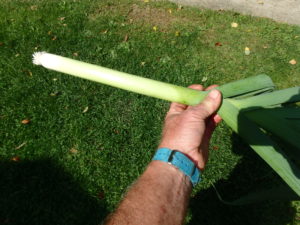
This leek has 12 inches of useable stem once a few leaves have been pulled off
Leeks are ready to harvest, but can stay in the ground a few more weeks. I use leeks not only for leek and potato soup, but also as a substitute for onions. And you don’t have to just use the white part of leeks. Commercial growers hill soil over the leeks as they grow, keeping a longer portion white than I do. But most of the green part of the stem is good to use, too. I pick every other one now, thinning them out, and leaving some to get even bigger.
My peppers are pathetic this year. I only planted a few, some Hungarian wax and a few sweet peppers. I got a few of the hot wax peppers early on, but the cool, rainy summer has not encouraged most plants to blossom and produce fruit.
By now my peppers must be scared that winter is coming and they have not produced enough seeds to keep their line of DNA alive. We had one night where the temperature went down to 33 degrees! That should have been a wake-up call. So I am hoping that they will bloom and produce some fruit during the hot Indian Summer days that are sure to come.
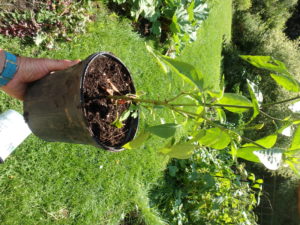
Transplanted pepper plant
I am trying an experiment with my peppers this year. On Labor Day I dug up 2 Hungarian hot wax peppers and transplanted them into 8-inch pots. I used potting soil, not garden soil in the pots as it will stay fluffier than garden soil, which tends to compact in a pot. I am keeping them in the garden, but will carry them inside any time the temperature is predicted to go much below 50 degrees. Then I’ll carry them outside again in the morning, sort of like walking the dog. They are wind-pollinated, so being indoors will not be a problem. I’ll let you know if I get some peppers this way.
As a rabid, mad-dog gardener I never stop thinking about my garden. There is always something to try – which keeps me young.
Do you suffer from hay fever? Read about the true culprit at Henry’s blog https://dailyuv.com/news/918785. You can e-mail Henry at henry.homeyer@comcast.net. His mailing address is PO Box 364, Cornish Flat, NH 03746. Please enclose a SASE if you wish a reply from him by mail.
Planting a Tree
Posted on Wednesday, August 30, 2017 · Leave a Comment
I fell in love this summer. With a tree, that is. The Northern catalpa (Catalpa speciosa) is a fast-growing tree that blooms beautifully in late June in my part of the world. The flowers, about 2 inches long and wide, are white with 2 lobes and purple or lavender stripes inside. They are deliciously fragrant. I got a 10-foot tall specimen at E.C. Brown Nursery in Thetford, Vermont.
It is very important to find the “trunk flare” before planting a tree. That is the lower part of the trunk that flares out above ground in the trees planted by Mother Nature. The flare is waterproof, but if buried in soil or mulch it will rot and the important cambium layer can be damaged, injuring the tree. When young trees are put in pots the flare is often covered by 3 inches of soil or more.
If not corrected, trees with buried trunk flare often die in 6 to 10 years because their trunks are essentially girdled by the rot. If you have a tree with a trunk that doesn’t flare at ground level, pull back some soil until you can see the trunk flaring out. Cut away the little roots you will encounter.
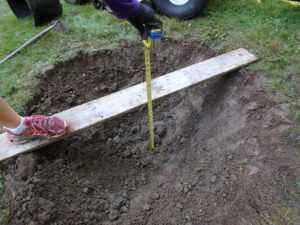
The hole should be wide not deep
It’s important to dig the hole for a tree the proper depth. You want to place the root ball on unexcavated earth so that it will not settle into a lower position that will fill in with soil or mulch, covering the trunk flare. The hole should be wide, not deep. I uncovered the trunk flare in my catalpa, which was just an inch or so below the soil line in the pot. There were plenty of small roots in that inch of soil I removed, and I just cut them away.
I also looked for roots encircling the root ball because it’s important to cut those back, and to tease out roots from the root ball before planting. I used my fingers to loosen roots at the edge of the root mass after removing the tree from its plastic pot.
Next, I measured the root ball. It was 16 inches wide and 12 inches deep. I dug a hole 3 times the width, and just an inch or two deeper than the depth of the root ball. I dug the hole with sloping sides down to the bottom. I used a hoe to scrape the bottom of the hole to make it flat.
As I dug, I placed the soil from the hole in wheelbarrows. One wheelbarrow was for topsoil, another for the poor-quality subsoil I encountered at the bottom of the hole. I was fortunate to find just a thin layer of subsoil – heavy clay, then sand beneath that. The sand will ensure good drainage.
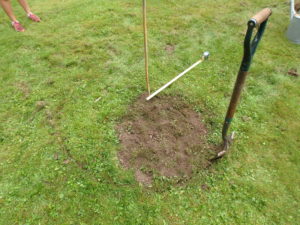
Dig a hole 3x as wide as the pot the tree came in
If you have only a shallow layer of decent topsoil, you may want to replace some of the subsoil you encounter with topsoil that you purchase in bags. But don’t replace all your soil, even if it’s not of good quality. Mix topsoil 50-50 with the crummy soil only if most of the soil is of poor quality.
A teacher at Vermont Technical College once told me to imagine a tree as a wine glass sitting on a dinner plate. The wine glass is the tree we see, the dinner plate is the root system. So the tree needs to spread its roots far and wide. Creating a planting hole full of compost and rich topsoil will encourage the roots to stay in the original hole instead of spreading out. That’s known as the “bathtub effect.”
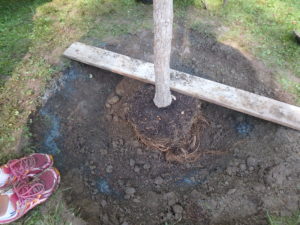
Make sure the tree is straight in all directions
To dig the hole the proper depth, I use a board (or a rake handle) to span the hole, measuring from time to time as I approached the proper depth. I dug down 14 inches for my 12 inch rootball, and in the bottom of the hole I added some of the better topsoil I’d dug up. I packed that down so it wouldn’t settle later.
Mother Nature does not use fertilizer when she plants trees. I don’t either. Fertilizers contain nitrogen, which stimulates fast green growth. But I want my tree to get established, spread its roots, and grow at a moderate rate. But I did add 2 mineral products that I bought in bags.
First, I added trace minerals in a mix sold as Azomite. It is a mix of some 70 minerals from volcanic and sea sources, mined and packaged in Utah. I have found it to add vigor and resistance to stress in plantings. The other product is called green sand. It is mined from a formerly undersea deposit in New Jersey. It is a good source of potassium and trace minerals. Potassium helps build strong cell walls.
I also paid attention to the north-south orientation of the tree when planting. Trees develop thicker bark on their south sides because they get more sun there. If a tree is planted with the north side from the nursery facing south at your house, the bark can develop sun scald in winter, crack, and damage the tree. Trees generally have more branches on the south side, so I planted the bushier side facing south.
Watering trees is important the first year, and even in dry times during the second year. I made a ring of soil around the tree to keep water from running away. And an inch or two of ground bark mulch will help to keep the soil from drying out.
Planting trees is not rocket science. Take time, do it well, and your tree will please you for the rest of your life.
Read Henry’s blog posts at https://dailyuv.com/gardeningguy.Reach him by e-mail at henry.homeyer@comcast.net.
Shady Ladies: Hostas and Other Wonderful Shade Plants
Posted on Tuesday, August 29, 2017 · Leave a Comment
It took me a long time to appreciate hostas. When I was a young gardener, I wanted bright flowers with lots of pizazz. Roses. Daffodils. Peonies. But over time I have come to appreciate the subtle colors of green, the soothing textures, the dependable nature of hostas. Let’s look at a few.
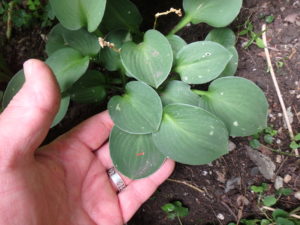
Blue Mouse Ears
I took a walk around my gardens and counted about a dozen different kinds of hostas. The smallest, ‘Blue Mouse Ears’ has little leaves just 2 inches long. My largest hosta is probably Hosta montana, ‘Stephen Parish’ from Cider Hill Gardens in Windsor, VT (www.ciderhillgardens.com). It stands 3 feet tall in a clump 5 wide – even though I divided it in half 3 years ago. I have to admit I don’t know the names of many of my hostas, having gotten divisions from friends, or just plain lost the tags.
Some basics: hostas do well in shade and thrive in rich, dark well-drained soil that never dries out. That’s a tough demand. But they will grow and survive even in shade with dry, poor soil. They just won’t get as big or look as impressive.
I have my biggest hosta growing in 2 different locations. The first is the ideal soil described above, the second place is in shade with dry soil and plenty of tree roots competing. The difference is remarkable. The plants in ideal soil are a full foot taller, and much more vigorous. One might even think they are different species.
I shudder when I drive past a house with hostas growing in full sun. It’s like tying up your dog in full sun, in August, with no water bowl. Inhumane. The hosta leaves bleach out, develop brown edges and practically scream at their owners. Some morning sun is fine for many hostas, but afternoon sun is brutal for most. That said, it’s almost impossible to kill a hosta, so they survive.
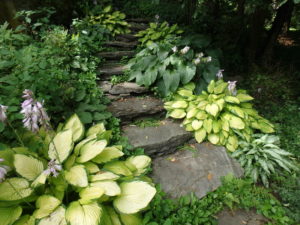
Henry’s stone steps with hostas
Most hostas are hardy to Zone 3 (minus 40 in winter) or Zone 4 (minus 30). So unless you live in the arctic, you can grow hostas. Having selected a nice spot with gentle sun, enrich the soil with plenty of compost and a little organic bagged fertilizer mixed in. Always water right after planting, and once a week or so until the plant is well established.
Problems? Slugs love hostas, and so do deer. When the leaves come up in the spring, rolled up like cigars, squirrels and chipmunks will eat them like asparagus. I once spayed liquid fish fertilizer on those early rodent treats, and was rewarded with the sounds of a squirrel screaming after taking just one bite! I was working in a public garden, and got a serious glare from a patron who thought I’d poisoned the poor thing.
As to slugs, some years are worse than others. There are chemical slug remedies, but I’m not sure even the so called organic one, which uses iron phosphate, is safe. According to one report I read, the “inert ingredients” which are not listed, may actually be toxic to the slugs – and us. I say pick off the slugs and put them in soapy water, or let them munch your hostas. Saucers of beer are attractive to slugs, too, and will drown them. But that might be too good a demise for slugs.
I recently went to see Gary and Sarah Milek of Cider Hill Gardens in Windsor, VT because I have gotten many of my favorite hostas from them, and they have splendid display gardens. Here are a few of the hostas I liked:
Gold Regal. Large leaves, all of a yellow-green.
Gold Standard. Large yellow-gold leaves with green edges.
Sagea. Large, dark green leaves with white or yellow edges
Brother Stephan. Yellow/chartreuse leaves with dark green edges
Curly Fries. This name is worthy of a giggle. The leaves are very narrow and long, green and white, with scalloped edges.
Empress Wu. Nice rich green leaves. Gary says it is the largest of all hosta plants, sometimes standing 5 feet tall!
Hosta leaves will shade out most weeds, so they can be used as ground covers. Jewell weed will grow up through hostas, however. I like to plant daffodils between clumps of hostas as I don’t need to cut back the daffodil leaves – the hostas will obscure them by the time they are getting old.
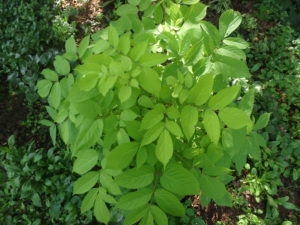
Spikenard Sun King looks great in shade
While at Cider Hill I also got a chartreuse spikenard (Aralia cordata) that really looks great in shade. It’s a variety called ‘Sun King’ and I also got one last year. This year it is a nice large plant that does not attract slugs, and has maintained its color all summer.
I also got a nice creeping sedge for a shady groundcover while at Cider Hill. It has leaves 8 to 12 inches long, green with white edges. It’s a variegated Carex. I’m hoping it will out-compete the spotted deadnettle (Lamium spp.) that is currently taking over empty places in my shade garden.
So don’t ignore those shady places. Hostas and plenty of other plants will grow just fine there.
Reach Henry by e-mail at henry.homeyer@comcast.net or by writing him at P.O. Box 364, Cornish Flat, NH 03746. Please include a SASE if you wish a mailed response. See his multi-weekly short blogs about gardening at https://dailyuv.com/gardeningguy.
Getting Ready for Winter
Posted on Tuesday, August 8, 2017 · Leave a Comment
Here it is, early August and I’ve just picked my first tomatoes, but I’m already thinking about winter. No, I don’t anticipate frost until mid-October or later, but I depend on my garden to feed me much of the year. So I start early getting food processed for storage. I freeze, dehydrate, can and store veggies for winter. Let’s look at tricks you can use to save you time and labor as you save your harvest.
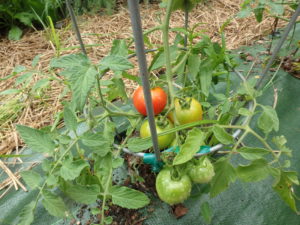
Tomatoes are ripening
Tomatoes are key to almost any soup, stew or stir fry I make, and I don’t want to be buying tomatoes in February, or to depend on cans of sauce processed in factories in California. I want to cook with tomatoes that I grew myself, or that are from a local farmer I trust.
If you grow just a few tomato plants for sandwiches and salads, or even if you planted half a dozen ‘Romas’ for making some sauce, you can have a wealth of tomatoes for freezing if you talk to your local farmer. Most sell “field grade” or “canners” by the bushel at very reasonable prices. They are not as pretty as top grade fruits, but I’ve bought a bushel – 50 pounds –in years when my own crop succumbed early to blight.
Many farmers now grow tomatoes in hoop houses which means they get tomatoes earlier than we do, and they largely avoid blight. So there are times when farmers are practically swimming in tomatoes. That’s when to buy them.
What can you do with 50 pounds of tomatoes? I would freeze most of them. Wash and dry the fruit, then fit them into freezer-grade plastic bags, not storage bags. Freezer-grade bags cost just pennies more per bag, but are much better for the job.
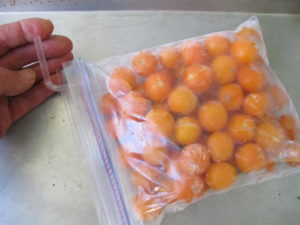
A straw used to remove air from a bag of cherry tomatoes
Suck out any excess air from the bags with a common drinking straw. Just close the bag 99% of the way, suck out the air and snap it closed with 2 fingers – just as you pull out the straw.
Later, to get them ready for use, I run each frozen tomato under hot water while rubbing it gently so that the skin comes right off. After I set it aside for 5 minutes it softens enough for me to cut out the stem attachment point. Then I quarter it, chop it, and put it in the pan.
If you like to make homemade sauce but hate the canning process, just freeze it. Cook up your tomatoes with fresh herbs and onions, and let it cool. Then pack in freezer bags or plastic containers.
I’ve had both front-opening freezers and chest freezers, and I recommend the front-opening ones. It is easy to lose track of what is buried in the bottom of the chest-type freezers. But you’ll find the last bag of kale if it’s on a shelf where you can easily see it. And after a year or two in a freezer, food loses its flavor and often becomes unappealing.
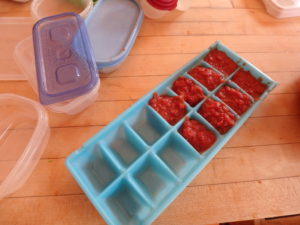
Cube trays
I also freeze ice cube trays filled with my homemade tomato paste. I use my less-perfect tomatoes for paste, which I freeze in ice cube trays. To make paste, I wash tomatoes, and then core them with a paring knife. I squeeze out the seeds and extra juice, which makes for less boiling time and fewer seeds. Then I quarter them and puree them, skins and all, in my food processor.
I cook the puree at low heat in a big enameled cast iron pot (which helps prevent scorching on the bottom of the pot). I know it’s done when I can literally stand up a soupspoon in the paste – after 3 hours or more. I let it cool overnight (or 8 hours) with the cover off the pot, allowing a little more moisture to evaporate. Then I spoon the paste into the ice cubes trays. After they are frozen, I remove the cubes and put them in freezer bags.
Most years I dehydrate several bags of “sun-dried tomatoes”. Except they aren’t sun-dried. They are dried in an electric food dryer. Mostly I dry cherry tomatoes, a variety called ‘Sun Gold’. I cut them in half and place them face up on the screens. It takes from 12 to 24 hours to do a batch, depending on which kind of machine you use, and how juicy your tomatoes are.
I have 2 brands of dryers, a NESCO American Harvester and an Excalibur. The Excalibur uses less electricity (660 watts per hour vs. 1,000 watts per hour) and is more efficient because the flow of hot air goes across the drying screens, not from top to bottom as the NESCO dryer does. But it costs roughly 3 times as much, depending on the model. Both brands are very good.
I also use my dehydrators to dry apples, pears, hot peppers and more. I especially like drying hot peppers because I can get them brittle, and then grind them up in my coffee grinder. That allows me to just add a little in a dish – or a lot if I’m not having company.
So don’t wait until fall. Start putting up food for winter like the proverbial squirrel. Winter is just around the corner.
Henry is the author of 4 gardening books. His web site is www.Gardening-Guy.com. See extra photos for his newspaper articles at https://dailyuv.com/gardeningguy and get daily tips.
Vines Worth Growing
Posted on Saturday, July 29, 2017 · Leave a Comment
As a boy I was fascinated by the idea that Tarzan the Ape Man could move through the jungle above the forest floor by swinging from vine to vine. I doubt that I ever saw a real Tarzan movie, but my imagination was good. I knew I wanted that ability to swing from vines. Now I just grow them. Let’s look at a few so you can decide if you’d like to plant one this summer.
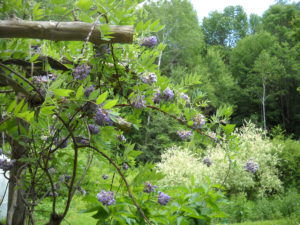
Amethyst Falls Wisteria
Wisteria is a vine loved by many, particularly gardeners who have moved to New England from warmer parts of the country where it thrives. For decades, wisteria was a frustration for northern gardeners: it would grow nice green vines, but never blossom. That was because it set buds one summer for blooms the next spring. It bloomed before growing leaves and shoots. Our winters in the North Country killed the buds.
Then two new varieties appeared on the market: ‘Blue Moon’ and ‘Amethyst Falls’. Both are hardy to Zone 4 (minus 30 in winter) and bloom on new shoots that appear each spring. Mine bloom in late June or early July for about 3 weeks. The scent of Amethyst Falls I do not find pleasant (overtones of cat?), but the blossoms are smaller than those on Blue Moon and seem to last longer. I grow it on a cedar trellis that serves as an entrance to my vegetable garden.
The soil for my wisterias is rich, dark, and moist; they will grow anywhere, I think, given at least half a day of sun. The more sun, the more blossoms. I have heard from friends in southern New England that wisteria can be a pest because birds eat the seeds and spread them around, starting them at the edge of the woods. That has not happened for me.
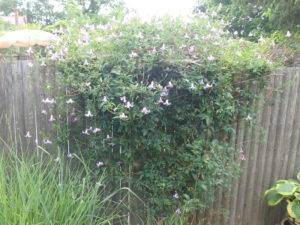
Clematis Betty Corning
Clematis is another great vine. I have 5 different kinds of clematis, and fully intend to buy another this summer – I just saw a great one while on a recent garden tour. That one, I learned from garden designer Cyndy Fine of Westminster, VT, is a Clematis viticella called ‘Betty Corning’. It blooms most of the summer and into the fall. It is has nodding bell-shaped flowers that are lavender to blue. Hardy to Zone 3 (minus 40 degrees).
The most vigorous, reliable of my clematis in one called Clematis jackmanii. It has nice purple blossoms and grows up wires I have attached to the front of my house. It easily grows 10 to 12-feet tall, and blooms enthusiastically most of July.
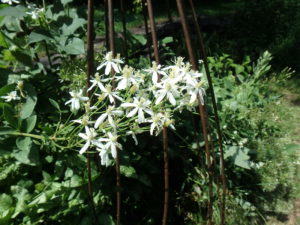
Clematis recta
Then I have one called Clematis recta. Unlike most of the others, it does not climb up a trellis, but flops on the ground unless supported by something solid – a fence of some sort that can contain it. It blossoms appear in huge clusters of small white blossoms, followed by delicate airy seed heads. It dies back to the ground each winter. But each year it gets bigger and more bodacious.
All clematis want essentially the same thing: hot tops and cool feet. Plant perennials in front of your clematis to shade and cool the roots, but provide plenty of hot sun for the vines. They like rich soil, and plenty of moisture.
Then there is an amazing vine form of hydrangea: Hydrangea anomala ssp. petiolaris. This will attach itself to brick or stone with holdfasts, as opposed to twining vines like wisteria and most clematis. I have it on the north side of my barn as it grows well and blooms without much need for sunshine.
I originally used plastic ties to attach my climbing hydrangea to the barn, as its “feet” won’t grab wood. Now it has sent shoots in between the rough barn boards and it no longer needs support. It sends out “arms” 3 to 4 feet from the barn, each loaded with large white flower panicles that seem to defy gravity. Even in winter it is gorgeous.
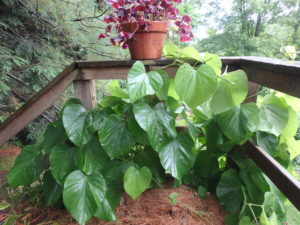
Dutchman’s Pipe
Dutchman’s pipe (Aristolochia macrophylla) is another vine I grow that is very adaptable. It will grow in crummy soil in sun to shade, but does not want to be terribly dry. It has huge leaves, and small white blossoms reminiscent of little ivory pipes. Once established, it would be impossible to pull out. I have it growing on the north side of my deck, and it climbs up and tries to twine around potted plants growing on the rail. It completely hides the mess beneath the deck!
As for Tarzan, only wild grapes would do for his exploits. These are pests sometimes in the forest, as they can climb up trees and choke out nice trees. When I see that they are a problem, I cut them off at the base with roots loppers – a quick and easy, but temporary solution. But the birds do love the fruit when it is ripe, so I often do nothing about them.
Henry is the author of 4 gardening books. His web site is www.Gardening-Guy.com. See extra photos for his newspaper articles at https://dailyuv.com/gardeningguy.
How to Minimize Tomato Blight
Posted on Wednesday, July 19, 2017 · Leave a Comment
John Denver introduced me to a Guy Clark song called, “Home Grown Tomatoes” with a refrain that goes, “Only two things money can’t buy. That’s true love and homegrown tomatoes”. How true. I love tomatoes.
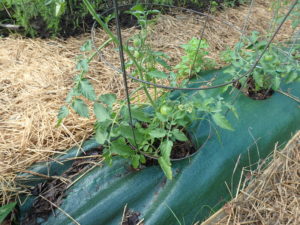
Healthy tomato plants in mid-July
Growing disease-free tomatoes is nearly impossible. Usually by this time of the year, gardeners see lower leaves turning yellow and getting spots. Stems turn black early on. Some summers, we only get a few fruits, those tomatoes that started early. Other years we get late blight half way through the season and our plants and fruit turn to disgusting black mush.
So what can we do? According to companies that produce seeds, we can choose varieties of tomatoes that are disease resistant. Breeders using old-fashioned breeding techniques have been successful in breeding resistant hybrids. But some say the flavors are not always as good as the old fashioned heirlooms. I grow both kinds.
This year I am growing ‘Brandy Boy’ (a hybrid produced by Burpee Seeds) that is supposed to taste as good as the heirloom Brandywine, one of my favorite heirloom varieties, and have improved disease resistance.
I know I like ‘Defiant’, a medium-sized hybrid with high resistance to late-blight, produced by Johnny’s Seeds. But Defiant does get early blight, which reduces its production. Still, I grow it each year.
This year my tomato plants are beautiful. Only a few leaves on a few plants showed any signs of yellowing leaves by mid-July. Here are a few things I have done to help prevent tomato diseases.
At planting time I mulched my tomatoes with leaves that I collected last fall. Some fungal disease reside in the soil, and when it rains, or when you water, splash-up sends spores onto the tomato leaves, causing disease. Mulching helps minimize splash-up. Grass cuttings are good, too.
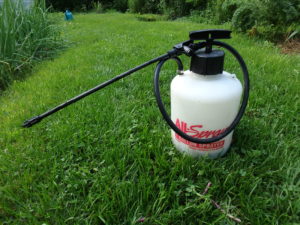
A simple one gallon sprayer is used for applying bio-fungicide
This year I got a soil drench from Gardeners Supply Company called “Root Shield”. This is a bacterial powder that I diluted with water and applied to the soil around each tomato. It is approved for use by organic gardeners. The bacteria attacks the pathogenic fungi in the soil, minimizing the chance of them getting on the tomato plants.
The other bacterial fungicide I applied is called “Serenade”, which I also obtained from Gardeners Supply Co. This contains Bacilius subtilis, a broad spectrum bio-fungicide. It is designed to be sprayed on leaves and stems once a week – and before signs of infection are seen. I have sprayed just twice, not keeping up with the schedule, but will. It’s easy to forget about disease when your plants are disease-free. Once plants are infected, both bio-fungicides are not going to solve the problem.
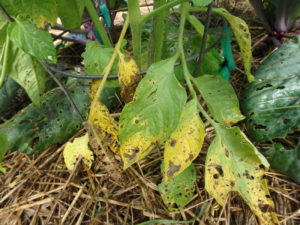
Diseased tomato leaves are often a problem
What else can you do? If you have tomato leaves turning brown, cut them off and put in the household trash, not the compost pile. I did this pretty regularly last year, and I think it helped.
If you get late blight – which basically causes a total meltdown of the plants – quickly bag everything in contractor bags and get everything affected out of the garden. Fortunately, late blight does not survive New England winters. But if you do get it, do not overwinter potatoes, or allow ‘volunteer’ potatoes to grow, as they can carry the blight. Tomatoes and potatoes are in the same plant family.
Fungal diseases often require moisture on the leaves so that fungal hyphae (their root-like appendages) can penetrate the leaves. So do not water at dusk. Water in the morning if possible, and try to keep the leaves dry.
I use a watering wand, not an overhead sprinkler. This is a hand-held watering device – a 30-inch long wand with a sprayer on the end – that allows me to deliver water around the roots, but none on the leaves. In a normal summer I rarely water tomatoes – my soil stays lightly moist most of the time just with rain. But if we go a week or so without rain, I do water.
Many tomato plants will grow taller until the fall over or are pruned back. It’s better to cut off tall branches and keep your plants supported by their cages or stakes. Cutting back plants allows them to spend their energy making tomatoes, not stems and leaves.
As a gardener I am always optimistic. I think this year’s crop of tomatoes from my 37 plants will be the best ever. But I’ll be happy with whatever I get.
Read Henry’s twice-weekly blog posts at https://dailyuv.com/gardeningguy You can sign up for an e-mail alert each time he posts. You may reach Henry at PO Box 364, Cornish Flat, NH 03746 or henry.homeyer@comcast.net.

 Click Here to buy from Cobrahead