Growing Roses and More
Posted on Thursday, March 13, 2025 · Leave a Comment
June is, traditionally, the month for weddings. It is also the time when old fashioned roses bloom, along with peonies, iris and many other great garden flowers. Is that coincidence? Perhaps. But maybe the two are linked. Let’s look at some great June flowers you can grow, and how to succeed with them.
My mom was an organic gardener who loved her roses. And although she is no longer with us to deny it, I think she may have cheated when it came to her roses. Back in the fifties and sixties roses were much fussier than they are now. They suffered from all kinds of fungal diseases and were eaten by ferocious Japanese beetles that made mincemeat of leaves and blooms. I think she used chemicals to kill the beetles and subdue the fungi.
Now we no longer have to resort to chemicals to have nice roses. Breeders have worked hard to develop roses that stay healthy and avoid predation from hungry beetles. The beetles were easy: they bred roses without scent to attract them. I don’t know how they developed roses resistant to diseases, but they have. I never see rose diseases, and I never spray.
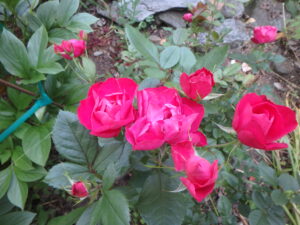
Knock out roses are reliable bloomers
My favorite roses are part of the “Knockout” series of roses, though I know others who really like the “Easy Elegance” series. They do not grow blossoms on long stems, but have multiple blossoms per stem. My “Knockouts” start blooming in June, bloom all summer, and up until hard frost – or even later.
Roses love full sun, but will grow in part shade. But the more sun they get, the better they do. Six hours of sunshine is considered full sun by most authorities. Afternoon sun is more potent than morning sun, so the west side of the house is better than the east.
Roses need good, rich soil. If you have sandy soil or a heavy clay, you will need to improve it in order to succeed. What does that mean? Mix in lots of compost when you plant, and add some organic fertilizer. Dig a hole that is at least 3 times as wide as the pot it was in when you purchased it. Mix the soil for the hole 50-50 with good compost- either your own, or a good bagged compost. I like Moo Doo or Coast of Maine brands.
Roses need more water than most other things, but do not want to sit in soggy soil. They should get an inch of water per week from rain, or a good dousing from your watering can applied slowly so it can soak in. A deep watering once a week is better than a little sprinkle every day.
Soil pH I important, too. The pH is a measure of the acidity or alkalinity of your soil. You can buy an inexpensive kit to test it, or send a sample out to be tested for pH and soil quality at your state Extension Service. Roses do best in slightly acidic soil – in the range of 6.0 to 6.8. If you soil has a lower number, you should add limestone and mix it in. But don’t add too much. A test should tell you how much to add.
Many roses are grafted onto rootstock. The bud union – a scar – should be buried in the soil. The scar is obvious on bare root roses, but is probably buried if you buy a rose in a pot. The colder the climate, the deeper that graft line or bud union should be. For Zone 4, it should be about 4 inches below the final soil line. Zone 5? 3 inches. Zone 6? 2 inches.
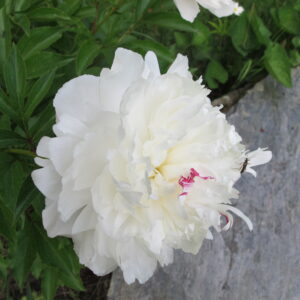
Peony ‘Festiva maxima’ that my grandmother grew
Want more blossoms? Roses do better if they get some fertilizer a few times during the course of the summer. An organic, slow-release bagged fertilizer called Rose Tone is designed just for roses, but I use Pro-Gro, my go-to organic fertilizer and sometimes use liquid fish and seaweed fertilizers made by Neptune’s Harvest. I add half a cup of Pro-Gro to the hole when I plant.
Other June flowers suitable for a wedding are peonies and iris. Peonies live forever if planted right – deep rich soil amended with plenty of organic matter. I have one from my grandmother, and she died in 1953. If you planted one that never blooms, you have probably planted it too deep. The “nibs” or growing points under the soil surface for next year’s growth should be no deeper than three quarters of an inch. You can feel them by poking around in the soil with your fingers. Pull away some soil if they are too deep, and it should bloom next year.
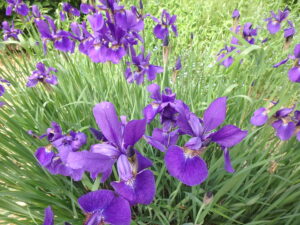
Siberian iris are tall and elegant
Siberian iris only bloom for a few days, but are magnificent. They come in a variety of blues and purples. Old patches tend to develop a dead spot in the middle because the plants have used up all the soil nutrients. Divide in the fall and re-plant, or add some organic fertilizer now.
There are too many gorgeous flowers to mention them all. But if you are planning a wedding, be advised that flowers do not bloom on an absolute calendar. Your favorite peony may bloom on June 15 this year – and June 21 or June 3 next year. You best bet is to have a good florist as a backup.
Henry is enjoying more time in his
garden, now that he only writes a column once a month. Feel free to send questions to him at
henry.homeyer@comcaset.net or PO Box 364, Cornish Flat, NH 03736. Please include a SASE if you wish an answer by regular mail.
Getting the Garden Ready
Posted on Thursday, March 13, 2025 · Leave a Comment
As the saying goes, “Spring has sprung.” In my garden, daffodils are blooming and tulips are on the way. My peas are planted. But how do you know when to plant your veggies and tender annual flowers? It’s not just about the last frost of the spring, you need to think about which plants can survive and thrive in cold, wet soil and which would rather wait to get planted until late May – or even mid-June.
In the vegetable garden, tomatoes, peppers and eggplants are the prima donnas. I generally wait until June 10 at 9 AM to plant them. Or something like that. I shape up my wide, raised beds well before I plant, allowing the soil to dry out and get warmed up. I rake off the straw or leaves I used to protect the soil from erosion over the winter. I like to work in aged compost well before planting time.
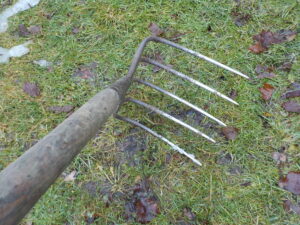
This potato rake is great for preparing soil for planting
Peas and spinach are very cold hardy and can survive frosts. Root crop like carrots, beets, onions and potatoes prefer warm soil for growing, but will tolerate cool soils and won’t get killed by a late frost even if their leaves are up. But in my opinion, almost any plant would prefer to grow in soil that is at least 50 degrees.
Whether you start your tomato seedlings indoors or buy plants from a garden center, you should “harden them off.” They need to be introduced to sun and wind in small doses at first so they don’t get sunburned or dehydrated after being pampered for weeks in a greenhouse or on a kitchen windowsill. This process will take 5 days or so, but if you don’t do it, you will either kill your baby peppers or stunt their growth for 2 weeks or more while they recover.
Start by putting your plants outside in a place protected from the wind that only gets morning sun. Give them two hours of morning sun the first day, then bring them back inside or well out of the sun’ rays. Increase the time outside each day and by day 3 give them some afternoon sun, too. On day 5 they should be okay outside all day, and after that you can plant them.
What about fertilizer? I generally don’t give annual flowers like cosmos or zinnias any at all. Soluble nitrogen found in chemical fertilizers will make them grow tall, but delay flowering. Of the vegetables, only peppers need no fertilizer, but in my opinion no vegetables should get chemicals of any kind – including fertilizer and pesticides.
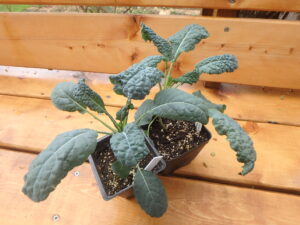
This kale was started indoors on Feb. 22 and needs to be hardened off before going in the ground in early May
Newly planted seedlings and seeds need to be kept in lightly moist soil, A seedling that cracks open its husk to send up a shoot may not make it to the soil surface if the soil is too dry. So check your garden every day. And if your tomato starts look limp or drooping, water immediately – even if it means going to work late. Just email me, I’ll send an excuse to your boss to keep you out of trouble.
There are many ways to keep your plants lightly moist – either in the vegetable or flower garden. One way is to set up a drip irrigation system. I’ve had good luck installing soaker hoses – rubber hoses that leak slowly though pores. I’ve bought the “Snip and Drip” system from Gardeners Supply.
The basic kit comes with the hose and T-junctions and fittings to install it. Then, if you buy a watering timer the system will come on a schedule you determine. I’ve used many types of timers during my time as a garden designer and installer. My advice? Get the simplest one you can get.
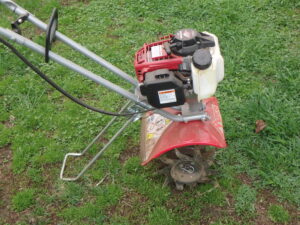
I no longer recommend rototillers
What about rototillers? Should you rent or buy one, or not? I used one for years until someone more knowledgeable than me explained why he didn’t: rototillers seriously disturb the microbes in the soil. They break up useful fungal networks that support your plants. They make a bed clean and neat, but in fact, have only sliced up the weeds and buried them. One invasive root becomes multiple roots and can move them further from their initial location. I have a friend who rototilled a small patch of horseradish and turned the bed into a large bed full of horseradish he could never eliminate.
So how do I prepare my soil? I use a 5-tined old fashioned potato rake that loosens the soil as I pull it through the soil. Or you can use an ordinary garden fork to loosen the soil if it is a heavy clay, and then finish it off at planting time with a good hand tool like a CobraHead weeder. You can use a hoe to pull soil from the walkways up to form mounded beds. And as you improve your soil with compost each year it will get easier to prepare nice, fluffy beds rich in organic matter.
Gardening is fun. It is rewarding, too: tomatoes and lettuce taste better when eaten the day they were picked. The exercise will make you healthy, too. Just don’t work so hard you get blisters and sunburn. Ease yourself into gardening – just like you harden off your plants.
Henry is an organic
gardener who has been fussing around in
gardens for about 75 years. He is the author of 4
gardening books. His email is
henry.homeyer@comcast.net.
Ten Tips for Planning a Successful Garden
Posted on Thursday, March 13, 2025 · Leave a Comment
Despite late snow storms that dumped deep snow over much of New England, spring is right around the corner. Let’s take a look at some keys to a successful year in the vegetable garden.
- Don’t bite off more than you can chew. Yes, I grow about 40 tomato plants each year, but most folks don’t want to can or to put up many pounds in the freezer. A well-tended small garden is better than a huge weedy one. Select plants that you love, and just plant a few. Don’t crowd them. You don’t have to start everything from seed – most garden centers have plants for sale in six-packs, and a good selection of varieties.
- Don’t use any chemicals in the garden. Mother Nature doesn’t, and you shouldn’t either. A chemical fertilizer is largely made
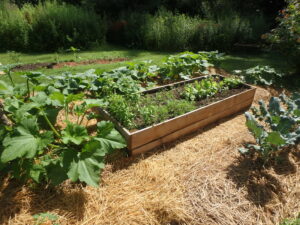
Raised beds are easier to weed and harvest
of salts of nitrogen, phosphorous and potassium. Too much of these salts can kill the microorganisms that work with the roots of your plants to feed them. A bag of 10-10-10 is 70% filler, and the content of this portion is not specified – it’s a “trade secret”.
- Compost if your best friend in the garden. Unlike chemical fertilizers, it provides most or all of the micronutrients needed by plants, things like magnesium, calcium and sulfur. And it contains living organisms, the bacteria and fungi that work with your plant roots to provide nutrients to your plants. Mycorrhizal fungi coat the roots of plants. They produce acids that dissolve minerals and share them with your plants. The plants pay the fungi with excess sugars they produce on sunny days.
- Build up mounds of soil and compost to create raised beds, or build wood-sided ones. You can hoe soil from the walkways into your raised beds, and maybe buy a pick-up truck load of compost to mix in and enrich your soil. Most landscapers will deliver compost. Raised beds provide nice loose soil and discourage kids and dogs from walking through them. And in a rainy summer like the last one, raised beds drain well,
 Enrich your soil with organic fertilizers like Pro-Gro and Plant Tone. They are made from things like ground peanut hulls, soybean meal, seaweed and oyster shells, with a few natural-occurring minerals. They are broken down in the soil and released slowly – just a small amount is water-soluble. They are a big help in poor soils, but don’t overdo these either.
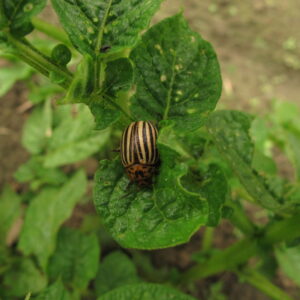
- Make a habit of walking through your garden every day. Look for problems: are your newly transplanted tomatoes looking limp? If so, they probably need water. Are there potato beetles? The Colorado potato bug can be a real problem. But if you watch for orange egg masses under the leaves and scrape them off, and pick larvae and beetles every day, you can control the problem in a home garden. One adult lays many eggs that can produce new adults in 30 days or so.
- Don’t let weeds blossom and produce seeds. Ever. Make 10 minutes of weeding every day a part of your daily ritual, just like you brush your teeth every day. Use a good weeding tool – I really like the CobraHead Weeder because it easily gets under weeds, and can be used to tease out long roots. Some weeds spread by root, so getting out entire roots is important. A scrap of root from many grasses will survive and produce new plants.
-
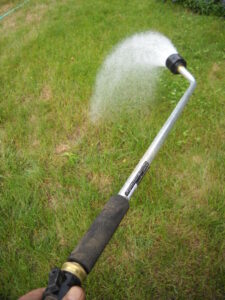
Watering wands get lots of water where you want it
Water judiciously. Those flip-flop overhead watering devices may be good for a newly planted lawn, but waste a lot of water in your vegetable garden. Water with watering can, or attach a watering wand to your hose. A good watering want allows you to water around your plants, but not your walkways or empty places. Too busy to water, or off to the beach? Use a water timer and soaker hoses. They can do the job for you.
- Why weed your walkways and around your tomatoes many times in a season if you can prevent it? I put down 4 to 6 layers of newspaper, then a layer of straw or mulch hay to keep it in place and help hold in moisture. Most weeds won’t grow though the newspaper, and earthworms will eat it up by the end of the season. Inks in newspapers now are soy-based, but I avoid the colored sections.
- Don’t get discouraged, no matter what. Last summer we had lots of rain and not so much sunshine, and many vegetables did not perform well for me – or anybody. Your garden will do better in times of drought or persistent rain if the soil is rich in organic matter and biologically active. Regularly re-plant some things you know how to grow, perhaps lettuce, and rejoice in fresh salads. And remember, there is never a good reason to spray chemicals on your plants – after all, if it kills the Japanese beetles, it can’t be good for you. Good luck!
Henry eats something from his
garden every day of the year by storing and freezing things from his not-so-small
garden. Send him questions or comments by e-mail at
henry.homeyer@comast.net, by mail at PO Box 364, Cornish Flat, NH 03746. Please include SASE if you wish a response by mail. He will be writing just one
article a month henceforth.
Pruning Fruit Trees: Now is a Good Time
Posted on Thursday, March 13, 2025 · Leave a Comment
March, April and May are good months to prune your fruit trees. Traditionally farmers pruned their fruit trees in March. I think they did so because they had less other work they could do at this time of year – it was too early to plant, weed or harvest. You can prune fruit trees any time of year without harming the trees, but since the snow is gone now, pruning on a sunny afternoon will give you a good excuse to be outside. Let’s take a look at how to do it.
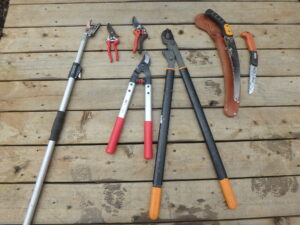
Tools for pruning
First, you need good sharp tools: hand pruners, a pair of loppers, and a pruning saw. A pole pruner is also helpful, and you may want to use a 4- or 5-foot stepladder. Don’t buy cheap tools: they will not do a good job for long. Buy the best you can afford, and take good care of them. Pruners and loppers can be sharpened with a simple and inexpensive diamond-studded sharpener, but most pruning saws are not suitable for sharpening.
Pruning fruit trees is not complicated. Your goal is to thin out branches that clutter up the tree and shade out other branches. Every leaf should get direct direct sun at some point during the day. My pruning mentor told me that a robin should be able to fly through a mature apple tree without getting hurt.
The biggest culprits, and the most commonly ignored, are the water sprouts that pop up vertically from bigger branches. They are, by far, the most numerous new branches each year; they shoot straight up and new ones are just the thickness of a pencil. But ignored for a few years, they gain mass and produce lots of leaves. Get rid of them.
Water sprouts are partly a tree’s response to a need for more food for the roots. Trees that haven’t been pruned in years have many of these. After a heavy pruning, a tree may produce lots of water sprouts to replace food-producing branches that have been removed.
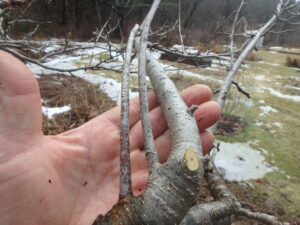
I’d remove the two smaller branches here
It is important to know where to make your cuts. Each branch has a “collar” at its base, a swollen area where it attaches to the trunk or a bigger branch. This is where the tree heals best and it should not be removed. Cut just past the collar. But if you cut too far out the branch being removed, you will be leaving a stub that can take years to rot away. Once the stub has rotted and fallen off, it can properly heal – but in the meantime it is a place where infections can occur.
I like to begin work on a tree by walking around it a few times and really looking at it: are there dead branches? Are there big vertical branches that once were water sprouts? Do some branches head into the center of the tree? All of those culprits need to be removed.
I generally take out the dead branches first. I look for dry, flaking bark. Try bending the branch. A dead branch will crack and break instead of bending. For small branches you can scrape the bark with your thumbnail. If it shows green, it is alive; if not, it’s dead.
Then I look at the overall branching of the tree. It is quicker and easier to remove larger branches first, rather than making 50 small cuts on that same branch.
You should not remove more than 25% of the leaves on a tree in any given year. Leaves are the engine of the tree: they make the sugars that feed the roots and the beneficial microorganisms in the soil. They provide the energy that allows the tree to make flowers, fruit and seeds. I once pruned a mature apple with just three cuts. I removed three large problem branches, and each would have had hundreds of leaves, come spring. I had reached my 25% limit. The next year I was able to remove lots of smaller branches.
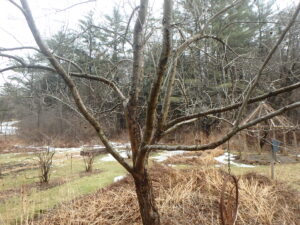
This apple tree is not cluttered with extra branches
Pruning every year, or at least checking each tree each year, is a good plan. It is much easier to remove a small branch than one that is 5-inches thick. If you do need to remove a big branch, take steps to prevent it from falling prematurely and tearing the bark of the trunk. Do this by first making an under-cut a couple of feet from the trunk, but just go part way through the branch. Then, just past that cut, cut from the top all the way through. Most of the weight of the branch will fall to the ground, allowing you to make a cut through the branch just past the branch collar without risk of tearing the bark.
Other branches that need to be removed? Any branch that heads back through the middle of the tree. If two branches form a tight “V”, remove one of them. Otherwise they will grow together and “include” bark that will rot, and can rot the wood. If two branches parallel each other, one shades the other, so remove the least desirable branch.
Learn to identify “fruit spurs” on fruit trees. These are 2- to 6-inch spurs (branches) with buds on their tips. Each bud should produce several flowers and eventually fruit. Vertical branches have few fruit spurs, branches at a 45-degree angle to the trunk should produce many, at least when the tree is old enough to bear fruit. Newly planted trees might wait 5 years before producing fruit, so be patient!
Pruning is good for trees. Don’t think of it like surgery that removes an arm or a leg. Think of pruning as creating art: a beautifully pruned tree is work of art, pleasing to the eye all year, especially in winter. Some fruit trees, like pears, will require lots of work every year if you want them to produce fruit low enough to reach from the ground. But all fruit trees will benefit from least a little trim every year. Learn to enjoy this work, and the benefits it offers.
Growing and Eating Cardoon
Posted on Thursday, March 13, 2025 · Leave a Comment
Most years I start some onion seeds and perhaps a few artichokes indoors n February; this year I will also start some cardoon seeds at the same time. Cardoon, which is a lovely looking plant related to artichokes, is a delicious vegetable, too.
Artichokes and cardoon are in the thistle family, and closely related. With artichokes, we eat the flower bud before it matures. The edible part of cardoon is the midrib of the long leaves, much as we eat the stalks of celery. But cardoon stalks are eaten cooked, not raw.
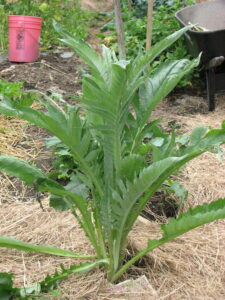
Cardoon is a big, leafy plant
Since cardoon plants are rarely sold at garden centers, you may wish to buy some seeds now and plant them indoors in February. It grows best in full sun with rich soil and plenty of moisture. Like artichokes, cardoon seems to have few pests or diseases. It is also a lovely decorative plant in the flower garden. It is a big plant that is vertical in growth habit and has silver-green leaves with toothed edges. You may need to stake it to keep it from encroaching on nearby plants.
Towards the end of the growing season and before it flowers, you must blanch the leaves before eating them. Blanch in this use means depriving them of light, not steaming them. In the Piedmont district of Italy (in the north-west part, near Turin) farmers do this by digging up cardoon before the first frost in the fall. They lay it in a trench and cover with soil for 2 weeks to blanch it and give it a bittersweet flavor. Easier yet, according to the Johnny’s Selected Seeds catalog, you can blanch the plants by wrapping them with several layers of newspapers (avoid colored print), enough to keep out the light. You don’t dig them up to do that. By the way, I find I always learn something when I read the Johnny’s catalog. The variety I ordered from Johnny’s Seeds is called “Porto Spineless”.
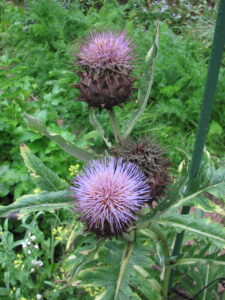
Cardoon blossoms are like thistles
Cardoon is in the thistle family, and if you don’t harvest the leaves it will eventually produce gorgeous purple flowers like those you see on wild thistle plants. I have read that if you are in Zone 6 or warmer, it will survive the winter just like a perennial flower, just cut it back, leaving the stubs of leaves at 10 inches.
In Italy there is a cardoon dish called “bagna cauda”. It is to the people of the Piedmont what haggis is to the Scots. If you meet someone you like, you invite them over for a bagna cauda – which translates loosely as “hot bath.” But cardoon goes in the bath, not people.
An evening with bagna cauda features a container of hot olive oil –an inch or two deep- with a whole head of thinly sliced garlic and a can or two of anchovies in it. It is brought to a simmer and kept simmering with a hot plate or flame. Like fondue, you spear food and cook it in the hot oil – the midribs are cut into 1 inch pieces for cooking. But the one key ingredient is always cardoon – Yes, there can be radishes, cubes of beef, celery and perhaps peppers, broccoli, cauliflower, mushrooms or fennel. But without cardoon, it is not a proper bagna cauda. It is good to add an occasional splash of red wine in the pot to keep the garlic and anchovies from burning. You need loaves of good French bread that you tear – not slice – into pieces and use to catch any drips of oil.
For the less adventurous and the garlic adverse, here is the recipe I adapted from Ellen Ogden’s wonderful cookbook, “From the Cook’s Garden”:
1 pound cardoon stalks (1 plant), rinsed clean and towel dried
3 tablespoons unsalted butter
2 tablespoons unbleached all-purpose flour
1 cup milk, heated
one half cup grated sharp Cheddar cheese
one quarter cup grated Parmesan cheese
one quarter cup dried bread crumbs
Preheat oven to 375, and warm an 8 x 11 inch baking dish, lightly buttered. Prepare midribs of leaves by cutting off the leaf portion, and cutting into 4-inch pieces. Cook the cardoon by boiling in lightly salted water for 10 minutes, or until tender. Melt butter and whisk in flour, cooking for two minutes. Gradually whisk in milk and bring to simmer. Remove from heat and stir in Cheddar cheese. Add salt and pepper to taste. Spread bottom of baking dish with a little sauce, arrange half the stalks in dish, and cover with sauce and half the Parmesan cheese. Repeat and sprinkle with bread crumbs. Bake until top is lightly brown, about 20 minutes.
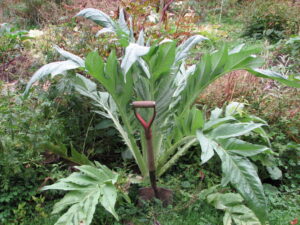
Cardoon with one of my shovels for size comparison
As much as I love artichokes, you really only get a few tablespoons of food from a plant that takes up a two or three-foot square section of garden. Cardoon has a similar flavor, but you get enough from one plant to serve as a side dish for four people. And because it is so vertical, it takes up less space. It is a gorgeous foliage plant that can get to be 3-4 feet tall, so you can plant it in either the flower garden or the vegetable garden.
Part of the fun of gardening, for me, is in the eating. Fresh is better than store-bought. And for cardoon, growing your own is probably the only way to have some. So if you plan to start your own tomato seedlings indoors in April, why not start early with some cardoon?
Henry is the author of 4
gardening books. Reach him by e-mail at
henry.homeyer@comcast.net. This winter his column will appear just once a month.
Remembering Tasha Tudor (1915-2008)
Posted on Thursday, March 13, 2025 · Leave a Comment

Tasha and her last corgi, Meggie
Tasha Tudor, one of America’s favorite children’s book illustrators and writers – and a great gardener – died peacefully at home on June 18 at the age of 92. She sold her first book, Pumpkin Moonshine, in 1938 by going to New York and walking from publishing house to publishing house with her book under her arm until she finally sold it, after many rejections, to the New York office of Oxford University Press. Since that time she has illustrated about 100 books including classics like Little Women and The Secret Garden, and written several of her own books, including Corgiville Fair and Corgiville Christmas, which came out in 2002 – when she was 86.
Mrs. Tudor dressed and lived as if she were living in the 1830’s, making her own clothes (similar to those of that period), growing vegetables, and until she was 84, milking her own Nubian goats. She loved to go barefoot, wearing shoes only when entertaining guests or traveling. She lived in a little house far off the beaten track in Marlboro, Vermont. Her house, built by her son, Seth, was modeled on a New Hampshire farmhouse built in 1740; it was so small that when I visited her I had to duck to get through the doorways.
In general, Mrs. Tudor hated politicians and journalists. I managed to wheedle my way into her good graces by bringing her homemade cookies and unusual plants. I’d read that she loved clematis and primroses, so I presented her with some, unusual species she did not have. After she decided I was all right, she admitted, with a wry smile, that she lined her bird cage with newspapers showing the faces of politicians – face up. A very proper lady, she did not say what she did with pictures of journalists.
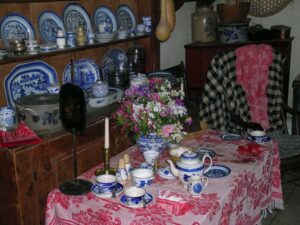
Tasha’s Tea service
An excellent cook who believed in the goodness of butter and cream, Mrs. Tudor had made a pineapple upside down cake in my honor. She loaded it with heaping spoonfuls of fresh cream she had whipped up just before my arrival, telling me she didn’t believe in the evils of cholesterol. She told me that once, when she was tired of waiting for a stone mason to show up to build a retaining wall behind her house, she put up a “Wanted” poster for him at the local post office. She offered a homemade pie as the reward for bringing him. The mason turned up the next day, claimed the pie, and began the work.
Gardening was a passion for Mrs. Tudor, and she did some every day all spring, summer and fall. She also had a small glass greenhouse in which she grew tropical plants like Angel’s Trumpet and a huge peach-blossomed Brugmansia. She told me she first fell in love with plants at the age of five, while she and her well-connected family were visiting Alexander Graham Bell, who grew a fragrant yellow rose known as Father Hugo’s rose (Rosa hugonis).
Mrs. Tudor was quite formal in some ways, but progressive, too. She used her mother’s last name, not her father’s or her husband’s. She expected to be mentioned in writing as Mrs. Tudor not Tasha, and insisted on calling me Mr. Homeyer, even when I protested that I preferred being called by my first name.
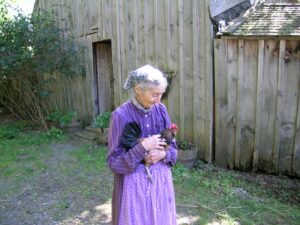
Tasha loved roosters, including this one named Chicahominy
During our first visit she lamented that she wanted to plant more of her favorite crabapples, but that the varieties were no longer available. I found one for her at E.C. Brown’s nursery in Thetford, Vermont, and she had her son take there the very next day. She generally traveled with her pet rooster, Chickahominy, but no one at EC Brown’s remembers him being there that day. Maybe he was feeling tired – her Corgi, Meggie, loved to chase him. She told me that Chickahominy “likes to go motoring” and that for his ceaseless efforts controlling cutworms, he was “getting a PhD in entomology”.
Mrs. Tudor stayed fit and trim throughout her life. When I saw her in 2005 she said that she could still fit into her wedding dress and chin herself on a bar. She continued planting trees when she was in her late eighties – including a crabapple that Wayne Mezitt of Weston Nurseries in Hopkinton, Massachusetts made especially for her – grafting a scion from an old variety that was out of commercial production, ‘White Weeper,’ onto rootstock. She had purchased the same variety of crabapple some 40 years before, and was still remembered at the nursery. She made an impression wherever she went.
Near the end of my second visit with Mrs. Tudor I asked her to what she attributed her energy, good health and long life. Without a moment’s hesitation she said, “Goat’s milk and gardening.” Then, with a straight face but a twinkle in her eye she added, “And choosing the right parents.” Mrs. Tudor grew huge expanses of forget-me-nots that bloomed in waves beneath her crabapples, which seems appropriate. She marched to her own drummer, and will not be soon forgotten.
A Year in the Garden
Posted on Thursday, March 13, 2025 · Leave a Comment
As we begin 2024, I think it is good not only to look back on the year we have just concluded, but also to plan ahead. We can’t know if we’ll be facing hot and dry or wet and soggy this summer – or perfect conditions. But we can make plans and hope for the best.
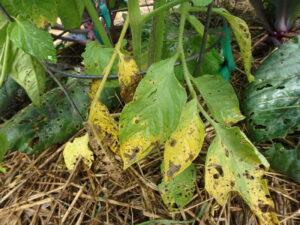
Diseased tomato leaves are often a problem in wet summers
For many of us, 2023 was a disappointment. The summer was rainy much of the time. Vegetables like tomatoes and potatoes – vegetables that require lots of energy to build fruit or tubers – did not do well. Fungal diseases like late blight are most virulent with moist conditions, which we had in spades. And in my part of the world, there was a late frost that spoiled the blossoms on uor fruit trees – so no apples or pears. Sigh.
On the other hand, it was a great summer for newly planted trees and shrubs. I planted yet another pawpaw tree this summer, along with a fringe tree , an American hazelnut and a gooseberry. Although I watered them all well at planting time, the soil stayed moist all summer from the rain, and all have done well.
Pawpaw (Asimina triloba) is a native fruit tree that is common in the woods of Pennsylvania and Ohio. The fruit is almost tropical in flavor, sometimes compared to a mix of mango and , banana flavors. The trees are rated hardy to zone 5 (minus 20 degrees F), but I have had one survive much colder temperatures – and another that died in a cold winter.
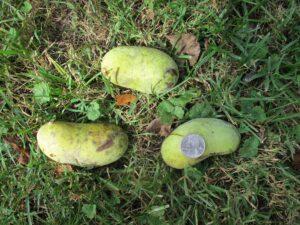
Pawpaw fruit has a tropical flavor but a texture that is mushy.
I have one pawpaw tree that is now 20 feet tall and 10 years old or more, but I am yet to get any fruit from it – despite the fact that it has blossomed. Apparently they are self-sterile, so in the past three years I have been planting new trees from different sources. Pawpaws send up root suckers, but these are genetic clones and not suitable for pollinating the mother tree. They are most often pollinated by insects that feed on dead meat, so one friend I know hangs road kill in her trees to attract pollinators!
A few thoughts about planting trees: First, preferentially choose trees and shrubs that are native to New England – or the United States. These are best for our birds and pollinators. And no, that doesn’t mean you should deprive yourself of the beauty of a Merrill or Jane magnolia. I just want to suggest a 90-10 or 80-20 ratio of natives to imported or hybridized varieties.
Secondly, if you plant trees in spring or summer, you must water during dry times. Fall is usually wet enough. A newly planted tree needs 5 gallons of water once a week distributed in a wide circle around it. A 2-inch layer of mulch will help minimize drying on hot August days and keep the mowers and string trimmers at bay. Mulch will also minimize weeds that compete for nutrients and water.
Some gardeners focus on growing vegetables, others on flowers. I want both. I started as a vegetable gardener, largely because there is little better in life than biting into a home grown tomato warm from the sun. I grow both heirloom tomatoes like Brandywine, Cherokee Purple and Ox Heart. But I also plant and hybrids like Sungold, my favorite cherry tomato, and Defiant, which is resistant to some diseases.
If you grow open pollinated (heirloom) tomatoes, you can save a few seeds each year and dry them on a paper towel. Store them in a cool dark location and they will serve you well if you want to start your own seedlings, starting indoors in early April. But don’t save hybrid seeds as most will not breed true.
One of my readers wrote me this fall reminding me of something I wrote long ago: “I will make it through another winter because I want to see what else did.” It’s true. I can’t let age catch up with me because I want to see the annual show: snowdrops blooming in March; my Merrill magnolia which blooms each year with a thousand double white blossoms on my birthday in April; and the Japanese primroses – 500 to a 1,000 of them beginning in May and lasting until mid-June.
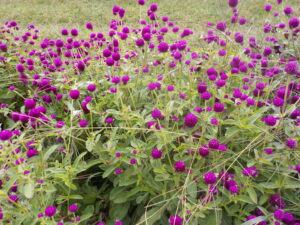
Gomphrena, an annual, is great in arrangements.
My advice about planting flowers is simple: grow what you love. Grow what your Grammie and mother grew. Grow what stops you in your tracks when you see if for the first time each season. Plant more of your favorites each year, or divide them and spread them out to new corners of the property. But keep it simple: Don’t plant so much that weeding becomes a dreaded chore.
I love arranging flowers and keep a vase of my own cut flowers on the table from March until after Halloween. You can do this if you plant lots of bulbs for early spring, your favorite perennials, and very importantly, this: plant annual flowers. Annual flowers keep on blooming all summer if you keep them from going to seed.
It’s easy to buy six-packs of annuals in spring and plant them in your perennial beds as well as in your vegetable garden. Most like full sun or part sun/part shade. And don’t fertilize annuals in the garden – too much nitrogen promotes leafy growth but delays flowering. Potted annuals do need some fertilizer as the fertilizer in potting mix is water soluble and gets used up or washes away.
Remember, as you ponder your plans for a
garden while looking at a snowy landscape, that
gardening should be fun. As they say, “Take time to smell the roses.” Place chairs or benches in the
garden so you can stop for tea or the cold beverage of your choice while chatting with a friend or loved one. My
garden is my respite. It’s where I go when the world is too much with me. So do some planning now. Read
gardening books. And dream. I certainly do, and know it pays off . Henry’s column will appear at the beginning of each month this winter. You can reach him at
henry.homeyer@comcast.net or PO Box 364, Cornish Flat, NH 03746.
Holiday Gifts for the Gardener 2023
Posted on Saturday, December 2, 2023 · Leave a Comment
Once again it is time to find the perfect gifts for your loved ones. Gardeners are easy to shop for because there are so many good things to shop for, and they will be probably be pleased with whatever you choose. As a shopper, I always try to support local, family owned businesses – they support our community and I want to support them when possible. Let’s take a look at some ideas.
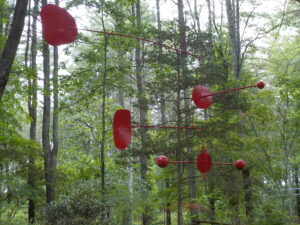
Sculpture in the woods at Bedrock Gardens
Think about buying tickets for you and your gardening friend to a special garden, or perhaps one of the spring flower shows. This will allow the two of you to have some time together and to get some ideas about what you both can do in your gardens. One of my favorite gardens is Bedrock Garden in Lee, NH. This garden was developed by plant guru Jill Nooney and her husband, Bob Munger, over a 25 year period and recently achieved 501-(c)-3 status as a non-profit. Not only does it have a fabulous collection of plants, Jill is a sculptor and welder who has created art that is displayed in the gardens. This is truly a gem of a place and worthy of visits. Suggested donation of $15. See their website for schedules.
Another garden I love is Saint Gaudens National Historic Site in Cornish, NH. Augustus Saint Gaudens was a world-known sculptor who lived and worked there in the early 20th century. The well-maintained formal gardens and grounds are enhanced by his fabuolous life-sized (or larger) bronze sculptures. The grounds are open year-round, and the galleries are open from Memorial Day weeknd through October 31. Admission is $10 and is valid for 7 days.
Of the Spring Flower Shows, the Connecticut show in Hartford is probably the biggest in New England, and well worth a visit. It will be February 22 to 25 in 2024 and although tickets are not yet on sale, you can make up a nice card inviting your gardening buddy to go with you.
Garden tools are generally a hit. On my second birthday I was given a child-sized wheelbarrow, a watering can and a shovel, all of which helped form me as a life-time gardener. Most garden centers sell good quality tools for kids made of metal, not plastic. See what you can find for a small person in your life.
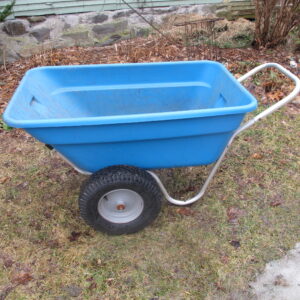
I’ve had this Smart Cart for 20 years
Adults like tools, too. For 20 years now I’ve had a Smart Cart, a well balanced two-wheel cart. The frame is made of airplane-grade tubular aluminum and the 7-cubic ft body of heavy-duty plastic. It comes either with bike-type wheels or smaller, fatter wheels capable of traversing wet areas more easily and carrying heavier loads. I chose the wide wheels, which make the cart rated for 600 pounds. The narrower wheels are rated for 400 lbs. I’ve never had a flat tire and the cart has served me well. The bin pops out if you want to wash a dog in it, or carry home manure in your Subaru. It is not inexpensive, but worth the investment.
My favorite weeder is the CobraHead weeder, a single-tine, curved hook that teases out roots with ease and precision. It has become an extension of my body – I use it for planting, weeding, and more. About $29 and available not only on-line, but from good garden centers and seed companies everywhere.
Although there may be no better mousetrap to invent, amazingly there is a new design to the shovel, one called the Root Slayer. It is all one piece of steel; it has a straight leading edge that comes sharp and stays sharp. The edges are serrated and able to slice though roots like a hot knife through butter. Great for planting in the woods or near trees. I still use my regular shovel or spade for digging in my garden or filling a wheelbarrow with compost. But if I want to plant a tree in a field, it is great for slicing though sod. I use it for dividing big clumps of daylilies and other tough perennials. Available at good garden centers.
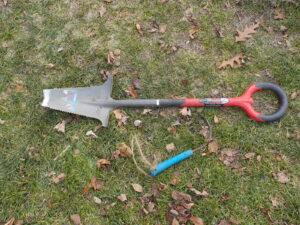
Root Slayer spade and CobraHead weeder are excellent tools
I know most of you probably keep track of garden events on your phone – things like when you planted lettuce seeds or when your delphinium bloom. I don’t. I like an old fashioned journal I can write in with a pen. Blank books are readily available, and some companies even sell special garden journals. Gardening is a slow and thoughtful pastime and lends itself to the handwritten word.
If you know that your gift-recipient starts seeds in the spring, or plans to, you might consider getting an electric heat mat as a gift. They considerably speed up the time needed for germination of weeds in the spring, So for example, corn seeds can take 2 or 3 weeks to germinate in cold, wet soil, but will pop up in 3 to 5 days when on a heat mat. If course, you then have to transplant the seedlings, but that is not bad for a small patch. I generally use a planting flat with 98 cells for corn and transplant them when they have leaves two inches tall.
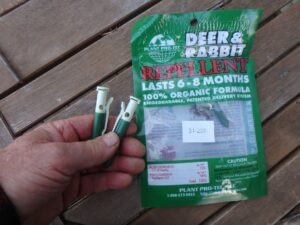
Garlic clips are quite effective deer repellents
If deer are a problem, some garlic-oil clips will add some protection in winter for your tasty trees and shrubs. I’ve had excellent luck with them, specifically with a brand called “Plant Pro-Tec Deer and Rabbit Repellent”. They come in a package of 25 for about a dollar each, and seem to last all winter. The are advertised as working for 6 to 8 months. Of course, depending on how hungry the deer are, the may not be 100% effective.
Seeds are great gifts, and serve well as stocking stuffers. If you save heirloom tomato or flower seeds, you can package up some of your favorites for a friend, along with a good description. And you can gift a nice houseplant, particularly one in bloom. But most of us already have all the houseplants we need.
Lastly, books are great gifts for gardeners – especially now, in winter when we have time on our hands. If I could select just one book, I’d pick “Essential Native Trees and Shrubs for the Eastern United States” by Tony Dove and Ginger Woolridge (2018, Imagine, Bunker Hill Studio Books, $35 hardback). I’m totally behind the movement to plant native plants to support our birds, pollinators and wildlife and this book will answer all your questions – which are attractive to deer, salt tolerant, good for poor soils and much more. It has excellent photos.
Enjoy picking good gardening gifts as you play Santa this year. Your loved ones will love you even more.
Henry is writing just one
gardening article per month
this winter. You may reach him at PO Box 364, Cornish Flat, NH 03746 or by e-mail at
henry.homeyere@comcast.net.
Reflections on 25 Years of Writing a Gardening Column
Posted on Tuesday, November 28, 2023 · Leave a Comment
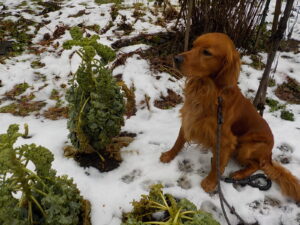
My dogs have always appeared in the column. Here is Rowan who appeared in with kale his first December
On November 8, 1998 my first gardening column appeared in my hometown paper, The Valley News of West Lebanon, NH. Since then I have written over 1,200 weekly columns and answered countless questions from readers. I am 77 years old, and plan to slow down a bit – I’ll be writing just one column per month this winter, and perhaps 2 a month after that. We’ll see.
I’ve learned a lot during that time, interviewed plenty of interesting gardeners, and visited (and written about) great gardens in New England and further afield. Thank you, dear readers for sending me suggestions, asking questions, and generally keeping me on my toes. Early on I wrote about digging in the dirt, and got an irate e-mail from a reader: “It’s not dirt,” she wrote. “It’ soil. It’s what makes a garden work well. Dirt is what you sweep up.” Later, during an election campaign, another reader told me to shut up about politics and write about what I know, gardening. As I said, you have kept me in line all these years.
My favorite interview was with Ray Magliozzi of Public Radio’s Car Talk. He lives in a suburb of Boston and has a simple but elegant garden of rhododendrons, roses, dahlias and a tropical called Datura or Angel’s Trumpet. He has the same quirky sense of humor and boisterous laugh in the garden that he had on the radio. I asked him if there was a common thread between gardening and working on cars. Quickly he answered with a full belly laugh: “Dirt. But garden dirt washes off more easily. The reason I love gardening is that I love getting my hands dirty. When we fix cars, it’s not all science. There’s an art to it, too.
Who else? The White House Gardener, Dale Haney. Tasha Tudor, the reclusive artist and gardener living in southern Vermont. Jean and Weston Cate, octogenarians who introduced me to the Seed Savers Exchange and the Boston Marrow Squash, a winter squash that they told me was the most popular squash grown in America in the 1850’s – and still grown by them. And I interviewed and became friends with Sydney Eddison, a fabulous garden writer who, when I called her recently had just come in from re-building a stone wall – even though she is now in her 90’s.. Gardeners do seem to last a long time.
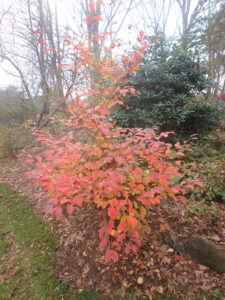
I bought this Stewartia for its blossoms and only learned later that its fall foliage is worth writing about
I love the letters and e-mails of you readers and wish I had saved them all. Here’s part of one that I got recently that might interest you: what to do about the dreaded Asian jumping worm? : “I sprinkled the tea seed meal (using my hand fertilizer spreader) and within a week (after a light rainfall which surely helped the process) the worms came to the surface (ick) and died. It would be lovely if they just stayed in the ground, but it was also gratifying to see that the tea seed meal actually worked! I have been told that they lay eggs this time of year so I will begin the process anew next spring.” She told me that she bought it at her local feed-and-grain store. My reader used 50 pounds for her lawn and gardens – about half an acre. The worms die in winter, and hatch in early summer, so I may try it as soon as I see them next summer. That said, I must warn you that even though this is a natural, organic product, it can have negative effects on fish and amphibians. Do your research, and I will, too. To be continued …
What else have I learned as part of my experience writing a column? Although I had been a gardener since I was a toddler and learned how to grow veggies and flowers from my Grampy, I took took classes to fill in the gaps in my knowledge. I went to Vermont Technical College in Randolph, Vermont and took classes including a great one about all the trees and shrubs that do well in our climatic zone. I already knew all the native trees that grow in Connecticut (where I grew up), but few shrubs and virtually no unusual decorative trees.
I took the Master Gardener course in New Hampshire, and that taught me lots of technical details about things like lawn care, insects and diseases, and lots more that I had never focused on. I drove 60 miles each way for 10 weeks to Concord, NH where I spent half a day taking classes. And I committed to helping teach others in my community – which I have been doing ever since. And it helped expand my knowledge for the column. I continue to take seminars given by experts whenever I can.
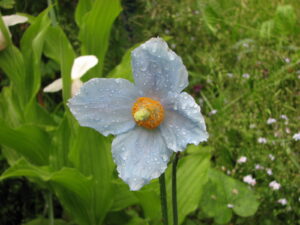
Himalayan Blue poppy is a rare color in the garden. that of the sky.
Writing a column also gave me a great excuse to buy plants. I needed to know, for example, if Toadlily or Himalayan blue poppy would do well here, and what they needed to succeed. I learned to buy perennials in groups of 3 or 5 – to make a bold statement, or to try in various locations.
I needed to learn how to design a beautiful landscape with flowers, trees and shrubs. All that was part of my education. I now grow about 200 kinds of flowers, and nearly 100 kinds of trees and shrubs. I’ve written about the ones that thrived – and the ones I’ve killed.
Eventually I learned not to buy plants unless I already have a place in mind where I might plant them. Okay, I fib a little there. I am a sucker for beautiful flowers in bloom, and will buy them – and make a place for them somewhere!
What is my advice to you after all these years? Never get discouraged or give up. But also don’t bite off too much work. Start small and increase your gardens, one bed at a time. Stay true to using organic practices: chemicals disrupt the natural balance of nature. Make a long term plan for your garden if you can. Establish sight lines, pathways, and create small “rooms” in the garden. Plant trees early on – they take the longest to reach maturity. And when you reach my age, those trees can be magnificent. I planted several in 1972 that please me every I think about them. Lastly, take time to sit down and enjoy your garden. You deserve to do so every day of the year.
I’d love tor hear from you, dear reader. Is there an
article that you remember best, or one you clipped and still refer to? I’m at
henry.homeyer@comcast.net or PO Box 364, Cornish Flat, NH 03746. Thanks!
Late Fall Chores in the Garden
Posted on Tuesday, October 31, 2023 · Leave a Comment
For many of us, November is a drab and dreary month: days are short, gray skies the norm. Flowers are largely gone, the soil is soggy and a drizzle or a downpour is common. Soon snow will not be unusual- we’ve already seen a wintry mix. But there are things you can do when the sun comes out – or with rain gear on.
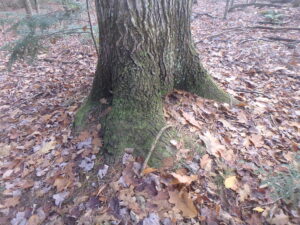
Trunk flare is easy to see on big trees but harder on new plantings
If you planted trees in the past few years, you should look at them carefully. Most planting tags on purchased trees tell you to plant them at the depth they are in the pot. Unfortunately, many trees are grown on huge farms and slapped into pots without regard to the “trunk flare” – that part of the tree that should be above ground.
Look at a mature tree planted by mother nature – or a squirrel. You will see that the base of the tree widens out, and often roots are seen snaking across the soil near the tree for a while before diving down to seek nutrients and moisture. When planting a tree it is essential that the trunk flare be above ground. If not, soil fungi will rot the bark and eventually kill the cambium layer below it. This will kill the tree in six to ten years. Even if the bark looks flaky and damaged, it probably will recover if you take action now.
If the tree you planted comes straight out of the ground like a telephone pole, or if there is mulch piled up against the tree, you must remove the material that will cause problems.
Mulch is easy to fix – take your hand and pull it back, creating a doughnut hole for the trunk, at least 4-inches all around. Mulch has its place: it will keep down weeds and help prevent the soil from drying out in times of drought. But more than 4 inches of mulch can also prevent light rains from reaching the roots. Don’t overdo it. No mulch volcanoes. I’ve been seen removing mulch from trees in public spaces!
If there is soil over the trunk flare, use a hand tool to loosen the soil and pull it back, too. You may find little roots there, but cut them off. Re-grade the area for a foot or more around the tree in ll directions. For a larger tree that was sold in a burlap wrapping, it is not uncommon to find 3 to 6 inches of soil over the trunk flare. The burlap wrapping – now often made of plastic materials – should have been removed at planting time. If not, your tree is doomed. Plastic wrapping will never degrade, so need to dig up the tree and remove it now. Burlap will degrade in time, but often not for years.
What else is there to do in the garden now? This is a good time to move shrubs or small trees that are not doing well where they are. Roots do most of their growth between the time leaves drop and the ground freezes, ,which makes this a good time for moving them. Cool temperatures and rainy days help plants you move now, too. sd
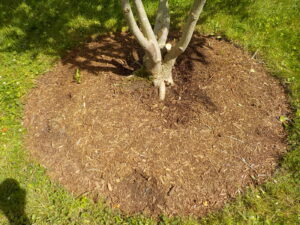
Mulch around a tree will hold in water and help keep weeds from stealing water.
I was visiting long-time friends in Ohio recently, and they had 3 Fothergilla shrubs that had been in the ground 5 years and done almost nothing. I took a garden fork, thrust it into the soil nearby and tipped it back. Out popped the root ball – as if it had been planted the day before. I picked it up and took a look. Clearly the shrub had been in a one-gallon pot for a long time before they planted it. The roots had grown around and around the pot, keeping them from extending out into neighboring soil for moisture and minerals.
After soaking the root ball in a pail of water, I used my fingers, a small folding saw and a CobraHead weeder to tease the roots apart. I broke or cut some, but it didn’t matter. The shrubs were doomed unless I could get the roots pointed out and away from the tangled mess they’d been in. I replanted them in places with more sunshine and less competition from big perennials in beds where they should grow and be happy. It may take a year or two before they really start to thrive.
It’s tough to know just where to plant a tree or shrub for optimal growth. I like to observe the same species in another garden or ask a friend if they’ve had luck with the same species. The internet can help if you consult a university or arboretum website. I like books, too, especially any written by Michael Dirr. He seems to know more than anyone else. So do your homework, and think about moving any unhappy woody plants.
By the way, it’s not too late to plant spring bulbs, garlic or bulbs for forcing in pots. I particularly like forcing spring bulbs (daffodils, tulips, crocus and more) by potting them up now and keeping them in a cold place where they won’t freeze. Then in February and March I bring them into the warmth of the house, and they bloom early. I pot up enough to give some away to ailing or aged friends.
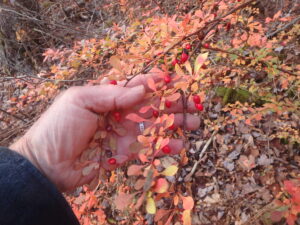
Barberry is easily identified by its red berries now
This is a good time to dig out invasive shrubs like burning bush or barberry that have been planted by birds. Their distinctive leaf color will help you find them now in your woods.
On the next to last day of October this year I plugged in my blue “fairy lights” in my Merrill magnolia and a nice pear tree. It was a gloomy, wet day, and the blue lights looked great against the yellow leaves. Some people call these Christmas or holiday lights, but I consider them just a cheerful boost to my spirits when gardening is nearly done and weather keeps me from doing my final chores.
Henry is UNH Master
Gardener, a regular speaker at
garden clubs and libraries, and the author of 4
gardening books. Reach him by e-mail at henry.homeyer@comcast.net.

 Click Here to buy from Cobrahead