Pruning Blueberries
Posted on Tuesday, March 15, 2016 · Leave a Comment
March is a good time to prune not just fruit trees, but also your blueberries. Blueberries here in New England are relatively slow growing, so they don’t need to be pruned every year. But they do need help from time to time.
Ready to prune? Your first question should be,” Has the soil thawed and dried out enough to walk around the bushes without damaging the soil?” This is important. You can damage soil structure and roots by walking on soil that has thawed, but has a layer of frozen soil beneath it. Also if the soil is squishy, making sounds or leaving footprints, you should stay away. Yes, I know you want something to do outside on a warm spring day. But stay away from the blueberries, off the lawn and out of the garden until soil has dried out.
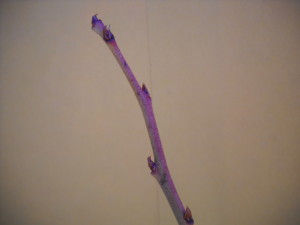
Blueberry leaf buds
Before making your first cut you need to know the difference between leaf buds and fruit buds. A branch that has few or no fruit buds is a good candidate for your pruners. Snip it off, and it will open up the bush, allowing sunshine to get to the productive branches.
Fruit buds are fat and leaf buds are not, they are slim and pointy. Simple as that. The rounded fruit buds generally produce a cluster of berries, not just a single berry, and you will certainly lose some berries when you take off a branch, it’s inevitable. But let the number of fruit buds on a branch guide you as you make your cuts.
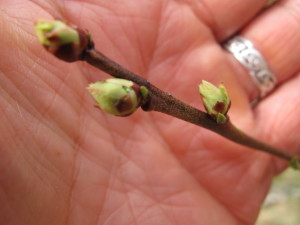
Blueberry fruit buds
Whether pruning blueberries or apples or pears, you should never cut branches in a way that leaves stubs. Branches heal at their point of origin, either at the trunk or a bigger branch. On larger branches you may notice a larger, almost swollen area called the branch collar; they should remain when pruning any type of branch. If you cut off a branch an inch from the branch collar, the stub will need to rot back to the branch collar before it heals. In the meantime pests or diseases may be attracted to the dying wood.
Pruning is the ultimate game of choices for the gardener. Remove this branch or that? Here are some guidelines for making your choices.
- Removing a few larger branches is generally better than making many small cuts.
- First, remove any dead branches. They don’t count in your calculation of how many branches can be removed – they are not contributing anything to the plant’s wellbeing. It is generally accepted that you can remove a quarter to a third of tree or shrub’s leaves in one year. You can identify a live branch even in winter by rubbing it gently with your thumbnail. If you expose a green layer, it’s alive.
- When deciding between two branches, remove the older, less vigorous branch and leave younger stems, which on blueberries often have a green or reddish color.
- Prune away branches that are damaged or rubbing against another branch.
- In general, branches should be grow out, away from the center of the bush. Branches that aim into the middle will eventually cause problems.
- Blueberries sometimes develop a viral infection that causes “witches brooms.” These are masses of fine twigs growing on one branch. Remove the entire thing and put it in the trash, or burn it.
Blueberries really are easy to grow. They need full sun, which means a minimum of six hours per day. But most importantly, they need very acidic soil. Now would be a good time to collect a soil sample and send it off for testing at your state Cooperative Extension laboratory. You can download the form on-line, just Google “soil testing” and your state.
If your soil is not acidic enough, you can add elemental sulfur. This is fine for organic gardeners, too, as it is mined from the earth, not manufactured in a chemical plant.
Changing the soil pH may take you a number of years. It is better to add some elemental sulphur this year, and again next year and in later years rather than dumping too much on at once. Your ultimate goal is a pH in the range of 4.0 t0 5.0. The scale is logarithmic, meaning that 4.0 is ten times more acidic than 5.0, and a hundred times more acidic than 6.0. Seven on the scale is neutral.
My last bit of advice, and one I don’t follow well myself, is to keep the root zone of the blueberries weed free. Mulching with a thick layer of chipped branches is the best way to do so, and I’m going to do so this year!
So do some pruning this year, your blueberries will develop into more vigorous plants in just a year or two. And the rules for pruning blueberries can be applied to your apples, crabapples, plums and pears. So get busy!
Henry is now blogging regularly and you can read this at https://dailyuv.com/henryhomeyer. You can sign up for e-mail alerts when he posts there. His website is www.Gardening-Guy.com.
Bird Food
Posted on Tuesday, March 8, 2016 · Leave a Comment
When I was a boy and saw robins hopping around on the lawn when it was still frozen and partially snow-covered, my first impulse was to go buy some fishing worms and put them out. We feed the chickadees sunflower seeds, don’t we, I asked my mom? Why not feed the robins?
Sixty years later I am feeding the robins – but not worms. The robins this year came back early, and in great numbers. They have been feasting on crabapples lingering on a tree I planted outside my kitchen window. We gardeners can do much to provide the biological diversity needed in our environment to feed the birds – robins included. And earlier this winter that same tree fed the wild turkeys for a day or two. Fortunately it produces plenty of fruit, and there was some left for those early birds from the south.
Many years ago I attended a talk by naturalist Ted Levin of Norwich, Vermont. He explained that not all fruit is created equal. Birds need calories, and thus go first to any food source that has a high fat content, particularly in winter. Birds are a bit like teenagers: pepperoni berries would suit them fine. Some fruits have high sugar content, which also makes them attractive. Think of blueberries, and how quickly the birds can make clean off a bush if it’s not covered in netting.
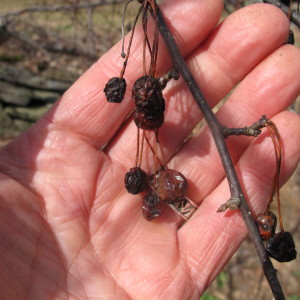
Robin food – crabapples
Of the crabapples, some are liked by birds and others ignored. According to Kevin Brown of E.C. Brown Nursery of Thetford (www.ecbrownsnursery.biz), the following are good crabapples loved by birds: Snowdrift, Sugar Time, Sargent, Red Jewel, Prairie Fire and Golden Rainbow.
In many places staghorn sumac (Rhus hirta) are still loaded with dry red fruit, their seeds are clustered in “bobs” that are displayed at the tips of the top branches. Sumac is not generally planted by gardeners – unless you consider birds gardeners. They eat the seeds at this time of year and some seeds pass through their digestive systems unharmed. But sumac seeds have very little fat content, so, according to Levin, they have remained largely uneaten until now – the hungry time. I have seen starlings and bluejays eating them, and read that another 20 or so species do, too.
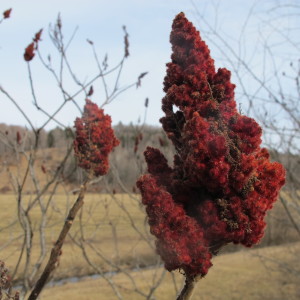
Staghorn sumac
If you are interested in learning more about trees that feed birds, or provide them with shelter or nesting sites, there is a wonderful book available in paperback by Richard M. DeGraaf calledTrees, Shrubs, and Vines for Attracting Birds. It is in a second edition published by University of New England Press for $24.95. The book lists what birds use each of a hundred or so plants for food, shelter and nesting. So if you want to attract a specific bird, you can find plants that will attract it.
Other good woody plants for bird food include elderberries, grapes, shadbush (Amelanchier spp.) and pagoda dogwood (Cornus alternifolia). Elderberries like moist soil – I have them growing right up next to my stream. They are not long-loved plants, generally surviving under 10 years. Planting 2 or more varieties together will help to get better pollination.
Grapes produce their fruit on new canes. So prune them heavily each winter, before they set blossoms or leaves. A good structure to support the vines is important, too.
Shadbush is one of the first trees to bloom each spring. Its blossoms are similar to apples, but the fruit is small and dark, almost like a blueberry. Birds are ready to eat the fruit a few days before it is fully ripe, so although I have several bushes, it was many years before I got to eat any.
Pagoda dogwood is a wonderful native shrub that grows willy-nilly on my property. Like elderberries, it is not a plant with a long lifetime. It’s an understory tree that can do well even in shade. The blossoms, unlike those on its cousin the flowering dogwood (Cornus florida), are small and understated. In late summer its fruit – dark blue drupes (fruit with one large seed, like a cherry) are prominently displayed on red upward-facing stems. And the birds love them, stripping them off as soon as they are ripe.
All evergreens are important to birds, too, including white pine, hemlock, balsam fir and spruces of all kinds. Birds not only eat the seeds, they nestle in their branches to be out of the winter winds.
So don’t worry about feeding those early-arriving robins. No need to buy fishing worms for them. But do think about planting some nice trees or shrubs for them this year. They’ll appreciate your efforts and reward you by eating some of the bugs in your yard.
Henry Homeyer lives in Cornish Flat, NH and is the author of 4 gardening books. His website iswww.Gardening-Guy.com. Henry is now blogging twice a week. Read his blogs athttps://dailyuv.com/henryhomeyer.
Wheelbarrows
Posted on Thursday, March 3, 2016 · Leave a Comment
Thinking about writing a memoir, I recently pawed through my late mother’s journal from 1948. I was amazed to read that on my second birthday my sister, Ruth Anne, herself just four and a half, gave me a wheelbarrow, my first. My parents gave me a watering can. My Uncle Ralph and Auntie Ruth gave me a shovel.
With gifts like those, is it a surprise that I turned out to be a gardening guy? Or that I now own 7 kinds of wheelbarrows, uncountable hand tools and several watering cans? Spring is just around the corner and this might be a good time to look over the necessities for the upcoming gardening season.
One of my first memories in life is being in the garden with my grandfather when a quick thunderstorm approached. Grampy scooped me up, placed me on a pile of weeds in his wooden wheelbarrow, and we raced back to his old farmhouse. I loved that wheelbarrow.
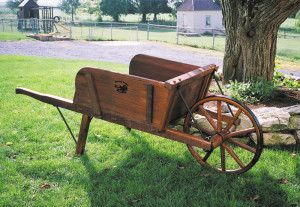
Wooden wheelbarrow
Many years later I searched for a company making wooden wheelbarrows and found Spring Valley Woodworking in Gordonville PA run by Ike Lapp, who is Old Order Amish. I’ve met Ike and purchased one of his barrows. It has removable sides, which is nice for lugging fence posts, and a steel-rimmed wooden wheel that never goes flat. It even makes the same squeak my grandfather’s wheelbarrow made all those years ago.
To reach Ike and order a barrow, leave a message for him at 717-355-9366. He can’t have a phone in his home or workplace, but has a plywood shack with an answering machine in the middle of a field. He will return your call at his convenience, not yours. Maybe we should all be more like that.
My sturdiest wheelbarrow, the one I go to most often is called a Smart Cart (www.shopmullerscarts.com). It is great for heavy and bulky loads. The axle is centered under the load so that it feels light to the touch and turns easily on its two wide 16-inch diameter wheels. It has a tubular aluminum frame and a big plastic bin (7 cubic feet).
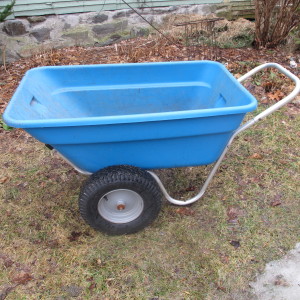
Smart Cart
You can easily remove the bin from the frame so that you can wash the dog in it, or carry compost in the back of your car. My model (with wide wheels) is rated for 600 lbs; the wire wheel version is rated for 400 lbs. There is also a 12-cubic foot bin that is interchangeable with the 7-foot bin, though I’ve never seen it.
Everything about this cart is well designed. It’s more expensive than a standard wheelbarrow, but worth it. I’ve kept mine outdoors all summer for years without problems. I visited the web site and see that there are now 2 grades of carts: contractor (original) and a less expensive residential grade, which I have not tested.
Then there is the standard old-fashioned one-wheeled wheelbarrow in either metal or plastic. I have a metal one, but have had a plastic one, too. The metal ones are better for heavy loads, but do rust over time. Generally they have wooden handles that are replaceable – though you shouldn’t have to. Their biggest advantage is that they can turn on a dime and will go down a narrow path in the garden – something 2-wheeled barrows generally cannot do. They come in two sizes: 6- and 4-cubic foot varieties. I have the larger one.
I also have a plywood garden cart. The original brand, often called a Garden Way cart, is made by Carts Vermont (www.cartsvermont.com) though other companies now make them. These come in 2 sizes: Mid-size (6.5 cu feet) and large (13.6 cubic feet), which I have. These are great for carrying bulky loads like hay and leaves. They use 26-inch bicycle tires, but offer a solid tire as an option – which I wish I had. Avoiding flat tires would be great.
Then there is my folding aluminum wheelbarrow. It is the Tipke 2100 folding cart (www.tipkemfg.com/foldit), and is remarkably sturdy. It has removable sides like my grandfather’s cart but its main claim to fame is that it folds up – and weighs just 33 pounds. If you are an apartment dweller, you can store it in a closet; it will fit in a small car to go to the community garden, but it can carry up to 330 lbs.
There are also electric powered wheelbarrows that can assist you in getting up a long incline with a heavy load. A rechargeable 24 volt battery is the standard power source. I tried one a few years ago, but the motor and battery add weight and cost, so I was not interested. I’ve seen several brands on-line.
I’ve also tried the cheap plastic wheelbarrows with plastic wheels. They cost well under $100 at big box stores, and are worth even less. I wouldn’t have one, but I suppose if you are just beginning and on a restricted budget, one might do the job for a few years.
When possible, I recommend buying wheelbarrows after trying one out. So go to your local feed-and-grain store or garden center and test drive one. Do it now, before you get too busy in the garden.
Henry lives and gardens in Cornish Flat, NH. His website is www.Gardening-Guy.com.
Potted Bulb Plants
Posted on Wednesday, February 24, 2016 · Leave a Comment
As we amble toward spring I find I crave blossoms more and more. This must delight the people who sell flowers, as I have a hard time walking by a display of iris or daffodils growing in pots without buying some. But buying grocery store potted bulb-flowers is not just an indulgence. Many can be kept alive until the ground thaws and planted. Others are less durable. Let’s take a look.
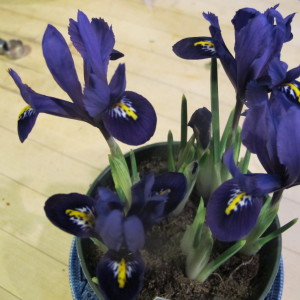
Iris reticulata
I love those little purple iris that are commonly sold in 4-inch pots. I bought some recently for $3.99 and although they only lasted a week, I was delighted to have them. This particular iris is known to botanists by its Latin name, Iris reticulata. It’s related to Siberian iris and bearded iris, but has different growing needs.
According to the tag that came with the iris, you can plant these outdoors “in part shade after last spring frost.” What they don’t tell you is that Iris reticulata require very good drainage. They originated in the mountains of western Asia where they grow wild on pumice slopes of extinct volcanoes.
If you want these fabulous little iris to succeed for you, do not plant them in a heavy clay soil. In fact, build a six-inch raised bed of sandy soil and grit with very little organic matter. Outline your planting bed with stones or bricks. You should be able to pour water from your watering can over the bed and not have any pooling. Planting on a hillside will help with drainage, too. Most of my soil is too rich for Iris reticulata, so I’ve not had good luck with them after the first year. I guess this year I’ll build them their own little bed.
Tete-a-tete daffodils are great little bundles of yellow joy that are common in grocery stores and at flower shows. Each bulb produces more than one mini daffodil. They are very cold hardy and can be planted outdoors when the soil has thawed. Just keep them watered indoors after blooming. Like other small bulbs, plant the tips just 2 inches beneath the soil surface.
Every year I force paper whites. Also in the daffodil family, these are not usually planted in soil indoors, but in a container filled with pebbles. Choose one that has no holes and arrange the paper whites bulbs among the stones. Later, when the leaves and stems are tall, they will tip over unless you arrange your stones so that they hold the bulbs in place. I add water until it just kisses the bottom of the bulbs. Roots emerge and soon thereafter green leaves and flower buds emerge. Each bulb should produce more than one blossom.
The paper white flowers are usually – though not always – highly fragrant. Some people do not like the scent, though I do. And even after the flowers have dried out they still look good to me for quite a while. The unfortunate part about paperwhites is that they are not viable in our climate outdoors. No, do not save them and plant outdoors. They will not come back for you next year.
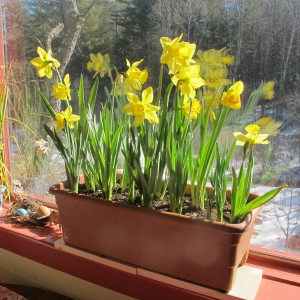
Forced daffodils in Earth Box
I also potted bulbs for forcing that I put in my cold basement last November, and I have brought them up into the light and warmth of the house. This year I used a plastic container called an “Earth Box” for planting. The one I used is 22 inches long, 9 inches wide and has a planting space about 7 inches deep; I planted about 20 bulbs in it. It is a “self-watering container” that has a water holding compartment a couple of inches deep.
Self-watering containers are all the rage for growing flowers on decks and doorsteps. They prevent the dehydration (and death) that old fashioned flower pots allowed. They wick up water from the water reservoir so that you only have to water once a week or so, depending on the weather. But they are great as containers for bulbs, too, because they don’t leak water out onto your table or windowsill unless you dump gallons of water and make them overflow.
Tulips are some of my favorite flowers but are also loved by deer, chipmunks, voles (but never moles), red squirrels, gray squirrels and a variety of other rodents. The bulbs are even edible by humans – some Dutch ate them to avoid starvation in WWII. So most years I plant some in pots and force them to bloom indoors. Just enjoy them now.
My personal experience is that tulips bloom well their first year –indoors or out – but fewer and fewer bloom each year thereafter. So if you buy potted tulips at the florist shop or nursery, I don’t think they are worth babying along until summer and planting outdoors in May.
I planted 100 tulips in a big raised bed in my vegetable garden last fall. I planted a few garlic cloves in with them in an effort to discourage rodents, though that is no sure cure. In the past deer have not bothered my tulips, but if I am feeling paranoid or see lots of footprints near the tulip bed, I could surround it with a chicken wire fence. Since the bed is only 8 feet by 3 feet, even a 4-foot fence should keep out the deer, I believe. I will use the tulips as cut flowers.
So brighten your house with some flowers grown from bulbs. Most you’ll be able to plant outdoors for another show next year, albeit later.
Henry may be reached by e-mail at henry.homeyer@comcast.net or at P.O. Box 364, Cornish Flat, NH 03746. Please include a stamped envelope if you wish a response by mail.
Thoughts of Charles Darwin During a Walk in the Woods
Posted on Wednesday, February 17, 2016 · Leave a Comment
I have great respect for Charles Darwin. He was a scientist who traveled around the world, observed nature, kept great records, collected specimens, applied logic and came up with a theory that changed how we see the world. He wrote The Origin of Species in 1859 which presented, clearly and forcefully, the theory which became known as evolution.
Darwin postulated that from time to time plants and animals had mutations that made them more or less competitive than others of their species. Those that were better able to survive had more progeny and their changes were more likely to persist and dominate. “Survival of the fittest” became a mantra of scientists that we’ve all heard.
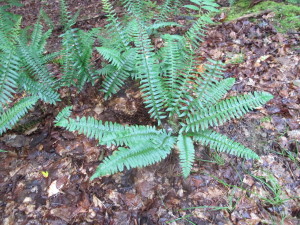
Christmas fern
On a recent walk in the woods I pondered Darwin’s ideas as I looked at the flora of the forest. At the forest floor I observed just one species of fern, the Christmas fern (Polystichum acrostichoides). It was everywhere I looked. Its greenery on that warm, sunny day presumably was using February sunshine to produce food for its roots. I know there are many other ferns in the woods, but all the others had lost their leaves in the fall, and were dormant. Using sunshine in winter must be an evolutionary advantage.
Next I reflected on the wildflowers I love. Early spring bloomers like hepatica are short and bloom before forest trees have leaves. Fall bloomers like goldenrod and cardinal flower are taller. Why is that? They may have evolved in competition with grasses and other tall plants that would shade out shorter things. Plants seem to time their blooming so that they will survive and thrive.
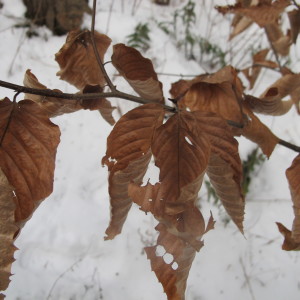
Why do beech leaves linger on the branches in winter
I have often wondered why young beech trees and some oaks hold onto their leaves until spring. Researching this on the web, I found a fabulous article in Northern Woodlands Magazine (http://northernwoodlands.org) by Vermont forester Michael Snyder. He explained that the first prehistoric trees were all evergreen, and that deciduous trees developed later. In cold regions such as ours, shedding leaves helps to minimize water loss and damage due to the cold.
The process of holding onto brown leaves until spring is called marcescence. Snyder postulated several reasons why this ability to hold onto leaves might be an advantage. First he noted that dropping leaves in spring might provide some organic matter as mulch just when a growing plant needs it. Leaves left on the ground all winter would be farther along in the decomposition process. In my view, that doesn’t make sense – trees that are growing green leaves need nitrogen, and brown leaves have little to offer. Nitrogen usually off-gasses when leaves turn brown, going back to the atmosphere. Sure, organic matter in the form of carbon does enrich the soil, but that is a slow process.
Snyder wrote that some other researchers suggest the leaves might help to trap snow in winter, thus retaining water. That does not match with my observations. Others suggested that the leaves might provide some protection to leaf buds against the cold. Again, that is not logical to me. Lastly, he proposes that the leaves might be a deterrent to hungry deer browsing tips of branches, removing leaf buds in winter. Yes, that makes a certain amount of sense to me.
Most trees are adapted to thrive either in sun or shade, but not both. The Canadian hemlock, one of the most common trees in my environment, can grow pretty much anywhere – full sun to full shade (though it does not do well in soggy soil). I can see why it so common in the wild. But it does not do well with road salt or pollution. Will this tree develop new varieties that are tolerant of human interference? Remember that evolution is very slow, often taking millions of years to create new species.
In marketing circles the promoters of a new product are always looking for a “market niche.” This means finding a product that no one else is selling, whether that be a wrist-watch computer or a new type of hair gel. It seems that plants do much the same. They “look for” a place where other plants don’t want to be or can’t succeed.
A great example of a plant market niche is on bare rocks. With no soil what self-respecting plant would want to grow there? Enter the lichens. These are relatively primitive living things that can survive on bare rock in full sun. Technically, they are not even plants.
Lichens are two life forms living together in a symbiotic relationship: fungus and algae or cyanobacteria. Those latter beings can, by photosynthesis, produce food; the fungus provides structure and moisture it gathers. Each species helps the other, and is helped by it. What an amazing evolutionary miracle! Together these living creatures have evolved the ability to live from Antarctica to tropical jungles. Lichens cover roughly 6% of our land mass – so I guess they’ve had good luck finding market niches.
So go for a walk and ponder the miracles of life. And try to figure out why beeches and oaks hold onto their leaves. If you come up with a new theory, be sure to let me know. I’m still not convinced I know the answer.
Henry is a UNH Lifetime Master Gardener and the author of 4 gardening books. His website is www.Gardening-Guy.com.
Groundhog (Day) Soup
Posted on Wednesday, February 10, 2016 · Leave a Comment
The old timers say that on Ground Hog Day we should still have half our wood supply – or more. This year I had more than half as it’s been a warm winter. Or perhaps not a real winter at all. At the half way point I always want to still have plenty of vegetables left from the summer, and I do. To celebrate Ground Hog Day this year I made a soup of my own vegetables, largely with root crops stored in the basement in an old fridge. Here is what I used:
Ground Hog Soup
1 rutabaga, cut in ½ inch cubes
1 kohlrabi, cut in ½ inch cubes
5 carrots, cut in rounds
3 medium-small yellow onions, finely chopped
½ a small celeriac, finely chopped
1 huge garlic clove, finely chopped
5 frozen whole large tomatoes (or substitute a 28 oz can crushed tomatoes)
2 cups winter squash, steamed
2-3 tablespoons finely chopped fresh ginger
1 tsp dried parsley
¼ to ½ tsp dried hot pepper (optional)
fresh rosemary (3-4 sprigs)
1 qt vegetable stock
1 cup cider
olive oil, salt and pepper as needed
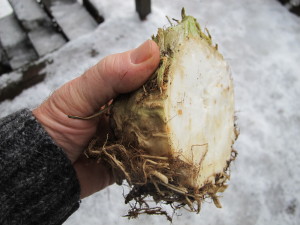
View of interior of celeriac
To make the soup I began by sautéing the onions in olive oil until translucent. I use a heavy enameled iron pot for this. While the onions were cooking I chopped the rutabaga and kohlrabi into half-inch cubes, and the carrots into rounds. I added a quart of vegetable stock (I could have made my own, but cheated and used store-bought). Then I put in the root crops I’d cut up and turned down the heat to simmer. I added a cup of cider made from my own apples that I’d frozen, then thawed for this.
I’m sorry to admit that my supply of whole frozen tomatoes is getting low and will have to revert to store-bought canned tomatoes before the new crop comes in this summer. I freeze whole tomatoes in zipper bags in September because it is such an easy way to put them up, much easier than canning. Now I just run them under hot tap water and rub off the skins. I let them sit for a few minutes, then chop them up and toss into the pot.
I added some Espelette hot pepper powder – my own that I dried and ground in the coffee grinder – but you can add jalapeno and use more or leave it out altogether. I added dried parsley and fresh garlic, rosemary and ginger at this time, too.
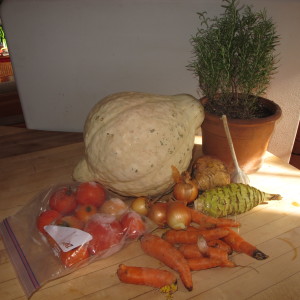
Hubbard squash and other winter veggies for soup
I always have plenty of winter squash. This year I grew 2 large Hubbard squash in addition to many smaller Waltham butternut squash. For this soup I cracked open a Hubbard even though I couldn’t use all the meat from this 10-pound squash all at once. I cut it into many pieces, removed the seeds, and steamed it in a stock pot until it was soft.
I separated the flesh of the squash from the leathery skin with a large spoon and used 2 cups of the meat for this soup. The rest I cooled, then bagged and froze for later. I blended the squash in my food processor with liquid and tomatoes chunks from the soup pot, though you could use chunks of squash in the soup instead. I find pureeing it makes for a nice thick soup.
Last summer I dug my rosemary in mid-September and potted it in a 50-50 mix of potting soil and good compost. I’ve had it in a south-facing window and it has some soft growth as it leans toward the window, but is healthy, overall. I will start increasing the water to it as spring gets nearer. By March it will need twice as much water as I give it now. Three sprigs of this added good flavor to my soup.
A few words about rutabagas and kohlrabi. They are both great “keepers” for winter storage. Rutabaga grows well in full sun and rich, lightly moist soil. They need to be thinned to 8 inches apart early on or else you’ll get big tops and small roots. The flesh is sweet, not bitter the way some turnips can be. It works like potatoes in a soup, but never crumbles apart the way potatoes do.
Kohlrabi comes in purple or white varieties, and both are crispy and fresh either in a salad, soup or stir fry. ‘Kossak’ is a white variety that can be left in the ground all summer, getting huge – 8 inches or more – but not tough. It is designed for winter storage, and I usually grow some. Thin to 6 to 8 inches apart for good production, more if you are growing Kossak.
If you don’t have rutabagas or kohlrabi, you can substitute potatoes and perhaps add something else from your garden. I generally boil potatoes separately when adding to a soup or stew, and add them towards the end so that they are not mushy or crumbly. I bet green beans would be good in this soup, too. Whatever you use, it’s bound to be good. Bon appetit!
Henry gardens and cooks in Cornish Flat, NH. His e-mail is henry.homeyer@comcast.net. Or write him at P.O. Box 364, Cornish Flat, NH 03746. Please include a stamped envelope if you want him to answer a question.
Spring Flower Shows
Posted on Tuesday, February 2, 2016 · Leave a Comment
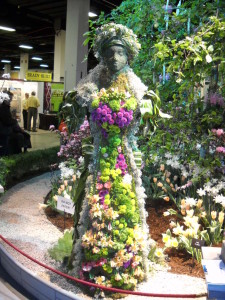
Boston Flower Show
This has been a relatively easy winter for me. No heavy snows requiring me to climb up on my roof to shovel off the flat part above a death-defying 30-foot drop. No temperatures lingering below zero for days on end. Still, it’s winter and I’m a gardener who is already thinking about spring. Thank heavens for the spring flower shows! Here is this year’s schedule. Mark your calendar and get ready to go.
One of my favorite flower shows is on the first weekend of the big shows: the Rhode Island Flower Show (www.flowershow.com) at the Rhode Island Convention Center in Providence on February 18-21. This year’s extravaganza is called “Spring Fling” and is being promoted as a treat for all your senses: things to see, smell, touch, taste and hear.
So there will be, in addition to the standard flower displays, cooks whipping up treats and teaching tricks, and bands playing Friday and Saturday from 4 to 7 pm. Friday’s band will do tunes from the 50’s and 60’s, while Saturday’s band, Hey 19, is a Steely Dan tribute band. Should be fun. The show sells drinks and has a small dance floor, too.
As with all shows, attending the lectures and slide shows at the Rhode Island Show are an important part of the show for me. Actually, I’ll be speaking both Friday at4pm and Saturday at noon. But I may go hear Roger Swain of Victory Garden fame, or some of the many other speakers. And I love all the displays – from professionals to rank amateurs.
Also on February 18 to 21 is the Connecticut Flower Show (www.ctflowershow.com) at the Convention Center in Hartford. Like the Rhode Island show, this show boasts plenty of flower displays, vendors and lectures. In fact, it boasts 4 lectures at a time (in different rooms) for 4 time slots on the four days! Want to learn how to grow plants for Monarch butterflies? Learn about ground covers or decorative grasses? Build a water garden? An expert will tell you all about it.
Two regular New England flower shows are not scheduled for 2016. The Vermont show, one of my favorites, is on a two-year cycle, and this is an off year. The Portland, Maine show is also not happening this year. They are moving the show out of the ancient warehouse it has been in to new quarters next year.
The biggest show of the east, in Philadelphia, will be held March 5 to 13 at the Pennsylvania Convention Center (www.theflowershow.com). The Pennsylvania Horticultural Society has been holding this event since 1829, when Andrew Jackson was President! It covers about 6 city blocks and will be attended by over a quarter of a million people over a nine-day period. It’s not inexpensive: an adult ticket is $27, kids are $15. No special deals for elders. Still, if you love the flower shows, you should travel to it at least once.
Then comes the Boston Flower Show (www.bostonflowershow.com) March 17 to 20 at the Seaport World Trade Center. This in another big show that is worth seeing. Like the Philly show, don’t go on the weekend if you can avoid it. It starts on a Wednesday, and will be much less crowded then, and on Thursday.
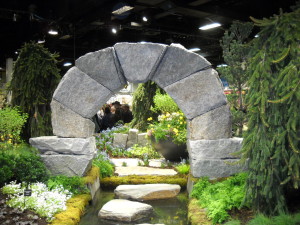
Boston Flower Show
The Boston show has a remarkable number of vendors selling everything from teak furniture to garden tools, plants and pottery. The gardens created for viewing are always interesting, as are the individual entries of potted plants, flower arrangements and more. Tickets are $20 for adults, $17 for seniors. Travel companies often offer package deals including bus fare and admission – which might be nicer than driving in Boston traffic and paying for parking.
The Seacoast Home and Garden Show (http://seacoast.newenglandexpos.com/)in Durham, NH on April 2 and 3 is a nice show on a manageable scale. Held in the Whittemore Center Arena at UNH, admission is only $8 or $6 for seniors. It is more than a flower show, with many home improvement companies present at well.
The last flower show in New England is in Bangor, Maine, the BDN GardenShow (http://bdnmainegardenshow.com/) April 15 to 17 held at the Cross Insurance Center. I’ve never been to it.
Actually, the last – and perhaps the best – of the shows takes place May 24 to 28in London: the iconic Chelsea Flower Show (https://www.rhs.org.uk/shows-events/rhs-chelsea-flower-show). I’ve never been, but am giving serious thought to going this year. I talked to a friend who has been there twice who said, “The Chelsea Show is the pinnacle of anybody’s garden show experience.” She told me to join the Royal Horticultural Society so that I can get in before the crowds.
The show is less commercial than ours, I gather, and is both indoors and out. The scope of the show is absolutely amazing – it even includes masses of vegetables. And the Queen goes every year, too! Another friend sent me a link to an hour BBC television special on the 2015 Chelsea Show, which got me even more excited about going: https://www.youtube.com/watch?v=uMz6cgnc8f0.
So go to a show, even if you can’t make it to London.
Henry gardens in Cornish Flat, NH. Reach him by e-mail athenry.homeyer@comcast.net. His website is www.Gardening-Guy.com. He is the author or 4 gardening books.
Tree Identification
Posted on Wednesday, January 27, 2016 · Leave a Comment
Winter is a slow time for me – there is no weeding or mowing or transplanting to do – so I have time to cross country ski or walk almost every day. I love observing the trees and native shrubs of the forest, and try to know the name of everything I see. Trees without leaves are a bit of a challenge to most of us, but by now I should know almost everything I see, either by tree shape, bark or buds. If you don’t know the woody plants you see in winter, now is a good time to learn them.
I own a number of books that are sold as tree identification books, though most of them try to cover every tree in North America, and can be difficult to use. Last year I got one I really like and sometimes put it in my pack, just in case I see something out of the ordinary. It’s called Forest Trees of Vermont by Trevor Evans. It has detailed information about 82 trees native to Vermont or that have been introduced and are common in the state. Each species has 3 to 6 photos of the leaves, bark, buds, flowers, nuts and sometimes the entire tree, along with descriptions of important characteristics.
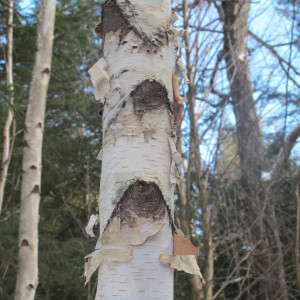
Whtie or paper birch
There are six species poplars, for example, that grow in Vermont (and presumably throughout New England), but only 4 are native. I know just 2 of the native poplars, the big-toothed poplar (Populus grandidentata) and the quaking aspen (P. tremuloides), and one non-native species, the Lombady poplar (P. nigra) So much for knowing all the trees of the forest. For each genus (a scientific grouping a closely-related plants), there is a chart that summarizes the differences and similarities of each species for their bark, leaves and buds (which are key for winter identification).
An interesting distinction for poplars is the difference in taste of the bark. I’d never read any reference to taste before as a distinguishing characteristic. Quaking aspen has ”very bitter” tasting bark, according to the book, while bigtooth aspen does not. That’s a very useful and easy distinction – from a tree farmer who clearly know his trees. Taste is not a distinguishing characteristic for most groups and is not mentioned, but the odor of twigs is used for cherries and plums. Again, very useful.
The book also has 2 dichotomous keys: one for summer identification, one for winter. In high school biology class I learned to use keys, and find them useful. A key has pairs of observable characteristics. So, for example, a useful distinction is whether a tree has needle-like leaves, or broad leaves. In the first group, all but the tamarack are evergreen. By dividing all trees into 2 those categories, the pool of trees is considerably reduced. In the first group you have pines, cedars, spruce, firs, hemlock and tamarack. Then a second pair of characteristics is used to divide each group into a smaller group, and so on until you find your tree.
Even though, as a well known geezer, I do not have a cell phone, I recognize the utility of including QR codes in the book. For you other geezers and geezerettes, a QR code is a little square with dots that you show your cell phone and, though the wonder of the internet, connects you to a database. In this case there are one or two codes per tree: one taking you to the U.S Department of Agriculture’s NRCS site, another to the Forestry Service site. There is a huge amount of information available there.
Long ago I learned another good distinction: whether leaves and twigs sit opposite each other, or staggered on a branch. There is a mnemonic to help with this: MADCap Horse. That stands for Maple, Ash, Dogwood, members of the group Caprifoliaceae (a group including honeysuckles, viburnums, elderberries and some other shrubs) and horse chestnut – those all have opposite branching. Eeverything else has alternate branching (with minor exceptions, of course).
I should note that the opposite branching distinction is not infallible. For example, a mature sugar maple has many twigs that do not appear to be opposite another. That is because one has fallen off. Look to the top of the tree, where younger twigs are present and you will see opposite pairing.
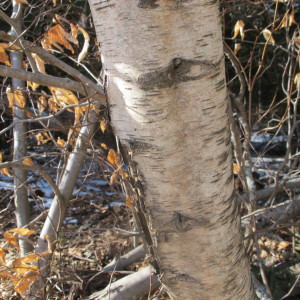
Gray birch
In winter bark is useful to me for identifying trees. Everyone can probably identify a birch by its whitish bark. But is it a white or paper birch (Betula papyrifera) or a gray birch (B. populifolia)? According to the charts in Forest Trees of Vermont, both have chalky or grayish white bark but gray birch’s bark is “dirty looking”. And paper birch bark separates into “thin horizontal papery layers”, while the gray birch’s bark does not. That should do it. Yellow birch also has papery layers, but the bark is “silvery gray or light yellow”. The book also notes that yellow birch gives off a “wintergreen odor when young branches are scraped”.
Although this book was aimed at Vermont readers, I think it would be useful anywhere in New England. So go for a walk with it or the tree book of your choice, and see what you can identify.
Henry is the author or 4 gardening books. His website is www.Gardening-Guy.com. He lives in Cornish Flat, NH.
Hudson Valley Seed Library
Posted on Wednesday, January 20, 2016 · Leave a Comment
It’s that time of year again. Time to buy seeds, either at your local feed-and grain store, the local garden center, or from a catalog. I like to buy locally, but catalogs do present a wider variety than most stores can offer. Recently I called Ken Greene, founder of the Hudson Valley Seed Library in Eastern New York State, to have a chat about seeds.
Hudson Valley Seed Library
The Hudson Valley Seed Library (www.seedlibrary.org) is a bit different than most seed companies. It was started in 2004 by Ken Greene to make locally grown seeds available to gardeners in his region, and to keep old local varieties from disappearing. He wanted to develop strains that are particularly good in the northeast, and to teach gardeners how to save seeds themselves.
Ken was afraid that the big companies would take over the seed market with genetically modified seeds (GMO’s), though that fear seems not to have materialized. Most seed companies refuse to sell GMO’s, though many farmers use them to grow grains and cotton.
Ken is a self-taught gardener. His education is in special education, but when he was working part-time in a library he offered patrons some seeds that he had grown. Take some seeds, he told them, grow them out and then bring some back for next year. He taught the patrons how to save seeds properly. It was sort of a slow-moving seed swap and no money changed hands. It was a big success, so in 2008 Ken quit his day job and started his seed company. He kept the same name he had used when he started, Hudson Valley Seed Library.
Most large seed companies contract with farmers to produce the seeds they sell in colorful little paper packages. Although a hundred years ago New England boasted many seed companies that produced seeds for local use, now there are just a handful of companies based here. Our summers are short, and often high in humidity which can encourage fungal diseases, so even local companies generally develop and test their varieties here in New England, but then send seeds to growers elsewhere for mass production. Idaho, New Mexico and other hot, dry areas are prime seed-growing areas. Hudson Valley grows its seed in New York and New England, much of it on Ken’s farm in Accord, NY.
Hudson Valley only sells open pollinated varieties, those that will breed true, year after year. You can save seeds from these. I save seeds from my favorite heirloom tomatoes every year, as they are open pollinated. Each tomato has both male and female parts, and they can be wind or insect pollinated. Heirloom just means that they are varieties that have been around for a long time – generally 50 years or more.
Some heirloom vegetables are open pollinated, but are susceptible to inadvertent crosses by insect or wind pollination. Cucumbers, squash and pumpkins are easily cross pollinated, resulting in those weird monsters that sometimes show up in your compost pile. If you want to save seed from the vine crops, you (and your neighbors) need to separate varieties by a quarter of a mile or more, or protect the blossoms from insects and hand pollinate blossoms yourself. Hudson Valley has a membership program that offers education to its members about seed saving, and opportunities to test new lines of seed.
I asked Ken about some of his favorite open pollinated varieties. He suggested that I try his New York Early Onion. He said most gardeners don’t bother starting onions from seed, but that this one is a great onion that keeps well and is worth the time and effort. You should start these indoors in flats anytime from mid-February to late March – and I will.
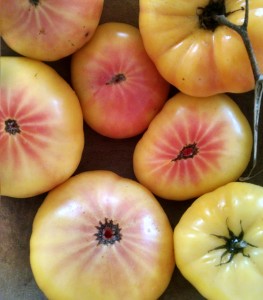
Summer Sunrise
A great container tomato, Ken said, is Summer Sunrise. It’s a small plant but produces full-sized salad tomatoes on sturdy stems, and has great heirloom flavor. He also likes growing ground cherries, a relative of tomatoes that taste like ”pineapple, citrus and tomato”. They are not ripe until they fall off, so you harvest them by picking them up off the ground. Each comes wrapped in a husk – to keep the fruit clean! I’ve grown them, but not recently, and might try some again.
One of my favorites from Hudson Valley is Piracicaba, a broccoli relative that only produces what, in a standard broccoli, we would call side-shoots. No big head. But Piracicaba is very productive and very tasty. It continues to produce long into the fall, too.
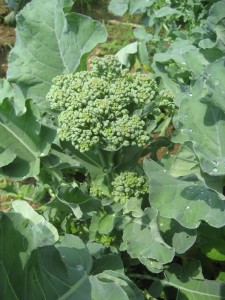
piracicaba
I will also try Hank’s Xtra Special Baking Beans. I’ve always found that dry beans are a lot of work to clean and get ready to use, but Ken gave me his method, which I like: let bean pods dry in the field, then pull them. Hang the plants in a hoop house or barn until the pods are brittle. Then beat the plants against the inside of a clean 30-gallon trash can to knock the beans loose, avoiding the task of shelling. To get rid of the extraneous material, set up a box fan so that it can be blown away as you empty the trash can into a bucket. Slick!
There is nothing wrong with buying hybrids or modern varieties, though I do find many of the old open-pollinated heirlooms offer wonderful flavors I could never find in the grocery store. So I grow both, and maybe you should, too.
Henry has been a UNH Master Gardener since 1998 and is the author of 4 gardening books. His website is www.Gardening-Guy.com.
The One-Day Cold
Posted on Wednesday, January 13, 2016 · Leave a Comment
I don’t often catch colds. Part of that may be that I eat well, and get plenty of sleep and exercise daily. Or maybe it is just that I don’t have school-age kids and work out of my house, so I don’t come in contact with all the germs that are floating about. But over the holidays I went to parties, saw the grandkids, shopped and had plenty of chances to catch a cold. And I did catch one.
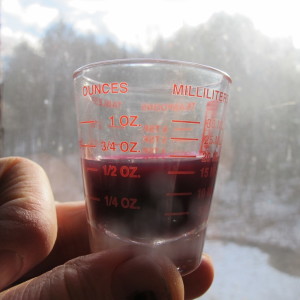
Elderberry elixir
One morning shortly after the holidays I woke up with a sniffle, a scratchy throat, and a general feeling of malaise. So I got out the big guns: Fire Cider and elderberry elixir. I took about half an ounce of each of these herbal cures after breakfast, again at mid-morning, and then after lunch. As if by miracle, my symptoms started to go away. I continued the cure, and by bedtime I felt fine. Coincidence? Perhaps.
Several years ago I learned how to make Fire Cider from Vermont herbalist Rosemary Gladstar. She explained that the ingredients in this potion stimulate the immune system and help the body heal itself. That makes sense to me as the recipe (see below) contains garlic, horseradish and hot pepper – and more! Any one of these is likely to make my body wake up and pay attention!
Here’s the basic recipe as given by Rosemary Gladstar: In a glass jar combine the following ingredients:
- 1/2 cup grated horseradish
- 1/8 cup minced garlic
- ½ cup finely chopped onion
- ½ cup grated fresh ginger
- ½ to 1 teaspoon powdered cayenne (or other hot pepper)
- About a quart of organic vinegar, preferably locally made and containing the web of live bacteria that constitute the “mother” of the vinegar.
- ½ cup honey (or to taste), heated till well liquid.
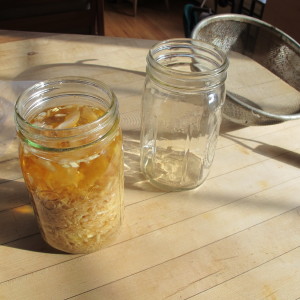
Fire Cider before decanting
All ingredients are best if fresh, local and organic; I grew most of mine. Let this steep, preferably for 3 to 4 weeks, then pour through a sieve and it is ready to use. You can use it sooner than 3 weeks, of course. Seal with a plastic lid, or put a plastic bag over the jar and seal with a canning lid. The fumes are strong enough to eat through a normal canning lid over time. Keep cool or in the fridge.
For Christmas my sister-in-law, Lisa Goodale Brinton, gave me some Fire Cider she had made which was an enhanced version of the one I learned from Rosemary Gladstar. She made it by the gallon, adding rosehips, sun-dried shiitake mushrooms, rosehips, orange and lemon juice and zest, fresh thyme and rosemary and fresh turmeric root that she had fermented using kambucha. It tasted very good, and was the potion I used to help kick my cold.
After I made my Fire Cider I added some fresh rosemary and lemon juice: a sprig of the rosemary and the juice of a lemon. I added it after I first tasted it, and it only improved the flavor. I read that one can add powdered turmeric instead of macerated fresh fermented turmeric, so I added a teaspoon of dry turmeric powder. Spices don’t last forever, so it is always good to buy fresh spices regularly. My turmeric was several years old, so I got some fresher stuff to use.
While reading to see if anyone could explain why Fire Cider might help kick a cold I came across some amazing news: a corporation called Shire City Herbals has trademarked the term Fire Cider and has filed lawsuits to prevent others from using the term. Yikes, I could be in trouble now! But apparently lots of protest has been made; see www.freefirecider.com for more information. Rosemary has been sharing her recipe since the 1970’s and the recipe was included in her wonderful book,Rosemary Gladstar’s Herbal Recipes for Vibrant Health – which came out before Shire City Herbals even started their business.
I also recently made some elderberry elixir. I went to my freezer and got some of my frozen berries. In a saucepan I heated 6 cups of elderberries, 2 cups of water, a quarter cup of honey, a couple of tablespoons of lemon juice and half a teaspoon of cinnamon. I brought it to a boil and simmered it until the berries were mushy.
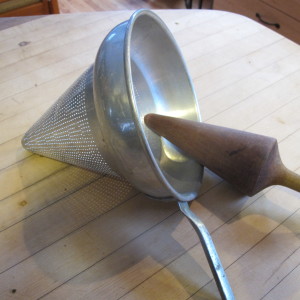
Jelly cone
I used a jelly cone to separate the elderberry pulp and the juices. This is an aluminum cone with lots of small holes. It comes with a pointed wooden masher that I use to crush the berries and extract the juice. The 6 cups of berries produced a little less than a quart of the elixir. I will keep it in the fridge as otherwise if would ferment and spoil.
I can’t promise you that Fire Cider or my elderberry elixir will prevent or cure the common cold. But at worst, they are great placebos: tasty and full of zing.
Henry can be reached at P.O. Box 364, Cornish Flat, NH 03746 or by e-mail athenry.homeyer@comcast.net.

 Click Here to buy from Cobrahead