A Few Tips for Growing Great Flowers
Posted on Sunday, May 28, 2023 · Leave a Comment
I’m a sucker for a good looking flower. Back when I was first developing my flower beds I would go to a plant nursery and grab everything and anything that was in bloom and looking great. And I believe in buying multiples: not one plant, but three or five! Needless to say, I was in trouble when I got home and looked for a place to plant them. I needed to create new beds for each truckload of perennials I brought home. Even so, I couldn’t help myself.
Now I am more judicious when I go shopping for plants: I decide ahead of time what I need, and how many. I decide where they will go before I leave home. Still … a few plants seduce me with their beauty every time I arrive at a good greenhouse.
By the way, I’ve heard from many gardeners that some of their perennials, trees and shrubs were damaged by a hard frost in May. Leaves that turned brown will not recover – but will be replaced. I am cutting damaged stems of perennials back to the ground and they should re-sprout. Trees and shrubs that have gone through the winter and leafed out are hardy here, and should send out new leaves on their stems, even if they don’t bloom this year. They have dormant buds that will wake up, and plenty of energy in their roots. I won’t bother taking off the dead leaves. So stop worrying if yours got frost damaged.
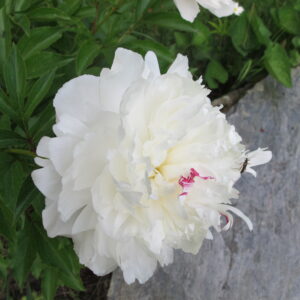
Peony ‘Festiva maxima’ that my grandmother grew
Peonies, primroses and barrenwort (which is usually referred to by its scientific name, Epimedium) are blooming in my gardens. I recommend that you buy these now, while in bloom, so you know what you are getting – and if you like them as much as I do.
Some peonies are highly fragrant, others not at all. Some have blossoms with many petals (called doubles) while others have just one or two rings of petals (called singles). Doubles are magnificent but often flop when it rains, sometimes breaking their stems. So you need to tie them to stakes or support them in wire cages made for the task. If you see both kinds in bloom, you can decide what you want to buy.
Most plants have a finite lifespan, but peonies seem to last forever. I have a division of one that was my grandmother’s – and she died in 1953. So plant them well: I dig a wide hole and add compost to it, along with some organic fertilizer – which is naturally slow release. Full sun is best, but they will do okay with 4 to 6 hours of sunshine.
Peonies can be fussy: don’t cover the little growing points beneath the soil with more than ¾ of an inch of soil, or they probably will not bloom. If yours don’t bloom, remove some soil from around them as they are probably too deeply planted.
Primroses, generally, do well in partial to full shade. Some do well in dry soil, but most like moist, rich soil. Read the plant tag carefully before planting. Sometimes I will try a plant in one place, and if, after a year or two, it is not performing well I move it. Sometimes I move a plant more than once to find the right place for it.
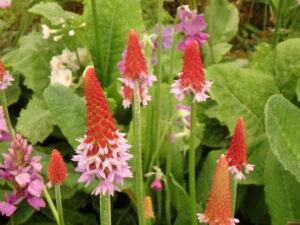
Primula vialii is not commonly sold but is wonderful
Arlene Perkins of Montpelier, VT is an expert grower of primroses. She told me long ago that all primroses like to grow under old apple trees. The partial shade is right for most, and the soil is naturally enriched by dropping leaves and fruit over time. It is under a cluster of old wild apples that I have had my best luck with primroses, particularly the candelabra or Japanese primrose (Primula japonica). They have multiplied by seed and root from a few planted 20 years ago to over 500 plants, I estimate.
Last year I planted many Primula viallii (no common name) in the perfect growing conditions for them. They bloomed magnificently last summer but so far not one has shown up again. The blossoms are very different from any I know: like little red-topped elf caps over pink/purple bases. It said to self-sow, and it is early yet, so I might see some yet.
Lastly, I love barrenwort or Epimedium. I have about eight different species or varieties of Epimedium, and all are wonderful. Epimedium grow in light to deep shade and do fine under deciduous trees, despite the competition from tree roots for moisture and minerals. My resource books tell me they do best in moist soils, but I grow them routinely in fairly dry soils. I think rich soil is the key, not the amount of moisture.
The common red one (Epimedium rubrum) blooms early in spring but hides its flowers under its leaves, which I don’t like. But it forms such a dense shade cover with its handsome leaves that no weeds will grow under it – so I forgive it.
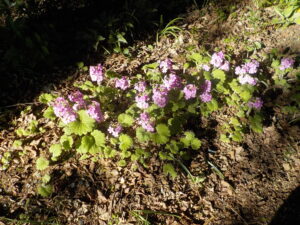
This newly planted Epimedium ‘Pretty in Pink’ will develop into a 2-ft wide plant
The colors I grow range from pure purple to red to pink to white, with others a variety of yellows. Again, I suggest buying them in bloom – now – so you can see if the blossoms are prominent above the leaves, or hidden below. The common red one (Epimedium rubrum) blooms early in spring but hides its flowers under its leaves, which I don’t like. But it forms such a dense shade cover with its handsome leaves that no weeds will grow under it – so I forgive it.
I like “collecting” different varieties of plants I like and seeing the differences between different kinds. If one kind does well, its cousins probably will, too. So go buy more of your favorites!
Many thanks to all you readers who have donated to support
Notes from the
Garden. If you have been enjoying the column, learning from it and wish to donate, please go to my website,
www.Gardening-Guy.com and go to store/donations and follow the prompts. Or do it the old fashioned way, and mail a check to Henry Homeyer, PO Box 364, Cornish Flat, NH 03746.
Tips for Planting the Vegetable Garden
Posted on Tuesday, May 16, 2023 · Leave a Comment
Although there are many old sayings like, “Plant your potatoes when the oak leaves are the size of a mouse’s ear”, I would rather depend on soil temperature and calendar dates. Besides, who really knows the size of a mouse’s ear?
Mid-May is good for cool weather crops like spinach, peas, lettuce, onions, potatoes and broccoli-family plants. Heat-loving plants like tomatoes, cukes, zukes, corn and peppers? I have a soil thermometer and I don’t put them in the ground until it is at least 60 degrees. The date for this is usually around June 10 here in chilly Cornish Flat, but may be sooner depending on where you are.
I know you are anxious to get your crops growing, but tomato seedlings put in chilly soil and with cold nights are not happy. They don’t do much growing and may take time to recover. I’d rather keep them sitting on a sunny lawn all day and bring them in at night.
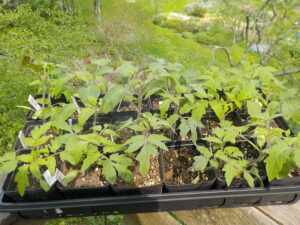
My tomatoes are hardened off, but the soil and nights are still too cold
Before you think about putting plants in the ground, please harden them off. That means introducing them to full sun over the period of a week. Start with morning- only sun, then add an hour of afternoon sun and work up to a full day of sun. Cloudy days allow you to keep them out all day, but watch out for rain. If they are in a flat that holds water, they can get too wet or get beaten flat.
I also consult with a biodynamic calendar that recommends when to plant the different categories of plants: flower, fruit, leaf and root. The one I use, called “Stella Natura” uses the position of the moon, stars and planets to determine what to plant – or more importantly, when to plant nothing.
Ask at the nursery where you buy your plants if they have been hardened off. Things like cabbage and lettuce probably are already hardened off and sitting outside the greenhouses on tables. If so, they are ready to plant anytime, but no harm in asking.
While keeping your plants happy in their little plastic six-packs, you might want to water with a dilute fish fertilizer solution. At the nursery they generally are given dilute chemical fertilizer, but I find fish fertilizer works well, and they grow strong and tall. I like Neptune’s Harvest brand.
Few of us have enough garden space for everything we want to grow, so we have to make decisions about how many tomatoes or potatoes we should grow. Ask yourself what are my favorites? Will I actually can or dehydrate tomatoes if I put in a dozen plants and we don’t eat them all in salads and sandwiches? Be realistic.
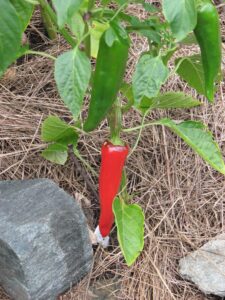
Black stones placed near heat-loving peppers help keep them warm at night
Don’t crowd your plants. Tomatoes need 24 inches between plants. Potatoes need 18 inches, onions 4 or 5 inches in rows a foot apart. Crowd them? You get more onions but smaller ones. Peppers on the other hand only need 12-inch spacing as they like to actually touch their neighbors.
A good reference guide is The Vegetable Gardener’s Bible by Vermont author Ed Smith. Even I use it from time to time, and I’ve been growing veggies for decades. Ed and his wife Sylvia really know their stuff, and buy very few vegetables in a year.
To maximize garden space I plant quick-growing plants like radishes and lettuce in between or around slower growing things like tomatoes. Plant a tomato, put it in its 54-inch support cage (never use small cages), then circle it with lettuce starts. The lettuce will be ready to eat before the tomato is big enough to shade them. I just planted my onions, and planted lettuce in the spaces between rows of onions. Don’t plant things in your asparagus patch, despite all that space, as asparagus hates company.
To maximize production, think about growing up. No, not you. Your cucumbers squashes, and pole beans. If you do this, be sure to put the trellis on the north side of your garden to avoid shading out other plants. You can buy a trellis or build your own using posts with attached chicken or welded wire with square openings.
If you want to grow hot peppers or eggplants, think about providing them some extra heat. No, not blankets. Choose dark rocks the size of a loaf of bread and place them near your plants. They will absorb heat from the sun and radiate it back during the night. You can also cover them with ReMay or row cover, a light synthetic fabric made for gardens that holds in heat and keeps bugs off.
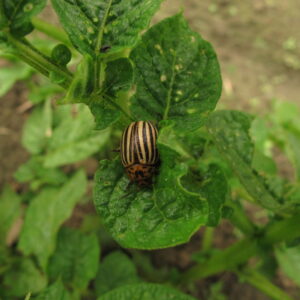
This potato beetle will lay orange egss under potato leaves. Remove them all!
Most years I have a pest called the striped cucumber beetle. It dwells in the ground and comes out at night. If I were to plant cukes, pumpkins or squashes by seed in the ground, the beetles would arrive and eat those first two leaves off right away, killing the plant. So now I start them indoors by seed and let them develop 4 to 6 leaves before I plant them outside. Sometimes I cover them with ReMay, too.
Potatoes are plagued by the Colorado potato beetle almost anywhere. I minimize the problem by planting my potatoes later in the season than my neighbors. And I look for these striped beetles, their larvae and orange egg masses. I hand pick them and then drop them in soapy water. I do that early on as they multiply quickly and each beetle will lay many eggs.
Being a good gardener takes time, but don’t be discouraged. One day you will retire and have plenty of time – even if maybe not enough energy! Just remember to take time to enjoy what you do!
Henry is a lifelong organic gardener and the author of 4 gardening books. His website is
www.Gardening-Guy.com.
Early Season Treats from the Garden and the Woods
Posted on Tuesday, May 9, 2023 · Leave a Comment
Even if you planted your peas and spinach in April, you will not be eating them anytime soon. Despite days of full sun and occasional days of high temperatures, spring in New England is often cold and rainy, too. Our vegetable gardens putter along, but few things are ready to eat until June – or later. But there are vegetables you can be eating now, however, if you plan right.
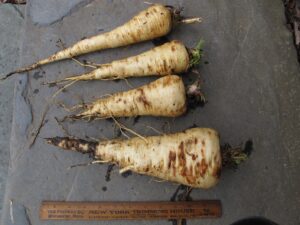
Parsnips will grow in soil suitable for carrots and are an early spring treat
I eat parsnips as soon as the snow melts and the ground thaws. How? I overwinter parsnips in the ground, which sweetens them up and makes them even tastier. I plant parsnip seeds in June – they need warm soils to germinate. Even then, they take 2 to 3 weeks to come up out of the ground.
Parsnip seeds only are good for one year, so buy new seeds each year. Plant the seeds an inch apart and half an inch deep. A key to success is to thin your parsnips so they are not crowded. Thin them in July when the greens are 4- to 6-inches tall They need 3 to 4 inches of space between plants if you want good-sized parsnips. If you mulch the plants well with ground-up autumn leaves or straw, your work is done until harvest time the following spring.
Parsnips are an old fashioned vegetable, but prepared properly they are delicious. I peel and chop parsnips into half-inch thick slices, and steam them until slightly soft. Then I cook them briefly in a frying pan with butter. At the last moment I add maple syrup and cook at low heat until it caramelizes. Yum! Don’t have any this year? You can buy parsnips at your farmers market or even the grocery store.
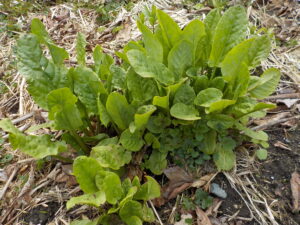
Sorrel is ready to eat now for me
A little-known perennial green is sorrel. Once established, it produces a plethora of light green, lemon-flavored leaves, year after year. The French make soup with it, perhaps because the greens themselves pretty much melt and disappear if you sauté them. So for years I just added them raw to salads.
Then I got Deborah Madison’s wonderful cook book, “Vegetable Literacy”. She uses sorrel with peas and leeks to make a soup. But I don’t really follow recipes, and found that yes, indeed, sorrel goes well with peas. But I found I can boil frozen peas, then at the last minute add chopped sorrel. Just boil it for another minute, drain, add butter and enjoy!
Another early perennial vegetable, asparagus, is also coming in to season. If you like asparagus – and I can’t imagine anyone not liking it steamed and slathered in butter – you should grow it. It is mostly sold as crowns (roots), not seeds, for starting a patch, but seeds are available if you want to start an acre of asparagus.
Don’t crowd your asparagus. The roots are sold in bundles of 25, which is fine for a family of two. Plant them 18 inches apart and six inches deep. Buy any of the Jersey hybrids, they are all male and won’t start new plants that will crowd out your established plants. When planting, add lots of compost and some organic fertilizer. They like full sun, and plenty of moisture, but will grow with as little as 4- to 6- hours of sunshine if that is all you can offer.
To keep on getting good asparagus every year, keep it well weeded and top dress it with organic fertilizer every year after you finish picking. Mulch is good for keeping weeds down. And don’t over-pick your asparagus: three weeks is the season for a well-established patch. Don’t pick any in year one or two. The plants need to store lots of energy for next spring’s production, so they need to grow fronds all summer for that.
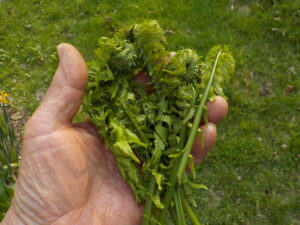
Fiddlehead stems are good tp eat, too.
Fiddleheads are a great spring treat. They are the new shoots of the Ostrich Fern, a big shade-loving fern that is common in New England. All ferns come up as fiddleheads, but only the Ostrich fern is tasty. There is an easy way to identify them: they are the only ones that have a groove up the inside of the stem – just like celery.
I sauté fiddleheads in butter in a cast iron frying pan. First I brown some slivered almonds in olive oil, then add the fiddleheads and some chopped garlic or the bulbs of ramps (more on them below). I pick not only the curled part of the fiddlehead, but also the first 6 inches of stem. But I only take one or two fiddleheads from each plant to allow it to develop well.
Ramps, also called wild leeks, are easy to grow if you have an open wooded area with maple, ash or beech. They are commonly sold now at farmers markets. Both the bulb and the leaves are edible, so cut off the bulbs and plant them. Next year they will please you by showing up in early spring. If you plant 25 to 50 bulbs each year for 3 years or more, you will develop a nice patch. Once established they will spread by seed and root.
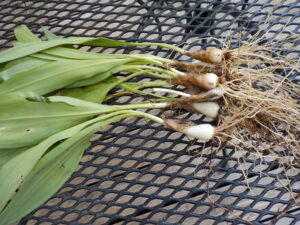
Ramps are easy to grow and a real spring treat
My favorite way of eating ramps is to clean them and rub off the gelatinous covering of the bulb, and then chop the entire plant for cooking. I fry them in a cast iron pan until the leaves wilt, then make scrambled eggs. They can also be added to anything that require garlic or onion – they are the same family.
We will have to wait until July or August to get our tomatoes, even those like ‘Early Girl’ and ‘Fourth of July’ that are quick oto produce. But if you start some perennials in your garden, you can be enjoying taste treats even now, in May. I am.
Henry Homeyer is the author of 4 gardening books. His email is
henry.homeyer@comcast.net. he is a liflelong organic gardener and a 20+-year veteran of the UNH master Gardener program.
How is Your Soil and How Can You Improve It?
Posted on Tuesday, May 2, 2023 · Leave a Comment
Most gardeners know that success in the garden depends on many factors: you can’t grow a sun-loving plant in a shady area, for example. And a shrub that loves wet places won’t do well in dry soil. But the key to success is really the quality of your soil. Not only that, any soil can be improved with some help from you, the gardener.
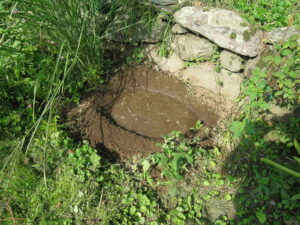
Testing drainage is simple
Ten thousand years ago the glaciers made a final pass over New England grinding rocks into sand and smaller bits that became sandy, clay and loam soils. Soil is made up of roughly 45% ground rocks, 5% organic matter and the other 50% is air. Surprisingly, plants get their oxygen through their roots, not leaves.
Of course if you have been driving your car over the lawn, it is compacted and has much less air. Even walking regularly over the ground will compact the soil, which you should avoid, especially when the soil is wet. Compacted soil is not only has less oxygen, it is tough for roots to penetrate, and it is more likely to be water-logged. Crab grass does much better than planted grasses in compacted soil.
An easy test for soil compaction in your lawn is to take a screw driver with a 6-inch shaft and see if you can easily insert it into your soil. If not, it is seriously compacted. A lawn with compacted soil will improve if you spread a half-inch layer of compost over it every year. Earthworms and other soil organisms will slowly move it into the soil, improving it. Flower and vegetable beds can be loosened with a fork or hand tool.
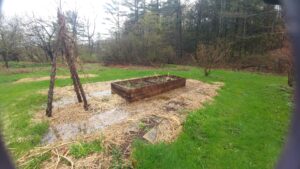
Raised beds are great for areas that flood or stay wet
It makes sense to get a soil test done every three years to see if your soil is improving with your efforts. Your state extension service has a lab that will test your soil for a fee. Get the home garden test, which will tell your soil pH (acidity), mineral content, organic matter content and soil texture. If your vegetable garden is near the house and was built before 1978, get the soil tested for lead (the law prohibiting lead in paints passed in 1978). Some states include testing for lead for free in the standard test.
By adding compost or aged manure to your soil in the garden, you will increase the percentage of organic matter and improve soil texture or tilth. You should have at least 4% organic matter, and 8% is terrific. I add compost every time I plant anything, even though my soil is excellent. Good compost contains lots of living bacteria and fungi which help plants.
Your soil test will not tell you how much nitrogen your soil has, as that number varies daily according to moisture levels and temperature. But if you have plenty of organic matter, it probably has adequate nitrogen. Still, I add some slow-release organic fertilizer when planting anything except annual flowers. Organic fertilizer (unlike most chemical fertilizers) slowly provides nitrogen and other nutrients, rather than all at once. This encourages healthy growth, not a fast spurt of green growth.
Two simple tests you can do involve digging holes. Dig a hole with straight edges down at least a foot to see the soil profile. The top layer will be darkest, as that is where the topsoil is – maybe just two inches, or maybe as much as six inches. The deeper the topsoil, the better. Adding compost and working it in will increase the quality of the soil; the top six inches of soil is where most plant roots are (except for trees).
The next layer is subsoil, which is a different color, perhaps a light brown or reddish brown. Finally, you may get to a layer of sand, gravel or clay. Sand or gravel will help your soil drain well, clay will act like a barrier, holding water. If the soil stays wet much of the year, it will be gray.
Drainage is important for most plants. You can test this by digging a hole 24 inches wide and about 8 inches deep. Fill it with water. If it drains out right away, or within 20 minutes, you have very good drainage. If it holds water for a few hours, especially if there has been much recent rain, you are fine. If it holds water overnight, you have a drainage problem.
If you have a drainage problem, you can build raised beds, either with wood sides or just mounded up. There are plenty of companies selling raised beds or corners for making raised beds with lumber you buy locally. Most lumber stores will cut your lumber to length.
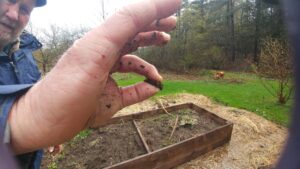
Rub moist soil between your fingers to determine soil type
Another simple soil test you can do for free is to moisten some soil, then rub it between your fingers. If it is sticky, it is a clay soil. If you feel grains of sand, it is a sandy soil. If it is neither, and is a nice brown color, you have a good loam- which is what you want.
The last test is to take a handful of moist soil, and try to form it into a cylinder. Clay soil will hold together well. Loam, which has some clay, will hold together – but break apart if you touch it with your other hand. Sandy soil will fall apart when you squeeze it. The remedy for sandy or clay soil is a generous dose of compost.
Rome was not built in a day, the saying goes. This is true for soil, too. It takes years to get your garden soil in optimum condition everywhere. So work on the places where you are planting for quicker results.
No Mow May
Posted on Tuesday, April 25, 2023 · Leave a Comment
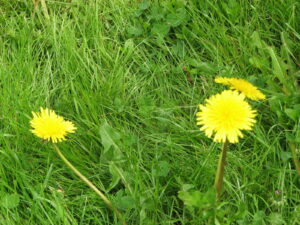
Dandelions in lawn help feed pollinators early in the spring
In 2019 a British non-profit called Plantlife coined the phrase “No Mow May”. They proposed that gardeners leave their mowers in storage for the month of May in order to let wildflowers and weeds bloom and provide pollen and nectar for pollinators. And of course the caterpillars of many pollinators feed all our baby birds, so the ramifications are vast.
Early spring is a tough time for pollinators, especially here in New England as there are not many flowers to visit. I like the idea of a simple action that can have positive effects on so many species of wildlife.
The most obvious advantage to you is that you have a few extra hours to do other things in your garden. May is a busy time for most of us: raking out beds, pulling weeds that wintered over and are starting to grow in our beds. Planting early vegetables and flowers. Shopping for new plants. We can even bask in the sun like seals if we have the time to do so.
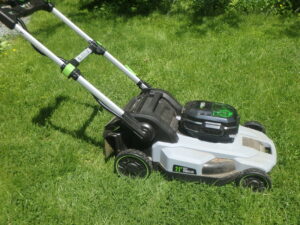
Electric mowers have improved greatly in the past few years. They are quiet and non-polluting
Next, you are not spending any money on gas or electricity (if you have a battery-powered mower). Most gas powered mowers do not have the emission controls that are required for cars. According to the Environmental Protection Agency (EPA), one hour operating a new gasoline lawn mower emits the same amount of volatile organic compounds and nitrogen oxide as driving a new car 45 miles.
According to the EPA, lawn mowers and other garden machines like leaf blowers, string trimmers, etc., contribute as much pollution as our cars and homes. The statistics on lawns are deceiving; two percent of the land mass in America is lawn. But that is more square miles of land than all the corn grown here. Roughly 80% of homes have at least some lawn.
If we mow our lawns from May to the end of October, that’s six months of mowing. Eliminating one month of mowing reduces those emissions by 17%. Good for the environment, good for the wallet.
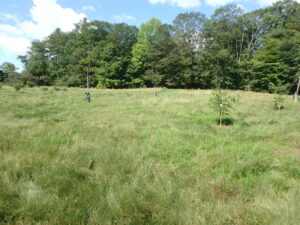
We stopped mowing this lawn and here it is in late August
For the last two years I have been installing trees in what was a 5-acre lawn in Hanover, NH. So far we have planted about 150 of them – and we largely stopped the mowing, just leaving pathways throughout. The owners now have their field mowed everywhere just once every two years to control growth of unwanted woody plants like poplars, which spread by root.
We were delighted last spring to see the field come alive in spring. At least a dozen species of flowers bloomed, probably more. And the bees and other pollinators just loved it.
You must be wondering what happened when we just stopped mowing. Grass grew, and largely flopped over as it got taller. It was nothing like the unruly 2- or 3-foot tall mess that the mowing guys predicted. We were always able to walk anywhere in the field even though it was not mowed. Of course, when the mowing crew shows up soon, they have big, industrial-scale mowers that will chew up anything.
For your home lawn you may want to pay attention to how tall the grass gets in May. Presumably your push mower or electric mower will not mow tall grasses as easily as the riding mowers used on the field described above. If you can only avoid mowing for two or three weeks, it’s still better than mowing it short every week in May.
Another advantage to the No Mow May is that you will probably end up with a better, more resilient lawn in times of drought. The longer your grass, the more food it produces for the roots, allowing them to grow longer and deeper.
Your lawn might complain about being mowed short on June 1. So put the blades up as high as they go, to avoid giving the lawn that “scalped” look. The lower parts of blades of grass may be a little pale in color as they were shaded out by the taller parts. Leave your lawn a little longer this year – it doesn’t have to look like the infield of Fenway Park.
What about bare spots on the lawn? These are often filled in with crabgrass, an annual weed. For large areas, you will need to plant new lawn seed – the sooner the better.
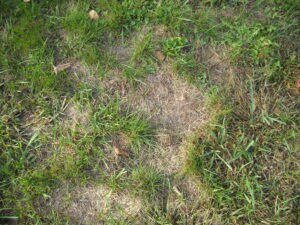
This part of the lawn needs re-seeding
Filling in empty spots can be done in May by scratching the soil with a short-tined rake to loosen the surface. Add half an inch of compost and mix it in with the soil. Then spread seed over it – just broadcast it with your hand in small areas. I use a lawn/leaf rake to mix the seed in with the soil: I flip over the rake and drag it lightly over the area, which mixes in the seed well. If you have a metal tamper, use it to press down the planted area. If not, use a small board and step on it.
I never fertilize my lawn, and it looks fine to me. If your lawn is a little feeble, check the soil pH. If it is too acidic, you can spread some limestone. Lawn grass prefers nearly neutral pH.
So take a break from mowing this May. Tell your neighbors what’s going on, so they won’t call you a lazy slug! You are just being environmentally conscious. Thanks!
Henry is an organic
gardener who has lived in the same house since he bought it in 1970. He is the author of 4
gardening books. Reach him at
henry.homeyer@comcast.net.
Early Spring Bloomers
Posted on Tuesday, April 18, 2023 · Leave a Comment
I like to have blossoms in the garden and in vases everywhere. I try to have something blooming all the time – or as often as possible. Right now, in mid-April, I count more than ten species of plants in bloom, along with seven species of bulb plants which are blooming by the hundred for me.
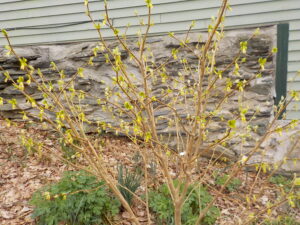
Leatherwood
Let’s start with trees and shrubs – what I call woodies. The most unusual woody is leatherwood (Dirca palustris). This is a native woodland plant that does well in part shade. Although the literature says it prefers moist, rich soil, I have it in dry soil and it does well there.
Leatherwood has small greenish-yellow flowers that appear about the same time as forsythia –mid April for me. Mine is slow growing with lovely gray bark that reminds me of beeches. This is a well-mannered, slow growing plant that stays 3- to 6-feet tall and wide.
February Daphne (Daphne mezereum) is in bloom now with highly fragrant pinky-purple flowers. It is originally from Europe, Turkey and Iran. I love it so much I named a corgi after it (she is now gone, alas). It stays 3-5-feet tall and wide. In the fall it has produces small red berries.
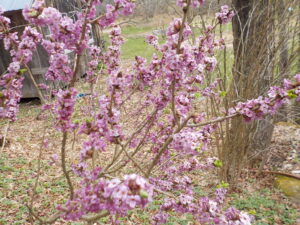
I named a dog after this shrub, Daphne mezereum or February daphne
Magnolias are in bloom now, too. My favorite is the Merrill magnolia, a hybrid which produces double white, lightly fragrant flowers. I planted mine as a small tree in 2004, and now, 19 years later, it is about 40 feet tall with a spread of 25 feet. It blooms reliably (nine years out of ten) on my birthday, April 23. It is a good specimen tree to put in a lawn, and will do well even if the soil is consistently moist to soggy.
These magnolias come as both single-stem and multi-stem trees, but most are multi-stemmed, as mine is. However, when the stems get big they grow together at their base. Sometimes the included bark rots and weakens the stems, making them susceptible to splitting. I removed one big stem on mine two years ago and the tree has recovered.
Forsythias are in bloom everywhere with bright yellow flowers. If yours only blooms down low, in the area covered by snow, the buds which were formed last summer were killed by the winter cold. So get rid of it and buy a new variety such as New Hampshire Gold, Vermont Gold or Meadowlark. All are hardy throughout New England.
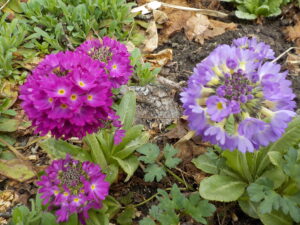
Drumstick primroses
My favorite early spring perennial is called the drumstick primrose (Primula denticulata). It comes with flowers in purple, blue, pink, magenta and white. The florets are small and arranged in 2-to 3-inch globes on 6-inch stems. They do best in moist to wet soil in sun or partial shade.
Hellebores or Lenten Roses (Helleborus orientalis) are also wonderful spring flowers. Mine have been blooming for a couple of weeks already and will continue on for another month or so. The blossoms are 5-petaled and 2- to 3- inches wide with yellow stamens in the center. Colors range from white and cream to pink, purple and nearly black. They are evergreen, but last year’s leaves should be cut off now as they are all bedraggled.
A dainty flower with beautiful finely-cut foliage is a spring ephemeral called corydalis or fumewort (Corydalis solida). It pops up in my garden where it wishes, and I am always glad to welcome it. It seems to do best in moist, part shade with rich soil. The flowers on mine are small, long-spurred light blue, but other colors are also possible. There is a yellow variety of a related species (C. lutea).
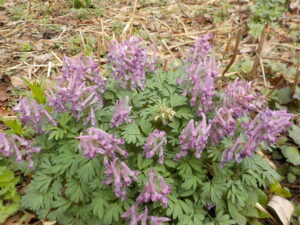
Corydalis solida
Lungwort or pulmonaria (Pulmonaria spp.) is a good ground cover that is blooming for me now, too. It is interesting that a single stem might support blue, pink or apricot flowers all at once. All do well in shade or partial shade and better in moist soils than dry soils. It spreads by root.
There are at least a dozen different species of pulmonaria including P. longifolia with spotted leaves and multicolored blossoms. The one I like best is P. angustifolia which has very intense blue flowers and solid green leaves. I’ve read that varieties or species with more white spots grow better in full sun than those with fewer or no spots.
Wildflowers are starting to bloom, including one of my favorites, bloodroot (Sanguinaria canadensis). These white multi-petaled flowers come up from the soil wrapped in the leaves that look like a green cigar. In cold days, or at night, the blossoms close up but open on sunny days when the bumblebees are working.
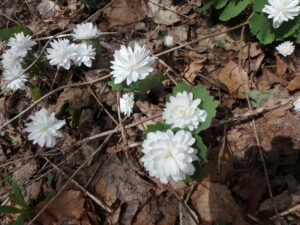
Double bloodroot is rare and not usually found in the wild but is sold in specialty nurseries
The bloom season of bloodroot is short, but there is double bloodroot which is sterile and blooms for a longer time. Like all bloodroots, the clumps get bigger every year, so you can dig them up and divide them to start doubles in new places. The sap from the roots is poisonous, so wear gloves when dividing any bloodroots. Do that in now, or in the fall.
We certainly deserve spring blossoms for having survived winter and mudseason. But you do have to plan and plant for those early bloomers.
Henry is the author of 4
gardening books and is a 25-year veteran of the Master
Gardener program. Reach him by email at
henry.homeyer@comcast.net.
Things to Try … Or Not!!!
Posted on Saturday, April 15, 2023 · Leave a Comment
Are you in a rut? Spring is here, but most of us cannot plant anything outdoors due to cold nights or wet ground. Yes, you can plant seeds indoors and baby them until early summer, but that requires a place to grow them and lights to keep them happy. So maybe you should put on your thinking cap and decide what you want to do later on, and do some research.
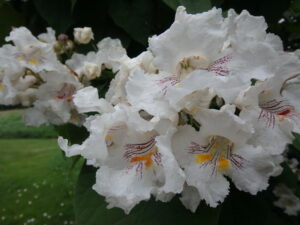
Catalpa blooms for me in late June into July
For starters, you could join a plant society, of which there are many. If you love daylilies, join the American Hemerocalis Society. You will find people who love daylilies, too, but have much more knowledge than you ever will. You will learn how to collect seeds and to hybridize daylilies of new colors. Truth be told, there probably are no more new daylilies – someone has tried pretty much every cross of two varieties. Still, hundreds more are named every year.
Or what about the International Aroid Society? The Arum genus has a diverse collection of plants from skunk cabbage to Philodendrons to Colocasia yams. The Plumeria Society of America is focused solely on the 11 species of Plumeria – known as Frangipani in English. Hostas? Wildflowers? Boxwood or Bonsai? There are societies for each and every group.
Any easy project indoors would be to start an avocado tree. Avocados ripen in California starting in spring and going through summer. Winter avocados won’t usually sprout from their seeds – they have been in cold storage too long. The classic method it to perch a seed in a glass of water using 3 toothpicks to keep its bottom just kissing the water. Put the point end up and the fat end down. I cut one open recently, and it was already sprouting! So I planted it in a mixture of potting soil and compost. I let the sprout just peak out above the soil line.
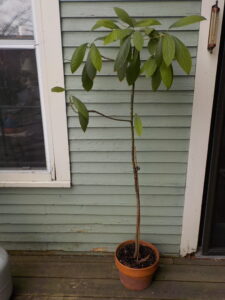
The avocado tree lives inside all winter, but goes on the deck in summer
I have grown many avocado trees over the years, generally by recognizing the shiny leaves in my compost pile. So I know that you don’t have to suspend the seed in water – they will be glad to grow in compost. When I lived in West Africa I was able to buy avocados for a penny or two apiece, and often fed them to our cats. Cats love them because of their oil content. I have a 5-foot tall avocado tree growing in a 12-inch pot that lives as a house plant in winter, and goes out on the deck in summer. It started life in the compost pile.
Try to remember the favorite flowers of your grandparents, or your parents. This would be a good time to ask your mom, for example, what did her mom really love? My grandmother, who died in 1953, loved peonies. My mother, may she rest in peace, dug up one of her mom’s peonies and moved it from Spencer, MA to Woodbridge, CT and grew it for decades before I came along and divided it in the early 1980’s and brought a part of it to Cornish Flat, where I live. The peony I got is called ‘Festiva Maxima’ a highly fragrant double white, with splotches of red inside – blood from a fairy princess, I think.
If your Grammy loved roses, study your yard and figure out where one could go in loving memory of her. And do a little research now if you have never grown roses. Roses are easier to grow now than they were 40 or 50 years ago when Grammy was growing them. I love the ‘Knockout” series of roses. The Knockouts are not fragrant, so they do not attract Japanese beetles, and they bloom for months. They are highly resistant to diseases. They don’t have long stems, but sometimes I have dozens of blossoms at once – for months.
Think about planting an oak later in the month. Many gardeners don’t think of planting oaks saying they get too big, or grow too slowly. But it has been proven that oaks are the #1 best plant to support our birds, pollinators and mammals. And you can even plant a sprouting acorn now.
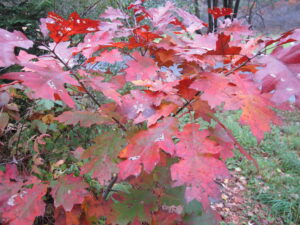
Oaks are pretty for us and food for caterpillars and wildlife
Oaks probably grow faster than you think. I planted several bareroot oaks in the spring of 2021. They were as thick as a pencil and only a foot or two tall. In two years many of them have taken off and are three feet tall or more, and will be ten feet tall in less than 5 years.
Want a fast-growing flowering tree? Plant a catalpa. They are native and the flowers are amazing. Fragrant, attractive. The leaves are huge – big enough that Native Americans used them for diapers for babies, I’ve read. I bought a 10-footer five years ago and now it already a shade tree – 25 feet tall with a 20-foot wide crown.
What else can you do? Grow a lot of something you love, starting from seed. I love rosemary, and recently bought a packet of seeds and planted 50 seeds. If all goes well, I will have plenty to share.
I will grow them on an electric heat mat (designed for use with seeds) as they germinate best at temperatures in the 70’s. Once they have germinated I will grow them under very bright LED lights, and will transplant them into rows in my vegetable garden in mid-June. Of course I will keep some in pots, and grow them on the deck.
Lastly, plan on growing a vegetable you have never grown before. Me? This is the year of the tomatillo. I did grow one once before, but only one plant and they are not self-pollinating. So this year I plan to plant 3 or 4. They are big plants, as big as tomato plants. You might try tiny decorative pumpkins, or huge ones. Or rutabagas.
Dreaming is part of being a gardener. Dream big. You’ll be glad you did.
More Chores for Spring
Posted on Wednesday, April 5, 2023 · Leave a Comment
Although I still have some snow around the house here in Cornish, NH, many of you may be looking at brown grass and mud. It will be some time before real spring weather is safely ensconced. We all want to get outside and enjoy warm, sunny days – and most of us are itching to do some work in the garden.
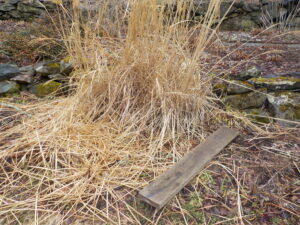
This plank will let me cut down this decorative grass without compacting the soil
If you do go outside, please be extra careful where you walk. Your lawn and gardens are probably soggy, and your footsteps can easily compact the soil and damage roots. Take a different route to your garden each time you go out. Game trails in the forest can be made by animals as small as a house cat due to compaction if they follow the same path, day after day. Plants do not thrive if their roots are in compacted soil.
I live on a dirt road, and each year the town plows dump sand and gravel mixed with snow on the lawn. I try to shovel that grit and snow back onto the road or haul it away while it is still mixed in with snow to cut down on raking later in spring. Use a soft rake – one with bamboo or plastic tines – when you rake the lawn so you will be less likely to tear up the grass as you rake.
If you have decorative grasses that overwintered, they are probably pretty bedraggled by now. It is better to cut down tall grasses before they start growing. Last year’s stems will not turn green- they grow new stems each year. The only problem you might have now is that they may be in a garden bed that you wish to avoid walking in. I use a serrated knife for the job, but pruners will work, too.
If you want to work in flower beds, find a couple of three-foot long 6- to 8-inch wide planks. Place them in your garden bed and step on them instead of the soil. They will distribute your weight and allow you to work while avoiding the problem of compacting the soil.
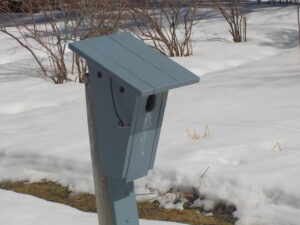
It’s time to clean out your birdhouses
If you have bluebird boxes or other nesting boxes, this is a good time to clean them out. I don’t know just when the bluebirds arrive and claim their nesting places, but I want to be ready for them. This would also be a good time to put up a bat house. Bats eat lots of mosquitoes so you should welcome them to your garden. Pre-made bat boxes are available, and directions to make your own are available on-line.
I love art and whimsy in my garden, and have all kinds of interesting art placed around my property. I recently noticed that some of it has tipped or fallen over. Depending on the nature of the whimsy, you might be able to right it now. Others, such as wire sculpture that has rods designed to go into the soil might have to wait. My soil is still frozen, which deterred me from fixing all of mine that needed straightening.
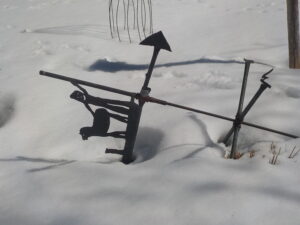
Fix art and whimsy that has fallen this winter
It’s too early here for me to rake leaves and clean up garden beds that need it. But I am picking up sticks that were blown out of trees. After a little drying time in the barn they will provide me with kindling for my woodstove.
In the past I piled up broken branches each year and burned it all in late winter while there was still plenty of snow around the pile. I have stopped creating burn piles, for two reasons. First, little animals may have settled into the burn pile over the winter, and I don’t want to evict them – or possibly kill them. And certainly there are lots of insects that overwinter in dead branches and stems of thing like goldenrod and bee balm – which used to go into the burn pile (but are now composted).
The second reason is environmental: the bonfires I enjoyed in the past send up a lot of smoke and air pollution, and I want to avoid doing that. Instead of burning those branches, we bought a chipper/shredder to make chipped branches that can be used on pathways to keep down weeds. Or they can be double-ground and the fine results are good for mulching or mixing with food waste in our compost pile.
Chipper shredders come in many sizes. We bought a gasoline-powered machine that will allegedly take 3-inch stems, but is actually better for things half that size and smaller. Manufacturers want to sell their products, so they tend to exaggerate a bit. But buy the most powerful machine you can afford. Ours cost $600 and is good for our needs.
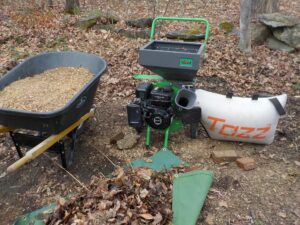
This gas-powered chipper-shredder helps make mulch and compost materials
What don’t they tell you? Chipper/shredders are noisy and can be dangerous. Mine does not start in winter. One pass though the machine makes a rough mixture of shredded branches that is not aesthetically pleasing to my eye as a mulch. But this material is easily dumped in the top hopper for fine grinding. Electric machines are out there, but the ones I’ve tried are not as powerful as a gas-powered machine. Good for small branches and leaves, I suppose.
I’ll start my tomato seedlings around April 10 indoors. These I will plant outdoors around June 10. Vine crops I’ll plant later – early May will be fine for cukes, squash and pumpkins that will go out in mid-June. I don’t need to tend seedlings any longer than need be.
Spring and summer are just around the corner. So try to be patient and avoid compacting your soil. If you see foot prints in the soil, you should stay off it. Or wear your snowshoes to get around the garden!
Early Spring Chores
Posted on Wednesday, March 29, 2023 · Leave a Comment
Early spring is a good time to look at the trees and shrubs on your property when you are not distracted by flowers and leaves. Study your “woodies” now to see if they need some care– and if some plants need to be removed for the health or beauty of the remaining ones.
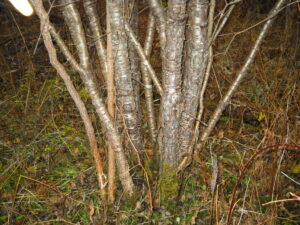
Buckthorn often grows with several stems in a tight grouping
If you have a wooded area on your property, it probably needs some help from you, especially if you haven’t done any thinning or grooming of trees in recent years. Start by going outside and really look at the trees growing on your property with a critical eye.
In nature trees grow willy-nilly. Where a seed lands is largely determined by chance. It is unable to know if it is 6 inches or 6 feet from another tree. If it germinates and grows it might be a good place, or it might be smack-dab next to another tree – or your house.
Ask yourself this question as you walk around your property at your trees: what is the future of this particular tree? How big does this type of tree grow to be? What will this one look like in 10 years? In 50? Is it too close to its neighboring trees or to the house? Is it shading your vegetable garden or favorite flower bed?
I’m a tree-hugger but I have no problem with cutting down trees when judicious removal is beneficial. Now is the time to plan on some careful thinning of trees to improve the health of your best trees and to improve the looks of your landscape.
Before you start tagging trees for culling, you need to learn to identify the trees on your property. A good guide is “A Guide to Nature in Winter” by Donald Stokes, a wonderful book that will help you with that. Because there are no leaves on most trees out there now, the Stokes book is great – it identifies trees by their bark, shape and buds. It also teaches much about all the other living things out there in the woods – from snow fleas to deer and everything in between.
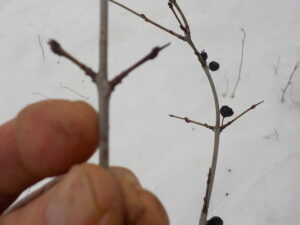
Buckthorns still have black berries and small branches that are sub-opposite (see pair just above my finger) or opposite each other.
Trees that I cull from my woods include poplars (Populus spp.), boxelder (Acer negundo) and alders (Alnus spp.). These are fast-growing trees that are short-lived and that produce lots of seedlings.
Trees that I revere are maples, oaks, beeches, birches and hop hornbeams (Carpinus caroliniana). I would think long and hard about cutting down one of them. But if a fast-growing poplar were growing within six feet of one of my favorites, I would not hesitate to cut the popular down. Trees need plenty of space to do well.
Invasive shrubs make their way into most woods, too. Barberries, burning bush and honeysuckles are shrubs that can choke out native shrubs and many native wildflowers. I work on eliminating those every spring, but the honeysuckles are still ahead of me. Learn to identify them and tag them for removal.
There are a few buckthorns (Rhamnus spp.) moving into the neighborhood, and I am keeping a sharp eye to make sure none get established on my property. Buckthorns are foreign invaders that cannot be easily killed by cutting them down because they sprout up from their roots if you cut them down.
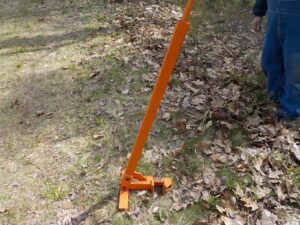
A weed wrench allows anyone to pull out invasive shrubs
To rid your property of buckthorns, you can pull young ones or girdle the older ones. Trees up to about 2.5 inches in diameter can be pulled with a tool designed for that purpose. It is often called a weed wrench, although the original Weed Wrench company has gone out if business. Another brand of weed wrench is called the “Pullerbear”. It is a steel tool with a gripping mouthpiece and a long handle that provides mechanical advantage. They come in several sizes and prices. For more info see www.pullerbear.com. I have not yet tried one of this brand, but they look like the old weed wrenches I have used.
If you cut down a mature buckthorn it will stimulate the roots to send up many suckers that will develop into new trees. To prevent this from happening, you need to girdle buckthorns twice about 12 inches apart. Cut through the bark severing the green cambium layer all the way around the trunk, but don’t cut deeply. They will usually survive two years before dying. Girdling starves the roots of food from the leaves.
You can girdle them now but doing so right after they leaf out in the spring is better. Just tag them now, and plan their demise. Some buckthorns develop multiple stems in a cluster, making it tough to girdle them, but it is possible using a pointed pruning saw.
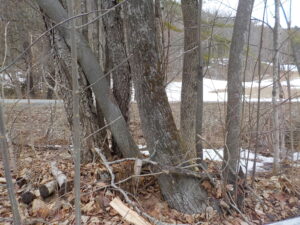
These trees will never thrive, and most will die from crowding
Hemlocks and pines often grow so densely that their lower limbs die out because the sun never reaches their leaves. Removing those lower branches opens up the landscape – another task you could do now. And think about removing any wild grapes that are climbing your trees – they can kill them.
So enjoy the spring weather and make some plans for real spring.
Bringing Spring into the House
Posted on Wednesday, March 22, 2023 · Leave a Comment
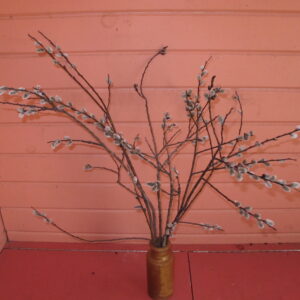
Pussy willows in a dry vase
Even though spring has arrived according to the calendar, I fear winter is not done with us yet. Mother Nature is full of tricks, so I am not packing away my snow shovel just yet. But to reassure me that she will provide us with flowers this spring, I am forcing her hand a bit. Or should I say, forcing some woody stems to blossoms indoors now.
Each spring when winter seems to be carrying on forever, I cut stems of early-blooming trees and shrubs and bring them into the house to enjoy their blossoms. If you wish to try this, you need to know which trees and shrubs to use, and learn to identify buds that will produce flowers, not just leaves.
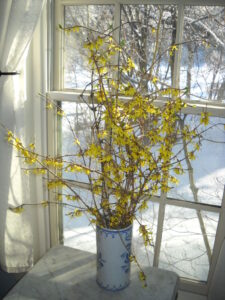
Forsythia forces easily indoors now
The easiest to force are forsythia and pussywillows. But it is also possible to force magnolias, rhododendrons and azaleas, apples and crabapples, cherries, plums, dogwood, spirea and peach. Of course cutting stems off your young peach or plum tree will reduce your fruit crop.
Trees and shrubs that bloom early in the season are quicker to produce their flowers. Shrubs like hydrangeas that bloom in late summer or fall will not bloom now, no matter what you do. I’ve never had much luck with lilacs, though perhaps if I tried closer to bloom time it would work.
In general, flower buds tend to be bigger and fatter than leaf buds. Apple and crabapple trees produce flower buds on short “fruit spurs” but not on those tall water sprouts that appear each summer. So if you are pruning your apples now, look for branches with short spurs and fat buds. Keep those, and bring them into the house.
I lost a plum tree this winter – it broke under the weight of snow and ice. It took 20 years from the time I planted a bare root twig to the time it first produced fruit. This year it was loaded with fruit spurs and I was looking forward to a big crop of plums. No matter, these things happen. I am making the best of it by cutting lots of stems with fruit spurs and placing them in vases in the house. I should get a multitude of blossoms in a few weeks.
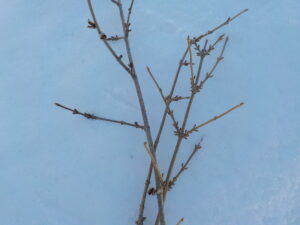
Forsythia with flower buds in pairs
I am also cutting stems from forsythia bushes to bring in the house. Forsythia is one of the first to bloom outside, and one of the easiest to force inside. It produces bright yellow flowers in quantity. Look for branches with pointy buds on stems that are at least 2 years old. You will see skinny new-looking branches that grew last year. They probably won’t produce flowers. Stems that are closer in diameter to pencils are what you want. Older branches have stems growing out of them, often with flower buds.
Then there are the pussy willows. . What we call pussywillows are actually the male catkins – pollen-producing parts – of two species of willows (Salix caprea and Salix discolor). Both grow wild, and are available at nurseries.
Pussy willows, like all willows, like wet, swampy areas. They will grow up to be small trees, but can be kept to a manageable size with yearly pruning – and now is a good time to do so. The more you trim your pussy willows, the more vigorous and productive they will be. Left unpruned, pussy willows can easily reach 20 feet tall. Since they bloom on their upper branches, picking good-looking stems can be difficult unless you have a pole pruner.
An established pussy willow is next to impossible to kill. If you have wild pussy willow that is tall and gangly, you can take a saw and cut it all right to the ground. It will come back. It can grow four feet or more in a single season.
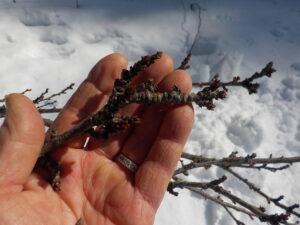
Fruit buds on plum tree
If you see yellow dust on your pussy willows, they are already producing pollen. So if you are allergy-prone, don’t pick stems with yellow on them. But you can halt pussy willows from producing pollen: pick them at their peak of beauty, and place them in a dry vase. They will stay looking the same for a year. If you pick them before they are fully developed, put them in a vase with water to let them mature. Drain off the water when the little gray kitties are at their cutest.
In 2005 I worked as a volunteer on an organic farm in the Dordogne region of France that grew willow for making baskets. I worked through an organization called Willing Workers on Organic Farms (
www.wwoof.org). In exchange for 4-6 hours of work each day I got room and board, lived with a family, and learned a lot about willows – including how easy it is to root them.
To root willows, cut 8-12 inch sections of vigorous young stems in May or June. Strip off the lower leaves, and push the stems into moist soil, leaving just 2 inches above ground. Roots will develop at each node (where leaves start) on the stem below ground; new stems and leaves will grow above ground, so long as you leave at least one node above ground. Depending on your soil, you may need to poke a hole in the ground with a screwdriver before inserting your willow stem; be sure the ground is firmed up around it when you are done.
So cut some stems to flower and chase away the late winter blues. It’s easy, and now is the time to do it.

 Click Here to buy from Cobrahead