-

Now available for $24.95 including shipping. -
Now available for $21.00 including postage. Vendors I Like
 Click Here to buy from Cobrahead
Early Spring in the Garden
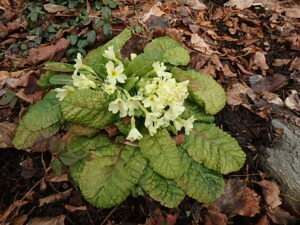
Primula vulgaris in early April
This was supposed to be my very last gardening column, but (spoiler alert) it is not. I started writing a gardening column in 1998 and wrote weekly for 25 years. Then in late 2023 I dropped down to once a month. I liked the extra time and freedom it gave me to do other things.
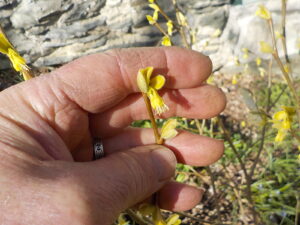
Leatherwood blossoms
Despite occasional snows, our gardens are awake in April. Flowering bulbs abound: snowdrop and winter aconite have been blooming since March; early daffodils, glory of the snow, scilla (also called Siberian squill) and crocus are plentiful. Trees are awakening, too: spring witch hazel is blooming and leatherwood (Dirca palustris) will bloom by the middle of the month.
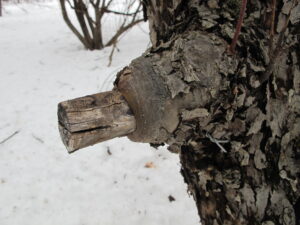
Don’t leave stubs, they have to heal back to branch collar
The timing of spring clean-up depends on the weather, and where you live. We don’t cut back many of our tall perennials and grasses in the fall as they offer food for seed-eating birds, and some harbor eggs or larvae of pollinators in their hollow stems. We’ll wait until the weather is consistently in the 50’s before we clean up and remove dead stems so insects can hatch. We’ll rake and remove debris from mid-to late-April.
- Never remove more than 20% or 25% of the live, leaf-bearing branches. This may mean spreading out your pruning over 2- or 3-years if a tree is badly overgrown. Pile up your branches as you work, so you can estimate more easily how much you have cut off.
- Don’t leave short stubs of branches, cut back to the swollen area called the branch collar. This is where it heals.
- Remove all dead branches. They don’t count in that 25% threshold.
- If two branches are rubbing, crossing or fighting for sunshine, remove one. Don’t be afraid to cut out large branches.
- Remove all “water sprouts” which are thin, pencil-like sprouts growing straight up. Do this every year. Remove any root sprouts, too.
- Remove branches pointed toward the middle of the tree.
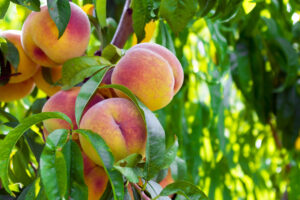
I want peaches like these
This year Cindy and I plan to plant two more peach trees. I planted a good-sized “Contender ” peach in 2021, and although it has produced some peaches, they have not been very tasty. So this year I will plant a ‘Reliant’ peach and a ‘Red Haven’. Both are peaches that are tasty and hardy here in our Zone 5 garden. And I hope to convince Cindy we should remove the ‘Contender’. She is much less ruthless than I am.
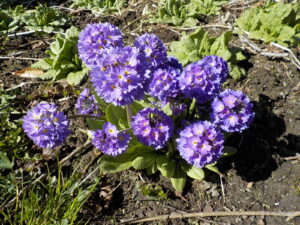
Drumstick primula is an early spring bloomer
If you have a good location for primroses, think about obtaining some Candelabra Primroses (P. japonica). These beauties bloom on 2-foot stalks with rings of small trumpets in magenta, pink or white. They grow and produce a new set of flowers each week for 4 to 6 weeks starting in mid-May for me. And best yet: they produce lots of seeds and spread quite rapidly. They do best in rich, moist soil beneath mature apple trees. Buy three plants and before you know it, you’ll have a dozen, then three dozen. Twenty five years ago I was given seven plants, now I have more than 500!
Early Spring Bloomers
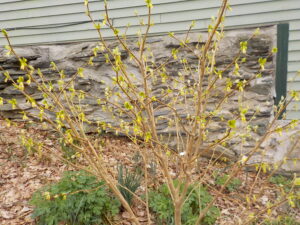
Leatherwood
Let’s start with trees and shrubs – what I call woodies. The most unusual woody is leatherwood (Dirca palustris). This is a native woodland plant that does well in part shade. Although the literature says it prefers moist, rich soil, I have it in dry soil and it does well there.
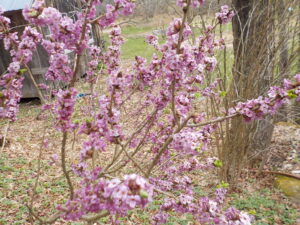
I named a dog after this shrub, Daphne mezereum or February daphne
Magnolias are in bloom now, too. My favorite is the Merrill magnolia, a hybrid which produces double white, lightly fragrant flowers. I planted mine as a small tree in 2004, and now, 19 years later, it is about 40 feet tall with a spread of 25 feet. It blooms reliably (nine years out of ten) on my birthday, April 23. It is a good specimen tree to put in a lawn, and will do well even if the soil is consistently moist to soggy.
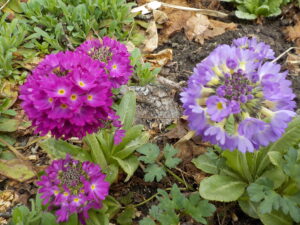
Drumstick primroses
My favorite early spring perennial is called the drumstick primrose (Primula denticulata). It comes with flowers in purple, blue, pink, magenta and white. The florets are small and arranged in 2-to 3-inch globes on 6-inch stems. They do best in moist to wet soil in sun or partial shade.
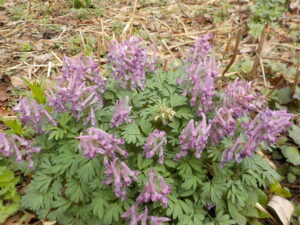
Corydalis solida
Lungwort or pulmonaria (Pulmonaria spp.) is a good ground cover that is blooming for me now, too. It is interesting that a single stem might support blue, pink or apricot flowers all at once. All do well in shade or partial shade and better in moist soils than dry soils. It spreads by root.
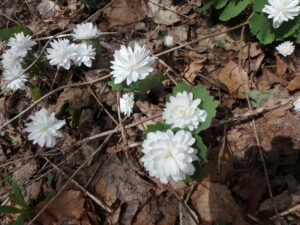
Double bloodroot is rare and not usually found in the wild but is sold in specialty nurseries
The bloom season of bloodroot is short, but there is double bloodroot which is sterile and blooms for a longer time. Like all bloodroots, the clumps get bigger every year, so you can dig them up and divide them to start doubles in new places. The sap from the roots is poisonous, so wear gloves when dividing any bloodroots. Do that in now, or in the fall.
Trees and Shrubs for the Shade
I grew up in a small town in rural Connecticut. Behind the house there was a brook and a hardwood forest with a high canopy of old maples that created a cool space for spending hot summer days. My favorite understory tree was a small, bushy tree that had very fragrant leaves and stems, which I decided must be witch hazel, as the barber splashed witch hazel on my neck after each haircut, and it was vaguely the same. I frequently chewed on the leaves and green twigs in lieu of the chewing gum that was forbidden to me.
This summer I discovered the name of that plant: spicebush (Lindera benzoin). One of my gardening clients had requested one for her garden, and as soon as I crushed a leaf, I was transported back 60 years. I knew it immediately. Most winters my part of New Hampshire drop to minus 25 degrees Fahrenheit, so any plant that will survive here must be rated for Zone 4 (Minus 20 to minus 30). I checked my favorite tree book (Michael Dirr’s Manual of Woody Landscape Plants), and sure enough, spicebush is rated for Zone 4. I will get my own as soon as I find the right place on my property to plant it.
From Dirr’s book I learned that spicebush can get to be up to 12 feet tall and wide, and is in the laurel family. There are 80 species of Lindera, both deciduous and evergreen (L. benzoin is deciduous). Apparently it blooms in early spring but the yellow blossoms are only one fifth of an inch across, so not overwhelming (I have no memory of it blooming). Fall leaf color is yellow. Dirr’s book says it does well in moist, well drained soils in full sun or half shade, though in my experience it will do well in dry shade in open woodlands. Dirr says spicebush is not often found in nurseries, but E.C. Brown’s Nursery in Thetford, VT has several nice ones.
Another woodland plant that I would like to try is leatherwood (Dirca palustris). Like spicebush, this is a native shrub that will grow in shady areas but this one prefers moist to wet soil – and I have plenty of that. Apparently it only gets to be 3 to 6 feet tall and wide, and is more open and spreading in shade than in sun. It is has small yellow flowers that bloom very early in the spring, well before the leaves emerge. Native Americans used the bark to make bow strings, fish lines and in the manufacture of baskets. Tough stuff.
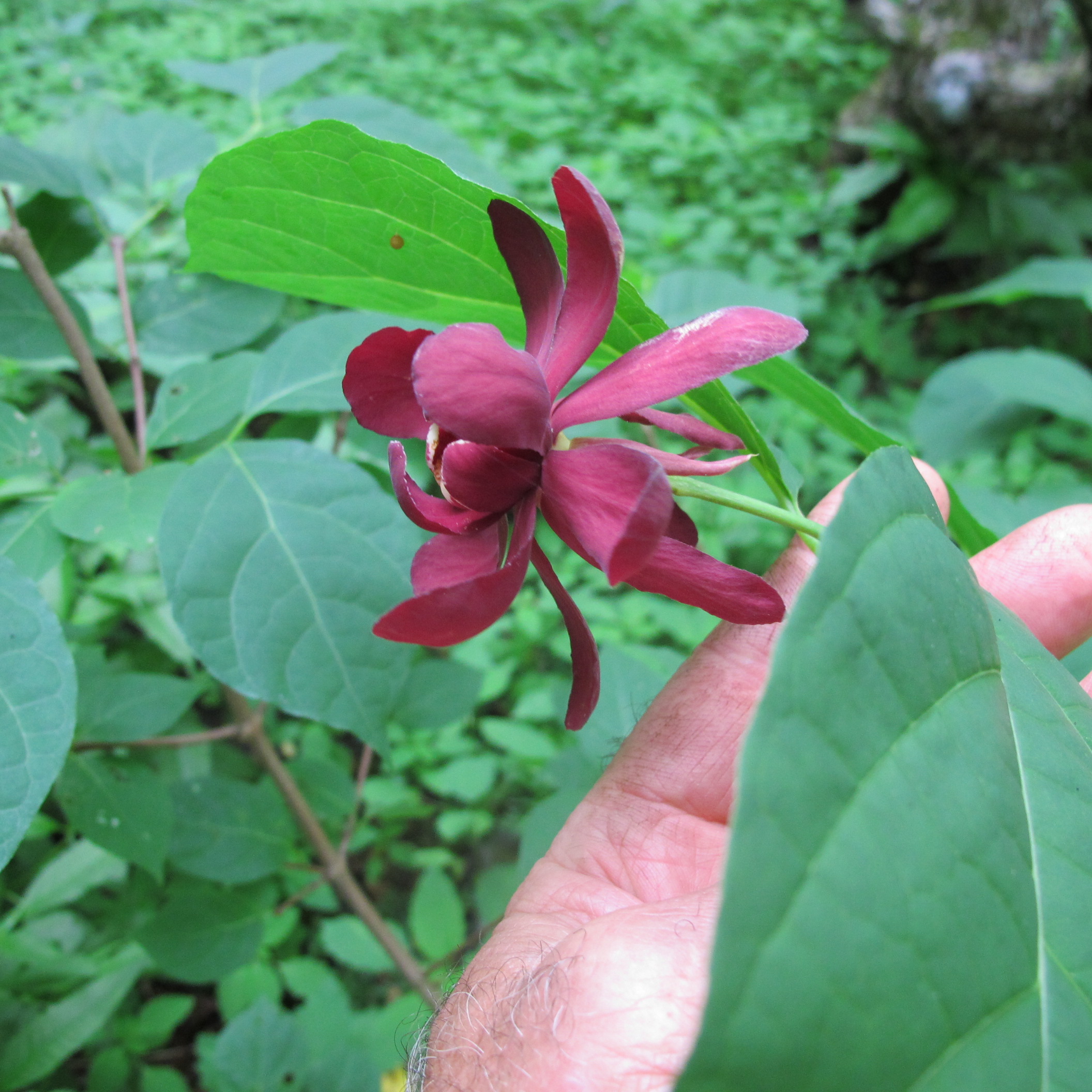
Calycanthus-or-sweetshrub
Three years ago I planted a sweetshrub or Carolina allspice (Calycanthus florida). The first 2 years I grew it in full sun with deep, rich moist soil. Both years the leaves yellowed – as if the sun were too strong and bleached them out. So last fall I moved it into a grove of old wild apples that provide full shade, and it seems to be doing much better. It is blooming now, and has put on considerable new growth.
Sweetshrub grows to be 6 to 9 feet tall with a 6 to 12 foot spread. Some varieties have very fragrant flowers, but mine is not. Dirr’s book suggests buying the shrub is in bloom in early summer, as the fragrance varies from plant to plant. It is adaptable to acid or alkaline soils, and is hardy to Zone 4.
Mountain laurel (Kalmia latifolia) is another fabulous shrub that will grow in deep shade (or even full sun), and I have grown it these past 20 years or so, even though I am on the northern edge of where it is successful. Mine produces delicate three-quarter inch diameter flowers, cups of white with pink veins. After cold winters I don’t always get flowers. There are cultivars with flowers in white to rose, and everything in between. Definitely buy when blooming. It does best in acidic soil that is cool and lightly moist. I have seen it growing abundantly in the wild at Sleeping Giant State Park in Hamden Connecticut, where there is a high, dry, open hardwood forest.
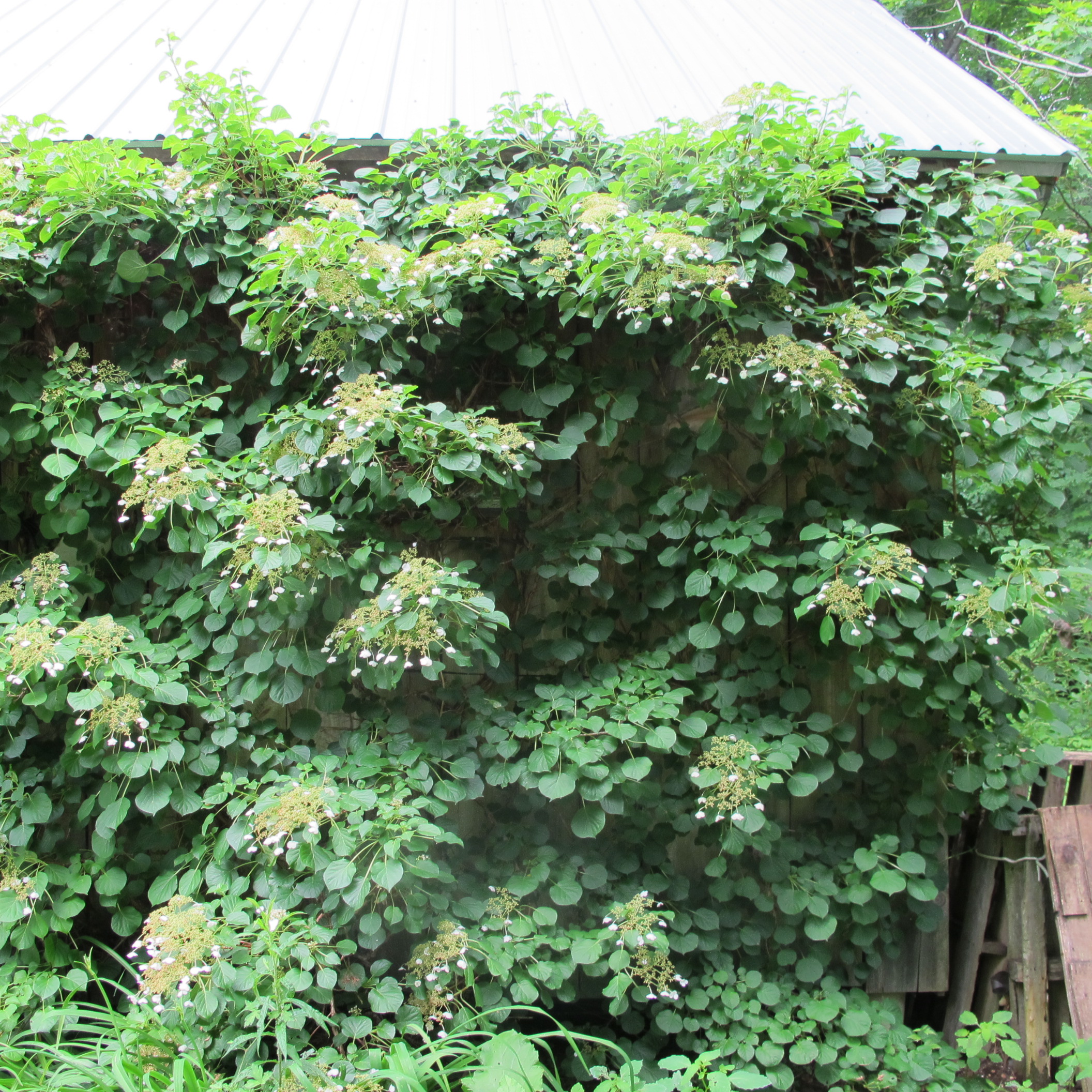
Climbing hydrangea on barn wall
Of all the shade-growing woody plants, the most dramatic on my property is the climbing hydrangea (Hydrangea anomala subsp. petiolaris). I have vines that completely cover the north side of my barn – and that only get a few hours of sun each day. It is in bloom now, with flower corymbs (flat topped inflorescences) that have both fertile and sterile (showy) blossoms and are 6 to 10 inches across.
Climbing hydrangea is slow to get established – mine took 6 years – but once it begins to grow, it quickly covers a surface. It will attach itself to stone or brick, but needs to be strapped onto wood surfaces, at least at first. Mine has grown through the cracks on the barn and is now self-supporting. Its vines can grow 60 feet or more, and has support arms for its flowers that reach straight out from the barn that are up to 3 feet long. It is truly dramatic.
So don’t despair if your property is mostly in the shade. There are these plants, and lots more, that will amaze and delight you.
Henry Homeyer is the author of 4 gardening books. His Web site is www.Gardening-Guy.com.