Tips for Growing Wonderful Flowers
Posted on Monday, June 1, 2026 · Leave a Comment
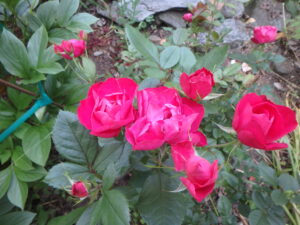
Knock out roses are reliable bloomers
I’ve heard it said that June is the most common month for weddings. I’m not sure why, but my theory is that June, despite black flies and noxious ticks, is a great month to be outside for wedding receptions. Roses are in bloom, as are peonies, iris and so much more.
Roses have evolved considerably since I was a boy in the 1950’s. Breeders have created modern hybrids that are disease-free and bloom almost non-stop all summer. In the old days rosarians sprayed roses regularly with various poisons to minimize damage from fungal diseases and insect pests.
Many told fashioned roses bloom mostly in June and are deliciously fragrant. New hybrids will bloom more or less continuously all summer if in full sun, but most are not fragrant. And they are rarely attacked by insects as they have no scent that would attract them. Since I’m technically a geezer, I should grow the old fashioned roses – but I like these new hybrids.
There are several lines of trademarked roses. I love the ‘Knock-Out’ roses. They are winter hardy (in Zone 4) and offer blooms until October for me. Everything the Proven Winner people grow – annuals, perennials, roses – do very well. Their ‘Oso Easy’ line of roses is well regarded, but I haven’t personally grown any.
My wife loves heirloom roses and has had great luck buying some from Old Sheep Meadows Nursery in Alfred, Maine. And if they will grow in Alfred, Maine, they will grow where you are. According to his website, the owner, Raymond Graber, has been growing roses in Maine for over 60 years. He has a wealth of knowledge and he is happy to share it.
Three bits of knowledge I can share abut roses: 1. They love – and need – plenty of water. Water daily in hot or dry times. 2. They like dark, rich soil and some added garden lime and slow-release organic fertilizer at planting time. 3. Although six hours of sunshine or more is recommended, most will do fine with four. You don’t have any roses? Go buy a few. We only live once.
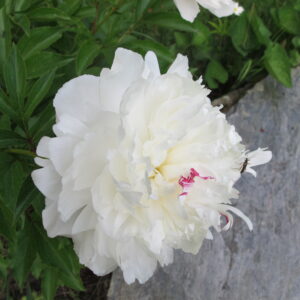
Peony ‘Festiva maxima’ that my grandmother grew
Most plants have a finite lifespan. Many perennials will die out in 10 years. Some trees last a hundred or more. But I often say, “Properly planted, peonies will live forever.” My maternal grandmother, Anna Lenat, died in 1953 when I was just seven years old. My mother dug up one of her peonies and brought it to our home in Connecticut. I dug it up again in 1984 and divided it, leaving half with my mom, and planting half at my home in Cornish, NH. The roots or tubers, presumably more than 100 years old by now, still produce plenty of blossoms.
I always recommend buying peonies in June when they’re in bloom –seeing is believing. Some are fragrant – even heavenly fragrant – while others are not. Some have stiff, strong stems, while others flop even on sunny days from the weight of their magnificent blossoms. “Single” peonies have just one row of petals so are less prone to flopping. But most common are the doubles: gorgeous, but with so many petals they flop when it rains.
Peony rings are wire cages sold to hold up flower stems even on rainy days. Most are too low to really do the job right. Plus, you have to remember early in May to install them. By now mature plants are too big to fit the cages over them. My solution is to poke three bamboo stakes firmly into the soil around each plant and then connect them at the appropriate height with green garden twine. If you were a Scout, you may remember learning to tie a clove hitch. That’s the knot you want.
If you bought a nice peony a few years ago and it no longer blooms, you may have planted it too deeply, or covered the “nibs” (growing points) with too much mulch. Feel around the plant to see where next year’s growth will emerge from little pointy nibs. More than an inch of cover will often inhibit blooming. Yes, you will have a healthy plant – but no blossoms.
My great Great-Granny told me that peonies need ants crawling around on the buds for them to open. Not true. Peonies attract aphids, and ants come to harvest the sweet “nectar” that is their poop.
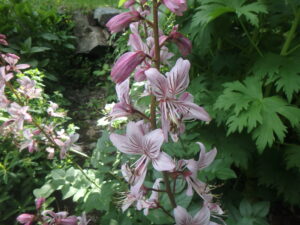
Gas plant is a good addition to any garden
Other great June flowers in my garden include gas plant (Dictamus alba) which has an intense citrus odor that is strongest at dusk to attract night-flying moths.
Delphiniums are wonderful plants with stalks often over 5-feet tall and loaded with blue, purple or white blossoms. But you do need to stake them to keep them upright in the rain. Scratch in some slow release organic fertilizer each spring as they are heavy feeders. And if you cut them back to the ground after blooming, they probably will re-bloom in the fall.
Perennial bachelor buttons (Centaurea montana) are easy to grow and make good cut flowers. Blue to purple, they love sun and will make you feel like you have made it as a gardener.
All the flowering plants are wonderful. Think back to what your parents and grandparents grew. That’s a good place to start shopping. Or better yet, see if you can dig some plants from their gardens if they will let you.
Henry can be reached at PO Box 364, Cornish Flat, NH 03746 or henry.homeyer@
comast.net. He is the author of 4 gardening books.

Delphinium are gorgeous but each stalk needs support
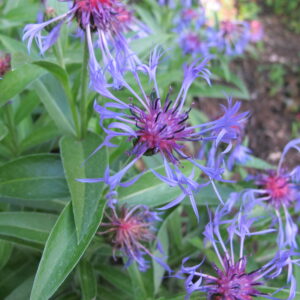
Bachelor buttons have unusual, spidery flowers.
Everything You Wanted to Know About Peonies, but Were Afraid to Ask
Posted on Tuesday, June 8, 2021 · Leave a Comment
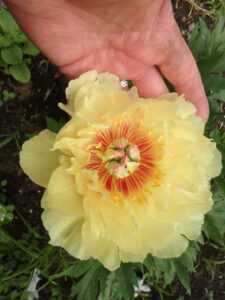
Itoh peony ‘Garden Treasure’ in my garden last June
If you don’t have a peony, I’m surprised. If you don’t have three, you should. They are blooming now, and this is a great time to buy them. Go to your local garden center or family-run plant nursery and buy some more, no matter how many you have. Buying in bloom means you can see the color of the blossoms, and sample the fragrance. Not all are very fragrant, but some are so lovely they might make you swoon.
When my wife Cindy Heath moved in with me in 2019, she insisted on bringing many plants – including her Dad’s favorite peonies and several others. I walked around recently to count how many peonies we have together. We have 44 between us, including my grandmother’s favorite,’ Festiva Maxima’. Grandmother died in 1953, but her peony lives on.
I regularly get questions about peonies. “Why did my new peony bloom once, but never again?” It‘s probably planted too deeply in the ground. In the fall, cut back your stems and feel for the “eyes” which are next year’s growth. To get blossoms, they should not be covered with more than about an inch of soil. If your peony is too deeply planted, or covered deeply in mulch, don’t dig it up, just pull back some soil and mulch to fix it.
Another question I get: “Why are there ants on the blossom buds?” Some write saying their grandparents told them the ants are involved in opening the buds. Is that true? No. The ants are attracted because there are aphids on the buds, and aphid droppings are called honey dew. Honeydew is sweet and attracts ants.
Gardeners are often frustrated by the fact that after a rain, many gorgeous flowers flop over or even break. Peony cages are sold in garden centers, but often these are much too short to prevent the problem.
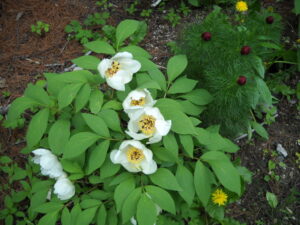
Peony Woodland (P. obovata with red buds of the fernleaf peony
What is the solution? Buy bamboo stakes that are 3 or 4 feet tall place two to four around each clump of peonies, pushing them deep into the soil. Then encircle the plant with twine, tying the string to each stake with a clove hitch. If you didn’t learn how to tie a clove hitch in the Scouts, U-tube will teach you. The encircling twine should be set about two-thirds the height of the plant. Do this when the buds have not yet opened.
Some gardeners write asking if it is okay to move peonies, and when should they do it? Conventional wisdom is that peonies do not like to be moved, but if you must, do it in the fall when they are starting to go dormant. That’s good advice, but peonies can be moved anytime. I once moved 50 peonies in June, and they all bloomed the very next year.
But I do agree that there can be problems moving peonies. The roots are fleshy, a bit like long, thin sweet potatoes. And they are easily broken unless you take great care. I would only dig them after a long, soaking rain – or if I had watered well a few days before and the water had soaked down deep. Some roots go 18 inches into the soil or more. And remember: be sure not to bury them too deeply. Look for those pointy little nubs and keep them near the soil surface.
Do peonies have diseases to watch out for? Rarely. The only problem I’ve ever had is with botrytis, a fungal disease that blackens leaves and kills them and the blossoms. And that only happened once. I removed the blackened leaves and sprayed with a solution of a product called ‘Serenade’.
Serenade contains a soil bacterium that kills fungal diseases including botrytis, but has no ill effects of humans, pets, fish, insects or birds. It stopped the infection, and it has not recurred. Serenade is commonly sold at garden centers, and has a shelf life of 3 years if properly stored.
I have peonies that bloom starting in late April some years, others that bloom in May and June. My earliest are woodland peonies: the fernleaf peony, Paeonia tenuifolia and the obovate peony, Paeonia obovata. The first is bright red, with single blossoms and finely divided leaves. Both have just a single layer of petals. My obovate peonies are cream colored, but produce blue seeds in red seedpods. The seeds are vigorous self-sowers.
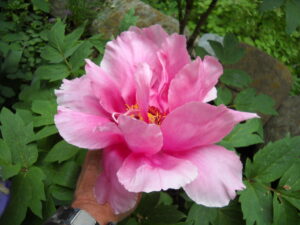
Tree Peonies are larger than most
Then there are tree peonies. These are small shrubs that produce huge flowers, up to 8 or 10 inches across. The blossoms are short lived, but spectacular. I had one for 20 years, but it died after a cold winter. Then a few years ago I bought an Itoh peony. This is hybrid of a tree peony crossed with a regular peony. The Itohs generally have yellow blossoms and produce many, many large blossoms over several weeks at maturity. But they are pricey: expect to pay $50 or more for a young plant.
Lastly, gardeners ask me, “Can you grow peonies in a shady garden?” Yes and no. Given good rich soil and plenty of moisture, you will get some blossoms with just four hours of sun per day, which is considered a shade, or part-shade garden. They really like full sun, and do best with six hours of sun or more. Those two woodland peonies I mentioned will do fine in shade, but are nearly impossible to find for sale.
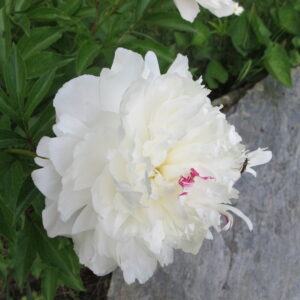
Peony ‘Festiva maxima’ that my grandmother grew
One last bit of advice: Since peonies live so long, be sure to add compost and a little slow-release organic fertilizer at planting time. Then every few years, top dress the soil around your peonies with some fertilizer and compost to get best results.
If I were to be exiled to a remote island and could only choose just one perennial flower to take with me, I don’t know if I would take a ‘Festiva Maxima’ peony. I do know that it certainly would be high on my list. How about you? Send me the name of your favorite flower. Let’s compare notes.
Reach Henry by e-mail at
henry.homeyer@comcast.net or write a letter to Henry at PO Box 364, Cornish Flat, NH 03746. He is a UNH Master Gardener, and the author of 4 gardening books.
Primroses and Other Great Plants for Shade
Posted on Tuesday, June 13, 2017 · Leave a Comment
If I were to be consigned to life on a remote island, what one flower would I bring along with me? That’s a bit like asking you which child is your favorite, or which piece of music you could listen to for all eternity.
There are so many wonderful flowers, but some years ago I pondered the question and selected the peony ‘Festiva Maxima’. That’s a double white one with a spot of red in the middle, and a fragrance so alluring, I wrote, that it could make one swoon. I acknowledged that Festiva Maxima does have a flaw: rain weighs down the blossoms, and sometimes the flowers break their stems – even if in a peony support cage.
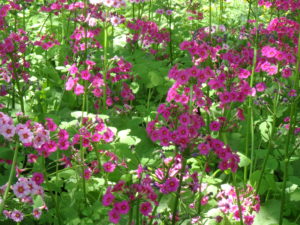
Primula japonica
But if you were to ask me today, I would say my favorite flower is the Candelabra or Japanese primrose, Primula japonica. I have a patch of them blooming in the shade of 3 old wild apples in moist, dark soil. I started with just a few plants, but they drop seeds and fill in spaces, overtaking what was once a meager, struggling lawn.
I estimate that right now I have 200 to 250 square feet of primroses in full bloom; in a 3 foot by 3 foot square, I counted about 25 or 30 plants in bloom – so I have more than 500, perhaps even 750. All this in 10 or 15 years, and no work other than a once-a-year weeding of Jewel Weed, which also loves the conditions.
Each plant has a rosette of light green leaves and sends up a flower stalk 12 to 36 inches tall. Flowers ring the stalk in tiers, starting with one tier, and working up to 4 tiers of blossoms on the oldest plants as the season progresses. At each tier there are a dozen small blossoms – or up to 20 – pointing out like bugles. Each blossoms is about an inch across.
The colors vary as they hybridize. My favorites are a deep magenta. At the other end of the spectrum are the whites, though not pure white. Then there are pink, and dark pink ones. All are fabulous. Fragrance? Nothing much. But that would be like expecting a prize poodle to be able to read the newspaper.
The bloom period starts for me in late May and goes through most of June. A month or more with some blossoms. At any given moment a plant might have just one ring of flowers, or up to 3. As the flowers fade and die off, some develop a nice light blue.
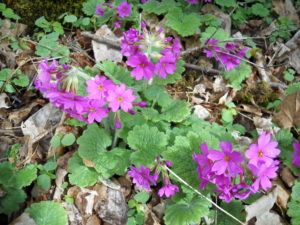
Primula kisoana
Before the candelabra primroses bloomed came another nice one, albeit with no common name, Primula kisoana. This one, unlike the other, will grow in either moist or dry shade. It has lovely pink blossoms that pop up just 6 inches above the fuzzy leaves that are so dense that they keep weeds from appearing. The leaves are 5 inches or so wide with a scalloped edge and a light green color.
One of the greatest things about the Primula kisoana is that it spreads by root. But unlike mint or bee balm, this little beauty does not run over and outcompete other plants. It will politely meet up with the roots of another, and move to the left or right instead of grasping for every inch of soil. Where I have it in dry shade it gets some morning sun, but no afternoon sun.
Another nice plant I have blooming now, and which can act as a ground cover, is bigroot geranium (Geranium macrorrhizum). To avoid confusion I should explain that the bright red or white geraniums popular in window boxes are not geraniums at all, but are in a genus (scientific grouping) known as Pelargonium. Geranium is a genus of hardy perennials.
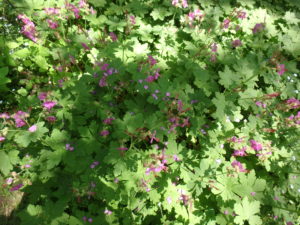
Geranium macrorrhizum
The bigroot geranium thrives where other perennials may survive, but few love: dry shade with competition from tree roots. Maples and locust are notorious for sucking everything out of the soil, yet I have planted the bigroot geranium under those trees, and had them thrive. Will they grow under hemlocks or pines? No, that’s asking too much.
Bigroot geranium comes in at least three colors: white, pink and dark pink. The leaves are about a foot tall, with the flower stems standing above them at about 20 inches. Their leaves form a dense mass of foliage that most weeds find inhospitable.
On another note, many readers have been complaining that their tomatoes are yellow-leafed and miserable looking. Not to worry. Tomatoes need sunshine, and early June was, for most of us, rainy and cold. They will recover soon.
Plants suck up moisture that contains the minerals they need – but only if the moisture is required to replace water that the plants have given off. They don’t give off much water vapor when it’s chilly and wet, so they can get nitrogen-starved. With heat and sunshine they will recover.
I have set up Adirondack chairs near my primroses and spend at least some time there every day. And even though I’ll never have to pick just one flower to grow, these primroses are a real delight to me.
Read Henry’s twice weekly blog at https://dailyuv.com/gardeningguy. Reach him by e-mail at henry.homeyer@comcast.net.

 Click Here to buy from Cobrahead