• Wobar and the Quest for the Magic Calumet
    Now available for $24.95 including shipping.
  • Now available for $21.00 including postage.
  • Recent Articles

  • Vendors I Like

    click here to buy from Cobrahead Click Here to buy from Cobrahead
  • Cobrahead

    This is the best darn weeder made in the country, and I think I've tried them all. I use it to dig weeds, tease out grass roots, and mix soil at planting time. Neither right nor left handed, it is lightweight and strong.
  • West Lebanon Supply

    I buy all of my organic fertilizers and soil amendments at West Lebanon Supply. They carry several lines of seeds, watering devices, tomato cages, landscape fabric and much more. They also sell pet supplies - and allow dogs in the store!
  • E.C. Brown Nursery

    E.C. Brown Nursery has an amazing selection of high quality trees, shrubs and perennials. The staff is incredibly knowledgeable. Looking for something unusual? E.C. Brown Nursery probably has it.

Late Spring Chores


Spring arrives in New England in fits in starts and starts: Hot and sunny one day, chilly and drizzly the next. Maybe even a few flurries to outrage the impatient gardener. But there is much that can be done in late April, even on a rainy day.
 

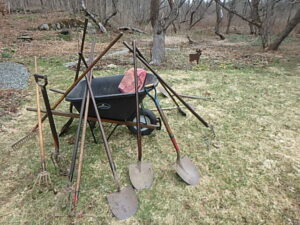
Oiled tools drying in the sun

I much prefer tools with wooden handles: if treated properly they will last your entire lifetime. Every year or two I clean up and oil the handles of my garden tools, which keeps the wood supple. I‘ve got tools with wood handles I’ve used regularly for over 40 years, and some from my grandfather that are more than 75 years old.
 
First I clean up the handles by rubbing with fine steel wool or, if very rough, with 100 grit sandpaper. Then I wipe them down with a scrap of a towel. Finally I use a brush to paint them with boiled linseed oil. I then let them dry in the sun or in the barn it’s a rainy day, and wipe them down the next day.
 
Shovels should be sharpened from time to time. Get a wide, medium-rough flat file and push it firmly across the shovel’s edge on the backside of the blade. Take long, slow strikes but do not saw back and forth with your file. Look carefully at the angle it came with, and try to mimic that angle with your file. A sharp shovel is much more efficient than a dull one. But it’s not a good idea to sharpen the blade until it’s knife-sharp. It will dull quickly if you do. Sharpening a dull shovel is not quick work, 
 

Soil thermometers are useful tools for deciding when to plant

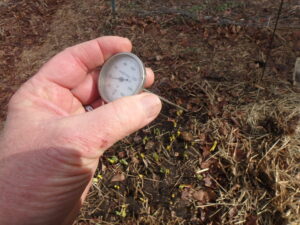
Impatient to get things growing in the vegetable garden? Peas, spinach, arugula and lettuce are very cold-hardy and can be planted early by seed– even if frost will still occur. Soil temperatures of 40 degrees are adequate for germination of them, but I think 50 degrees is better. For most seeds, I prefer to wait until the soil hits 50 degrees or more. I worry seeds will rot if the soil is too cold and wet. That goes for potatoes and onions, too. Cukes, squash, pepper and tomato seedlings I don’t plant until June.
 
Soil thermometers look like little probes with a dial on top, something like the one you poke in a turkey to see when it’s done. Garden centers sell them. If you get one, poke it down four inches to get your reading.
 
If your soil was covered with leaves or straw for the winter, rake that off your planting beds now so that the sun will hit your soil directly and warm it up. Mulch keeps the soil cool. If there are weeds coming up, pull them as soon as you can – no sense letting them get a head start on your plants.
 
This is also a good time to look for invasive plants on your property. For me, the cast of characters includes bush honeysuckle, barberry, buckthorn and multiflora rose. If you have a Norway maple, you probably have lots of new seedlings from it that are easy to pull.
 
You can get a list of invasives from your state on-line, but I found the Vermont Invasive Plants list is best – it includes just the 12 most common, along with pictures, so it’s easier to use.
 
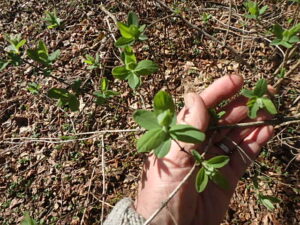
Many invasives leaf out early and drop their leaves late in the fall. That gives them an advantage over many natives. Honeysuckle puts out greenery in mid-April for me. Burning bush holds its red leaves late in the fall, so it’s easier to find small ones then.
 

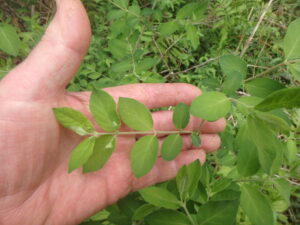
Honeysuckles have opposite branching; they leaf out early

Although not easy, digging out invasives is generally the best way to control them. Cutting them down usually does not kill them. Buckthorn is the worst: cut one to the ground, and a dozen will grow from the roots. If you can double-girdle all the stems down low, it will die after 2 winters. Basically, you’re starving the roots from the nutrition produced by the leaves.

 
Potting mix is readily available at all garden centers, big box stores, and even some mini-marts. But if you are going to fill up lots of flower pots, you can save money by making your own.
 
If you never emptied you pots and window boxes last fall, you can reuse it this year. First pull the dead plants, and dump the used potting soil into a pile. Then make up some new potting soil and mix it 50-50 with your old potting soil.
 
To make potting soil, mix add equal parts coir or peat moss, compost and perlite (which looks like crumbled Styrofoam but is actually super-heated volcanic minerals) to it in roughly equal quantities in a wheelbarrow until mostly full. Stir well. Add half a cup of a slow-release organic fertilizer like Pro-Gro or Plant-Tone and mix well. It is best to water the peat moss or coir before using as it can be very dry.
 
When I make potting soil, I don’t measure things exactly. I probably use more compost than perlite or coir. If you have a good source of mature compost, you can save money and add good microorganisms to the soil. The finished product should be fluffy and not quick to clump up when you grab a handful of it. But if you are only going to use a few pots, just buy a bag of potting soil.
 
So don’t get discouraged by a few cold days now. Summer is on the way, so get ready.
 
You may reach Henry at henryhomeyer@comast.net.

 Getting Rid of Invasives


Well intentioned people of the past century imported many handsome plants. Unfortunately, some of them – absent the predators of their homeland – became pests here in America. These “invasives” generally spread quickly by seed and root, and can take over our gardens and adjoining wild places. Many will grow in sun or shade in wet or dry soil – in other words – anywhere!

 
This is a good time to work on removing as many invasives as you can. You can obtain the entire list on-line as each state keeps a list of plants that are considered invasive and are prohibited from sale, propagation or transportation. But let’s look at a few that are common and important to remove, no matter where you live.
 

Honeysuckle leaves are oval and opposite each other on the stem

For me, those include bush honeysuckle (Lonicera spp.), barberry (Berberis thunbergii) and common buckthorn (Rhamnus cathartica). I recently organized a work day on a hiking trail in Cornish that focused on honeysuckle and barberry. We tried to pull these shrubs by hand, but also used a device called a weed wrench for bigger specimens.
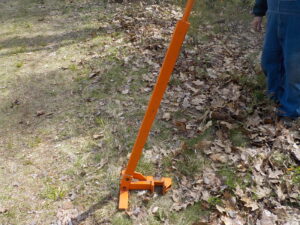


A weed wrench allows anyone to pull out invasive shrubs

Although weed wrench is used generically, it was in fact a trade name, but the company has gone out of business. Similar tools be found under the name “Pullerbear”, “Uprooter” and perhaps others. I have used Weed Wrenches, but not other brands. These are steel tools with sturdy handles and a gripping mouthpiece that bites onto the stem of a shrub up to 2 or 3 inches in diameter, depending on the model. You pull back, and with great leverage you pull out the culprit, roots and all. Some brands come in different sizes.
 
Many invasive plants are hard to eradicate because if you leave a part of the root in the ground when pulling it out, it will re-sprout. And simply cutting down an invasive tree or shrub usually will often not work: the roots will send up new shoots, and may respond by sending up many, many new shoots.
 
But don’t be discouraged if you can’t get all the roots out. You are severely setting back the plant you pulled and it will be several years before the plant can produce seeds for birds to distribute elsewhere.
 

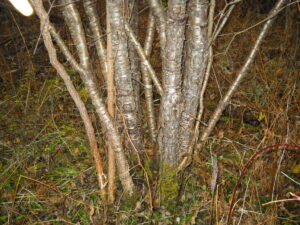
Buckthorn often grows with several stems in a tight grouping

Buckthorn is one of those that responds to cutting by sending up many new plants. Instead of one buckthorn or a clump of buckthorn, you get dozens of buckthorn. But you can kill buckthorn by girdling the trunk. Take a small pruning saw and cut through the bark all the way around the trunk. Don’t cut into the hardwood, just cut the bark. Then go 12 inches higher up, and do it again.
 
Girdling a buckthorn is a slow death: you are interrupting the flow of sugars from the leaves to the roots, which slowly starve to death. I have done this in winter, and the tree leafed out and seemed normal that spring and the next spring. The third spring it never leafed out – it was dead, and did not sent up any new sprouts around the tree.
 
That said, it is not always easy to girdle buckthorn. They often grow with several trunks that merge near the base and grow tightly together. So a folding saw with a pointed tip is the best way to get into the cluster of stems. Or try to cut the clump twice down low, near the base.
 
During the recent work day in Cornish, I spoke with someone who explained a theory of invasive plant control that made a lot of sense to me. It was a theory proposed by Dr. Steve Dewey of Utah State University, and was based on the way firefighters approach wildfires. When a fire is raging, sometimes all you can do is try to contain it, and look for places where the wind has sent sparks that are just starting a new fire.
 

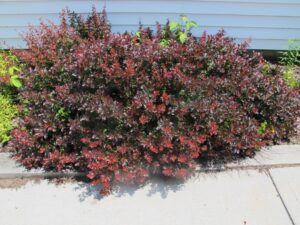
This barberry planted at our posts office has red leaves, but most have green ones. All have thorns and red berries in winter

Likewise, when there is a bad infestation of an invasive plant like honeysuckle or barberry on a property, look around for spots where a single small plant is growing. It will be easier to pull than a big one. And within a few years, a small plant will be a big plant producing seeds for birds, wind or water to move to a new location – and to produce a big patch. So put out the glowing ember first, then work on the big fire – or infestation – next.

 
An easy invasive plant to pull is garlic mustard. This is a biennial weedy plant and might not be thought to be so bad. But its roots produce a toxin that kills beneficial soil fungi that will, in time, reduce tree viability. It can grow in deep shade in our forests. The toxin it produces will eliminate the mycorrhizal fungi that live in symbiotic relationship with our trees, gradually weakening the trees – and killing them. Not only that, garlic mustard inhibits the germination of seeds of many species of native plants, including many spring wildflowers.
 
As a biennial weed, garlic mustard has two forms. In the first year it produces a low rosette of rounded leaves. The second year it sends up 18- to 36-inch flower spikes with pointy, heart-shaped leaves with jagged edges. The small white flowers have 4 petals and bloom in clusters about an inch or more in diameter. One plant can produce about 4,000 seeds. And although about 70% of the seeds will germinate the next year, some will remain viable in the soil for up to 10 years. 
 
So organize a work party in your town – it’s more fun than taking on invasives on your own. Try to remove any one of the invasives that threaten our woodlands and wetlands. Your grandkids will thank you one day.
 
Henry can be reached at henry.homeyer@conmcast.net. He is the author of 4 gardening books.