It’s Time to Pay Attention to the Vegetable Garden
Posted on Friday, June 12, 2026 · Leave a Comment
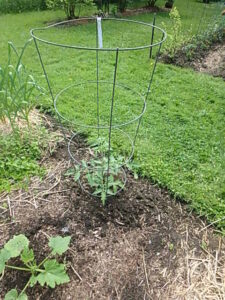
Tomato cages keep plants from sprawling on the ground
By now, most of us have planted our vegetable gardens. My peas, onions, lettuce, spinach and potatoes went in early, and now our tomatoes and peppers have settled in and are starting to grow. Is it hammock time? No, now it’s better to do some maintenance so that we can go to the beach later on – with a good conscience.
Many gardeners are looking for a magic potion to put on their tomato plants to prevent that nasty fungal disease that blackens the leaves and shortens the lifespan and production of their tomato plants. Alas, there is none. But there are a few things you can do to minimize it.
Right now go look at your tomato plants: do they have any leaves that touch the soil? If so, take a sharp knife or scissors and cut them off. The spores of the disease are in the soil – unless you area starting somewhere that was, most recently, lawn or field. That first year you will probably have plants free of blackened leaves.
Mulch under your tomato plants now, before disease sets in. The spores get on leaves by splash-up when you water or get a heavy rain. Got a bagger on your lawn mower? Save the grass and spread it over the soil. Or you can buy straw (which is seed-free) or mulch hay (which is not, but is less expensive). Spreading 4-layers of newspaper on the ground before putting down mulch helps keep soil moist and helps weeds from germinating. I don’t recommend using chipped branches or bark mulch in the vegetable garden.
One last bit of advice on tomatoes: I have found that buying the biggest cages possible is best: 54 inches tall, with 4 legs not 3. They’re not cheap, but you should get 25 years or more out of each if store them in the barn for the winter.
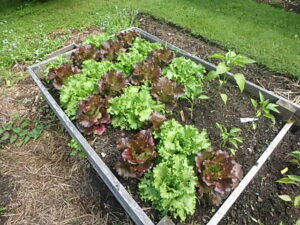
It’s time to start more lettuce from seed
I have plenty of lettuce to eat right now, having planted it early. But I will start seeds now. Although I could sow seeds directly in the ground, I prefer to plant in seeds in cells and keep them on a sunny deck where I will see them, water them, and monitor them. When they have 2 true leaves, sturdy ones, I will plant them in the ground. That allows me to space them well. Small seeds are easy to over-plant directly in the ground, and then I’d have to find the time to thin them later.
That brings me to thinning, sigh. The most tedious job in the garden. If you planted carrots, beets and radishes early on, they are about ready to thin. Start now and thin to 1-inch apart. Then, by the fourth of July, thin again – but to 3-inches apart. Crowded carrots compete with their cousins for water and minerals just as they would with weeds. Eat those thinnings. Young carrots are a real treat.
I don’t mind weeding. Some of you do, and I agree it can be tedious. Young people wear earbuds and listen to music, but I like to listen to the birds and the burble of my brook going by. Did you know that by adding stones to a brook you can tune it? In 2003 I interviewed Robert Irwin, an installation artist who designed the gardens at J. Paul Getty Center in Los Angeles, and he told me he personally “tuned” a recirculating brook he had installed at the gardens. Water falling over stones makes a pleasant sound which depends on the drop and quantity of water falling.
But back to weeding. The best time to weed is after a rain or a good watering. I use a CobraHead weeder, a single-tined tool which easily slides through the soil, loosening it so that weeds pull easily, and weed roots are less likely to snap off. Right now is the time to weed because the bigger they get, the more difficult they are to pull.
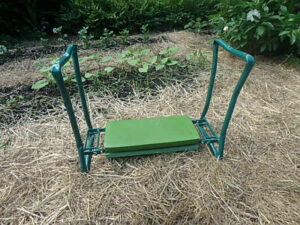
The kneeler is comfy and makes it easier to stand
I used to do all my weeding standing up, bent from the waist. Now? Mostly I kneel. I use a “Garden Kneeler” I got from Gardener’s Supply Company. It has a padded kneeling platform a few inches off the ground and handrails on the sides that are a great help in getting up from the kneeling position. Turned over, it provides a seat, and it can be folded up for storage. Using mine, I just weeded a double row of onions 16 feet long, and felt no aches and pains from doing so.
To avoid re-weeding the same bed, over and over, there are two things you should do: 1) never let your weeds flower and produce seeds. 2) Mulch after weeding. Same as above, newspaper covered with straw. In the old days, newspapers used toxic chemicals in the ink. Now? As far as I know, all the inks are made with soy products. By the end of the summer my earthworms will have mostly eaten the papers.

The first step of mulching as I do it is to put down newspaper003
If you grow potatoes, it is important to watch for potato beetles. Go down the row, pawing through the leaves so you can watch for the orange egg masses under the leaves and scrape them off. Later, if you look for larvae or beetles every day or two and pick them off, you can control the problem in a home garden. Just drop the culprits in a jar of soapy water. There is also a biological control called Bt which is a naturally-occurring bacterium that you can spray; it sickens the larvae as they eat the leaves but will not harm anything else.
I’ve been picking and eating homegrown vegetables all my life, and I am convinced that it helps me stay young(ish) and healthy. And it gives me great joy.

 Click Here to buy from Cobrahead