-

Now available for $24.95 including shipping. -
Now available for $21.00 including postage. Vendors I Like
 Click Here to buy from Cobrahead
Holiday Gifts for the Gardener
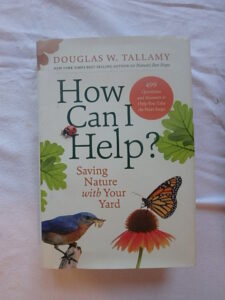
Learn how to help save nature with this book
I put up blue holiday lights outdoors on trees and shrubs. And I think about gifts for my loved ones – most of whom are gardeners. Let’s see what I am helping Santa with this year.
Nut wizard
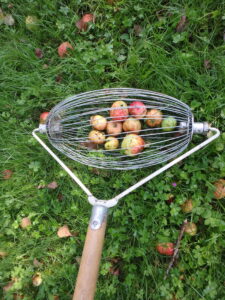
I believe in supporting local garden centers and avoiding internet purchases. We need our local purveyors of plants, seeds and fertilizers. But an unusual tool might not be found locally: the Nut Wizard. This is a long-handled tool with a rolling wire device the size and shape of a football that picks up apples or nuts. When the device is full, spread the wires over a bucket or wheelbarrow and it empties. This is fun to use – kids love it, so Tom Sawyer will be proud of you for “letting” them use it. I got one long ago, and see that now there are several brands, not just the Nut Wizard, and several sizes.

Gardener’s Journal
Maybe I am from a different era than you (or a different planet), but I like keeping a journal. I started at age 8, but confess that these past 20 years my computer has become my record keeper. Perhaps you use your cell phone (I don’t have one). This year I am going back to keeping a handwritten gardening journal.
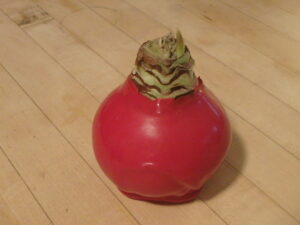
This amaryllis needs no water or soil and looks great even before blooming
Lastly, a friend recently sent us an amaryllis bulb that had been dipped in shiny red wax. It’s gorgeous, and for non-gardening friends it is excellent, too: no soil needed, no watering needed. Just put it on the table and watch it grow, blooming in 4 to 6 weeks. It sits nicely on its flat base of wax. I can’t wait to see it bloom! It’s available from Jackson & Perkins on-line for a little over $40.
Tree-Related Fall Chores
It’s that time again. Time to think about getting ready for winter. Some trees are showing signs of changing leaf color. Vegetable gardens are winding down. Summer flowers are finished with their blooms, and even fall flowers are beginning to decline. Sigh. Summer is just about over.
Last winter we had record-setting snows in many places. One of the consequences of that was that meadow voles and other rodents had good protection from owls and hawks. Voles feasted on the bark of apple trees, stripping the bark with immunity – and fatally damaging many trees. A tree will slowly starve to death if it loses bark all around the trunk, although that may take a year or more. The leaves continue to produce the sugars all summer, but the damage prevents the sugars from getting to the roots – and they starve.
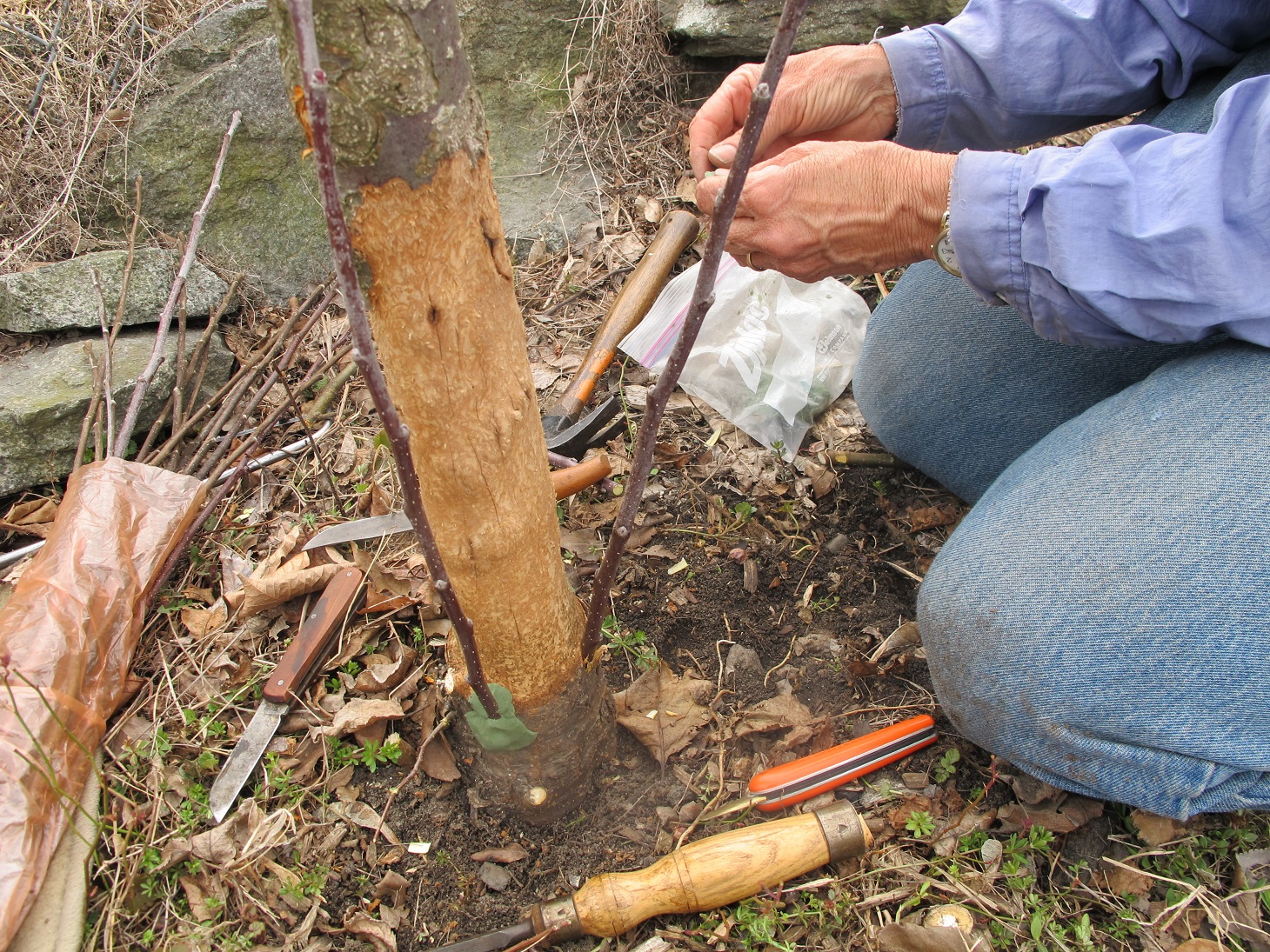
Bridge grafting
When my partner, Cindy Heath, retired after 26 years as director of Recreation and Parks in Lebanon, NH a nice crabapple tree was planted in her honor near the community garden. But last winter it was girdled by voles. So I hired a grafting specialist, Jenny Wright of Unity, NH, who met me last spring to do some repairs. She did what is called bridge grafting, grafting 4 twigs to span the damage. Two of the four grafts “took” and the tree has been saved. Even one successful graft probably would have worked. It’s probably not a job you can take on without help, but there are people who can help you.
Of course, the damage could have been prevented, and I would like to recommend that you take steps to protect any young fruit trees from similar damage if we have another snowy winter. Buy some “hardware cloth” and wrap it around the bottom 24 inches of the tree. Hardware cloth is a wire mesh that comes in a variety of sizes. Quarter inch mesh is best. You should be able to buy a small roll 24 inches wide. You will need tin snips to cut it and some wire to tie the ends together. For a 2-inch diameter tree, make a 4-inch diameter cylinder around it. Be sure to remove the wire mesh before the tree grows into it. Older trees are rarely eaten by rodents.
Another job for the fall is to clean up all those fallen apples that litter the ground. You may think they are harmless, but if you had any apple scab on your apples it is important to pick them up. If you don’t, come spring the fungal disease that causes scab will release spores and infect next year’s crop.
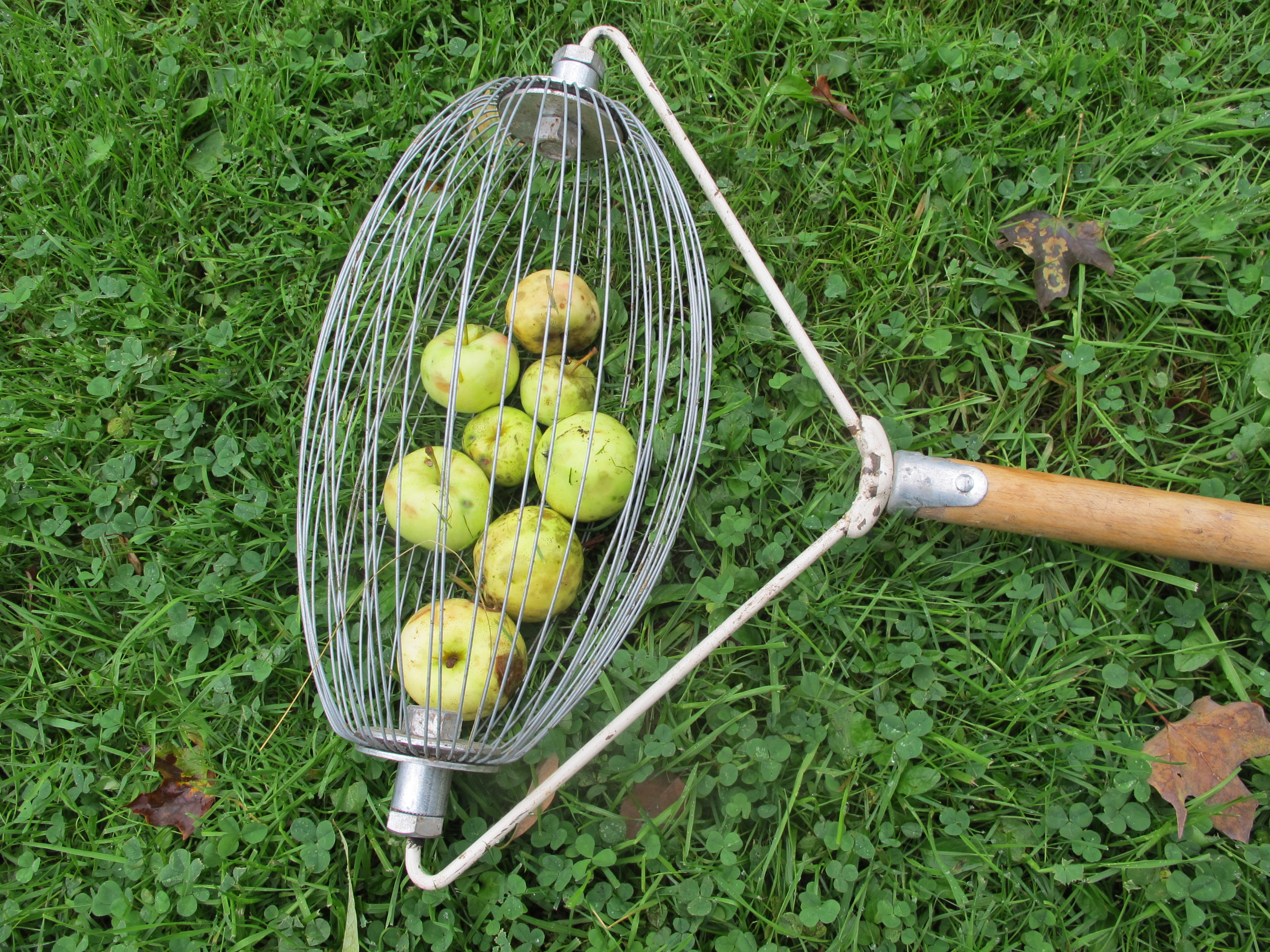
Nut Wizard with apples
Raking up apples is tedious and often leads to damage to the lawn around a tree. But I have a “Nut Wizard”. It consists of a football-shaped wire device that turns on its axis when pushed across the ground by a long handle. The wires separate a little when going over an apple, which then enters the interior of the tool. When I have about 25 apples captured, I empty them into a wheelbarrow by separating the wires enough for the apples to fall out.
I got my Nut Wizard for about $50 from Elmore Roots Nursery (www.elmoreroots.com or (802) 888-3305). The greatest thing about it? My grandchildren love using it. Tom Sawyer would be proud of me!
If you have blackberries or raspberries, this is the time to cut down this year’s canes. Canes only produce for one year, and will only be in the way next year so cut them off near the ground. I use a pole pruner to cut the canes. I have a tool that works very well – it is lightweight and has a squeeze grip (like hand pruners). After snipping off a cane I can grab it with the blades (by squeezing very gently) and pull it out of the patch.
The tool I use is made by ARS, model LA 180 L1.8, which I got from OESCO tool company (www.oescoinc.com or 800-634-5557). It sells for about $100, but is well worth it if you have lots of berries and don’t like getting blood transfusions.
If you planted new trees or shrubs this year, it is important that they go into the winter well hydrated. Water them weekly as we go into the cold season if we don’t have a lot of rain.
Be sure newly planted trees are mulched with ground bark or wood chips. That will help keep the roots warm as winter approaches. Roots continue to grow even after leaf drop – until the ground gets too cold. A 3 to 4 layer of bark chips will allow them to grow longer into the autumn. But don’t let the mulch touch the tree – leave a donut hole around the trunk to avoid rotting of the tree bark.
Trees are my friends for lots of reasons, including the gift they bestow on me each fall. I don’t look on raking up leaves as a pain in the you-know-where. I look at leaves as a great source of organic matter and mulch for my gardens. I run them over with the lawn mower, and then rake them up. Once chopped and mixed in the some grass clippings, they don’t blow away. So keep that in mind when raking leaves instead of watching football!
Henry is the author of 4 gardening books. His website is www.Gardening-Guy.com.