Late May in the Garden
Posted on Monday, May 25, 2026 · Leave a Comment
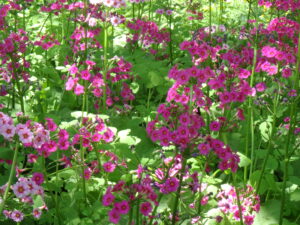
Candleabra primroses delight me each year starting in late May
Asking me to name my favorite flower is, perhaps, like asking you to name your favorite child or dog. But late May brings one of my top picks: the candelabra primrose (Primula japonica). It sends up a flower stalk with a circle of florets, then it grows a few inches and sends out more blossoms, getting taller and blooming sequentially for nearly a month. They grow best in deep, rich, moist soil in partial shade and ideally under old apple trees.
Late May will also produce early peonies I love including two part- shade peonies, Paeonia obovata and P. tenuifolia. The latter is also known as the fernleaf peony for its finely cut foliage; the blossoms are a deep red. Neither are common in garden centers, but keep an out for them.
Spring is a good time to improve your soil. Most commercial farmers grow food by adding chemical fertilizer to the soil before planting. I am an organic gardener, meaning I do not use pesticides nor do I use any chemical fertilizer.
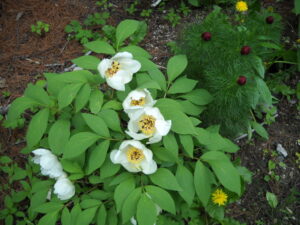
Peony Woodland (P. obovata) with red buds of the fernleaf peony 002
Chemical fertilizers are safe to use, but only provide three of the 17 elements needed by plants to grow and thrive. Granted, most of those elements are needed in very small quantities and may already be in the soil, but I want to provide my plants with the equivalent of a full 5-course meal, not a bowl of white rice.
Chemical fertilizers only contain nitrogen (N), phosphorus (P), potassium (K), and lots of filler. A 5-10-5 fertilizer is 5% N, 10% P, 5% K; the rest -80%- is filler. Nitrogen in the form of nitrate and ammonia ions is used by plants to make proteins, fueling green growth. Phosphorous promotes growth of roots, blooming, seeds and fruits. Potassium is important for growing thick cell walls to survive cold and excess heat.
Plants also need other elements in order to thrive: calcium (for cell metabolism), magnesium (for chlorophyll needed for photosynthesis), sulfur (for making proteins and fats). Also needed are micronutrients like iron, chlorine, manganese, zinc, copper, boron, molybdenum and nickel.
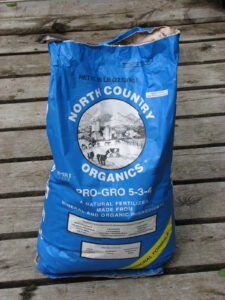
Pro-Gro Organic Fertilizer is a slow release fertilizer.
All those elements above are found in organic fertilizers like Pro-Gro, Gro-Tone and others. And while most chemical fertilizer provide water-soluble elements for quick absorption, organic fertilizers are mostly slow-release, providing key elements over a period of months, or even years. Most contain things like cotton seed meal, kelp meal, ground peanut shells and ground oyster shells.
So what can you do to improve your soil? Add compost. Don’t buy just a bag or two of compost and think it will improve your whole vegetable garden with some left over for new perennials. Borrow a pick-up truck and get a “scoop” from a front-end loader at your garden center. Or get it delivered. Alternatively, you can buy aged manure from your local dairy farmer. Even aged manure will have some weed seeds, but it will add good organic material that will be used by your plants.
Why is compost so good? Well-made compost is full of microorganisms that will work with your plants. Many produce organic acids that help to dissolve minerals from fine stone particles in the soil and make those minerals available to your plants. Compost is, or should be, biologically active: full of living bacteria and fungi. And it will improve soil texture making root growth easier for your plants.
Our soils were created back during the last ice age when glaciers a mile thick ground up bedrock, making sand and even the finer bits of stone that are in clay and loam. Fully 50% of all soil is made of ground up rocks. The rest? Anywhere from 1% to 8% is organic matter, and the rest – nearly 50% of soil by volume – is air. Oxygen is absorbed by root hairs from the air in the soil.
Two other key ingredients do not come from the soil. Plants get carbon, a major part of all plants, from carbon dioxide that is in our air. Nitrogen is in our air, but most nitrogen used by plants comes from decayed plant or animal material – or is made in a chemical factory and sold as a fertilizer.
I highly recommend getting your soil tested every 3 to 5 years. Each state university offers a service for gardeners and farmers. It will tell you soil pH (a measure of acidity), soil type, levels of some soil minerals and the percentage of organic matter. It will offer suggestions on what to add to your soil, though different plants have different needs. You should strive to have 4% or more organic matter in your soil.
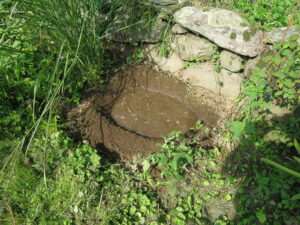
Testing drainage is simple. Dig a hole, fill it up, see how long it takes to drain.
You can perform a simple test to see how well your soil holds water or drains. Dig a hole 24 inches wide and 8 inches deep with sloping sides. Fill it with your hose and time how long it takes to drain. Sandy soil will drain almost immediately. Clay soil will hold water for several hours, even overnight. Good loam might take an hour or two, depending on how much rain you’ve had recently.
Adding compost will help heavy clay or sandy soils will help them considerably. Soil texture and the ability to hold some water but draining well is important to most plants. Compost does both.
Improving your soil takes years, even decades. Yes, I do use some slow-release organic fertilizer at planting time, but my real success has come from years of adding compost.

 Click Here to buy from Cobrahead