-

Now available for $24.95 including shipping. -
Now available for $21.00 including postage. Vendors I Like
 Click Here to buy from Cobrahead
Beautiful Annual Flowers
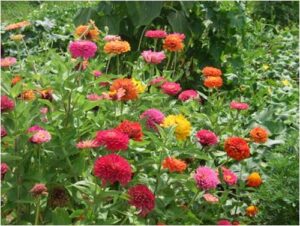
Zinnias
Unlike most perennials, almost all annual flowers have the advantage of blooming all summer. Keep cutting off the flowers to use in vases (or to remove tired blossoms) and most will continue blossoming until frost. Some take a rest in the heat of summer, but produce again later on. And bees and moths do visit most of them, too.
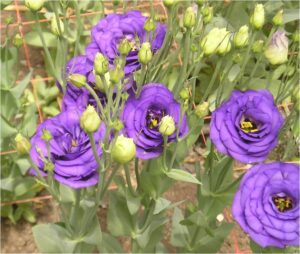
Lisianthus comes in several colors and lasts forever in a vase.
So for example, it is already too late to start lisanthus, one of my favorites, by seed. It takes 17 days at to germinate and then, in my experience, it sulks (like a teenager told to put on different clothes before going out) for another few weeks before putting on any real growth. I’ve grown it – but don’t bother most years. I’d rather save the effort for other plants that grow more quickly, so I just bought two 4-packs of lisianthus from Edgewater Farm.
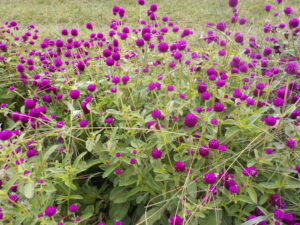
Gomphrena, an annual, is great in arrangements.
What other annuals does Anne Sprague like? Broom corn, celosias of all kinds, but particularly ‘Sylphid’, with greenish blossoms. ‘Blue Horizon’, a tall ageratum. ‘Frosted Explosion’, an annual decorative grass. Orlaya is like an annual baby’s breath. She said beneficial insects love it. Gomphrena and Statice, both have a ‘QIS’ series that is superlative. They can be used fresh or dried. Gomphrena, also sold as globe amaranth, comes in several bright colors.
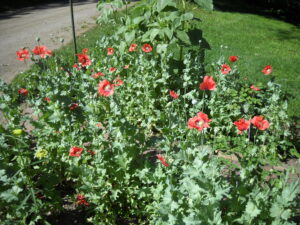
Annual poppies
Annual poppies are some of my favorite flowers, even though they do not last well in a vase. If you let your annual poppies drop seeds where they grow, and they will come back, year after year. Or you can harvest seeds and plant them elsewhere next year.
Understanding Flowers
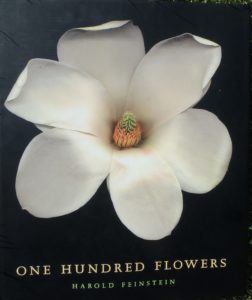
Book cover 100 Flowers
At a recent used book sale I purchased a copy of a lovely book called One Hundred Flowers by Harold Feinstein (Bullfinch Press, 2000). This large-format book includes not only 100 amazing, huge close-up photos of flowers against black backgrounds, it has a lovely introductory essay by Sydney Eddison, a dear friend and fellow gardener writer. Sydney’s introduction is thought-provoking, and worthy of discussion here.
Ms. Eddison begins by explaining the purpose of flowers: to allow plants to reproduce and set seed. For annuals, flowers like cosmos or sunflowers, have but one chance to extend their genetic line. Failing to create seed and have that seed planted – by gravity, an animal or by a gardener – an annual is lost forever at the end of the season. It is generally an advantage for an annual to produce lots of seeds, in hopes that at least one will grow and extend the lineage.
Annuals must reproduce, and consequently they are excellent advertisers – they often have bright colors or strong scents to attract bees or other pollinators. Other annuals depend on the wind to pollinate them, and they need not be so bright – think wheat or corn. Still, the genetic lineage of an annual plant ends if seeds are not produced. Of course many seeds will remain viable for years, and most species have plenty of specimens trying to extend the lineage each year.
Perennials, trees and shrubs, by contrast, can go dormant, and live through winter for another chance to get their genes spread. Perennials generally die back at the onset of winter, but their roots go dormant until spring. Biennials, things like foxgloves, are more like annuals – they only flower once, in their second year.
In her essay, Sydney Eddison did a concise Anatomy and Physiology 101. Most flowers, but not all, have both male and female reproductive organs, generally on the same flower. But it is to the advantage of plants to cross pollinate with other flowers of the same species, and they have evolved to do so. Just as we don’t generally marry our sisters or cousins, flowers get vigor and new traits by crossing with other flowers.
How do plants insure that they are not self-pollinating? One way has to do with timing. Sydney Eddison gives the example of sunflowers. Each “flower” is actually a collection of hundreds to tiny flowers all jammed together, but using one set of bright yellow petals to attract pollinators. That’s efficiency personified.
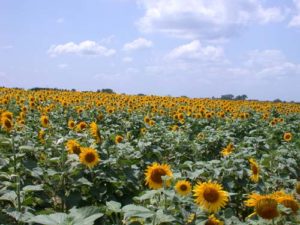
Each sunflower is made of hundreds of flowers
The stigma, or the female part of the sunflower that is receptive to male pollen is delivered by bees or other pollinators, but it stays closed while a particular sunflower is shedding pollen. Later, another pollinator, attracted by those bright yellow petals, will deliver pollen from a different plant.
Many flowers seemingly make pollination difficult. Nectar or pollen is hidden away deep inside a flower. An industrious bee must crawl inside to get at the goodies. In so doing, the bee or other insect delivers pollen, the male gametophytes, from one flower to another. In the fall I love the sound of bees grumbling about their hard life after they finally force themselves inside turtle head, which is one of my favorite flowers of the season.
Flowers entice us just as readily as they do butterflies, bees and moths. We love them and we grow them for beauty as well as for the food they might produce. Humans have been hybridizing plants for eons – long before genetic engineering was even imagined. Creating hybrids can be as simple as breaking off a pollen-laden anther from one variety of flower and touching it to the female stigma on another. Then saving seed, planting it, and seeing what you get.
But once again, timing can be key. If the wind or a big, fat bumblebee has already pollinated a flower, your efforts may not create anything different. But, as Ms. Eddison points out, hybridizers have been dreaming of blue lilies and black gladiolas, and trying their best to produce them – for decades without luck so far.
If you want to try hybridizing flowers, you can “bag” a flower before it opens to prevent accidental pollination. Daylilies are easy to do this with – just use a small paper or wax bag that you place over an unopened flower and secure with a rubber band or piece of yarn. Not every daylily, even ones you pollinate, produce seeds, however. And a friend who has done this hundreds of times explained that most crosses don’t produce anything of interest.
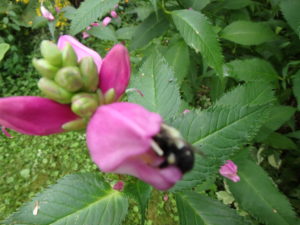
Turtle head with bumblebees emerging
Genetic engineering –made possible just within the last 25 years – allows scientists to add genes to the make-up of organisms in ways unfathomable to Gregor Mendel, who proposed the laws of genetic inheritance in 1865. So for example, back in 2003 I interviewed scientist, Dr. Mark Brand at UConn who introduced genes from a frog into a rhododendron to help it be less susceptible to a fungal root rot. That is not something you or I could do – or would I want to.
Green plants first appeared some 400 million years ago. They evolved from aquatic algae to mosses to ferns to flowering plants. The first flowering plants appeared about 300 million years ago and now there are estimated to be 400,000 distinct species. And remember: all animals on this planet depends on plants, either directly or indirectly. They are not just decoration, they sustain us all. So go garden. Your plants depend on you as much as you depend on them.
Henry Homeyer is a UNH Master Gardener with over 20 years’ experience, and an organic gardener for well over 50 years. You may reach him at henry.homeyer@comcast.net or P.O. Box 364, Cornish Flat, NH 03746.