There is Plenty to Do in the Garden Now
Posted on Friday, October 2, 2026 · Leave a Comment
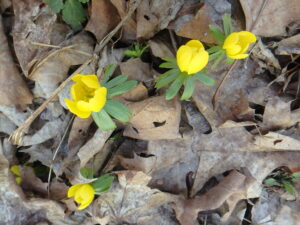
Winter aconite is a very early bloomer
It will soon be time to gather up your leaves and store them for use in the garden. If you can run over them with your mower to chop them up, they’ll break down quicker, becoming a nice source of organic matter to improve the soil in your vegetable garden, or to use as mulch in flower beds. If you leave them on the lawn, they may smother the grass, come spring, so do it now. If you have a huge quantity of leaves and no way to chop them up, just put them in a pile, and in 2 or 3 years they will be completely broken down for use as compost.
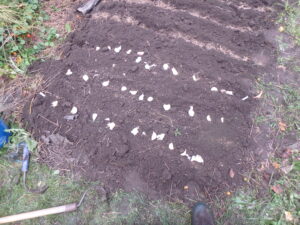
Place your garlic cloves on the soil to establish spacing before planting
I’m already looking ahead to my next gardening season. In October I plant my garlic crop, which I’ll harvest next August. I save some bulbs from this year’s crop and use them for planting now. Of course, you can buy “seed garlic” if you didn’t grow any this year or want to eat all you grew. But don’t plant grocery store garlic because it probably has been treated to keep it from sprouting. And it probably is the wrong kind for our climate: we need to grow “stiff neck” garlic, not the kind with stems you can braid.
I pick my biggest, best garlic for planting. Each bulb gives me 4 to 8 cloves, which I’ll plant 3-inches apart and 3-inches deep. You should work the soil well to make it loose and fluffy. Add compost if it is not rich. My soil is very rich, but I still add some organic fertilizer to the rows. Cover the cloves with soil, pat it down, and then add a thick layer of straw or hay over the bed. That will keep the soil warm for a while, encouraging roots to grow now, before winter. In the spring the garlic will push through the straw, but not many weeds will. It’s my easiest crop to grow, and it stores well in a cool place for months.
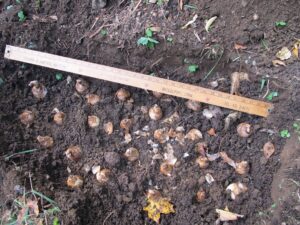
Daffodil bulbs planted in a 36-inch oval hole, ready to cover with soil
I like to buy early blooming daffodils to pot up for “forcing”. Forcing spring bulbs means to pot up bulbs, letting them rest in a cool place for 8 to 16 weeks, and then bringing them into the warmth of the house to bloom early on a sunny windowsill. Small bulbs like crocus take 8 weeks, daffodils 10-12 weeks, tulips 14 to16 weeks. So if you pot up bulbs this month, you can have blossoms indoors in January or February. Little daffodils like Tête-à-Tête are great for forcing, and I like to pot some in 4-inch pots for gifts. I crowd 3 or 4 bulbs in a 4-inch pot.
To fill your pots, you can re-use the potting soil from pots of annuals you grew on your porch or steps this summer, buy potting soil, or make your own. I make a wheelbarrow of potting soil for forcing using a mix of good compost I get each year by the truckload, garden soil, peat moss and perlite. Perlite is the white fluffy stuff you see in potting soils that looks like Styrofoam but is really heat-expanded mica.
The compost I get is rich, dark and fluffy, and it comprises at least 50% of my mix. I soak peat moss and break up any lumps before mixing it in; it’s about 25% of the mix. I like to add a little garden soil, too. And perlite – too helps keep it fluffy and holds water. The mix should be loose and fluffy. Forced bulbs don’t need fertilizer – they have everything they need to bloom.
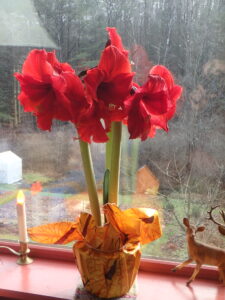
Amarylis bloom nicely in winter
Then there are the amaryllis bulbs I get to re-bloom every year. I keep them in their pots all summer, leaving them outside in a sunny spot. Now I bring them indoors to my cool, dark cellar. They need to go dormant – cut off the leaves and put each in a paper bag. Keep at a temperature of 50 degrees or cooler for 5 or 6 weeks. Then bring them into your house, water, and put on a sunny windowsill.
October is the month for planting bulbs outdoors. I started planting spring bulbs in 1983, I think, and have planted some every year since. I know have uncountable numbers each year, but still plant more. Most spring bulbs live for many decades, but not tulips. Tulips I treat as annuals. I have some daffodils I dug up at my boyhood home more than 40 years ago, they were old then – yet they still bloom every year.
Early spring bloomers can be planted in a shady area – they recharge the bulbs early, before leaves come out; daffodils can be planted along a woodland path, but really excel in full sun. If you plant snowdrops on a south-facing hillside, they should bloom in early March. Winter aconite, a lesser-known, low, brilliant-yellow flower, will bloom with them. Both will spread nicely over time.
I was visiting a public garden in Wales one September when a groundskeeper was planting daffodils in the lawn. He confounded me when he took a 5-gallon pail of old tennis balls, and flung them all out on a gentle hillside. “Why, pray tell, did you do that,” I asked. “Oh,” he replied,” I want a random planting, not rows or circles of bulbs.” I’ve never done that, as I want my daffodil to get lots of sunshine each spring, and bulbs in a lawn won’t be ready to be cut back until the Fourth of July. Maybe their budget allows them to re-plant each fall.
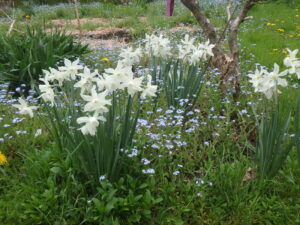
Thalia is one of the few daffodils that will thrive in damp or wet soil
To save labor, I excavate a spot suitable for planting one to three dozen bulbs: an oval, a circle or an amoeba. I put stones and sod in a bucket, good soil in a wheelbarrow. For big bulbs like daffodils, the hole is 6 inches deep; for small bulbs, just 2-3 inches deep. I loosen the soil with a hand tool, my CobraHead weeder. If soil is poor, I add some compost and stir it in. Then I always add a slow-release organic fertilizer. Choose your site well: most bulbs do not like to grow in consitently moist or wet soil. “Thalia” is a daffodil that does not mind it.
There is much to do in your garden on a sunny fall day. But don’t forget to pause and admire a blue sky and puffy white clouds.
You may reach
Henry at
henry.homeyer@comcast.net. He is recovering from a fractured ankle bone, is bored silly, and would love to hear from readers.
Keeping a Record of What’s Blooming in the Garden
Posted on Monday, May 25, 2026 · Leave a Comment
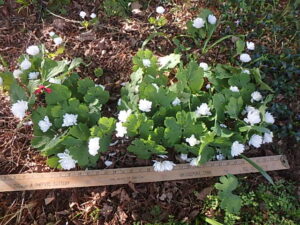
Double bloodroot spreads by root not seed. A few plants have spread in the past 15 years or so.
I decided this year to do a better job of keeping track of what plants are blooming when, and photographing them. I encourage you to do the same – we all forget what we have from time to time. And next winter we’ll be able to enjoy our gardens.
My favorites right now? Double bloodroot – they’re like miniature double white peonies. They have four strings of chromosomes instead of two, so they are sterile, and bloom for up to 2 weeks. Ordinary bloodroot only blooms until it is pollinated.
Then there is my new Merrill magnolia hybrid I planted last year. It replaces one that succumbed to a fungus after 21 years and always bloomed on my birthday in late April. This one opened its buds on May 2 with large double white blossoms. It’s fabulous!
We plant lots of bulbs each year. A recent addition to our crop of daffodils is one called ‘Thalia’, which I just love. It is one of the few that will thrive in soil that stays consistently moist. The stems are tall, the blossoms are nearly white with short cups. It seems many bulbs produce more than one blossom stem. It blooms in early May for me.
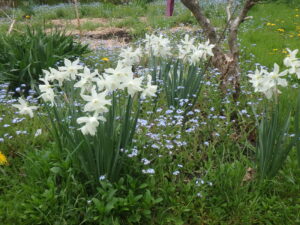
Thalia is one of the few daffodils that will thrive in damp or wet soil
My favorite gardening centers are open for the year, and I’m visiting them all to see what might seduce me. I am always looking for new perennials but I try to hold off buying any until I know I have space for them. But that can be tough to do.
I start my own tomato plants from seed indoors, and some flowers, but have bought some vegetable starts. I just don’t have the time and space to start everything under lights. If you are buying packs of cold hardy plants like Brussels sprouts, broccoli or kale, there is one key question to ask at this time of year: “Are these hardened off yet?” Seedlings raised in a greenhouse can get sun- and/or wind-burned in your garden if you plant them outdoors right away and they have not yet been hardened off.
To harden off young plants, it is best to start them off with just a few hours of morning sun, then some afternoon sun, and finally all day sun. When I harden off my tomatoes, I take a full week to do so. And it’s worth the wait, sunburned leaves will drop off and die. Your plants will recover, but they will lose a week or two of good growth.
May is the month for weeding. If you start off with a weed-free garden, you will have much less work later on, especially if you mulch well. Get the annual weeds before they develop big root systems. Get perennials like dandelions now, before their roots seeds go deeper and are harder to pull. Moist soil makes weeding easier, so go out after a spring rain.
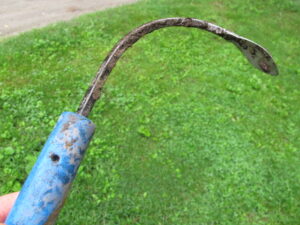
CobraHead weeder
My favorite weeding tool is the CobraHead weeder. It is a single-tine tool that easily gets under a weed and allows you to loosen the soil and to pull up from under the weed while you tug from above. It is also great for teasing out long creeping roots.
For really deep rooted weeds like burdock, I use a garden fork to loosen the soil down a foot or more. I plunge it all the way in, then tip it back. I do that in 2 or more spots around the weed if it is huge. Then I pull s-l-o-w-l-y.
I use a similar technique for pulling invasive shrubs like multiflora rose, honeysuckles, barberry or buckthorn. Pulling them and getting all the roots is tough – the roots tend to break off. But if you are as determined as I am, a CobraHead is good for teasing out smaller broken sections of root.
Buckthorns are, arguably, the most difficult invasive to kill. Cutting them back will stimulate the roots to send out new shoots all around the tree. But you can kill buckthorn by double-girdling the trunk. Take a small pruning saw and cut through the bark all the way around the trunk. Don’t cut into the hardwood, just cut the bark. Then go 12 inches higher up, and do it again.
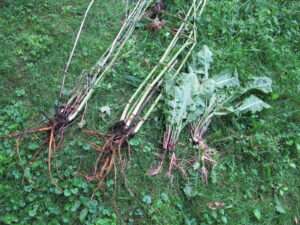
Dandelions and other deep-rooted weeds pull best when soil is moist.
Girdling a buckthorn is a slow death: you are interrupting the flow of sugars from the leaves to the roots, which slowly starve to death. I have done this in winter, and the tree leafed out and seemed normal that spring and the next spring. The third spring it never leafed out – it was dead, and did not sent up any new sprouts around the tree.
Your last chore for now is to fix those dreaded bare spots in the lawn. Buy some new seed, if yours is more than a year old. Use your garden rake to loosen the soil, then top dress with some good compost and work it in. Sprinkle seed by hand – no need for one of those fancy walk-behind seed spreaders. Just fling it gently until it is evenly spread. Don’t be stingy.
Grass seeds need some sunlight to germinate. To cover the seeds a little bit, take a lawn rake and turn it upside down; drag the tines over the area being treated. That will mix the seed in to the soil, but not bury it deeply. Finally you should pack down the seeds with a roller, or use a tamper. Or put down a wide board and walk on it. Make sure the soil doesn’t dry out after planting. I cover it with a very light layer of straw to help keep it from drying out.
Yes, spring is a busy time for us gardeners. But I love it: the colors, the smells – and even the hard work.

 Click Here to buy from Cobrahead