Late May in the Garden
Posted on Monday, May 25, 2026 · Leave a Comment
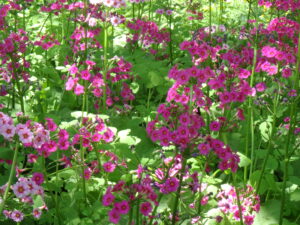
Candleabra primroses delight me each year starting in late May
Asking me to name my favorite flower is, perhaps, like asking you to name your favorite child or dog. But late May brings one of my top picks: the candelabra primrose (Primula japonica). It sends up a flower stalk with a circle of florets, then it grows a few inches and sends out more blossoms, getting taller and blooming sequentially for nearly a month. They grow best in deep, rich, moist soil in partial shade and ideally under old apple trees.
Late May will also produce early peonies I love including two part- shade peonies, Paeonia obovata and P. tenuifolia. The latter is also known as the fernleaf peony for its finely cut foliage; the blossoms are a deep red. Neither are common in garden centers, but keep an out for them.
Spring is a good time to improve your soil. Most commercial farmers grow food by adding chemical fertilizer to the soil before planting. I am an organic gardener, meaning I do not use pesticides nor do I use any chemical fertilizer.
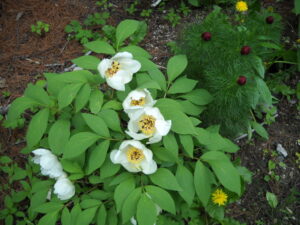
Peony Woodland (P. obovata) with red buds of the fernleaf peony 002
Chemical fertilizers are safe to use, but only provide three of the 17 elements needed by plants to grow and thrive. Granted, most of those elements are needed in very small quantities and may already be in the soil, but I want to provide my plants with the equivalent of a full 5-course meal, not a bowl of white rice.
Chemical fertilizers only contain nitrogen (N), phosphorus (P), potassium (K), and lots of filler. A 5-10-5 fertilizer is 5% N, 10% P, 5% K; the rest -80%- is filler. Nitrogen in the form of nitrate and ammonia ions is used by plants to make proteins, fueling green growth. Phosphorous promotes growth of roots, blooming, seeds and fruits. Potassium is important for growing thick cell walls to survive cold and excess heat.
Plants also need other elements in order to thrive: calcium (for cell metabolism), magnesium (for chlorophyll needed for photosynthesis), sulfur (for making proteins and fats). Also needed are micronutrients like iron, chlorine, manganese, zinc, copper, boron, molybdenum and nickel.
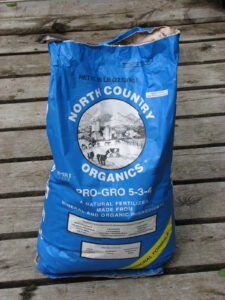
Pro-Gro Organic Fertilizer is a slow release fertilizer.
All those elements above are found in organic fertilizers like Pro-Gro, Gro-Tone and others. And while most chemical fertilizer provide water-soluble elements for quick absorption, organic fertilizers are mostly slow-release, providing key elements over a period of months, or even years. Most contain things like cotton seed meal, kelp meal, ground peanut shells and ground oyster shells.
So what can you do to improve your soil? Add compost. Don’t buy just a bag or two of compost and think it will improve your whole vegetable garden with some left over for new perennials. Borrow a pick-up truck and get a “scoop” from a front-end loader at your garden center. Or get it delivered. Alternatively, you can buy aged manure from your local dairy farmer. Even aged manure will have some weed seeds, but it will add good organic material that will be used by your plants.
Why is compost so good? Well-made compost is full of microorganisms that will work with your plants. Many produce organic acids that help to dissolve minerals from fine stone particles in the soil and make those minerals available to your plants. Compost is, or should be, biologically active: full of living bacteria and fungi. And it will improve soil texture making root growth easier for your plants.
Our soils were created back during the last ice age when glaciers a mile thick ground up bedrock, making sand and even the finer bits of stone that are in clay and loam. Fully 50% of all soil is made of ground up rocks. The rest? Anywhere from 1% to 8% is organic matter, and the rest – nearly 50% of soil by volume – is air. Oxygen is absorbed by root hairs from the air in the soil.
Two other key ingredients do not come from the soil. Plants get carbon, a major part of all plants, from carbon dioxide that is in our air. Nitrogen is in our air, but most nitrogen used by plants comes from decayed plant or animal material – or is made in a chemical factory and sold as a fertilizer.
I highly recommend getting your soil tested every 3 to 5 years. Each state university offers a service for gardeners and farmers. It will tell you soil pH (a measure of acidity), soil type, levels of some soil minerals and the percentage of organic matter. It will offer suggestions on what to add to your soil, though different plants have different needs. You should strive to have 4% or more organic matter in your soil.
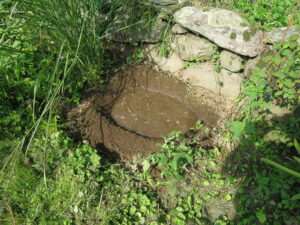
Testing drainage is simple. Dig a hole, fill it up, see how long it takes to drain.
You can perform a simple test to see how well your soil holds water or drains. Dig a hole 24 inches wide and 8 inches deep with sloping sides. Fill it with your hose and time how long it takes to drain. Sandy soil will drain almost immediately. Clay soil will hold water for several hours, even overnight. Good loam might take an hour or two, depending on how much rain you’ve had recently.
Adding compost will help heavy clay or sandy soils will help them considerably. Soil texture and the ability to hold some water but draining well is important to most plants. Compost does both.
Improving your soil takes years, even decades. Yes, I do use some slow-release organic fertilizer at planting time, but my real success has come from years of adding compost.
Keeping a Record of What’s Blooming in the Garden
Posted on Monday, May 25, 2026 · Leave a Comment
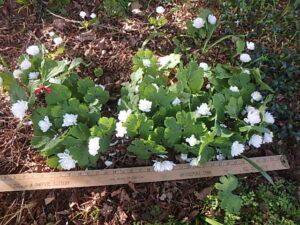
Double bloodroot spreads by root not seed. A few plants have spread in the past 15 years or so.
I decided this year to do a better job of keeping track of what plants are blooming when, and photographing them. I encourage you to do the same – we all forget what we have from time to time. And next winter we’ll be able to enjoy our gardens.
My favorites right now? Double bloodroot – they’re like miniature double white peonies. They have four strings of chromosomes instead of two, so they are sterile, and bloom for up to 2 weeks. Ordinary bloodroot only blooms until it is pollinated.
Then there is my new Merrill magnolia hybrid I planted last year. It replaces one that succumbed to a fungus after 21 years and always bloomed on my birthday in late April. This one opened its buds on May 2 with large double white blossoms. It’s fabulous!
We plant lots of bulbs each year. A recent addition to our crop of daffodils is one called ‘Thalia’, which I just love. It is one of the few that will thrive in soil that stays consistently moist. The stems are tall, the blossoms are nearly white with short cups. It seems many bulbs produce more than one blossom stem. It blooms in early May for me.
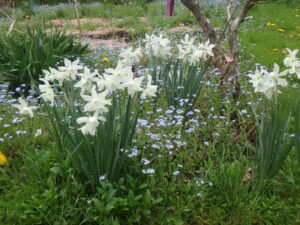
Thalia is one of the few daffodils that will thrive in damp or wet soil
My favorite gardening centers are open for the year, and I’m visiting them all to see what might seduce me. I am always looking for new perennials but I try to hold off buying any until I know I have space for them. But that can be tough to do.
I start my own tomato plants from seed indoors, and some flowers, but have bought some vegetable starts. I just don’t have the time and space to start everything under lights. If you are buying packs of cold hardy plants like Brussels sprouts, broccoli or kale, there is one key question to ask at this time of year: “Are these hardened off yet?” Seedlings raised in a greenhouse can get sun- and/or wind-burned in your garden if you plant them outdoors right away and they have not yet been hardened off.
To harden off young plants, it is best to start them off with just a few hours of morning sun, then some afternoon sun, and finally all day sun. When I harden off my tomatoes, I take a full week to do so. And it’s worth the wait, sunburned leaves will drop off and die. Your plants will recover, but they will lose a week or two of good growth.
May is the month for weeding. If you start off with a weed-free garden, you will have much less work later on, especially if you mulch well. Get the annual weeds before they develop big root systems. Get perennials like dandelions now, before their roots seeds go deeper and are harder to pull. Moist soil makes weeding easier, so go out after a spring rain.
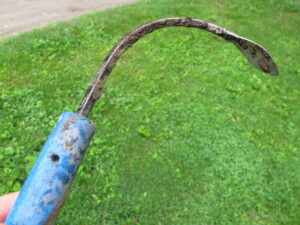
CobraHead weeder
My favorite weeding tool is the CobraHead weeder. It is a single-tine tool that easily gets under a weed and allows you to loosen the soil and to pull up from under the weed while you tug from above. It is also great for teasing out long creeping roots.
For really deep rooted weeds like burdock, I use a garden fork to loosen the soil down a foot or more. I plunge it all the way in, then tip it back. I do that in 2 or more spots around the weed if it is huge. Then I pull s-l-o-w-l-y.
I use a similar technique for pulling invasive shrubs like multiflora rose, honeysuckles, barberry or buckthorn. Pulling them and getting all the roots is tough – the roots tend to break off. But if you are as determined as I am, a CobraHead is good for teasing out smaller broken sections of root.
Buckthorns are, arguably, the most difficult invasive to kill. Cutting them back will stimulate the roots to send out new shoots all around the tree. But you can kill buckthorn by double-girdling the trunk. Take a small pruning saw and cut through the bark all the way around the trunk. Don’t cut into the hardwood, just cut the bark. Then go 12 inches higher up, and do it again.
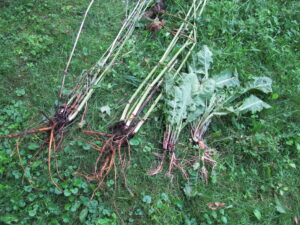
Dandelions and other deep-rooted weeds pull best when soil is moist.
Girdling a buckthorn is a slow death: you are interrupting the flow of sugars from the leaves to the roots, which slowly starve to death. I have done this in winter, and the tree leafed out and seemed normal that spring and the next spring. The third spring it never leafed out – it was dead, and did not sent up any new sprouts around the tree.
Your last chore for now is to fix those dreaded bare spots in the lawn. Buy some new seed, if yours is more than a year old. Use your garden rake to loosen the soil, then top dress with some good compost and work it in. Sprinkle seed by hand – no need for one of those fancy walk-behind seed spreaders. Just fling it gently until it is evenly spread. Don’t be stingy.
Grass seeds need some sunlight to germinate. To cover the seeds a little bit, take a lawn rake and turn it upside down; drag the tines over the area being treated. That will mix the seed in to the soil, but not bury it deeply. Finally you should pack down the seeds with a roller, or use a tamper. Or put down a wide board and walk on it. Make sure the soil doesn’t dry out after planting. I cover it with a very light layer of straw to help keep it from drying out.
Yes, spring is a busy time for us gardeners. But I love it: the colors, the smells – and even the hard work.

 Click Here to buy from Cobrahead