Helping Your Plants to Survive the Winter
Posted on Tuesday, January 12, 2021 · Leave a Comment
If you are like me, you buy new perennials, trees and shrubs every year. Most plants sold locally are hardy, but not all. It’s good to know the “zone hardiness” of plants before you buy them, and how the zone maps work. In a nutshell, the colder the climatic zone, the lower the number.
The USDA (Department of Agriculture) has created maps showing the climatic zones of all states and regions. They are based on many years of temperature records, and rate each zone according to the coldest average temperatures in each zone. Summer temperatures are not considered in creating the hardiness zones.
Each zone covers a 10-degree range of temperatures. The coldest zone in New England is Zone 3, which includes places where temperatures each winter range between -40 and -30 degrees Fahrenheit. Some maps include an “A” and “B” designation to further describe the zones. An “a” is 5 degrees colder than a “b”. So Zone 4a is minus 25 to 30, and 4b is minus 20 to 25.
Trees and perennial plants that survive in Zone 4, which includes much of Maine, Vermont and New Hampshire, should be hardy to -30 degrees, though we often only see minus 20 degrees. Zone 5 is -20 to -10, Zone 6 covers areas where temperatures range between -10 and zero, and Zone 7, which includes much of Rhode Island, temperatures only drop down to zero or 10 degrees above.
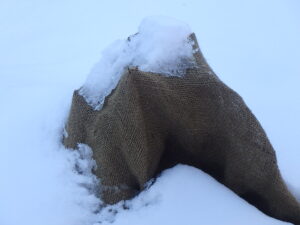
Burlap will help protect this heirloom rose planted in the season
All that said, you can grow perennials, trees and shrubs that are not rated to be hardy in your zone. The key is to get them well established before winter arrives, and to provide them with growing conditions that are optimal – sun, soil and moisture levels that correspond to their needs. You probably cannot grow perennials and woodies that are rated for two zones warmer than yours, but one zone is generally possible.
Some trees and shrubs will survive in a colder zone, but might not bloom every year. Or ever, for that matter. Here in Zone 4, old fashioned wisteria vines that do well in Connecticut or Rhode Island will survive but their flower buds (which are set the summer before) are spoiled by our cold, so they do not bloom.
Harvey Buchite of Rice Creek Gardens in Blaine, Minnesota wanted a wisteria that would bloom in his Zone 4 gardens. He was given a seedling on his wedding day 34 years ago, one started from a seed of a fairly tough hybrid. His turned out to be a wonder vine, and he named it the Blue Moon Wisteria, and sold it for many years. It blooms reliably after winter temperatures of 30 below. The reason for its success? Blue Moon, unlike most other wisteria, blooms on shoots grown in the current season – on new wood.
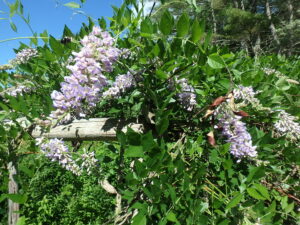
Blue Moon wisteria blooms on new wood so is not bothered by cold
I called Harvey Buchite in 2006 and he reported that even after hard winters it will bloom, and often 3 times each summer. I’ve had one since 2004 and get a very nice set of blooms each year around the Fourth of July. It usually re-blooms a little in the fall. Others have been developed since then that will bloom in zone 4, including “Amethyst Falls” which I grow and like even better.
Survival rates in a cold winter can be improved by mulching the roots of your delicate or borderline-hardy plants. I bought a Japanese Andromeda ( Pieris japonica) this year, even though it is only hard to Zone 5. In the fall I spread a thick layer of leaves around the base to keep the roots warm as winter approached. I could have used bark chips instead, which is also a good mulch.
Trees and shrubs extend their roots in the fall up until the ground freezes, and I wanted my little shrub to grow as big a root system as possible. And later, when temperatures drop to minus 20 and below, I wanted to keep the roots protected.
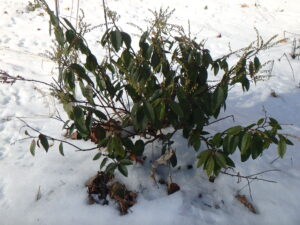
This Japanese andromeda is a Zone 5 plant in my Zone 4 garden but should survive
That Andromeda was loaded with flower buds when I bought it. I may wrap it with burlap or landscape fabric to protect those blossoms from harsh winter winds, though I haven’t yet. In the long run it will have to survive on its own – I have too many plants to fuss over them all every year. The first year is always the most important – once established, plants are tougher.
Sometimes freezing and thawing of the ground will push a plant up and part way out of the soil. This allows roots to be exposed to the air, freezing and dehydrating. That is almost always lethal. But this usually only happens the first winter after planting. Check new plants after a thaw, and if a plant has popped up, push it back down and mulch it well.
Wrapping shrubs or small trees with burlap or a synthetic, breathable cloth will help to protect flower buds from desiccation and dieback. I find roses in my climate often are badly burned by winter winds, but I rarely do anything to protect them. I just cut back the roses to green wood in April or May, and they bloom nicely. I cut back a nice double red “Knockout” rose to the ground this past spring, and it rewarded me with dozens of blossoms all summer, starting in June.
I do lose some plants to winter conditions most years, but don’t feel bad about that. As I see it, I learn something each time one dies, and losing one plant means I can try a new one! Or, if a particularly loved plant does not survive in one location, I may buy another and plant in a different spot.
Henry’s Book, Organic
Gardening (not just) in the Northeast: A Hands-On, Month-by-Month Guide has been re-printed and will be shipped to people who ordered it as soon as he receives it. E-mail Henry at
henry.homeyer@comcast.net.
A Guide to Nature in Winter
Posted on Tuesday, January 5, 2021 · Leave a Comment
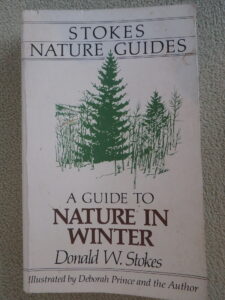
A Great Book for Exploring the Winter Landscape
This is a good time to be outdoors exploring the fields and woods. There is so much to see that will be buried in snow later on. But you may ask, what is there to see? Trees, winter weeds, animal footprints, signs of insects, shelf fungi on trees, evergreen woodland plants and more. If I had to choose one person to show me the outdoors in winter, it would be Donald W. Stokes who wrote A Guide to Nature in Winter, that covers all these topics and more.
I find that learning the names and characteristics of plants and animals makes them more interesting. Many people look at all evergreen conifers and call them “pine trees”. But if you know the difference between a white pine and a Canadian hemlock or a balsam fir, you can decide if you want to grow one or the other on your property.
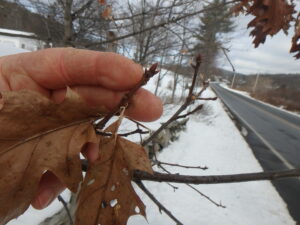
Oak buds have pointed tips and come in clusters at the tips of the branches
Donald Stokes’ book explains that if you learn to identify the six most common deciduous trees and the six most common trees with needles or cones, you will know 80% of the trees in most northern forests. And you can do this in winter. Bud location, size and shape are good indicators for identifying trees.
- Maples. Like ash trees, the buds, branches (and later leaves) are arranged opposite each other, while most other trees alternate the location of them on stems. Maples have oval buds that are between ¼ and ½ inch long.
- Ash. Buds on ash trees are larger than maple buds, and are dark and dome shaped. The twigs on ash trees are generally thicker than on maples.
- Oak.These have clusters of buds at the end of each branch, and the younger trees often hold onto their brown leaves through the winter. Buds and branches appear in an alternating pattern.
-
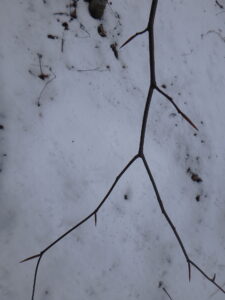
Beech buds alternate on the steam and are long and pointed
Beech. The buds on beech are long and pointy. But the most distinguishing characteristic is its smooth, gray bark. There is a beech fungal disease which can mar the bark, making it look like a bad case of acne.
- White Birch. Most people can recognize white birch by its bright, white and peeling bark, but other birch species can have golden or greyish bark. The bark also has long horizontal lines marking it, and they often have catkins hanging from the tips of upper branches.
- Poplar, also called aspen. These trees tend to grow in clumps in places with poor soil. The upper bark has a greenish tinge, and their buds are variable in color, but always have sharp, pointy ends.
Then there are the evergreens:
- Pines.They have clumps of needles in groups of 2, 3 or 5. White pine, the most common, has groups of 5 long, soft needles.
- Hemlock. These trees have short (1/2-inch), soft needles with 2 white lines on the underneath side. There is a short stem between needle and twig.
- Balsam fir. One-inch needles, also with 2 white lines underneath but no stem between needle and twig.
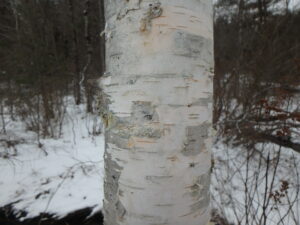
Birches have horizontal lines on their bark
- Cedar. Small, scale-like needles arranged along the twigs.
- Spruce. Four-sided needles that are uncomfortably sharp to the touch.
- Larch. No needles in winter, but cones may be present. Stubby twigs on branches.
After that basic list of characteristics, the Stokes book provides interesting details about the various species of trees, and differences within a genus. So, for example, he explains that most wooden sports equipment – and the handles of our garden tools – are made from ash because it is strong, relatively light, and flexible. And he notes that sycamores, known for beautiful variegated bark, are often hollow when large, and home to nesting mammals like raccoons and skunks.
I was fascinated to read that willow seeds, if washed away and deposited on a muddy bank (in spring), can germinate in two days and grow seven feet during the first year.
Poplars or aspen are often the first trees to grow after land has been burned or damaged by construction of roads. They often appear in clusters, as new trees pop up from the roots. They are not long-lived like maples or oaks which can live hundreds of years: poplars, Stokes noted, generally last no more than 80 years, and frequently less.
Did you know that the sounding boards of many musical instruments are made of spruce? Stokes points out that it is especially clear of knots and imperfections, and resonates better than other woods.
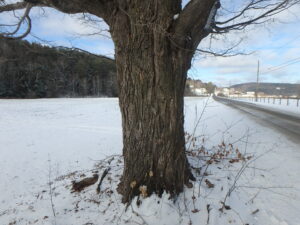
Old sugar maples have craggy bark
If you pay attention to your trees, you will learn to identify them by shape and bark. Sugar maples, for instance, have nice rounded tops and older ones have craggy bark. I can identify a white pine from a fast- moving vehicle: branches on the lower part of the tree droop downward, upper branches reach for the sky.
So head outdoors and study the trees along a woodland path. And bring along A Guide to Nature in Winter. Almost anyone will learn something from it in no time.
Henry can be reached by e-mail at
henry.homeyer@comcast.net or by snail mail at PO Box 364, Cornish Flat, NH 03746. He is the author of 4 gardening books.
The Year in Review: 2020
Posted on Tuesday, December 29, 2020 · Leave a Comment
This past year was a tough one for many of us: isolation due to Covid-19, political turmoil, employment interruptions and more. But in the garden? For me, it was pretty good, overall. It was a very dry summer, but that meant that there were fewer fungal diseases on my tomatoes and phlox. Since a small stream passes through my property the water table is high, and my established plantings did fine with little supplemental watering.
Let’s start in the vegetable garden. What tomatoes did best for me? For sheer production, it was one called “Big Mama”. She is shaped like a plum tomato, but 3 times the size or more. Flavor-wise it was not spectacular for fresh eating, but it was great for making sauce. I got seeds from Burpee.
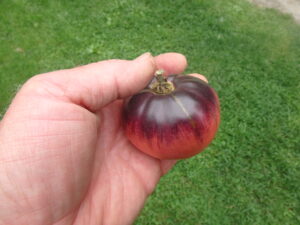
Blue Beauty Tomato
My best flavored tomato? One I bought as a seedling called Hungarian Heart. It is a big, juicy tomato that makes any sandwich memorable. I ate them for breakfast, lunch and dinner when I had them. Seed for this heirloom tomato are available from The Seed Savers Exchange or Burpee seeds. And since it is an heirloom, you can save seeds from this year’s harvest to use next year.
Equally tasty is a perennial favorite of mine, the Sun Gold cherry tomato. Early, relatively disease-free, highly productive. It’s a modern hybrid, so you’ll need to buy seeds or plants every year. But buy them early: they sell out fast. Great for snacking or in salads, I also dehydrate them by the hundred and use in soups, stews and salads all winter.
Best looking early tomato? One called Blue Beauty. It starts out blue, but ripens to be a red tomato with black shoulders. Very productive with 6-to 8-ounce tomatoes and a nice flavor. Hybrid. Seeds available from Pine Tree Garden Seeds.
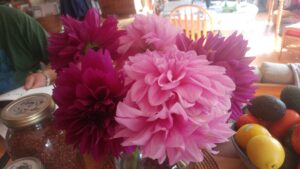
Dahlias make nice cut flowers
Best annual flowers? My wife Cindy ordered 18 Dahlia tubers last winter, and we started them indoors last March in 12-inch pots. We grew them under lights until mid-June when the soil was warm enough to please this heat-loving flower. They grew purple, pink and white 6-inch blossoms on 6-foot tall plants. We had more dahlia plants than any normal people would want, and even after we gave away a few, we had a forest of them.
These big plants had to be staked, and the only thing strong enough to support them were 1-inch square hardwood grade stakes, 5- or 6- footers. We dedicated one 8-foot by 3-foot flower bed to them, and scattered a few plants elsewhere.
For years I have been trying to find the perfect spot for a nice flowering shrub called Carolina allspice or sweetshrub (Calycanthus floridus). I moved it this year for the third time, and finally found a good spot. About ten years ago I planted it in full sun with moist soil, and the leaves burned. Then I put it in shade, and it didn’t flower much. This year I moved it to a drier location in dappled shade under a pear tree. It grew well, and appears to have settled in well.
Sweetshrub produces nice burgundy flowers in late June. Some varieties are very fragrant. Mine is not. (Note to self: always buy flowering plants when in flower if they are supposed to be fragrant).
We had a fierce windstorm in 2020, and it partially tipped over a 15-foot catalpa tree that we’d had for 3 years. I was able to push it back up to vertical position, but worried that it was unstable. I tied it to 3 stakes for a while. Then I had the idea to place a large stone over the rootball on the side that had lifted up. That really stabilized it, and I removed the ropes which had begun to dig into the bark. So far, so good, despite strong winds this fall.
For years I have been frustrated by weeds that infested a walkway though a terraced area for flowers. Goutweed and creeping grasses were seemingly impossible to eradicate, especially since the roots could hide under the large flat stones I had used as stepping stones. This year my wife, Cindy, decided to make it better.
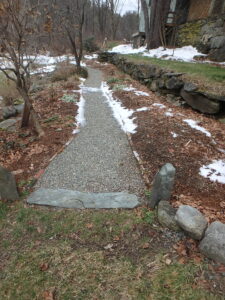
Pea stone pathway lined with bricks was a big project but worth it
First, we removed all stepping stones and she dug out the weed roots. She hired three teenagers to wheelbarrow away the soil and help with the digging as she excavated the path. They dug out a pathway about eight inches deep, two-to three-feet wide and 80 feet long. They then put down 6 inches of one-inch crushed stone and covered it with landscape fabric. Then they edged it with bricks standing on edge, and filled it with rounded pea stones about half an inch across.
The project was a huge success: for the first time ever, we had no weeds in the walkway. Not one, all summer. Stone, with no soil mixed in, will not grow weeds and the bricks kept soil in the beds from getting into the pathway. We will be on the lookout for scraps of goutweed that might pop up at the edges of the walkway next year, but the landscape fabric will keep any scraps of root from sending up shoots.
Each year is different. Each year certain flowers or vegetables are supremely happy, and others sulk. That’s part of the fun of gardening: remembering the good, learning from the bad, and looking forward to the next year. My best wishes to you all for 2021.
Getting the Most Out of Your Cut Flowers
Posted on Tuesday, December 22, 2020 · Leave a Comment
Snow is finally here in Cornish Flat. The cardinals and blue jays are providing a little color to an otherwise unremarkable world. The sun is lurking behind gray clouds, and on a good day we get 9 hours of light. I DO miss the colors of summer. I still keep fresh cut flowers on our table – just not flowers from my garden.

Alstromeria is a long-lasting inexpensive cut flower.
Cut flowers are among modern America’s true bargains. For the price of a bottle of wine – or a few of cups of fancy coffee – you can buy flowers that will grace your table for up to three weeks. But there are some things you should know about getting good table-life for your investment.
Where you buy your flowers may affect how well they last. A floral shop or a good Food Co-op has trained personnel who trim each stem in the store every other day. And someone who regularly changes the water to keep to keep it fresh. Chain grocery stores probably count on you buying their flowers before the flowers need to be trimmed or their water changed.
In either case, you should cut off half to three quarters of an inch from each stem before you put them in a vase, and change the water regularly. Never let leaves sit in the water. Leaves will rot, promoting growth of bacteria, which will impede water take-up. Ask for the little packets of powder that florists provide, and add that to the water to prolong the life of your flowers. A couple of drops of chlorine bleach may work, too.

Chrysanthemums
Keep your arrangement cool if you can. Putting it near a radiator or wood stove will shorten its life. If you’ve invested in roses or tulips, you may wish to move the vase to the entryway or mudroom at bedtime to keep the flowers extra cool during the night.
Some flowers are better picks than others if you’re on a budget and can’t afford to buy new flowers every week. Here are my recommendations for good cut flowers:
- Alstromeria: Each long stem has clusters of 2-inch lily-like blossoms in pinks and reds, with yellow throats. Very long-lived. Great value. Most grocery stores sell them inexpensively.
- Chrysanthemums: These come in a variety of sizes and colors, from the huge spider mums to little guys. I love the scent of the flowers –it’s not overpowering, but it’s there if you sniff them.
- Lisianthus: These look like silk flowers to me: perfect white, pink or lavender-colored bell-shaped flowers on long stems. Tough to grow in the garden, they are perfect in a vase – I’ve kept them for up to 3 weeks.
- Miniature carnations: Each stem has 2-4 blossoms. They come in a variety of colors. Mix dark red “minis” with red roses to make a bouquet of roses look fuller. And even after the roses go to Valhalla, the carnations will still be good!
- Baby’s breath. Tiny white pompoms are great on their own, or mixed with colorful flowers. I have kept them in a dry vase for months.
- Statice. I grow these for use as dry flowers, which tells you that they really do last forever – even out of water. They come in blue, purple, pink and white. You can put them in a dry vase and they will last all winter.
- Spray roses: Instead of a single blossom per stem, these have 2-5 blossoms, giving you more bang for your buck. Will last about a week with proper care.
- Orchids: While not cheap, orchids can last up to a month. I love dendrobiums, though they are not common, even in floral shops. Cymbidiums have bigger blossoms but also last extremely well. And of course you can buy potted ones, which bloom even longer and can be coaxed to re-bloom next year if you put in the effort to keep them happy.
- Kangaroo paws: These Australian natives are fuzzy and cute. They come in pinks, reds and browns, and last very well. Not every florist will have them. I grew then in a pot on the deck one year and love them – like Teddy bears on a stem!
It’s possible to change the colors of cut chrysanthemums. Here is what has worked for me: leave a few stems of a white mum out of water for 12 hours, then cut off 2-3 inches and put it in water with food coloring. Try it with a few stems, to see if you like the results. Put 8 drops of food coloring in a glass with just an inch of water.
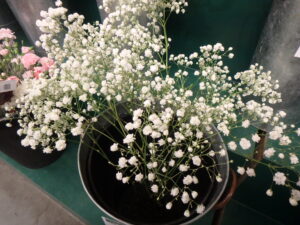
Baby’s breath is a good filler all or lovely by itself.
When I tried it with blue food coloring, my white mums had turned color – but not the true blue I wanted, more of a ghastly greenish blue. Still, if you want to have some fun with your kids, this is an easy way to show how water and dye move up a flower’s stem.
Everyone loves to receive the gift of cut flowers, even guys. So treat your loved one – or yourself- to fresh flowers this winter. They’re cheerful, and can make winter less oppressive for gardeners.
Chores to Do Before Real Winter Arrives
Posted on Tuesday, December 15, 2020 · Leave a Comment
Our gardens are put to bed for the winter: veggie stalks are pulled and composted, perennials are cut back, weeds pulled, leaves raked. Everything is a snug as a bug in a rug. But I’m not done quite yet – and you might have a few chores to do before deep snow arrives, too.
Young trees, especially young fruit trees, are often targeted by voles in winter. If they chew all the way around a tree, removing bark and the cambium layer beneath it, they will die. This is called girdling and happens most often in winters with deep snow because rodents live beneath the snow and are less likely to be caught by owls or other predators.
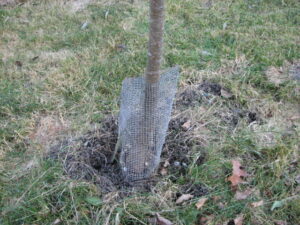
Hardware cloth to protect apple tree from voles
To prevent girdling, you need only surround young trees with a protective shield of “hardware cloth” made with quarter-inch wire mesh. It is sold at hardware stores and comes in rolls of various widths. I use 24-inch wide hardware cloth and cut it with tin snips. It is too tough to cut with scissors. I cut pieces that will go around the trunk and overlap a little, and tie it with wire or string. I squeeze the top after encircling the trunk so that no ambitious mice can drop down from the opening.
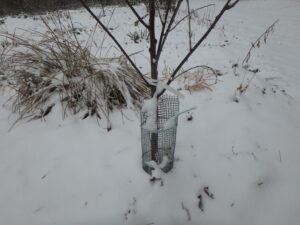
Hardware cloth will keep rodents from chewing the bark and killing this young cherry tree
Another rodent-related task is to protect my riding lawn mower from mice that want to spend the winter inside the air filter. They have done that in the past, causing problems. Now? I just put a few moth balls in a sock, lift the hood, and lay it inside. It keeps away the mice.
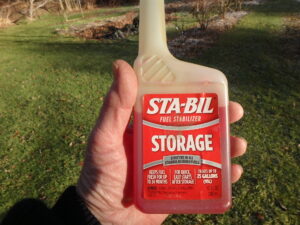
Fuel stabilizer will save headaches in the spring
I have already winterized my mower. This means I added something to prevent the gas from going flat during the months of non-use. I use a product called Sta-Bil. Add it to the gas, then run the engine for 5 minutes. Come spring, my mower starts right up.
I find that it is useful now, in the fall, to go outside with a clipboard and pencil to draw this year’s vegetable garden. Yes, the garden is all cleaned up, but I still remember exactly where everything was. Come spring I might not remember just exactly where the leaks or beans were.
I use wide raised beds for my veggies, and leave them in place from year to year. It is good to pick a new spot each year to plant the regulars – tomatoes, potatoes, squash, etc. I like to rotate plantings so that insects and diseases are less likely to find their favorites. Rotation doesn’t stop diseases or pests, but it makes sense to minimize them by moving crops from year to year. In small gardens, this is almost a futile effort and even in large gardens you will have tomato diseases each year no matter what you do.
I don’t believe in pampering my plants. They have to make it on their own, without too much fussing from me. So I have never been one to build shelters over shrubs to shelter them from cold winds or ice falling off the roof. I don’t plant shrubs beneath the drip line of the house.
This year I got a small cut leaf Japanese red maple and planted it about 10 feet from the drip line of my house. It was a perfect planting spot except for one thing: when the relatively flat roof of the house is shoveled after a foot or more of snow, the ice and snow could land on it – after a 30 foot drop. Yikes. I decided to build a simple shelter for it, as I had spent $125 on the tree and don’t want it broken.
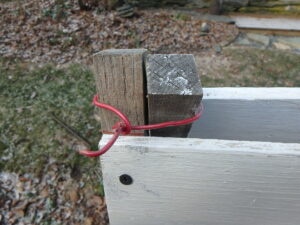
Wire the 2 sides of the A-frame together
Here is what I did: I got four 5-foot long wooden grade stakes and a piece of half-inch plywood. I had a scrap of plywood 60 inches by 40 inches, and cut it in half to create two pieces 30 by 40 inches. I painted the plywood to keep it from delaminating, and then screwed the plywood to the stakes. I left two inches of each stake clear at the top before attaching the plywood, and drilled holes sideways through them.
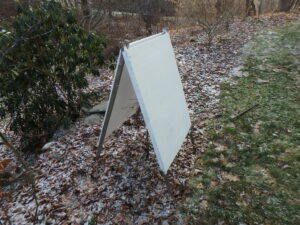
A simple plywood A-frame will protect a shrub from snow and ice coming off the roof
To set up the shelter, I pushed the bottom of the stakes into the soil at an angle, meeting in the middle over the small tree. Then I tied them together with a strand of copper wire going through the holes I had drilled in the stakes. It seems sturdy, and strong enough to deflect any snow pushed off the roof.
I have a number of hand tools with wooden handles that are 50 to 75 years old, tools that my parents and grandfather used and that were passed on to me. I treasure them. To keep them in good condition, I clean and oil those wooded handles in the fall, and recommend you do yours, too.
First, I wipe off any soil from handles and blades. Blades get brushed with a wire brush if needed. Handles get a quick touch up with fine steel wool or sand paper if there are rough spots. Then everything gets wiped down with rag moistened with boiled linseed oil. That oil is available at hardware stores – even in this day of fiberglass handles, which don’t need treatment. The oil on metal parts will minimize rusting. Motor oil would work, but I don’t want it going in the soil next spring.
An old saying goes, “A woman’s work is never done.” That’s true for gardeners of both genders. I’m sure I will find something else to do before deep snow flies that is not on my list. Meanwhile, I can dream of finding time to read good books by the wood stove.
Henry’s book,
Organic Gardening (not just) in the Northeast, has sold out. A second printing is underway, but some orders will not be shipped until after Christmas. You may e-mail Henry to check on the status of your order at
henry.homeyer@comcast.net.
Feeding the Birds – Naturally
Posted on Wednesday, December 9, 2020 · Leave a Comment
By now many of us are providing seeds to the neighborhood birds. Of course the seeds we provide are just a part of the diet of a wild bird. It’s important to grow a diverse selection of native trees, shrubs and perennials to help provide shelter and nesting places for our wild friends, and to provide food all year long. Why native? Native species evolved with the birds and they are genetically programmed to feed on them.
Doug Tallamy, an entomologist living in Pennsylvania, counted the number of butterflies and moth species that, as caterpillars, fed on an oak tree on his property. He counted over 400 species. He also counted species on a non-native shrub, burning bush ( Euonymus alatus), and found only one. The caterpillars of those butterflies and moths are what birds feed their babies each spring and summer, providing protein and fat needed for their development.
If you watch the birds at your bird feeder carefully now you will see that not only are many of the birds eating the seeds you provide, they are also nibbling things on the trees they perch on. In crevices in the bark are dormant insects and their larvae. Chickadees, nuthatches and woodpeckers – three of the most common birds at our feeders – are constantly pecking at bits of food.
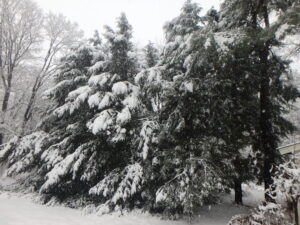
Hemlocks provide shelter for our birds
There is a huge native cherry tree ( Prunus serotina) right by our feeders, a white pine and several Canadian hemlocks along with a couple of mature pear and apple trees nearby. The birds grab a seed at the feeder, zoom off to eat it and rest before returning. But while they are in those trees they almost always find something to tasty to peck at. Planting trees near your house and bird feeders is a good plan if you want to support your birds.
Fruit trees are great for your birds. Apple, pear and especially crabapple trees hold onto some fruit in winter. And while a chickadee might not tear into a dry and wizened apple, bigger birds do. I have seen turkeys feeding in a small weeping crabapple tree that could barely support them. Blue jays, crows, cardinals, grosbeaks and finches and other birds enjoy fruit in winter, too.
So what shrubs have edible fruit that is available to your birds in winter? Right now I see berries on cranberry bush viburnum (Viburnum opulus) and nannyberry (Viburnum lentago). Winterberry (Ilex verticillata), a native deciduous holly, produces myriads of bright red berries visible now in swamps and drainage ditches along the road. It is only eaten by a few birds, so the berries linger on into the winter – and are great for decorating wreaths. Junipers, a low-growing bush on low-fertility fields has berries now, too. Eaten by grouse, pheasants, grosbeaks and others, juniper berries are also used to flavor gin!
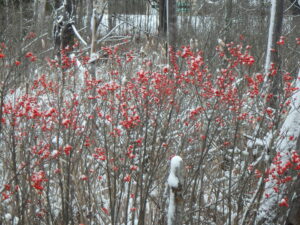
Winterberry grows best in wet places
Alders (Alnus spp.) generally are considered weedy and not planted in the landscape. They grow in wet places as large shrubs or small trees. They are nitrogen-fixing plants, and their seeds are eaten by sparrows and finches, among others. The seeds persist well into December.
Roses that bear fruit are important food sources, too. The invasive climbing wild multiflora roses (Rosa multiflora) are loved by birds, but they drop seeds which grow and take over and smother other shrubs and trees. Beach roses ( Rosa rugosa) produce lots of rose hips, and these are eaten by some birds. And although this species of rose is originally from Asia, it does not seem to take over the landscape the way multiflora roses do.
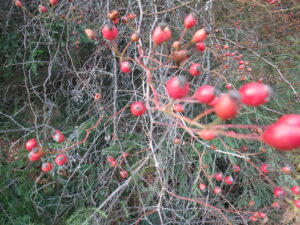
Multi flora rose hips are eaten by birds, but the plants are invasive and should be avoided
Of the big trees useful to birds, white pine (Pinus strobus) and Canadian hemlock (Tsuga canadensis) are two of the most important. Some 40 species of birds eat seeds of the white pine, and at least two dozen eat seeds of Canadian hemlock. Importantly, both are used in winter for shelter. They hold their leaves (needles), providing a break from cold winter winds. Both are used for nesting in the summer.
Any plant that holds onto its berries or seeds into winter is eventually eaten by birds. One of the small trees, staghorn sumac (Rhus hirta) is the least favorite of our birds. The red fruit generally is ignored until spring when returning robins and other migratory birds arrive when food is scarce. The fruit is sour and low in the fats that birds love, but a hungry robin will chow down on sumac if earthworms are not available. Sumacs grow mainly along roadsides in sandy, low-fertility soil. They spread by root and I don’t recommend planting them. But if you have some, leave them be if you can.
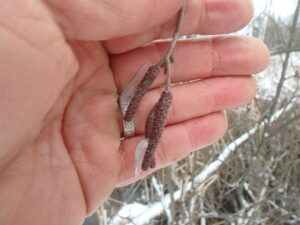
Alder catkins provide seeds now
Mentioned above as food for caterpillars that feed baby birds, oaks are important winter food sources, too. Acorns are a preferred food for turkeys and grouse, but can be cracked by a surprising number of small birds. Others eat the meat of acorns that are broken by cars or people, or clean out shells opened by large birds or mammals. Bears and squirrels love acorns, too.
Gray squirrels have been pirating my bird feeders, so I looked up on-line just how much they eat per day. Only a quarter of a cup of sunflower seeds per day will feed one, so I am letting the two portly, geriatric squirrels eat, and only chase them away if they get too greedy when my little chickadees are waiting.
Henry is offering one of his books, Organic Gardening (not just) in the Northeast, a Hands-On, Month-by-Month Guide as a holiday special for $15 including shipping. To get a signed copy, mail him a check at PO Box 364, Cornish Flat, NH 03746.
Holiday Gifts for the Gardener
Posted on Wednesday, December 2, 2020 · Leave a Comment
I love the holiday season: the lights, the carols, the cookies and more. It’s a good antidote to the news, and to the gray and chilly weather. Last summer many gardening necessities sold out as so many people were quarantined at home and took to gardening. So I recommend getting presents now, before everything is sold out. Here are some ideas for presents to gardeners.
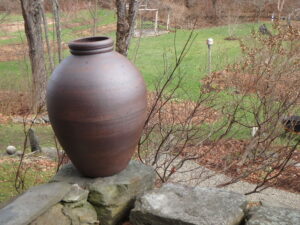
Stephen Proctor pot enhances the garden
Nice pots are good presents, both for growing plants on the deck or just for their sheer beauty. For my birthday this year my wife gave me an urn made by Brattleboro, Vermont potter Stephen Procter. It is 20 inches tall, a foot wide in the middle and tapering to a 6-inch neck. His website,
www.stephenprocter.com, shows mostly huge pots, some 6-feet tall, but he makes smaller things like mine, too. And your garden center will offer a wide variety of nice pots for growing things, too.
We all need hand tools, and sometimes we lose them. So you can always give a weeder to your loved one. The best of these, in my opinion, is the CobraHead weeder with its curved single-tine that is great for teasing out roots of grasses and invasive weeds, or for use at planting time to loosen the soil. Available locally or from CobraHead.com for about $28 including shipping. Made in America.
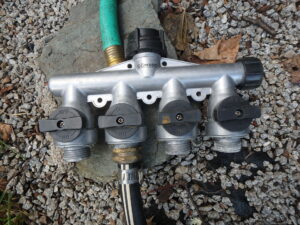
A 4 way splitter provides for hoses going in different directions
Last summer was dry, so watering devices and accessories were hard to buy locally much of the time. One item that is a bit of luxury, for me, is a 3-way or 4-way splitter for the hose. Look for a good, heavy duty metal one at your local garden center. Why 4-way? One for each hose. No more disconnecting and reconnecting hoses. Price? Around $30. Give a 5 or 6-foot hose to go with it, to attach to the spigot and the splitter. Under $10.
Another watering device is a watering wand. Dramm is the best because their wands deliver a lot of water in a gentle fashion. I like a 30-inch wand with a built in on-off controller. Around $25.
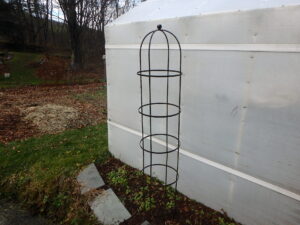
Essex Round Trellis
I like adding height to the garden, and an easy way to do this is with Gardeners Supply’s “Essex Round Trellis”. It comes in 5-foot and 7-foot heights, and I selected the taller one to grow my morning glories next year. Metal, easy to assemble, $60 or $80. It will look good in the garden all winter, too.
Also from Gardener’s Supply I got some metal edging. It comes in a variety of lengths and assembles and installs easily. Sold as 12 to 24-foot kits in a variety of metals and finishes for $43 to $80. These bend nicely, and create a finished look for a flower bed.
Organic-Gardening-book-cover.pdfI love gardening books. I realize that the web has a lot of information, but nothing beats a book in my hands as I settle in on a cold and snowy day.
Norwich, Vermont garden designer Bill Noble came out with a beautifully illustrated book this year, Spirit of Place: The Making of a New England Garden (Timber Press, $35). It is a lovely description of his gardens – and the thought processes that went along with doing this over a long period of time.
Organic Gardening book cover
I have a few cases of my last book, Organic Gardening (not just) in the Northeast: A Hands-On, Month-by-Month Guide (Bunker Hill Publishing, 2015) collecting dust. It came out at $17.50 in paperback, but I am offering it now at $15 including shipping. It’s a collection of my best articles arranged by month. Send me a check at PO Box 364, Cornish Flat, NH 03746.
Storey Publications (
www.storey.com) is one of my favorite publishers for garden books, not only because their books are practical and well written, but many are in paperback and very affordable. Their
Vegetable Gardener’s Bible by Ed Smith ($24.95 in paper) is a classic, and a must-have even for experienced gardeners.
New to me this year are these, all looking interesting. Best of all is a great book on soil by Dianne Miessler, Grow Your Soil: Harness the Power of the Soil Food Web to Create Your Best Garden Ever. It explains very well how soils work, what soil test results mean, and how to correct deficiencies. You don’t need to be a scientist to read this one. ($16.95 in paper)
The Gardener’s Weed Book and The Gardener’s Bug Book, both by Barbara Pleasant ($14.95 each) are very useful No color illustrations, but the drawings are fine. Written for organic gardeners.
Saving Container Plants by Alice and Brian McGowan is a useful book for all of us in New England that want to winter over tender perennials that we have grown in pots on the deck all summer, but that can’t survive the winter outdoors. A stocking stuffer at $9.95 in paper.
Lastly, give your loved one a pile of … manure. Farmers and garden centers sell hot-composted or aged manure that is great for the garden. It will improve the soil and nurture soil organisms. Three yards is a small dump truck load, or you can go get a load in a pick-up truck.
All my best to you, my readers, in this holiday season. Don’t be naughty, and Santa may bring you what you want.
Steps You Can Take to Ensure Your Trees Survive and Thrive
Posted on Monday, November 23, 2020 · Leave a Comment
I’ll have to admit that I see many fewer volcanoes of mulch snuggling up to trees in public places. I think the word is out, at least with municipal workers, that trees can be damaged or killed by over-exuberant mulching. Among homeowners? I’m not so sure. Let’s take a look at the problem.

Don’t create mulch volcanoes like this. 003
Tree bark is wonderful stuff: no matter the weather, bark protects its tree from rain, snow, cold or drought. But it is only rated for above-ground use. Bury tree bark, or cover it with mulch, and microorganisms will break it down and attack the green layer of cambium beneath the bark.

Tip die back due to damage to trunk flare
So what is this cambium layer? It is an active, growing layer of cells that produce the phloem and xylem tissue that provide for the transportation of necessary liquids and that provide mechanical strength. If the cambium layer is destroyed, the tree will die – but not right away. Most experts say that if the cambium layer is compromised, it can take six to ten years for a tree to decline and die. First signs of the problem include tip dieback – top branches losing leaves – and earlier fall color than previously seen.
When you mulch around a tree, you should leave space between the tree trunk and mulch. Some say, leave a donut hole around the tree. How much? Four to six inches is good, depending on the size of the tree. Bigger tree, bigger space. And even if you have started with a mulch-free space around the tree, don’t assume there is still a space. Go look. Gravity works 24/7, and rain and wind can move mulch a little.
Don’t get me wrong: I am not against mulching around trees. It serves two important functions. It keeps down weeds, and it keeps away exuberant guys (usually) with weed whackers. No mulch? That guy with ear protection and a raging string trimmer can girdle your tree in a heartbeat. And that would be as bad as letting mulch slowly rot the bark.
By pulling away the bark mulch, you can save the tree. I have removed mulch and seen damaged bark. But if the cambium is still functioning, the tree can recover, and I’ve seen that, too.
There is another way that the cambium layer can be compromised: covering the trunk flare with soil at planting time. Burying the portion of the tree that should be above ground will lead to a slow death.
Growing trees is an industry. Americans buy hundreds of thousands every year. They are sold at family-run nurseries and big box stores, but often started in nurseries in the warmer regions of the United States. Trees are often grown in fields, like corn, and then lifted and potted up to be sold to your local nursery.
If you ask how deep to plant your little tree, the most likely answer (from my informal survey of homeowners) is “Plant it just like it is in the pot.” But that is generally bad advice. The process of taking a field grown tree and getting it into a plastic pot is not precise. Time is money, so trees are often plunked in containers with little regard for the depth they were growing in the field. The trunk flare (that part that should be above ground) is often buried.
To recognize the trunk flare of a tree, go outside and look at a tree planted by Mother Nature. You will see at the base of a tree that there are above-ground roots heading away from the tree, and that the base of the tree widens just above ground level. That wider portion is the trunk flare, and must be above ground.
Before planting a tree, take your fingers and pull away the soil from the tree trunk at the surface until you can see the trunk flare. If the tree has been in the pot for a few years (often the case for larger trees) and the flare has been covered, little roots have started to grow out of the trunk flare, and should be cut off.
Larger trees for sale at nurseries have often been moved from their original pots or bags to larger ones. At that juncture, soil is added, and often covers the trunk flare. I have planted trees that came from the nursery with four to six inches of soil over the trunk flare. By removing that, I saved the trees.
What should you do if you planted a tree without regard to trunk flare? Take a look at it carefully. If your tree trunk is as straight as a telephone pole at the soil surface, you need to do some digging. You need to expose the trunk flare.
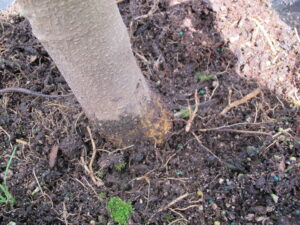
I have removed 2 inches of soil to expose trunk flare, but need to remove more
I like to use a single-tine hand tool called the CobraHead weeder ( www.CobraHead.cm) to expose the trunk flare. I gently and slowly loosen soil and pull it back with my hands. In fact, I use my fingers as much as possible, as I don’t want to damage the bark on the trunk flare. Once you see the flare, re-grade the soil around the tree trunk. It is not as scary a proposition as it sounds. You can do it.
Trees are our friends. It’s not enough to give them a hug from time to time (as I have been known to do, on occasion), you have to be sure they are properly planted and tended. So go outside and look at yours. You may have to do some work on the next warm day.
Dealing with Deer
Posted on Tuesday, November 17, 2020 · Leave a Comment
Winter is near, and, for most of us, so are the deer. They need extra food now, to get ready for winter, and some of what they eat – green leaves and grasses– are not readily available. So they are eating evergreen plants like yew, arborvitae and rhododendrons in our yards. There are steps you can take to help save your shrubs.
What can you do? You’ve probably heard the solution, but might not like it: an eight-foot deer fence around the perimeter of your property. Even then you might get an occasional Olympic deer that can sail over it. But generally deer are kept out by such a fence.
You don’t have to have a steel fence – lightweight plastic fencing will work, too. And you can use poles to support the fencing, straight young tree trunks you cut yourself from the back forty. And you don’t have to fence your entire property. You could put up temporary fencing just for the winter around a tree or shrub that is particularly attractive to deer that has been browsed in the past.
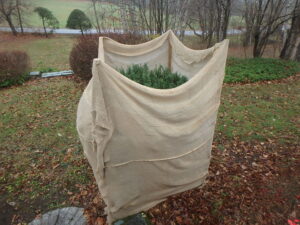
Burlap can be used to keep deer away from tasty shrubs
Recently I helped set up barriers around a pair of large yew shrubs. The shrubs are about 6 feet tall and wide, and in past they have been stripped bare by deer. I got four 8-foot hardwood stakes and drove them into the ground around each shrub– I needed a stepladder and a 3-lb sledge to do it.
The widest burlap we could buy was 44 inches wide, so my wife Cindy sewed 2 strips together to make an extra wide band. We draped the cloth over the stakes, and stapled the cloth to the stakes – all the way to the ground. We did not cover the top of the shrub, just the sides, so snow will fall through and not weight down the cloth. It worked well last year – the poor deer went hungry.
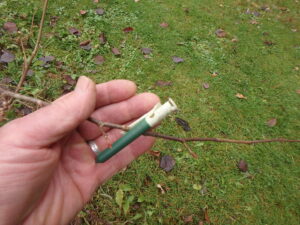
Garlic clips work well for me to deter deer
What else? There are numerous repellents that work to a greater or lesser degree. I’ve had great luck using little garlic clips that I get from Gardener’s Supply Company. Each has a clothespin type clip to attach it to a shrub, and has little cylinder filled with garlic oil. When you poke the device with a tool they provide, it releases the odors for up to 6 months. I use 2 per shrub, or more for bigger things or more attractive deer food.
Coyote urine is sold as a deer repellent, too. It is sold with one-ounce plastic bottles that have holes in the sides, a hanger on top and a cotton ball in the bottom. Dribble a little of their magic potion on the cotton, and hang it in a tree. Of course, you can also just bring your dog around the property and let him mark trees and shrubs. Some people hang bars of Irish Spring soap to discourage deer.
There are numerous sprays, too. Bobbex, Deer Away, Liquid Fence and Plantskydd are some of the most commonly sold varieties. Most use rotten eggs, garlic, or fish oils. You might not want to spray your plants the day of a garden party, but most odors disappear to us after a few days. If deer pressure is high, you might want to alternate which one you use.
Deer are creatures of habit. If they know you have good browse, they will come. If they think you have a pet coyote, they will stay away. No dog? Get dog hair from your local pet groomer. Some people hang sachets containing human hair out in their yard, or hang bars of Irish Spring soap to repel the deer.
There are ways to scare deer away, too, but most take some effort to set up. You could install a motion detector attached to a radio with an all-talk radio format. When the deer arrive, Rush Limbaugh comes on and scares them away, I suppose. I’ve seen motion detectors that attach to a hose, and send out spray when deer are detected. That only works in summer, obviously.
In areas of high deer population, gardeners sometimes choose their plants based on their appeal to deer. People, Places and Plants magazine (Now, sadly, out of business) asked its readers to rate plants eaten by deer. They published the results in Issue #45 (summer, 2004). Here is some of what they said:
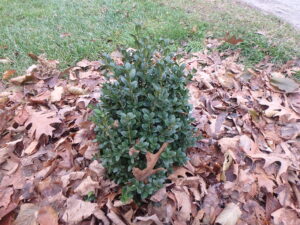
Boxwood are generally not eaten by deer
Seldom eaten shrubs include boxwood, dogwoods, forsythia, and spirea. Occasionally eaten shrubs include blueberry, hydrangeas, lilacs, summersweet clethra, and viburnums.
Trees rarely pruned by deer include birch and ginkgo. Their survey listed occasionally eaten trees as Japanese maple, pear, pine, magnolia, spruce, willow and crabapple. I raised an eyebrow when I saw crabapple, as I frequently see apple trees that have been browsed by deer. Crab apples, I assume would be the same, but please let me know if I’m wrong.
In areas with lots of deer, it makes sense to plant perennials that deer love near the house, and those eschewed by deer farther away. So hostas and tulips, loved by deer, should be right near the house. The survey found flowers usually eaten include lilies, daylilies, hollyhocks, black-eyed Susans, and asters. Scented things like lavender, artemesia and oregano are generally of little interest, and those seldom nibbled include balloon flower, bleeding heart, astillbe, foxgloves, columbine, peonies, Russian sage, yarrow and monkshood.
For a more complete list of deer preferences, you may want to consult a book on the issue. One I like is Outwitting Deer by Bill Adler Jr. But remember, if you have a plant that is dear to you, fence around it – there is almost nothing a hungry deer won’t eat.
Henry is the author of 4
gardening books. He is an organic
gardener and long time UNH Master
Gardener. You may reach him by e-mail at
henry.homeyer@comcast.net.
Giving Thanks
Posted on Tuesday, November 10, 2020 · Leave a Comment
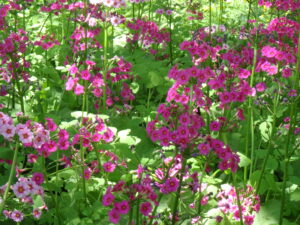
Candelabra primroses delight me each June
I think it’s important to take time to count my blessings. I try to take time each day to reflect on how grateful I am for living the life I do. And on a sunny afternoon near Thanksgiving I like to sit outside and reflect on everything I have to be grateful for. Here are some thoughts about my life, and how gardening helps to make my life full, satisfying – and rich in flowers and vegetables.
I am grateful to have a loving family and wonderful friends. On July 1 of this year Cindy Heath and I got married, after 11 years of partnership. Our family and friends attended via Zoom. Cindy is a wonderful person, an accomplished fiber artist and a terrific gardener. Not only that, she loves to weed! The gardens here in Cornish Flat have never been so well tended. I am so grateful to have her in my life.
I am very pleased to have a newspaper column that has kept me writing and learning for 22 years. On November 11, 1998 my first gardening column appeared in the Valley News of West Lebanon, NH. In that article I reflected then on how important it is to clean up the garden each fall, and to get rid of weeds before their seeds get in the soil.
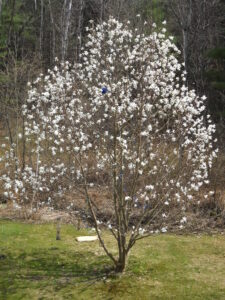
My ‘Merrill magnolia blooms magnificently each April
I also noted that “As insects may have laid their eggs on or in vine crops, tomatoes and potatoes, it is not a good idea to compost these plants.” Diseased or insect-prone plants I recommended for the burn pile or the household trash – or perhaps a pile in a far corner of the property, well away from garden beds. I am happy that our vegetable garden is fully cleaned up and put to bed.
I am grateful for my gardens. My huge ‘Merrill’ magnolia tree that blooms with a thousand white blossoms on my birthday in April. The primrose garden with hundreds of blossoms in the shade of old wild apple trees in June. The peonies that are seemingly everywhere. Milkweed that attracts and nourishes the gorgeous Monarch butterflies. Fall asters, and so many more.
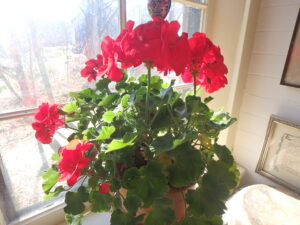
I am grateful for bright red geraniums on my windowsills
Although this may sound silly, I am grateful to have so many potted geraniums in the house. This year we brought in all our geraniums ( Pelargonium spp., not to be confused with perennial geraniums of a different plant family that winters just fine outdoors). They sit on bright windowsills and will bloom off and on all winter, and go outside next summer. Their bright red blossoms give me joy.
I am happy and grateful that I have a small crape myrtle tree in a pot, and have learned how to overwinter it indoors. I bought it in Florida in 2018 and brought it home as carry-on luggage.
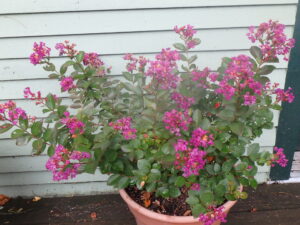
My crape myrtle is a source of joy
Last winter I brought it indoors and overwintered it in our cold, dark basement that stays in the 35 to 50 degree range. I didn’t think it would survive, but it did and bloomed magnificently this summer. The fall foliage was a great red, the leaves dropped, and it has now settled in for its winter rest.
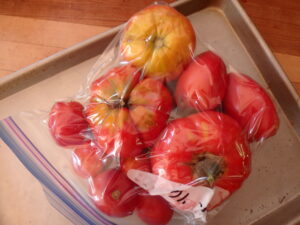
Freezing tomatoes extends the season feeding me even in winter for which I am grateful
I am grateful that we have put up so much food for the coming months. We froze lots of whole tomatoes in zipper bags for use in soups and stews, along with dried cherry tomatoes and some tomato sauce. What else is in the freezer? Lots of leeks, zucchini, kale, Hubbard squash, beets, blueberries and peppers.
I’m happy to have good farm stands nearby. I only had a few peppers this year, so I bought half a bushel from Edgewater Farm in Plainfield, NH at the end of the year. They are great farmers who use the IPM method: Integrated Pest Management. As IPM farmers, they use many of the techniques of organic farmers but reserve the right to use pesticides if a crop is in danger. I prefer to buy organic produce, but trust them to use the least toxic chemicals, and only if necessary. I buy my corn from them and I am always pleased when I get a corn worm: it means that they did not have to spray.
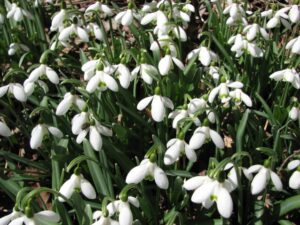
Snowdrops are the first of the bulb flowers to bloom in Spring, and always make me happy when they appear in March
I am happy and grateful that I have been able to plant bulbs each fall for decades. Winters are long here, and the thought of all those little balls of energy waiting in the soil for the onset of spring to come up and share beauty with me makes me happy.
At age 74 I like to point out that I will make it through another winter just because I want to see what else did. I regularly take chances with plants that are not supposed to be hardy in my climatic zone. This year I planted a cut-leaf Japanese red maple, a variety called ’ Tamukeyama’. The cut-leaf varieties are generally less hardy than the standard varieties, of which I have three.
The grower of our Tamukeyama, John Lyon of Newbury, NH (Lyon Family Nursery) told me it is one of the hardiest varieties. We’ll see. I’m happy to have it, and if it does not survive a cold winter, so be it. Although I have never done this before, I will protect it from the wind with a little A-frame shelter made of plywood. I do love the plant.
I am happy and grateful for you, my readers. Each week I get nice e-mails or thoughtful hand-written notes thanking me for sharing my knowledge and sharing personal experiences, and only occasionally disputing my assertions. When my corgi, Daphne, passed away last summer, I was inundated with messages of sympathy. Thank you. Please write to tell me what you are grateful for, where you live, and if I can quote you in a future column.
Lastly, I am grateful that all the newspapers that carry my column are still in business. Subscribe! Buy the paper. Donate to the paper if you get it free. Advertise if you have a business. Local newspapers are the lifeblood of our communities.

 Click Here to buy from Cobrahead