Tips for Extending the Life of Your Tools
Posted on Friday, November 22, 2019 · Leave a Comment
By now most of us have put our gardens to bed – or done as much as we will this season. The morning of the first snow storm I finished cutting back the perennials in my last two flower beds. Whew, just in time. The vegetable garden has long been cleaned up, weeded and mulched with fall leaves. Only the kale is still standing, and I will continue to pick and eat it.
What I have not done, and am betting you have not done either, is to get all my tools ready for winter. It’s always one of the last thing I do before my annual hibernation. This is a good time to work on your tools.
First, anything with a gas engine needs to have fuel stabilizer put into the gas tank to keep the engine from getting clogged up with gunk over the winter. And if you can buy gas without ethanol in it, that stuff is better than ordinary gas. But stabilizer really cuts down on the hassle of starting your mower or chain saw, come spring. The bottle will tell you how much to use. Run the engine for 5 minutes after you add it.
It’s time to clean off the dead grass that accumulates under the deck of your lawnmower. If possible, tip your mower on its side to clean off the gunk with a putty knife or gardening tool. Or just reach in through the place it shoots out the grass and scrape off as much as possible. What you don’t want is accumulated gunk that holds moisture, causing your mower to rust.
I know that some mowers also have ports where you can attach a hose to blast the grass off (my riding mower came with one) but I find they don’t really do the job – especially if you don’t do it every time you use the machine.
In the past I have had mice nest in the air filter of my riding mower. Now I put a handful of mothballs in an old sock, and place it over the air filter and that deters them.
As a man of certain age – past 70 that is – most of my tools have wooden handles. Yes, I have tried those new-fangled fiberglass-handled tools, but don’t like them. Some of my tools were used by my grandfather and/or my parents before me. I treasure them knowing that 3 generations of sweat has seeped into the wood, giving the tools a nice dark polished look. That patina is enhanced by an annual application of boiled linseed oil.
Late each fall I take some time to polish the wooden handles of my hand tools and sharpen the blades, where appropriate. Using medium to fine grit sandpaper I rub out any rough spots or potential splinters on the wooden handles. Then I polish the handles a little more with some fine steel wool and wipe them clean. Lastly, I use a paintbrush to apply several coats of hot linseed oil and let it soak in. That keeps the handles from drying out. A well-oiled handle rarely breaks or gives splinters.
My father always painted some red “Rustoleum” paint on the metal parts of garden tools to make them easier to find and to identify them as his. I found one of his old shovels in the back of the barn and saw that the handle was dry and cracked – I had not used it or maintained it in years. I sandpapered the many rough spots before polishing with steel wool and the applying 3 coats of linseed oil. I just kept reapplying the oil until it stopped soaking in.
A wire brush is a good tool for cleaning up the metal blades of tools – I use one to get off rust. After that, I use a rag with a little linseed oil on it to oil the metal. Something like WD-40 would work, too, and even get off some rust, but I don’t particularly want to introduce chemicals and petroleum products to my soil next spring – even in small quantities.
Hoes and shovels work best when kept sharp. You can sharpen them on a bench grinder or with a rough file or a whetstone. I have a grinder with a stone wheel, but rarely use it – it’s too easy to take off too much metal. Before sharpening a tool, study the angle of the blade – hoes and shovels are only sharpened on one side (the inside) and all you need to do is mimic the original angle, drawing the stone or file over the blade in consistent, even strokes.
What about hand tools? Now most have plastic handles that require no maintenance, and edges of steel so tough that sharpening is not required. But it makes sense to wipe off accumulated grime with a cloth and get any dirt off the blades before retiring them for winter.
Cleaning up my machines and tools is not very high on my list of fun things to do on a Saturday morning. But I recognize that doing so will extend their lives and, for wood-handled tools, add to my enjoyment of them next spring. So have at it. Your grandchildren may use some of your tools one day – if you keep them well maintained.
Henry lives and gardens in Cornish Flat, NH. Reach him at
henry.homeyer@comcast.net. He is available to talk to your garden club or other group.
A Late Fall Garden Chore: Pruning
Posted on Tuesday, November 12, 2019 · Leave a Comment
Fall is here, and winter is not far behind. I’ve seen some snow and scraped frost from my windshield. The sun is slow to get above the hills in the morning and quick to disappear in the afternoon. The sky is often gray and gloomy. These things take their toll on the spirits of gardeners like me. As an antidote, I plant bulbs and prune. Both lift my spirits. I’ve finished planting bulbs, but I’m still pruning.
First, what should you prune now, and what should wait until spring or summer to prune? Anything that blooms in spring or early summer has already formed the buds that will flower next year. Lilacs, forsythia, crabapples, magnolias, rhododendrons, viburnums and many more are ready to bloom when the weather and length of day dictate blooming.
Many gardeners refuse to prune spring blooming woody plants now. It’s true that if you prune then now you lose blossoms – but that does not stop me. Trees and shrubs get messy fast. Ignore them for a few years and they are as untidy as an unmade bed.
In my opinion, it’s better to lose a few blossoms than put off a job that needs to be done. When the lilacs are blooming I am planting veggies and flowers and fixing the mess moles made of my lawn. I have no time to prune them then.
On the other hand, I do not prune evergreens now. Pines, hemlocks and spruce I prune right after they finish their new growth in July. If you remove it each year, you can keep evergreens roughly the same size, if you wish.
I like to be sure that the lowest branches of a tree are high enough off the ground so that mowing is easy. That said, I have a huge Merrill magnolia that blooms with a thousand huge white blossom each year in late April. It has two low branches that make it difficult to mow there, and I have been considering removing them for at least 5 years.
Finally I have decided to remove those two low culprits, but I will wait until after blooming next spring. And who knows, I may change my mind before I get out the saw.
I like to prune when trees are bare of leaves because I can see the bones of the tree. I can see branches that reach through the middle of the tree to grab some sunshine on the other side. I can see branches rubbing up against other branches, or branches that have died and have not yet fallen. All those I will take out.
My late sister, Ruth Anne Mitchell, loved to prune. Her trademark move was to sit down under a tree or shrub and look up through the branches, preferably when they were bare of leaves. She claimed she could see the clutter in the middle of the tree that way, and decide what to take out. Me? I like to circle a tree or shrub several times, looking at it from every direction.
Where you cut a branch is very important. There is a swollen area at the base of each branch called the branch collar. The bark there is often wrinkled. Cut the branch just past the branch collar, leaving the collar on the tree.
Why is that important? The collar is where the tree naturally heals itself. If you leave a long stub past the collar, the tree will have to wait for the wood to rot back to the branch collar before healing, potentially leaving an open wound for years. Conversely, if you remove the branch collar and cut the branch flush to the tree, you leave a much bigger wound than if you do it properly.
A properly pruned tree gets sunshine on each one of its leaves every day. Pruning opens up the canopy to sunshine and allows breezes to dry the leaves of dew or rain. For trees like lilacs and apples that are susceptible to fungal diseases, it’s important that leaves dry out quickly before fungal hyphae (root-like structures) penetrate the leaves.
One last chore: if you planted a new tree this year, you may wish to protect the bark from rodents that chew the bark under the snow. Meadow voles living under the snow can girdle a tree and kill it. Surround the tree with metal mesh called “hardware cloth”. Get the kind with just quarter-inch spaces, not chicken wire. Surround the trunk from the ground to 24 inches.
Many gardeners avoid pruning the way children avoid the dentist. The way your dog views visiting the vet. But instead, think of pruning as going to a really, really good hair stylist. You are giving your tree or shrub a fancy haircut, not performing surgery – even though there are such things as “tree surgeons”.
Tips for Forcing Bulbs for Indoor Blooms in Spring
Posted on Tuesday, November 5, 2019 · Leave a Comment
It might be nice to take a week in February or March and travel to the Caribbean. By then most of us are tired of snow and cold. But if that is not in your budget, perhaps you need to plant some bulbs in pots for spring forcing. I do it every year, and it brings joy to my heart just when I need it.
First, the basic concept: bulbs need a certain time in a cold, dark space to get ready to bloom in spring. But you can create that in a pot, and trick them into blooming earlier than they would outdoors in the ground. When you bring your pots into the warmth of the house, those foolish bulbs think it is spring – in February or March.
Each type of bulb needs a different length of rest in a chilly place in order to bloom. Small bulbs need about 8 weeks, daffodils 12 weeks, and most tulips do best with 15 weeks. Tulips should never be brought up into the warmth of the house before February or they might just produce foliage, but no blossoms.
The hardest part of forcing bulbs is finding the correct spot to place the pots. Ideally, you will have a place that is 35 to 45 degrees. A place that is usually below 50 degrees and above 32 degrees works best. If you have a garage that is usually above freezing, that will work fine.
A few days of sub-freezing temperatures are not a problem. What you want is for the bulbs to send out roots in the pot, which they will do in November and December in your garage or on the steps out of your cellar through the bulkhead. I suppose you can also put a blanket (or a trash bag full of dry fall leaves) over the pots to keep them warmer in the coldest part of January.
Each fall I fill up a wheelbarrow with potting soil and compost, a 50-50 mix. I generally use the potting soil that I used in summer for annuals on the deck. The mix should be fluffy, contain no roots, and be lightly moist to start the process. I fill the pot one third full, place my bulbs, and then fill to within an inch of the top of the pot.
When buying bulbs to force, look for packages that say “Good for Forcing” or “Early Season Bloomers”. “Darwin” tulips are generally good forcing, and are for sale at garden centers and grocery stores. Early daffodils force better than late season varieties.
One year I ignored my bulbs for forcing until it was time to take them out of my cold basement. I had very few blooms. Why? Because they dried out. I should have checked the soil once a month, and watered lightly. Bulbs don’t want to sit in soggy soil, but they can’t grow roots and get ready to bloom if the soil gets bone dry. It’s a balancing act. The soil should be lightly moist.
Outdoors mice and squirrels can be a problem, as they consider bulbs good high-protein, high-calorie meals. I’ve read that during World War II, some Dutch farmers ate their tulips to keep from starving. Rodents think along similar lines. Daffodils and alliums are not of interest to rodents.
I live in a home built in 1888 and despite my best efforts, a few rodents sneak in and out at will. So I have to protect my indoor bulbs from them. I do this by placing a plate over the top of a round pot, or cutting a piece of wood to put over rectangular ones. This keeps the mice at bay.
Come spring, bulbs will start to grow and push up out of the soil. Still, I label each pot with the date it was planted and what is in the pot. That will allow me to bring up early bulbs before the tulips.
You can plant 2 layers of bulbs in larger pots. Set your large bulbs, the daffodils, tulips and alliums, near the bottom of the pot, but be sure to have 2 inches of soil below the bulbs. Add soil mix and then plant a layer of crocus or glory-of-the-snow ( Chionodaxa luciliae) so that they are near the top of the pot. Bring out the pot into the warmth of the house when it is time for the larger bulbs. The little bulbs will bloom right away, followed by the bigger ones which can take 3 to 4 weeks to bloom.
Can you re-use forced blooms? Sure. Keep them in a sunny windowsill and water as needed until the soil has thawed outdoors. Plant them in the spring just as you would in the fall. They might need a year or more to recover from their indoor adventure.
Paper whites, a type of daffodil commonly sold for forcing in pots of gravel and water, don’t need the long chilling period of other bulbs. They are not hardy in our climate, however, so don’t bother planting them outside in the spring. They can go right in the compost pile.
There is something very satisfying to me about being able to have tulips and daffodils blooming in my house while snow is still on the ground. I know I will have hundreds blooming in May, but having a few early ones indoors helps me through the gray days of mud season.
Think about joining Henry on a Viking River Cruise from Paris to Normandy and back next June. E-mail him at
henry.homeyer@comcast.net for details.
Fifteen Flowers That Bloomed in October in My Garden
Posted on Tuesday, October 29, 2019 · Leave a Comment
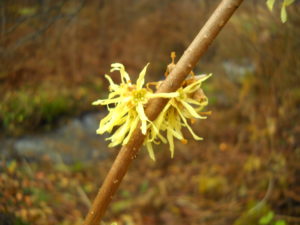
Witch hazel November
Despite frost and short days, my garden produced plenty of flowers in October. I look for plants that will perform in the shoulder seasons – March, April, October and even November. Here are some I love that are blooming still, or that bloomed earlier in October.
- My ‘Knockout’ roses were still blooming in late October. This trademarked variety has me completely loyal to them. They start blooming in June, and continue until Halloween or later. Not every bush blooms every day, but some do. Most are not fragrant, though that has its advantage: they don’t attract Japanese beetles or rose chafers.
- Seven Sons Flower tree (Heptacodium micinoides). The small white flowers on this tree are delicate, and slightly fragrant. It’s fast growing, small tree that needs annual pruning – it can grow stems up to 7 feet long in one season, though it shouldn’t get taller than 25 feet or so. Hard frost damages the flowers.
- Witchhazel (Hamamelis virginiana). This understory tree has small curly yellow blossoms that really aren’t obvious until late October when the yellow foliage falls off. The branches of mine are loaded with blossoms now, and will look good well into November. Not a showy plant, but a welcome treat at this time of year.
- Disanthus (Disanthus cercidifolius). This large shrub has spectacular purple foliage, more dramatic than the reds of burning bush (Euonymus alatus). And if you get up close for a look, it has little half-inch red blossoms in October. Quite a worthy shrub, but not well known. Even though I’m in a cold zone 4, and this shrub is said to be only hard to Zone 5 (minus 20), I’ve had it for several years.
- Autumn crocus (Colchicum speciosum). This is my one

Colchicum
bulb plant for October. It is similar to spring crocus, but many times larger. I was given a dozen bulbs 20 years ago, and now I have just one left – the others seem to have disappeared. It displays its foliage in spring which then disappears. In October large pink (or white or lavender) blossoms appear. Floppy, but wonderful. I shall buy some more next summer.
- Fall monkshood (Aconitum carmichaelii ‘Arendsii’). You may know the June-blooming monkshood (Aconitum napellus), but this late bloomer is a treat that blooms in late October. It grows to be 4 to 5 feet tall, and has an intense blue-purple hooded flower. Also called wolf’s bane because the sap was used allegedly used to poison wolves in Russia by spreading it on meat that was left out for wolves.
- Blooming with my monkshood is a pink-magenta phlox. Unlike the other phlox I have, this one starts late and just keeps on blooming. I wish I knew the cultivar name, as it has little mold or mildew, too. A good cut flower.
- Rudbeckia I have 2 varieties that bloom well into October. ‘Henry Eiler’ is just finishing up. A 5-foot tall plant with petals with gaps between them give it a distinctive look. And then there is ‘Prairie Sun’ which blooms from late June until now. It has a green eye, instead of a brown one.
- Globe flower (Trollius europaeus). The bright yellow flowers are a complete surprise, as it should bloom in early summer. But this year it is in full, glorious bloom in the last week of October. Go figure.
- New York ironweed (Vernonia noveboracnesis). This is a tall purple flower that looks a lot like a New England aster. It can reach 5 to 6 feet tall in moist rich soil, which it likes best. I now grow it in dry soil, as it got too big in moist soil. It bloomed well though mid-October for me.
- New England Aster (Aster novae-angliae). Another tall fall bloomer, I have pink and purple varieties that often reach 5 to 6 feet tall. Monarch butterflies love to get some nectar from the flowers before heading south.
- Canadian burnet (Sanguisorba canadensis). A native plant of the wetlands, this tall flower appears as a dozen thin bottle-brush flowers on each stem, in clusters. I have 3 or 4 other species in this genus that bloom earlier in summer.
- Sneezeweed (Helenium autumnale). This flower was named after Helen of Troy, a woman so beautiful that it said she launched 1,000 ships. I have it in various colors: yellow, yellow and rust, orange and brown. It can be 5 feet tall, or as short as 2 feet, depending on where it is grown and the cultivar. It does fine in ordinary garden soil, but thrives best in moist soils. Sneezeweed does not make you sneeze – it was used as snuff in earlier times.
- Pink Turtlehead (Chelone lyonii). This tall pink flower blooms for 6 to 8 weeks with multiple hooded pink flowers on tall stems. Bumblebees love this flower, though it is a challenge for them to crawl inside for pollen. It finished blooming in mid-to-late-October.
- Fountain grass (Miscanthus sinensis ‘Morning Light’).
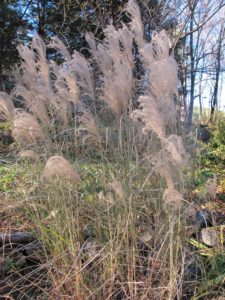
Miscanthus sinensis ‘Morning Light’ looks good much of the winter
Most of us do not think of grasses as having flowers, but they do, of course. This 6- to 8-foot tall grass has wonderful fluffy panicles a foot long or so. They move well in the breeze, and many stay erect through much of the winter.
So if you think that flowers finish blooming in September with the last of your daylilies, think again! Buy some of the plants I mentioned next spring and plant them. October flowers can be spectacular.
Henry is available to speak to your garden club or library. Reach him at
henry.homeyere@comcast.net or P.O. Box 364, Cornish Flat, NH 03746.
Now is the Time to Plant Garlic!
Posted on Thursday, October 24, 2019 · Leave a Comment
The easiest crop I grow every year is garlic. I plant it in October, mulch it well, and harvest it in early August. That’s it. If it’s well mulched, I don’t even have weed the bed more than once or twice. Not only that, I use this year’s harvest to plant next year’s crop, so it’s free. Each year my garlic crop gets better as I use the best of this year’s harvest to plant next year’s crop. My garlic is well adapted to my soil and climate.
If you want to grow garlic but don’t have any for planting, you can buy some “seed garlic” on-line, or you can check with a local farm stand for garlic you can plant. Don’t use grocery store garlic. Much commercial garlic has been treated with chemicals to prevent sprouting. And most grocery store garlic is the wrong kind for planting in New England – and some of it is from China. I avoid anything grown in China, due to concerns about toxic chemicals used there.
There are two basic categories of garlic: soft neck garlic and hard neck garlic. Grocery store garlic is usually soft neck, the kind you see braided and hung up in Italian restaurants. It is less hardy than hard neck garlic, a bit bland and less interesting to cook with.
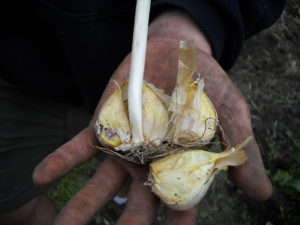
Hardneck Garlic ready for planting
Here in New England we should plant hard neck garlic, which has a stiff “scape” or stem that starts in the middle of the bulb, and grows up as the stalk and produces a flower in July. The fresh scapes can be cut and used in sauces or omelets.
To plant garlic, begin by selecting a bed in full sunshine. Weed it well and make sure the soil is loose and fluffy. In a bed 24- to 30-inches wide I plant 3 rows of garlic. I make furrows with a hand tool or hoe and add some organic fertilizer which I then stir into the soil.
Divide a bulb of garlic into individual cloves for planting. Mine vary from 4 or 5 cloves per bulb up to a dozen. Most have 6 or 8 cloves per bulb. I plant my cloves a hands-width apart, which is about 5 inches. I push each bulb into the soil so that the bottom of the clove is about 3 inches deep, or with the tips 2 inches from the soil surface.
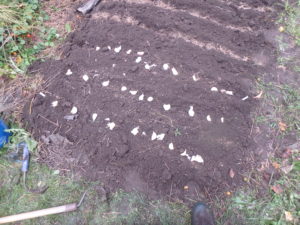
Place your garlic cloves on the soil to establish space before planting
When I plant the second row I stagger the cloves so that they are not lined up with the first row. In the third row I match the cloves with those in the first row. Staggering the bulbs insures a little extra space between bulbs. When all are in the soil I push soil over the cloves and pat the soil down with my hands. If your soil is sandy or a heavy clay, adding some compost before planting is good.
The last step is mulching your bed. You can use straw or mulch hay. Straw should not have any seeds, but it is much more expensive to buy – usually more than $10/bale. Mulch hay is just hay for cows that got wet and is no longer tasty to them. It should be under $5/bale.
Take a section of a bale and shake it over the bed. It will fall apart and spread out. I put 8 to 12 inches of loose hay or straw over the bed. By spring it will have compacted to 3 inches of mulch, and the garlic will grow right through it – though weeds won’t. The mulch will keep the soil warm for a while this fall, which is good. The garlic needs to grow roots and get established before the soil freezes.
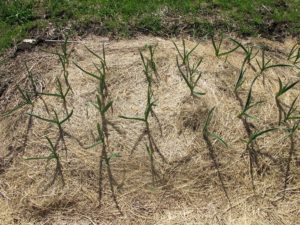
Garlic grows through th mulch, shown here in May
Sometimes garlic will send up a green shoot in the fall. When this happens, gardeners write me, asking if their garlic will suffer if it grows in the fall. Nope. The frost will kill the greenery, but not harm its potential, come spring.
Garlic has many uses. Not only will it scare away vampires, it is an important ingredient in many dishes. And it can be used medicinally. Vermont herbalist Rosemary Gladstar is famous for her fire cider recipe. This concoction is used to help prevent colds and other winter plagues. It contains garlic, raw apple cider, horseradish, hot peppers and other natural ingredients. It can have quite a kick, depending on how you make it.

Fire Cider book cover
Rosemary Gladstar and a group of her colleagues and students have put together a lovely book called, “Fire Cider! 101 Zesty Recipes for Health-Boosting Remedies Made with Apple Cider Vinegar” published by Storey Publishing in 2019. Nearly every one of the recipes includes garlic. The book also tells the tale of how a company tried to trademark the name Fire Cider, though recently, I have learned, the upstarts lost in court.
What else is garlic food for? Here is my recipe for garlic bread, which is good with almost any dinner: Crush 2 to 3 cloves of garlic in a press, and mix with a stick of butter that is soft and slightly warm. Add 3 tablespoons of grated Romano or Parmesan cheese and ½ teaspoon of tarragon, and mix with a fork. Slather liberally on sliced Italian or French bread, wrap in aluminum foil, and heat in a 350 degree oven for 15 minutes. Consume! This has no calories if you use your own garlic.
If you don’t have a vegetable garden, plant some in a flower bed. The scapes in mid-summer are curly and stiff, and great in flower arrangements. So get some garlic, plant some, eat some and stay healthy!
E-mail Henry if you are interested in joining him on a Viking Cruise from Paris to Normandy and back next June. He’s at
henry.homeyer@comcast.net or PO Box 364, Cornish Flat, NH 03746.
It’s Time to Plant Bulbs for Spring Blossoms
Posted on Thursday, October 17, 2019 · Leave a Comment
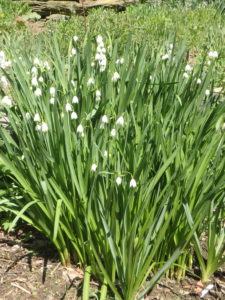
Leucojum
This is the season for planting bulbs – from mid-October until the snow flies. Actually, I’ve shoveled snow off a bed to plant bulbs in November, and they did fine. Bulbs have everything inside them needed to succeed their first year. If you want them to keep on thriving, they will generally need plenty of sunshine, good drainage – and you must not cut off the foliage before it starts to die back.
That said, there are exceptions. The small bulbs like snowdrops, crocus, scilla and glory of the snow are fine in the shade of deciduous trees. That’s because they will bloom early and re-charge themselves before the trees get dressed in leaves that will shade their beds. No bulbs that I know of thrive in the shade of pines, hemlocks or other conifers.
Deer can be a problem for some sorts of bulbs. Tulips are tasty to them, and many a gardener has wept tears of frustration when the deer ate their tulip buds the night before they were to open. Repellents can work – my aging corgi, Daphne, is still a great deterrent – but there are commercial repellents as well.
Garlic, soap, coyote urine and nasty repellents made with rotten eggs and blood meal can keep deer away – unless they are really hungry, or just plain mean. If deer are a problem, you can protect bulbs with wire mesh. No need to build an 8-foot fence, just build a dome or cage over them using chicken wire.
Squirrels, mice, voles and chipmunks can eat bulbs. Some folks buy cheapo hot pepper powder to sprinkle in the bulbs, but it is probably only good for one season. You can put sharp cinders or oyster shell meal (sold at feed and grain stores for chickens) into the hole at planting time. Alternatively you can feed the rodents all winter, or catch and deport them in a Hav-a-Hart trap. Peanut butter with a sprinkling of sunflower seeds will attract them to your cage. They can’t resist.
In the past I have always planted 25 to 50 bulbs in a hole at once. I dig to the appropriate depth, loosen the soil at the base, add some fertilizer and scratch it in. Usually I just use a slow-release organic fertilizer like Pro-Gro, but there are mixes made specifically for bulbs, often called Bulb Booster. I place the bulbs in the hole, pointy end up, and fairly close together. I plant bulbs closer than the directions say – and no bulb has ever complained.
I recently attended a presentation on bulbs by a Dutch expert, Jacqueline van der Kloet. She proposed random plantings. She showed slides of wheelbarrows filled with bulbs of various types, sizes and bloom dates. She mixed them together and then tossed them out onto a flower bed for planting. Her people used trowels to plant every bulb individually. That seems like a lot more work, but the look in spring was interesting.
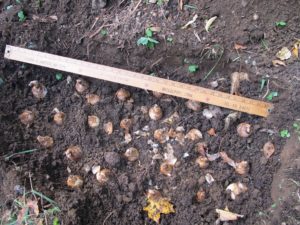
Daffodil bulbs planted in a 36-inch oval hole, ready to cover with soil
On a recent Sunday I gave random planting a try. We had 25 daffodils, 150 crocus of various types and 6 big alliums. The bed for the bulbs was about 2 feet wide and 10 feet long. The soil is very rich and fluffy, so planting was easy. Even with a fruit tree and 4 peonies in the bed there was room for the bulbs. We will plant annuals in that bed, come June, so we may inadvertently disturb some of the bulbs when we do that.
Instead of using a trowel to plant, I pulled back the soil with a curved hand tool with a single-tine called the CobraHead weeder. For crocus, planting was easy: they only need to be 3 inches deep. To get down 6 inches for the daffodils and allium, I needed to use my fingers to keep the loose soil from falling into the planting hole as I prepared it. Still, it went along quite quickly.
Most bulbs don’t like soil that is constantly wet. Much of my property is on the flood plain of a little stream, and in winter and spring does stay quite moist. In the past I have had good luck in the moist areas with Camassia (Camassia sp.), Summer Snowflake (Leucojum aestivum) and some daffodils. I have done tulips there, too, but in raised beds to improve drainage.
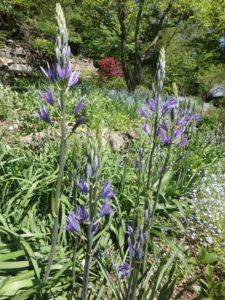
Camassia
Camassia is a lesser known flower, generally in shades of blue or white. The stems are about 18 inches tall, with many florets along the top part of it. They bloom in May or June and hold up well on the stem and in a vase.
Summer snowflake has tall white flowers that resemble snowdrops on steroids: they are on stems that are 12 to 18 inches tall, and each stem has 3 or 4 flowers. I got 25 bulbs about 20 years ago, and now have a huge clump each spring. They bloom in mid-May for me.
Ms. van der Kloet recommended two varieties of daffodils that do well in damp soil: Jenny and Thalia. Thalia I have grown: it’s a nice white one, and fragrant. My recommendation for gardeners with moist soil? Add lots of compost to the soil, including under the bulbs, and raise the beds as much as possible. Even 4 to 6 inches will help. But if you have truly soggy soil, your bulbs may rot, so experiment before planting in large numbers.
Winter is long, and I want something to look forward to. Spring bulbs are worth every penny I spend on them. And if a few get eaten by rodents or succumb to soggy soils? So be it. I will always have plenty to enjoy.
Henry Homeyer is a gardening coach, speaker, and consultant and is the author of 4 gardening books. He can be reached at henry.homeyer@comcast.net.
Putting the Garden to Bed
Posted on Tuesday, October 8, 2019 · Leave a Comment
Pardon me for saying so, but it’s time to get ready for winter. That’s right. A few days ago (or was it weeks?) we were swimming in the ocean and lounging in the sun. But we’ve had frost, and I’ve seen serious snow as early as October 15. Here are some of the things on my list:
Clean up the vegetable garden. Harvest the last of the root crops, pull the weeds and mulch everything with leaves. The key here is this: pull the weeds.
Annual weeds will die with the cold, of course, but most have produced seeds by now that will guarantee that their progeny will appear next year. When you pull them, try to avoid knocking loose the seeds. Be gentle.
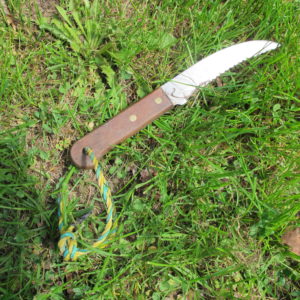
This knife has a serrated edge and is great for cutting back flower stems
Perennial weeds and grasses have serious roots that are hard to pull, and will survive the winter. If you can get them out now, you will have less work next spring. In the spring the soil will be wet, the air cold. We will still have some nice warm days for weeding before winter.
Use a good weeding tool to get all the roots out. I like the CobraHead weeder to tease out the roots and comb though the soil. It’s a simple hook that slides through the soil easily and lifts up scraps of root. You can suppress weeds in the spring by putting down old newspapers and covering them with straw or leaves.
Insect pests and fungal diseases can be minimized next year by getting rid of plants this fall. Tomatoes generally have at least some leaf blight, and squash family plants often have both insects and fungi by the end of the summer. Potato bugs may have visited your plants. So get rid of these plants by putting them in the household trash or by adding them to a pile of brush you will burn after snowfall. I suppose you could drag them off to a far corner of the property, but I know that potato bugs, at least, will hike a long way for a free lunch.
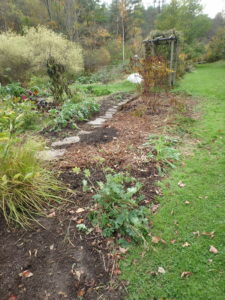
Most perennials were cut back in this bed
Clean up the flower garden. This entails cutting back most flowers and pulling weeds. I say cut back most flowers, but suggest leaving a few tall flowers for the birds – they like seeds of sunflowers, black-eyed Susans and purple coneflower, among others. Those tall plants also provide a little winter interest for you silhouetted against the snow.
Instead of cutting back your perennials with your pruners, try using a serrated knife. Next yard sale you see, stop and buy a steak knife. They work great. Grab a clump of stems and saw them off. I suppose one of those folding pruning saws would do it, too – but wear gloves and be careful using one. They are very sharp.
I’ve used hedge clippers, too, for fall cleanup, but often old clippers don’t do a good job on heavy stems; things get stuck between the blades. I have a pair that works well made by Barnel, their B1000L hedge shears. Available from www.oescoinc.com.
Should you rake the leaves out of your flower beds? That all depends. If you leave the leaves, they will help suppress weeds in the spring, and will eventually decompose. Still, many gardeners like the look of a clean flower bed. The choice is yours. Me? I generally leave them.
Another fall task involves improving the soil, particularly in the vegetable garden. Adding a layer of compost after weeding is always a good plan. Add an inch of more of compost and stir it in with a tool, and it will stimulate your soil to become more biologically active by adding and feeding soil microorganisms.
Many garden centers sell compost by the truckload for a price considerably more reasonable than by the bag. Dairy farms often sell aged manure or hot-composted manure (which is even better). Some will deliver it to your garden. If you keep your raised beds in place each year, just add the compost to the beds, don’t waste it on the walkways.
Fall is a great time to get your soil tested. Your state Extension Service offers this service, just go on-line and download the form. If you have never had soil tested, pay extra and get tested for heavy metals if you grow edibles. Houses built before 1978 (when lead was banned in paint) often have lead in the soil nearby – which is dangerous. A good soil test will not only tell you if your soil is deficient in minerals, it can tell you if it has adequate organic matter and a soil pH that works for your plants.
For a more in-depth soil test, you can do a test with Logan Labs (https://loganlabs.com/) and for a fee of $30, talk with a soil scientist about the results.
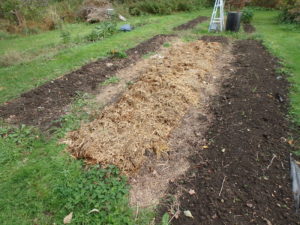
Mulch on a vegetable garden will keep down weeds in the spring
Last, rake the leaves, or better yet, chop them with the lawnmower and then rake them up. Chopped leaves are fantastic mulch, and a real boost to your soil. Earthworms love them, and will bring the organic matter down into the soil. When you cut the lawn at the end of the season, lower the blades a little because long grass is more susceptible to winter fungal problems.
There are plenty of other tasks to do in the garden, so play hooky on a sunny day and get back out into the garden. You’ll never regret doing so.
I now have pricing for the Viking River Cruise I hope to lead from Paris to Normandy and back next June 19 to 26. E-mail me for the details at henry.homeyer@comcast.net. This could be great fun, and I plan to do some gardening talks in the evenings.
Easy Ways to Get and Store Juice from Your Fruit
Posted on Tuesday, October 1, 2019 · Leave a Comment
For me, this has been a banner year for grapes. I have just a couple of plants, but they are large and vigorous. They are the Concord type with big seeds. I know one is a ‘Purple Valiant’, but the other name is long forgotten. They are quite tart for fresh eating, and the birds seem to enjoy them more than I do, so they get most of them. Not this year. I had enough to make some juice, and a neighbor gave me even more.
Six years ago I bought a NorPro brand “Steamer/Juicer” while visiting friends in Seattle, Washington. The salesperson had convinced me it would be great for making all kinds of fruit juices, plus, it was on sale! But until recently, I never did much with it.
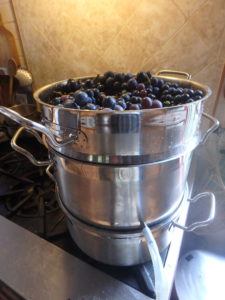
The juicer/steamer cooks the fruit for about an hour to get all the juice out
The juicer consists of 3 parts, all heavy duty stainless steel: an 8.5-quart water pot, which sits on the stove burner and produces steam. Fitting into that is a 4-quart juice catcher with a volcano-shaped opening in the middle that sends steam into the fruit basket sitting above it, and catches the juice that drips down. Finally, on top, is an 11 quart fruit basket that is full of holes. And of course there is a nice glass lid.
It works like this: First, wash the fruit and remove any bad fruit. Bring water to a boil in the water pot, then place the juice catcher on top of that. The juice catcher has a drainage pipe attached, and a hose with a clamp on it, allowing you to easily drain off the juice. The steam passes up through the juice catcher and into the fruit basket, cooks the fruit and releases the juices. Each batch of grapes makes 3 to 4 quarts of grape juice.
Previously I had made grape and elderberry juice with something called a jelly cone. This is a V-shaped metal cone full of holes like a colander. To make juice, I removed the stems and cooked the berries until they are a mush. It comes with a V-shaped wooden pusher that is used to squeeze the cooked fruit against the sides of the cone. That releases the juice while most of the pulp stays in the cone.
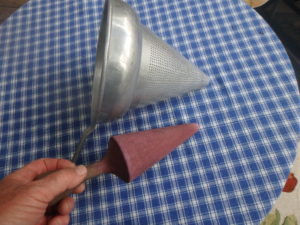
A jelly cone is a low tech way to make juice
It sounds easy to use, but is actually quite messy and tedious. To make elderberry juice, for example, each elderberry has a tiny stem that must be separated from the berry. The nice thing about the steamer/juicer is that you can leave all the stems on.
Another way to make juice is to use a muslin jelly bag and hand squeeze the cooked berries to get the juices out. I gather that it is messy, but effective. I see that commercially made jelly bags are available on-line if you don’t want to make one.
In addition to grapes, I used my steamer/juicer to make juice from crabapples. I have one crabapple tree that produces large fruit – up to an inch and a half in diameter – with nice wine-red skins and tasty fruit. So I picked 150 of them and used them to make one batch of juice in my steamer. I cut each apple in half before steaming to facilitate juice production. The result was a nice pink, mild-flavored apple juice. I got nearly a gallon of juice.
I made over 4 gallons of juices and obviously could not drink it all before it would begin to ferment. What did I do? I could have canned it in glass jars in a hot water bath. According to the video I watched, 5 to 10 minutes fully submerged in a boiling pot of water would preserve it for storage on a shelf. But that’s a lot of work, too.
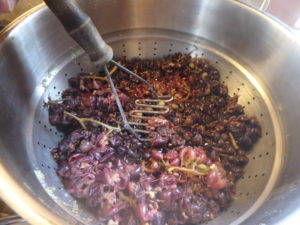
After cooking you can mash the fruit to get a little more juice
Instead of canning the juice, I decided to freeze it. I went to my local apple orchard/cider producer and bought half gallon plastic jugs with snap-on lids. I decanted my juice from the steamer into half gallon glass bottles when hot, and allowed it to cool. Plastic is not suitable for boiling or very hot liquids.
After it cooled I poured the juice into the plastic jugs for freezing. I left at least an inch and a half of air space at the top of each jug so that when the juice froze and expanded it would not push off the lid and spill into my freezer. Half gallon jugs just fit on the door of my freezer.
Making grape or elderberry juice is a job for old clothes, dark-colored ones, as the juice will stain as badly as red wine. I put down a thick layer of newspaper over the wooden countertop in case I spilled any.
I love eating something I grew every day of the year. I store, dry and freeze all kinds of fruits and vegetables. Making juices allows me to expand my list of foods available in winter. It takes a lot of time to prep everything, but I know that the food I put up is chemical free, too, which is important to me.
Join me on a Viking River Cruise from Paris to Normandy and back next June. Just e-mail me for information: henry.homeyer@comcast.net.
Fall Lawn Care
Posted on Tuesday, September 24, 2019 · Leave a Comment
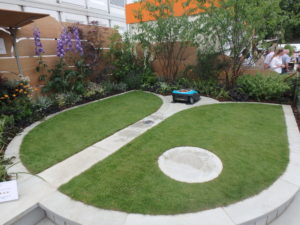
This robot mower from the Chelsea Flower Show is quite a leap from the sheep that were the original mowers
I have to admit that I don’t pay much attention to my lawn. I mow it as needed, but don’t fuss about dandelions, which I consider cheerful. But I realize many gardeners DO care about their lawns, so I will share with you a few tips for the fall.
There are often places on lawns where someone left a wading pool or forgot a pile of weeds. Now is a good time to re-seed. Why? The soil is warmer than in the spring, and it is less likely to dry out now than in the summer.
To fill in a bare spot, first scuff the area with a garden rake – the kind with strong, short tines. Then spread some good compost, perhaps half an inch of it. Mix that in with your rake. Compost encourages healthy bacteria and fungi to live in the soil, supporting your lawn.
Next, spread seed over the area. For small areas, you can just take seed in your hand and fling it. Seed spreaders are sold if you have a large area. After seeding, drag a lawn rake over the area upside down – with the tips of the tines up. That will mix the seed with the soil and compost, but not rake the seed away the way it would if the tines were down. Pat down the area with a tamper, your feet, or a lawn roller if you can get your hands on one.
There are special fertilizers available for lawns, but I’m not a fan of chemical fertilizers for a number of reasons: they are made with chemicals that are not suitable for organic gardeners. Some are even combined with pesticides of various types – to prevent weeds, insects, grubs, fungus or moss. Even organic fertilizers need to be used with care: phosphorous (the middle number in the 5-10-5 designation) is prohibited in any lawn fertilizer in many states because phosphorous can cause problems in waterways.
Some people like to shade the newly planted area by spreading a thin layer of mulch hay or straw. That helps to keep the new seed from drying out in the sun. The grass will grow right through it. Be sure to water if the soil starts to dry out. It is critical to keep the seeds from drying our once planted.
Over-seeding is good to do now, too. That means adding some seed to thin places, not just those bare spots. Follow the same procedure: scuff, add compost, seed, mix in with your rake.
What seed should you use? I generally recommend a “conservation mix”. This has a mixture of varieties of tough grasses including tall fescue. I like Dutch white clover in the mix, as it will take nitrogen from the air and add it to the soil – free fertilizer. Clover, however, is killed by the herbicides sold to kill weeds in lawns. Kentucky bluegrass is sometime touted as the best grass for lawns, but it is a high-maintenance variety, and should never be more than 20% of a mix.
If you have trees shading your lawn, get lawn seed designated for shady areas. If not, it will not thrive. And over time, a sunny lawn often becomes a shady lawn as trees along the perimeter get bigger. Maples steal a lot of water and nutrients from a lawn, and their roots extend way past their drip line.
What should you do about moss in the lawn in shady spots? I like it. You can let it take over, or you can rake it out and add limestone to sweeten the soil – moss likes acidic soil. And I guess you have to cut down some trees or lop off branches to get more sun on those mossy places. Me? I live with it. I’ve seen labels on bags on “Death Row” (the chemical aisle at the garden center) that promise “No More Moss for a Year” and shudder at thoughts of my earthworms and beneficial fungi and bacteria dying from the moss killer. Ugh!
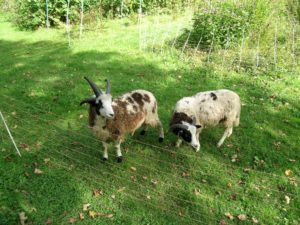
I used sheep as lawnmowers for part of my lawn one summer., but they were a lot of work!
Fall is a good time to send off a soil sample to your state university extension service to see what the soil is like in your lawn. If the soil pH is less than six, you should add some limestone this fall. It will raise the number, but slowly, so it’s good to do it now. The report will tell you how much limestone to add, and should also tell you if you need to add organic matter, phosphorous, potassium or magnesium. If you are low on magnesium, buy dolomitic limestone, not calcitic limestone.
If you walk across the lawn in the same path every day, eventually the grass will get so compacted it will stop growing, particularly if you walk on it when the grass is wet. The solution? Put down stepping stones or pavers as lawn will not thrive in compacted soil.
If you plan to put down stones, cut out the grass underneath them first. Do this by using an old steak knife. Cut around a stone, then move it and dig out the sod and any soil needed so that the stone will be about level with the lawn. I like a CobraHead weeder for that. By having the stones level with the lawn you can mow over it without hitting them with the mower.
Fall leaves are great for the grass. Put the mulcher attachment on your mower to chop them up fine, starting now, and let the earthworms feast on them. Don’t leave too thick a layer, however, as it can choke the grass.
A little lawn is a nice thing. But my philosophy is this: if it’s green and you can mow it, it’s a lawn. I’ll never get hung up on having a magazine-perfect lawn.
Henry hopes to help lead a Viking Cruise from Paris to Normandy next June, including a stop at Monet’s garden in Giverny. For more info, e-mail Henry at henry.homeyer@comcast.net. He will be giving gardening lectures evenings on the boat.
Six New-to-Me Trees to Consider for Planting
Posted on Tuesday, September 17, 2019 · Leave a Comment
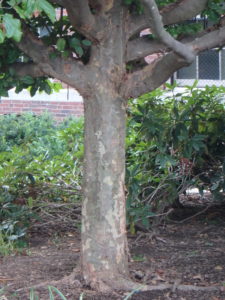
Persian ironwood has interesting bark
The Amherst campus is a perfect place for a tree walk: they have been planting trees for over 100 years, and have not only some state champion trees, but at least one national champion. Mike Dirr, a UMass graduate, has been consulting with the landscape personnel for years. Here are 6 trees I did not know, but am considering for use in my own gardens.
- Three flowered maple (Acer triflorum). I had never seen one before, and although it is available in some nurseries, it is not common. Hardy to Zone 4 (minus 30 degrees). It is a small maple, up to 20 or 30 feet tall and wide with great fall color. The exfoliating bark is interesting, giving the tree winter interest. It gets its name from its yellow-green spring flowers that come in clumps of three. This would be a nice street tree.
- Amur maackia (Maackia amurensis). This is another small tree, getting to be about 30 feet tall and 20 wide. It has an upright form with glossy dark green compound leaves. One of its main virtues is that blooms when many other trees are done blooming – probably in July in New England. The flowers are small and white, arranged on 6-inch vertical panicles.
It is a great street tree because it will grow in any type of soil and is not fussy about soil pH. It is hardy to about minus 40 degrees.
- Tuliptree (Liriodendron tulipifera). In contrast to the trees above, this is a majestic tree that has grown to be up to 200 feet tall in the wild, though generally 70 to 90 feet in cultivation. It has a strong straight trunk. I first fell in love with it in New York City’s Central Park. One planted by George Washington is still alive at Mt. Vernon, and both he and Jefferson loved this tree.
The leaves are tulip-shaped and up to 8 inches wide. The flowers appear in late spring and are yellow tinged with orange in the center, 3 inches in size. According Dirr’s new book, it is unfortunate that the flowers appear so high up, as they are difficult to see. I have used the seed pods as Christmas tree decorations.

Tulip tree Emerald City is not as tall as wild ones
What I had never seen before is the cultivar ‘Emerald City’ which is a smaller and hardier version of the classic. Although it can grow to 55 feet tall and 25 to 30 feet wide, Mike Dirr said in our climate it will probably not exceed 30 feet tall, and is hardy to as much as minus 35.
- Persian ironwood or Parrotia (Parrotia persica). This is another small tree (to 30 feet), one that can be multi-stemmed or single-stemmed. The tree I saw on the tour was single-stemmed and had wonderful mottled bark. The bark would be enough to make the tree a worthwhile investment – after all, flowers last but a moment, and we have many months of winter without leaves.
Parrotia blooms very early, in late winter at the time some witchhazel are blooming. The blossoms are small, and without petals according to Dirr’s book. They appear as “clusters of maroon-red stamens along the branches, bringing cheer to the cold dreary landscape.” In the fall the leaves often show yellow, orange, red and purple. Leaf borders in spring can be tinged with purple. Hardy to Zone 4.
- Swamp white oak, columnar varieties (hybrids of Quercus bicolor). Mike Dirr suggested to the landscape staff at UMass Amherst to plant some columnar oaks about 6 years ago in front of Herter Hall, and a variety of them are quite remarkable now, already reaching to 25 or 30 feet tall, but only 8 to 10 feet wide.
My favorite of the columnar oaks is ‘Beacon’, one called “Bonnie and Mike”, named after Dirr and his wife. It is one they discovered and introduced to the trade. It will grow to 50 feet but stay just 15 wide. Lovely foliage.
- Japanese snowbell (Styrax japonicus). This would be my first choice for a new tree on my landscape but it is only hardy to Zone 5 (minus 20, so it is “iffy” for me. It apparently has lovely fragrant white flowers in spring. It grows well in sun or part shade, and grows to 30 feet tall and 35 feet wide, though it grows just a foot or two per year.
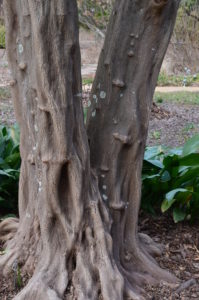
Japanese snowbell bark is unusual
But the selling point for me is the bark: “gray-brown, smooth, sinewy, developing irregular, orange-ish brown, interlacing fissures” according to Dirr’s new book.
I remember interviewing Tasha Tudor and being amazed that she was still planting trees when she was in her 90’s. So I shouldn’t hesitate to plant more trees now that I am in my 70’s. Finding the right tree and having enough space is my major challenge.
Henry is the author of 4 gardening books. You may reach him at henry.homeyer@comcast.net.

 Click Here to buy from Cobrahead