Ten Fabulous Annual Flowers I Love to Grow
Posted on Tuesday, July 11, 2017 · Leave a Comment
I want colorful flowers growing alongside my front walkway every day from May to November, and generally have them. I do so by growing annual flowers. I grow more than 100 species of flowers elsewhere on my property but the vast majority are perennials that only bloom for a few weeks each year.
All plants (and most animals) have a strong need and desire to maintain their genetic lineage. Their “goal” in life is to pass on their DNA to a new generation. Perennial plants and trees can assume that if they don’t have any descendants this year, they can next year. Not so for annuals. If they don’t bloom and produce seeds this summer, their lineage stops. There is no second chance.
So to get continual blooms from your annual flowers, all you have to do is pluck off the flower heads once they start to look bedraggled. That is known as “deadheading.” The flowers seem to ”know” that if the flowers are gone, so are the potential seeds, and they keep on blooming. Here are some of my favorite annuals.
Pansies. These are my early bloomers. I buy field grown pansies and plant them in the walkway or in a whisky barrel in April or May for early color. By now they are lanky and fading, so I will either cut them back hard for fall blooms, or just yank them.
‘Senorita Rosalita’ cleome. This is a Proven Winner trademarked variety, so it cannot be purchased as seed or in 6-packs. It is generally sold in 4-inch pots or larger and costs more than common annuals. Unlike ordinary cleome, ‘Senorita Rosalita’ stays short and compact, has no thorny protuberances on the stems, and does not have a strong noxious scent. And it blooms continuously all summer. It likes full sun and does well in hot, dry locations. ‘Senorita blanca’ is a similar white variety. I grow this each year, often starting plants from seed, though they need at least 12 weeks to get to the size needed to plant outside. Like all the plants on my walkway, these like plenty of direct sunshine. The flowers are cute little round balls of color- magenta, pink, white. The stems dry well, and I often keep their bright blossoms in a dry vase all winter. I hang them upside down until the stems are dry enough to support the flowers.
Brazilian verbena (Verbena bonariensis). This is one of my favorites, and adds height to the display. It has thin stems up to 5 feet tall, but rarely needs staking because the purple blossoms are quite small. If you cut it back as it grows, it will branch nicely, providing more blossoms. The blossoms keep on looking good even after light frost.
Licorice plant (Helichrysum petiolare). This is a foliage plant with no flowers that I’ve ever seen. It stays low and branches nicely with silver-gray or yellow-green foliage. I mainly use it in my window box by the front door, but it also works in the ground. Cut stems are fabulous in a vase, too.
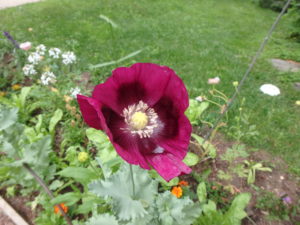
Annual Poppy
Annual poppies. These are blooming for me right now in various colors: orange, purple, yellow (California poppy) and polka dots. Some are doubles, meaning they have extra petals. Annual poppies are an exception to the rule that annuals keep on blooming all summer, but I don’t care. I love these beauties with their gray or silver foliage and delicate blossoms. Many annual poppies scatter their seeds and will start up next spring on their own.
Scaveola. This plant takes abuse, so I put it in my window box with licorice plant – where drying out is more of a problem than in the ground. It can look dead from dehydration, but a watering brings it right back. Its stems are generally 6 to 12 inches loaded with small purplish-blue flowers.
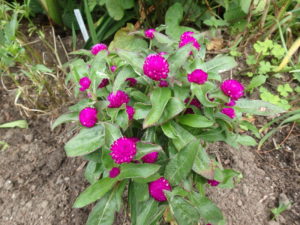
Gomphrena
Gomphrena. A variety of verbena, this comes in purples, magenta, white, pink and more. It creates a cascading mass of bright flowers that bloom all summer.
Zinnias. Fabulous flowers. They come from short (Profusion series are under a foot tall) to tall (Benary’s Giant, 4 feet tall). Keep picking them for vases, and they will branch and produce more flowers. A wide variety of colors, including lime green. I plant these by seed in a bed in my vegetable garden, just scattering last year’s dried flowers over and raking them in.
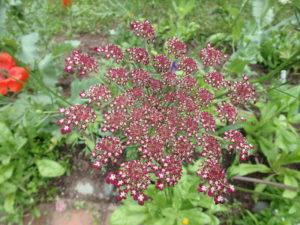
Wild Carrot
Wild carrot. (Daucus carota ‘Dara’). One of my new favorites. This looks like Queen Anne’s lace, which is a biennial wild flower, but this is an annual that comes in a variety of colors – white, pink and burgundy. I bought some started plants and they are blooming nicely.
Salvia. There are hundreds of kinds of salvias, both annual and perennial. I grow annual salvias mainly for their vertical form (8 to 24 inches tall spikes) and their intense blue and purple. They also come in fire engine red (which I tend to avoid), white and bi-color. All are tough as nails in hot sun.
I realize it’s hard to find nice annuals now – many nurseries have sold all the good ones. But many can be started by seed, even starting now. Just read the seed packets to see how long they need to bloom. I love my annuals, and their long-running show of beauty.
Henry is the author of 4 gardening books. His web site is www.Gardening-Guy.com. See extra photos for his articles at https://dailyuv.com/gardeningguy
Veggies You Can Plant Now for Fall Eating
Posted on Wednesday, July 5, 2017 · Leave a Comment
Most gardeners don’t think of July as the time to plant seeds in the vegetable garden. But it should be. This is a good time to plant many things including broccoli, Happy Rich, lettuce, kohlrabi, fall radishes, carrots and beets. With good warmth and plenty or rain (or water from your hose), these plants will probably do better now than in if they were planted in the spring.
If you planted peas, spinach or lettuce early this spring, you probably have a bed that is empty now. Instead of just growing weeds, why not get out your seed packets and plant a second crop in that bed?
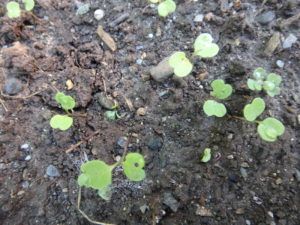
Arugula seeds germinate quickly
In the spring I generally plant seeds in those little black plastic 6-packs. I do that because the soil outdoors is cold and wet, and seeds are prone to rot. Now, however, the soil is warm and seeds will germinate much more quickly. All you have to do is check them daily to be sure that the soil has not dried out.
Broccoli, if you read the seed package, takes about 55 days to maturity. So if you plant in mid-July, you should be picking heads of broccoli in mid-September or even a bit earlier. Read the seed packets carefully: as I peruse my Johnny’s Selected Seeds catalog, I see broccoli varieties that mature in anywhere from 48 to 80 days. Some varieties like ‘Arcadia’ (63 days) are listed as “Tolerant of cold stress.” That one also says it makes lots of side shoots. Since broccoli produces well into October for me, getting side shoots is important.
So how should you plant broccoli if you have always put it in as nice little plants that you – or the local grower down the road – has grown? I would suggest planting 3 seeds in groups about 16 inches apart. Why 3 seeds? First, not every seed will germinate, so I like to ensure that at least one will come up. But rather than plant them like carrots in a long line, just plant a few seeds where you want one plant. Then as soon as the plants have 2 real leaves, pull out all but one. And since you’ll see leaves in clumps every 16 inches, you won’t have a hard time identifying them – even if you have never done it before.
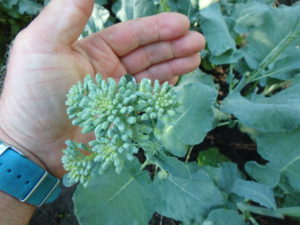
Happy rich
One of my favorite veggies is one you might not know: Happy Rich. It is a non-heading broccoli type plant. Instead of one big head, it produces many small heads similar to side-shoots on standard broccoli. I get seeds from Johnny’s Seeds. A similar plant is piricicaba, which I get from Hudson Valley Seed Library. Both are quick to mature and have sweet flavored florets. I find they are tasty even if the florets don’t get picked on time and they produce white or yellow flowers. And the leaves are tasty, too!
Carrots and beets can take 55 days to maturity, or up to 80 days. Select early varieties for fall crops now. Yaya and Mokum are both under 60 days, while most storage carrots are about 75 days – which still means they will be ready by the end of September – and long before hard frost.
I suggest buying pelleted seeds for carrots if planting now. Pelleted seeds are coated with a layer of clay, which means they are much larger and easier to handle. Plant them an inch or two apart and they will not be competing with each other as tiny seedlings – and will grow faster. Planted an inch apart you will not have to thin them until they are edible-sized.
I planted lettuce and arugula seeds in late June. Arugula, which is basically a weed, germinated right away. Both need little or no soil cover – they need light to germinate. I try to plant lettuce once a month all summer and into the fall to keep it coming. Hot weather encourages lettuce to bolt, or produce flowers and seeds. Once the plants start to elongate in preparation for flowering, they get a bit bitter. Edible, but not as sweet.
Swiss chard is another quick and easy crop that you can plant now. My High Mowing organic seed catalog has half a dozen different varieties that mature in 50 to 60 days, and produce baby greens in 25. I particularly like the ‘Rainbow Mix’ that has stems of yellow, red and orange. And did you know that beets and Swiss chards are just variations on the same species? Yup. And you can eat the roots of Swiss chard like beets when you pull them in the fall.
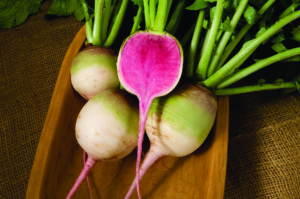
Red Meat Radish
My favorite radish is one that I will plant soon: ‘Red Meat’ radish from Johnny’s seeds. It is red in the middle instead of white like a watermelon. It never has the sharp bite of a spring radish, and stays nice even when the radishes get to be golf ball-sized and bigger. If planted in spring, it bolts.
In the past I’ve had good luck planting daikon radishes in the summer for fall use, too. These Japanese radishes get huge, and have a distinctive bite. Many use them for pickling.
So get out there and plant some seeds. Just be sure that they stay well-watered and most things will do just fine. Even many green beans only need 55 days. So if you were too busy to plant before the 4th of July, get started now.
Read Henry’s twice-weekly blog posts at https://dailyuv.com/gardeningguy You can sign up for an e-mail alert each time he posts. You may reach Henry at PO Box 364, Cornish Flat, NH 03746 or henry.homeyer@comcast.net.
When Good Flowers Get Out of Control
Posted on Tuesday, June 27, 2017 · Leave a Comment
Every garden has a few thugs. Nice flowers with handsome blooms that somehow get too rambunctious and take over. They can choke out other plants as easily as weeds. That happens, in part, because we are reluctant to pull them. In general, they have roots that extend and send up new shoots. Let’s look at a few.
I recently pulled up a lot of beebalm (Monarda didyma). That was tough for me to do because it is such a great flower, and it has not yet bloomed. But it had run roughshod over most of one large flower bed, and it had to be brought under control.
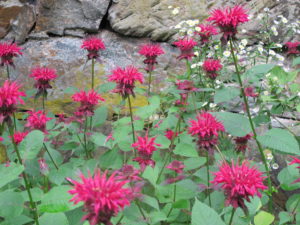
Beebalm
Beebalm likes morning sunshine and soil that does not dry out completely. There is also a native beebalm (Monarda fistulosa) that I’ve seen wild in the Mid-west and Rockies. It is shorter, and has pale lavender colored flowers. It does well in hot, dry locations. Our garden beebalm comes in six or more colors from purple to pink – but it does best out of the hot afternoon sun. It sends roots up to a couple of feet, and because it is tall, it can shade-out and out-compete other flowers. As the Red Queen in Alice in Wonderland pronounce, “Off with her head!”
For removing any plant with extended roots, I like the CobraHead weeder. It is curved like a single steel finger, and can be used to loosen the soil under and around weed (or thug-like flower) roots. I gently tug on the flower stem, while loosening the roots. Beebalm, like most plants with long roots, has nodules in the roots. If you break the root, new plant stems will grow from a nodule.
Another difficult plant is Obedient Plant (Physostegia virginiana). What a funny name for a plant that is not the slightest bit obedient. Its roots are problematic because they break so easily, more so than any other plant I know. They send down a tap root that breaks off, even if you have loosened the soil. And it can take over a garden in just a season! I no longer allow it in any of my garden beds, but have moved some to the edge of the woods where deep shade on one side, and lawn on the other, can control it.
All that said, Obedient Plant is a lovely cut flower. It has strong square stems (like mints), and for me it grows up to 5 or 6 feet tall. It lasts well in a vase, with pink or white spikes of many small flowers. I had it in full sun in rich, moist soil, and it ran like crazy!
There is a form of Obedient Plant that has green and white leaves, and it is much more obedient! Like any variegated-leafed plant, this one has less vigor because it has less green chlorophyll to make the food that feeds the roots and flowers. I grow this one, though I find I often need to stake it to keep the flower stems from flopping over.
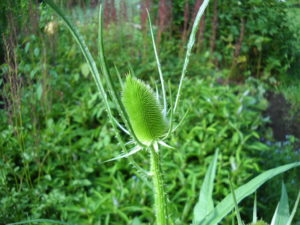
Teasel
Another potential thug that I allow in my garden is common teasel (Dipsacus fullonum). Hated by corn farmers in the Mid-West as an invasive weed, it spreads by seed, not root. It’s a biennial. The first year of its life it does not flower, but produces distinctive long, light-green leaves (often with little wart-like bumps) in a low rosette. The second year it sends up a flower stalk up to 6 or 7 feet tall, and produces a seed head that is like a piece of sculpture.
Individual teasel flowers are very small and a light purple, but they don’t all appear at once. Bees love them! The seed head is very showy, a 2-inch spiny extravaganza that looks great in a vase as a cut flower, or later as a dried flower. I wear leather gloves to pick it, and then rub off the spines on the stems for use in vases.
The key to controlling teasel is to learn to recognize and pull the first year plants. That, and picking the stems with flowers before they distribute seeds. I suppose I will get e-mail telling me how stupid I am for allowing this thug in my garden, but I have been able to keep it under control – and I introduced it 20 years ago! Don’t introduce it to your garden unless you can pay attention to it, and keep it controlled.
Sometimes we make mistakes. We see a well-controlled plant blooming in its pot and buy one (or more). We put it in the garden, and only later decide that it has some bad qualities. It has taken me a long time to realize that it’s great to recognize that a plant is not for me, and then be able to dig it up and toss it into the compost.
I recently needed space for a new plant, and decided that I did not like my Siberian Bugloss (Brunnera siberica). I bought it because I have another species of Bugloss (B. macrophylla) that I like a lot. ‘Jack Frost’ Brunnera has lovely small blue flowers in spring and low green and white leaves all summer. But the Siberian relative does not stay in a compact mound, and is a bit floppy. So I yanked it in favor of something new.
Call me fickle if you wish, but I have a limited amount of garden space, and I reserve the right to remove any plant that does not, at least occasionally, cause me to say with glee, “I love that plant!”
Read Henry’s twice-weekly blog posts at https://dailyuv.com/gardeningguy You can sign up for an e-mail alert each time he posts. You may reach Henry at PO Box 364, Cornish Flat, NH 03746 or henry.homeyer@comcast.net.
5 Things You MUST DO in the Vegetable Garden This Weekend – or Soon
Posted on Tuesday, June 20, 2017 · Leave a Comment
Okay, nobody likes to be told what they have to do. Or when they have to do it, so I apologize for telling you what to do. And you don’t really have to do these things immediately, but doing them soon will help you later on.
- It’s time to thin root crops- my least favorite task in the garden. But by now carrots, beets, parsnips and so forth need to be thinned in order for them to develop well.
- You need to put in your tomato supports to keep the plants off the ground, either tying them to stakes or surrounding them with wire cages.
- You need to hill up your potatoes if they have six to twelve inches of green growth by now.
- Cut off those tall flower spikes from your rhubarb. Quick, easy, productive.
- Weed.
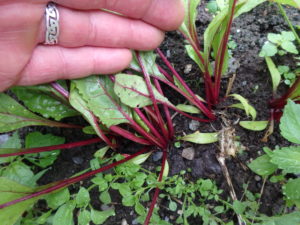
Beets ready for thinning
Let’s take a look at each of these tasks. First, it’s important to thin root crops that are too close. I’m assuming you planted these frost hardy plants in late April or May, and they have gotten to be 3 inches or so tall by now. They’re big enough that you don’t have to wear your reading glasses to distinguish individual plants.
Carrots and beets can compete with each other just as they would have to compete with weeds. Nutrients from the soil, water, even sunshine is minimized if veggies are too close. So thin your carrots and beets to an inch apart now, and 2 to 3 inches in a month. Yes, you can get a crop without thinning, but the production is vastly reduced. And you can eat the thinnings.
Beets seeds are actually seed capsules with 2 to 3 seeds inside each one. So no matter how well you space your seeds, you will need to thin them. There are monogerm beets like ‘Moneta’ from Johnny’s Selected Seeds that only have one beet embryo per seed capsule, but those are rare. You can re-plant the thinnings, but it’s not always successful. Take a pencil, poke a hole, drop in the roots of the beet, and firm up the soil. Or you can just eat the beet greens.
When I was young and very busy raising kids, I didn’t stake up all my tomatoes. Some I let flop over and lay on piles of straw. Those on the ground suffered from diseases much more than those I caged. I now use 4-legged cages that are 54 inches tall – the biggest commercially available.
This year a friend gave me a home-made cage made from sheep fencing. The fencing is made into a 24-inch cylinder that stands 48 inches tall. Each cage needs a 6-foot grade stake to keep it from tipping over and openings that are big enough for your hand to pass through to pick tomatoes. I’ll decide if this cage is worth replicating next year.
Depending on the weather and where you garden, it may be time to hill your potatoes. This means adding soil over the planted seed potatoes. Roots go down from the seed potato, and new potatoes form above the seed potatoes. If you want lots of potatoes, there has to be room for them to grow. So adding soil from the walkways or your compost pile is essential to having enough depth for good production. Another way to do that is to pile on a thick layer of hay or straw, a technique I am trying with some of my potatoes.
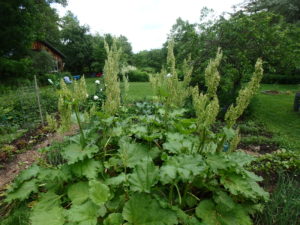
Rhubarb with seeds ready to cut off
Rhubarb, I have heard, is one of the last flavors to be lost by the elderly as their senses diminish. That’s why, I suppose, that homes for the elderly serve rhubarb desserts at this time of the year. It’s very easy to grow- once established there is little to do other than occasionally add some compost to the soil, or to scratch in some organic fertilizer.
By now, however, rhubarb is sending up tall shoots with white flowers to produce seeds. They are quite spectacular as flowers go – they grow as fast as Jack’s proverbial beanstalks. But like all seeds, they consume energy and minerals from the soil, so it makes sense to cut them down.
Last, but not least, you need to weed. You know that. I find that if weeding becomes a regular part of you day – like brushing your teeth or making your bed – the weeds will not overcome your garden. Even 10 or 15 minutes a day will make a huge difference.
Right now I have been concentrating on tall, deep-rooted weeds like dandelions and burdock. I find that since the soil is moist down deep, it is easier to get these weeds more easily than later in the summer when the soil is dry. I use a garden fork to loosen the soil down a foot or more, then apply even, gentle pressure pulling on the top of the plant. Most come out all in one piece. That’s good, as a broken tap root will send a new plant up later.
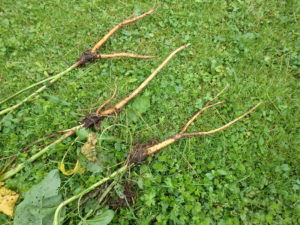
Deep rooted weeds pull nicely when soil is wet
Never let weeds go to flower or set seeds. If nothing else, snip or pull off the flowers to keep the weeds from producing seeds. If you have particularly virulent weeds like goutweed, dispose of the flower heads in the trash going to the incinerator or land fill. Some weeds can produce viable seeds even after being pulled or having their flowers cut off.
So get busy in your vegetable garden. There’s lots to do.
Read Henry’s twice weekly blog at https://dailyuv.com/gardeningguy. Reach him by e-mail at henry.homeyer@comcast.net.
Primroses and Other Great Plants for Shade
Posted on Tuesday, June 13, 2017 · Leave a Comment
If I were to be consigned to life on a remote island, what one flower would I bring along with me? That’s a bit like asking you which child is your favorite, or which piece of music you could listen to for all eternity.
There are so many wonderful flowers, but some years ago I pondered the question and selected the peony ‘Festiva Maxima’. That’s a double white one with a spot of red in the middle, and a fragrance so alluring, I wrote, that it could make one swoon. I acknowledged that Festiva Maxima does have a flaw: rain weighs down the blossoms, and sometimes the flowers break their stems – even if in a peony support cage.
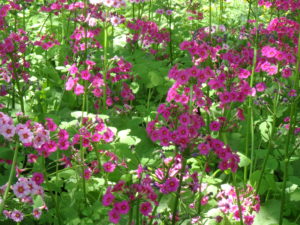
Primula japonica
But if you were to ask me today, I would say my favorite flower is the Candelabra or Japanese primrose, Primula japonica. I have a patch of them blooming in the shade of 3 old wild apples in moist, dark soil. I started with just a few plants, but they drop seeds and fill in spaces, overtaking what was once a meager, struggling lawn.
I estimate that right now I have 200 to 250 square feet of primroses in full bloom; in a 3 foot by 3 foot square, I counted about 25 or 30 plants in bloom – so I have more than 500, perhaps even 750. All this in 10 or 15 years, and no work other than a once-a-year weeding of Jewel Weed, which also loves the conditions.
Each plant has a rosette of light green leaves and sends up a flower stalk 12 to 36 inches tall. Flowers ring the stalk in tiers, starting with one tier, and working up to 4 tiers of blossoms on the oldest plants as the season progresses. At each tier there are a dozen small blossoms – or up to 20 – pointing out like bugles. Each blossoms is about an inch across.
The colors vary as they hybridize. My favorites are a deep magenta. At the other end of the spectrum are the whites, though not pure white. Then there are pink, and dark pink ones. All are fabulous. Fragrance? Nothing much. But that would be like expecting a prize poodle to be able to read the newspaper.
The bloom period starts for me in late May and goes through most of June. A month or more with some blossoms. At any given moment a plant might have just one ring of flowers, or up to 3. As the flowers fade and die off, some develop a nice light blue.
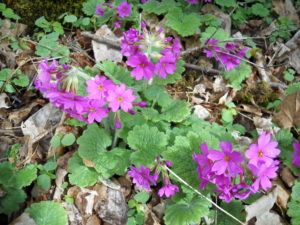
Primula kisoana
Before the candelabra primroses bloomed came another nice one, albeit with no common name, Primula kisoana. This one, unlike the other, will grow in either moist or dry shade. It has lovely pink blossoms that pop up just 6 inches above the fuzzy leaves that are so dense that they keep weeds from appearing. The leaves are 5 inches or so wide with a scalloped edge and a light green color.
One of the greatest things about the Primula kisoana is that it spreads by root. But unlike mint or bee balm, this little beauty does not run over and outcompete other plants. It will politely meet up with the roots of another, and move to the left or right instead of grasping for every inch of soil. Where I have it in dry shade it gets some morning sun, but no afternoon sun.
Another nice plant I have blooming now, and which can act as a ground cover, is bigroot geranium (Geranium macrorrhizum). To avoid confusion I should explain that the bright red or white geraniums popular in window boxes are not geraniums at all, but are in a genus (scientific grouping) known as Pelargonium. Geranium is a genus of hardy perennials.
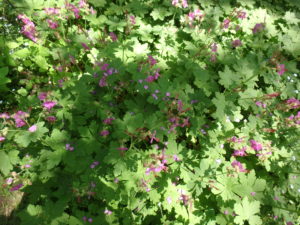
Geranium macrorrhizum
The bigroot geranium thrives where other perennials may survive, but few love: dry shade with competition from tree roots. Maples and locust are notorious for sucking everything out of the soil, yet I have planted the bigroot geranium under those trees, and had them thrive. Will they grow under hemlocks or pines? No, that’s asking too much.
Bigroot geranium comes in at least three colors: white, pink and dark pink. The leaves are about a foot tall, with the flower stems standing above them at about 20 inches. Their leaves form a dense mass of foliage that most weeds find inhospitable.
On another note, many readers have been complaining that their tomatoes are yellow-leafed and miserable looking. Not to worry. Tomatoes need sunshine, and early June was, for most of us, rainy and cold. They will recover soon.
Plants suck up moisture that contains the minerals they need – but only if the moisture is required to replace water that the plants have given off. They don’t give off much water vapor when it’s chilly and wet, so they can get nitrogen-starved. With heat and sunshine they will recover.
I have set up Adirondack chairs near my primroses and spend at least some time there every day. And even though I’ll never have to pick just one flower to grow, these primroses are a real delight to me.
Read Henry’s twice weekly blog at https://dailyuv.com/gardeningguy. Reach him by e-mail at henry.homeyer@comcast.net.
Mulching: Hay, Straw and More
Posted on Tuesday, June 6, 2017 · Leave a Comment
If weeds are the bane of the gardener, mulch is the gardener’s friend. Not only that, mulch can hold in moisture in dry times, and give a nice, tidy look to the garden.
Let’s start in the vegetable garden. Properly mulched, weeding can be minimal – say an hour a week for a big garden like mine. I keep down weeds in my walkways and around all large plants like tomatoes with a one-two punch: a layer of newspapers (4 to 6 pages thick) and a layer of straw or mulch hay (4 to 6 inches thick before it packs down).
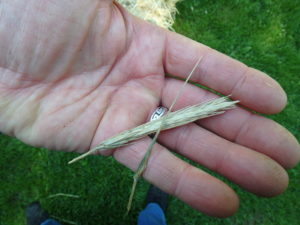
This straw seed head has no seeds
What is the difference between mulch hay and straw? Price, for starters. You can easily pay $8 to $10 a bale for straw, and as little as $2 or $3 for hay. Why is that? Straw is grown as a crop specifically sold as mulch, and it has no seeds. You might see what appear to be seed heads, but they are empty as the farmer grows rye, then cuts it before pollination takes place.
Hay is a waste product: food for dairy cows that got rained on, and is no longer edible. Picky eaters, those dairy cows. And it has plenty of seeds. The newspapers I put beneath it generally keep hay seeds from growing in the garden. But some seeds will escape and grow – particularly in the spring of year two unless you did a phenomenal job of cleaning up in the fall.
Many gardeners use black landscape fabric in the flower garden, covered with bark mulch or wood chips. The fabric is a good barrier, though the roots of some weeds and grasses can get through it, making it difficult to remove. Other gardeners use bark mulch directly on the soil, and that can be effective, too.
If you use wood chips or bark mulch, be sure not to place too thick a layer down. Two to three inches is good, 4 to 6 inches is bad – the mulch will keep a quick rain shower from getting moisture to the roots of your plants.
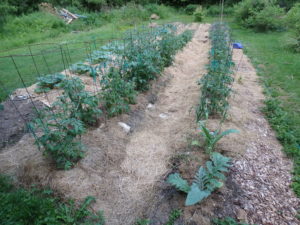
Hay & newspapers used as mulch
Some gardeners worry about bark mulch stealing nitrogen from the soil as it breaks down. Don’t. Yes, the microorganisms that break down the mulch need some nitrogen, but I have never seen plant leaves turn yellow (the sign of nitrogen deficiency) because of mulch. Or if you must worry, just put a layer of slow-release organic fertilizer on the soil beneath the mulch.
You can buy wood chips or ground bark mulch in bags or by the truckload. Buying it by the bag is convenient if you just need a little, but it is much more expensive that way.
If buying wood chips by the bag, read the label. If it says, ‘color enhanced’, I would avoid it. It means the chips have been dyed – and I am an organic gardener who does not want chemicals. I have heard that some cheap wood chips are actually construction waste that has been chipped and dyed – old 2-by-4’s and the like.
I like ground hemlock because of the color, and the fact that it tends to last longer than some others (except cedar, but I have only found that for sale in bags). I buy the hemlock by the pick-up truck load.
And please, for the health of your trees, do not create “mulch volcanos.” To keep down weeds some gardeners pile wood chips right up against the trunks of trees in a volcano shape. The wood chips may harbor fungi and bacteria that can attack the bark of your precious tree, eventually killing it in 6 to 10 years. Instead of a volcano, create a “donut.” Leave 3 or 4 inches of space between the tree and the mulch.
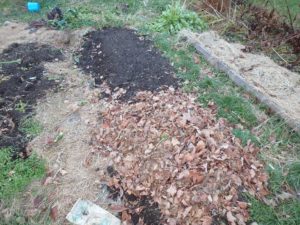
Leaves are great mulch
My favorite mulch? Fall leaves that have been run over by a lawn mower, then raked and stored for the spring. Full of goodness for the soil, and a good deterrent to weeds. Over the years, leaves will enrich your soil considerably. And they’re free!
Cocoa mulch is sold as a mulch, and I know some who love it. It has a very fine texture and looks nice. But it smells like chocolate chip cookies when it first goes down, and some dogs have been known to consume it – causing sickness and even death if one believes everything one reads on the internet. Chocolate products are bad for dogs. It also tends to mold, though that only lasts a week or so. It can be very slippery when wet; I advise against using it on a hillside.
Buckwheat hulls are an alternative to cocoa mulch, but they are not sold in many garden centers. Like cocoa hulls, they are very fine textured and look very nice, but are very expensive compared to bark or wood chips.
At the Chelsea Flower Show, which I attended recently in London, someone had quotes about gardening stenciled onto blank walls. One of my favorites was from Robert M. Pyle: “But make no mistake: the weeds will win. Nature bats last.” So mulch, but don’t expect to get a summer of weed-free gardening.
Read Henry’s blog at https://dailyuv.com/gardeningguy. He has a dozen photos from the Chelsea Flower show there now. You may e-mail him at henry.homeyer@comcast.net.
The Chelsea Flower Show
Posted on Wednesday, May 31, 2017 · Leave a Comment
It would be a bit of an exaggeration to say that I have always wanted to attend the Chelsea Flower Show in London. But not much. For years I’ve dreamed of going – and finally, this year, I went. Air ticket prices are down dramatically, the dollar is strong, and I decided there was no better time than now to cross off yet another item on my bucket list. It was well worth the effort.
Some basics: the Chelsea Flower Show is held on the grounds of the Chelsea Hospital in central London, which is now a retirement home for World War II soldiers. The show is bigger than anything in America: it encompasses 11 acres of displays, the vast majority of which are outdoors. That means that full-sized mature trees are installed, and in one case, a garden in a faux stone quarry was installed with blocks of stone stacked up more than 25 feet.
The show includes garden displays, rare plants, sculpture, food courts, vendors selling garden paraphernalia, music and much, much more. It has been an annual event since 1913 with the exception of a few years during the World Wars .
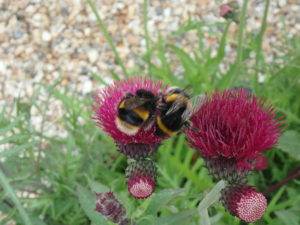
Cirsium rivulare Atropurpureum
Tickets for next year’s show go on sale August 1, and although prices are not yet posted, tickets are not cheap – this year a full day ticket went for 100 pounds (($128). Each year the number of tickets is limited and they generally sell out before the event – this year some determined attendees apparently paid scalpers 500 pounds and more. It’s the Super Bowl of gardening.
If you want to go next year, the best plan is buy a membership to the Royal Horticultural Society, which allows you to attend a day before the doors open to the public, and offers discounted tickets.
I go to flower shows to learn. I delighted in seeing new (to me) species of flowers and new ways of combining flowers in the garden. I loved meeting garden experts and artists who created sculpture for the gardens.
So what are some of the things I learned? Thistles, which we generally consider weeds, can look great when planted in the garden. There I was in a city of millions, and a thistle, Cirsium rivulare ‘Atropurpureum’, was loaded with bees of all sorts! Clearly a great pollinator. Although a quick internet search did not lead me to seeds for that magenta-purple variety I saw there, I did find some seeds for a species native to the U.S. – Cirsium discolor – that is not the weedy pest farmers hate. So I shall order some seeds and try growing it.
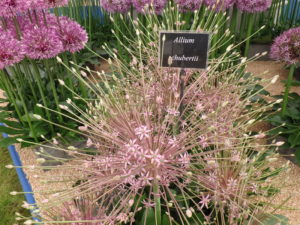
Allium schubertii
Alliums were in all their glory at the show. Big, dramatic balls of flowers on 18- to 30-inch stems were used in many of the gardens. These are bulb plants in the onion family, and I have a few. I shall look for Allium schubertii which has an other-worldly pinkish flower head about 16 inches across. Another good one was just labeled with its variety name, ‘Powder Puff’.
Angelica (Angelica gigas) is another flower that was often used in the show. This is a 3- to 5-foot tall purple-leafed flower that I grew 25 years ago, but it is a biennial that does not come back after flowering, and I dropped it from my plant palette. But I have already purchased and planted one since returning from the Chelsea show. It can be very dramatic in the garden.
Ferns were used as filler in many of the gardens at Chelsea, and I shall try using them, too. Of course, their gardens only had to look good for 6 days, so ferns that spread, or get too tall, were not a problem, though they might be in my garden. I have a patch of Japanese Painted Fern (Athyrium niponicum) which is great in dry shade. But this summer I will investigate other ferns. Many nurseries sell them, but I admit I haven’t paid much attention to them.

George Ball of Burpee
Interesting people I met? George Ball, owner of Burpee Seeds was there. He is a highly knowledgeable (and opinionated) plantsman who is passionate about seeds. I was interested to learn from him that Melania Trump’s grandfather was a Slovenian onion breeder.
Mr. Ball pointed out that most vegetable seeds originally came from Europe, which is actually farther north than we are – and hence not good choices here. He believes that modern hybrids, not heirloom seeds originally from Europe, are best. And he told me that in a blind taste test, 4 of 5 times, Burpee’s hybrid ‘Brandy Boy’ beat the heirloom ‘Brandywine’, which is one of my favorites for flavor. I am trying it this year, since it ripens earlier, and produces more fruit, according to him. I’ll let you know how mine do in August.
At a reception on press day by David Austin Roses for a new rose named after actress Dame Judi Dench, who was there, I met the 91-year old founder of the company. I was able to thank him for all the beauty he has introduced to the world.
The English know how to throw a party – or have a flower show. Picnics with champagne were everywhere. Women were dressed in flowered clothes and elegant garden hats; men wore suits, even in the hot sun. Of course, everyone was very polite. And I got to check off another item on my bucket list.
Read Henry’s twice-weekly garden blog at https://dailyuv.com/gardeningguy You may reach Henry at henry.homeyer@comcast.net or P.O. Box 364, Cornish Flat, NH 03746.
Tips for Growing Better Roses This Summer
Posted on Monday, May 22, 2017 · Leave a Comment
My grandmother and mom grew roses, even though their roses were often plagued by bugs and diseases. But in recent years the rose industry has produced a number of carefree roses that anyone with 6 hours of sunshine and even a slightly green thumb can grow.
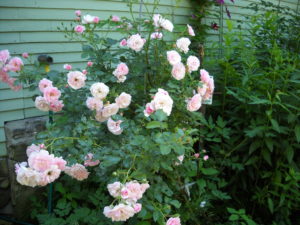
Roses
Probably the first place to start a quest for a great rose would be at a good family-run garden center. Find the rose expert there, and ask about good varieties for your area. In general, fragrant roses tend to attract Japanese beetles and other insect pests. I personally like the ‘Knock Out” rose series. These roses are highly disease resistant and, in my experience, they attract few pest bugs. There are other disease-resistant varieties, of course.
If you live in a cold place where winters reach minus 25 or more, I’d look at the Canadian Explorer series of roses. These were developed in Ottawa, Canada and include those tough rugosa roses in their gene pool. Rugosa roses are also called beach roses, since they often grow in pure sand on the dunes of Cape Cod and elsewhere.
A good resource for selecting and maintaining problem-free roses is a book I like very much, Roses for New England: A Guide to Sustainable Rose Gardening by Mike and Angelina Chute. This book is full of information relevant to New England gardeners, and reading it would be a good way to educate yourself about roses. It reinforces what I have learned about roses over the years – and taught me some things I didn’t know.
So what do roses want? Good soil with a slightly acidic pH, plenty of sunshine, soil that is slightly moist all the time, a little fertilizer, and someone who loves them and is willing to pull off the beetles and drown them.
The soil that roses want is a good loam amended with compost. Dig a hole that is about two and a half feet wide and 18 inches deep. Keep half the soil and mix it with an equal amount of compost in a wheelbarrow or on a tarp.
You could send away a soil sample to determine the soil pH and to see what minerals are deficient, though that might take a few weeks before you get a response. Or you could just go to your local garden center and buy a kit for testing soil pH. Much of New England has acidic soil, but roses like something in the range of 6.0 to 6.8 – slightly acidic.
You can improve your soil pH by mixing in limestone (which is available in bags at your garden center). Mixing in a cup per rose is a good start, depending on your soil pH. I knew a rosarian who always buried a 4 inch square scrap of Sheetrock (wallboard) beneath each rose to provide calcium and improve soil pH over time. A cup of bone meal or rock phosphate at planting time will add phosphate, a mineral that roses need.
Roses need sunshine to do well, the more the better. The Chute’s book taught me that if you have to choose morning sun or afternoon sun, go for morning sun. That way the dew dries up more quickly – and fungal diseases, which love wet leaves, are minimized naturally. Six hours of sun is considered adequate, but the Chutes mention that roses with fewer petals need less sun to bloom.
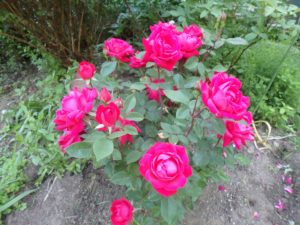
Knock Out rose
I have a rose right near my front door – and the hose that is connected there. It has bloomed well for decades, in part, because every time I fill a bucket, wash the car or use the hose, I give the rose a nice drink. Roses love water. I have a watering wand on the hose so that I can direct water to its base, and not wet the leaves. In dry summers watering roses is key. How much? At least 5 gallons per week for a mature rose.
I rarely fertilize my roses, but the Chute’s book says that fertilizing regularly increases blooming. I might try a couple of applications of an organic liquid fish fertilizer this summer. Be aware that too much fertilizer pushes fast growth that is more susceptible to diseases and insect damage.
What else should you consider when selecting roses? I like roses grown on their own roots, not grafted onto root stock. If the plant dies down to the soil over winter, a rose will sometimes send up shoots from the roots, which are different from the rose you planted if you buy grafted roses.
Also read the tag carefully to see if it is a one-time bloomer each season, or a re-bloomer. Some roses like the Knock-Out roses bloom for most of the summer. Be sure to cut off blossoms after flowering to encourage more blossoms.
Finally, now is the season to cut off any brown, dead portions on stems – most roses suffer a little winter damage. Cut above an emerging leaf.
I’m an organic gardener which means I don’t spray my roses, not for fungal diseases, not for insect pests. I firmly believe that if you have a rose in good soil with good sunshine and adequate water, your roses will be healthy and not attract many insects.
Henry is at the Chelsea Flower Show in London this week, and will not be answering questions. Read his report on the show next week!
It’s (Almost) Time to Plant Tomatoes
Posted on Tuesday, May 16, 2017 · Leave a Comment
Maybe you’ve already planted your tomatoes. I have not. I’m waiting until June 10. By then, even in my cold Zone 4 garden, I know there will be no more frost and the ground will be above 60 degrees. And the stars, moon and planets will be aligned from June 10 to 12 to promote success for fruits, one of the 4 categories listed in the Stella Natura calendar, a biodynamic guide that I follow (www.stellanatura.com).
I start my seedlings indoors in April, and I’m in no rush to put my babies outside in the cold, rainy world that I’ve been seeing in May. And even if you have planted yours, I bet mine will catch up with yours. Tomatoes hate cold feet and a few days of chilly rain will make them cranky – and slow their growth.
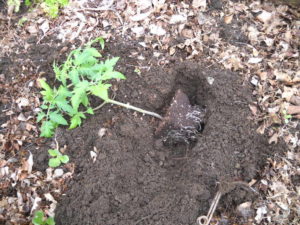
Tomatoes planted sideways develop more roots
Before my tomatoes and other plants get in the garden they get “hardened off.” If you are new to gardening, that just means I introduce them to the sun and wind over a period of time. An hour at first, or a morning on a north-facing deck. Later 4 hours of afternoon sun, and finally, if the temperature will stay up above 50 all night, they have a sleep over outside, but out of the wind. All this just means when they go in the ground, they will not be shocked.
Do you buy your seedlings? Ask at the garden center if the plants you buy have been hardened off. Even Brussels sprouts can be damaged if they have never been hardened off and go right in the garden.
I want my tomatoes to have lots of vigorous roots. To help ensure this I pinch off most leaves on the stem, leaving just those on the very top – sort of like a cartoon palm tree. Then I bury that stem and it develops lots of extra roots. Sometimes I just plant the root ball and stem down deep. Other times I plant the tomatoes sideways: I make a space for the root ball, and a little trench for the stem. I cover all that, and turn up the stem at the top so the few remaining leaves are barely above the soil line.
Leggy broccoli can be planted deeply, too, to help it stay erect, and to develop more roots. Legginess is common for seedlings started indoors that have been a little light-starved, and I think all can be planted deeply, but only have done this with tomatoes and broccoli.
What else gets extra care and a late planting date? Eggplants, peppers, cucumbers, squash of all types and basil. They all like hot climates, and come from them. I did plant seeds in May including peas, spinach, carrots, beets, parsnips, cabbage and lettuce. Those are all doing fine. Actually peas went in a bit late and are not up yet for me at the time of writing.
Peas can be very slow to germinate, and can even rot in the ground if we get a lot of cold rain. I plant most everything in raised beds, in part, to get the soil to warm up early and to dry out better. My garden is near a stream and we have a high water table, so raised beds help. I just mound up the soil from walkways and add compost to get nice raised beds.
Peas and beans of all types can benefit by being inoculated with a bacterium powder that is sold in garden centers and at my feed–n-grain store. Peas and beans are legumes, a group of vegetables with nodules in their roots. If these contain rhizobium bacteria, they take nitrogen from the air and “fix” it so that it stays in a form useable by plants. Free fertilizer, if you will.
Contrary to “rural legend”, the nitrogen fixed by peas and beans does not improve the soil very much. I always thought the rhizobium bacteria were pumping nitrogen into the soil. In fact, most of the production is used by the plants themselves.
The nodules that contain the bacteria are generally pink or reddish when producing well, and can be as big as a pea. When you pull a pea or bean plant, look at the roots. If you do not see lumps of nodules, be sure to introduce the bacteria next year (it may or may not be present in your soil naturally).
A few words about mulching: do not mulch your plants right away. Wait until the soil is very warm – 60 degrees or more – before mulching. Yes, the mulch will keep down weeds and hold in moisture, but it will also prevent the sun from warming the root zone.
I know gardeners that like to put down black plastic to kill weeds and add heat to the soil. I have used it –particularly for growing watermelons and pumpkins – but don’t like it. Most plastic lasts just one year and then has to go to the landfill. It’s not a sustainable practice.
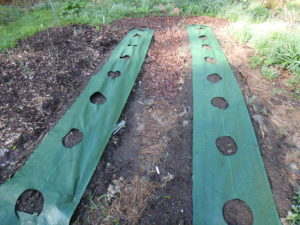
These GardenMats have pre-cut holes ready for tomatoes
I do like using woven landscape fabric, however. A Vermont company, GardenMats, produces rolls of fabric with pre-cut holes spaced for specific crops. These mats keep down weeds but let air and water pass through. The rolls are 4 feet wide, but I slice mine down the middle as my raised beds are only about 30 inches wide. I put leaves or mulch hay around the edges and in my walkways.
New England weather is never predictable, so I tend to plant later than many gardeners. Usually I am glad I did.
Read Henry’s blog at dailyUV.com.
Spring Lawn Care
Posted on Tuesday, May 9, 2017 · Leave a Comment
Lawns? My philosophy is this: If it’s green and you can mow it, it’s a lawn. Dandelions? Who cares? Their blossoms are cheerful. Creeping Charlie, plantain? Pests, but not awful. And so on. I love a lawn with some biodiversity. But bare and thin spots I like to fill in or over-seed. Now is the time to do that.
I recently called Paul Sachs of North Country Organics, manufacturer of Pro-Gro fertilizer and more, to talk about spring lawn care using organic products. Paul explained to me that all the New England states have laws against applying phosphate-containing fertilizer on lawns. Why? To minimize phosphate run-off into lakes, ponds and streams, thus reducing the growth of algae and other plants from running rampant and diminishing water quality.
Mr. Sachs explained that this law makes it technically illegal to fertilize your lawn – unless the middle number on your bag of fertilizer is “0”. Farmers who spread manure on the fields are exempt from this provision, and their fields are much more likely than you to cause run-off of phosphates.
There is a loop-hole to the law, however. Paul Sachs explained that you are allowed to fertilize with phosphate-containing fertilizers if you are also spreading seed. Most lawns have some thin spots, or bare spots, so adding seed makes sense. And if you use an organic fertilizer like Pro-Gro (a 5-3-4 fertilizer) there is very little soluble phosphate anyway. Its phosphorus content comes from rock phosphate, bone meal and bone char – all of which are only minimally soluble, and not normally a problem.
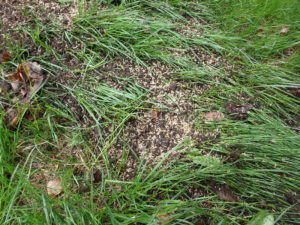
This lawn is thin, so it needed overseeding
What is involved in over-seeding? Basically, you need to spread 3 to 5 pounds of seed per 1,000 square feet of lawn (roughly 30 feet by 33 feet). First, cut the lawn a bit shorter than you would otherwise. Then rake the lawn to remove the cut grass and any dead material that is on the lawn. You want seed to be in contract with the soil. If you have the time and energy, you can scuff up the soil in bare spots with a garden rake before spreading the seed. You can spread seed with a mechanical seeder, or, for small spots, just fling it using your hands.
I buy a small truckload of compost each year for use on my gardens and lawns. It is loose and fluffy and is easy to distribute. After spreading some seed, I fling compost with a shovel over the seed, and then smooth it out using a lawn rake turned upside down. My goal is to spread a quarter to a half an inch of compost on the lawn, at least in the areas that look the worst.
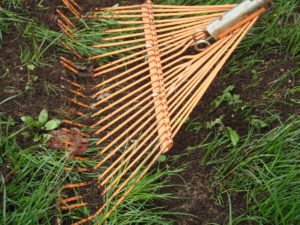
The back side of a lawn rake is good for spreading compost or seed.
Compost is not necessarily rich in nitrogen – the driver of green growth – but it has organic matter, beneficial microorganisms and micro-nutrients that would not be found in a chemical fertilizer. If you are really interested in a deep green lawn with lush growth, you could not only spread compost, but also some organic fertilizer – Mr. Sachs recommends about 20 pounds of Pro-Gro per 1,000 square feet of lawn.
Almost any store that sells seed will have something called “Conservation Mix”. That is what I use. A typical mix might have 35 percent creeping red fescue, 25 percent turf type tall fescue, 10 percent Kentucky bluegrass, 12 percent turf type perennial ryegrass, 15 percent annual ryegrass, 3 percent white clover.
A few words about clover. When I was a kid back in the 1950’s, we sometimes spent lazy afternoons rolling around on the lawn and looking for 4-leaf clovers, said to guarantee good luck. But since then chemical companies have perfected “Weed-n-Feed” products that provide herbicides along with fertilizers to “ensure a perfect lawn.” Those products kill clover. So what have they done? They have declared clover a weed.
Clover is not a weed. It is a beneficial plant that actually takes nitrogen from the atmosphere and fixes it in the soil, essentially giving you free fertilizer. The seeds are tiny, so a little in a mix goes a long way. If you get an organic fertilizer it has no herbicides, so of course. And when you buy a bag of conservation mix, you may want to turn it upside down and shake it a little. Clover seeds tend to migrate toward the bottom of the bag, potentially giving an uneven distribution.
A conservation mix has the advantage of biodiversity. If a pest or disease attacks one grass, another might not be affected. Kentucky blue grass, for example, is lush and gorgeous, but susceptible to many diseases. A little is better than a lot in a mix.
Unless your lawn is right on the edge of a stream or lake, you probably will not be causing any problems by fertilizing your lawn a little. Lawn is a great filter, and will generally prevent the migration of fertilizer into water bodies. And there are organic fertilizers that have no phosphates at all: North Country Organics has a 6-0-6 called Natural No-Phos.
I know that some gardeners remove their lawns and put plants everywhere. But before you do that, remember that lawn is the easiest of all plantings to maintain. A little work now, some mowing as needed, and it looks good. Especially if, like me, you are not worried too much about the presence of a few dandelions.
Read Henry’s twice-weekly blog at https://dailyuv.com/gardeningguy His e-mail is henry.homeyer@comcast.net and his snail mail is P.O. Box 364, Cornish Flat, NH 03746. Please include a SASE if asking for a mailed response to a question.

 Click Here to buy from Cobrahead