-

Now available for $24.95 including shipping. -
Now available for $21.00 including postage. Vendors I Like
 Click Here to buy from Cobrahead
Getting Ready for Winter and More
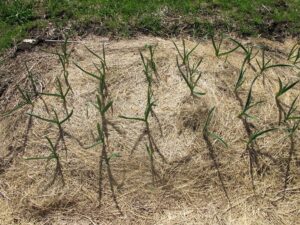
Garlic grows through th mulch, shown here in May
After a hot, dry summer – there was a drought in most parts of New England – we had a very early frost this year, September 20. Not enough to kill our late potato vines, but enough to kill squash and dahlias. I was caught off guard. I am now getting ready for winter.
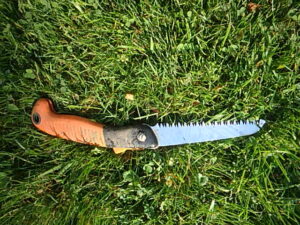
This folding saw will easily cut down tough stalks of big perennials
We have an exorbitant number of flower beds so it’s a lot of work to cut back perennials and get out any late-season weeds. Here are a few tips:
- Use a serrated knife or folding pruning saw to slice off multi-stemmed plants like daylilies. Grab a handful of foliage and with one swipe, they are all ready for the wheelbarrow.If that method is not for you, how about using hedge shears or even a weed whacker to cut down big expanses of flower stalks?
- I have my pollinator or “Darwin” bed which gets no weeding – it has filled up with tall plants that fight it out for space: phlox, fall asters, goldenrod, Joe Pye weed and obedient plant. I leave it until spring to clean up, as it provides good places for beneficial insects to overwinter.
- We have a lot of hostas, and I wait to clean up until hard frost has killed the tops. Then I can either just grab the mushy leaves and pull them off, or use a rake to do the work.
- As for weeds, we don’t have many. The flower beds are weeded early in summer, and then well mulched. But I use my favorite tool, the CobraHead weeder, to remove any late season invaders. It is able to get under weeds, loosen the root, and get them all out.
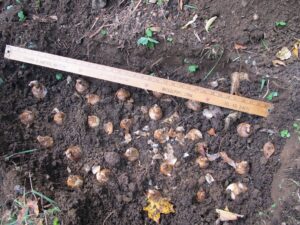
Daffodil bulbs planted in a 36-inch oval hole, ready to cover with soil
Daffodils last many years – tulips less so. I plant 100 tulips just 3 or 4 inches apart in rows 8 inches apart in my vegetable garden once it is cleaned up, and use them for cutting and putting in vases and for giving away. I generally pull the bulbs after cutting in the spring, but one year I kept 50 or so and replanted in the fall. The following spring they bloomed, but were shorter and smaller. Since deer love tulips I can use chicken wire vertically along the sides of the bed to keep them away, come spring.
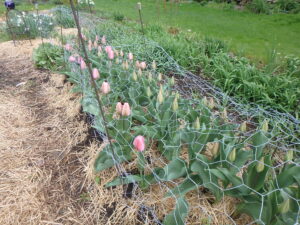
Tulips protected from deer
I prune some trees and shrubs in October, too. You really can prune any month, but once leaves are down it is easier to see their stems and look for crowded areas, crossing or rubbing branches, and dead branches to remove. To identify dead branches, just rub the bark with your thumbnail. If it shows green, it’s alive, if not, it’s dead. Prune so sunshine can hit every leaf and there is good air circulation.
Mulching: Hay, Straw and More
If weeds are the bane of the gardener, mulch is the gardener’s friend. Not only that, mulch can hold in moisture in dry times, and give a nice, tidy look to the garden.
Let’s start in the vegetable garden. Properly mulched, weeding can be minimal – say an hour a week for a big garden like mine. I keep down weeds in my walkways and around all large plants like tomatoes with a one-two punch: a layer of newspapers (4 to 6 pages thick) and a layer of straw or mulch hay (4 to 6 inches thick before it packs down).
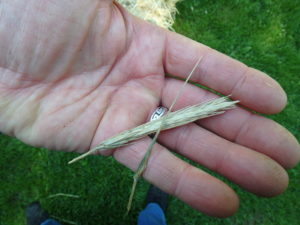
This straw seed head has no seeds
What is the difference between mulch hay and straw? Price, for starters. You can easily pay $8 to $10 a bale for straw, and as little as $2 or $3 for hay. Why is that? Straw is grown as a crop specifically sold as mulch, and it has no seeds. You might see what appear to be seed heads, but they are empty as the farmer grows rye, then cuts it before pollination takes place.
Hay is a waste product: food for dairy cows that got rained on, and is no longer edible. Picky eaters, those dairy cows. And it has plenty of seeds. The newspapers I put beneath it generally keep hay seeds from growing in the garden. But some seeds will escape and grow – particularly in the spring of year two unless you did a phenomenal job of cleaning up in the fall.
Many gardeners use black landscape fabric in the flower garden, covered with bark mulch or wood chips. The fabric is a good barrier, though the roots of some weeds and grasses can get through it, making it difficult to remove. Other gardeners use bark mulch directly on the soil, and that can be effective, too.
If you use wood chips or bark mulch, be sure not to place too thick a layer down. Two to three inches is good, 4 to 6 inches is bad – the mulch will keep a quick rain shower from getting moisture to the roots of your plants.
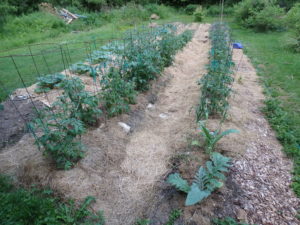
Hay & newspapers used as mulch
Some gardeners worry about bark mulch stealing nitrogen from the soil as it breaks down. Don’t. Yes, the microorganisms that break down the mulch need some nitrogen, but I have never seen plant leaves turn yellow (the sign of nitrogen deficiency) because of mulch. Or if you must worry, just put a layer of slow-release organic fertilizer on the soil beneath the mulch.
You can buy wood chips or ground bark mulch in bags or by the truckload. Buying it by the bag is convenient if you just need a little, but it is much more expensive that way.
If buying wood chips by the bag, read the label. If it says, ‘color enhanced’, I would avoid it. It means the chips have been dyed – and I am an organic gardener who does not want chemicals. I have heard that some cheap wood chips are actually construction waste that has been chipped and dyed – old 2-by-4’s and the like.
I like ground hemlock because of the color, and the fact that it tends to last longer than some others (except cedar, but I have only found that for sale in bags). I buy the hemlock by the pick-up truck load.
And please, for the health of your trees, do not create “mulch volcanos.” To keep down weeds some gardeners pile wood chips right up against the trunks of trees in a volcano shape. The wood chips may harbor fungi and bacteria that can attack the bark of your precious tree, eventually killing it in 6 to 10 years. Instead of a volcano, create a “donut.” Leave 3 or 4 inches of space between the tree and the mulch.
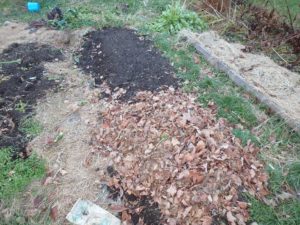
Leaves are great mulch
My favorite mulch? Fall leaves that have been run over by a lawn mower, then raked and stored for the spring. Full of goodness for the soil, and a good deterrent to weeds. Over the years, leaves will enrich your soil considerably. And they’re free!
Cocoa mulch is sold as a mulch, and I know some who love it. It has a very fine texture and looks nice. But it smells like chocolate chip cookies when it first goes down, and some dogs have been known to consume it – causing sickness and even death if one believes everything one reads on the internet. Chocolate products are bad for dogs. It also tends to mold, though that only lasts a week or so. It can be very slippery when wet; I advise against using it on a hillside.
Buckwheat hulls are an alternative to cocoa mulch, but they are not sold in many garden centers. Like cocoa hulls, they are very fine textured and look very nice, but are very expensive compared to bark or wood chips.
At the Chelsea Flower Show, which I attended recently in London, someone had quotes about gardening stenciled onto blank walls. One of my favorites was from Robert M. Pyle: “But make no mistake: the weeds will win. Nature bats last.” So mulch, but don’t expect to get a summer of weed-free gardening.
Read Henry’s blog at https://dailyuv.com/
Fall Chores
The fall equinox arrives on September 23 this year. On that date, days and nights are of equal length, but with each subsequent day the nights get a little bit longer and we begin our descent into winter. For many gardeners, the shortening days are not welcomed. I try to look at the positive side: we all need a break from weeding and working on our gardens. It’s not time to hang up our tools and put them away, but we can start to slow down.
My vegetable garden did well this year. We had plenty of rain – but lots of sun, too. Often the rain was torrential – which is not ideal – but it most often fell at night, followed by sunny days which were great for growing. I worked a piece of borrowed land this summer, one that had been fallow for a couple of years, and I was not bothered by tomato blights there, so the leaves are still green and the plants producing well.
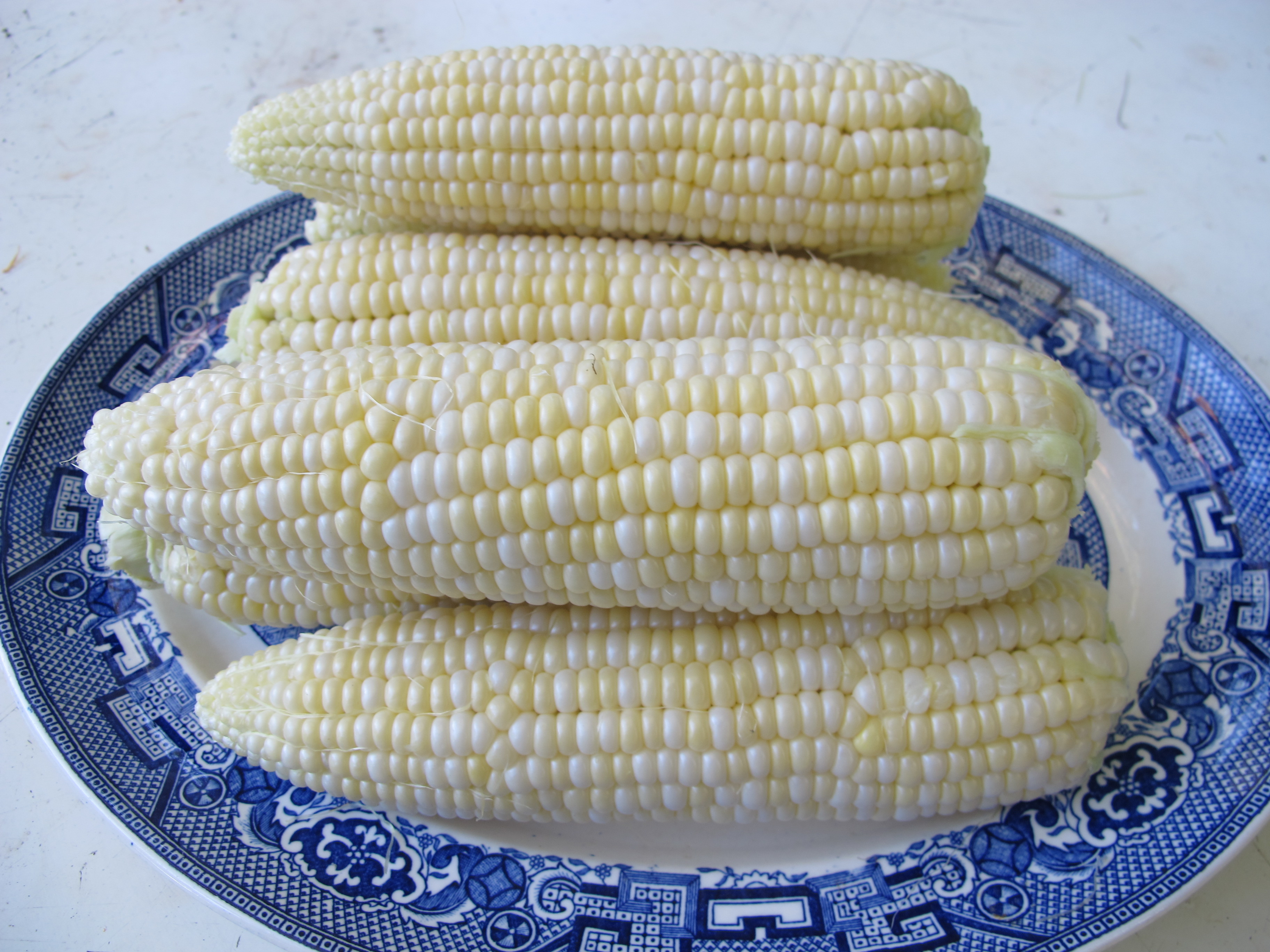
Organic Corn from my Garden
I grew corn for the first time in more than 20 years and was delighted that the corn did not all get ripe at once; it ripened over a 3 week period. I had plenty to share, which is nice, too. People often say that you can’t grow corn organically – that you need insecticides to kill the corn ear worms and chemical fertilizers to feed the nitrogen-hungry plants. I used neither, and got fat, juicy ears that produced not a single worm. I fertilized with Pro-Gro organic fertilizer at planting time. Period. Too much nitrogen from chemical fertilizers has been shown to attract insects.
I used a lot of hay as mulch this year, and that really helped to keep weeding to a manageable level. Three or four inches of mulch hay around the tomatoes applied early on kept down weeds and provided a nice clean place for fruit, some of which inevitably lands on the ground (despite the cages).
It’s important to clean up and remove diseased plants once they have stopped producing. I like to mix plant carcasses with brush in a pile in the garden where I can burn it all after the snow flies. Insects (and their larvae and eggs) and fungal spores can be effectively destroyed that way. Weeds harboring seeds can go on the pile, too. Weeds with big clusters of seeds should not go in a compost pile that you intend to use anytime soon. Weed seeds can last for years, and composting often does not kill them.
Some of my flower beds are less weedy this year than in the recent past. I’ve realized that I have more flower beds than I can keep up with by myself, so I hired a fellow to help me weed this summer – and he actually knows the difference between a flower and a weed! It was quite liberating. But I need to go over some of the beds he worked on and get out little weeds that have appeared since he cleaned them up. Weed seeds – or scraps of root – are a fact of life, and re-weeding is always necessary. If I get these little weeds now, it will help me have cleaner beds in the spring. It will help, too, if I put down a layer of bark mulch after this weeding.
Each summer I grow colorful plants on my deck, and I dread the onset of cold weather as many of these plants will never be happy inside the house. They just can’t survive the lower light levels indoors. Each fall night that portends frost I scurry back and forth from the deck to the indoors, lugging my favorite plants. I keep them living as long as I can but realize that some will have to be left to succumb to the arriving cold.
A fall chore I do each year without fail is to wash the leaves, top and bottom, of any plant that I bring in from the outside. I do this to wash off aphids and their eggs and larvae. Aphids are well controlled outdoors – there are lots of predator insects that consider them the Ben and Jerry’s of the insect world, consuming them with glee. But indoors? Even a few eggs will soon produce adults that will reproduce and make a mess of my houseplants. So I wash them with a sharp stream of water from the hose, let them dry in the sun, and then bring them indoors for the winter.
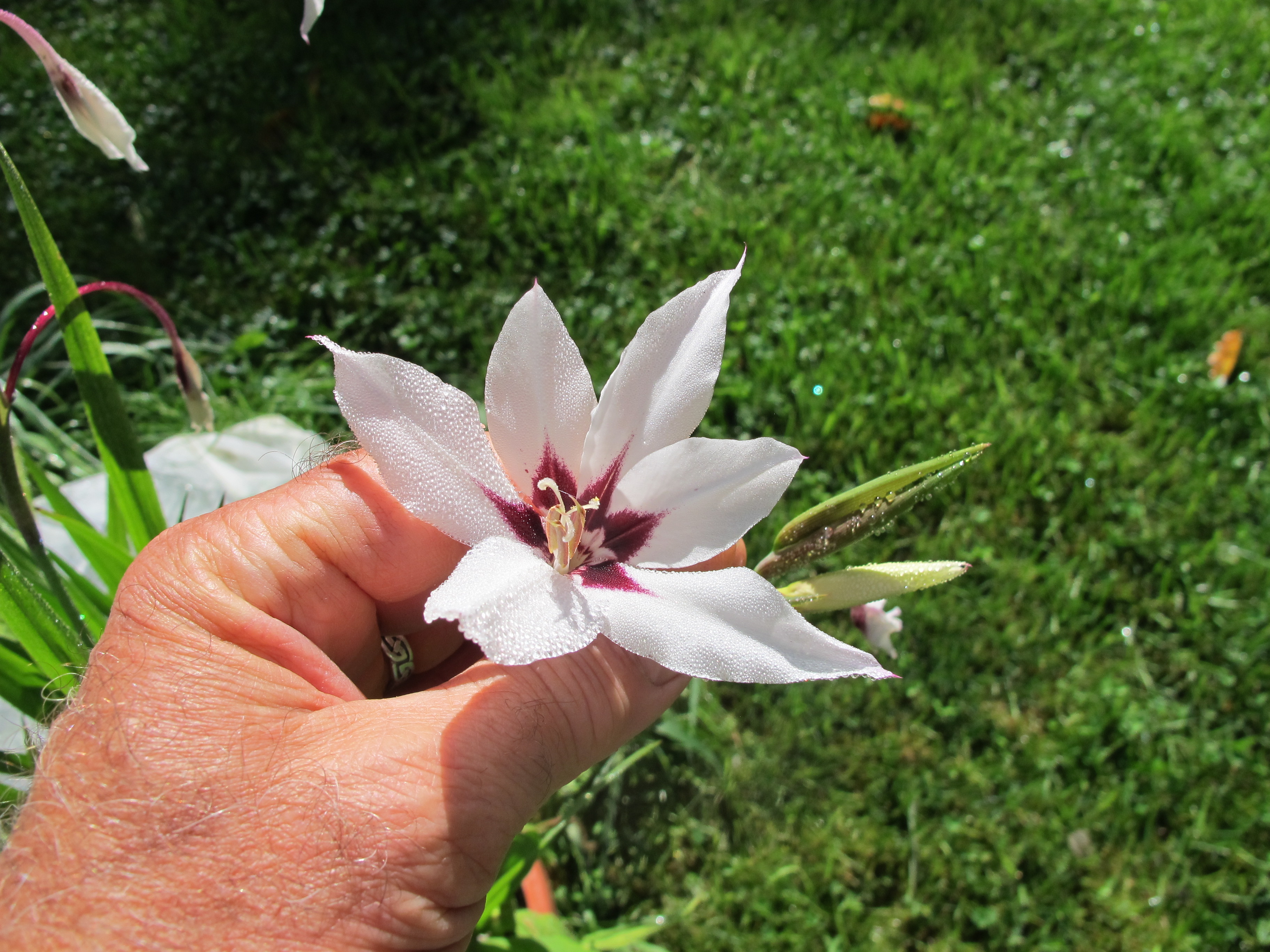
Sword lily
A fall chore I often forget to do in time is to dig up and store tender bulbs like gladiolas, dahlias and peacock orchids or sword lilies (Acidanthera spp.). These will not survive our winters and deserve to come indoors to live in a paper bag in a cool spot. This year I resolve to do better. I planted sword lilies in pots and they are blooming beautifully right now, and are delightfully fragrant.
This week I will plant some grass seed. Fall is a good time to fill in dead spots on the lawn. The soil is warmer now than in the spring, and fall rains will make watering less needed. There is still plenty of time for the new grass plants to get established before cold weather. I’ll just scuff up the soil with a short-tined garden rake, spread some seed, and then cover it with a thin layer of mulch. Finally I’ll smooth over the mulch with the back side of a lawn rake to mix in the seed and compress the soil a bit by putting down a board or small square of plywood and stepping on it lightly.
There will still be plenty of summer-like days ahead, but it’s good, I think, to start planning for fall and winter. Before we know it, we’ll be raking up the leaves – and shoveling snow.
Henry Homeyer is a garden designer and consultant, and the author of 5 books. His web site is www.Gardening-Guy.com.