Selecting and Training Flowering Trees
Posted on Thursday, May 23, 2013 · Leave a Comment
This has been a great year for flowering trees and shrubs. My Merrill magnolia had many hundreds of white blossoms in late April.
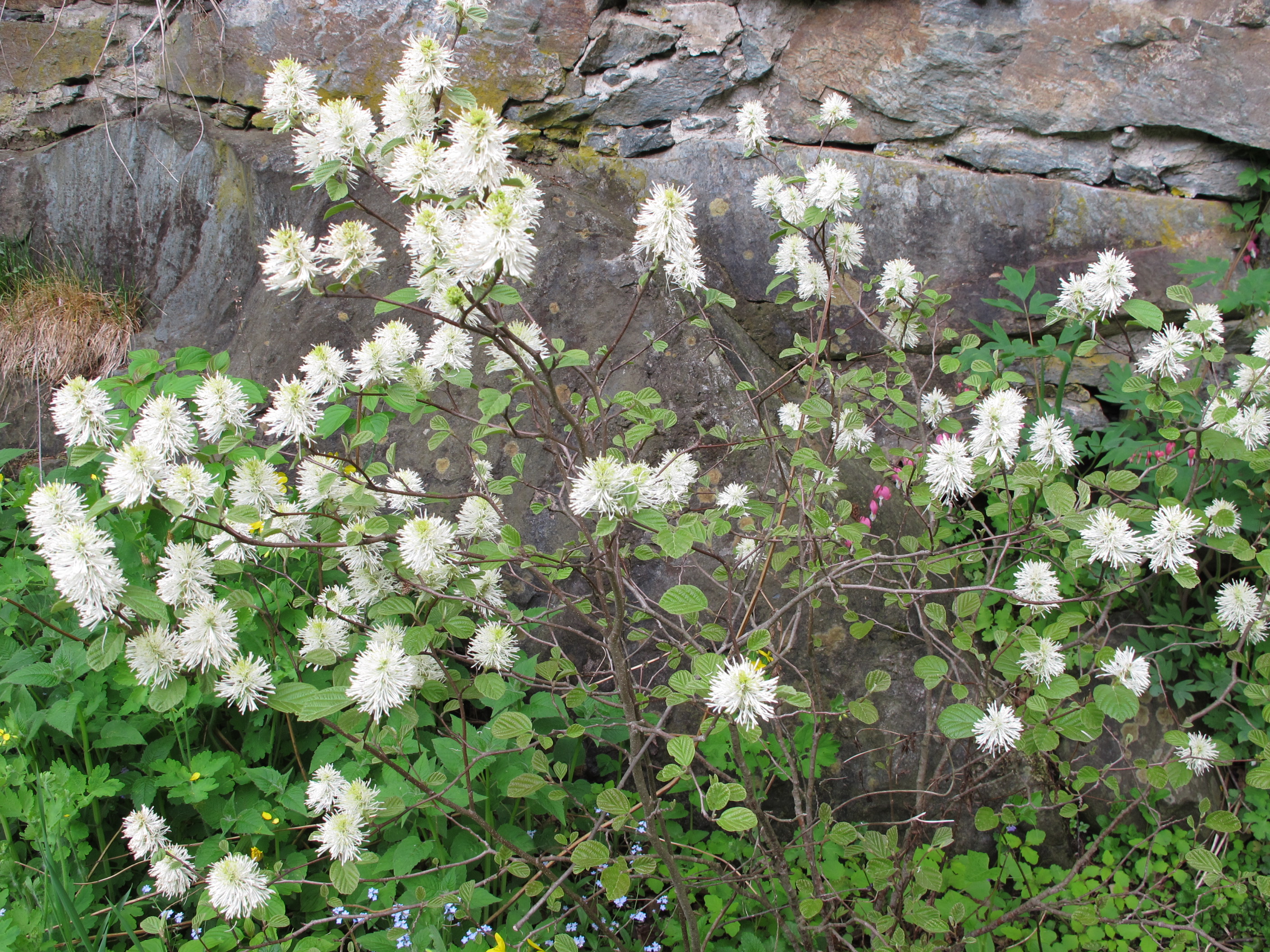
The crabapples everywhere put on a spectacular display this year. My fothergilla (a shrub with great fall leaf color) is in bloom now with its tidy white bottle-brush flowers. My ‘Olga Mezitt’ rhododendron (one of the parents of the popular PJM rhodie) is looking great and my wild azaleas are getting ready to bloom. And now the lilacs are blooming for me and I am overwhelmed with the large purple, blue, white and pink panicles (clusters of flowers). Spring has definitely sprung.
Fothergilla
All these blooms this year will certainly encourage many gardeners to buy trees and shrubs and plant them. That’s a fine idea, but if you plant now, please remember that you must keep watering them all summer if we don’t get an inch or more of rain per week. When August comes around it will be easy to have your new tree dehydrate if you get lazy or forgetful.
New trees and shrubs need a year or more to grow roots sufficient for their needs if we get hot, dry weather. So if you are forgetful or will be doing lots of traveling, you might want to hold off on planting a new tree until fall, which is also a good time for planting. Fall is cooler and more likely to be rainy.
I like to buy flowering trees and shrubs when they’re in bloom. That allows me to see the color and check out the fragrance. But there is more than just the flowers to consider when selecting a good crabapple or magnolia. Let’s start with size and price. Bigger
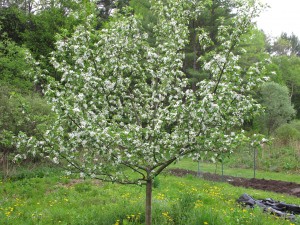
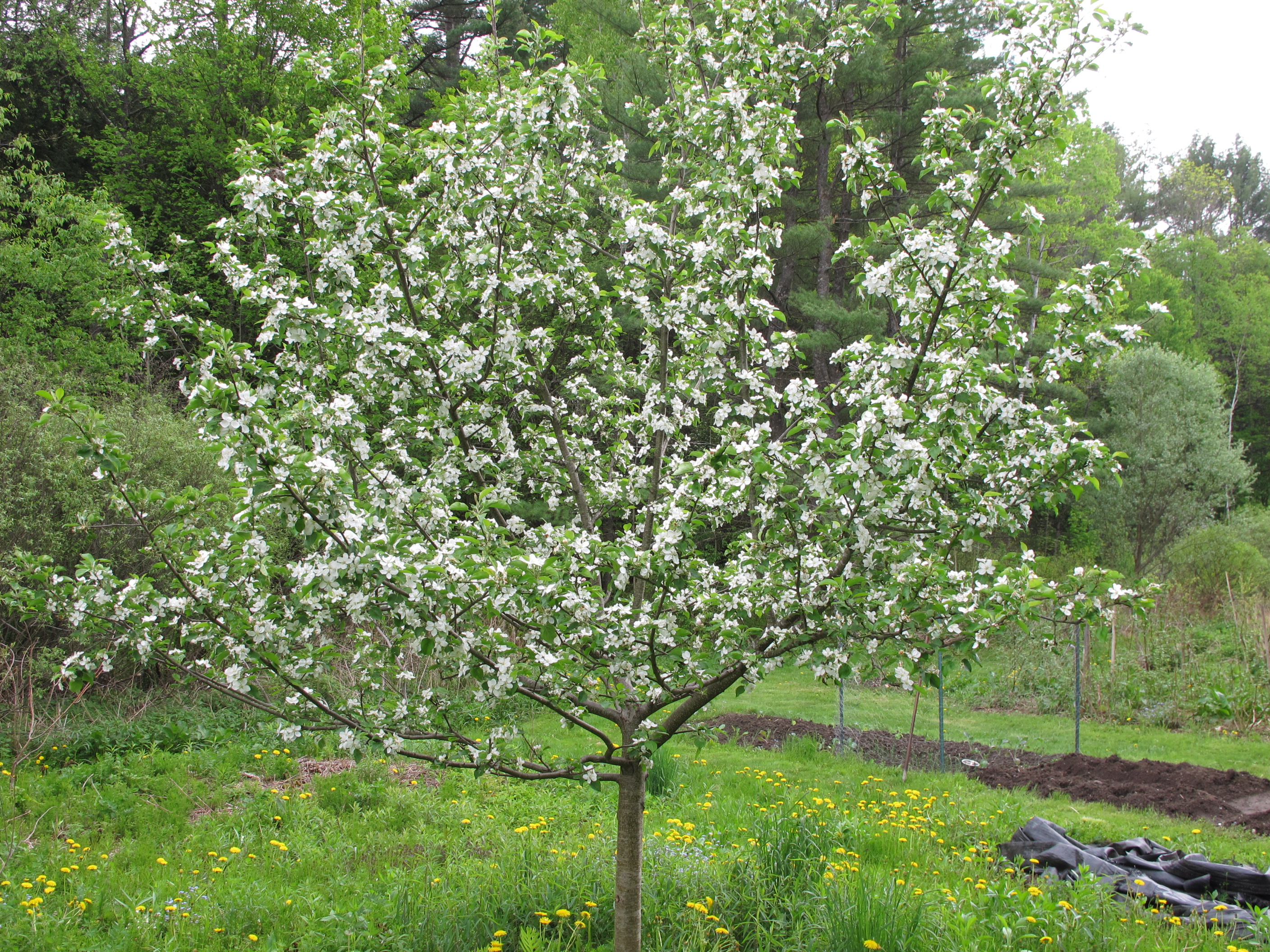
Nicely pruned apple tree
is not necessarily better. If you are on life support and don’t expect to be around in 5 years, sure, buy the biggest tree you can afford. But be aware that a bigger tree is not only more expensive – it is also harder to plant and takes more water and care. A bigger tree may have a smaller proportion of its root system intact after being dug up and put in a pot than a small tree. I like to buy smaller specimens and then train them to be a nice shape. That’s harder to do on a larger tree.
I recently visited a nice new nursery run by Henderson’s Tree Service on Rte 14 in Hartford, Vermont. There I chatted with my friend Sylvia Provost who is co-owner of the business. I asked Sylvia what she would look for if purchasing a crabapple for herself. Without a moment’s hesitation she responded. “Structure,” she said.
What Sylvia was talking about is the shape of the tree and the placement of the branches. Fruit trees produce best on branches that leave the trunk at a right angle or are aiming just slightly upward. Branches that shoot straight up are not usually good fruit and blossom producers.
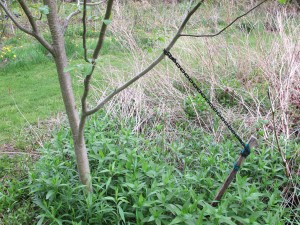
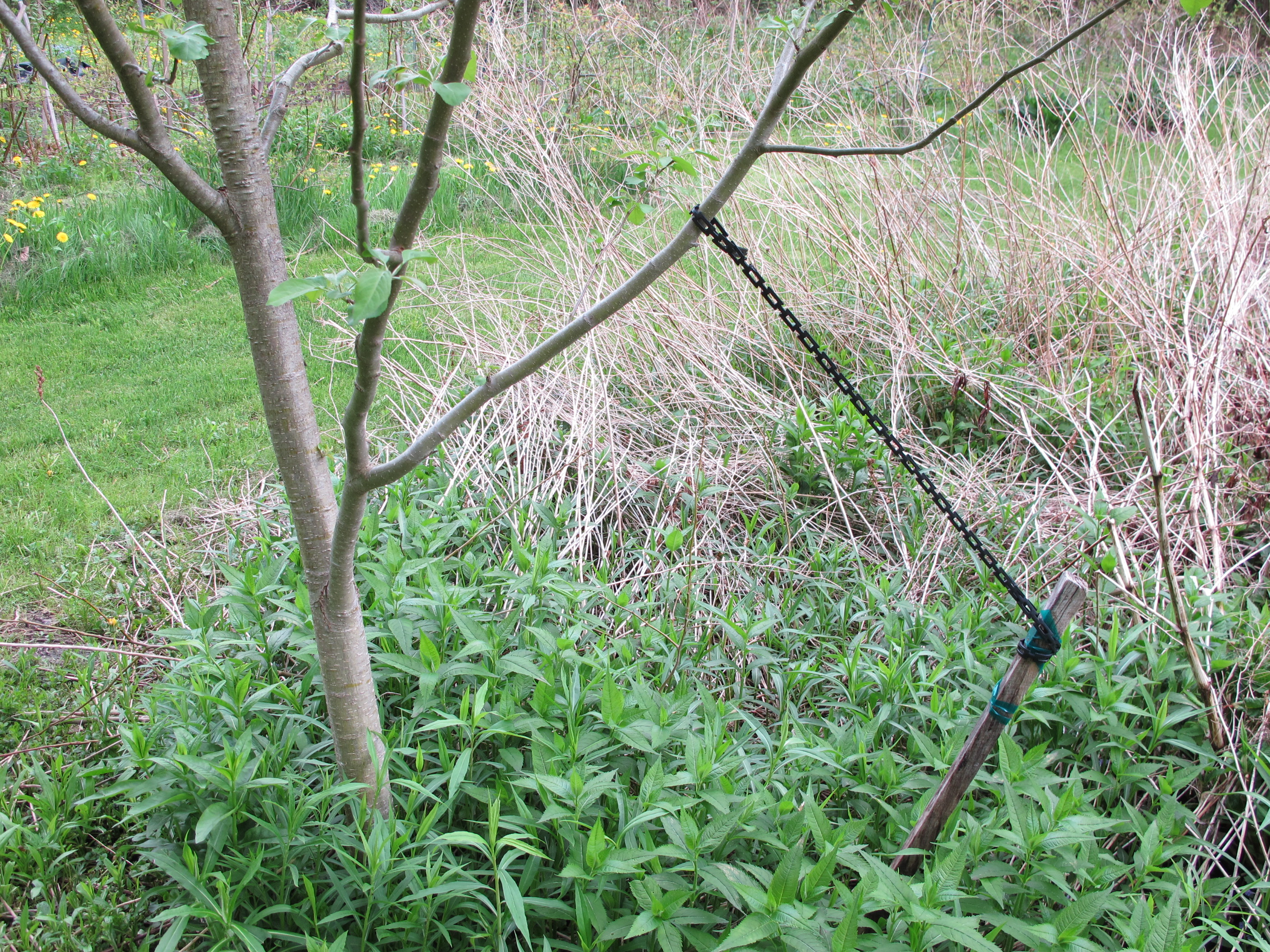
Changing the angle of a branch
And although Sylvia noted that you can train a tree to be the shape you want, it is easier to start with something that is closer to your ideal before you start training. So, for example, Sylvia said that if you have a swimming pool some distance from your patio, you should choose a tree that has an open format, one that you can see through – and see what is happening at the pool. Conversely, if you have nosy neighbors and want to screen their view of your patio, you might select a tree that has a full, dense arrangement of branches.
Generally, pruning a tree should begin in the second year of its life at your home. I often see apple and crabapple trees that have very low branches. I like to prune off those low branches to make it easy to mow around, and to have a nicer look. And if two branches are both striving to be the “leader” or the dominant, tallest stem, I remove one. And although most books say you should prune fruit trees in March or April, you can safely make a few judicious cuts now to train your tree.
You may train branches to grow at different angles by weighing them down – if you do so soon. This is an activity for spring, starting before the new layer of cambium growth has occurred. You can drive a stake into the ground and tie a branch to it for the next 2 months. A branch the diameter of a finger can weighed down by hanging a plastic pop bottle on it, then filling it with water until it bends to the correct angle.
Chris Wilson of the EC Brown Nursery in Thetford, Vermont suggested that when buying a tree, look at leaf color – leaves should be green, not tinged with yellow. He also suggested making sure the tree has branches on all sides, and that the bark has not been damaged.
So if you’ve delighted in the flowers on trees in your neighborhood this year, go get one or more. Study several specimens to find the best one. And just remember to water all summer long!
Henry Homeyer is a gardener and garden designer living in Cornish flat, NH. His Web site is www.Gardening-Guy.com.
Filed under Article · Tagged with EC Brown Nursery, flower crabapple tree, fothergilla, gardening guy, growing fruit trees, Henderson's Fine Gardening, Henry Homeyer, how to prune a tree, how to purchase fruit trees, hydrangeas, merrill magnolia, Olga Mezitt rhododendron, pruning trees, training tree branches
Spring Flowers
Posted on Wednesday, May 15, 2013 · Leave a Comment
Like most gardeners, I rejoice in spring. New leaves on trees have a special hue; the grass is finally green; flowers of every persuasion are in bloom. The air is warm, the black flies haven’t arrived, life is good. So we trundle off to the garden center and buy flowers and plant them. Here are some flowers I am enjoying in May, including a few you might not have in your garden.
I know most of you don’t like Latin names of flowers, but they are useful for precisely naming flowers, and for showing relationships. The scientific genus Dicentra is in its full glory now: D. spectabalis, D. exemia, D. cucularia are three species in bloom for me.
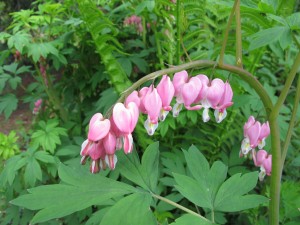
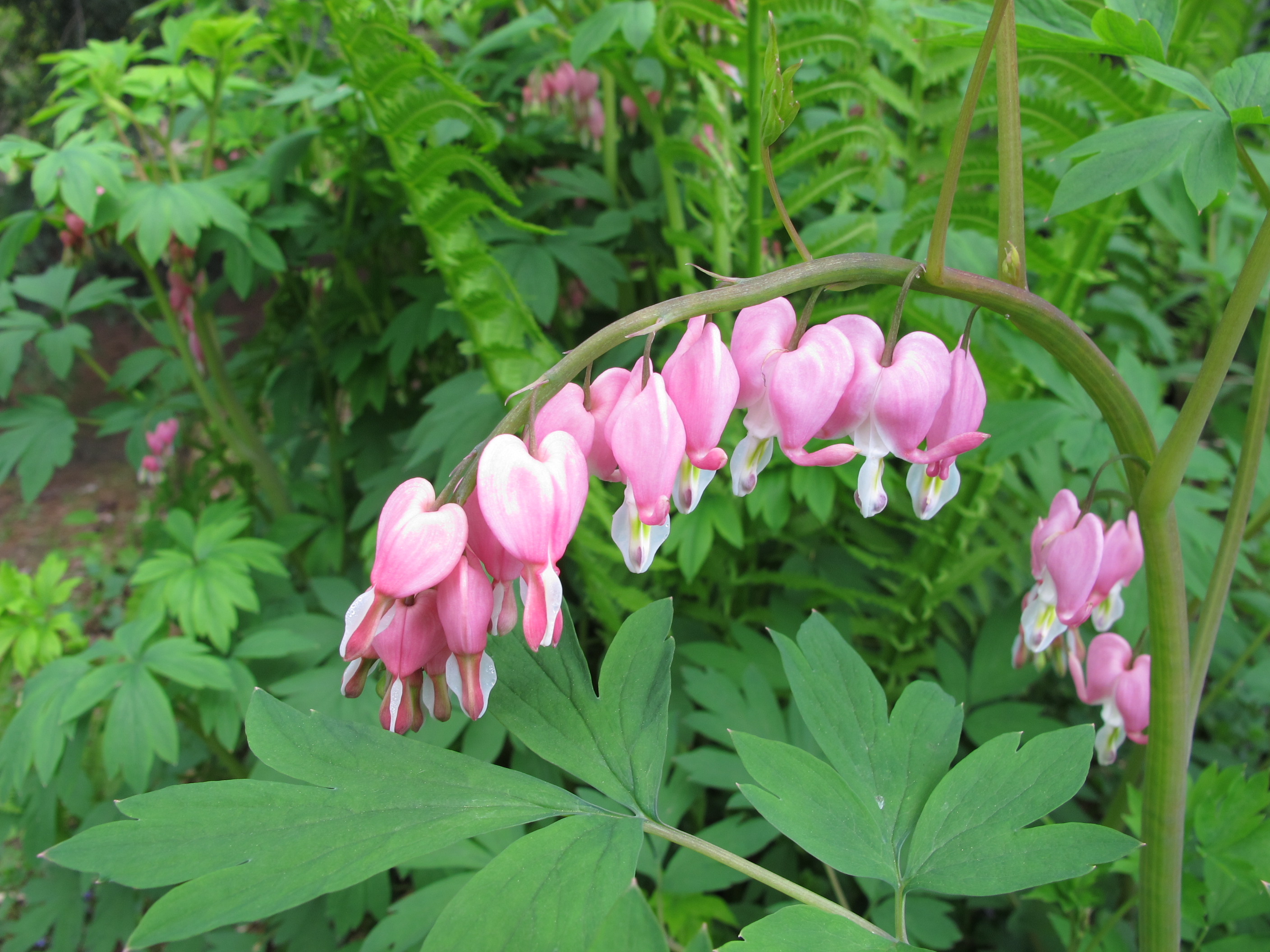
Bleeding Heart
The first one (D. spectabalis ) is spectacular, as its Latin name indicates. I have some plants that stand up to 3 feet tall and wide, and it can have dozens of flower stems at once. You probably call it bleeding heart – though some call it “a living Valentine”, which is appropriate since the strands of pink flowers are shaped like cut-out hearts with little appendages hanging down, perhaps drops of blood from a broken heart. It also comes in a pure white variety, a sub-species with the epithet ‘alba’ appended to its name.
Bleeding hearts will grow in full sun, but do better in part sun or dappled shade and rich, lightly moist soil. Full afternoon sun will make them run through the bloom cycle more quickly and the foliage to turn yellow well before autumn.
Fringed bleeding heart (D. exemia) is shorter and less showy. It is a shade plant that will bloom on and off all summer, which is unusual for a perennial. The flowers come in shades of pink to reddish, and there is also a white variety. Although it is often called wild bleeding heart, I have only seen it in the woods a few times. Its foliage is very nice – it is highly incised and frilly.
The last of the three, D. cucularia, is commonly known as Dutchman’s breeches for the white flowers which resemble pants hanging on a clothesline. It is a true wildflower, but is sold at a few good nurseries. It is what is called a spring ephemeral: it comes up, blooms, and the foliage disappears after a few weeks. I pronounce its species name cuckoo-laria, which to me is a humorous name for a flower. “Cuckoo, cuckoo” I call out to it when I see it blooming. (See, aren’t you liking Latin better? It can be fun to use.) Mine grows in the shade of an old apple tree in damp, rich black soil.
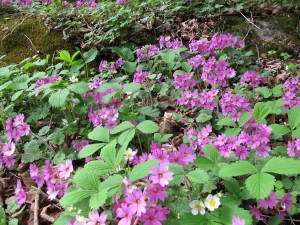
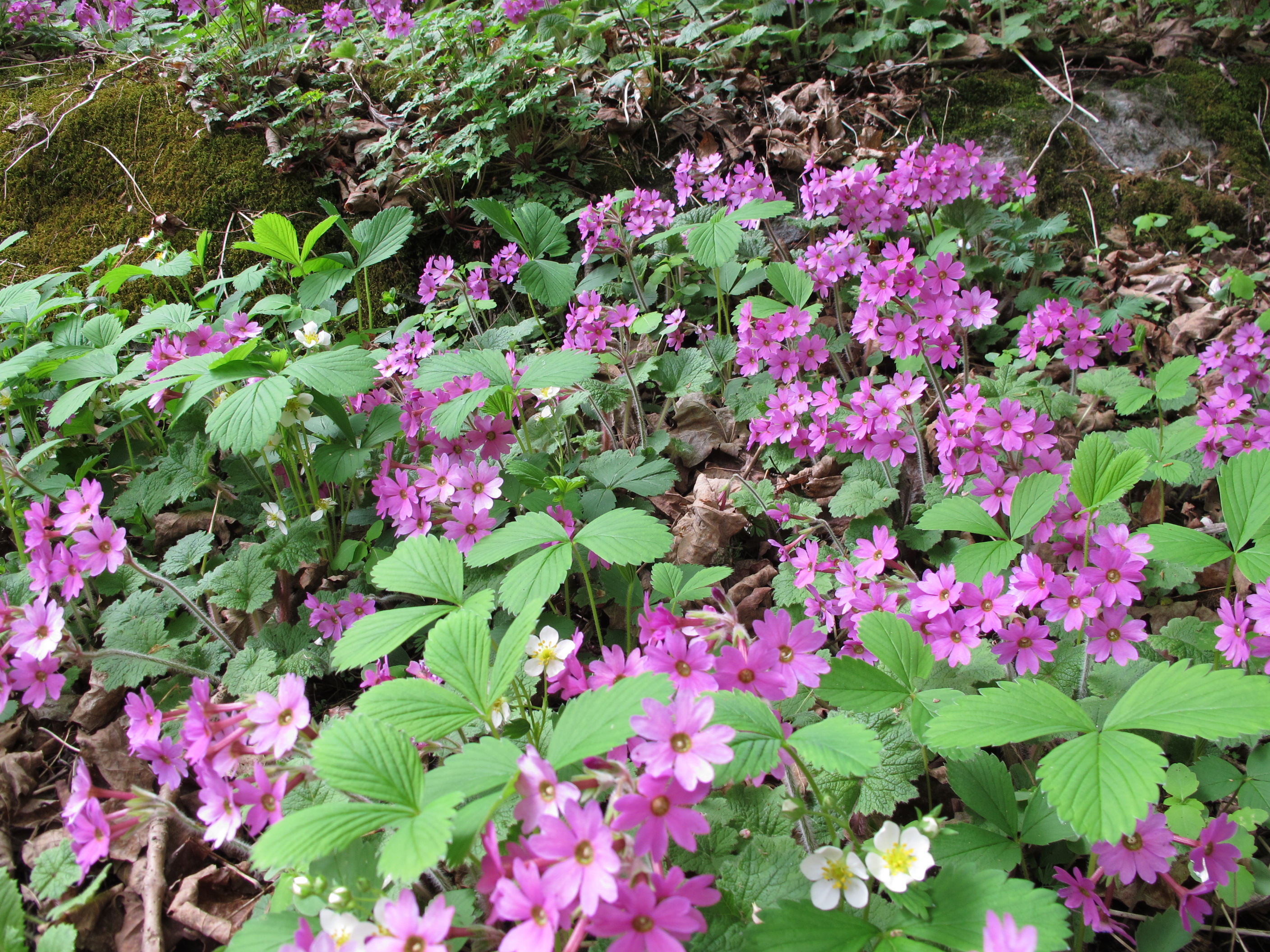
Primula Kosoana
If you have a mature apple tree, it is a great place for growing primroses. In mid-May I have several species growing under mine, including a fabulous magenta-colored one that has no common name, so you will have to ask for it by its Latin name, Primula kisoana. Or you can call it the kissing primrose, I suppose, since the species name starts off with “kiss”. (Kiss-o-ana). But at the garden center they will not know it by that name, only the Latin. I got mine at Cider Hill Gardens in Windsor, VT.
Primroses are low plants that grow in clumps that I have in all colors except blue. Most do best in shade or part shade, and many will grow in dry shade – though moist soil is better for most. Coming along soon I will have the candelabra primroses (Primula japonica), which indicates they were introduced from Japan). These are the tallest of my primroses, reaching up to 18 inches or so. They have three tiers of blossoms sticking out off a tall straight stem sort of like the spokes of a wagon wheel, and come in at least 3 colors – white, pink, deep red.
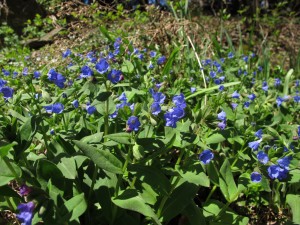
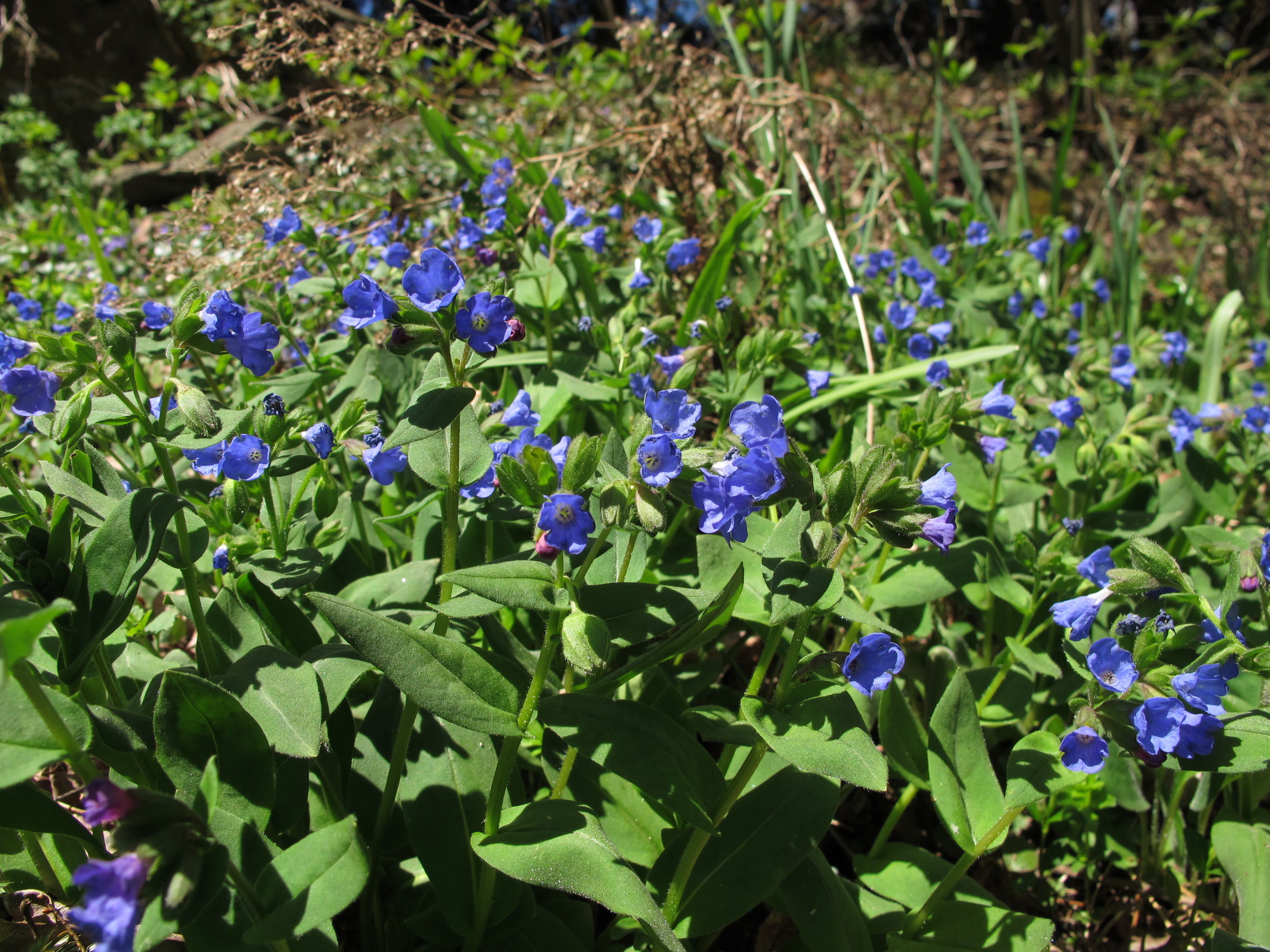
Pulmonaria Longifolia
For the past 6 weeks or more I’ve had various colors of lungwort (Pulmonaria longifolia) blooming. Lungwort is a dreadful name for a lovely flower, so I call it by its Latin genus, Pulmonaria (pronounced Pull-mon-aria) . It starts very early and blooms for a long time; it comes in a variety of colors: blue, peach, pink and combinations of those. It spreads by root, filling in dark, shady places that many flowers would eschew. It does fine in crummy dry soil.
You know the common bulb plants: daffodils, tulips, crocus. If you’ve planned well – selecting early, mid- and late-season varieties – you have examples of those blooming much of the spring. But do you have summer (or giant) snowflake (Leucojum aestivum)? It is wonderful! I’ve had a clump for 15 years or more, and it just gets bigger and better every year. It reminds me of snowdrops on steroids. White nodding blossoms on tall green stems and lots of foliage. Mine are 18-24 inches tall, even though my reference text on bulbs (Taylor’s Guide to Bulbs) says it should be only 9-12 inches tall.
One last thought: take pictures of your flowers on a weekly basis. These will help you do planning next winter when you are trying to see what times of the year need more color. Your digital camera will keep track of the dates of blooming, too.
Henry Homeyer is a garden designer and public speaker on gardening. Contact him at henry.homeyer@comcast.net, PO Box 364 , Cornish Flat, NH 03746 or 603-543-1307.
Getting Started in the Vegetable Garden
Posted on Wednesday, May 8, 2013 · Leave a Comment
After a few hot spring days many of us are more than ready to plant vegetables in the garden. It’s important, however, not to jump the gun. There are things you can plant now, but others still have to wait – tomatoes, peppers, eggplants, cukes and squashes, among others. My garden will surely see frost again, and the ground is not as warm as many plants need to do their best.
I have planted my peas, and I would say it’s safe for anyone in New England, even the cold spots, to plant them now. That said, let me warn that pea seeds can rot if planted in cold, wet soil. I have a relatively wet vegetable garden because it is near a stream and the water table is high. To fix that problem I grow my veggies in wide raised beds.
Most of my beds are just mounds of soil that are six inches taller than the walkways and about 30-36 inches wide. When making the beds I loosened the soil, then raked soil from walkways into the beds, which raised them up. I also add wheelbarrows of compost each year and work it into the top few inches of my raised beds – making them even taller. Now they drain well, which is important in spring or during long periods of rainy weather.
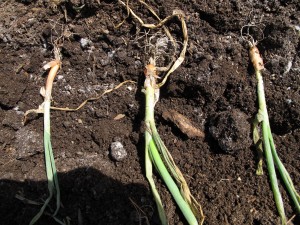
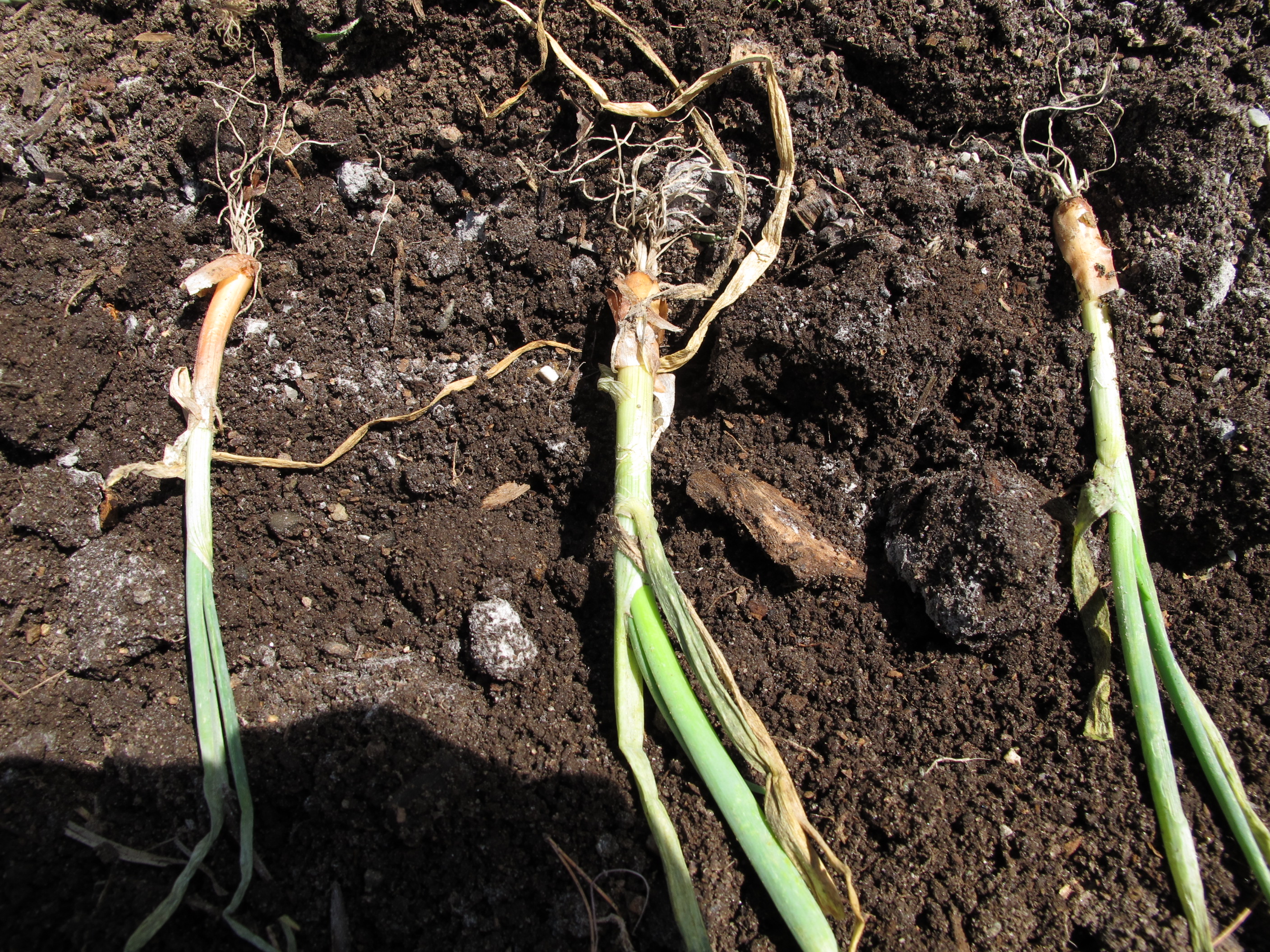
Onion Sets Ready to Plant
I have planted my onions, too. Some years I plant onions by seed indoors in early March. Other years I buy onion plants. These are always bigger and fatter plants than the onions I start from seed. Maybe they start growing them in January – but I don’t want to have to baby plants along for such a long time.
Most gardeners buy onion sets, which look like little bulbs, though I rarely do so now. These are tiny onions that are already a year old – they’ve been grown so close together that they never developed any size and are used to start new plants. They certainly do work, and are much less expensive than buying onion plants. But I feel they are less vigorous than the plants.
What else have I planted outdoors by seed? Spinach, lettuce, carrots, kohlrabi and beets. Spinach is the hardiest of those – frost is not generally a problem, even for young plants. The others are somewhat frost hardy but can benefit by some protection if the weather is forecast to drop into the mid- to low-twenties. Row cover or Reemay is a spun synthetic fabric that works well to provide a little frost protection.
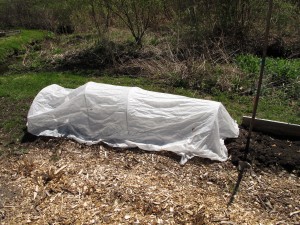
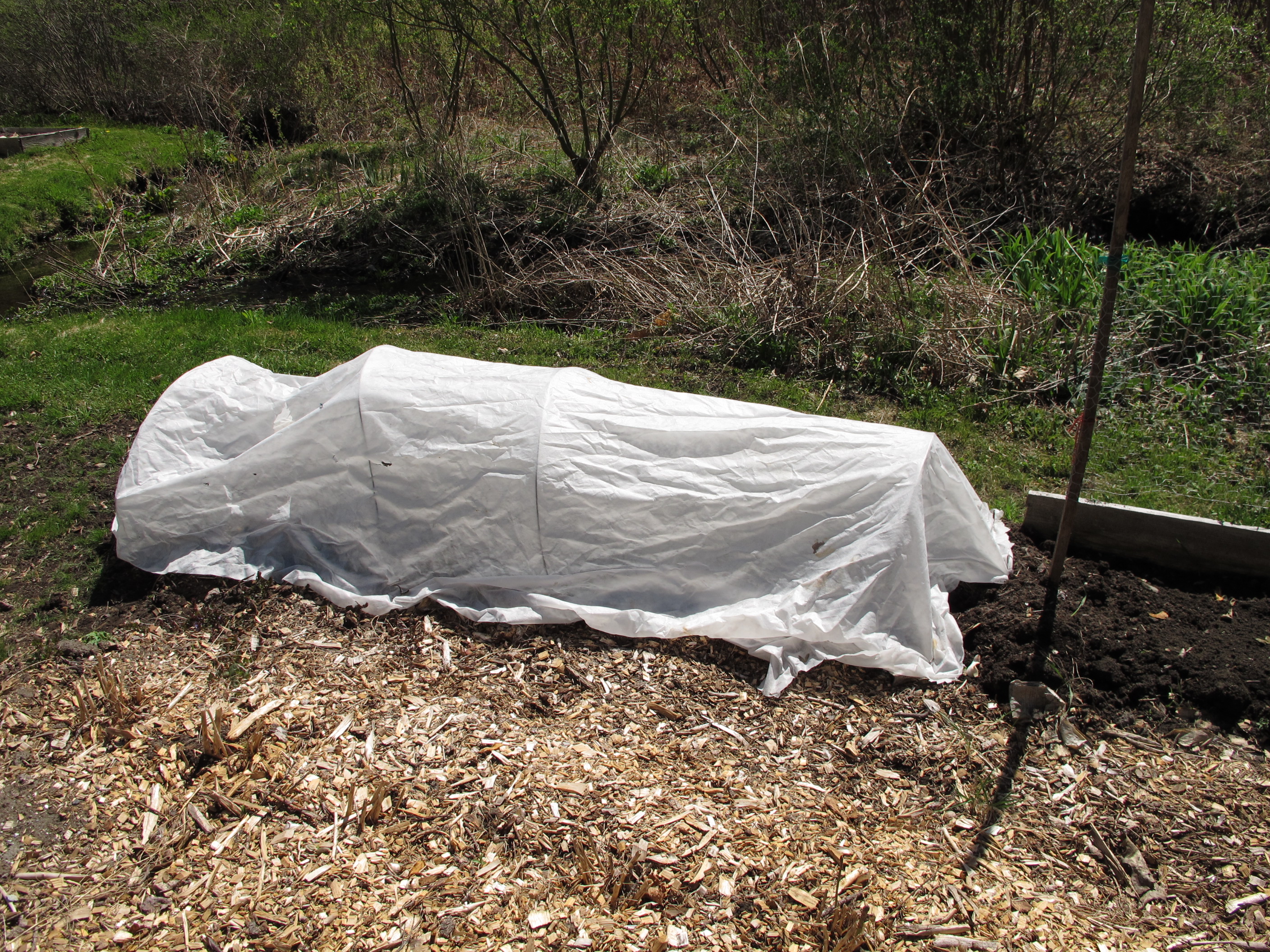
Row Cover on Wire Hoops
There are different thicknesses of row cover available, including one called the GardenQuilt Cover, which claims frost protection to 24 degrees F. When I use that, I keep it on only at night – light passes through it, but it reduces the strength of the light considerably. Others, the thinner ones, only provide a degree or two of protection, but can stay on all the time, keeping insects like flea beetles from getting to your plants.
Young plants are much less frost hardy than older plants. Kale, for example, will survive very cold temperatures when mature, but can be damaged when young by moderate frost. I have harvested kale in December when covered by snow. I start my kale plants indoors in April and then plant them outside in mid-to late- May.
Any plant that has been started indoors needs to be hardened off before going into the ground. This is also true for plants purchased from garden centers. You should ask when you buy seedlings of annual flowers and vegetables if they have been hardened off. If they are on display on tables in the sun, they probably will be fine. But things grown indoors or in greenhouses have tender leaves that can literally get sunburned or wind burned.
I harden off my seedlings over a 5 to 7 day period. I start by carrying flats of seedlings outdoors and giving them morning sun in a place where the house blocks the wind. Then the go to a spot where they get a couple of hours of afternoon sun for a couple of days. Finally they get all day sun and are ready after a day to go in the ground.
Watering is key for small plants. They don’t have a big root system yet, so they can dry out quickly. I check seedlings growing in pots or 6-packs at least twice a day (when outdoors, or once if indoors) to see if they need watering. Bigger seedlings, those that have been growing for several weeks, get a little dilute fish or seaweed fertilizer as they have used up the nutrition found in potting mix (which is relatively void of minerals).
Once in the ground seedlings still need daily watering. I like to use a watering can as it is gentler than a hose. I water seeds that have not germinated daily (or check to see if they need any), too.
Spring is the time when the garden makes its most urgent demands. Fortunately, most of us are eager to spend time outside now, too. Enjoy!
In addition to being an avid home gardener, Henry Homeyer is a gardening consultant and a specialist in fruit tree pruning. Contact him at henry.homeyer@comcast.net. His Web site is www.Gardening-Guy.com.
Spring Lawn Care
Posted on Wednesday, May 1, 2013 · Leave a Comment
It’s time for a little lawn care. I’m not obsessive about my lawn, but I like a nice green swath between the flower beds that is suitable for badminton, croquet or general lounging. It need not be Kentucky bluegrass, and certainly should have some dandelions, those cheerful harbingers of warm days and blue skies. For me, if it’s green and I can mow it, it’s a lawn.
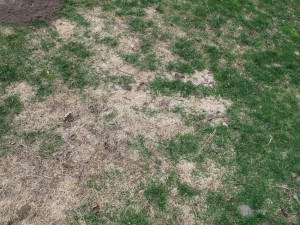
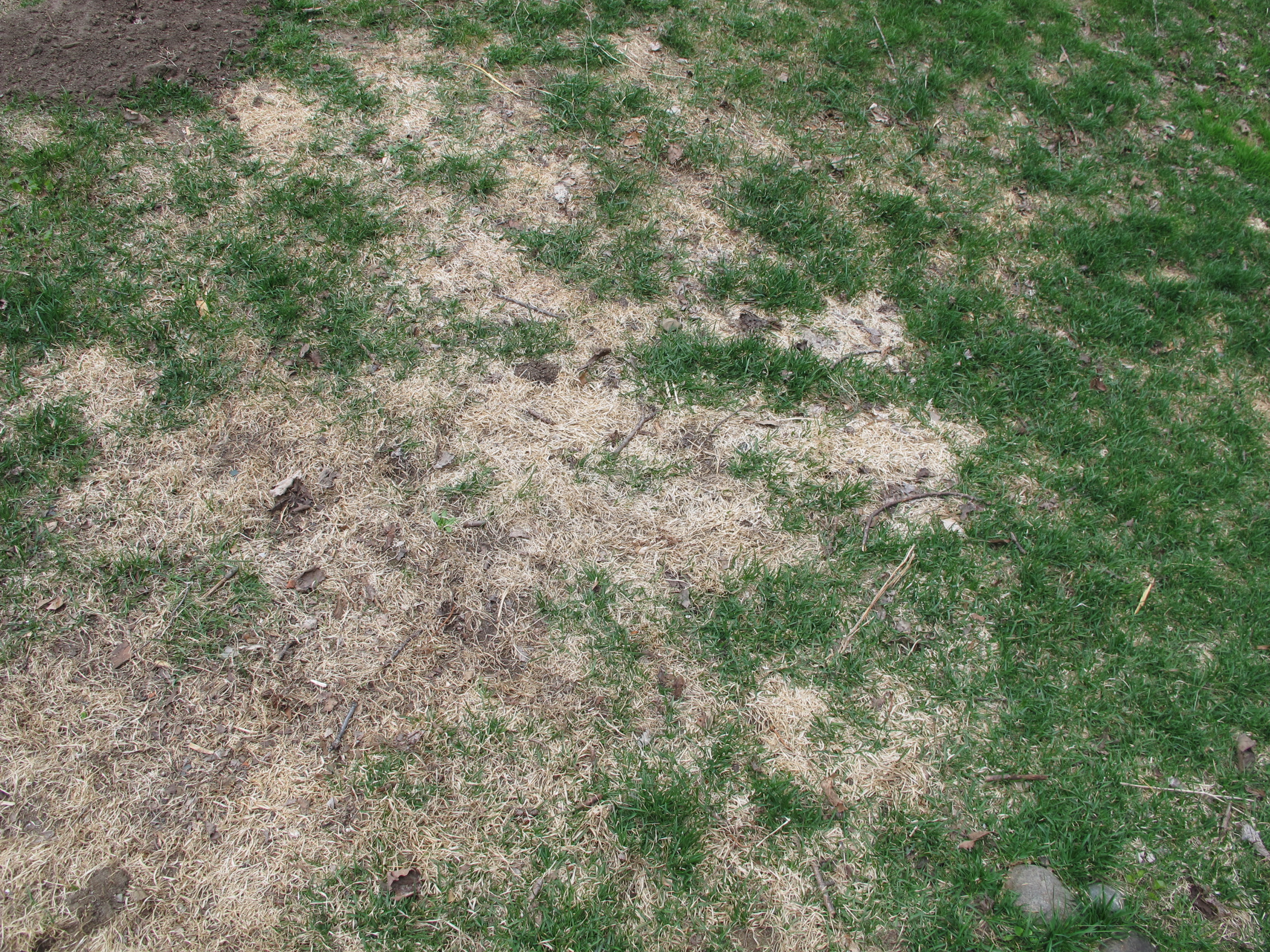
Winter damaged lawn
Right now my lawn is not all green. Not by a long stretch. My household includes 3 dogs, and they have killed a fair amount of grass right outside the front door. And then there are the moles out back that have been excavating their own Big Dig much of the winter.
Dead spots and thin spots need to be seeded, and the ground is warm enough now to do that. I use a “conservation mix” because it is full of good tough varieties that can take a beating more than one that is largely Kentucky bluegrass. And diversity is good for minimizing disease problems.
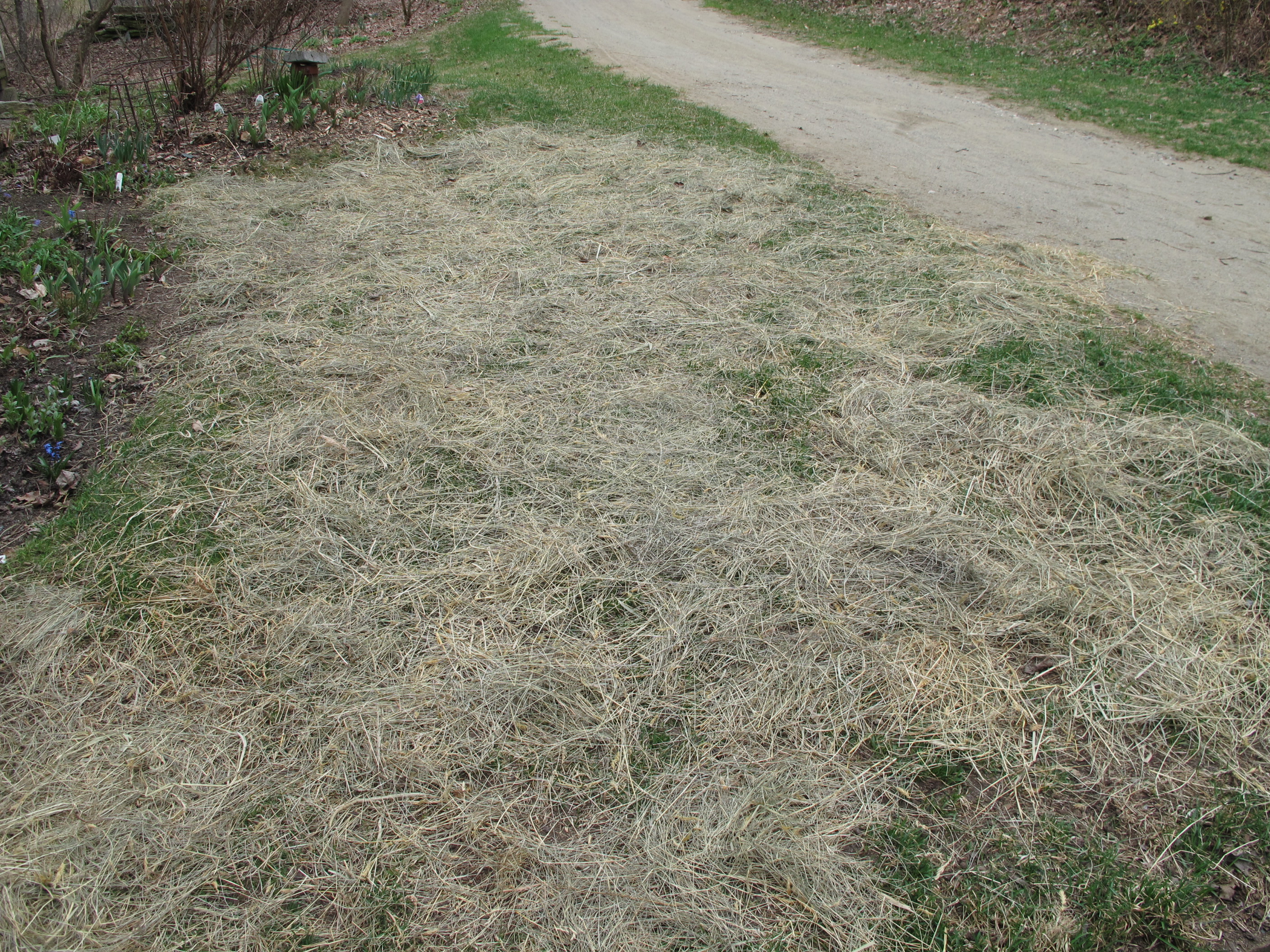
For large dead spots I take a short-tined garden rake and rake the dead grass out, roots and all. Then I spread half an inch of good compost over the area and scratch it into the top inch or so with a rake. I broadcast a fairly dense sprinkle of seed (by hand), then use a lawn rake to mix the seed into the top quarter inch. I do this by flipping over the rake and dragging the long tines over the soil – upside down. That lightly buries the seed, though there is always still seed visible. Grass seed doesn’t need much soil cover, if any. Lastly, I spread a little mulch hay or straw over the top – just enough to shade the soil and keep it from drying out.
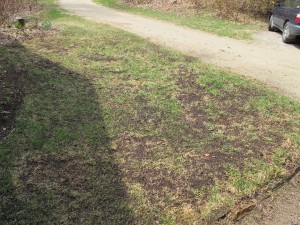
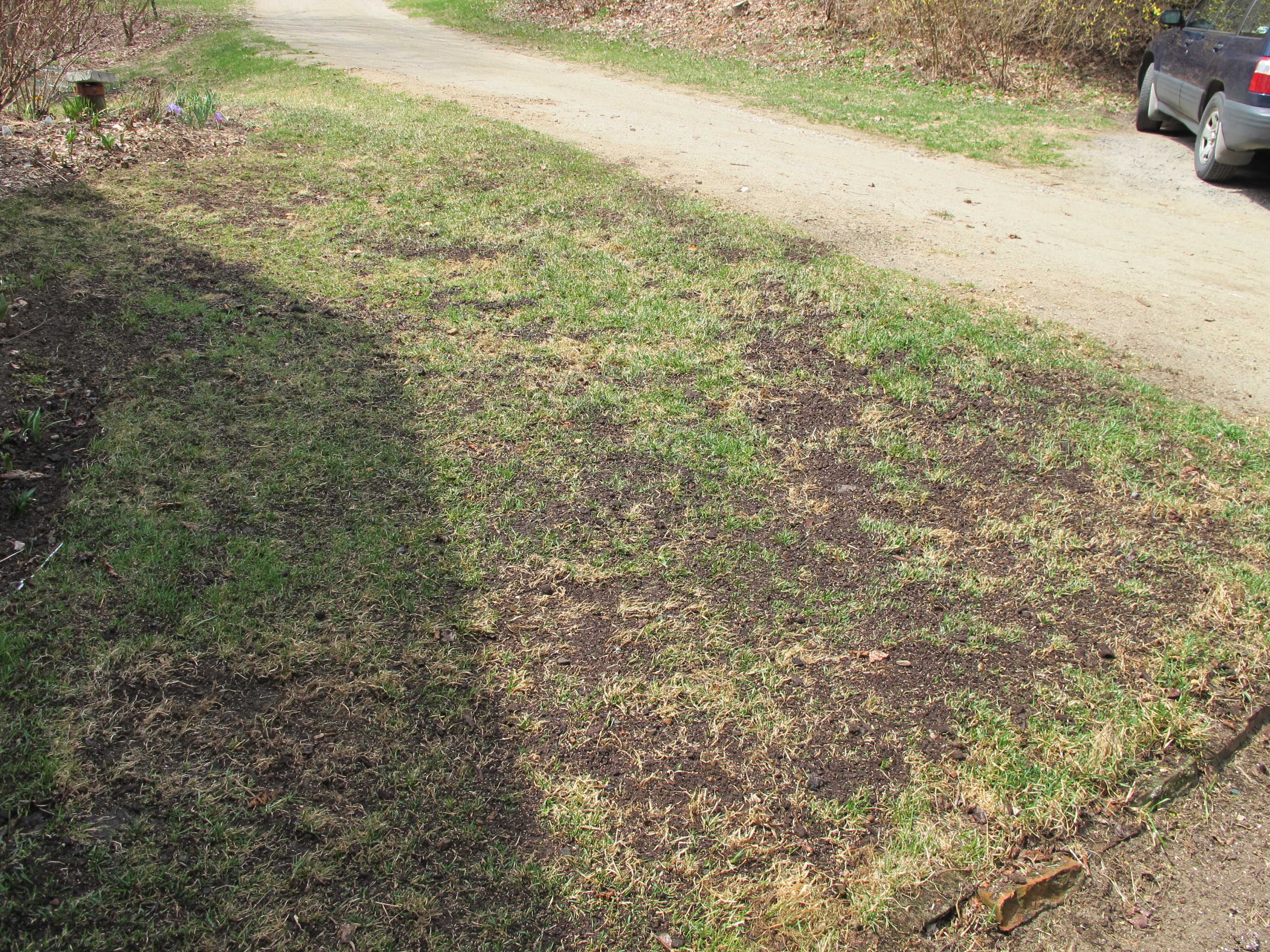
After raking out dead graass
In some areas the grass is growing but is sparse, or contains some dead grass. There I briskly rake the lawn using a bamboo or metal awn rake to remove the dead grass as much as possible. Next I spread some compost with a shovel and even it out with my rake. Then I “overseed” the lawn with seed, just sprinkling it by hand (though I suppose you could do it with a seed spreader). I don’t spread straw on the overseeded places, as there is enough existing grass to provide shade. Generally the soil stays damp at this time of year, too.
You may have noticed that I did not mention adding fertilizer to the lawn. My soil is pretty good because I don’t collect my grass clippings when I cut the lawn, and I do not add any herbicides or insecticides to kill weeds or bugs. Chemicals of any sort, even chemical fertilizer, inhibit the growth of beneficial bacteria and fungi in the soil. My “lazy” way of dealing with the lawn helps me to have biologically active soil, one rich with microorganisms that break down grass clippings, enriching the soil. Earthworms are a big help, too, aerating the soil and fertilizing the soil with their castings.
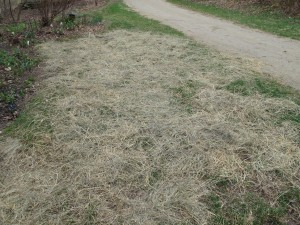
Light layer of hay over re-planted lawn
If you feel you must add fertilizer to the soil, choose an organic one. Instead of chemical salts that can harm beneficial microorganisms, an organic fertilizer has naturally occurring ingredients like ground oyster shells and peanut hulls, chicken manure and seaweed. Chemical fertilizers can dissolve and disappear in a week of rain, but the ingredients of organic fertilizers won’t.
Want to minimize crab grass? Corn gluten contains a protein that reduces germination of weed and crabgrass seeds in the lawn. It is usually sold at feed-and-grain stores or garden centers in 50-pound bags. You can’t apply it when you seed your lawn, as it would affect good grass seeds, too. But it’s not a miracle. It will reduce germination, but it doesn’t kill weeds or their seeds.
I’m told that corn gluten works best when applied 3 years in a row. And one last benefit: it also acts as an organic fertilizer that contains about 10% nitrogen by weight, breaking down and releasing the goodness slowly. This is the time of year to spread corn gluten – though I must admit, I never have.
About those moles: they seem to do most of their excavation in the fall and winter, leaving piles of nice soil on the lawn. I just rake that soil onto a wide shovel, collect it in my wheelbarrow, and then add it to raise beds elsewhere, or to fill in depressions.
Moles can be repelled with castor-oil based solutions. I used to make my own, but all castor oil at the pharmacy seems to be the new, better, more modern “good tasting” kind. But garden centers still sell mole repellents made with castor oil, and though I haven’t tried them, they should work just fine.
And what about moss? I ignore it. It generally grows in shady areas that are acidic. If you don’t like it, rake it out and plant seed designated for shady areas. But first add some limestone and compost to sweeten the soil and improve the soil. On-line I read about a moss killer that promises “one application will kill moss for a year”. That makes me shudder when I think about my dogs walking on that soil, were I to apply it – which I will not!
So go out and enjoy the sun. And remember that setting the blades of your lawnmower to 3 inches will help your grass have more energy and will help to shade out crabgrass and weeds.
Henry’s Web site is www.Gardening-guy.com. See past columns there or search for answers to gardening questions.
Getting Ready for Summer: Lilacs and Grapes and Blackberries, Oh My!
Posted on Wednesday, April 24, 2013 · Leave a Comment
I love spring. It brings warm weather and plenty of excuses to stop working on the computer and get outside. Here are some of my chores for this week and next: 1) Prune the grape vines while still dormant. 2) Clear out last summer’s fruiting canes from the blackberry patch. 3) Give some limestone to the lilacs. 4) Fertilize the bulb flowers.
Grapes bloom and produce fruit on new shoots. That means that you can prune them now, and not lose any grapes later on. In fact, if you do not prune them now, you will get less fruit- and a jumble of vines. Pruning stimulates new growth – and better yields.
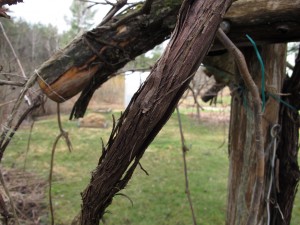
Old grape cane showing shaggy bark (center)
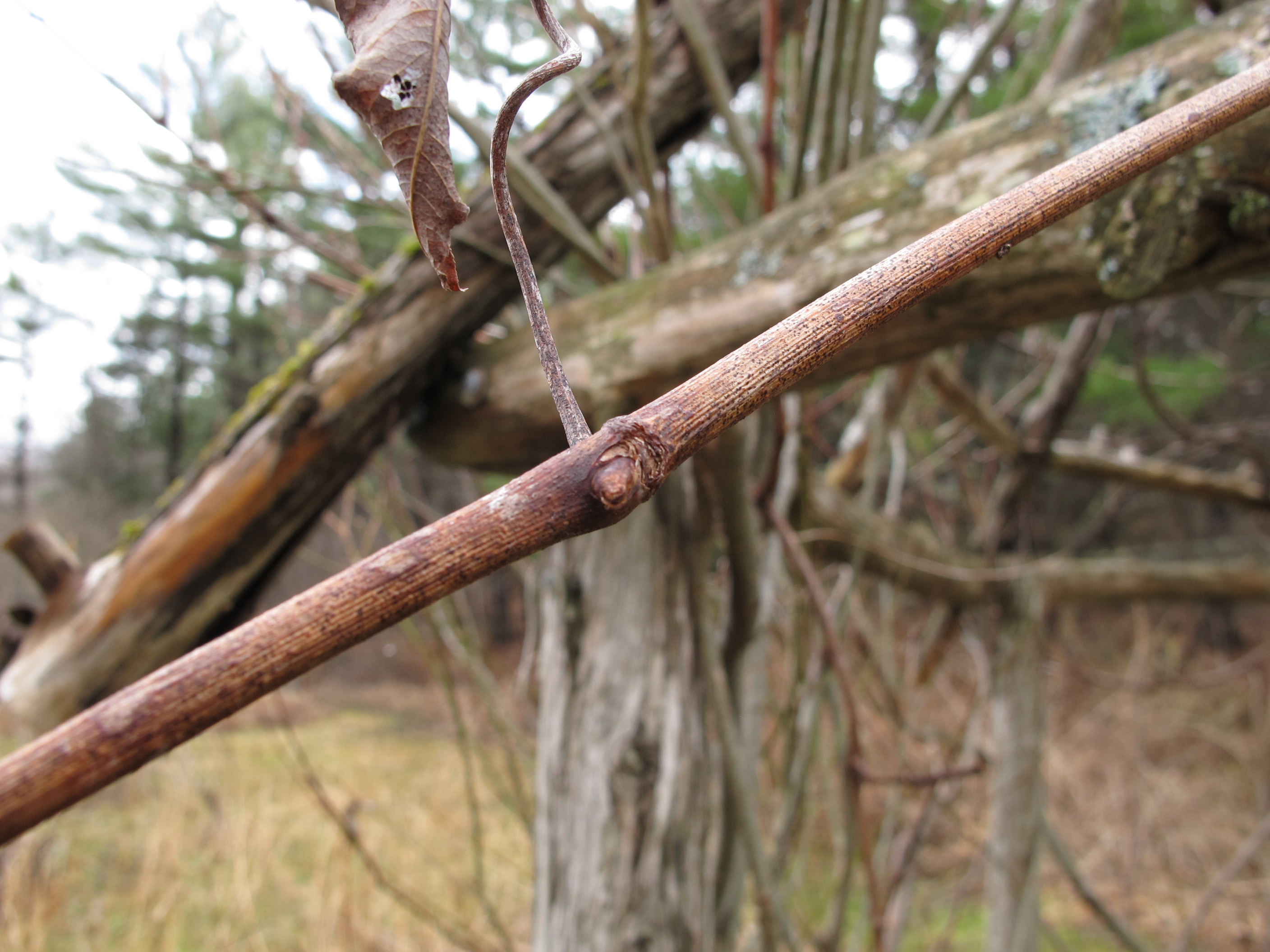
Many people avoid pruning their grapes because the task seems daunting. Here is the key: this year’s fruit grows on new shoots, or canes, that grow on last year’s canes, not older wood. Last year’s canes are smooth and tan, while older wood is darker and has shaggy bark.
Each of last year’s canes needs to be shortened up so that there are just a few buds that will produce new canes this year. Buds are obvious if you look carefully: small protuberances on last year’s growth. Some grapes have buds close together near the base of last year’s canes. Others have them well spaced out, say a foot apart. In either case, you only need a few buds to produce this year’s fruiting canes. So in the first instance, you prune back hard, leaving just a short spur with a few buds. In the second, you need to leave last year’s cane longer in order to have an adequate number of buds (and hence, new fruiting canes).
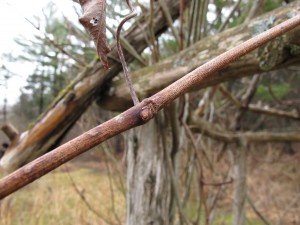
First year grape cane with bud
My friend Lewis Hill (1924-2008) wrote a nice book about pruning : Pruning Simplified. In it he warned that if you have an overgrown grape vine that has not been pruned in many years, you should spread out the work over a few years. The goal is to “get the vine back to a single trunk with four strong, well-spaced branches.”
Last year I worked hard at reducing the size of my blackberry patch and creating a pathway down the middle of the patch. It’s time now to do so again because blackberries are very vigorous and spread by root. A single row of plants can easily become 10 feet wide and virtually impenetrable unless worked on every year.
Blackberries produce fruit on canes that grew last year. Last year’s fruiting canes are dead, and need to be removed. Look carefully and it will become obvious what’s what. Last year’s canes are light brown and lifeless. This year’s fruiting canes are darker colored and covered with buds at this time of year. Your job is to cut off the dead ones at the base and remove them.
I use a pole pruner (an ARS brand) to cut off the canes, and then by gently squeezing the grips on the pruner, I use it to pull out the cut cane. This keeps me out of the blackberry patch – and without cuts or scrapes from the sharp thorns.
I use my lawnmower to control the spread of my blackberries. New shoots pop up in all directions, and each will grow into a new plant if allowed to grow. I have a row of blueberries 5 feet or more from the blackberries, and shoots regularly pop up amongst them. I put on heavy leather gloves and try to pull them up, roots and all. I put down a thick layer of wood chips on my walkway up the middle of my patch.
Conventional wisdom has it that March is the time to give lilacs some wood ashes or limestone to keep the surrounding soil near neutral. I disagree. You can do that any time of the year. March is just when of the past farmers cleaned out their wood furnaces and had the time to spread ashes. But now is a good time to do so if you haven’t already done so.
Lilacs do not flower well in highly acidic soil. Because we get acid rain, our soil tends to get more acidic each year unless we add something to counteract that acidity. I should note that I don’t add limestone or wood ashes to my vegetable garden because it is very high in organic matter, and is very biologically active. The microorganisms help keep the soil near neutral.
I sprinkle wood ashes around a mature lilac at the rate of 1-2 quarts per plant using a one-quart yogurt container or coffee can. I don’t bother stirring the ashes into the soil as the first rain will wash it in. Correcting the soil pH will not affect this year’s blooming, but will help next year. This year’s buds are already there and ready to bloom.
My last job this week is to sprinkle some organic slow-release fertilizer around my bulbs plants like daffodils. This will slowly enrich the soil and provide needed minerals to the bulbs so they will remain vigorous in years to come. I like to do it now because I can see where the bulbs are growing – in the fall the foliage will be long gone.
So get outside and get to work. We gardeners don’t get any time off now – or for that matter, until next winter. It’s what keeps us young!
Henry Homeyer may be reached at henry.homeyer@comcast.net. His Web site is www.Gardening-guy.com. Henry lives and gardens in Cornish Flat, NH.
Hastening Spring
Posted on Wednesday, April 17, 2013 · Leave a Comment
I don’t know about you, but I’m tired of cold, raw, rainy days. And I really don’t want any more snow or slush. We’ve had some good warm and sunny days, but I know I shouldn’t expect them consistently yet. There are things I do to make me feel like spring and summer are on the way, even when it’s sleeting outside.
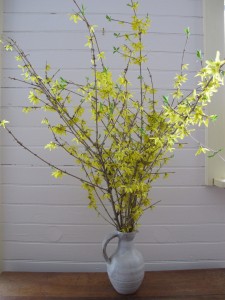
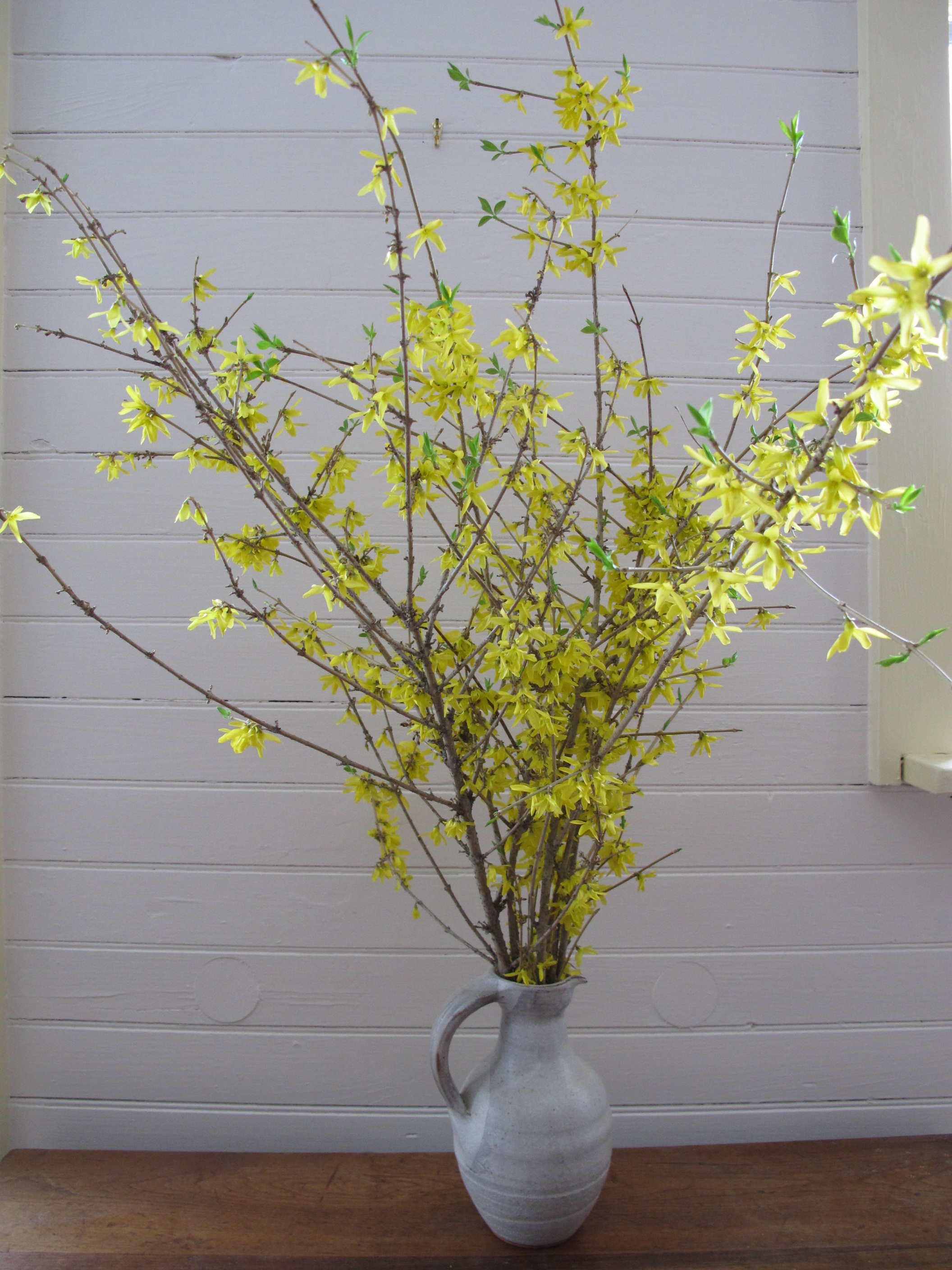
Forsythia
A couple of weeks ago I picked some stems of forsythia, that old fashioned shrub that displays mounds of bright yellow flowers long before most other shrubs bloom. By now these seemingly lifeless branches are loaded with flowers in full bloom on a sunny windowsill in my house.
The key to forcing forsythia is to pick twigs that grew last year – young, vigorous stems – that are loaded with pointy buds about a quarter of an inch long. These are the flowers buds. Cut stems 18-24 inches long and put in a vase on a sunny windowsill. It took less than a week for mine to bloom.
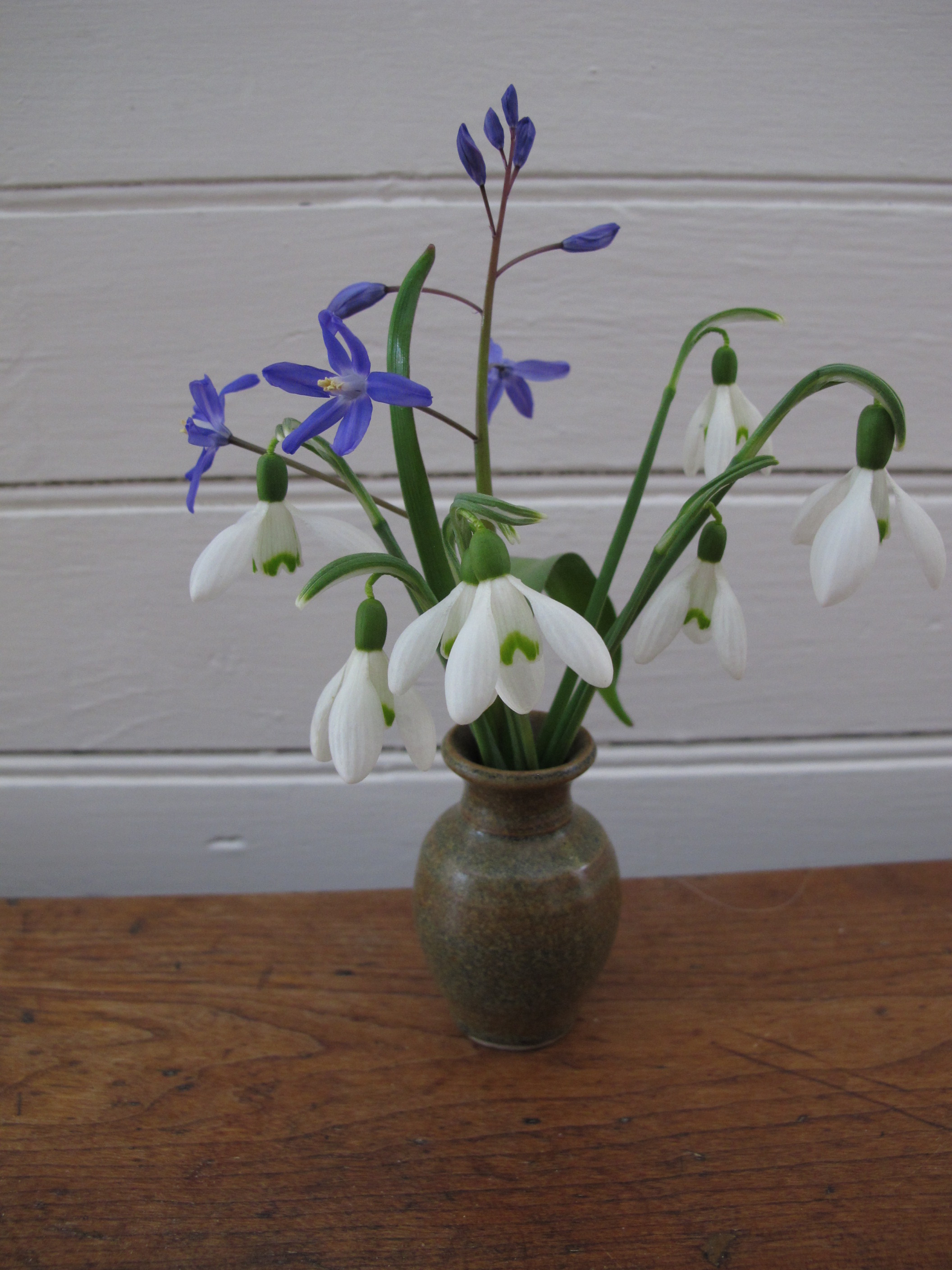
I pick flowers now, too. Right now I only have two things in bloom outdoors: snowdrops and glory of the snow. Snow drops are demure, understated white flowers that only grow 4-8 inches tall, and tend to stay on the shorter end of that range. I have a thousand or more in bloom now because I started transplanting them from my parents’ gardens back in the 1980’s and they have naturalized and spread by seed. They have spread out into my lawn, blossoming in clumps of a dozen or so.
Glory of the snow (Chionodaxa spp.) is another great early spring bloomer. I have the classic blue/purple ones as well as some less common pink ones. These diminutive beauties look up, showing their open throats, which are white and contrast nicely with their blue petals. Many gardeners ignore the small bulb plants, focusing on daffodils and tulips which are more dramatic when they bloom. But I like early blossoms, and have planted plenty of these small wonders, too. The time to plant is in the fall, September and October.
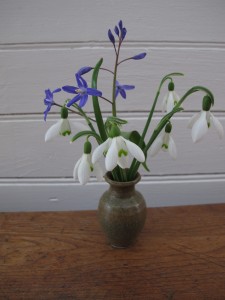
Snow Drops & Glory of the Snow
Now is the time to order spring bulbs – I know where the holes are in my planting space, and I know what I need to order. So I called Becky Heath, co-owner of Brent and Becky’s Bulbs in Gloucester, VA to order up more spring bulbs to plant next fall (www.brentandbeckysbulbs.com or 804-693-3966). I asked for the very earliest of crocus, as I mostly have late-blooming ones. Becky suggested ‘Blue Pearl’ and “Blue Bird’ (both varieties of Crocus crysanthus) as good early bloomers, and a species called Crocus tommassinianus.
I gave Becky my credit card info and asked her to fill up a $50 order with anything nice that is early. Later that day she emailed the details of the order which included some winter aconite (Eranthis spp.), a nice low yellow flower, and 2 species of Scilla, great deep purple flowers. I have both, but not enough. They will ship bulbs in September, but for now I will just mark the spaces where they should go with tags. Brent and Becky’s is one of the few remaining family-owned bulbs companies, and I like to support any family-run business that I can.
Pussy willows are starting to appear along my stream, and I will go pick some this week. The gray furry “pussies” are actually the flowers of a type of willow. If you pick them when still closed up, put them in water to get them to open. If they look fine when you pick them, just place them in a dry vase. They will not change in appearance if you keep them dry. In water they will go through their life cycle, producing yellow pollen and dropping it on your table.
If you planted tulips last fall, the foliage should be showing by now. Deer love tulips, and some of my gardening friends have given up on them because of the deer. My suggestion? Put chicken wire teepees around clumps of tulips now, and keep them in place until after they have blossomed. And pick the blossoms when they are just about to open up. Most of us spend more time in the house than in the garden, so having cut flowers indoors makes sense to me.
When I shopped for groceries recently a got a nice slump of daffodils in bud, 10 stems for $3.99. I have daffies coming along outside, but I want some now. But store daffodils can be iffy. Sometimes they don’t open up, or appear dehydrated and wrinkly. You are always sure to get good flowers from a florist, or from a store with a good floral department. In my experience, big grocery stores don’t always have great ones. It is always important to cut off ¾ of an inch of stem and put in water as soon as you get home.
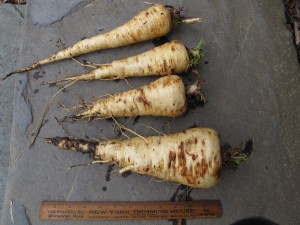
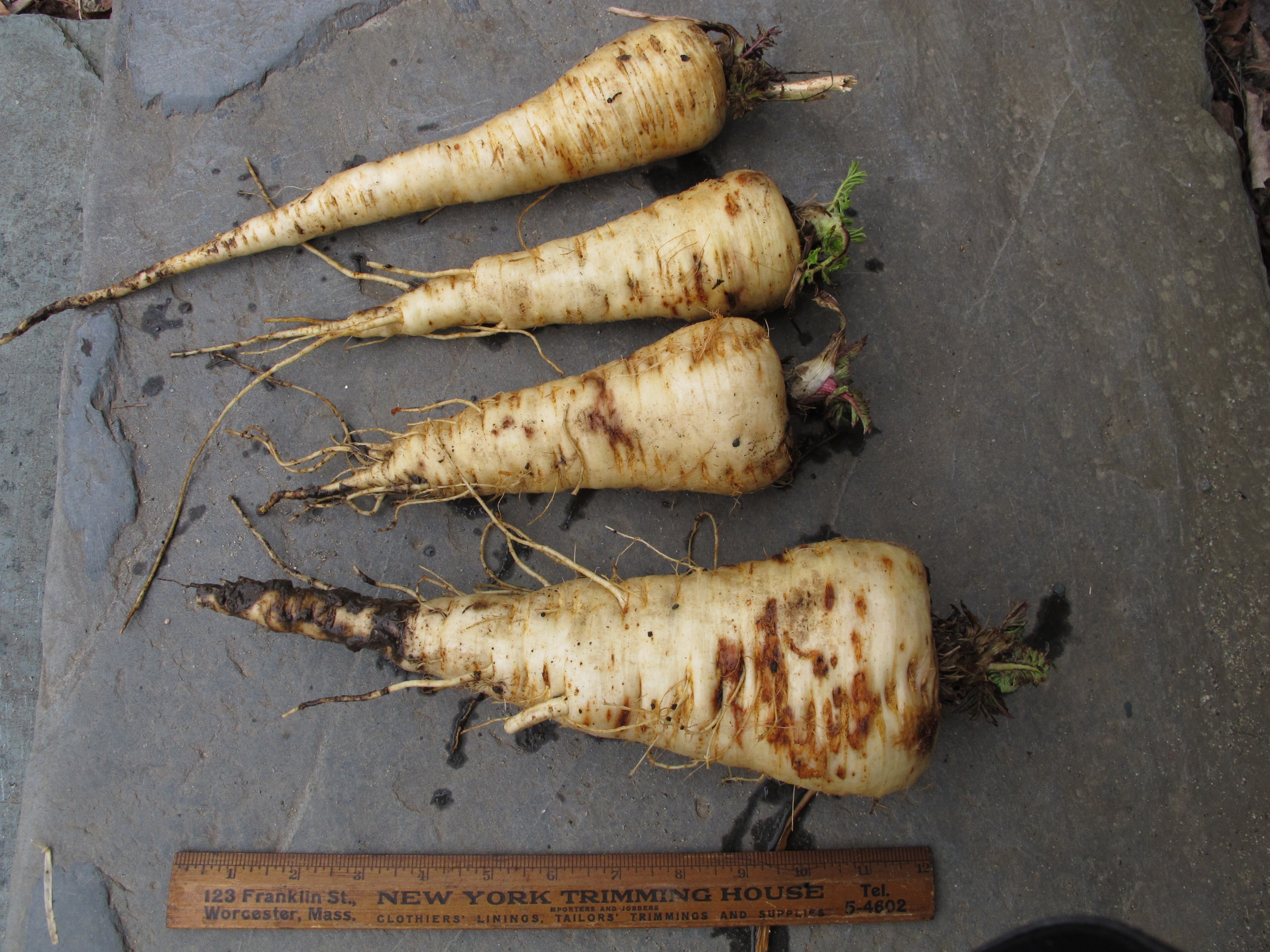
Parsnips
Lastly, I know summer is coming when I eat my first fresh garden vegetables. This year that was on April 11, when I dug some parsnips. Parsnips look like big white carrots, and are delicious after a winter in the ground, getting sweeter. I boil them, then serve with new maple syrup, raisins and walnuts. Spring is on the way!
Henry’s website is www.Gardening-guy.com. You can reach him at henry.homeyer@comcast.net or P.O. Box 364, Cornish Flat, NH 03746.
Growing Windowsill Greens
Posted on Saturday, April 13, 2013 · Leave a Comment
I grow a lot of my own food and strive to be as self-sufficient at possible. So I store, freeze, can and dehydrate lots of garden produce each summer and fall. I hate buying produce at a store if I can grow it myself, but so far I’ve never been able to produce winter greens or tomatoes. Not until recently, however, when I read Peter Burke’s wonderful new book, Indoor Gardening: Seed to Salad in Seven Days .And although I still can’t produce my own tomatoes indoors, I’ve grown edible greens on the windowsill. It’s easy.
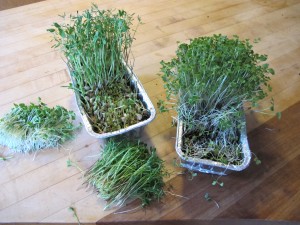
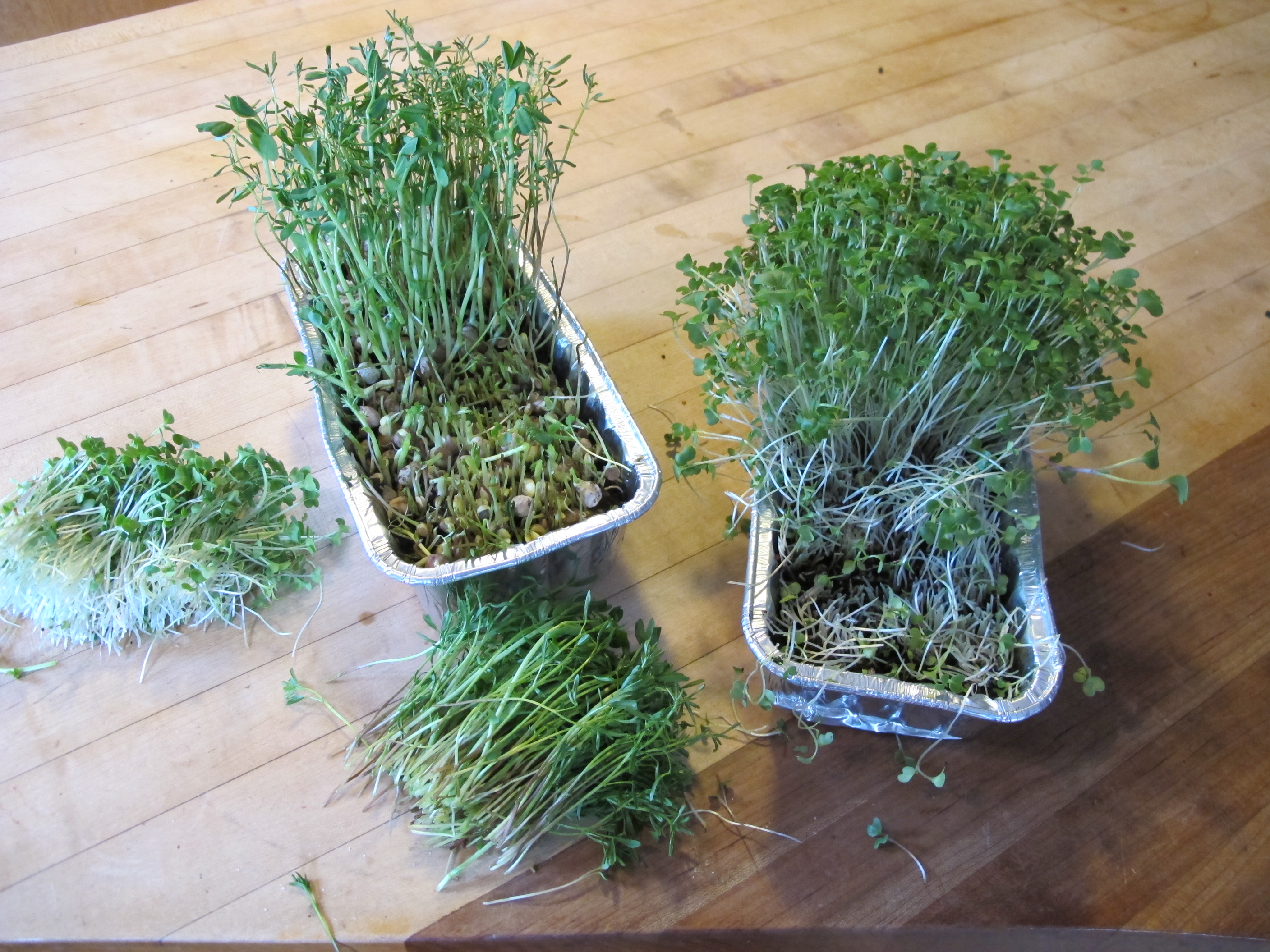
Harvesting Sprouts
Here’s the basic plan: you can grow sprouts of peas, broccoli, radish, buckwheat, sunflower or just about anything edible without lights or special equipment. You need a source of organic seeds, some soil-less potting soil, a little compost and some kelp meal, and some shallow containers (without holes in the bottom). I used “disposable” aluminum bread pans, the kind you would use to make a loaf of zucchini bread to give away, 4” wide and 8” long. Oh yes, and a windowsill, but it need not even be terribly bright.
I followed Peter Burke’s directions and soaked seeds overnight before using. A 4-by-8 inch container needs 2 tablespoons of large seeds like beans or sunflowers, or 2 teaspoons of small seeds like broccoli or radish. If you use the 3-by-6 inch size baking tin, you need only half that amount.
Meanwhile, I measured out a gallon of soilless potting mix into a plastic zipper bag and added 3 ½ cups of water. You need to do this ahead of time as the peat moss in the soilless mix is usually very dry, and it takes time to absorb the water. Peter recommends using a juice pitcher for measuring and pouring the mix. He starts sprouts every day, so he makes up lots of bags of mix at once.
The seeds are going to be placed on the surface of the “soil”, not planted in it. Their roots will go straight to the bottom of the container, so that is where the book says to place your “fertilizer” – 2 tablespoons of compost and 1 teaspoon of dried kelp (he pre-moistens it, though I didn’t). Add the moistened seed starting mix on top of that, leaving half an inch or so of space near the lip of the container.
After soaking the seeds for 6-24 hours, drain them by pouring them into a kitchen sieve, and rinse. Then spoon the seeds over the soil surface and use the back of the spoon to move them around, distributing them evenly. These seeds then need 4days or more to germinate and start growing. They should be in the dark for that phase. Peter Burke explains that folding a piece of newspaper so it is 6 layers thick and then soaking it will make a good cover to help keep out light and keep seeds lightly moist.
You need a warm, dark place to keep the containers during the next phase. I stored mine in a cool cupboard that was only 55 degrees, and they did not germinate in the 4 days that Peter suggested was to be expected. So I added some heat by putting an electric heat mat (the kind I use for starting seeds in flats) in the cupboard. That way I quickly got the temperature up to 65 degrees or more and they germinated in a couple of days. I left them in the dark for another day or two, as recommended, and the sprouts pushed the newspaper cover up and got 2 inches tall.
Then comes the fun part. I removed the newspaper and put the baking pans on the windowsill. The sprouts greened up almost immediately and started a growth spurt. Each day I marveled at this bright green food source growing on my windowsill, and gave a daily watering to keep the soil mix from drying out. Within 4 days they were 4 inches tall and ready for harvesting. Peter Burke explains in his book that you should harvest when sprouts are 4-7 inches tall and before they develop a second set of leaves, which can be bitter.
I gather that Peter Burke eats salads made entirely of sprouts, all kinds of sprouts. I mixed mine with some early spring lettuce mix from the store, and added cucumber and other standard salad ingredients. I like the flavor of the sprouts, and like watching them grow.
To learn more or to see plenty of very good color photos of the process, go to Peter Burke’s web site, www.thedailygardener.com and order his book. It’s available from him for $35 at P.O. Box 13, Calais, VT 05648.
As a grandfather and a former school teacher, I am always thinking of ways to get kids interested in growing things. Growing windowsill greens would seem to be a perfect Science Fair project, or a way to kids to like growing – and eating – healthy vegetables. And for the rest of us? Growing good food made quick and easy.
Henry Homeyer is the author of 4 gardening books, and a new children’s novel called Wobar and the Quest for the Magic Calumet. Learn more at www.henryhomeyer.com.
Starting Seeds Indoors
Posted on Wednesday, April 3, 2013 · Leave a Comment
Wind in the Willows, one of my favorite children’s books, has a great quote that came to me recently. The water rat says to his friend, the mole, “Believe me, my young friend, there is NOTHING–absolutely nothing–half so much worth doing as simply messing about in boats. Simply messing,’ he went on dreamily: `messing–about–in–boats; messing—-“. At that point he crashes into the bank and comes back to reality.
What, you might fairly ask, does that have to with gardening? Well, at this time of year I would substitute the word “seeds” for “boats”. Messing about with seeds is wonderful – for the soul, for the mind, and later –for your garden. It’s time now to start planting seeds indoors for summer vegetables.
I generally plant tomato seeds indoors around April 10, sometimes a bit sooner, for planting outdoors 8 weeks later. I have already planted onions, celeriac, a few special peppers and lots of lisianthus (an annual cutflower). Those all need more than 8 weeks. Later, 4-5 weeks before planting time in June, I will start my squash and cucumber seeds in 3-inch pots. By starting them indoors and putting out good-sized plants (they grow fast) I am able to prevent them from being eaten up by striped cucumber beetles. Those beetles can devour a freshly germinated seedling outdoors in a single night – but won’t do much to plants with 6-inch vines.
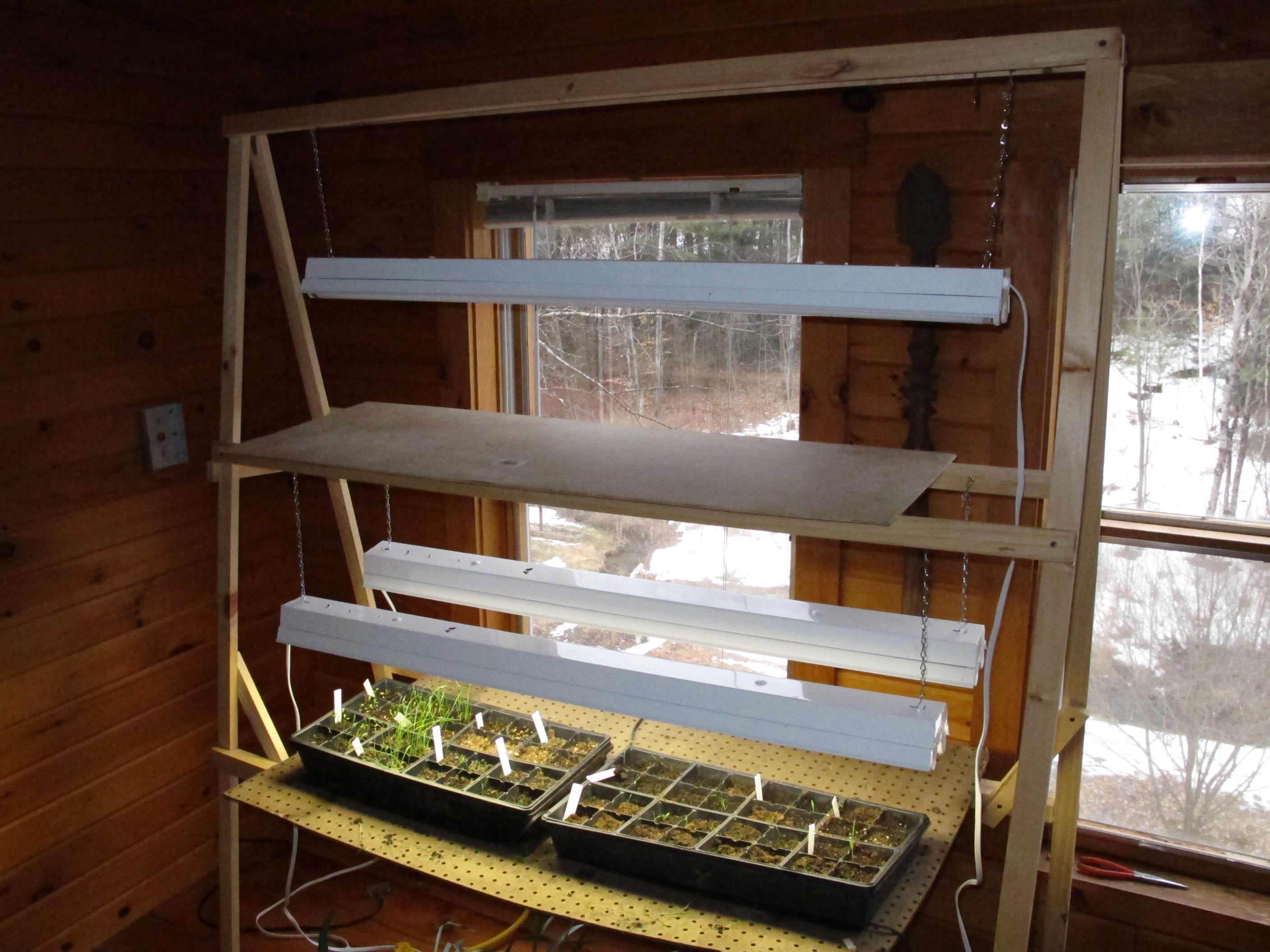
There are a couple of keys to success growing tomatoes and other seedlings indoors. Most important is having adequate light. You really cannot grow healthy seedlings by depending on sunlight on a windowsill. You need lights – either the new-fangled LED lights for plants, or T-8 fluorescent fixtures that are 4-feet long and provide good light for seedlings. You do not need those special (read expensive) “Gro-Light” bulbs with special wave lengths (equivalent to the sun) for starting seedlings.
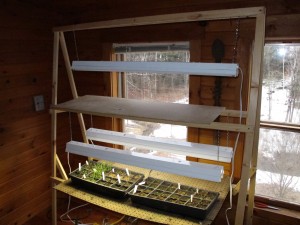
Plant Stand
Last year in my column I wrote directions for building a simple A-frame plant stand, so will not repeat them this year. You may find it at my web site, www.Gardening-Guy.com. Just go to the search engine box and type in plant stand. Or, if you prefer, design your own or buy a light stand from your local garden center or from Gardeners Supply (www.gardeners.com). But you do need lights to succeed.
It is also critical that seeds and the potting mix you use do not dry out, especially when the seeds are just starting to open up and send out little roots and shoots. They are particularly vulnerable then. So check your seeds every day and water as needed.
You may also get clear plastic covers to fit over your growing flats. These allow light to pass, but hold in water. Water will evaporate, then condense on these covers and rain down gently on your seedlings. You could accomplish the same effect with plastic wrap but then, as they germinated, the plants would butt heads with the wrap. The plastic covers provide an inch or two of growing space, allowing some to grow while others are still waking up.
Commercially prepared seed starting mix is largely composed of peat moss. Peat moss has no “food value” to plants. It provides a light, airy space that roots find easy to penetrate, and it holds water. Most have some fertilizer added, but this soon disappears either by washing away or being used up by the plants. So, as your plants get bigger, plan on giving them some liquid fertilizer – or they will languish.
Seaweed or fish fertilizers are readily available, and are better than chemical fertilizers – they provide a full menu of minerals, including the micronutrients important for plants. Fish fertilizers may offend some delicate noses when growing plants indoors, however.
An alternative to growing seedlings in straight potting mix is to mix it 50-50 with compost. It probably makes sense to buy compost for this even if you make your own. Why? Because commercial compost should be weed-free and your own compost probably is not. Unless you know what each seedling looks like when it first germinates, you may end up babying weeds along – or pulling out your seedlings. This can be a real problem if growing flowers that you have not grown before.
Lastly, think about planting seeds by the position of the stars and moon. I know, I know, it sounds pretty “out there”. But last year I used the Stella Natura (www.stellanatura.com) planting calendar which uses biodynamic principles to determine when to plant or transplant, and I saw real differences when I experimented with planting in the designated blackout times. Seeds are still one of life’s mysteries – all that life packaged in such a small container. Who knows what really affects them? Not me, that’s for sure.
Henry may be reached at henry.homeyer@comcast.net. His web sites are www.Gardening-guy.com and www.henryhomeyer.com.
House Plants That Are Really, Really Easy
Posted on Wednesday, March 27, 2013 · Leave a Comment
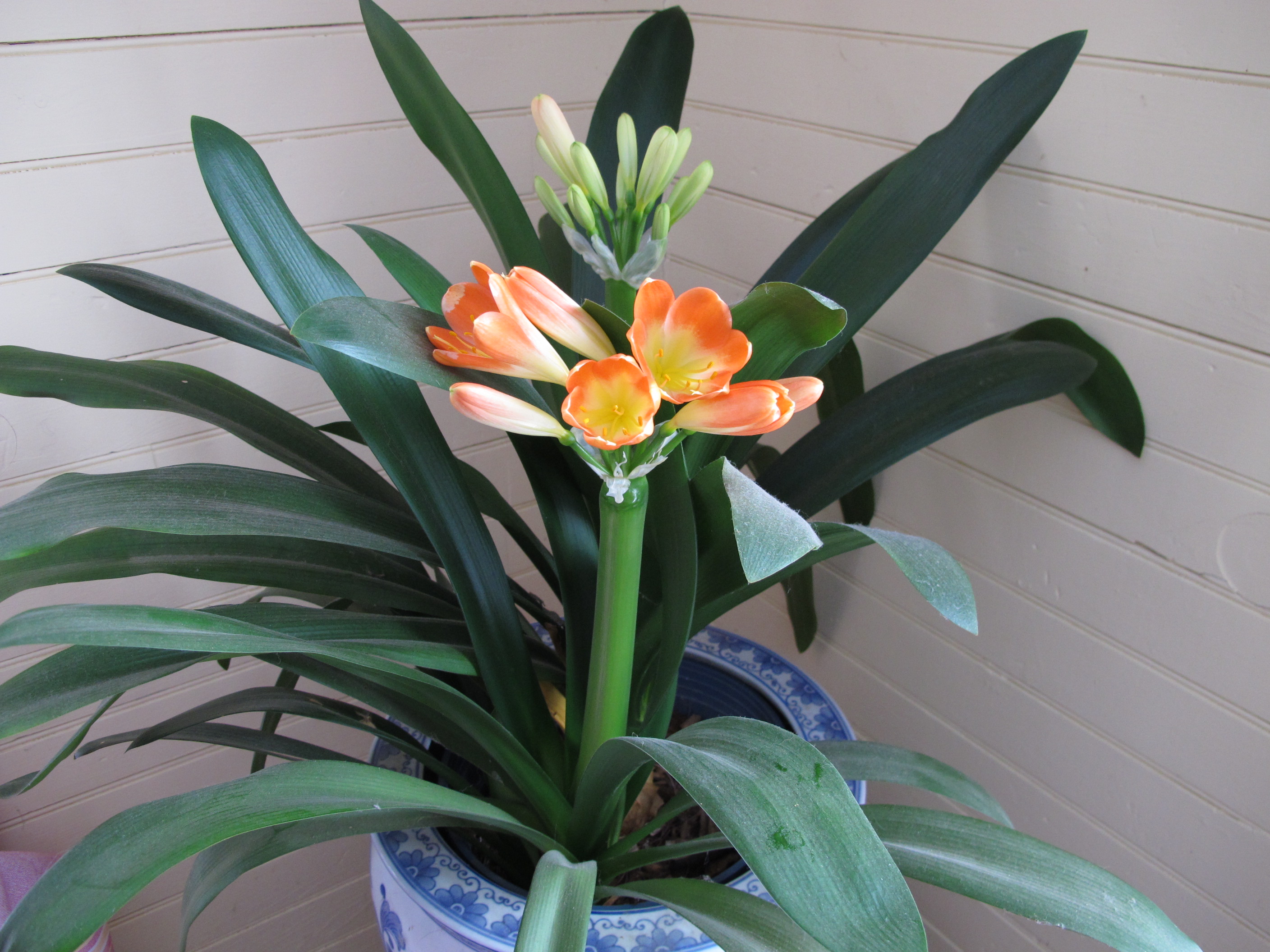
I recently went over to a houseplant and gave it praise. I said, “Thank you clivia, for producing flowers for me. I know I don’t deserve them because I don’t do anything for you. I don’t even wipe the dust off your beautiful green leaves. You are so undemanding that sometimes I’ve gone a whole month without watering you – and didn’t wilt or complain. And now you are beginning to flower. Thank you.” I really did say that. And I meant it.
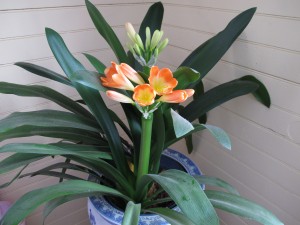
Clivia
Clivia, also known as Kaffir lily, is a plant that comes from South Africa where it lives in deep forests with low light conditions and survives much of the year without rain. So it is an ideal houseplant. It has18-24-inch glossy strap-like leaves and once a year it produces a tall flower stalk with a cluster of orange blossoms. I haven’t done anything for mine, and it has produced two more plants, offsets from the parent plant. And now one of those two offsets is preparing to bloom, too.
But bloom time is unpredictable for my clivia. Keeping it quite dry in the winter in a cold room and then giving it a little liquid fertilizer now is supposed to help it wake up and bloom. I’ve never given mine fertilizer, and still it blooms. One year it bloomed in August and won a blue ribbon at the Cornish Fair.
I like keeping an aloe plant in the house to use occasionally on a burn or a bothersome bug bite. You have bought hand lotion with aloe vera in it, I’m sure. The aloe plants available for purchase have similar healing properties – just cut off a leaf and rub the cut surface on a burn, spreading its juices. Again, I do nothing for it. It sits in a north window, getting little or no direct sunlight. And it only gets watered very occasionally. Yet it has survived for 25 years or so. Benign neglect.
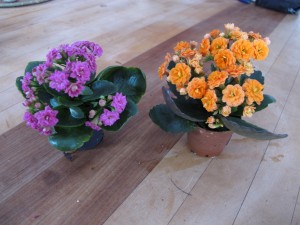
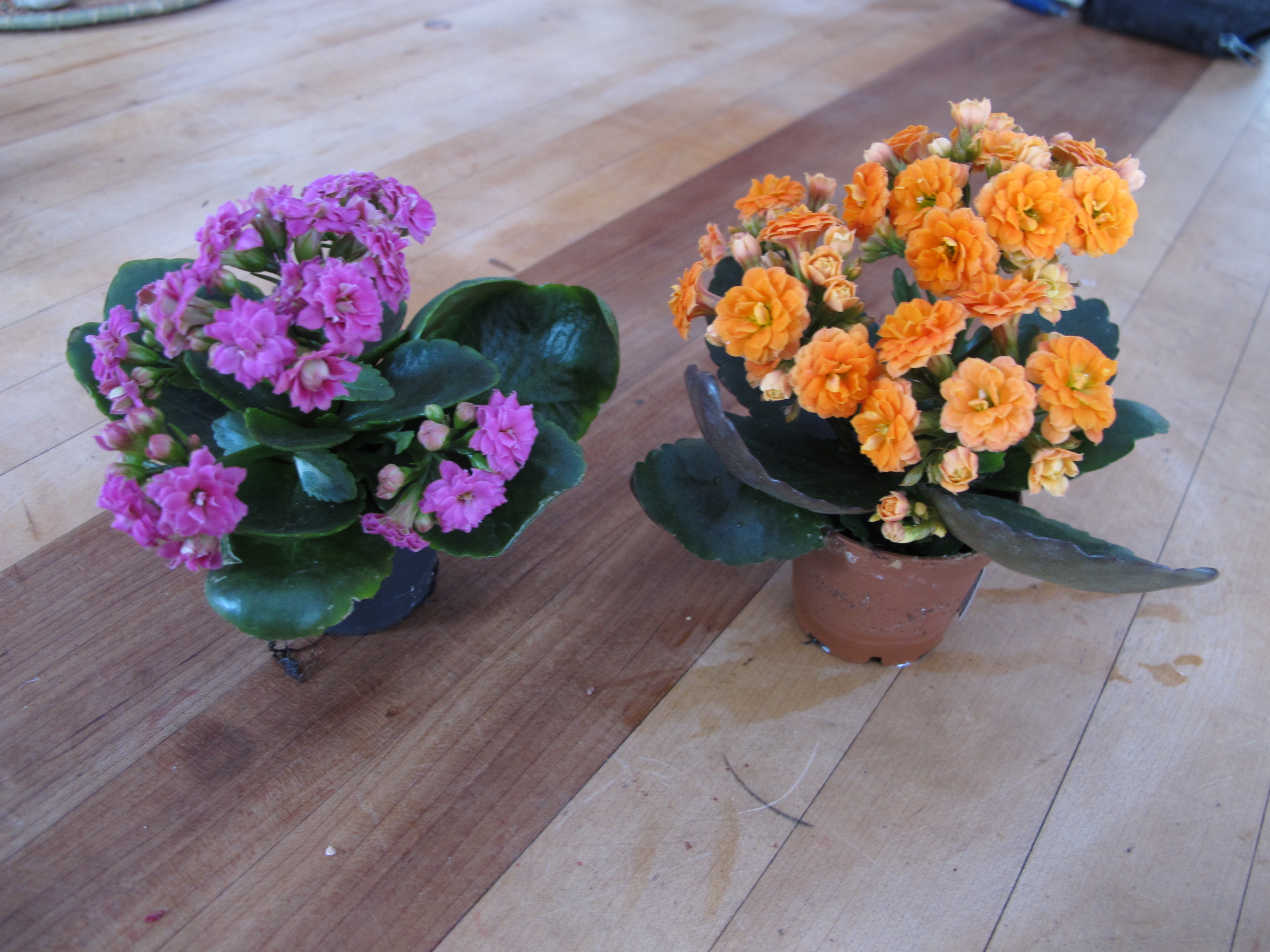
Kalanchoe
At the Vermont Flower Show I bought some perky little plants that I’ve had before: kalanchoe. Think energizer bunny. They are commonly sold in grocery in 2-inch pots, loaded with little pink or yellow or orange blossoms. And they just keep on blooming, for months, it seems. I keep mine on a morning-sun windowsill, and do actually give them water once a week. If I forget to water they droop, but quickly recover with a good soaking. I only paid $3.99each and they keep blooming. What’s not to like?
Then there is the pony tail palm (Beaucarnea recurvata). This is a houseplant that reminds me of a soccer ball in a pot, topped with a woody stem and a big head of green strap-like leaves thrown off in all directions. I keep mine in a 12-inch deep pot and still the leaves are so long they hang down to the table.
In the summer I leave my ponytail palm on the deck where it gets a few hours of sunshine each day. In the winter I keep it in a west-facing window and only water once a month or so – the bulbous base stores water, and it goes somewhat dormant in winter anyhow.
Swedish ivy (Plectranthus sp.) is another “you can’t kill me” plant. It is not an ivy, but does make long stems that will hang down and out of a pot. The leaves of mine are all green with purplish stems. Occasionally it will produce tiny light blue flowers.
The great thing about Swedish ivy is that it is so easy to start new plants. Just cut off a few stems, put in a jar of water, and they will root. Then pot a group of them up for a nice pot of foliage. It does like more water than the other plants discussed above, but it always recovers if I let it dehydrate. It can appear dead, but so far, mine has always bounced back.
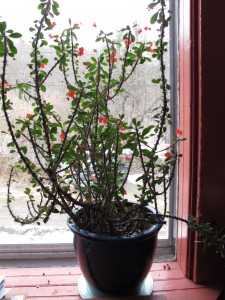
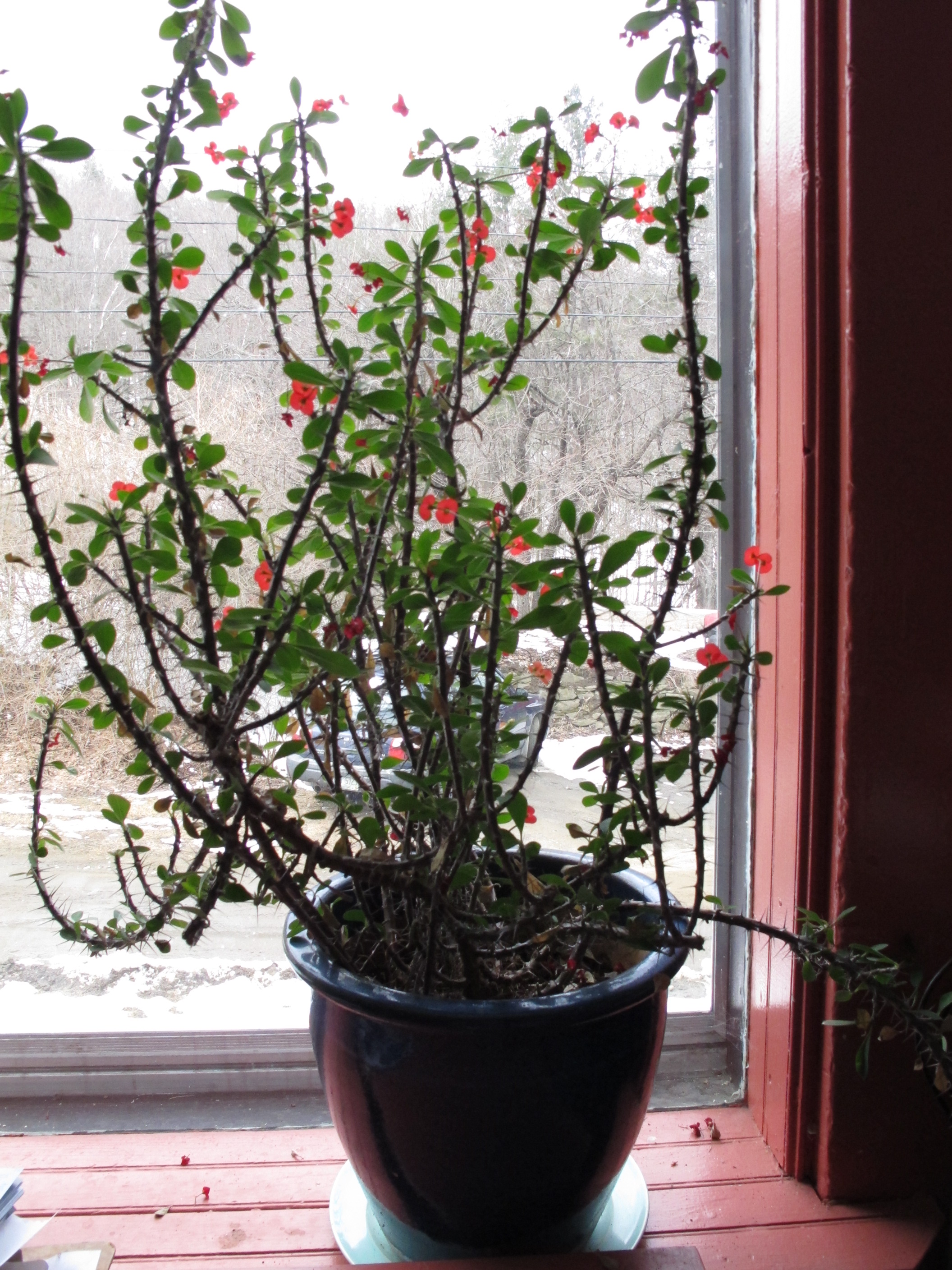
Crown of Thorns
The last of my favorite tough-as-a nail house plants is crown of thorns (Euphorbia milii). I have one that is at least a hundred years old, so you know that it has had some rough treatment in its day. I don’t like the thorns, but I do like that it produces dozens of nice small bright red flowers all winter in a west-facing window. Like the others, it never seems to complain when I ignore it.
The worst thing you can do for most houseplants is to water too often. Most reliable, rock-solid houseplants come from the tropics, often from South Africa. Most can go a month or more without water – it’s what they have to survive in the wild.
I don’t fertilize houseplants. In nature no one comes along with liquid fish juice or a chemical solution to “help” them. Fertilizer will push growth – but I don’t need bigger house plants. I need easy houseplants – and probably a few less than I have. Re-potting helps many houseplants, but those I mentioned above I have never re-potted, either. Crown of thorns is too prickly. I’ve read that clivia roots are almost impossible to pull apart. So I just say thanks to my plants, or offer them a few words of encouragement, and they do just fine.
Henry’s newest book, Wobar and the Quest for the Magic Calumet is a children’s chapter book about a boy born with a magical mustache and the ability to speak to animals. Learn more at www.henryhomeyer.com. Reach Henry at henry.homeyer@comcast.net.
It’s Time To Work On Those Old Apple Trees
Posted on Wednesday, March 20, 2013 · Leave a Comment
I recently spent 3 hours in an old wild apple tree, bringing it new life. Apple trees need to be pruned from time to time, and this one had not been worked on for several years. Even wild apples, those planted by birds, can be wonderful additions to the landscape if nicely pruned. The fruit of wild apples is not tasty, but the flowers and form can be a delight to the eye. You can work on apple trees of any kind from now until the buds begin to open. That isn’t until sometime in May, depending on the weather and the variety you grow.
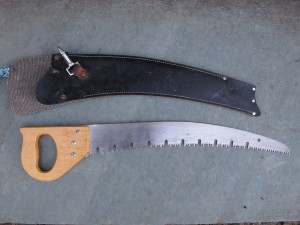
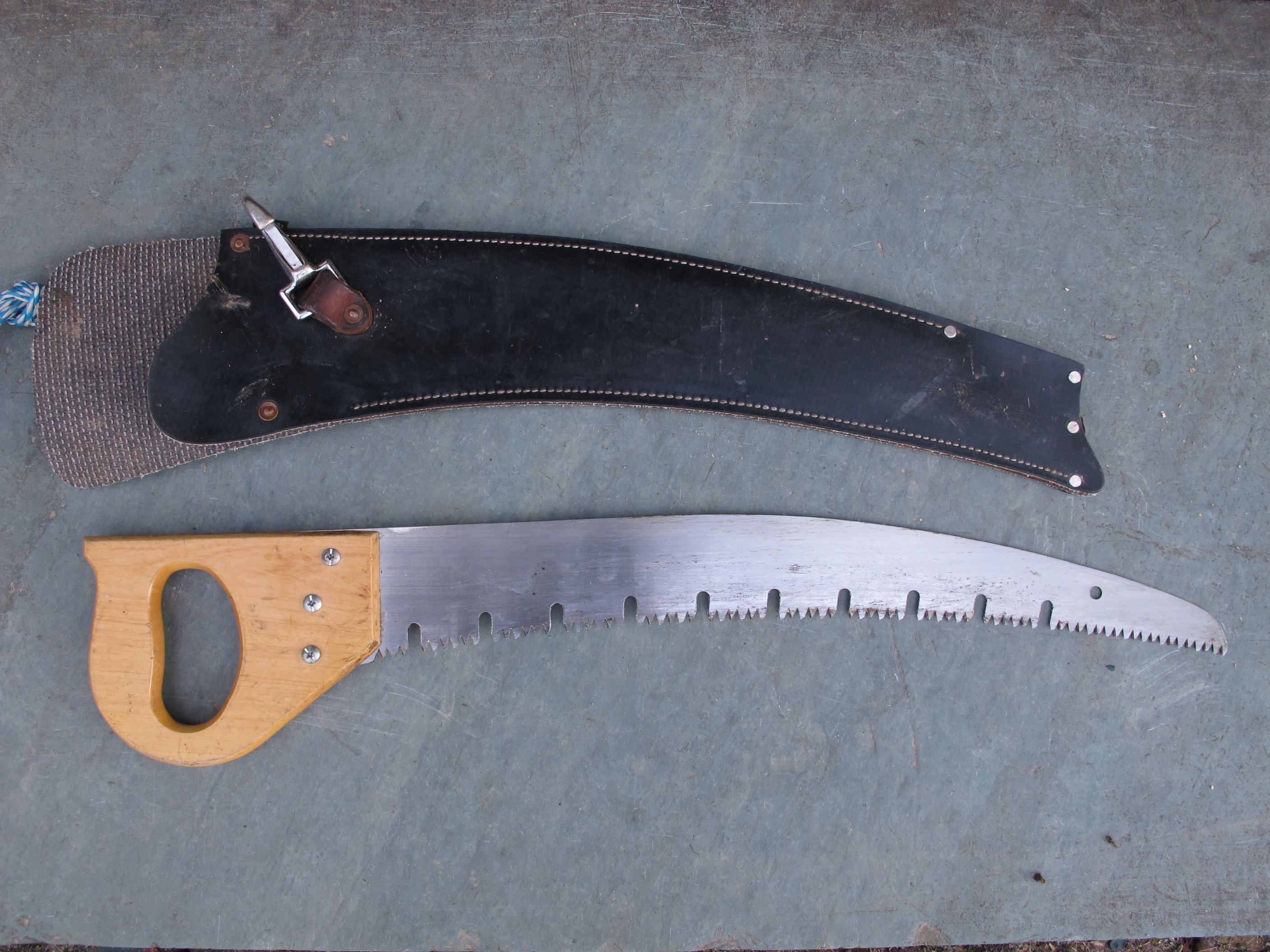
Corona Pruning Saw
Before discussing how to prune, a few safety reminders are in order. Always wear eye protection when pruning. Safety glasses are best, but sunglasses or prescription glasses are better than nothing. When cutting branches above your head, wear a cap with a brim and try to stand up-wind of the cut. You don’t want to fill your eyes up with sawdust, especially if on a ladder or perched on an upper branch.
Wear gloves and a long-sleeved jacket. Those will help to protect your skin from cuts if the saw slips. As you finish a cut, slow down and reduce pressure on the blade so that the saw will be less likely to surge forward when it finishes the cut. Never steady yourself by holding onto a branch below what you are sawing. Lastly, use good, sharp tools – a dull saw will be a frustration and can be a danger.
I like to walk around a tree several times to study it before I begin to prune. I want to decide which branches I will take out before I begin. If working with someone (which is always good) I like to hear what my co-worker thinks should be removed.
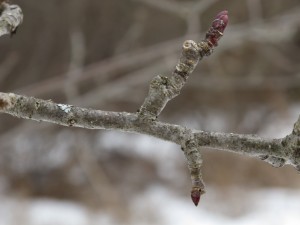
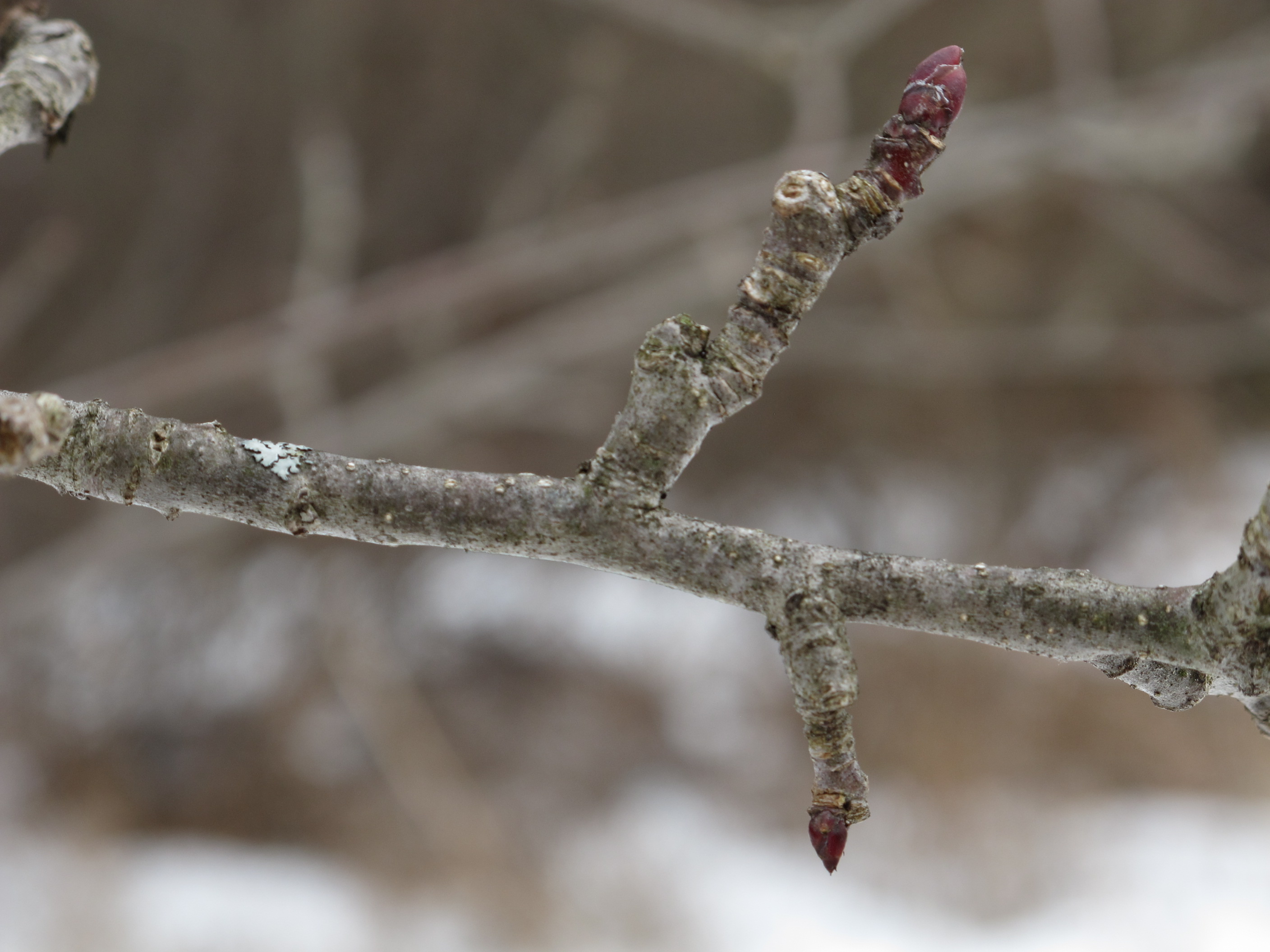
Fruit Spurs
When I teach pruning I tell people that the goal of pruning is to thin out the canopy so that sunshine can get to each leaf. This will also allow for good air circulation which will help to reduce fungal diseases. I like to say a bird should be able to fly through the tree without getting hurt.
Don’t make cuts flush to the trunk or a larger branch. But don’t leave 3 inch stubs, either. Leave the wrinkled bark where the branch originates. That part is the ‘branch collar’ and it is where the branch will heal and scab over.
The tree I pruned recently was mature but healthy; it had no dead branches or signs of disease. Normally I remove dead wood first.
Next, if 2 branches are rubbing or in danger of fusing together (because they are growing so close together), I remove one of them. On this tree, a four-inch diameter branch was rubbing against and fusing with another, so I removed it in a 2-part procedure. First I reduced the weight of the branch by lopping off most of it. This made the finish cut easier. A heavy branch is likely to snap off and tear the bark before the cut is completed.
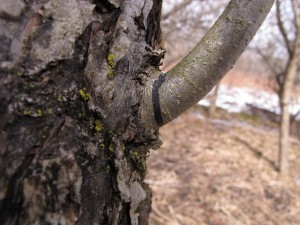
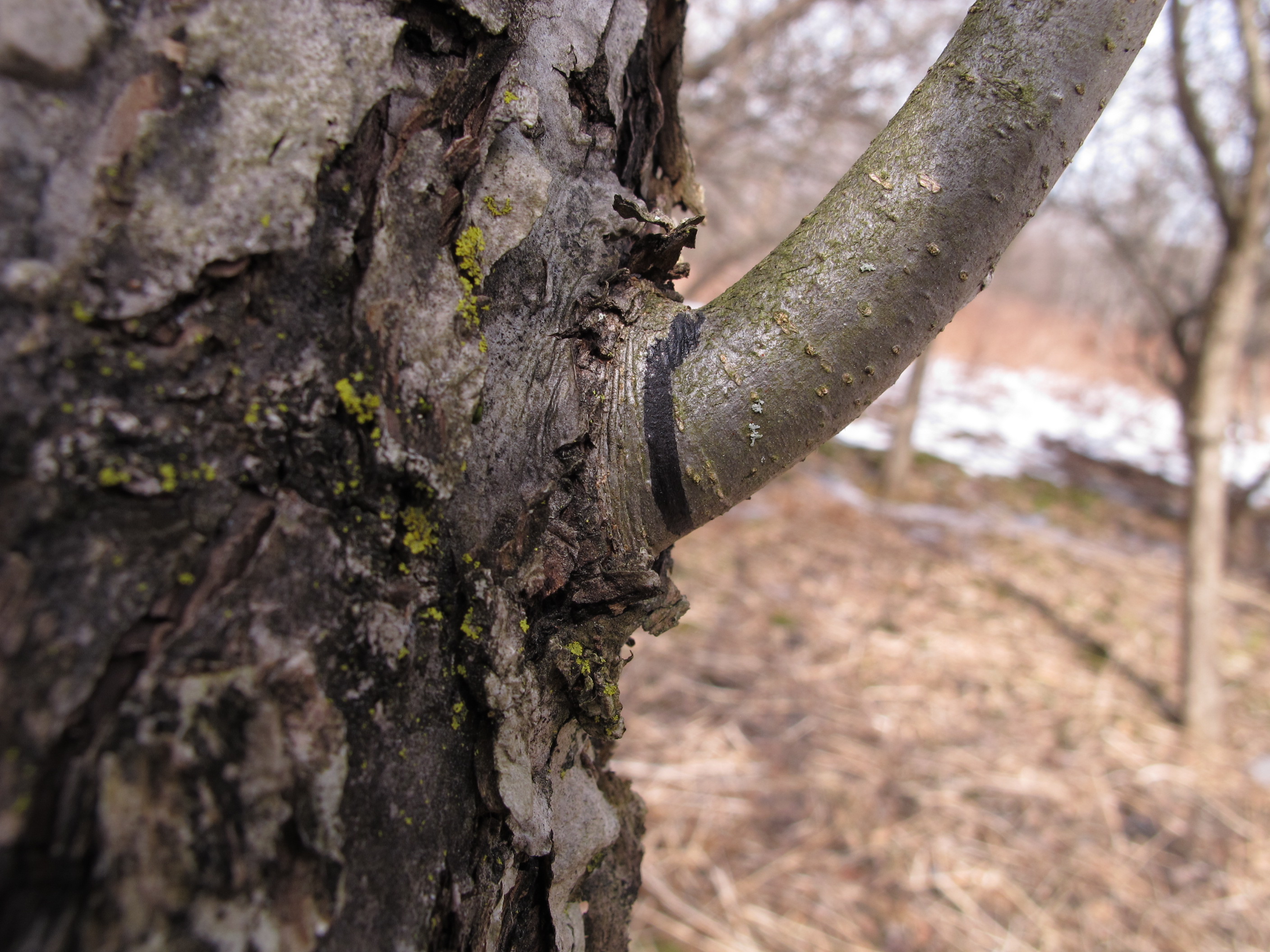
Prune Past Black Line
It was an awkward cut because the branches were so close together. I used a magic marker to draw lines to show me where to cut. This guided me as I angled the saw up to the exact spot I was aiming for as I completed the cut. I used a 21-inch scimitar-shaped pruning saw for the job. It has big teeth that make the job easier than a smaller saw, and unlike a bow saw, it can get in relatively tight places. It is a Corona brand saw, a model RS 7160that I bought from OESCO, a tool supplier in Conway, MA (www.oescoinc.com).
Branches that are at roughly a 45 degree angle from the leader generally produce the most fruit. Vertical shoots, on the other hand, are not very productive and should be removed. They start out as “water sprouts”, little pencil-sized shoots but will grow to be large if not removed. You should snip them off with hand pruners even though they will reappear next summer. However, if you do a good job of opening up the tree to sunlight, you may get fewer of them.
Blossoms and fruit appear on little fruit spurs, generally 3-4 inch twigs with a few larger buds. Fruit grows on spurs that are at least 3 years old. Each bud will produce more than one blossom and a few leaves. If you take a few branches with fruit spurs and place them in a vase, they will eventually bloom inside the house – a real treat for me. Other buds will just produce leaves, but even those are nice at this time of year.
I removed several large branches in the interior of the tree. It’s always a good plan to make a few cuts of larger branches than lots of little cuts. Don’t think of pruning as “cutting off an arm”. Pruning helps the tree to be healthy and to produce more fruit and flowers in future years.
So have at it. Go outside on a sunny day and start pruning. Take your time. Do the easy stuff first. You’ll gain confidence as you go, and, with time, your tree will turn into a piece of art.
Henry Homeyer’s web sites are www.henryhomeyer.com and www.Gardening-Guy.com.

 Click Here to buy from Cobrahead