Window Boxes: Something Everyone Can Have
Posted on Tuesday, August 8, 2023 · Leave a Comment
You may not have the time and energy to weed and maintain lovely perennial flower beds – or even to grow a few tomatoes, carrots and beans. But if you love flowers, you can have a window box or a big pot of flowers on your deck. They can add a punch of color all summer long. And it’s not too late to start now.
Before you get too excited about planting flowers at this time of year, visit your local garden center, farm stand or other source for plants. Some places sell out by the end of June, others keep nice annual flowers coming all summer long. And some are already selling chrysanthemums and fall asters which will provide nice color for the weeks ahead.
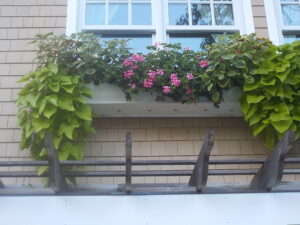
Caroline Storrs waters her window boxes every day
I recently visited Caroline Storrs of Cornish, NH to look at her window boxes as she told me hers were in their full glory now. Her husband, Peter, is a retired building contractor who built her window boxes for her. He used a synthetic wood made from PVC plastic for the window boxes. That material is more expensive than wood, but does not rot, warp or splinter. There are several brands available, and from what I can see synthetic wood costs from $10 to $15 per square foot of material.
Caroline explained that their window boxes were made wider and deeper than most commercially made window boxes. She said that the bigger the space available to the plant roots, the bigger the plants will grow – whether in pots or window boxes. She also pointed out that window boxes should be mounted so that there is an air space behind the boxes to prevent rotting the wood siding or clapboards.
The potting mix is also important. Caroline’s boxes run all the way across the garage beneath upstairs windows – for perhaps 30 feet. They are about 10 inches deep and 8 inches across, which means that a huge amount of potting mix is needed to fill them all. She makes her own potting mix instead of buying it in bags, which would be more expensive.
Caroline makes a planting mix of one third peat moss, one third perlite and one third compost (which she gets by the pickup truck load), mixing it in a big wheelbarrow. She also adds a slow-release fertilizer as the basic ingredients of the mix do not provide enough of the needed nutrients to sustain the plants all summer.
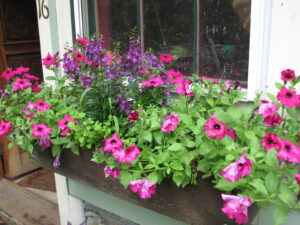
My window box with Supertunias and more
Not all annuals do well with high-nitrogen mixes, however, as they can grow tall but delay flowering. Plants grown for their foliage do well with lots of nitrogen, but may need pinching back to control size. If you do not use a slow-release fertilizer, you may need to use a liquid fertilizer every week or two to keep your plants happy.
Perlite is the white fluffy stuff in potting mixes that looks like bits of Styrofoam but is actually volcanic glass that is superheated until it pops like popcorn. It helps keep a planting mix from compacting. And although it does retain some water in its nooks and crannies, it does not absorb water.
Vermiculite is another material used in some potting mixes, and this does absorb water and holds it much better than perlite. It holds onto minerals, too, which perlite does not do. That’s important if you use liquid fertilizers which can wash away quickly.
I’ve read that too much vermiculite can lead to constantly a constantly wet mix, leading to root rot. From my experience, a mix of perlite and vermiculite is good, particularly in dry summers. Perhaps one part vermiculite and two parts perlite would be good. Vermiculite is mica that has been heated to a high temperature. Both products have a neutral pH.
In each window box Caroline planted geraniums, chartreuse-colored sweet potato vines and coleus, a foliage plant. Coleus now comes in both sun and shade varieties, and some that will grow in either sun or shade. It does not appear to bloom, but has multi-colored leaves that can be striking. The sweet potato vine hangs down and out of the box, while the coleus grows up and the geraniums add bold color in the middle of each box. She repeated the pattern all the way across the front of the garage to great effect.
Watering is important. Because her plants are so big and leafy, they require lots of water. Caroline told me that she waters every day – which means they do not travel in the summer. Peter told me that he drilled lots of holes in the bottom of the boxes to prevent the soil mix from staying soggy in rainy times. The holes can leak soil mix, so it is important to put landscape fabric or screen in the bottom.
I built a cedar window box more than 20 years ago and although it is starting to show its age, it is still sturdy. I did not treat it with anything. I recently made another similar box also using 6-inch wide cedar boards.
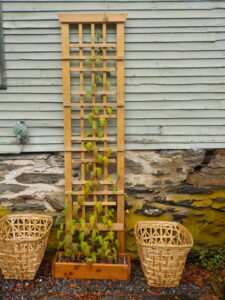
This small cedar window box is fine for a few morning glories
My new planting box is made for morning glories. I have a blank wall to which I attached a nice wood trellis and wanted to break up the tedium of the wall. And although 6-inch boards do not provide the depth of Caroline’s boxes, the vines have already reached the top of the six-foot trellis.
Gardening really is for everybody, even those with limited time, energy and space. Grow a few flowers in a window box or pot and they will reward you with their beauty – and that of the butterflies they attract.
Henry lives and gardens in Cornish Flat, NH. He is a lifelong organic gardener, and the author of 4 gardening books. You may reach him at henry.homeyer@comcast.net.
Pick Today? Pick Tomorrow? Pick Next Week?
Posted on Saturday, July 29, 2023 · Leave a Comment
Those of us who grow vegetables are faced with many questions each year: will there be a late frost that will harm our tomatoes and peppers if we plant them on Memorial Day weekend? Is it time to harvest garlic now, since they produced their scapes early this year? When should we harvest broccoli– now, with heads still fairly small – or wait till they get bigger? Will the sun finally prevail and give all our veggies a big boost after all this rain?
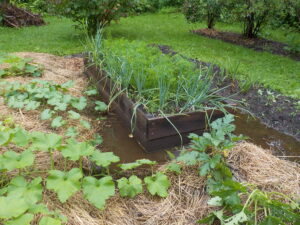
The vegetable garden is soggy at best
We have seen more rain than usual – much more. Even a quick shower results in standing water in the walkways between my mounded raised beds. But in addition to the excess water, plants aren’t getting their usual allotment of sunshine. They need sun – strong, bright sun – to grow and produce fruits and leaves. The lack of sunshine is what is causing smaller veggies, yellowed leaves, and later ripening.
Is it time to harvest garlic yet? After the plants send up those curly stems we call “scapes”, it is generally fine to harvest garlic. Traditionally I pull mine in mid- to late-August. But it’s important to pull them at the right time, not sooner or later than needed.
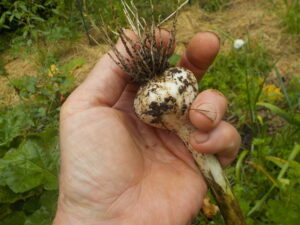
This garlic is smaller than I would expect, but the skin is strong and the others can continue to grow
Here’s what I do: I start by groping my garlic: I slip my hand into the soil and feel how big the bulbs are. I don’t pull them if they’re tiny. But to be on the safe side, I pull a few and look at the skin over the cloves. I want the skins to be strong and tight for good storage. If they are breaking down (due to all the rain), I pull my garlic. If not, I let them keep growing, but check them often.
What about potatoes? My advice is to wait. Yes, you will have some small potatoes as soon as they have blossomed. But I wait much longer than that to harvest mine, as I want big spuds. When leaves start to yellow and die back, then I dig them all. In the meantime, I slip my hand into the soil (without disturbing the plants) and grab a few “new” potatoes for a special treat.
Even though a healthy broccoli plant will produce more food from its side shoots than the main head, some of my plants are small and yellowed from lack of sun. I am pulling the feeble ones and planting a late crop of lettuce by seed in the space.
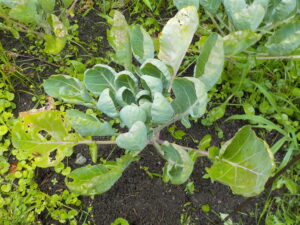
Brussel sprouts plants should be much bigger by now
My Brussels sprouts plants are also much smaller than normal this year. Fortunately, they will continue to grow until the end of October, or even later. If we get sunshine soon, they should recover. My normal advice is to cut the tops of the plants off on Labor Day weekend so that the plants don’t keep growing taller but instead send their energy into producing big “sprouts”. This year I’ll be lucky if they have stalks at all. So I will wait and see – and I accept that my harvest might be small or non-existent.
Carrots love the rain, and are growing nicely. We thinned them in early July and are keeping them well weeded. Still, little sunshine means they can’t bulk up as they would in a normal year.
Onions are ready to harvest when their tops flop over. Pull the onions, even if small, and allow them to dry for a week or so in a shady, breezy spot.
One bright spot in the garden this year is celery. I don’t usually grow it, as in the past mine has been tough to chew and a magnet for snails and slugs. This year I planted six plants, and although the stalks are not yet thick, the plants are big and so far have not seemed to attract pests. I ate a stalk, and it is tougher than store-bought. But tasty.
I usually grow celeriac instead of celery, and I did start some from seed indoors. Celeriac is also called celery root, and has a big bulb that grows above the soil surface. It keeps in the refrigerator for up to 6 months, and when added in a soup or stew, has the same celery flavor. This year –with little sun? The bulbs are not showing yet.
All this rain inspired me to grow watercress! I got seeds, and the packet says plant in wet soil, preferably in a shady area. I have that. I only did that recently, but the plants have sprouted and seem happy.
The Cornish Fair is always on the third weekend of August and has competitions for everything: who can throw an ax most accurately, who can produce the best strawberry jam – and much more. For me it is a time to compete in the vegetable and flower categories in the gym of the school. Tomatoes generally are ripe by then, but this year -who knows?
Even though I have been picking off the many yellowed leaves on my tomato plants, they are still far behind their usual selves. Do pick off the yellow leaves – they will only spread fungal disease. But only do so when the leaves are dry – if they ever are!
I heard that a study at Harvard found that people who eat a cup of ice cream every day live longer than those that do not. I couldn’t find this study on-line, but have my own theory: People who are happy live longer. If eating ice cream makes you happy, have some! Me? I think the study should have been focused on home-grown tomatoes and potatoes and garlic fresh from the garden. I know they keep me happy – and probably living longer than most!
Henry is an organic
gardener, and an optimist. He believes the summer will turn sunny with moderate rain. Reach him at
henry.homeyer@comcast.net if you want to dispute that.
Sal, of Blueberry Fame, Is Getting Old
Posted on Tuesday, July 25, 2023 · Leave a Comment

Blueberries for Sal, a classic story,..
Have you ever wondered what would happen after a story ends? I have. The children’s book “Blueberries for Sal” came out in 1948 and has been a hit for 75 years. If Sal was four years old in the book, she must be pushing 80. I imagine she went to the University of Maine and got a degree in teaching. She probably married her college sweetie at age 24, and taught for six years before deciding to start a family. I bet she makes a mean blueberry pie.
The key to a great blueberry pie, in my opinion, is to let the blueberries dominate the flavors, not sugar. Pick a recipe, and mix the ingredients using less sugar than recommended. Maybe half, if it seems like a lot. Or if your recipe uses just a half a cup for six cups of berries, it’s probably fine. Add cinnamon, but more is not better. Sometimes I like a little cardamom.
The best berries for a pie are those you picked yourself. Even better are those you grew yourself. I’m picking blueberries now, and have some tips on how to get a good crop.

Not all berries ripen at once, even in a cluster
Paul Franklin and his wife Nancy own Riverbend Farm, a self-pick orchard with apples, pears, pumpkins – and 1600 blueberry plants in Plainfield, NH. Paul once told me that there are just three things to get right if you want lots of blueberries: proper soil pH, proper soil pH, and proper soil pH. That’s right, if you don’t have very acidic soil for your berries, you can still have nice bushes, but without proper soil pH, you will only get a few.
For most of us, a simple soil test done with a kit you buy at the garden center or hardware store will show that our soil is around 6.0 or 6.5 if not adjusted. But blueberries want a pH of 4.5 to 5.5 which is much, much more acidic than that. The scale is logarithmic, meaning each change in a number multiplies the acidity 10-fold. So a pH of 5.5 is 10 times more acidic than a pH of 6.5 and 4.5 is 100 times more acidic.
How do you adjust pH? Buy soil acidifier or agricultural sulfur and sprinkle it on the surface of the soil. If you have a thick layer of mulch to keep down the weeds, pull it back, then add your acidifier. Follow the directions on the bag as to how much to add once you know your soil pH. It may take 2 to 3 years to drop the soil pH to the proper level. And doing it now won’t affect this year’s crop.
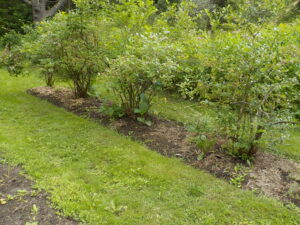
Blueberry bushes do best in a row running east-west
What else should you do? Give your bushes room to grow. I did a single row and spaced the bushes 6 to 7 feet apart. But they are a little crowded now, 20-some years later. If were doing it again, I’d space them farther apart. It’s best to run your row east-west rather than north–south to avoid one plant shading another. Full sun is best, but six hours of sun is adequate.
Blueberries like moisture, but don’t plant them in soggy soil. Also avoid the top of a sunny, sandy hillside. I have mine not far from my brook, and they have done very well. When planting, mix in some duff from under evergreen trees because it will help acidify the soil and will also add fungi that encourage good growth. Pine needles make a great mulch if you have some.
Blueberries do not like weeds, so do a good job of pulling out the grasses and weeds in the place you plant your berries – before you plant. And then add a good thick layer of wood chips around the plants to discourage weeds in the future.
Blueberries are pollinated by bees. And although some varieties are labelled “self-pollinating” it’s always bests to plant several bushes and at least two different varieties.
There is a terrible alien pest that has arrived in most parts of New England, the spotted-winged drosophila. This is an Asian fruit fly that lays eggs in good fruit, as opposed to other fruit flies which only attack over-ripe fruit. In a matter of days, blueberries can go from healthy to mushy and full of larvae. If you cut open a berry that has been infected, you will see the small larvae. At present there is no organic method for controlling them other than covering your bushes with a fine mesh too small for the fruit flies to reach the fruit.
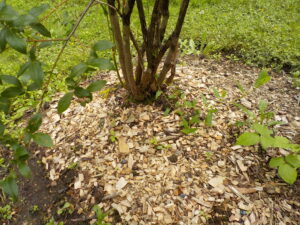
Wood chips make a good mulch
If you are planting blueberries now, choose bushes that produce their fruit early in the season and avoid plants that mature later in the summer. Why? Some growers are finding that the fruit flies don’t show up early in the summer, so they are getting crops of early blueberries before the pest shows up. And buy the biggest bushes you can find – or afford. Blueberries are relatively slow-growing in our climate.
Birds can be a problem, too. I no longer cover my bushes with netting – I found too many birds got caught in the mesh, so now we just share. And unless you get a flock of cedar waxwings (which are voracious berry eaters), most birds don’t seem to be greedy. Last summer I enjoyed watching bluebirds feeding their second set of chicks with my berries.

Sal had a close encounter with a bear
I bet Sal (who had a close encounter with a mother bear in that wonderful book) had three kids, two girls and a boy. By now those kids would range in age 43 to 48, so her grandkids are either teenagers or in college. But I bet they all visit her in blueberry season for her wonderful pie. Her mother’s recipe, no doubt. Pie is always a good lure for grandkids, especially blueberry pie.
Henry is the author of 4
gardening books and is a lifelong organic
gardener. Reach him by e-mail at
henry.homeyer@comcast.net.
Tips for picking and arranging flowers
Posted on Tuesday, July 11, 2023 · Leave a Comment
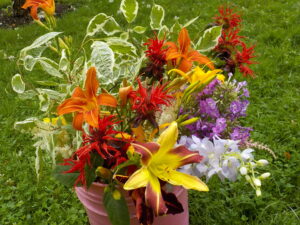
Pick plenty of flowers so you have many to choose from when arranging them
I’ve been keeping track this year of what blooms for me, and when. So far I’ve recorded over 100 species of flowers (plus many more named varieties of the same genus) and 40 species of flowering trees and shrubs. Blooming starts with snowdrops in March and will continue on until well after frost in November with witchhazel trees blooming even after leaf drop.
I grow so many flowers because they give me pleasure to look at them. And even though I spend a lot of time in the garden, I spend more time indoors than out, so I cut stems of annuals, perennials and flowering woodies and arrange them in vases. I want flowers on the kitchen counter, the dining room table, the desk I write at, the bedroom, the bathroom – in fact, every flat surface in the house.
Let’s look at some basics of preparing and arranging flowers. When is the best time to pick flowers? Pick in the cool of the morning, especially if the day will be hot. The stems are full of water and carbohydrates and should feel full, not limp. Bring along a clean container so that as you wander around picking flowers their stems are well submerged. Instead of picking flowers just before dinner with company, try to pick them before going to work in the morning.
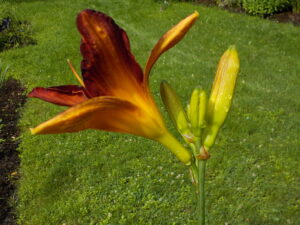
This daylily will fade in a day, but the other buds will open day after day
Flowers with multiple blossoms on a stem (delphinium, foxglove, for example) should have some blossoms in full bloom, others showing color and some in tight bud. This will prolong the show. Flowers that grow on individual stems should be in full bloom, or just starting to open. Peonies, for example, will often have tight buds on the same stem as an open blossoms, but it is rare for them to bloom in the vase. Daylilies only bloom for a day, but a single scape can have up to 10 buds that will bloom in sequence for a week or more.
It’s best to let your freshly cut flowers stay in the bucket of water for an hour before you arrange them. Cut the stems on a 45 degree angle using floral shears, or your by-pass pruners if they are sharp. Scissors made for cutting paper are not good for flowers, so you may want to buy a dedicated pair of floral shears.
Because of capillary action, water in hollow stems will be sucked up the stem a little as soon as you cut them. So you need to recut about ¾ of an inch of each stem and place it in a vase right away. Otherwise an air bubble may inhibit water take-up.
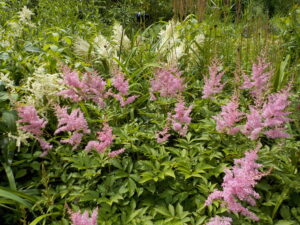
Astillbes have nice strong stems, good for use in a vase
Be sure to remove all leaves or flowers that would be submersed is the vase you are using. Why? The leaves will rot and ferment; the bacteria will inhibit water uptake.
Florists selling fancy roses or other expensive flowers generally provide a packet of “flower preservative”. But you can buy that stuff or make your own for your homegrown flowers. In a quart of water add a teaspoon of sugar, a teaspoon of household bleach and 2 teaspoons of lemon or lime juice. I learned long ago to drop a couple of copper pennies in a vase with a bunch of tulips to help keep the buds closed longer and have seen it work. Failing that, just change the water every two or three days, and trim off a little of each stem.
The height of the vase is important. I’ve read “expert” advice recommending different ratios for the height of the vase to the length of the flowers ranging from flowers being 1.5 times the vase height, up to 3 times the vase height.
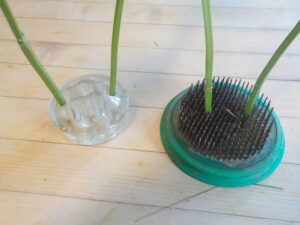
Two kinds of frogs that will hold stems in place in a vase or bowl
To my eye, a 6-inch vase will look good with 9-to12-inch flowers in it, but even 18-inch stems may look fine, especially of you place shorter flowers around the outside perimeter of the arrangement. I made an arrangement recently with six stems of beebalm in an 8-inch vase. I angled the stems to create support for a 24-inch stem of delphinium in the middle, standing straight up. That looked great to me.
There are devices called frogs that can be placed in a bowl or big vase to hold flowers in place. They consist of a piece of heavy metal with sharp, upward-pointing pins that allow you to stab the flower stems and hold them in place. Glass frogs also exist that have divots in a chunk of glass where a stem can be lodged.
What is blooming now that will look good in a vase? I love delphinium, astillbe, daylilies, roses, bee balm, phlox and Shasta daisies. All will last well in a vase, and provide plenty of height for a tall vase.
We just finished the peony season with the Itoh peonies lasting well past normal herbaceous peonies. They are the result of crossing tree peonies with regular peonies. Mine, called Garden Treasure, produced 30 or more 5-inch diameter blossoms that last very well in a vase.
Arranging flowers is an art form we can all enjoy. You don’t need training or expertise. Just pick what you like, and arrange them in a vase, or even in a tall water glass. Give flowers to an aging uncle or a friend with a sprained knee. Everyone loves the gift of flowers. And be sure to put some on your dinner table tonight.
July Chores for the Gardener
Posted on Tuesday, July 4, 2023 · Leave a Comment
For me, July has started off wet: rains, heavy at times, three days a week and going on for weeks. Although I like not having to water my new plantings in the vegetable garden and flower beds, some plants are having a tough time- they need sunshine!
It’s fortunate that I make raised beds in my vegetable garden which is near our stream. Hoeing up the earth from the pathways and adding compost has helped me considerably. Even though the beds are only six inches above the walkways, it helps to drain soggy soil. Of course it’s too late to do that if you have already planted on the flat of the garden – but remember for next year, as we may see these conditions again.
If you haven’t thinned your carrots, beets and other root crops yet, now is the time to do so. I try to get that done by July 4th, but later is okay. You can thin to one inch if you want to thin them again to two inches in a few weeks, or you can just thin to two inch spacing now. The advantage to thinning twice is that your carrots will be big enough to eat when you thin them the second time.
Carrots are heavy feeders, so you may want to side-dress the rows with a little slow-release organic fertilizer like Pro-Gro or Espoma Garden Tone. Just sprinkle a thin line of fertilizer alongside the carrots, and then use a hand tool to work it in a little.
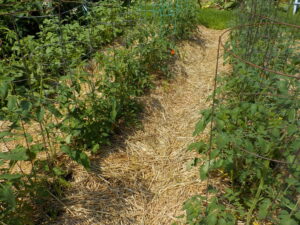
Straw placed over newspapers keeps down weeds in my vegetable garden
I recently finished mulching my pathways and around bigger plants like tomatoes. I put down a layer of newspaper – four sheets or more – and cover it with straw. This does a good job of keeping down the weeds. Hay is cheaper, of course, but has seeds which can grow.
For onions, carrots and other things planted close together in straight rows I tear strips of newspapers and cover them with grass clippings or, better still, chopped leaves from last fall. FYI: newspapers rip well from top to bottom, but not across the page.
I did lots of staking of peonies in June, as many of them have such heavy blossoms that they bend over and land on the ground, particularly after a rain. Tall fall asters and goldenrod and even phlox will fall over later on as they get too tall to stand up to rains and wind.
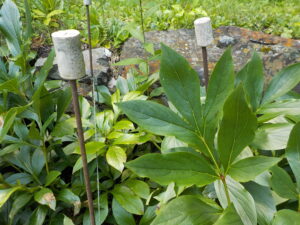
Wine corks placed on tips of iron rods protect me against a poke in the eye when bending over to sniff the peonies
I have lots of 4-foot and 5-foot quarter-inch diameter iron rods I had custom-made for me for holding up these fall beauties. The iron rods go deep into the soil more easily than thin bamboo stakes, and are stronger. To avoid getting poked in the eye when bending over, I put a wine cork on the top of each one. I drill a quarter inch hole into the cork and slide it on. They are a good excuse to buy a nice bottle or French red from time to time with a real cork!
It’s getting late in the season to cut back tall flowers to keep them shorter, but you might try cutting back some phlox or asters now if they haven’t start making flower buds yet. Traditionally this is called the “Chelsea Chop” and is named after the Chelsea Flower Show in London, which occurs in late May each year. After the Chelsea show English gardeners prune back big tall plants. They bloom later, are shorter, and often have many more blossoms. Good candidates for hard pruning include asters, Boltonia, purple cone flower, Joe Pye weed, sneezeweed (Helenium), bee balm, Russian sage, phlox, obedient plant, Rudbeckias of all sorts and Culver’s root.
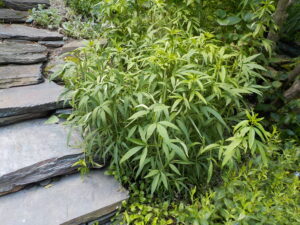
This tall coreopsis was cut back by half in late June to keep it a manageable size
Not all flowers respond well to the Chelsea Chop. Do not do this with lady’s mantle, columbine, goats beard, astillbe, delphinium, gas plant (Dictamus), fox glove, geraniums, daylilies, hostas, iris, lupines or oriental poppies, among others. You can find lists of which to cut and which to leave alone in Tracy DiSabato-Aust’s fine book, “The Well-Tended Perennial Garden”s. Everyone should have a copy of it.
Weeding flower beds is loved by a few gardeners, but avoided by many. I am so lucky that both my wife Cindy and I like to weed. Cindy is a formidable weeder, even better than me – and she has much more endurance than I do. If you don’t enjoy weeding, set a goal: work for half an hour. Work until this small bed is weed free. Weed every morning or evening for 15 minutes. Small efforts done every day really make a huge difference.
My advice? Get a good weeding tool that you like, one that will get under the roots so that you can lift from below and pull from above. For us, that is the CobraHead weeder (
www.CobraHead.com). It’s made like a curved finger with just a single tine. I can tease out roots that, if broken, would re-sprout. It’s important to get the entire root system out so you don’t have to pull the same weed over and over.
We use ground fall leaves in the flower beds, or lacking enough, we buy double-ground bark mulch. But be careful: if you use too much, you can starve your plants of water from light rains. An inch and a half is what I strive for. Anything less than an inch looks good, but won’t do much to deter weeds. And if there are roots from things like goutweed or Japanese knotweed, no amount of mulch will deter those culprits.
Growing Plants for Their Scents Makes Sense
Posted on Friday, June 30, 2023 · Leave a Comment
Do you remember your Grammy’s favorite rose? If you do, you probably remember how fragrant it was. For me, one of my grandmother’s favorite plants was the peony named ‘Festiva Maxima’. It is a double white with a drop of red in the middle. It’s in bloom now, with a fragrance so pleasant it almost makes me swoon. And even though she passed away in 1953, her peony has been divided and shared, and I have a piece of it, which I treasure.
My friend Nelia Sargent of Claremont, NH is an excellent gardener, growing trees, shrubs, perennials and annuals. She specializes in plants with fragrant flowers because she has been blind since she lost her sight while in college decades ago. I called her recently to see what flowers please her the most in spring, summer and fall. Let’s take a look.
Spring: Early each spring one of Nelia’s first bloomers is a witchhazel named ‘Arnold’s Promise’. Even though it is a Zone 5 plant (hardy to minus 20 degrees) and we are in a Zone 4 area, her home is within a mile of the Connecticut River, which tempers winters a bit. Arnold’s Promise blooms for her in April and, she said, one stem will fill a room with fragrance for up to two weeks in a vase.
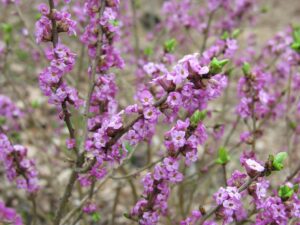
Close-up of February Daphne taken in late March
Another favorite of hers is February daphne (Daphne mezereum), which blooms here in late march into April. It is a small shrub that is relatively slow-growing and short lived. She says they are good for 10 years, but I’ve had one for 20. It is very fragrant and has lovely lavender flowers. All daphnes are fragrant and she also like Daphne burkwoodii, which blooms in May.
Viburnums are also fragrant shrubs grown by Nelia. She particularly like Viburnum judii and V. carlessii. The first, also called Judd’s viburnum, has semi-snowball bloom clusters that are pink in bud and white when open. It grows in full sun or part shade, as does Korean spice viburnum (V. carlessiii). Both prefer well drained rich soil in sun and stay a tidy 6- to 8- foot height and width. I grow the second and have had mixed luck with it: it is not always very generous with its blossoms, and does develop dead branches at maturity.
Summer: This is the season that has the most kinds of fragrant blossoms. Nelia has developed such a keen sense of smell that she was once invited to “smell test” and rate the lilacs at the Arnold Arboretum at Harvard.
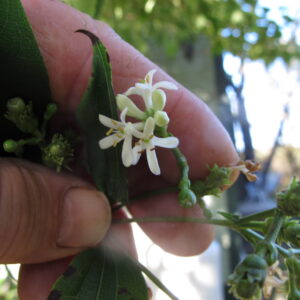
Seven Sons Flower Tree blossoms are small, but lovely.
Nelia told me that there are about 20 different fragrances from lilacs, each distinct. Her favorite lilacs are called ‘Sister Justina’, ‘Gertrude Lesley’, and ‘Miss Kim’. Miss Kim is often sold as a miniature, but it is really just slow-growing. Mine, now 25 years old, is about 12 feet tall and wide. The fragrance is lovely – I can smell it from 20 feet away, and on a sunny day it is loaded with butterflies and bees.
Then there are peonies. Properly planted, peonies last forever. And, as Nelia said, ”You can plant peonies for your heirs, but they yield immediately.” Purchase your peonies now, while in bloom at the garden center so you can see if they are fragrant –not all are – and see what they look like. Just don’t plant them so deep that their nibs or growing points are covered with more than an inch of soil, or they will not bloom in the future.
Nelia’s favorite peonies are Dawn Glow, Madame Deveronvale, Edulalis Superba (a very early deep pink), Festiva Maxima, Duchess De Nemours, and Carnation Bouquet (spicy, with a “carnation appearance”).
Mock orange (Philadelphus spp.) is a group of shrubs composed of about 20 species that are very fragrant. But they are a bit unruly and not suited for prime real estate in the garden. Nelia suggest planting them a bit away from the house, and letting them naturalize. I’ve never grown it myself due to its spreading behavior.
Late Summer and Fall: Many fall flowers are big, tall, bright – but not very fragrant. Here are few she likes.
Clethra: A nice shrub that likes moist places. She particularly likes ‘Ruby Spice’, which is a reddish one.
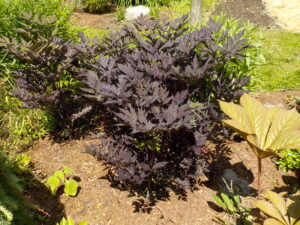
The foliage on ‘Hillside Black Beauty’ is nearly black and later it will have fragrant white bottlebrush flowers
Cohosh (formerly Cimicifuga spp., now included in the genus Actea): This plant has tall flower spikes that display drooping bottlebrush flowers. Bees absolutely love it. There is a black-leafed species that is quite distinctive called Hillside Black Beauty.
Seven Sons-Flower Tree (Heptacodium miconioides) starts blooming in September and may continue into October unless there is a bad frost. The blossoms are small and white, and delicately fragrant. I grow it for the bark as well, which is exfoliating and interesting all winter.
So, if you like fragrant flowers, try some of Nelia Sargent’s favorites. All are wonderful.
Henry is the author of 4
gardening books and a
gardening consultant. He lives and
gardens in Cornish Flat, NH. Reach him at
henry.homeyer@comcast.net.
The Gardener’s Bane: Slugs, Bugs and Ticks, Oh My!
Posted on Wednesday, June 28, 2023 · Leave a Comment
All gardeners have to contend with a variety of insects and other small pests in the garden – those that attack our plants and those that bite us. Mosquitoes? I can live with them. But ticks? That is another story.
I’ve tried every kind of spray to repel ticks and prevent bites. I haven’t found any that are 100% effective. There are lots of “all natural” ones out there, but it is hard to tell how effective they are. I don’t like sprays with Deet in them, but believe they probably are better at repelling ticks than the herbal applications. But I don’t rely just on repellents.
When I am working in brushy areas I wear long pants: lightweight quick-dry nylon. Then I either tuck the pants into my socks or wear some special tick gaiters. The ones I use are called Lymeez. According to their advertising, they are a mesh treated with EPA-registered micro-encapsulated permethrin tick repellent and closed with Velcro. LL Bean and other suppliers also sell clothing treated with permethrin to kill or repel ticks, mosquitoes and other insects.
From what I have read, permethrin not only repels ticks, it kills them. I have read about “tick tubes” treated with permethrin to kill the ticks on mice – a vector for Lyme. These little tubes contain treated cotton balls that mice bring to their nests, where the permethrin kills the ticks. I plan to get some for my woodpile.
Slugs and shell-covered small snails are always a problem in my garden. I usually keep a jar of soapy water in the garden near my lettuce, which is the preferred treat for these nasty critters. Pick and drown works.
Another garden pest is the Colorado potato beetle. This striped beetle can decimate the leaves of potatoes if you don’t control them early, even killing the plant or reducing your crop. The beetles are yellowish with black stripes, the larvae are beige to red with rows of black dots. The eggs are orange and generally found on the underneath side of the leaves. It is important to pick these pests early as they mature quickly and each female lays many eggs – multiplying their impact quickly if not controlled.
If you have too many potato plants to hand pick them all, there is a biological control called Bt. It is a bacterium that is diluted in water and sprayed on the plants. It is not a contact poison, it needs to be consumed by the larvae when they are young. They sicken, stop eating and die. But you may need to use it for a few years to really solve the problem. There are several different Bt formulas, so be sure you get one labeled for potatoes.
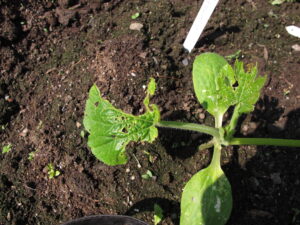
Leaves eaten by striped cucumber beetle
Striped cucumber beetles look a bit like potato beetles, but they are smaller and fast moving. They can strip all the leaves off your vine crops in a single night if they are present in the soil when your cukes or squash-family plants first germinate. You can cover the crops with row covers to keep them away, but they may already be present in the soil. Me? I start my vine crops indoors and only plant them when they have at least a six-inch long vine and can’t be killed by the beetles.
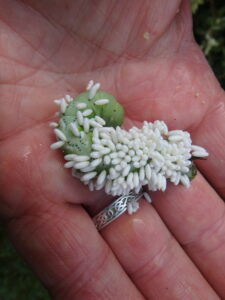
Larvae of parasitic asp on tomato hornworm will kill it
My least favorite pest is the tomato hornworm. Big, up to four inches long, they are aggressive when you pick them up. There is a natural predator, a parasitic wasp that lays eggs in them. So if you see what looks like grains of rice on them, just remove them to a faraway part of the garden. Those “grains of rice” are larvae that will suck them dry and keep them from reproducing. You can make or buy houses for these wasps and other good wasps and hang it on your shed. These are simply a collection of hollow bamboo pieces they can use to for shelter.
A good reason NOT to use insecticides is that they will inadvertently kill good bugs like lady beetles, spiders, praying mantises and more. You’ve probably never seen an assassin bug, but they are relentless killers of bad bugs, sucking them dry.
Many of us grew up thinking that most bugs, beetles, moths and other insects are harmful. For a long time my first inclination on seeing an insect in the garden was to squish it. Not anymore. Mother Nature tries to create a balance that keeps pests from taking over. Unless you know an insect is a pest – think Japanese beetle, rose chafer, striped cucumber beetle – leave it be. It might be the critter that controls others from decimating your garden.
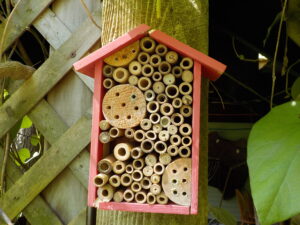
This simple structure provides a place for beneficial solitary wasps to lay eggs
If you want to learn about the bugs you see, you might want to pick up a copy of a nice small paperback called, “Good Bug, Bad Bug: Who’s Who, What They Do, and How to Manage Them Organically” by Jessica Walliser. It is well illustrated and also tells you how you can attract good ones– or even purchase them.
Being an organic gardener means you have to pay attention. Watch for problem pests and try to control them before they can ruin your flowers or veggies. And never use a chemical pesticide as it will throw everything out of balance.
Henry is a lifelong organic
gardener, and a 20-year veteran of the UNH Master
Gardener program. He is the author of 4
gardening books and a
gardening consultant. Reach him at
henry.homeyer@comcast.net.
Planting, Transplanting and Moving Plants
Posted on Wednesday, June 14, 2023 · Leave a Comment
Once, a long time ago, I was sitting on a porch overlooking a landscape with an acquaintance. I commented that if she removed or thinned a line of tall pine trees, she would have a lovely long view. “Great idea! I’ll have them moved,” she said. Even though she was a woman of means, I explained that it wouldn’t be possible to move 60-foot white pines. She should either live with them or cut some down.
On the other hand, I move shrubs and perennial flowers regularly. Done right, a plant barely knows it’s been moved. I have a number of reasons for moving a plant.
First, if the plant is not growing well. Perhaps the tag on it said, “Sun or Part shade.” Well, what is part shade? I define full sun as 5 or 6 hours of afternoon sun. Morning sun is less hot, and a sun-lover might want some afternoon sun in addition to the morning sun.
Why else move a plant? We all change our minds. Or plants grow and start to crowd out their neighbors. We get new plants and decide to plant one where something else is already growing. Moving plants is a normal part of gardening.
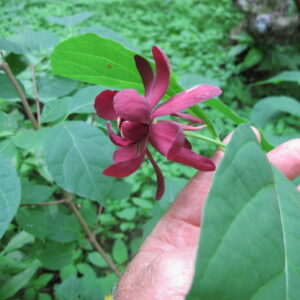
Calycanthus or sweetshrub is a shade-loving shrub that I moved twice to find it a happy home
I have a lovely shrub called Carolina sweetshrub or Calycanthyus floridus. My reference book by Michael Dirr, “Manual of Woody Landscape Plants” suggests planting it in sun or shade in deep moist loam. I planted it in full sun in deep, moist loam and the leaves burned that first summer. I assumed it had been grown in a shady place at the nursery, so figured it would be fine in Year 2. It was not. Its leaves burned again. So that fall I moved it to a shady spot.
For the next three years or more my sweetshrub did not burn up in summer, but neither did it flower much. I wanted those deep burgundy wine-colored blossoms, each more than an inch across. So I finally moved it again – this time under a pear tree that allowed filtered sunshine. Perfect! It has bloomed magnificently ever since.
My technique for moving a shrub is simple. I decide where it should go, and get the area ready by removing grass or plants and loosening the top layers of soil. Then I go to the plant if question with a drain spade that has a blade 16 inches long and only 5 inches wide. I slide it under the shrub on all four sides by thrusting the blade into the soil at a 45 degree angle. On each side I give the spade a gently downward push to lift and loosen the shrub a little. By the fourth thrust, it should be ready to lift out by sliding my two hands under the root ball.
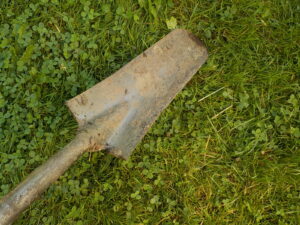
This drain spade is good for transplanting perennials and shrubs
I move the shrub into a waiting wheelbarrow and bring it to its new home. I measure the depth of the rootball and dig out a hole deep enough so that it will sit at the same depth it was originally. I dig a wide hole so that the area around the shrub will be nicely loosened and ready for roots to grow in it once I back fill the hole. I water well that day, and regularly all summer.
When I water a plant I have moved, I add something to the water: a capful (half a teaspoon) of something called “Superthrive” in a watering can of water. It was developed some 70 years ago and uses seaweed extracts and plant hormones to lessen transplant shock. I find it really helps. A small blurt of Neptune’s Harvest Fish and Seaweed fertilizer in the water adds some quick nutrition. I use both liquids on all my vegetables as I plant them, too.
Any plant that you planted this year can be moved now without damaging it. It takes several weeks before roots move far from their rootball. I don’t bother with a spade when moving new things. I use my CobraHead weeder which is shaped like a long curved finger. It gets under the rootball easily, and by wiggling it around I can loosen the plant and gently lift it out, pulling from below with my CobraHead.
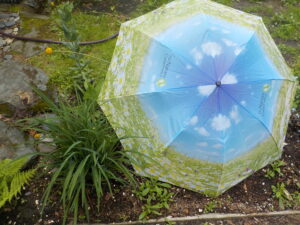
An umbrella cah shade a stressed plant until the sun goes down
When I am moving an established perennial, I am more careful. Over the years – both from experience and readings – I have learned much about the root systems of common perennials. You probably have, too. Some have roots near the surface while others are more like tubers that go deep.
Peony roots go deep, and are not easy to move without breaking their fleshy tubers. Peony experts say to move them in the fall, when they are going dormant. But I once moved a hedge of peonies in June with about 50 plants, and not one showed ill-effects.
It is best to move established perennials in the early evening, or on a cool or drizzly day. Some plants go into shock if disturbed in the heat of the day, so avoid doing so if you can. Others, like daylilies, don’t care at all about being moved on a hot dry day.
I recently was planting my front walkway garden and noticed a Rudbeckia called ‘Prairie Sun’ that was too close to another plant, so I moved it at 11am on a hot day. After lunch the leaves were limp and it was in distress. My solution? I gave it another drink of Superthrive and placed an umbrella over it to provide shade. By the next morning it looked like it had never been moved!
So go ahead, move plants. Other than big trees, there are very few you can’t move.
Henry is the author of 4 gardening books. He is a gardening consultant and speaker for garden clubs and library groups. Reach him at
henry.homeyer@comcast.net.
Learning from Other Gardens
Posted on Tuesday, June 6, 2023 · Leave a Comment
One of the best ways to learn how to create a lovely garden is to see others. Visit good gardens of neighbors, great gardens near and far. I recently visited three great gardens and, as always when viewing other gardens, they gave me much to consider. The gardens I visited were Bed Rock Gardens in Lee, NH, Chanticleer Gardens in Wayne, PA and Longwood Gardens in Kennett Square, PA.
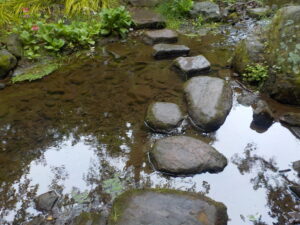
Path crossing water at Chanticleer
All these gardens had significant areas of lawn or meadow. I realize that lawns are not in favor, generally, among the pro-pollinator and bird crowd. But if you provide plenty of plants that support pollinators, I do not see lawns as bad. Each of these gardens has plenty of flowering trees, shrubs, perennials and annuals. Something is always in bloom, including both native plants and exotic ones.
So what does lawn accomplish? It provides contrast – a simple green palette – to show off the plants. Expanses of green are soothing to the eye. I can only focus on so many amazing plants before I get visually fatigued – much as I do when I visit an art museum.
Lawn also allows you to stand back to see the landscape from a distance. For trees, that is important. In a forested area, and all three of these gardens have them, individual trees are sometimes hard to see. They blend in with the others. But I need to stand back to look at a majestic beech or oak that towers 100 feet above me.
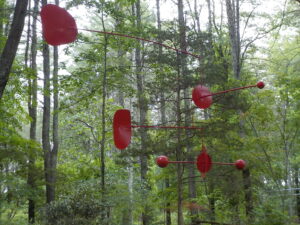
Sculpture in the woods at Bedrock Gardens
Bedrock Garden only recently was deeded over from the original owners, Jill Nooney and Bob Munger, to the non-profit that manages the property. Jill is an amazing sculptor who for over 30 years has created art to surprise and delight visitors to this 20 acre garden. Much of her art is painted welded steel that will delight visitors for the century ahead. She is the modern Alexander Calder of gardens.
Although I am not an artist, I do purchase and create art and whimsy for my own gardens, and you can, too. Look around at what you can use: a brass headboard from an abandoned bed; the rim of an old wagon wheel, a collection of stacked stones or a single tall standing stone buried in the ground. Stone always enhances a garden. Walls are expensive, but almost worth their weight in gold.
Pathways are important to a great garden, too. They lead the visitor from one area to another. Placing art or even a bench at a distance pulls viewers forward, luring them to see what is ahead. Chanticleer has wonderful pathways through the woods that appear to be wood chips embedded in rubber. Very soothing to knees and feet.
My late sister, Ruth Anne Mitchell, taught me long ago when viewing art or gardens that, “If you see a place to sit down, sit down.” So I do, and I find it enhances the experience of the garden. Not only am I less tired, often gardens surprise us with something special near a resting point. Perhaps you can design a special feature near a bench: rare and dainty plants or a small water feature.

Formal use of lawns and water at Longwood
All three of the gardens I visited made much use of water in the landscape. I am lucky enough to have a small stream that runs by my gardens. I built a bench near it, so I can listen to the burble of the water. And you can tune your brook: Place stones that hold back water, allowing it to cascade over them. Different drops create different sounds.
Years ago, for NY Times article, I interviewed by phone the designer of the gardens at the Getty Museum in Los Angeles, Robert Irwin. He created a recirculating stream that crossed a path through a woodland area seven times. He told me he tuned it so that at each little bridge visitors would hear a different aquatic tune. Think of that if you have a stream on your property.
Color is very important in designing good or great gardens. I only got the 8-color box of crayons as a boy; my sister Ruth Anne got the 64-crayon box. But I have learned to appreciate all the nuances of color and how they go together. The best explanation of how colors go together – or don’t – is a book by garden writer Sydney Eddison: “The Gardener’s Palette: Creating Color in the Garden” (Contemporary Books, 2003, $30 in hardback). Get it if you can find a copy.
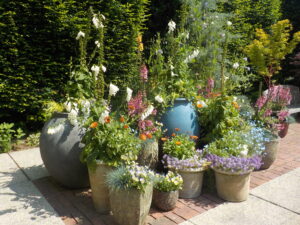
Pots at Longwood
Great gardens like those at Longwood, an old DuPont family residence originally, recognize that color is important all year. But most shrubs and perennials only bloom for a few weeks. So they choose trees and shrubs that are not only sculptural in form, but have also have nuanced colors in their leaves. Green is not one color, but many. Choose wisely.
Lastly, another way to present color all spring, summer and fall is to use annual flowers liberally. Many of these will keep on blooming in an effort to create seeds. Pots of annual flowers are used frequently in these great gardens. Pots place flowers closer to the viewer’s eye and can also be replaced with other pots if the flowers finish their displays or look a bit bedraggled.
So do visit other gardens this summer – whether at a local garden club tour or one of the fine gardens I mentioned here today.
Henry is a garden consultant and the author of 4 gardening books. He speaks often to garden clubs and library groups. Reach him at
henry.homeyer@comcast.net or PO Box 364, Cornish Flat, NH 03746.
The Tomato: Queen of the Garden!
Posted on Sunday, June 4, 2023 · Leave a Comment
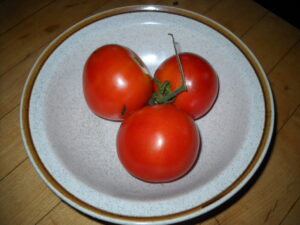
Defiant tomato are resistant to late blight
For me tomatoes are the best tasting, most important vegetable I grow. I eat them raw in salads and sandwiches or cooked in soups and stews. I dehydrate some, I freeze many whole, and I make some sauce for quick dinners in winter. But they are not grown without difficulties – and sometimes heartbreak.
Heartbreak is rare. More than 10 years ago something called “late blight” came early and infected tomatoes all over New England. Plants blackened and died, and the fruits rotted quickly, becoming inedible. Although many people blamed the Big Box stores, who knows? Spores can travel hundreds of miles in the wind.
Varieties of tomatoes have been bred to resist late blight since that fatal summer. The only one I have grown is called ‘Defiant’, developed by Johnny’s Selected Seeds. It is a nice F-1 hybrid with 4- to 6-ounce fruits that appear early. It is a determinate tomato which means that it produces a crop, then dies. Indeterminate varieties keep on producing until frost or blight kills them.
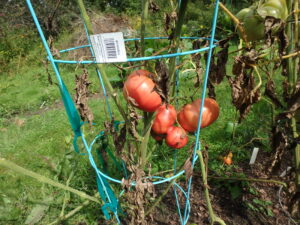
The leaves here have been killed by a blight which is common but does not affect the fruit
Of lesser portent is ‘early blight’. Except for first time gardeners, we all get it. It causes lower leaves to darken and dry up, but fruit is produced until all the leaves are gone. You can minimize this problem by mulching under your tomatoes with grass clippings or chopped fall leaves. You should do that now. Unlike late blight, early blight survives our winters in the soil, and splash up from hard rains or watering gets it onto the leaves.
Other fungal diseases are common, but can be minimized by spacing your plants well so they are not crowded. I use 24-inches spacing between plants and that seems adequate. It allows good sun sunshine on the leaves and breezes to keep the plants healthier.
To minimize diseases, don’t get the leaves of your tomatoes wet if you can avoid it. Avoid overhead watering devices, even though they are convenient. I use a watering wand to water my veggies as it allows me to direct the water just where my plants need it. It saves water, too, as I am not watering the walkways – and encouraging weeds there. The brand I like best is Dramm. Theirs allow good flow, but are gentle on the plants.
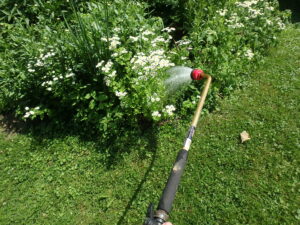
A watering wand directs a soft spray just where you want it
By now most of you have planted your tomatoes. If you haven’t, and if you think this will be a hot, dry summer, plant them deep in the soil. You can bury the root ball six inches down or more, and the stem will grow roots in the cooler, moister soil down deep.
Tomato plants need support. Forty years ago or so, when I was less experienced than I am now, I tried just putting straw on the ground and letting my tomatoes flop over and lay on the ground. I had heard it would work just fine, but it didn’t. It was harder to weed, and tomatoes were more prone to rot.
Now I use tomato cages. They are an investment, but last for 20 years or more, especially if you store them in the barn for winter. Get the biggest ones you can find. Generally that means a wire cage that has four legs (not three), and is 54-inches tall. These cages need to be pushed into the ground at least six inches so they will not tip over. If you have rocky soil, you may have to try several positions before you can install it deep enough.
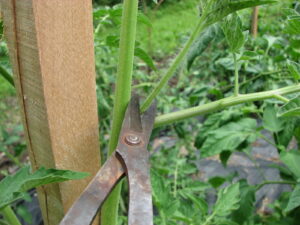
Remove tomato suckers early and often
Alternatively, you can buy 5- or 6-foot hardwood stakes. These are one inch square stakes that come with a pointed end that you can drive into the soil with a hammer – small rocks or not. But you have to tie your tomatoes to the stakes as they grow up. You can use old rags to tie them on, or sisal twine. Don’t use plastic twine as the vines may get damaged when they are loaded with heavy tomatoes. You may need to tie your tomatoes onto cages, too.
Throughout the summer you should prune out excess “suckers” that grow between the main stalk and a branch. These are just little shoots that develop into branches that clutter up the interior of your plant. They can shade out leaves and encourage diseases. If your plants get too tall in late summer, cut off the tops. This will keep the plants in their cages and putting their energy into producing fruits, not growing taller.
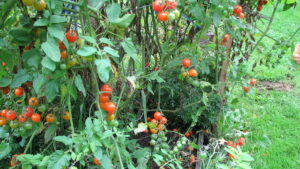
Sun Gold tomatoes
I grow at least a dozen Sun Gold cherry tomato plants each year. Each plant produces more tomatoes than I can count (even if I take off my socks to use both my fingers and toes). They are supremely tasty fresh, and are great dried and saved for soups and stews. I cut each tomato in half, and use a food dehydrator to get it ready for storage. Later, I add them to soups, stews – and even scrambled eggs.
Big tomatoes can be frozen whole and stored in Zipper bags, or chopped and stored in quart jars in the freezer. They aren’t suitable for sandwiches, but they are organic and tasty in cooked dishes.
If you freeze tomatoes whole, all you need to do is make sure they are clean. When you take them out of the freezer, you can remove the skins easily if you want by running them under hot tap water and rubbing gently.
No matter what I do with tomatoes, they always add flavor to any dish. I can’t wait for this season’s crop to be ready.

 Click Here to buy from Cobrahead