-

Now available for $24.95 including shipping. -
Now available for $21.00 including postage. Vendors I Like
 Click Here to buy from Cobrahead
Plants that Have Stood the Test of Time
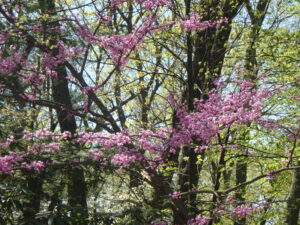
Redbuds will bloom well even in part shade
Jefferson grew one of my favorite trees, the Eastern Redbud (Cercis canadensis). It is a wonderful early-summer blooming medium-sized tree and I’ve had one for at least 10 years. It is suitable for a part shade location or full sun. In the wild (New Jersey and south) it is found mainly as an understory tree. It blooms in early summer with small pink blossoms that seemingly pop right out of the bark. Cold hardy varieties are common now and it is rated to Zone 4.
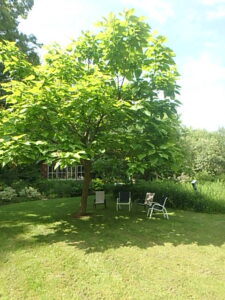
Catalpas are fast growing trees suitable as shade trees
Jefferson was intrigued by sugar maples as an alternate source for sugar, but they did not do well down there. Virginia is a bit too hot. In my experience, if you have an old maple that is declining in health, try giving its some garden lime. Spread it not just under the drip line, but go out much farther because the roots do.
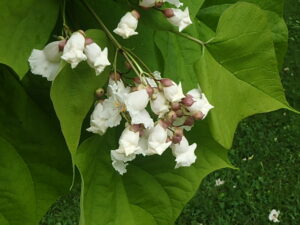
Catalpa blossoms
Catalpas can get 60 feet or more tall, and are a bit weak-wooded, so they are prone to wind damage or blow-overs. My solution? I use an extension ladder to get up to a spot 30-feet off the ground each fall and cut off all growth that occurred that year. I top it. That keeps it from getting too tall – it can and does grow up to 5-feet in a year. Of course, at some point I won’t be allowed up a ladder. So far, so good. I’ve done it for the last 3years.
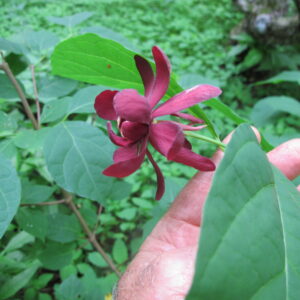
Calycanthus or sweetshrub is a shade-loving shrub.
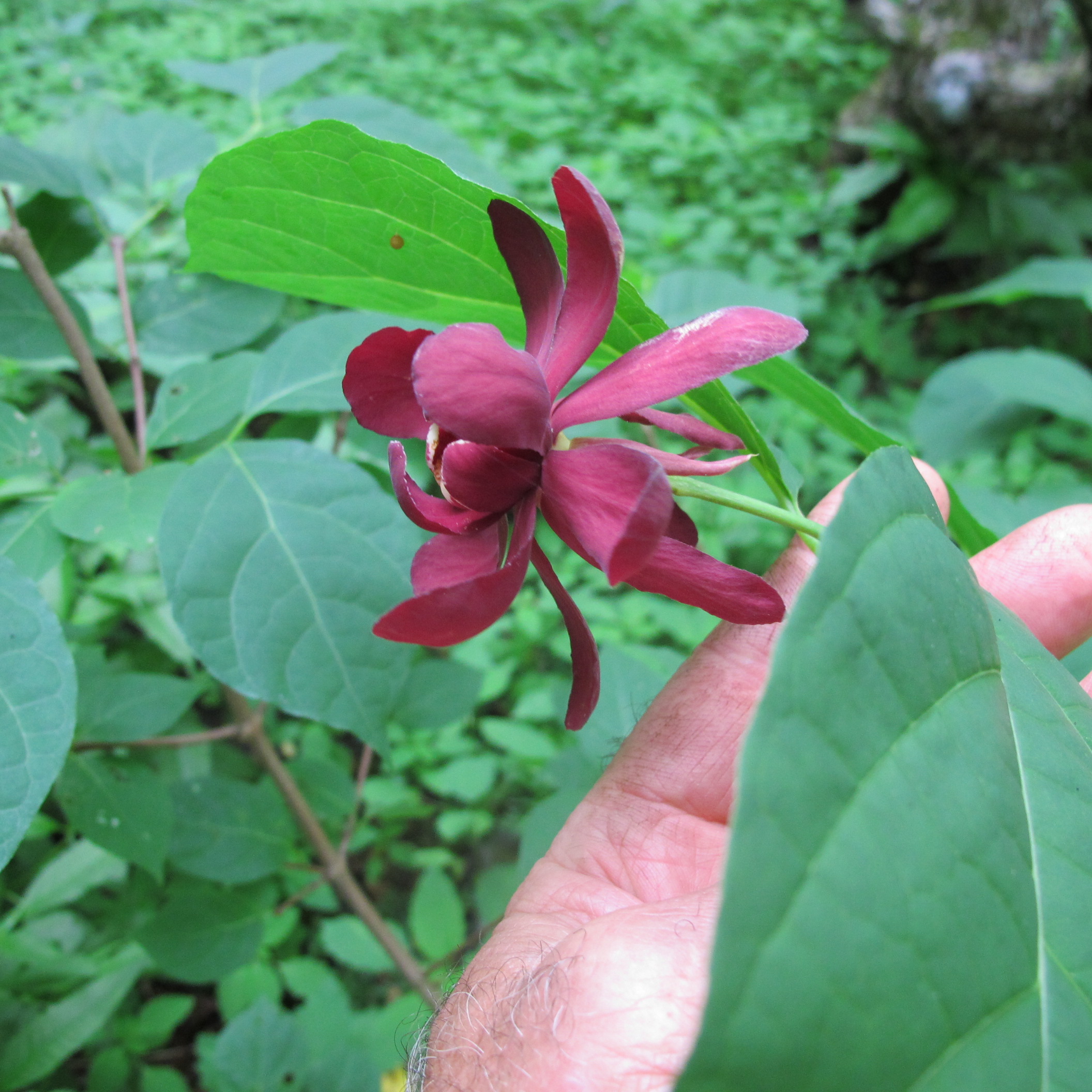
A shrub liked by Jefferson is called the Carolina Sweet Shrub (Calycanthus spp.). I grow it, but found it a bit fussy. I moved mine twice to find, like Cinderella, the fit that was “just right”. I first tried it in full sun and the leaves scorched – despite plenty of moisture. After the second year I moved it into shade, but it didn’t get enough sun and did not bloom much. Finally, five years later, I moved it under a big pear tree, where it gets filtered sun all day and it blooms and grows vigorously. The blossoms are a deep wine red, up to 2-inches across and shaped like little peonies. Some specimens are very fragrant, though mine is not. It blooms in early summer,
Some Native Shrubs to Consider for Your Landscape
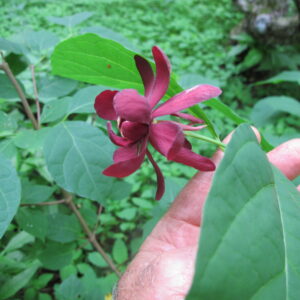
Calycanthus or sweetshrub is a shade-loving shrub I love
Common sweetshrub (Calycanthus floridus): This can be a fussy plant – I have moved mine twice to find just the right amount of sun. I have it growing under a tall, sparse pear tree and right now it is loaded with wine-red blossoms, each a bit like a miniature peony. Allegedly fragrant, mine is not, so buy in bloom and sniff first if fragrance is important to you. Reference books generally say it does best in full sun with moist soil, but mine burned in the sun, even with wet soil. Native to the south, but hardy to Zone 4.
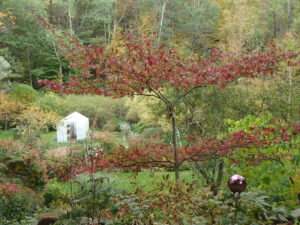
Pagoda dogwood showing fall color and interesting branching patterns
Pagoda dogwood (Cornus alternifolia): This is a native that often plants itself – with the help of birds- in semi-shaded places. It’s structure is fabulous – it often has 2-feet of stem between horizontal branches arranged in tiers. It prefers part shade, but I do have it in full sun growing out of a high rock wall. It grows 15 to 25 feet tall. Birds love the berries (drupes, actually) in August. White, subtle flowers in June. Not often sold in nurseries, but try it if you can find it. Avoid the variegated-leafed variety, it is not nearly as tough a plant and often fails to thrive
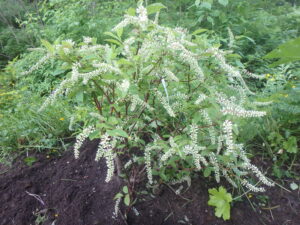
Sweetspire grows alongside my stream and has nice fall color
Virginia sweetspire (Itea virginica): New to me, I just bought one at Spring Ledge Farm in New London, NH when I saw one in bloom. It was gorgeous, and although rated as Zone 5 plant and I’m a little colder than that some years, I had to try it. It has bottlebrush white flowers in June and red fall foliage. Best of all, for me, it does well alongside water or in wet places in full sun to part shade – and I have plenty of that. It stays 3 to 4-feet tall, but can spread by root. Full sun to full shade.
Trees and Shrubs for the Shade
I grew up in a small town in rural Connecticut. Behind the house there was a brook and a hardwood forest with a high canopy of old maples that created a cool space for spending hot summer days. My favorite understory tree was a small, bushy tree that had very fragrant leaves and stems, which I decided must be witch hazel, as the barber splashed witch hazel on my neck after each haircut, and it was vaguely the same. I frequently chewed on the leaves and green twigs in lieu of the chewing gum that was forbidden to me.
This summer I discovered the name of that plant: spicebush (Lindera benzoin). One of my gardening clients had requested one for her garden, and as soon as I crushed a leaf, I was transported back 60 years. I knew it immediately. Most winters my part of New Hampshire drop to minus 25 degrees Fahrenheit, so any plant that will survive here must be rated for Zone 4 (Minus 20 to minus 30). I checked my favorite tree book (Michael Dirr’s Manual of Woody Landscape Plants), and sure enough, spicebush is rated for Zone 4. I will get my own as soon as I find the right place on my property to plant it.
From Dirr’s book I learned that spicebush can get to be up to 12 feet tall and wide, and is in the laurel family. There are 80 species of Lindera, both deciduous and evergreen (L. benzoin is deciduous). Apparently it blooms in early spring but the yellow blossoms are only one fifth of an inch across, so not overwhelming (I have no memory of it blooming). Fall leaf color is yellow. Dirr’s book says it does well in moist, well drained soils in full sun or half shade, though in my experience it will do well in dry shade in open woodlands. Dirr says spicebush is not often found in nurseries, but E.C. Brown’s Nursery in Thetford, VT has several nice ones.
Another woodland plant that I would like to try is leatherwood (Dirca palustris). Like spicebush, this is a native shrub that will grow in shady areas but this one prefers moist to wet soil – and I have plenty of that. Apparently it only gets to be 3 to 6 feet tall and wide, and is more open and spreading in shade than in sun. It is has small yellow flowers that bloom very early in the spring, well before the leaves emerge. Native Americans used the bark to make bow strings, fish lines and in the manufacture of baskets. Tough stuff.
Calycanthus-or-sweetshrub
Three years ago I planted a sweetshrub or Carolina allspice (Calycanthus florida). The first 2 years I grew it in full sun with deep, rich moist soil. Both years the leaves yellowed – as if the sun were too strong and bleached them out. So last fall I moved it into a grove of old wild apples that provide full shade, and it seems to be doing much better. It is blooming now, and has put on considerable new growth.
Sweetshrub grows to be 6 to 9 feet tall with a 6 to 12 foot spread. Some varieties have very fragrant flowers, but mine is not. Dirr’s book suggests buying the shrub is in bloom in early summer, as the fragrance varies from plant to plant. It is adaptable to acid or alkaline soils, and is hardy to Zone 4.
Mountain laurel (Kalmia latifolia) is another fabulous shrub that will grow in deep shade (or even full sun), and I have grown it these past 20 years or so, even though I am on the northern edge of where it is successful. Mine produces delicate three-quarter inch diameter flowers, cups of white with pink veins. After cold winters I don’t always get flowers. There are cultivars with flowers in white to rose, and everything in between. Definitely buy when blooming. It does best in acidic soil that is cool and lightly moist. I have seen it growing abundantly in the wild at Sleeping Giant State Park in Hamden Connecticut, where there is a high, dry, open hardwood forest.
Climbing hydrangea on barn wall
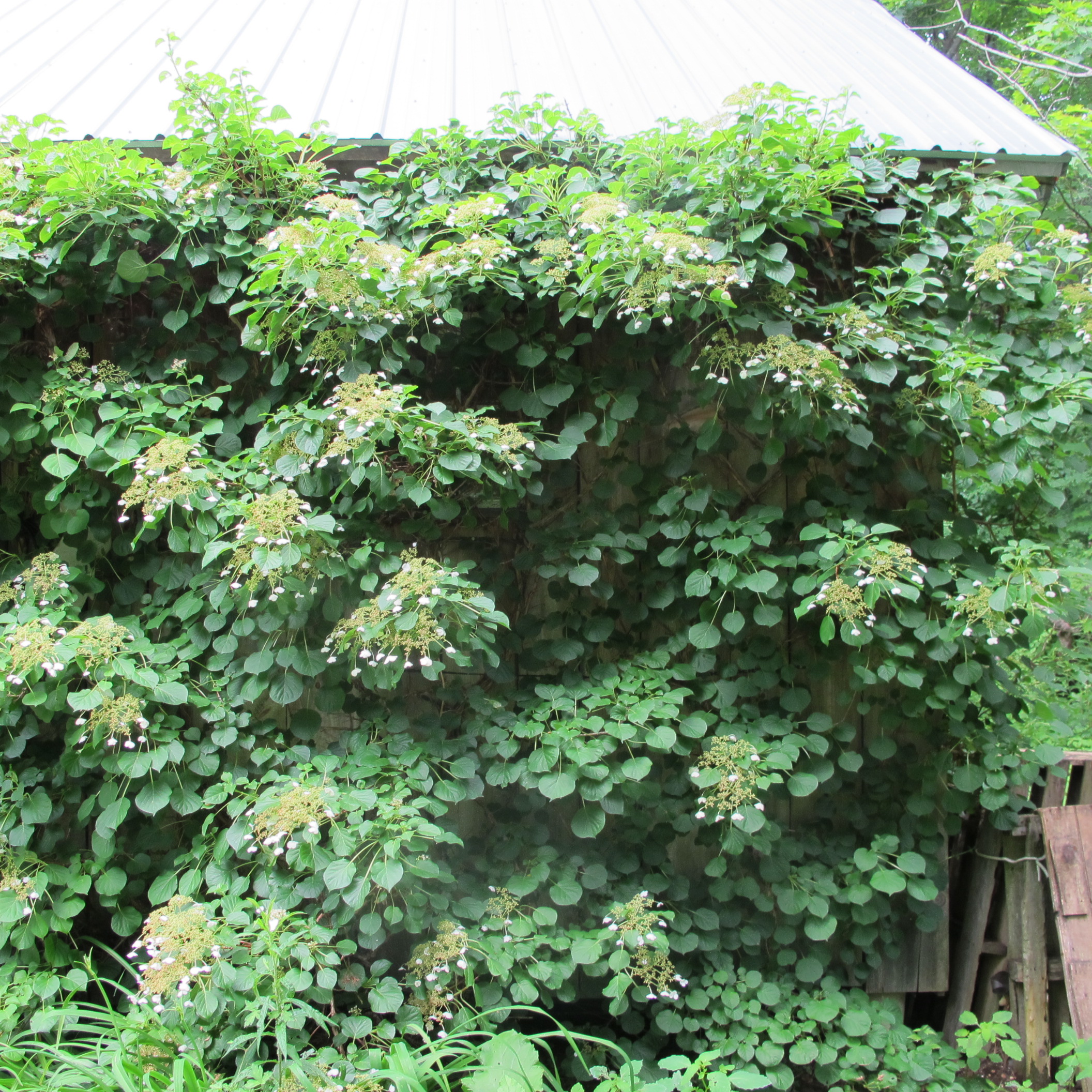
Of all the shade-growing woody plants, the most dramatic on my property is the climbing hydrangea (Hydrangea anomala subsp. petiolaris). I have vines that completely cover the north side of my barn – and that only get a few hours of sun each day. It is in bloom now, with flower corymbs (flat topped inflorescences) that have both fertile and sterile (showy) blossoms and are 6 to 10 inches across.
Climbing hydrangea is slow to get established – mine took 6 years – but once it begins to grow, it quickly covers a surface. It will attach itself to stone or brick, but needs to be strapped onto wood surfaces, at least at first. Mine has grown through the cracks on the barn and is now self-supporting. Its vines can grow 60 feet or more, and has support arms for its flowers that reach straight out from the barn that are up to 3 feet long. It is truly dramatic.
So don’t despair if your property is mostly in the shade. There are these plants, and lots more, that will amaze and delight you.
Henry Homeyer is the author of 4 gardening books. His Web site is www.Gardening-Guy.com.